


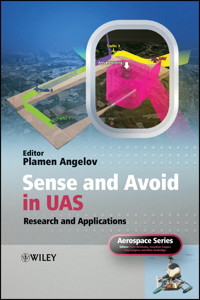
Sense and Avoid in UAS E-Book
97,99 €
Mehr erfahren.
- Herausgeber: John Wiley & Sons
- Kategorie: Fachliteratur
- Serie: Aerospace Series (PEP)
- Sprache: Englisch
There is increasing interest in the potential of UAV (Unmanned Aerial Vehicle) and MAV (Micro Air Vehicle) technology and their wide ranging applications including defence missions, reconnaissance and surveillance, border patrol, disaster zone assessment and atmospheric research. High investment levels from the military sector globally is driving research and development and increasing the viability of autonomous platforms as replacements for the remotely piloted vehicles more commonly in use.
UAV/UAS pose a number of new challenges, with the autonomy and in particular collision avoidance, detect and avoid, or sense and avoid, as the most challenging one, involving both regulatory and technical issues.
Sense and Avoid in UAS: Research and Applications covers the problem of detect, sense and avoid in UAS (Unmanned Aircraft Systems) in depth and combines the theoretical and application results by leading academics and researchers from industry and academia.
Key features:
- Presents a holistic view of the sense and avoid problem in the wider application of autonomous systems
- Includes information on human factors, regulatory issues and navigation, control, aerodynamics and physics aspects of the sense and avoid problem in UAS
- Provides professional, scientific and reliable content that is easy to understand, and
- Includes contributions from leading engineers and researchers in the field
Sie lesen das E-Book in den Legimi-Apps auf:
Seitenzahl: 651
Veröffentlichungsjahr: 2012
Ähnliche




















Contents
Cover
Series
Title Page
Copyright
Preface
About the Editor
About the Contributors
Part I: Introduction
Chapter 1: Introduction
1.1 UAV versus UAS
1.2 Historical Perspective on Unmanned Aerial Vehicles
1.3 UAV Classification
1.4 UAV Applications
1.5 UAS Market Overview
1.6 UAS Future Challenges
1.7 Fault Tolerance for UAS
Chapter 2: Performance Tradeoffs and the Development of Standards1
2.1 Scope of Sense and Avoid
2.2 System Configurations
2.3 S&A Services and Sub-functions
2.4 Sensor Capabilities
2.5 Tracking and Trajectory Prediction
2.6 Threat Declaration and Resolution Decisions
2.7 Sense and Avoid Timeline
2.8 Safety Assessment
2.9 Modeling and Simulation
2.10 Human Factors
2.11 Standards Process
2.12 Conclusion
Chapter 3: Integration of SAA Capabilities into a UAS Distributed Architecture for Civil Applications
3.1 Introduction
3.2 System Overview
3.3 USAL Concept and Structure
3.4 Flight and Mission Services
3.5 Awareness Category at USAL Architecture
3.6 Conclusions
Acknowledgments
Part II: Regulatory Issues and Human Factors
Chapter 4: Regulations and Requirements
4.1 Background Information
4.2 Existing Regulations and Standards
4.3 Sense and Avoid Requirements
4.4 Human Factors and Situational Awareness Considerations
4.5 Conclusions
Acknowledgments
Chapter 5: Human Factors in UAV
5.1 Introduction
5.2 Teleoperation of UAVs
5.3 Control of Multiple Unmanned Vehicles
5.4 Task-Switching
5.5 Multimodal Interaction with Unmanned Vehicles
5.6 Adaptive Automation
5.7 Automation and Multitasking
5.8 Individual Differences
5.9 Conclusions
Part III: SAA Methodologies
Chapter 6: Sense and Avoid Concepts: Vehicle-Based SAA Systems (Vehicle-to-Vehicle)
6.1 Introduction
6.2 Conflict Detection and Resolution Principles
6.3 Categorization of Conflict Detection and Resolution Approaches
Acknowledgments
Chapter 7: UAS Conflict Detection and Resolution Using Differential Geometry Concepts
7.1 Introduction
7.2 Differential Geometry Kinematics
7.3 Conflict Detection
7.4 Conflict Resolution: Approach I
7.5 Conflict Resolution: Approach II
7.6 CD&R Simulation
7.7 Conclusions
Chapter 8: Aircraft Separation Management Using Common Information Network SAA
8.1 Introduction
8.2 CIN Sense and Avoid Requirements
8.3 Automated Separation Management on a CIN
8.4 Smart Skies Implementation
8.5 Example SAA on a CIN – Flight Test Results
8.6 Summary and Future Developments
Acknowledgments
Part VI: SAA Applications
Chapter 9: AgentFly: Scalable, High-Fidelity Framework for Simulation, Planning and Collision Avoidance of Multiple UAVs
9.1 Agent-Based Architecture
9.2 Airplane Control Concept
9.3 Flight Trajectory Planner
9.4 Collision Avoidance
9.5 Team Coordination
9.6 Scalable Simulation
9.7 Deployment to Fixed-Wing UAV
Acknowledgments
Chapter 10: See and Avoid Using Onboard Computer Vision
10.1 Introduction
10.2 State-of-the-Art
10.3 Visual-EO Airborne Collision Detection
10.4 Image Stabilization
10.5 Detection and Tracking
10.6 Target Dynamics and Avoidance Control
10.7 Hardware Technology and Platform Integration
10.8 Flight Testing
10.9 Future Work
10.10 Conclusions
Acknowledgements
Chapter 11: The Use of Low-Cost Mobile Radar Systems for Small UAS Sense and Avoid
11.1 Introduction
11.2 The UAS Operating Environment
11.3 Sense and Avoid and Collision Avoidance
11.4 Case Study: The Smart Skies Project
11.5 Case Study: Flight Test Results
11.6 Conclusion
Acknowledgements
Epilogue
Index
Aerospace Series List
Sense and Avoid in UAS: Research and Applications
Angelov
April 2012
Morphing Aerospace Vehicles and Structures
Valasek
March 2012
Gas Turbine Propulsion Systems
MacIsaac and Langton
July 2011
Basic Helicopter Aerodynamics, Third Edition
Seddon and Newman
June 2011
Advanced Control of Aircraft, Rockets and Spacecraft
Tewari
July 2011
Cooperative Path Planning of Unmanned Aerial Vehicles
Tsourdos et al.
November 2010
Principles of Flight for Pilots
Swatton
October 2010
Air Travel and Health: A Systems Perspective
Seabridge et al.
September 2010
Design and Analysis of Composite Structures: With Applications to
Aerospace Structures
Kassapoglou
September 2010
Unmanned Aircraft Systems: UAVS Design, Development and Deployment
Austin
April 2010
Introduction to Antenna Placement and Installations
Macnamara
April 2010
Principles of Flight Simulation
Allerton
October 2009
Aircraft Fuel Systems
Langton et al.
May 2009
The Global Airline Industry
Belobaba
April 2009
Computational Modelling and Simulation of Aircraft and the Environment:
Volume 1 – Platform Kinematics and Synthetic Environment
Diston
April 2009
Handbook of Space Technology
Ley, Wittmann and Hallmann
April 2009
Aircraft Performance Theory and Practice for Pilots
Swatton
August 2008
Surrogate Modelling in Engineering Design: A Practical Guide
Forrester, Sobester and Keane
August 2008
Aircraft Systems, Third Edition
Moir and Seabridge
March 2008
Introduction to Aircraft Aeroelasticity And Loads
Wright and Cooper
December 2007
Stability and Control of Aircraft Systems
Langton
September 2006
Military Avionics Systems
Moir and Seabridge
February 2006
Design and Development of Aircraft Systems
Moir and Seabridge
June 2004
Aircraft Loading and Structural Layout
Howe
May 2004
Aircraft Display Systems
Jukes
December 2003
Civil Avionics Systems
Moir and Seabridge
December 2002
This edition first published 2012 © 2012 John Wiley & Sons, Ltd
Registered office John Wiley & Sons Ltd, The Atrium, Southern Gate, Chichester, West Sussex, PO19 8SQ, United Kingdom
For details of our global editorial offices, for customer services and for information about how to apply for permission to reuse the copyright material in this book please see our website at www.wiley.com.
The right of the author to be identified as the author of this work has been asserted in accordance with the Copyright, Designs and Patents Act 1988.
All rights reserved. No part of this publication may be reproduced, stored in a retrieval system, or transmitted, in any form or by any means, electronic, mechanical, photocopying, recording or otherwise, except as permitted by the UK Copyright, Designs and Patents Act 1988, without the prior permission of the publisher.
Wiley also publishes its books in a variety of electronic formats. Some content that appears in print may not be available in electronic books.
Designations used by companies to distinguish their products are often claimed as trademarks. All brand names and product names used in this book are trade names, service marks, trademarks or registered trademarks of their respective owners. The publisher is not associated with any product or vendor mentioned in this book. This publication is designed to provide accurate and authoritative information in regard to the subject matter covered. It is sold on the understanding that the publisher is not engaged in rendering professional services. If professional advice or other expert assistance is required, the services of a competent professional should be sought.
Library of Congress Cataloging-in-Publication Data
Sense and avoid in UAS : research and applications / edited by Plamen Angelov. p. cm. Includes bibliographical references and index. ISBN 978-0-470-97975-4 (hardback) 1. Airplanes–Collision avoidance. 2. Drone aircraft–Control systems. I. Angelov, Plamen P. TL696.C6S46 2012 629.135′2–dc23 2011044007
A catalogue record for this book is available from the British Library.
ISBN: 978-0-470-97975-4
Preface
This book is very special in several respects. On the one hand, it is the first of its kind where the reader can find in one place recent research results by leading academics from British, American, Australian and European universities as well as reports of implementation activities by leading industry-based researchers from giants like Boeing and authorities like MITRE. On the other hand, it combines topics such as human factors and regulation issues with technical aspects such as sensors, algorithms, methodologies and results. It is also unique because it reports the latest results from simulations, real experiments and implementation. Further, because the area of unmanned aircraft systems (UAS) is projected to grow exponentially in the next few decades in the most developed countries. Because of its nature (being closer to defence developments and thus being less open), publications (especially books, guides, instructions and reviews) are difficult to access. Indeed, the UAS market is forecast to grow from its present $5.9B to $11.3B annually during the next decade, totalling $94B for the period [1]. Moreover, it is envisaged that the F-35 Lightning II (Joint Strike Fighter) and respectively the Russian equivalent T-50 (PAK-FA) fifth generation jets will be the last major manned fighter aircraft types and the focus will shift to UAS. Large (multimillion) research and development programmes such as ASTRAEA, Taranis, SUAV[E], Mantis, etc. have taken place in the UK and similarly in the USA (two Grand Challenge competitions by DARPA; WASP III, Raven, Scan Eagle, MQ-9 and MQ-18, RQ-4 Blk and more recently, X47-B and RQ-170 (Sentinel) which was downed recently over Iran), leading European countries (France, Sweden, Germany, Czech Republic) and Israel during the last decade or so. UAS are critically important for future military capability in areas such as intelligence, surveillance, suppression of enemy air defence, close air support, situational awareness and missile defence. Their role in operations in Afghanistan and Libya cannot be underestimated. In 2009, the US Air Force started training more pilots to operate unmanned systems than to fly fighters and bombers [2]. The US Congress has mandated that, by 2015, one-third of ground combat vehicles will be unmanned [2].
There is also an embryonic, but very fast growing, civil market for UAS in areas as diverse and important for society as the police force, fire service, ambulance, coast guard, air sea rescue, fishing patrols, mountain rescue, utility companies, highway agencies, environmental protection, agriculture, nuclear industry, volcanoes research, postal services, communications, etc. It is reported [3] that currently there are some 300 UAS worldwide with over 100 (unsurprisingly) in the USA, followed by France and Russia and (somewhat surprisingly) the UK in 13th position with only 5, behind Switzerland, Norway, the Czech Republic, Japan and Israel.
Yet, the number of publications – and especially organised in books, guides and proceedings – on this specific topic of obvious interest is insignificant, if not non-existent. This book aims to fill the gap.
Before the reader is engulfed by technical details, it is worthwhile outlining the main topic, problem and terminology. First of all, it is important to clarify the meaning of the terms autonomy and autonomous. Broadly speaking, an autonomous system is one that can operate (including make decisions, plan actions, reach goals) without human intervention in any environmental conditions. In this sense, an autonomous system possesses a much higher level of automation and a higher level of complexity and intelligence than a (simply) automatic system, the theory (and industrial applications) of which was well developed half a century ago. In a more narrow sense, they distinguish different levels of autonomy, where the highest, sixth level is ‘full autonomy’ as described above. Below that there are five more levels starting from the lowest, first level of ‘human operated’ system, which often takes the form of a remotely operated vehicle (ROV). At this level, all the activities of the system are directly initiated by the human operator and the system has no control over the environment. The second, higher level, which can be called a ‘human assisting’ system, can perform actions if asked and authorised by the human. It can also be called ‘advice only if requested’ type of autonomy. The human asks the machine to propose actions and the human selects the actual action. At the higher, third level, which can be called ‘human delegated’, the machine suggests options to the human. The difference with the previous level is that it provides advice/suggestions even if not asked. Such a UAS can perform limited control activity on a delegated basis, for example automatic flight control, engine control. All of these, however, are being activated and deactivated by the human operator. A UAS of level four, which may be called ‘human supervised’ or ‘advise and if authorised act’, can suggest options and even propose one of them. This needs to be approved by the human operator, though, before being undertaken/activated! The penultimate level five, which can be called ‘machine backed by human’ or ‘act unless revoked’, includes UAS which can choose actions and perform them unless a human operator disapproves. This is, in fact, the highest level of autonomy of practical interest, because the highest level of ‘full autonomy’ is somewhat controversial (see, for example, Isaac Azimov's principles of robotics [4]).
In conclusion, there are several levels of autonomy and of practical interest are all levels but the last, the highest. Autonomous systems differ significantly from automatic systems known and used for over half a century. For the example of airborne systems, an automatic system would include vehicles that fly on a pre-programmed route through waypoint navigation, with landing controlled by the ground stations, payload switching on and off at predetermined points in the flight plan and capable of tracking a target. A UAS of interest (that is the subject of this book and offers huge potential for both military and civil applications) includes vehicle(s) that fly a mission based on tasks but has the ability to autonomously and adaptively react to threats and an evolving situation awareness capability, can adapt (evolve) the mission on the fly, where the payload can detect and manage the target and optimise performance, that can be activated and deactivated and where the interface between the ground and the vehicle is mission (task and information)-based, not control-based.
The topic of sense and avoid (SAA), which is also closely related to the term ‘see and avoid’ used in manned aircraft, is extremely important and was one of the main obstacles for wider application of UAS in non-segregated airspace related to the traffic safety and level of intelligence of the flying machines that are being produced and used both in military/defence and civilian domains. It has several aspects, including:
a. Regulatory (traffic safety, rules of the air or rules of engagement, level of human involvement and autonomy, etc.).
b. Technical (sensors, data processing, situation awareness and decision-making, aerodynamic limitations, etc.).
It has very intrinsic and strong links with a range of science and engineering subjects, such as:
system engineering;automatic control;aerodynamics;image and video processing;machine learning and real-time data processing;decision-making;human–computer interaction, etc.In this book, all of these issues are considered at some level of detail – including the implementation and experimental work which demonstrates ways to address or resolve them.
The book is composed of four parts, each one with a specific emphasis, namely Part I: Introduction (Chapters 1–3), Part II: Regulatory Issues and Human Factors (Chapters and ), Part III: Sense and Avoid Methodologies (Chapters 6–8) and, finally, Part IV: Sense and Avoid Applications (Chapters 9–11). The contributors are all experts in their field, and detailed biographies of each contributor can be found in About the Contributors at the start of the book.
An important goal of this book is to have a one-stop shop for engineers and researchers in this fast-moving and highly multi-disciplinary area, which covers many (if not all) aspects of the methodology and implementation of these new, exciting, yet challenging devices and complex artificial (yet very intelligent) systems which are bound to grow in number and complexity over the next decade and beyond. The aim was to combine the solid theoretical methodology based on a rigorous mathematical foundation, present a wide range of applications and, more importantly, provide illustrations that can be a useful guide for further research and development.
References
1. Teal Report, 2011. http://tealgroup.com/index.php?option=com_content&view=article&id=74:teal-group-predicts-worldwide-uav-market-will-total-just-over-94-billion-&catid=3&Itemid=16. Accessed on 18 July 2011.
2. L. G. Weiss. ‘Autonomous robots in the fog of war’. IEEE Spectrum, 8, 26–31, 2011.
3. UVS International. 2009/2010 UAS Yearbook, UAS: The Global Perspective, 7th edn, June 2009.
4. I. Azimov. ‘The machine that won the war’ (originally published in 1961), reprinted in I. Asimov, Robot Dreams. Victor Gollancz, London, pp. 191–197, 1989.
About the Editor
Plamen Angelov
Plamen Angelov is a Reader in Computational Intelligence and coordinator of the Intelligent Systems Research at Infolab21, Lancaster University, UK. He is a Senior Member of the Institute of Electrical and Electronics Engineers (IEEE) and Chair of two Technical Committees (TC): the TC on Standards, Computational Intelligence Society and the TC on Evolving Intelligent Systems, Systems, Man and Cybernetics Society. He is also a member of the UK Autonomous Systems National TC, of the Autonomous Systems Study Group, NorthWest Science Council, UK and of the Autonomous Systems Network of the Society of British Aerospace Companies. He is a very active academic and researcher who has authored or co-authored over 150 peer-reviewed publications in leading journals, 50+ peer-reviewed conference proceedings, a patent, a research monograph, a number of edited books, and has an active research portfolio in the area of computational intelligence and autonomous system modelling, identification and machine learning. He has internationally recognised pioneering results in online and evolving methodologies and algorithms for knowledge extraction in the form of human-intelligible fuzzy rule-based systems and autonomous machine learning. Angelov is also a very active researcher leading projects funded by EPSRC, ASHRAE-USA, EC FP6 and 7, The Royal Society, Nuffield Foundation, DTI/DBIS, MoD and other industry players (BAE Systems, 4S Information Systems, Sagem/SAFRAN, United Aircraft Corporation and Concern Avionica, NLR, etc.).
His research contributes to the competitiveness of the industry, defence and quality of life through projects such as ASTRAEA – a £32M (phase I and £30M phase II) programme, in which Angelov led projects on collision avoidance (£150K, 2006/08) and adaptive routeing (£75K, 2006/08). The work on this project was recognised by The Engineer Innovation and Technology 2008 Award in two categories: (i) Aerospace and Defence and (ii) The Special Award. Other examples of research that has direct impact on the competitiveness of UK industry and quality of life are the BAE Systems-funded project on sense and avoid (principal investigator, £66K, 2006/07), BAE-funded project on UAS passive sense, detect and avoid algorithm development (£24K consultancy, a part of ASTRAEA-II, 2009), BAE Systems-funded project (co-investigator, £44K, 2008) on UAV safety support, EC-funded project (€ 1.3M, co-investigator) on safety (and maintenance) improvement through automated flight data analysis, Ministry of Defence-funded projects (‘Multi-source Intelligence: STAKE: Real-time Spatio-Temporal Analysis and Knowledge Extraction through Evolving Clustering’, £30K, principal investigator, 2011 and ‘Assisted Carriage: Intelligent Leader–Follower Algorithms for Ground Platforms’, £42K, 2009 which developed an unmanned ground-based vehicle prototype taken further by Boeing-UK in a demonstrator programme in 2009–11), the £9M project GAMMA: Growing Autonomous systems Mission Management, 2011--2014, in which PI of £480K work); funded by the Regional Growth Fund, UK Government; the £3M project CAST (Coordinated Airborne Studies in the Tropics) which envisages usage of the Global Hawk with NASA so-called ‘innovation vouchers’ by the North-West Development Agency-UK and Autonomous Vehicles International Ltd (£10K, 2010, principal investigator), MBDA-led project on algorithms for automatic feature extraction and object classification from aerial images (£56K, 2010) funded by the French and British defence ministries. Angelov is also the founding Editor-in-Chief of Springer's journal Evolving Systems, and serves as an Associate Editor of several other international journals. He chairs annual conferences organised by the IEEE, acts as Visiting Professor (2005, Brazil; 2007, Germany; 2010, Spain) and regularly gives invited and plenary talks at leading companies (Ford, Dow Chemical USA, QinetiQ, BAE Systems, Thales, etc.) and universities (Michigan, USA; Delft, the Netherlands; Leuven, Belgium; Linz, Austria; Campinas, Brazil; Wolfenbuettel, Germany; etc.).
More information can be found at www.lancs.ac.uk/staff/angelov.
About the Contributors
Chris Baber
Chris Baber is the Chair of Pervasive and Ubiquitous Computing at the University of Birmingham. His research interests focus on the many ways in which computing and communications technologies are becoming embedded in the environment around us and the things we use on a daily basis. Not only do we have significant computing power in the mobile phone in our pocket, but, increasingly, other domestic and personal products are gaining similar capabilities. Chris is interested in how such technologies will develop and how they will share the information they collect, and also in how these developments will affect human behaviour.
Cristina Barrado
Cristina Barrado was born in Barcelona in 1965 and is a computer science engineer from the Barcelona School of Informatics, which belongs to the Technical University of Catalonia (UPC). She also holds a PhD in Computer Architecture from the same university. Dr Barrado has been working with UPC since 1989 and is currently an associate professor at the School of Telecommunications and Aerospace Engineering of Castelldefels (Escola d'Enginyeria de Telecommunicació i Aeroespacial de Castelldefels, EETAC). Her current research interests are in the area of the UAS civil mission, including payload processing, avionics CNS capabilities and non-segregated airspace integration.
Richard Baumeister
Richard Baumeister from the Boeing Company has over 30 years' experience performing system engineering and management of complex missile and space programs. From 1979 to 1982 Rich was the lead mission planner and orbital/software analyst for the F-15 ASAT Program. In 1982--1986 Rich helped supervise the integration and operations of the Prototype Mission Operations Center into the NORAD Cheyenne Mountain Complex. From 1987 to 1995 Rich was the Systems Engineering Manager for a classified complex national space system. During this period Rich oversaw the successful development of innovative techniques for the detection and resolution of system anomalies. From 1996 to 2004 Rich was Director of Product Development for RESOURCE21 LLC, a Boeing-funded joint venture. Rich led the technical research and development of aerial and space-based remote sensing-based algorithms and associated information products for Production Agriculture, Commodities, Crop Insurance, and Forestry markets. He directed and participated in the creation of numerous proprietary research papers/presentations dealing with the detection of various crop stresses using multi-spectral imagery. Rich successfully managed the development of an atmospheric correction process and decision support tools in support of a commercial collection campaign.
From 2005 to the present Rich has been supporting automated air traffic control concepts and algorithms, and was the lead engineer for Boeing on the recently completed Smart Skies program.
Rich received his PhD in Mathematics/Physics from the University of Arizona in 1977 and was an Assistant Professor of Mathematics at Arizona State University prior to joining the Boeing company.
Marie Cahillane
Marie received her first degree, majoring in psychology, in 2003 from Bath Spa University and an MSc in research methods in psychology in 2005 from the University of Bristol. Marie was awarded her PhD in cognitive psychology in 2008, from the University of the West of England. Whilst conducting her doctoral research she lectured in psychology at Bath Spa University. Marie's research interests and expertise are in cognition and perception and her teaching specialisms include research methods in psychology, in particular quantitative methods and experimental design. Marie joined Cranfield Defence and Security as a Research Fellow in 2008 and is now a Lecturer in Applied Cognitive Psychology. At Cranfield Defence and Security, Marie leads several human factors research projects within the military domain. Research includes the acquisition and retention of skills required to operate systems and human interaction with complex systems.
Luis Delgado
Luis Delgado is an aeronautical engineer from the National School for Civil Aviation (École Nationale de l'Aviation Civile or ENAC) in Toulouse, France. He also holds a degree in Computer Science Engineering from the Barcelona School of Informatics (Facultat d'Informàtica de Barcelona, FIB) which belongs to the Technical University of Catalonia (Universitat Politècnica de Catalunya, UPC). He earned both degrees in 2007. His research interests include improving the performance and efficiency of the air traffic management (ATM) system and flexible, reliable and cost-efficient unmanned aircraft systems (UAS) operations in civil airspace. He has been working with UPC since 2007 and currently is an assistant professor at EETAC. He is also a PhD student of the Aerospace Science and Technology doctorate program from UPC and expects to graduate in 2012.
Jason J. Ford
Jason J. Ford was born in Canberra, Australia in 1971. He received the BSc and BE degrees in 1995 and a PhD in 1998 from the Australian National University, Canberra. He was appointed a research scientist at the Australian Defence Science and Technology Organisation in 1998, and then promoted to a senior research scientist in 2000. He has held research fellow positions at the University of New South Wales, at the Australian Defence Force Academy in 2004 and at the Queensland University of Technology in 2005. He has held an academic appointment at the Queensland University of Technology since 2007. He has had academic visits to the Information Engineering Department at the Chinese University of Hong Kong in 2000 and to the University of New South Wales at the Australian Defence Force Academy from 2002 to 2004. He was awarded the 2011 Spitfire Memorial Defence Fellowship. His interests include signal processing and control for aerospace.
ŠtpánKopiva
Štpán Kopiva is a researcher and PhD student at the Agent Technology Center of the Gerstner Laboratory, Department of Cybernetics, Czech Technical University. Štpán graduated in 2009 from Imperial College London with an MSc degree in Advanced Computing. Prior to his current position, he worked as a programmer for the major POS systems manufacturer and researcher ATG. Štpǎn currently works on the AgentFly project -- large-scale simulation and control in the air-traffic domain. His main research interests are logics and formal methods for multi-agent systems, classical planning, and large-scale simulations.
John Lai
John Lai was born in Taipei, Taiwan, in 1984. He received the BE (First Class Honours) degree in Aerospace Avionics in 2005 and a PhD in 2010, both from the Queensland University of Technology (QUT), Brisbane, Australia. Since obtaining his PhD, he has held a research fellow position at the Australian Research Centre for Aerospace Automation (ARCAA) -- a joint research collaboration between the Commonwealth Scientific and Industrial Research Organisation (CSIRO) and QUT.
Juan Manuel Lema
Juan Manuel Lema was born in Montevideo, Uruguay in 1985 and is a technical telecommunications engineer from EETAC. He also holds a Master of Science in Telecommunications Engineering and Management. Mr Lema began his collaboration with the ICARUS group in January 2007, where he is a junior researcher. Currently he is a PhD student in the Computer Architecture doctoral program about UAS mission management.
George Limnaios
George Limnaios is a Major(Eng) at Hellenic Airforce. Since 1996 when he graduated from Hellenic Airforce Academy as an Avionics and Telecommunications Engineer he has been involved in the maintenance and support of A-7 and F-16 aircrafts serving the latter as a Technical Advisor and head of Quality Assurance Department. He is on educational leave seeking a post-graduate degree at the Technical University of Crete (Department of Electronic and Computer Engineering). His research interests include Renewable Energy Systems, Fault Tolerant Control, Fault Detection and Isolation and Unmanned Systems.
Luis Mejias
Luis Mejias received a degree in Electronic Engineering in November 1999 from UNEXPO (Venezuela), an MSc in Network and Telecommunication Systems from ETSIT-Universidad Politecnica de Madrid and a PhD from ETSII-Universidad Politecnica de Madrid. He has gained extensive experience with UAVs, investigating computer vision techniques for control and navigation. Currently, he is a lecturer in Aerospace Avionics at Queensland University of Technology, and a researcher at ARCAA.
Caroline Morin
Caroline obtained an M.A. and a Ph.D. in cognitive psychology from Laval University (Canada). She moved to the UK to take up a research fellowship at the University of Warwick where she was looking at the interaction between time and memory. In 2008, Caroline joined Cranfield University as a Research Fellow where she is leading a number of projects on Human Factors with a military population. Caroline's expertise is in human memory, categorization, time perception, decision making and human factors.
Peter O’Shea
Peter O'Shea is a Professor of Electrical Engineering at the Queensland University of Technology (QUT), Australia. He received the BE, DipEd and PhD from the University of Queensland, and then worked as an engineer at the Overseas Telecommunications Commission for three years. He has held academic appointments at RMIT's School of Electrical and Computer Systems Engineering for 7 years and at QUT's School of Engineering Systems for 10 years. He has won teaching awards from both the RMIT and QUT University Presidents, and has also won national teaching awards from Engineers Australia and the Australian Learning & Teaching Council. He was a co-recipient of the best technical paper award at the 2005 IEEE TENCON Conference. His interests are in (i) signal processing for communications, aerospace and power systems; (ii) reconfigurable computing; and (iii) engineering education.
Enric Pastor
Enric Pastor was born in Barcelona in 1968 and is a computer science engineer from the Barcelona School of Informatics, which belongs to the Technical University of Catalonia (UPC). He also holds a PhD in Computer Architecture from the same university. Dr Pastor has been working with UPC since 1992 and is currently an associate professor at EETAC. His research interests include new UAS architectures and the automation of mission processes in UAS civil applications.
Michal Pchouek
Michal Pchouček works as a Professor in Artificial Intelligence at the Department of Cybernetics, Czech Technical University, Prague. He graduated in Technical Cybernetics from FEE-CTU, obtained his MSc degree in IT: Knowledge Based Systems from the University of Edinburgh and completed his PhD in Artificial Intelligence and Biocybernetics at the CTU, Prague. He is Head of the Agent Technology Center at the Department of Cybernetics. His research focuses on problems related to multi-agent systems, especially topics related to social knowledge, meta-reasoning, acting in communication inaccessibility, coalition formation, agent reflection, and multi-agent planning. Michal is an author or co-author of cited publications in proceedings of international conferences and journal papers. In addition, he is a member of the program committee of relevant conferences and workshops.
Xavier Prats
Xavier Prats is an aeronautical engineer from ENAC. He also holds a degree in Telecommunications Engineering from Telecom Barcelona (Escola Tècnica Superior d'Enginyeria de Telecomunicació de Barcelona, ETSETB) which belongs to the Technical University of Catalonia (Universitat Politècnica de Catalunya, UPC) in Barcelona (Spain). He earned both degrees in 2001. Furthermore, he received his PhD in Aerospace Science and Technology from UPC in 2010. His research interests include improving the performance and efficiency of the air traffic management (ATM) system and flexible, reliable and cost-efficient unmanned aircraft systems (UAS) operations in civil airspace. He has been working with UPC since 2001 and currently is an assistant professor at EETAC. He co-founded the ICARUS research group and currently leads the group's air transportation research activities.
Jorge Ramirez
Jorge Ramirez is an aeronautical engineer from ENAC. He also holds a degree in Computer Science Engineering from the Barcelona School of Informatics (Facultat d'Informàtica de Barcelona, FIB) which belongs to the Technical University of Catalonia (Universitat Politècnica de Catalunya, UPC). He earned both degrees in 2000. His research interests include flexible, reliable and cost-efficient unmanned aircraft systems (UAS) operations in civil airspace and the use and optimization of communications navigation and surveillance (CNS) technologies for UAS. He has been working with UPC since 2007 and currently is a lecturer at the Castelldefels School of Technology (Escola Politècnica Superior de Castelldefels or EPSC). He is also a PhD student of the Aerospace Science and Technology doctorate program from UPC and expects to graduate in 2012. Before joining UPC, Jorge was a software engineer at GMV during the 2000--2002 period and worked on the operational implementation of the European Geostationary Navigation Overlay Service (EGNOS). During the period 2002--2007 he worked as a system engineer at EADS--CASA, focusing on the interoperability assessment of tactical datalink systems in different projects such as the European airlifter A400M, the British tanker FSTA and the Australian MRTT.
Pablo Royo
Pablo Royo is a telecommunications engineer from EETAC. He earned his degree in 2004. Furthermore, he received his PhD in Computer Architecture from the same university in 2010. His research interests include improving the performance and efficiency of the air traffic management (ATM) system and flexible, reliable and cost-efficient unmanned aircraft systems (UAS) operations in civil airspace. He has been working with UPC since 2002 and currently is a lecturer at the EETAC.
Eduard Santamaria
Eduard Santamaria was born in Sant Pere Pescador in 1974 and is an informatics engineer from the Barcelona School of Informatics, which belongs to the Technical University of Catalonia (UPC). He also holds a PhD in Computer Architecture from the same university. Dr Santamaria has been working with UPC since 2000 and is currently a lecturer at the School of Telecommunications and Aerospace Engineering of Castelldefels. His research is focused on mechanisms for mission specification and execution for UAS.
Hyo-Sang Shin
Hyo-Sang Shin is Lecturer on Guidance, Control and Navigation Systems in Centre for Autonomous Systems Group at Cranfield University, Defence College of Management and Technology. He gained an MSc on flight dynamics, guidance and control in Aerospace Engineering from KAIST and a PhD on cooperative missile guidance from Cranfield University. His experties include guidance, navigation, and control of UAVs, complex weapon systems, and spacecraft. He has published over 35 journal and conference papers and has been invited for many lectures both in Universities and industries mainly on path planning, cooperative control, collision avoidance and trajectory shaping guidance. His current research interests include cooperative guidance and control for multiple vehicles, optimal and adaptive nonlinear guidance, integrated guidance and control algorithm, coordinated heath monitoring and management, and air traffic management and sense-and-avoid for UAV.
David Šišlák
David Šišlák is a senior research scientist in the Agent Technology Center at the Department of Cybernetics, Czech Technical University, Prague. He is the chief system architect for the AgentFly and Aglobe systems. He participates in many research projects related to these systems, funded by Czech and also foreign research sponsors. His research interests are in technical cybernetics and multi-agent systems, focusing on decentralized collision avoidance algorithms in air-traffic domain, efficient communication, knowledge maintenance in inaccessible multi-agent environment, large-scale multi-agent simulations and agent frameworks. David received a Master's degree in Technical Cybernetics and a PhD in Artificial Intelligence and Biocybernetics from the Czech Technical University, Prague. David is an author or co-author of many cited publications in proceedings of international conferences and journal papers. During his PhD studies, he obtained the IEEE/WIC/ACM WI-IAT Joint Conference `Best Demo' Award, the international Cooperative Information Agents (CIA) workshop system innovation award for the Aglobe multi-agent platform and related simulations, and later he was a member of a team which won the main Engineering Academy prize of the Czech Republic. In 2011, David received the Antonin Svoboda prize for the best dissertation of 2010 awarded by the Czech Society for Cybernetics and Informatics.
Graham Spence
Graham Spence graduated from the University of Leeds (UK) in 1995 with a BSc in Computer Science with Artificial Intelligence. He continued as a postgraduate research student at Leeds and in 1999 was awarded his PhD on the subject of High Temperature Turbulent Diffusion Flame Modelling. For the next several years Graham worked in industry as a computer programmer, but was drawn back to a research post at the University of Sheffield (UK) in 2003, where he researched and developed a real-time model of aircraft interactions during wake vortex encounters. The project successfully integrated into a research flight simulator, large datasets resulting from large eddy simulations of the decay of aircraft wake vortices, enabling real-time simulations of the fly-through of computational fluid dynamics data. After completion of this project, Graham continued at the University of Sheffield where he researched and developed several automated airspace collision detection and avoidance algorithms. Recently, Graham has been involved in an international project that aimed to develop and demonstrate automation technologies that could assist with the challenge of UAS integration into non-segregated airspace. Graham currently works for Aerosoft Ltd in Sheffield (UK) and his research interests include aircraft separation algorithms, flight simulation, aircraft wake vortex interaction, data compression, computer networking and the application of recent smart phone and tablet technologies to airspace safety.
Antonios Tsourdos
Antonios Tsourdos is a Professor and Head of the Centre for Autonomous Systems at Cranfield University, Defence Academy of the United Kingdom. He was member of the Team Stellar, the winning team for the UK MoD Grand Challenge (2008) and the IET Innovation Award (Category Team, 2009). Antonios is an editorial board member of the Proceedings of the IMechE Part G Journal of Aerospace Engineering, the International Journal of Systems Science, the IEEE Transactions of Instrumentation and Measurement, the International Journal on Advances in Intelligent Systems, the Journal of Mathematics in Engineering, Science and Aerospace (MESA) and the International Journal of Aeronautical and Space Sciences. Professor Tsourdos is a member of the ADD KTN National Technical Committee on Autonomous Systems. Professor Tsourdos is co-author of the book Cooperative Path Planning of Unmanned Aerial Vehicles and over 100 conference and journal papers on guidance, control and navigation for single and multiple autonomous vehicles.
Nikos Tsourveloudis
Nikos Tsourveloudis is a Professor of Manufacturing Technology at the Technical University of Crete (TUC), Chania, Greece, where he leads the Intelligent Systems and Robotics Laboratory and the Machine Tools Laboratory. His research interests are mainly in the area of autonomous navigation of field robots. His teaching focuses on manufacturing and robotic technologies and he has published more than 100 scientific papers on these topics. Tsourveloudis serves on the editorial board of numerous scientific journals and conferences. He is a member of professional and scientific organizations around the globe, and several public organizations and private companies have funded his research. Tsourveloudis' research group has been honored with several prizes and awards, among which the most recent are: the 3rd EURON/EUROR Robotic Technology Transfer Award (2009); the 1st ADAC Car Safety Award (2010 and 2011); and the Excellent Research Achievements Award by the TUC (2010). In 2010/2011 he held a Chair of Excellence in Robotics at the University Carlos III of Madrid (UC3M), Spain.
Kimon P. Valavani
Kimon P. Valavanis is currently Professor and Chair of the ECE Department at the School of Engineering and Computer Science, University of Denver (DU), and Director of the DU Unmanned Systems Laboratory. He is also Guest Professor in the Faculty of Electrical Engineering and Computing, Department of Telecommunications, University of Zagreb, Croatia. Valavanis' research interests are focused in the areas of Unmanned Systems, Distributed Intelligence Systems, Robotics and Automation. He has published over 300 book chapters, technical journal/transaction and referred conference papers. He has authored, co-authored or edited 14 books, the two most recent ones being: On Integrating Unmanned Aircraft Systems in to the National Airspace System: Issues, Challenges, Operational Restrictions, Certification, and Recommendations (K. Dalamagkidis, K. P. Valavanis, L. A. Piegl), 2nd Edition, Springer 2012; Linear and Nonlinear Control of Small Scale Unmanned Rotorcraft (I. A. Raptis, K. P. Valavanis), Springer, 2011. Since 2006, he is Editor-in-Chief of the Journal of Intelligent and Robotic Systems. Valavanis has been on the organizing committee of many conferences, he is a senior member of IEEE and a Fellow of the American Association for the Advancement of Science. He is also a Fulbright Scholar.
Pemysl Volf
Pemysl Volf holds a Master's degree in Software Systems from the Faculty of Mathematics and Physics at Charles University, Prague. He is currently a researcher and PhD student at the Agent Technology Center of the Gerstner Laboratory, Department of Cybernetics, Czech Technical University. His research is focused on distributed cooperative algorithms used for collision avoidance in air traffic control and verification of these algorithms using theory and prototypes.
Rod Walker
Rod has degrees in Electrical Engineering, Computer Science and a PhD in Satellite Navigation and Electromagnetics, the latter involving a year-long sabbatical at the Rutherford Appleton Laboratory, Oxford, UK. From 1997 to 2005 he was the program leader for the GNSS payload on `FedSat', working closely with NASA's Jet Propulsion Lab in Pasadena, CA. From 1999 to 2009 he taught in QUT's Bachelor of Aerospace Avionics. He rose to the position of Professor of Aerospace Avionics at QUT in 2008. During this time he was involved in training over 300 aerospace engineers. He is the foundation director for the Australian Research Centre for Aerospace Automation (ARCAA).
Brian A. White
Brian A. White is Professor Emeritus at Cranfield University. His areas of expertise are robust control, non-linear control, estimation, and observer applications, navigation and path planning, decision making, guidance design, soft computing, and sensor and data fusion. He has published widely over his career in all of the areas with well over 100 papers. He has been invited for many keynote lectures, both in Universities and at International conferences, topics being mainly on autonomy, decision making, path planning in recent years. He has served on many editorial boards and working groups, both within the UK and Internationally. He was also a key member of the Stellar Team that won the MOD Grand Challenge, where many of the techniques mentioned in this proposal were implemented within an autonomous system comprising several UAVs and a UGV.
Michael Wilson
Michael Wilson is a Senior Researcher at Boeing Research and Technology -- Australia, specialising in unmanned aircraft systems. Michael has worked on the Smart Skies project since 2007. During this time he was also involved in the first commercially-oriented trials of the ScanEagle in non-segregated civilian airspace. Michael joined Boeing in 2000 and worked on the modelling and analysis of wireless and networked systems, the design and testing of signal and waveform detection algorithms and the modelling of antenna systems. Michael has also spent some time as a consultant and a part-time lecturer. Michael started his career working on Australia's over-the-horizon radar programme. His research focussed on the effects of the radio wave propagation environment on the design and the performance of radar systems. Michael gained his PhD in 1995, from the University of Queensland, where he used a phased-array radar to study ionospheric disturbances.
Andrew Zeitlin
Andrew Zeitlin leads the Sense & Avoid product team within RTCA SC-203, bringing this activity his experience with avionics standards and implementation. He is considered an eminent expert in collision avoidance, having devoted more than 30 years to spearheading the development and standardization of TCAS aboard commercial aircraft, and is currently co-chairing the Requirements Working Group of SC-147. He received the John C. Ruth Digital Avionics Award from the AIAA in 2007. He received a BSEE from the University of Pennsylvania, an MSEE from New York University, and a DSc from George Washington University.
Part I
INTRODUCTION
1
Introduction
George Limnaios,* Nikos Tsourveloudis* and Kimon P. Valavanis†
*Technical University of Crete, Chania, Greece
†University of Denver, USA
1.1 UAV versus UAS
An unmanned aerial vehicle (UAV), also known as a drone, refers to a pilotless aircraft, a flying machine without an onboard human pilot or passengers. As such, ‘unmanned’ implies the total absence of a human who directs and actively pilots the aircraft. Control functions for unmanned aircraft may be either onboard or off-board (remote control). That is why the terms remotely operated aircraft (ROA) and remotely piloted vehicle (RPV) are in common use as well [1]. The term UAV has been used for several years to describe unmanned aerial systems. Various definitions have been proposed for this term, like [2]:
Lesen Sie weiter in der vollständigen Ausgabe!
Lesen Sie weiter in der vollständigen Ausgabe!
Lesen Sie weiter in der vollständigen Ausgabe!
Lesen Sie weiter in der vollständigen Ausgabe!
Lesen Sie weiter in der vollständigen Ausgabe!
Lesen Sie weiter in der vollständigen Ausgabe!
Lesen Sie weiter in der vollständigen Ausgabe!
Lesen Sie weiter in der vollständigen Ausgabe!
Lesen Sie weiter in der vollständigen Ausgabe!
Lesen Sie weiter in der vollständigen Ausgabe!
Lesen Sie weiter in der vollständigen Ausgabe!
Lesen Sie weiter in der vollständigen Ausgabe!
Lesen Sie weiter in der vollständigen Ausgabe!
Lesen Sie weiter in der vollständigen Ausgabe!
Lesen Sie weiter in der vollständigen Ausgabe!




