


Sex, Gender and the Sacred E-Book
21,99 €
Mehr erfahren.
- Herausgeber: John Wiley & Sons
- Kategorie: Geisteswissenschaft
- Serie: Gender and History Special Issues
- Sprache: Englisch
Sex, Gender and the Sacred presents a multi-faith, multi-disciplinary collection of essays that explore the interlocking narratives of religion and gender encompassing 4,000 years of history.
- Contains readings relating to sex and religion that encompass 4,000 years of gender history
- Features new research in religion and gender across diverse cultures, periods, and religious traditions
- Presents multi-faith and multi-disciplinary perspectives with significant comparative potential
- Offers original theories and concepts relating to gender, religion, and sexuality
- Includes innovative interpretations of the connections between visual, verbal, and material aspects of particular religious traditions
Sie lesen das E-Book in den Legimi-Apps auf:
Seitenzahl: 957
Veröffentlichungsjahr: 2014
Ähnliche




















Gender and History Special Issue Book Series
Gender and History, an international, interdisciplinary journal on the history of femininity, masculinity, and gender relations, publishes annual special issues which are now available in book form. Bringing together path-breaking feminist scholarship with assessments of the field, each volume focuses on a specific subject, question or theme. These books are suitable for undergraduate and postgraduate courses in history, sociology, politics, cultural studies, and gender and women's studies.
Titles in the series include:
Sex, Gender and the Sacred: Reconfiguring Religion in Gender History
Edited by Joanna de Groot and Sue Morgan
Gender History Across Epistemologies
Edited by Donna R. Gabaccia and Mary Jo Maynes
Gender and the City before Modernity
Edited by Lin Foxhall and Gabriele Neher
Historicising Gender and Sexuality
Edited by Kevin P. Murphy and Jennifer M. Spear
Homes and Homecomings: Gendered Histories of Domesticity and Return
Edited by K. H. Adler and Carrie Hamilton
Gender and Change: Agency, Chronology and Periodisation
Edited by Alexandra Shepard and Garthine Walker
Translating Feminisms in China
Edited by Dorothy Ko and Wang Zheng
Visual Genders, Visual Histories: A special Issue of Gender & History
Edited by Patricia Hayes
Violence, Vulnerability and Embodiment: Gender and History
Edited by Shani D'Cruze and Anupama Rao
Dialogues of Dispersal: Gender, Sexuality and African Diasporas
Edited by Sandra Gunning, Tera Hunter and Michele Mitchell
Material Strategies: Dress and Gender in Historial Perspective
Edited by Barbara Burman and Carole Turbin
Gender, Citizenships and Subjectivities
Edited by Kathleen Canning and Sonya Rose
Gendering the Middle Ages: A Gender and History Special Issue
Edited by Pauline Stafford and Anneke B. Mulder-Bakker
Gender and History: Retrospect and Prospect
Edited by Leonore Davidoff, Keith McClelland and Eleni Varikas
Feminisms and Internationalism
Edited by Mrinalini Sinha, Donna Guy and Angela Woollacott
Gender and the Body in the Ancient Mediterranean
Edited by Maria Wyke
Gendered Colonialisms in African History
Edited by Nancy Rose Hunt, Tessie P. Liu and Jean Quataert
Sex, Gender and the Sacred
Reconfiguring Religion in Gender History
EDITED BY
JOANNA DE GROOT AND
SUE MORGAN
This edition first published 2014 Originally published as Volume 25, Issue 3 of Gender & History© 2014 Blackwell Publishing Ltd
Registered OfficeJohn Wiley & Sons Ltd, The Atrium, Southern Gate, Chichester, West Sussex, PO19 8SQ, United Kingdom
Editorial Offices350 Main Street, Malden, MA 02148-5020, USA 9600 Garsington Road, Oxford, OX4 2DQ, UK The Atrium, Southern Gate, Chichester, West Sussex, PO19 8SQ, UK
For details of our global editorial offices, for customer services, and for information about how to apply for permission to reuse the copyright material in this book please see our website at www.wiley.com/wiley-blackwell.
The rights of Joanna de Groot and Sue Morgan to be identified as the authors of the editorial material in this work has been asserted in accordance with the UK Copyright, Designs and Patents Act 1988.
All rights reserved. No part of this publication may be reproduced, stored in a retrieval system, or transmitted, in any form or by any means, electronic, mechanical, photocopying, recording or otherwise, except as permitted by the UK Copyright, Designs and Patents Act 1988, without the prior permission of the publisher.
Wiley also publishes its books in a variety of electronic formats. Some content that appears in print may not be available in electronic books.
Designations used by companies to distinguish their products are often claimed as trademarks. All brand names and product names used in this book are trade names, service marks, trademarks or registered trademarks of their respective owners. The publisher is not associated with any product or vendor mentioned in this book. This publication is designed to provide accurate and authoritative information in regard to the subject matter covered. It is sold on the understanding that the publisher is not engaged in rendering professional services. If professional advice or other expert assistance is required, the services of a competent professional should be sought.
Library of Congress Cataloging-in-Publication data is available for this book.
ISBN 9781118833766 (paperback)
A catalogue record for this book is available from the British Library.
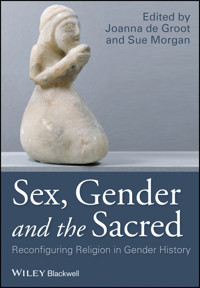
Cover image: Statuette of a Female Worshipper © R.M.N.-Grand Palais / Chezeville Brothers / Louvre Museum Cover design by Nicki Averill Design & Illustration
CONTENTS
Notes on Contributors
Introduction: Beyond the ‘Religious Turn’? Past, Present and Future Perspectives in Gender History
Past perspectives
Present perspectives
Crossing cultures, and transcultural exchanges
Religion, embodiment and subjectivity
Religion, gender and sexuality
Gender, religion and political activity
Future perspectives
Notes
Part I Crossing Cultures and Transnational Exchanges
1 Witches, Female Priests and Sacred Manoeuvres: (De)Stabilising Gender and Sexuality in a Cuban Religion of African Origin
Ocha-Ifá: African roots, Cuban praxis
Witches, warlocks and the spectre of history
The Egbe Gëlèdé: contemporary manoeuvres in gender, sexuality and the sacred
‘Women penetrate Ifá’
Conclusions
Notes
2 Liberal Religion and the ‘Woman Question’ between East and West: Perspectives from a Nineteenth-Century Bengali Women's Journal
Unitarian women activists as exemplars for Brahmo women
The ‘new’ Bengali woman and the spectre of the ‘strong-minded’ woman
Communications between Unitarian and Brahmo women
Liberal religion and the ‘woman question’ between east and west
Notes
3 Indeterminacy in Meaning: Religious Syncretism and Dynastic Historiography in the
Shannüren zhuan
The
Shannüren zhuan
The editor
Religious syncretism
Literary form: structures and strictures
Formulaic narrative in the Pure Land women's biographies
Truncated narrative in the Chan women's biographies
Some critical remarks
Appendix I: two samples of Pure Land women's biographies
Appendix II: two samples of Chan women's biographies
Notes
4 ‘All of Their Customs are Daughters of Their Religion’: Baptists in Post-Revolutionary Mexico, 1920s–present
Scholarship
Protestant inroads in Oaxaca
Convención Bautista Nacional de México in Tlacochahuaya
La
Unión Femenil
and the new chapel
Protestantism and violence
Memory and martyrdom
Conclusion
Notes
5 Creating the ‘Problem Hindu’:
Sati
, Thuggee and Female Infanticide in India, 1800–60
‘Of What Concerns Women’: Hindu femininity and victimhood
‘Execrable pride and selfishness’: Hindu masculinity and violence
Conclusions
Notes
Part II Religion, Embodiment and Subjectivity
6 Engendering Purity and Impurity in Assyriological Studies: A Historiographical Overview
Starting point: feminist epistemologies as a theoretical framework
Gender studies and Assyriology: a relationship under construction
Purity and impurity in Mesopotamia: defining terms
Terminology of ‘(im)purity’ in Assyriological studies: an assessment
Women and bodily products: blood and menstruation
A case study: (im)pure women in Mari
To conclude: gendered bodies and (im)purity
Notes
7 Lamentation Motifs in Medieval Hagiography
Literary inheritance
Tropes of maternal mourning
Weeping
Wailing
Violent gesticulation
Lamentation and the cult of saints
Lament motifs in late medieval saints’ lives
Conclusion
Notes
8 Architecture of Desire: Mediating the Female Gaze in the Medieval English Anchorhold
Mechanics of medieval sight
The dangers of sight
Redeeming sight
Architecture of desire
Notes
9 The Alluring Beauty of a Leonardesque Ideal: Masculinity and Spirituality in Renaissance Milan
Youthful male beauty in Christian thought
Masculine beauty and Neoplatonism in Renaissance Milan
Youthful beauty in Leonardo's thought
Image and viewer
The issue of sexuality
Composite beauty and Leonardesque androgyny
Notes
10 ‘Deaf to the Word’: Gender, Deafness and Protestantism in Nineteenth-Century Britain and Ireland
Deaf ‘heathens’: the problem of the ‘deaf and dumb’
Impious and impure: gendering irreligion
The deaf-mute's faith
Conclusion
Notes
Part III Religion, Gender and Sexuality
11 The Sexual Shame of the Chaste: ‘Abortion Miracles’ in Early Medieval Saints’ Lives
Early Irish hagiography
The Brigidine
vitae
The
vitae
of Áed and Cainnech
The
vita
of Ciarán of Saigir
Complications: making the text disappear
The miraculous in the motif: gender and chastity
Conclusion
Notes
12 ‘Give Me Chastity’: Masculinity and Attitudes to Chastity and Celibacy in the Middle Ages
Conclusion
Notes
13 Common Soldiers, Same-Sex Love and Religion in the Early Eighteenth-Century British Army
The autobiography of Sampson Staniforth
Military attitudes to sexuality and masculinity
Masculinity, religion and ‘the unpardonable sin’
Methodism and Staniforth's story
Conclusions
Notes
14 ‘Dark Ecstasies’: Sex, Mysticism and Psychology in Early Twentieth-Century England
Notes
15 Made Flesh? Gender and Doctrine in Religious Violence in Twentieth-Century Spain
Notes
Part IV Gender, Religion and Political Activity
16 Conversion Trouble: The Alawis of Hadhramawt, Empire, Gender and the Problem of Sovereignty in Nineteenth-Century South India
Sovereignty's global history
Global expansions, gender and religion
Resisting feudal futures
Immodest proposals: sovereignty, women's rights and the problem of conversion
Conclusion
Notes
17
‘Fatherland, Religion, Family’
: Exploring the History of a Slogan in Greece, 1880–1930
Notes
18 The More Things Change: Debating Gender and Religion in India's Hindu Laws, 1920–2006
The early 1920s debates: British, colonial, civilising
Debates of the 1940s and 1950s: moment of transition
The 2006 debates: Indian, postcolonial, modernising
Conclusion
Notes
Index
End User License Agreement
List of Tables
Chapter 6
Table 1:
Frequent Sumerian and Akkadian terms related to cleanliness
Chapter 18
Table 1:
Hindu Code Bills in Parliament
List of Illustrations
Chapter 4
Figure 1:
El Atalaya Bautista
’s 1926 cover story on the Tlacochahuaya Church’s inauguration.
Figure 2:
Remains of the original Baptist Church of Tlacochahuaya, Spring 2010. Photograph: © the author.
Figure 3:
Aurora and Salomón Hernández Juárez holding a framed picture of Samuel Juárez García. Photograph: © the author.
Figure 4:
Feast Day of St. Jerome, Tlacochahuaya, 30 September 2010. Photograph: © the author.
Chapter 8
Figure 1:
Cruciform squint in St Nicholas's Church, Compton, Surrey.
Figure 2:
Cruciform squint in St John the Baptist's Church, Newcastle-on-Tyne.
Figure 3:
Cruciform squint in St Mary of Charity Church, Faversham, Kent.
Figure 4:
Painted pillar across from squint in St Mary of Charity's Church, Faversham, Kent.
Figure 5:
Wall painting of St Catherine of Alexandria across from squint in St Botolph's Church, Hardham, Sussex.
Figure 6:
The grave in St Anne's Church, Lewes, East Sussex.
Chapter 9
Figure 1:
Marco d’Oggiono, The Young Christ, c.1490–95, Fundación Lázaro Galdiano, Madrid. (Attributed by the Fundación Lázaro Galdiano to Boltraffio.) By permission of Fundación Lázaro Galdiano. Madrid.
Figure 2:
Studio of Leonardo da Vinci, St John the Baptist, c.1490–1510, Ashmolean Museum, Oxford, WA1937.102. By permission of the Ashmolean Museum, University of Oxford.
Figure 3:
Marco d’Oggiono, Cristo benedicente, c.1490s, Galleria Borghese, Rome, inv 435. By kind permission of the Soprintendenza Speciale per il Patrimonio Storico, Artistico ed Etnoantropologico e per il Polo Museale della città di Roma.
Figure 4:
A grotesque old man in profile, Leonardo da Vinci, c.1490–95, Royal Collection, Windsor, RL 12448. Supplied by Royal Collection Trust / © HM Queen Elizabeth II 2013.
Figure 5:
Leonardo da Vinci, Heads of an old man and a youth, 1495, Galleria degli Uffizi, Florence. By permission of S.S.P.S.A.E and of the Polo Museale della città di Firenze, Gabinetto Fotografico.
Figure 6:
Leonardo da Vinci, Heads in Profile, c.1478, Royal Collection, Windsor, RL 12276v. Supplied by Royal Collection Trust / © HM Queen Elizabeth II 2013.
Figure 7:
Leonardo da Vinci, John the Baptist, c.1508–1518, The Louvre Museum, Paris. © Photo RMN-GP Photographe Stéphane Maréchalle.
Figure 8:
After Leonardo da Vinci, St. John the Baptist, c.1505–1507, Kunstmuseum, Basel. By permission of Kunstmuseum Basel. Bequest of Dr. Fritz Sarasin 1942. Photo credit: Kunstmuseum Basel, Martin P. Bühler.
Chapter 14
Figure 1:
Suzanne Schleck. ‘Icon of Evelyn Underhill’. Egg tempera and gold leaf on wood. 11″ × 14″. (2000). Reproduced courtesy of the artist.
Guide
Cover
Table of Contents
Introduction
Part
Chapter
Pages
ii
iii
iv
vii
viii
ix
1
2
3
4
5
6
7
8
9
10
11
12
13
14
15
16
17
18
19
20
21
22
23
24
25
26
27
28
29
30
31
32
33
34
35
36
37
38
39
40
41
42
43
44
45
46
47
48
49
50
51
52
53
54
55
56
57
58
59
60
61
62
63
64
65
66
67
68
69
70
71
72
73
74
75
76
77
78
81
82
83
84
85
86
87
88
89
90
91
92
93
94
95
96
97
98
99
100
101
102
103
104
105
106
107
108
109
110
111
112
113
114
115
117
118
116
119
120
121
122
123
124
125
126
127
128
129
130
131
132
133
134
135
1
137
138
139
140
141
142
143
144
145
146
147
148
149
150
151
152
153
154
155
156
157
158
159
160
161
162
163
164
165
166
167
168
169
170
171
172
173
174
175
176
177
178
179
180
181
182
183
184
185
186
187
188
189
190
191
192
193
194
195
196
197
198
199
200
201
202
203
204
205
206
207
208
209
210
211
212
213
214
215
216
217
218
219
220
221
222
223
224
225
226
227
228
229
230
231
232
233
234
235
236
237
238
239
240
241
242
243
244
245
246
247
248
249
250
251
252
253
254
255
256
257
258
259
260
261
262
263
264
265
266
267
268
269
270
271
272
273
274
275
276
277
278
279
280
281
282
283
284
285
286
287
288
289
290
291
292
293
294
295
296
297
298
299
300
301
302
303
304
305
306
307
308
309
310
311
312
313
314
315
316
317
318
319
320
321
322
323
324
325
326
327
328
329
330
331
332
333
334
335
336
337
NOTES ON CONTRIBUTORS
Anne E. Bailey completed her doctorate in 2010 and currently holds a postdoctoral research fellowship at Harris Manchester College, University of Oxford. Her research interests include saints’ cults and pilgrimage, hagiography, women's religious history and medical history, focusing chiefly on England during the High Middle Ages.
Esme Cleall is a Lecturer in the History of the British Empire at Sheffield University. Her recent book, Missionary Discourses of Difference: Negotiating Difference in the British Empire, analyses families, sickness and violence in a colonial context. She also works on disability in Britain and in the Empire.
Maya Corry is currently a Research Associate on the three-year ERC-funded project ‘Domestic Devotions: The Place of Piety in the Renaissance Italian Home, 1400–1600’, at the University of Cambridge. She completed her doctorate in the History of Art department at the University of Oxford, with a thesis titled ‘Masculinity and Spirituality in Renaissance Milan: The Role of the Beautiful Body in the Art of Leonardo da Vinci and the Leonardeschi’. While at Oxford, she was a Graduate Teaching and Research Scholar at Oriel College and co-convened the annual Italian Renaissance seminar series.
Érica Couto-Ferreira is currently working on the project ‘Medical Systems in Transition: The Case of the Ancient Near East’ at the University of Heidelberg. Her main research interests include gynaecology and diseases of women in cuneiform texts, medical professions in antiquity, constitution and transmission of medical knowledge in the Ancient Near East, and lexicography of the body in Sumerian and Akkadian.
Pat Cullum is Head of History at the University of Huddersfield. She is the editor, with Katherine J. Lewis, of Holiness and Masculinity in the Middle Ages (2005). She has written widely on clerical masculinity, lay piety and hospitals and almshouses in late medieval England.
Joy Dixon is an Associate Professor of History at the University of British Columbia, Vancouver. She is the author of Divine Feminine: Theosophy and Feminism in England (2001) and co-editor of ‘Religion and Sexuality’, a special issue of Victorian Review (2011). Her current project – tentatively titled ‘Sexual Heresies: Religion, Science, and Sexuality in Britain, 1870–1930’ – explores the impact of the new sexual sciences on religious life in Britain.
Susan Gane is a doctoral student researching the social history of the British army, 1730–70. Her work is built around autobiographies of men who were common soldiers in this period.
Agnès Garcia-Ventura is a researcher involved in Assyriology and gender studies. Her thesis (at the Universitat Pompeu Fabra, Barcelona) combines both fields and deals with the organisation of work in the Ur III textile industry. She is also carrying out research into the historiography of Ancient Near Eastern studies in Spain during the twentieth century.
Effi Gazi is Associate Professor of Modern History and Theory of Historiography in the Social and Education Policy Department, University of the Peloponnese, Greece. She received her doctorate from the European University Institute, Florence in 1997 and conducted post-doctoral research at Princeton University. Her publications include Scientific National History: The Greek Case in Comparative Perspective (2000); The Second Life of the Three Hierarchs: A Genealogy of the ‘Helleno-Christian Civilization’ (in Greek, 2004) and ‘Fatherland, Religion, Family’: History of a Slogan (1880–1930) (in Greek, 2011). Her research interests include the history and theory of historiography, intellectual and cultural history as well as the history of nationalism and the history of politics and religion.
Daniel J. R. Grey is Lecturer in World History Plymouth University, researching gender and violence in modern Britain and India. His book, Degrees of Guilt: Infanticide in England 1860–1960, is forthcoming with Liverpool University Press.
Joanna de Groot is a Senior Lecturer in History at the University of York. She works on gender and sexual histories of imperialism and orientalism, and of social, cultural and political movements in Iran and Europe. She is currently researching a gendered study of nineteenth-century Iran.
Wilson Chacko Jacob is Associate Professor of History at Concordia University, Montreal. During 2012–13, he was a EURIAS Visiting Fellow at CRASSH and Clare Hall, Cambridge University. This article forms part of a larger SSHRC-funded research project: ‘Sovereignty in Times of Empire: Islam, Gangsters, and Preachers’.
Yuet Keung Lo is an Associate Professor of Chinese Studies at the National University of Singapore. He specialises in Chinese intellectual history covering Confucianism, Daoism and Buddhism and their interactions from the classical period to late imperial times. He has published a book and numerous articles in these areas, and his recent publications include ‘The Drama of Numskulls: Structure, Texture, and Functions of the Scripture of One Hundred Parables’, Early Medieval China 12 (2006); ‘Conversion to Chastity: A Buddhist Catalyst in Early Imperial China’, Nan Nu 10 (2008); ‘Change Beyond Syncretism: Ouyi Zhixu's Buddhist Hermeneutics of the Yijing’, Journal of Chinese Philosophy 35 (2008) and ‘From a Dual Soul to a Unitary Soul: The Babel of Soul Terminologies in Early China’, Monumenta Serica 56 (2008). He is currently completing two books on early medieval China; one on Buddhist storytelling and one on gendered virtues.
Kathleen M. McIntyre is an Assistant Professor of Latin American History at Clarion University of Pennsylvania. She received her doctorate from the University of New Mexico in 2012. She is currently revising her thesis, ‘Contested Spaces: Protestantism in Oaxaca, 1919–95’ for publication.
Clare Midgley is Research Professor in History at Sheffield Hallam University. She is the author of Women Against Slavery (1995), Gender and Imperialism (1998) and Feminism and Empire (2007) and is currently researching a monograph on ‘Liberal Religion and the “Woman Question” in the Age of Empire’.
Zubin Mistry is currently preparing for publication a monograph on perceptions of abortion in the Early Middle Ages.
Sue Morgan is Professor of Women's and Gender History at the University of Chichester, UK. She writes on the history of gender, religion and sexuality in nineteenth- and twentieth-century Britain and has edited Women, Religion and Feminism in Britain, 1750–1900 (2002) and The Feminist History Reader (2006). She has also co-edited several collections including Manifestos for History (2007) with Keith Jenkins and Alun Munslow; Women, Gender and Religious Cultures: Britain, 1800–1940 (2010) with Jacqueline deVries and, most recently, Men, Masculinities and Religious Change in Twentieth-Century Britain (2013) with Lucy Delap. She is currently working on a history of religious discourses of love, sexuality and gender between 1880 and 1940.
Michelle M. Sauer is Professor of English and Gender Studies at the University of North Dakota. She specialises in Middle English language and literature, especially women's devotional literature, and publishes regularly on anchoritism, mysticism, asceticism, hagiography and Church history. Her recent books include The Lesbian Premodern (2011); How to Write about Chaucer (2009); The Companion to Pre-1600 British Poetry (2008) and a forthcoming volume, Gender in Medieval Culture (Continuum). Her current projects include an edition of the Wooing Group; an anchoritic guidebook; a collection on late medieval Carmelite Rules and several edited collections as well as articles and essays.
Mary Vincent teaches history at the University of Sheffield, where she is Professor of Modern European History. She is the author of various articles on gender, religion and politics in Republican and Civil War Spain and her most recent book is Spain 1833–2002: People and State (2007). She is currently working on a monograph of Franco's Crusade, looking at religious violence in the Spanish Civil War.
Carolyn E. Watson is Profesora Titular in the Escuela de Historia y Ciencias Sociales y at the Universidad ARCIS in Santiago, Chile. Her research analyses the role of race, ethnicity, gender and sexuality in the formation of national identity in twentieth-century Cuba.
Rina Verma Williams currently teaches in the Departments of Women's, Gender and Sexuality Studies and of Political Science at the University of Cincinnati. She received her doctorate in Political Science from Harvard University. Her areas of specialisation include South Asian politics; women and gender; ethnicity and nationalism; religion and politics; and politics of the developing nations. Her first book, Postcolonial Politics and Personal Laws: Colonial Legal Legacies and the Indian State, was published by Oxford University Press in 2006. Her current research examines the role of women and gender in religious nationalism in Indian politics.
Introduction: Beyond the ‘Religious Turn’? Past, Present and Future Perspectives in Gender History
Joanna de Groot and Sue Morgan
In the twenty-fifth anniversary year of Gender & History, this special issue on religion provides an opportune moment for the review and reassessment of an aspect of gender history that has developed a substantial scholarship and witnessed important historiographical shifts both before and since the 1980s. As a capacious heuristic category, ‘religion’ stands in for a range of meanings historically, from the highly individuated interior experience of prayer and mysticism to the public corporate structures of institutional or national religious politics. As the various contributors to this volume illustrate, religious discourses can be expressed through private contemplation, worship rituals, sacred works of art, spiritual communities, associational networks and nationalist agendas. They have been appropriated performatively by women and men in the past as part of both individual identity formations and socio-political practices. In what ways, then, might an analysis of religion help us rethink the current frameworks and narratives of histories of gender and, conversely, how might a focus on gender and sexuality illuminate the past interactions of religion and culture? These questions framed a stimulating two-day international symposium held in September 2012 at the University of York from which this volume developed, where speakers debated the tenacious and creative power of religion in fashioning gendered selves across a wide geographical, spiritual and chronological spectrum. Spanning almost 4,000 years from the second millennium BCE to the twenty-first century, the interlocking narratives of religion and gender were scrutinised from ancient Mesopotamia to renaissance Milan, from Song China to post-revolutionary Mexico, from medieval Ireland to modern Spain and Cuba, and from early modern England to nineteenth-century India.
Several major themes emerged from the symposium and are enlarged upon here: that we live in a world which is both increasingly secular and increasingly religious, and that within this paradox issues concerning gender and sexuality constitute repeated points of crisis and rupture; that in a field committed to exploring relations of difference through gender, age, ethnicity, class or sexual orientation, gender history has not always accorded religious differences a similar analytical force, subsuming them within national, ethnic or other cultural identities; following on from this point – ‘theology really matters’. As the exposition of a given faith's encounter with, and revelation of, the divine (an essentially metaphysical experience), theology has often been collapsed by historians into its wider social and more visible counterpart, religion. Yet as Dominic Erdozain warns, the omission of theology reduces religion to little more than a reflection or determinant of culture. In neglecting theological heterogeneity, the material impact of differing doctrines and beliefs upon the lives of men and women is obscured.1 For gender historians, this loss is particularly significant in understanding how hegemonies are made and maintained. As feminist theologians have demonstrated, symbolic and anthropomorphic images of the divine are saturated with gender constructs, often with important, if inconsistent implications for the temporal gender order. Patriarchy may have been well served, although sometimes subverted, by the Christian symbols of God the Father and Son, Eve and the Virgin Mary, but what were the lived gender effects of Hindu goddess cults such as that of Kali with its maternal and warrior-like representations of femininity, or Nahua deities of Central Mexico who transgressed gender binaries?2
Since its establishment, Gender & History has contributed regularly to the historiography of gender and religion through a wide range of articles. Among other subjects these have examined medieval convent spirituality, early modern Islamic conversion narratives, masculinity and priestly power in medieval Normandy and Florence, Jewish women in the Holocaust, Australian missionary masculinities and Aboriginal peoples, clerical marriage in the English and German reformations, diasporic West African spiritualities, Irish Catholic masculinity, Scottish missionaries and sexual misconduct, female Quaker ministries, and modern Italian and Argentinian Catholic women's organisations.3 A significant increase in articles centred on religion in the nineties and ‘noughties’ reflects a more general ‘religious turn’ in cultural history. Our introduction focuses upon past, present and future perspectives on the history of gender and religion, identifying some of the major tropes, narratives and turning-points to date, situating the volume's contents within some currently important themes in gender history and suggesting future potentialities for this burgeoning field.
Past perspectives
The earliest and most extensive historiographies of gender and religion over the last forty years have dealt with Christianity in its multiple forms. This literature, particularly in the anglophone world, has manifested interesting, albeit uneven developments shaped by diverse national contexts. In the USA, landmark articles such as Barbara Welter's ‘The Cult of True Womanhood’ (1966) and ‘The Feminisation of American Religion, 1800–1860’ (1974), led the way in identifying religion's formative contribution to one of the major organising tropes of women's history, ‘separate spheres’ ideology.4 Since then, an enormous literature on American women and religion has been forthcoming which, as Catherine Brekus observes, ‘virtually defies categorization’. Numerous studies of the beliefs and practices of enslaved women, African American holiness preachers, Catholic, Protestant, Mormon and Jewish men and women in addition to Native American forms of spirituality have been produced, despite a relative decline in interest during the 1980s due to the rise of the Religious Right and its ultra-conservative gender and sexual politics.5 In Britain, the socialist-feminist focus of much early gender history often marginalised religion as of limited relevance for understanding women's economic and political disadvantages. Nonetheless, Barbara Taylor's work has acknowledged the interaction of religious with other intellectual and political influences in the writings and activism of Owenite feminists and Mary Wollstonecraft.6 As the early modern historian Patricia Crawford would later comment, the religious subject appeared unexciting – all too often ‘the godly woman was the successfully socialised woman’.7 However, in its iconic reading of the role of gender in the formation of the middle classes, Leonore Davidoff and Catherine Hall's Family Fortunes: Men and Women of the English Middle Class, 1780–1850 (1987) provided what remains one of the most nuanced readings of Victorian evangelicalism and its contradictory implications for hegemonic constructions of both femininity and masculinity.8 It modelled an approach with rich possibilities for those working on gender and religion in other contexts.
One of the dominant narratives to emerge in modern scholarship recounts the ‘feminisation of religion’, a multivalent thesis originating in work on American Protestantism focused on women's greater preponderance in religious and church life and the increasing cultural designation of women as the more pious sex. Despite numerous studies of this phenomenon in Europe, North America and Australia, the theory has received increasing criticism as an overly simplistic formula that disregards both free-thinking, secularist and atheist women – many of whom, like the atheist and broadcaster Margaret Knight, attracted considerable vilification – and devout men (discussed later in this introduction).9 The ‘feminisation of religion’ theory, it is argued, reinscribes gender binaries and essentialises the very categories that require historical interrogation. It is also quite religiously specific. In Judaism, for example, it was certainly the case that pioneering women such as Lily Montagu and Ray Frank engaged in quasi-theological forms of social and educational activities among their co-religionists, as shown by Jean Spence, Shari Rabin and Susan L. Tananbaum.10 Nonetheless, Anne Summers has argued that the feminisation theory remains ‘largely inapplicable’ to modern western Jewish communities where, with women excluded from the rabbinate until the 1970s, religious practice remained overwhelmingly male and women's responsibility for Sabbath observance was a largely domestic affair. Benjamin Baader's work on nineteenth-century Judaism and bourgeois culture in Germany, however, suggests a more complex picture.11
A flourishing body of work on religion and women's historical agency, often using interpretative models such as ‘women's culture’ and ‘female associational networks’ in studies of family life, philanthropy, missionary activity, sisterhoods, preaching and social reform, suggests that the feminisation theory persists.12 The extent to which female religious activism might be designated ‘feminist’ has also prompted long-standing and unresolved debate. Feminism could be nurtured by heterodox forms of spirituality such as theosophy, Christian Science or the Babi-Baha'i tradition, and by religious scepticism or secularism. Recent work on women and gender in the Buddhist, Jewish and Hindu traditions has similarly recuperated women's agency, opening up gendered analyses of beliefs, texts and practices, and exploring the issues of embodiment and sexuality which interest several authors in this special issue.13 Work by Padma Anagol, Patricia Grimshaw, Rhonda Semple and others shows that religiously derived feminisms were often the product of complex transnational and local circulations of ideas, and of religiously syncretic interactions between colonial missionary and indigenous women's discourses. Transcultural and trans-spatial approaches to gender and religion, approaches which appear in some of the articles published here, have informed discussions of cross-confessional encounters in the Iberian peninsula as well as in early modern colonial settings in the Americas.14 Jacqueline de Vries has shown how suffragists often appropriated religious tropes, symbols and rituals, while others note that critical issues of liberal reform or civil rights often transcended religious differences while including faith-specific features.15
Nonetheless, theoretical analyses of the causal relationship between mainstream religious traditions and feminism seem inconclusive, with historians acknowledging religion's ability to mobilise women while simultaneously critiquing its tendency to delimit the radicalism of feminist ideas. As Immaculada Blasco Herranz has commented in her study of female Spanish Catholic militancy, such approaches reveal ‘a form of cultural ascent towards both a feminist consciousness and women's emancipation’ of an essentially secular kind.16 The early modern historian Sarah Apetrei remains similarly unconvinced by readings of religion as a ‘kind of implacable patriarchal intelligence’ against which women engaged in various ‘imaginative and intellectual gymnastics’ seeking to circumvent its more oppressive traits. Religion, she reminds us, ‘was not just the envelope for an unconsciously secular or self-serving agenda: it was the very origin and goal of feminism’.17 In her studies of seventeenth-century female visionaries and eighteenth-century Methodist radicals, Phyllis Mack argues that self-transcendence rather than self-advancement was their core spiritual aim. Carmen Mangion has similarly shown that women entering convents and sisterhoods were less interested in challenging the status quo than in pursuing a ‘higher calling’. Conceptualising authority in terms of humility, and agency in terms of ‘lack’ (lack of status, autonomy or even gender, as Mack famously phrases it) means that taking religion ‘on its own terms’ poses considerable conceptual challenges for feminist and gender historians.18
The recent global rise of new religious politics provides contemporary examples of women's support for so-called ‘fundamentalist’ movements with their frequently restrictive attitudes towards gender roles and sexuality. The instabilities created by environmental disasters, the failure of secular projects (whether nationalist, leftist or liberal), capitalism's global exploitation of the markets and labour, and the resulting poverty and destabilisation of family structures have provided opportunities for new forms of religiously inspired social and political action around faith-branded organisations. According to Martin Riesebrodt and Kelly H. Chong, this not only contends with other political forces at the level of state or community, but also acts as a means to access ‘“higher powers” in order to prevent crises or cope with them when they have occurred’.19 Nor do religious ‘fundamentalisms’ necessarily negate female agency or interests in the views of adherents. As with right-wing movements of the interwar years, religious nationalisms are regarded by many women as providing greater protection and self-respect for their established familial roles, whether in the USA, Latin America, India or the Middle East.20 Numerous studies of modern refigurations of ‘Islamic’ female dress codes have established how, for women who wish to study or work outside the home, they can provide protection from communal, patriarchal or familial criticism, and access to a degree of personal autonomy.21
The mobilisation of Iranian women in the anti-Shah movement of the late 1970s produced complex contradictions and intersections between the use of control over women as a flagship policy of the post-1979 ‘Islamic’ regime, the expansion of educational opportunity and public visibility for women, and both dissenting Muslim and liberal women's critiques of the official version of Islam. Arguably it is the strongly patriarchal family forms and communal investment in ideas of reputation and respectability with their religious inflections which constrain women quite as much as regime policy, as is also the case in the different political and economic setting of Afghanistan.22 In the USA, family and sexuality also became core terrains for religious conservatives from the mid-1980s, and, as in South Korea, female participation in Christian church life became a welcome and acceptable form of relief from the restrictions of the patriarchal family structure. The literal and symbolic roles of the female body and sexuality have been ubiquitous, notably the stance of the US Christian right on abortion and homosexuality (the latter paralleled among evangelical Christians in Africa and various Muslim and Hindu groups). Powerful configurations of gender, religion and body politics have sustained contemporary reaffirmations and refiguring of conventions of body covering, genital cutting, or widow burning.23
Hindu nationalism has involved female grassroots activism in India where Hindu women have mobilised against Muslim women.24 Other religious nationalisms in South Asia and the Middle East are inseparable from their anti-colonial origins and opposition to ‘contaminating’ western influences. Gendered rhetorics of religio-cultural authenticity entwine with invocations of scriptural tradition, but also with appropriations of the discourses of modernity. Thus Muslim and Hindu as well as Christian faith groups affirm the authority of established texts and practices while simultaneously asserting their conformability with ‘modern’ ideals of equity, opportunity and progress. In Iran, reformist Muslim intellectuals such as Ali Shari'ati attempted to align patriarchal gender prescriptions with a world in which articulate women staked modern claims to be heard; just as in Egypt the Muslim Brothers recognised spaces for autonomous activity by Muslim sisters. In Egypt and Iran, learned and pious women re-read sacred texts and challenged male-led claims to define ‘right’ versions of Islam. As with early modern European religious controversies, contests over the authoritative interpretation of texts and the ownership of that activity were powerfully inflected by gender politics.25
Women's recurrent representation as distinctive repositories of piety in many belief systems has meant that histories of masculinity and religion have been slower to emerge, although medievalists have produced important work in this field.26 As Yvonne Werner has noted, if religion was gendered female, then ‘religion and modern masculinity…seemed incompatible’.27 Much work remains to be done on religious masculinities, both lay and clerical, as well as on men's negotiations of the growing dissonances between secular and spiritual codes of manliness in modern times. Here, recourse to a rhetoric of paradox is tempting. Within the gendered power structures of institutional religion, men have exercised undeniable levels of power and privilege with adverse results for women's spiritual, social and professional equality. (Remarkably, women's struggle for religious leadership and the historicisation of various forms of reassertion by religious patriarchies remains an under-explored narrative within modern gender and religion.) Interestingly, confronted with dominant ideals of the competitive, promiscuous, rational and materialistic secular male subject within the wider culture, devout men have inhabited an increasingly precarious historical terrain. Nowhere has this cultural contradiction been more literally embodied than in the suspect, peripheral masculinity of the clergy or, as George Eliot described them, a third ‘clerical’ sex.28 Anti-clericalist sentiment has emerged at various past moments of popular political agitation expressed in plebeian, liberal and anti-puritan critiques, often accompanied, as Hugh McLeod shows for nineteenth-century England, by masculinist anti-clerical rhetoric directed against flamboyant ‘effeminate’ Anglo- or Roman Catholic priesthoods. Comparable Protestant rhetorics were deployed in Germany and the UK against gaudy, ‘feminised’ Jews, whether prominent individuals like Disraeli or more generally Jewish migrants, ‘white slave traders’ or entrepreneurs.29
The perception of religion as increasingly feminised, the churches’ declining ability to appeal to men, and a resulting ‘crisis model’ of modern religious masculinity has attained the status of historiographical orthodoxy in the field. Scholars have shown that attempts to buttress a dwindling religiously oriented masculinity from the 1850s onwards by emphasising muscularity, militarism, sporting prowess or heroism were a global phenomenon. Studies of the unstable but dominant trope of ‘muscular Christianity’ have been undertaken in numerous national contexts including Sweden, France, Canada, Germany, Australia, Ireland, Belgium and Spain as well as the USA and UK, each illustrating various theological emphases and narratives of decline.30 In addition the transnational expression of muscular Christianity through the central topos of sport shows how interconnections between colonial and metropolitan identities of religion and gender cannot be understood solely through unidirectional, imperialist notions of the effeminate Hindu or the aggressively martial Sikh.31 Instead, indigenous appropriations and a ‘new logic of postcolonial hybridity’ meant that Indians living under British colonial rule, or recipients of missionary activity in Japan, successfully de-Christianised and transformed the ‘muscular Christian’ ethic within new nationally and religiously specific formations such as muscular Hinduism or Japanese Bushido.32 Joseph Alter argues that the yoga renaissance led by men like Swami Vivekenanda, so central to muscular Hinduism in the late nineteenth century, represented a transcultural effort to reconceive relations between the body, morality and spirituality and thus requires a global rather than simplistically colonial analytical framework.33 Modern Buddhism, regarded by some as eminently appealing to men due to its reputation for rationalism, intellectualism and practical self-help, was similarly spiritually and ethnically multi-directional between South Asia, China, Europe and America.34
Like muscular Christianity, muscular Judaism in central and western Europe and the USA also focused upon physical strength and moral virtue. Although a minority movement, Zionism ‘constituted a significant means of displaying a new Jewish male type’ counteracting anti-Semitic stereotypes of passive, weak, scholarly Jews through an actively heterosexual representation of Max Nordau's muskeljudentum.35 For many migrant communities, the desire to minimise ‘alienness’ and encourage acculturation could result in conservative gender and sexual politics, as the work of Lara Marks, Rickie Burman and Paula Hyman illustrates.36 Their studies of Jewish communities parallel work on migrant Hindus and Muslims. As a result, new formations of migrant and diasporic gender identities were under constant (re)construction, shot through with differing inter-generational tensions and theological positions.
Attention to religion can provide gender historians with new ideas about hegemonic male identities and their relationship with marginalised, subordinate and complicit masculinities. Historians of medieval Christianity have contributed significantly to this process, exploring the emergence of Christianised masculinities, their intersections with pre- and non-Christian meanings and performances of ‘manliness’, and their complex links to expressions of sexuality.37 According to Erin Bell, early Quaker men preached nonviolence, propounding a masculinity which challenged dominant early modern codes of aggressive male competition and authority, yet still maintained traditional gender power structures within the Quaker community. The way in which religious communities sought to secure their own theological identities through cultural differentiation while seeking wider social acceptance is similarly highlighted in Sara Patterson's discussion of Mormon masculinity in late nineteenth- and early twentieth-century America. Here the legally required shift to monogamy necessitated new models of Mormon manhood marked by the dominant cultural virtues of business, patriotism and good citizenship rather than by polygamy.38
Alex Shepard and Garthine Walker have observed that cultural historians’ preference for synchronic readings of the multiple meanings of masculinity or femininity has tended to forestall diachronic analyses of gender's role as a catalyst for historical change.39 Several articles in this special issue interrogate conventional readings of historical periods such as the Renaissance, or map longer-term shifts in legislative attitudes to, and textual representations of, specific religious traditions such as Hinduism, Buddhism and Confucianism. However, the analysis of the role of gender in generating new periodisations of religion in the past has barely begun. Recent revisionist debates in religious history concerning the periodisation of secularisation and its complex relationship with modernity have received extensive attention, with Christianity's ‘cultural displacement’ relocated as late as the 1960s, a decade identified by arch-revisionist Callum Brown as witnessing the ‘death of Christian Britain’.40 Most significantly, gender rather than class-based analysis is given a crucial role in this shift. ‘Gender’, Brown asserts, ‘is emerging as possibly the single most important definer of the timing and content of long-term change to the Christian religion of Europe’.41 It is interesting to compare the emergence of ‘postsecular’ perspectives (discussed later) which take interactive rather than oppositional views of secular and Christian thought and practice, with the historiography of Islam and gender which still struggles to move away from working within that binary.
Present perspectives
In the chapters which follow, the ‘cultural historical’ approach to the past is heavily, but not exclusively, in evidence, as authors explore the ambiguous discursive effects of religious behaviour and theological ideas on notions of gender and sexuality and the material contexts in which they were produced, normalised and resisted. Most contributors present religion as a prism through which men and women, individually and collectively, experienced a range of political, theological, social and sexual encounters. ‘Difference’ is writ large in this, as in all gender history; what it means to be religious cannot be understood without reference to issues of gender, age, class, race, ethnicity or sexual orientation. Nor is religiosity itself a fixed state. Several chapters make clear that one is never ‘merely’ Hindu, Muslim or Buddhist, just as one is never merely male or female, black or white. Instead, authors illustrate that not only are religious identities constantly inflected by other categories of difference but also that they are configured through both peaceful means and violent warfare. The following discussions revolve around four important current trajectories in the history of gender and religion around which we have structured the volume: transcultural exchanges, the body, sexuality and political aspects of religion.
Crossing cultures, and transcultural exchanges
Cultural syncretism, pluralism and spatial mobility are at the core of the history of many religions, and thus transcultural approaches to that history are crucially relevant to historians’ analyses of religion in various periods and places. The spread of Buddhism from India into eastern Asia, of Islam from Arabia around the eastern and southern Mediterranean into central and south Asia, or of early Christianity from the eastern Mediterranean across Europe, involved complex interactions between the beliefs and practices of an expanding faith and those in the communities which it encountered. This can be seen in the growth of church-state relations and medieval sainthood in western Europe which developed out of accommodations between Christian, Roman and ‘barbarian’ elements, in the emergence of distinctive Tibetan, Sinhala or Chinese forms of Buddhism, and again in the crafting of the Muslim caliphate and of Sufi traditions from encounters between Muslim practices and Iranian or Indian influences. By the early modern period, as conquest and imperial power underpinned the expansion of Islam in India, of eastern Orthodoxy among the Slavs, of Roman Catholicism in the Americas and Asia, and of Protestantisms in North America and the Caribbean, new elements of cross-cultural exchange were layered into religious lives and institutions. The sharing of shrines and festivals by Muslim and Hindu villagers in northern India, the Mexican day of the dead and the crafting of Afro-Christian faiths among enslaved people in the Caribbean or Brazil, were outcomes of cross-cultural contacts shaped partly by state power and/or capitalistic colonial relationships. The more recent expressions of transcultural exchange across faiths and cultures, which are the focus of the pieces in this section of the volume, are thus embedded in longer histories. The legacy of Spanish rule in Mexico and long-standing Mexican links to the USA, like the centuries-long presence of Buddhism in China and of people of African descent in Cuba, as well as the extended period of British involvement in India, frame the specific topics discussed in those articles.
Gender is likewise central to studies of transcultural aspects of religious faith and practice. Gender practices ranging from dress codes to marriage and reproductive and sexual conduct have been constitutive of religious doctrines and of their collective or individual enactments in many faiths. Belief and practice have often been constituted around gender differences and roles for specialists and believers, and politicised by contests over, or subversions of, such differences; they may also be terrains on which gender difference can be sidestepped or problematised. As powerful and often persistent markers of material, political and cultural differences, gender arrangements and ideologies are likely to be important features in transcultural encounters between diverse faiths and power structures. Travellers, missionaries, imperial agents and intellectuals have often read the ‘otherness’ of the cultures which they encountered through the prisms of faith and gender, and colonial rulers and subjects have engaged with the lived outcomes of such readings, generating sources and discourses for historical study. In this volume four contributions demonstrate what can be achieved by such study.
The era of British involvement in India from the eighteenth to the twentieth centuries was one in which issues of religion and gender played out dynamically in the encounters of colonial subjects in the subcontinent with rulers and ‘experts’. British scholars, administrators and missionaries constructed varied notions of ‘Hindus’, ‘Muslims’ and ‘Indians’ around gendered practices including polygamy, child marriage, the erotic content of temple art and culture, gender segregation and widow burning. Alongside this, inhabitants of the subcontinent developed their own constructions of gender and faith in the era of modernity, making their own contributions to cross-cultural discourses on these matters. This can be seen in the refiguring of marriage and masculinity in colonial Bengal, in manoeuvrings around colonial restrictions by the courtesans of Lucknow, or in anti-colonial (often masculine) appropriations of gender rhetoric to assert cultural authenticity or claim leadership of ‘reform’.42 Daniel Grey's piece in this volume explores how British ideas of ‘the Hindu’ in the first part of the nineteenth century brought together perceptions of widow burning, ‘thagi’ (banditry) and female infanticide as distinctively gendered ‘Hindu’ practices.43 It suggests both the importance of considering the convergence of British views of these practices, linked by the use of bodily violence, and the way such views shaped British constructions of Hindu masculinity as well as femininity.
Grey emphasises that much cultural effort was made by colonial interpreters of female infanticide, thagi and widow burning to construct perpetrators as male. This allowed them to construct chivalric/pious rescuers and reformers as the embodiments of British masculinity (as Spivak's white men ‘saving’ brown women), and British femininity as morally active on behalf of subordinate colonial sisters, thereby locating Indian gender practices within ‘bad’ religion. It is shown to be significant that British commentators made efforts to erase the roles of women in infanticide, and of Muslims in thagi, in order to ‘Hinduise’ and gender their interpretations of these activities. In an interesting recasting of the ‘mild Hindu’ with his esoteric learning, favoured in much eighteenth-century British commentary on Hindu Indians, ‘the Hindu’ was now portrayed as savage and violent, moved to heinous acts by ‘superstition’ and ‘fanaticism’. It may be noted that this reconstructed image drew on the growing ethnographic ‘knowledge’ (and imagination) of British observers like Sleeman, and the moral agendas of religious and secular reformers rather than on earlier engagement with religious texts and specialists. However, whether analysing the Shastras, reporting evidence from local informants, or constructing authoritative interpretations of the ‘savage Hindu’, Grey's argument shows the interplay of colonial authority with local knowledge, shaping a hybrid expertise in depicting and controlling colonial subjects.
One facet of the politics around widow burning in the 1820s was the involvement of educated Indian men in debating that question, whether as part of their own modernising agendas or in dialogue with colonial policy makers. If Grey's text deals with the role of colonial cultural power, Clare Midgley's study of interactions between the Bengal-based Brahmo Samaj, British Unitarians and American transcendentalists explicitly takes up the theme of cross-cultural exchange and cooperation.44 The Brahmo venture can itself be seen as a syncretic project for developing links between Hinduism and cognate insights in other faiths, just as Unitarians and Transcendentalists explored notions of ‘universal’ religion. Midgley shows how the exchanges between Brahmo and Unitarian writers and activists centred on the task of arguing and implementing progress for women whether in England or Bengal. It suggests that Indians, Britons and Americans involved in these activities in the mid-nineteenth century were constituting cross-faith transnational ‘liberal’ and ‘reforming’ projects and networks, prefigured in the work of intellectuals like Rammohun Roy in the 1820s and 1830s. The exploration of journals, individual activists and organisations, with their nuanced responses to religious ideas from both Hindu and heterodox Protestant traditions complicates simple adversarial notions of colonial cultural politics or faith encounters, and foregrounds gender as a core topic for pious as well as ‘secular’ liberals and reformers of the period. It is sensitive to internal disagreements among Brahmo supporters over women's roles and autonomy and to Unitarian modifications to the cruder ‘civilising mission’ stance of many Britons, not least because of their dissident location and critical voice within the UK Protestant spectrum. Both Brahmos and Unitarians could position themselves as questioning reformers of their local gender status quo. This raises the interesting question of how far this analysis of interactive, if not equal, Brahmo/Unitarian relationships might challenge other views of how British feminism fed off colonial privilege and racial/religious ‘othering’, as well as off opposition to gender disadvantage and discrimination.45
The historiography of the British raj in India has been a fertile ground for gender historians, including some who have focused on religion. However, the broader relevance of our themes is shown in other pieces which also emphasise cross-cultural exchange and religious syncretism in studies of Cuba, China and Mexico. Carolyn Watson examines transformations in practice and self-perception among followers of Ocha-Ifá, a religion of Yoruba origin established by Afro-Cubans in Cuba, as they responded to socio-political changes and cultural challenges between the era of slave emancipation in the 1890s and the present.46 The article explores shifting gender roles, sexual meanings and interpretations of religious tradition among those involved in Ocha-Ifá. It considers the sexualised images of the faith constructed by Hispano-Cuban commentators, associating it with promiscuous extramarital sex in the early twentieth century, and with homosexuality and prostitution after the 1959 revolution. Watson also tracks contests and accommodations in gender roles and meanings within the cult from the 1930s as men took on divination roles performed by women, notably Victor Betancourt's late twentieth-century re-reading of African traditions which reaffirms female spiritual power and reframes gender and sexual identities among Ocha-Ifá initiates. The dense narrative enables analyses of the simultaneous preservation and reconstruction of West African traditions and the response of Ocha-Ifá followers to hetero-normative homophobic culture in Cuba, at odds with the sexual and gender fluidities which historically formed relationships between initiates, priests, the gods and seekers after spiritual favour. It demonstrates the agency and creativity of those involved in Ocha-Ifá over several generations, and the role of transnational and colonial legacies in their engagement with Yoruba traditions, and with the racialised legacies of colonial enslavement. Cross-cultural encounters with the dominant Hispanic or communist socio-political order and its changing sex-gender agendas, argues Watson, have shaped the survival and autonomy of Ocha-Ifá and its accommodation to those agendas.
Yuet Keung Lo's study of an eighteenth-century reworking of traditional biographies of Buddhist laywomen considers the intersections between faith traditions – two Buddhist pathways and Confucianism – in the work of Peng Jiqing, a pious Buddhist and Confucian scholar editing and supplementing texts inherited from earlier centuries.47 Lo demonstrates how the editor's efforts at ‘draconian’ homogenisation of the lives of women following Chan or Pure Land versions of Buddhism within traditions of dynastic biography and Confucian convention did not conceal ‘ideological incongruities and narrative differences’. This reveals both Peng's personal commitment to Confucian–Pure Land syncretism (which by his time included Chan Buddhist elements), and the different patterns of female religiosity in the two Buddhist traditions. Like the study of the lives of Irish saints in this issue by Zubin Mistry and the chapter on Assyriology by Érica Couto-Ferreira and Agnès Garcia-Ventura (both discussed further below), this reminds us both of the key role of the cultural norms of editors and interpreters of texts, and of the fluidity and complexity of hagiography and Buddhist spiritual practice. It thus offers perspectives on the varied ways in which Buddhist women might pursue their spiritual path, whether by assertive involvement with spiritual masters or by following more ‘genteel’ pious practices confirmed by such women's association with dreams and miracles. Readers see the gender, textual and doctrinal codes used to reconstitute long-gone lives in an eighteenth-century text. They can also glimpse women's negotiation of their own and others’ spiritual expectations in an earlier period, as well as Peng's masculine scholarly negotiation of literary convention and religious syncretism to transmit models of female spirituality to his family and social circle.
The pieces by Lo and Watson explore change over time in conjunction with religious hybridity and fluidity. Kathleen MacIntyre's examination of the gendered presence of Baptists in the Oaxaca region of Mexico likewise deals intersectionally with pre-Christian faith practice, Roman Catholicism, Baptist Protestantism and the secularising agendas of the post-revolutionary period.48 In considering the last of these, it invites further comparison with other contributions to this issue, specifically Joy Dixon's examination of the encounter of ‘modern’ psychological thought with Christian mysticism, Daniel Grey's work on ‘secular’ critiques of ‘Hindu’ practice, or Maya Corry's study of the links between humanism and Catholicism, noting that contact between the ‘secular’ and the ‘religious’ have been less studied than contests between them. MacIntyre's study of the 1920s and 1930s, and their more recent legacy, lays out the paradox of Baptist intervention in a Zapotec village being underpinned both by colonial discourses on ‘backward’ natives and by the new reformist nationalism of the post-Revolution Mexican regime. The role of Baptist women in this was marked by gendered approaches to missionary work (with a focus on childcare and food preparation among Zapotec women), by colonial/ethnic attitudes to ‘natives’ and by a commitment to civilising/modernising missions. Their appropriation of ‘Catholic’ discourses of martyrdom to depict the death of a male Baptist activist, and the use of tropes of progress and modernity to portray their work, like the transnational origins of Mexican Baptism in links to the USA, formed a cross-cultural basis for that work. Traditions of Protestant anti-Catholicism were refigured within a new civic/national culture in which Mexican women could be active if not enfranchised citizens, making or responding to calls of progress and Protestantism just as pious Catholic women actively resisted the new order. MacIntyre shows how the Baptist challenge to Catholicism was both faith-based and social, contesting established communal groupings, networks and festive gatherings, with their gendered patterns of participation, as well as sacred spaces and faith practices. The analysis illustrates the roles of religion, pro- and anti-Catholic female activism and memories of conflict and martyrdom in the shaping of new national/Christian/ethnic identities and differences both in the 1920s and 1930s, and at the present time.
The centrality of conversion, expansion and eclecticism in the history of so many faiths makes transcultural analysis an important tool for historians of religion. Discussion of the reworking of twelfth- and eighteenth-century Buddhism in relation to Confucianism, of re-readings of African religion in 1980s Cuba, and of links between modernising Hindus and Unitarians in nineteenth-century India and England illustrate the shaping roles of syncretic initiatives and cross-faith exchanges. They also demonstrate the gendered character of such initiatives and exchanges, whether constructing exemplars of Buddhist women, negotiating roles for male and female Ocha-Ifá priests in Cuba, or challenging Hindu widow burning and thagi and Zapotec women's Catholic and ‘native’ culture. By analysing the composite, changing versions of sexed and gendered belief and practice in these diverse transcultural, colonial and postcolonial settings, this group of articles opens up a range of understandings and possibilities for future work on gender and religion. By setting the specificities of time and place in a dynamic relationship to spatial mobility and cultural hybridity, they offer models and challenges for that work.




