


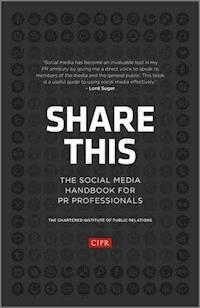
Share This E-Book
15,99 €
Mehr erfahren.
- Herausgeber: John Wiley & Sons
- Kategorie: Fachliteratur
- Sprache: Englisch
Share This is a practical handbook to the biggest changes taking place in the media and its professions by the Chartered Institute of Public Relations (CIPR) Social Media Panel. The book was conceived and written by more than 20 public relations practitioners representing a cross-section of public, private and voluntary sector expertise using many of the social tools and techniques that it addresses.
The book is split into 26 chapters over eight topic areas covering the media and public relations industry, planning, social networks, online media relations, monitoring and measurement, skills, industry change and the future of the industry. It’s a pragmatic guide for anyone that works in public relations and wants to continue working in the industry.
Share This was edited by Stephen Waddington with contributions from: Katy Howell, Simon Sanders, Andrew Smith, Helen Nowicka, Gemma Griffiths, Becky McMichael, Robin Wilson, Alex Lacey, Matt Appleby, Dan Tyte, Stephen Waddington, Stuart Bruce, Rob Brown, Russell Goldsmith, Adam Parker, Julio Romo, Philip Sheldrake, Richard Bagnall, Daljit Bhurji, Richard Bailey, Rachel Miller, Mark Pack, and Simon Collister.
Sie lesen das E-Book in den Legimi-Apps auf:
Seitenzahl: 332
Veröffentlichungsjahr: 2012
Ähnliche




















Table of Contents
Cover
ENDORSEMENTS
Title page
Copyright page
LIST OF CONTRIBUTORS
FOREWORD
INTRODUCTION
Part I: Changing Media, Changing PR
Chapter 1 AN INTRODUCTION TO SOCIAL NETWORKS
Part II: Planning
Chapter 2 KICK-START YOUR SOCIAL MEDIA STRATEGY
Chapter 3 WHAT HAS GOOGLE EVER DONE FOR PR?
Chapter 4 INTEGRATING TRADITIONAL AND SOCIAL MEDIA
Chapter 5 SOCIAL MEDIA GUIDELINES: CREATING FREEDOM WITHIN A FRAMEWORK
Chapter 6 OPEN COMMUNICATION: PSYCHOLOGY, ETHICS AND ETIQUETTE
Part III: Networks
Chapter 7 FACEBOOK: A WAY TO ENGAGE WITH YOUR AUDIENCES
Chapter 8 TWITTER: THE UNSTOPPABLE RISE OF MICROBLOGGING
Chapter 9 LINKEDIN: SOCIAL NETWORKING FOR PROFESSIONALS
Chapter 10 GOOGLE+: BETTER THAN BUZZ?
Chapter 11 THE BUSINESS OF BLOGGING
Part IV: Online Media Relations
Chapter 12 MODERN MEDIA RELATIONS AND SOCIAL MEDIA NEWSROOMS
Chapter 13 BRANDS AS MEDIA
Chapter 14 THE FUTURE OF BROADCAST
Chapter 15 MEDIA RELATIONS MODERNISED
Chapter 16 PITCHING USING SOCIAL MEDIA
Part V: Monitoring and Measurement
Chapter 17 REAL-TIME PUBLIC RELATIONS
Chapter 18 SOCIAL MEDIA MONITORING
Chapter 19 MEASURING SOCIAL MEDIA
Part VI: Skills
Chapter 20 SKILLING UP FOR THE FUTURE
Chapter 21 THE FUTURE OF PR EDUCATION
Part VII: Industry Change
Chapter 22 EMPLOYEE ENGAGEMENT: HOW SOCIAL MEDIA ARE CHANGING INTERNAL COMMUNICATION
Chapter 23 BACK TO THE FUTURE FOR PUBLIC SECTOR COMMUNICATIONS
Chapter 24 MODERNISING PUBLIC AFFAIRS FOR THE DIGITAL AGE
Chapter 25 SOCIAL MEDIA AND THE THIRD SECTOR
Part VIII: The Future
Chapter 26 HERE COMES WEB 3.0 AND THE INTERNET OF THINGS
Index
‘Social media has become an invaluable tool in my PR armoury by giving me a direct voice to speak directly to members of the media and the general public. This book is a useful guide to using social media effectively.’
Lord Sugar
‘Back in the day, the only way to easily communicate with your public was to use mainstream media and analysts as your mouthpieces. Recent years have brought an explosion of real-time communications channels that organizations use to reach their audience directly with valuable online content: videos, ebooks, white papers, photos, infographics, and more – and then have that information shared in social networks and covered by the media. However, many PR professionals still operate as if their only conduit is mainstream media. Share This cuts through the hype of social media to help business owners and public relations professionals make the transition to the new world of real-time communications.’
David Meerman Scott International bestselling author ofThe New Rules of Marketing & PR, now available in over 25 languages from Bulgarian to Vietnamese
‘Social media is PR. And this is a book by PR professionals and experts in social media. If you’re a PR professional, get the expertise and insights of the CIPR Social Media panel and impress your friends and clients. Gets a +1 from me. Like.’
Paul Mylrea Director of Communications, BBC
‘This crowd-sourced book on social media is a welcome addition to PR literature, as it brings together a range of insights and world-views of social media and helps the sense-making process on its roles, value creation and appropriate strategies. I hope it will be regularly updated, as this is such a fast-moving field.’
Professor Tom Watson Professor of Public Relations, Bournemouth University
‘Blogs like mine set the news agenda for traditional media, PRs would be daft to ignore a book about how old-school spin is dead and full of advice about how to work better now that social media has rewritten the rules.’
Paul Staines (aka Guido Fawkes)
‘This book challenges the minds and expands the horizons of PR and marketing professionals operating in today’s digital age, providing excellent insight into how to survive and thrive in it.’
Steve Walker, FCIM EMEA VP Corporate Communications, Oracle Corporation
‘Social media presents significant opportunities to the PR industry, and understanding and embracing these is critical to business success. This book covers and shines light on some of the most important topics in social media today. A must read for anyone in the PR business.’
Andrew Bloch Vice-Chairman and Founder, Frank PR
‘If you want to join a conversation on the convergence of digital and PR, this book is the conversation to go for. A series of essays that shakes up the status quo, questions conventional PR practices, and takes thoughtful positions in a social tone that will challenge, engage and entertain the reader. Get it while it’s hot!’
Gerry Brown, FCIM Lead Digital Analyst, Bloor Research
‘Share This is a brilliant concept – well conceived, well packaged, well written and a “must read” for any PR professional practicing today. To have such a broad compilation of views on social media – written specifically from a PR perspective – is definitely something our industry has been crying out for.’
Trevor Young (aka PR Warrior) Edelman Australia
‘From corporate communications to brand marketing, social is now at the heart of what we do as PR professionals. This book provides outstanding practical guidance developed by some of our industry’s most distinguished practitioners and honed through the very methods that they recommend.’
Marshall Manson Managing Director, Digital, EMEA, Edelman
‘When trying to make sense of the rapidly evolving social media world it makes sense to listen to the wisdom of crowds and Share This: The Social Media Handbook for PR Professionals does exactly that, being the result of a collaborative, online process using Google Documents. What makes Share This really valuable is the assumption that the PR reader isn’t starting from scratch; so those with a working knowledge of social media can use the book to provide practical and trend-led insights and apply them to communication challenges today – and probably tomorrow. As PR realises the power of social media to radically change how brands communicate with their audiences, never has there been a better time to read this book.’
Avril Lee Partner, CEO London, Ketchum Pleon
This edition first published 2012
© 2012 John Wiley & Sons Ltd
Registered office
John Wiley & Sons Ltd, The Atrium, Southern Gate, Chichester, West Sussex, PO19 8SQ, United Kingdom
For details of our global editorial offices, for customer services and for information about how to apply for permission to reuse the copyright material in this book please see our website at www.wiley.com.
All rights reserved. No part of this publication may be reproduced, stored in a retrieval system, or transmitted, in any form or by any means, electronic, mechanical, photocopying, recording or otherwise, except as permitted by the UK Copyright, Designs and Patents Act 1988, without the prior permission of the publisher.
Wiley publishes in a variety of print and electronic formats and by print-on-demand. Some material included with standard print versions of this book may not be included in e-books or in print-on-demand. If this book refers to media such as a CD or DVD that is not included in the version you purchased, you may download this material at http://booksupport.wiley.com. For more information about Wiley products, visit www.wiley.com.
Designations used by companies to distinguish their products are often claimed as trademarks. All brand names and product names used in this book and on its cover are trade names, service marks, trademarks or registered trademarks of their respective owners. The publisher and the book are not associated with any product or vendor mentioned in this book. None of the companies referenced within the book have endorsed the book. This publication is designed to provide accurate and authoritative information in regard to the subject matter covered. It is sold on the understanding that the publisher is not engaged in rendering professional services. If professional advice or other expert assistance is required, the services of a competent professional should be sought.
Library of Congress Cataloging-in-Publication Data
Share this : the social media handbook for PR professionals / Chartered Institute of Public Relations (CIPR) ; edited by Stephen Waddington.
p. cm.
Includes index.
ISBN 978-1-118-40484-3 (cloth)
1. Public relations. 2. Social media. I. Waddington, Stephen. II. Chartered Institute of Public Relations.
HD59.S45156 2012
659.20285'4678–dc23
2012019131
A catalogue record for this book is available from the British Library.
ISBN 978-1-118-40484-3 (hbk) ISBN 978-1-118-40485-0 (ebk)
ISBN 978-1-118-40486-7 (ebk) ISBN 978-1-118-40487-4 (ebk)
LIST OF CONTRIBUTORS
Jane Wilson
Chief Executive, CIPR
Stephen Waddington
Managing Director, Speed Communications
Katy Howell
Managing Director, Immediate Future
Simon Sanders
Marketing Consultant
Andrew Smith
Managing Director, Escherman
Helen Nowicka
Head of Digital, UK, Porter Novelli
Gemma Griffiths
Managing Director, The Crowd &I
Becky McMichael
Head of Strategy and Innovation, Ruder Finn
Robin Wilson
Director Digital PR and Social Media, McCann Erickson
Alex Lacey
Senior Corporate Comms Manager, Herbalife Europe
Matt Appleby
Managing Director, Golley Slater PR
Dan Tyte
Director, Working Word Public Relations
Stuart Bruce
Corporate Communications Consultant
Rob Brown
Managing Director, Staniforth
Russell Goldsmith
Digital & Social Media Director at markettiers4dc
Adam Parker
Chief Executive, Realwire
Julio Romo
Communications Consultant
Philip Sheldrake
Founding Partner, Meanwhile
Richard Bagnall
Board Director of Gorkana Group, MD of Metrica
Daljit Bhurji
Managing Director, Diffusion
Richard Bailey
Senior Lecturer in Public Relations, Leeds Metropolitan University
Rachel Miller
Senior Internal Communications Manager
Mark Pack
Head of Digital, MHP Communications
Simon Collister
Senior Lecturer at University of the Arts London
FOREWORD
Jane Wilson CEO, CIPR
The media through which humans communicate are constantly evolving, reflecting changes in technology and preferences in content and consumption. In public relations, communicating messages through a variety of media is the primary means by which we engage audiences in dialogue to develop mutual understanding and deliver against organisational objectives. As the media we use change, so must the practice of public relations.
Currently, a rapid evolution in media is taking place. Through the choices, made by millions every second of each day, to share and curate content, individuals the world over are engaging with each other on a scale unimaginable to most people just a decade ago.
Previous modes of media allowed for the transmission of information, filling a human desire for knowledge, but could not cater for the human impulse to interact. This is changing not only our profession, but society for the better.
For thirty years or more public relations was a mostly misapplied term, synonymous with the transmission of messages through news media. The practice of public relations focused on the management of relations with the gatekeepers to these media to the point where popular culture typically reflects a misunderstanding of our profession, labelled ‘PR’.
The evolution of media offers us an opportunity to take public relations back to a better understanding of itself. By providing us with the ability to listen to our audience, to reach them individually and as groups and with a new depth of data available to help us measure the outcome of this activity, and all in real time, we can achieve genuine dialogue by encouraging and participating in conversations. Social media may help public relations realise its potential contribution to the achievement of strategic objectives in an even more meaningful way.
To maximise this opportunity we need to adapt our skills to the media through which we seek to engage. This book is not a starting point. It assumes the reader has a better than basic understanding and is looking to move even farther ahead with expert guidance. It discusses how the evolution of media is changing areas of professional practice such as public affairs and internal communications. It looks at public and private sector public relations. It reminds us that, as paid advocates, we should tread carefully. We do not own the media space, our audiences do.
I am grateful to the experts, drawn from both members and non-members, who have shaped this book with their contributions and are actively shaping our profession with their willingness to share their knowledge. The Institute is particularly indebted to Stephen Waddington, who coordinated the authors and did more than any other person to bring it about. Sharing is the essence of our current media age. Learn from this handbook and share your experiences with us on the CIPR Conversation.1
Note
1CIPR Conversation: http://cipr.co/cipr-conversation
INTRODUCTION
Stephen Waddington, Editor
In time we’ll come to stop using the term social media as a catch-all phrase to describe the creation and sharing of content and it will become the norm. Share This: The Social Media Handbook for PR Professionals has been written to help accelerate that timescale.
In 2012 all media must be social – and public relations practitioners who want to continue to work in the industry must quickly adapt to this new environment.
The book developed out of a series of Summer Social workshops run by the CIPR’s Social Media Panel during the summers of 2010 and 2011 by Philip Sheldrake and Gemma Griffiths. Each week, people turned up to events around the country to hear experts – many of whom feature in this book – lead conversations about different aspects of the development of public relations.
At the end of the summer of 2011, the CIPR’s Social Media Panel decided to record and replay some of the conversations from these sessions in a book to share with practitioners more widely.
Share This is itself a social effort. We’ve pushed the boundaries of book production, which, in itself, has been an interesting process.
The book was conceived and written over a three-month period by 24 public relations practitioners representing a cross-section of public, private and voluntary sector expertise. The project was managed via a series of Google Documents with contributors reviewing and commenting on each other’s work.
Each chapter has been written as a standalone piece of work and is intended to be read independently. You can either choose the topics that interest you or read the entire book from start to finish.
My thanks to everyone who volunteered their time to contribute to the project and tolerated my persistent hounding against deadlines. Special thanks are due to Philip Sheldrake for his drive and support. Finally, thanks to Phil Morgan, Andrew Ross, and the team at the CIPR for recognising the potential of this project and supporting us in bringing it to fruition.
Part I
Changing Media, Changing PR
Chapter 1
AN INTRODUCTION TO SOCIAL NETWORKS
Katy Howell
The meteoric rise of social network sites like Facebook, Twitter and YouTube changed the communications landscape forever. But social media are vastly more diverse: a connected and complex ecosystem founded on relationships, passions and a desire to be connected.
Social networks are not new. As individuals, we have always maintained social connections, be they with family, friends or professional acquaintances. We belong to groups, clubs, neighbourhoods and, of course, society. The internet and developments in technology have simply made our networks visible and easily accessible. We can now meet friends and colleagues, ask for recommendations and even build relationships with brands – in an online and often public space.
It’s Big, It’s Connected and It’s Here to Stay
More than 70% of the internet population uses social networks in one form or another2 and the numbers are growing daily. One in nine people3 on Earth have a Facebook account, and if it was a country, it would be the third largest after China and India. Even relative newcomer Instagram has gathered 12 million members4 in less than a year.
And whilst the landscape continues to grow and change apace, our audiences have moved beyond the media hype and embraced new communication channels wholeheartedly. Social networking already accounts for 1 in every 6 minutes spent online.
Lesen Sie weiter in der vollständigen Ausgabe!
Lesen Sie weiter in der vollständigen Ausgabe!
Lesen Sie weiter in der vollständigen Ausgabe!
Lesen Sie weiter in der vollständigen Ausgabe!
Lesen Sie weiter in der vollständigen Ausgabe!
Lesen Sie weiter in der vollständigen Ausgabe!
Lesen Sie weiter in der vollständigen Ausgabe!
Lesen Sie weiter in der vollständigen Ausgabe!
Lesen Sie weiter in der vollständigen Ausgabe!
Lesen Sie weiter in der vollständigen Ausgabe!
Lesen Sie weiter in der vollständigen Ausgabe!
Lesen Sie weiter in der vollständigen Ausgabe!
Lesen Sie weiter in der vollständigen Ausgabe!
Lesen Sie weiter in der vollständigen Ausgabe!
Lesen Sie weiter in der vollständigen Ausgabe!
Lesen Sie weiter in der vollständigen Ausgabe!
Lesen Sie weiter in der vollständigen Ausgabe!
Lesen Sie weiter in der vollständigen Ausgabe!
Lesen Sie weiter in der vollständigen Ausgabe!
Lesen Sie weiter in der vollständigen Ausgabe!
Lesen Sie weiter in der vollständigen Ausgabe!
Lesen Sie weiter in der vollständigen Ausgabe!
Lesen Sie weiter in der vollständigen Ausgabe!
Lesen Sie weiter in der vollständigen Ausgabe!
Lesen Sie weiter in der vollständigen Ausgabe!
Lesen Sie weiter in der vollständigen Ausgabe!
Lesen Sie weiter in der vollständigen Ausgabe!
Lesen Sie weiter in der vollständigen Ausgabe!
Lesen Sie weiter in der vollständigen Ausgabe!
Lesen Sie weiter in der vollständigen Ausgabe!
Lesen Sie weiter in der vollständigen Ausgabe!
Lesen Sie weiter in der vollständigen Ausgabe!
Lesen Sie weiter in der vollständigen Ausgabe!




