


Erhalten Sie Zugang zu diesem und mehr als 300000 Büchern ab EUR 5,99 monatlich.
- Herausgeber: Parthian Books
- Kategorie: Gesellschafts- und Liebesromane
- Serie: Library of Wales
- Sprache: Englisch
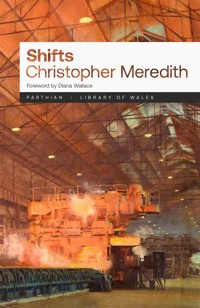
'the prose is spare and poetic, at once plain and rich, musical in its rhythms of speech and clear descriptions... A beautiful, understated first novel' – The New York Times 'A first novel of consummate skill' – The Sunday Times 'witty, compassionate, and brilliantly readable' – Diana Wallace A new edition of this classic Welsh novel with an introduction by Professor Diana Wallace Funny, lyrical and poignant, Shifts is a novel of the decline of industry and of the south Wales working class in the 1970s. It broke new ground on its appearance in combining a real, close-up depiction of work and ordinary lives with symbolic power and a wider imaginative reach. Jack Priday, down-at-heel and almost down and out, returns to his hometown towards the end of the 1970s after a decade's absence, just looking for a way to get by. His life becomes entangled with those of old friends Keith, Judith and O, and with the slow death throes of the male-dominated heavy industries that have shaped and defined the region and its people for almost two centuries. As circumstances shift around them, the principals are forced to find some understanding of them and to confront their own secret natures. From multiple viewpoints, Shifts is a slowburning, controlled and intense examination of the relationship between our inner lives, the people around us and the forces of history.
Sie lesen das E-Book in den Legimi-Apps auf:
Seitenzahl: 392
Veröffentlichungsjahr: 2023
Das E-Book (TTS) können Sie hören im Abo „Legimi Premium” in Legimi-Apps auf:
Ähnliche



















v
SHIFTS
CHRISTOPHER MEREDITH
Foreword
Widely acknowledged as the classic novel of de-industrialisation in Wales, Shifts is a far funnier, and stranger, book than that rather dry description might suggest. From the unsettling opening sentence – ‘O clocked off at exactly half past three’ – we are in a novel which combines closely-observed realism with a tightly-woven, but lightly-worn, pattern of imagery and symbolism. Christopher Meredith is an accomplished poet as well as a novelist and one of the great pleasures of Shifts is his playful dexterity with language. Just one of an exceptional range of linguistic registers in the novel, the south Wales valleys dialect spoken by his characters (‘Hiya butt. How be? A’right butty. Owzigoin? No’ bâd mun’) becomes a rhythmic, even poetic, expression of the specificity of a people and a place. When he began writing Shifts, Meredith has said that he ‘wasn’t even entirely sure if it was a novel at first’. One way of thinking about this impressively assured debut novel is to regard it as a kind of big ‘poem’ where the textures of language itself are part of the world Meredith is (re)making.
Published in 1988 but set a decade earlier in 1977, Shiftsis a novel concerned with history (rather than a historical novel) which looks back at a moment of radical change in south Wales. Set over just nine months, it follows the fortunes of four characters linked by their association with a steelworks, the closure of which will irrevocably alter their lives and the landscape they inhabit. Jack Priday is the returning ‘native’, back from Lancashire to find work and lodgings two valleys over from his old home and using his facility for puns and anecdotes to integrate himself into, and distance himself from, the community. His former schoolfriend, Keith Watkins, is viiiemployed at the steel-plant but increasingly obsessed by local history. Judith, Keith’s wife, is bored by their marriage but unable to commit to either becoming pregnant or finding employment herself. And, finally, the strangely named ‘O’, or Rob (nicknamed ‘Snobs’ in school), is a marginalised figure at the steelworks, obsessive about routines such as counting the number of times he can re-use a Sunblest plastic bag for his lunch. His name suggests both clock time (‘o’clock’) and nothingness (‘zero’). Weaving together the personal and the political, the novel shifts deftly between these four points of view, engaging our sympathies even as it turns a sharp eye on the characters’ weaknesses. Each of them, like everyone else in the novel, is ‘just looking for a bearable way of living’ in a town where the options are narrowing.
The title itself is multi-layered. Most obviously, it refers to the shift-work which has dominated the lives of the steelworkers. Monotonous and often at odds with the workers’ own natural rhythms (working night shifts has ‘Put [Keith’s] body-clock wrong’), these shifts nevertheless structured a way of life which is being lost as the men are laid off. ‘“They’m on’y fucking rolling one shift mind, days regular five days a bastard week,”’ one steelworker expostulates, ‘“Three shifts a day it used to be. Three shifts a fucking day seven days a week […] End of a shift you ’ouldn’ know whether you was coming or bastard going.”’ This mixture of resentment and loss reflects the ambivalent status of work in our lives: ‘the psychology of the thing’s complex, built on a paradox,’ Meredith has said of Shifts, ‘that your job is both what you are and what destroys you’. On a macro-level, the title also indicates the major historical ‘shifts’ taking place, which the characters for the most part only dimly recognise. The process of de-industrialisation, over which they have no control, up-ends traditional gender roles (the new jobs opening up in the marshmallow factory are primarily for women) and leaves the community in a state of limbo and paralysis.
The history of Welsh culture, Raymond Williams has argued, is marked by ‘a broken series of radical shifts’ within which there are ix‘certain social and linguistic continuities’. It is these ‘shifts’, as well as the continuities, which Meredith is tracing in the novel. While Jack presents himself as driven by the ‘biological imperative’, and Judith seems to look to the men around her for meaning, Keith turns to local history to try to make sense of his place in the world. From traces such as place names and old buildings, he tries to re-imagine how the landscape was transformed when the English Samuel Moonlow built the first furnaces in the then densely wooded valley and kickstarted the processes of industrialisation. Thus Meredith connects the ‘shifts’ which mark the beginning and end of this particular historical cycle. Language is crucial here too. Unable to read or speak Welsh, Keith cannot interpret his own history although it is marked on the landscape in names like ‘Henfelin’ or ‘Ty Mister’. Listening to a university professor explain how the town has existed on many ‘frontiers’ – of rural and industrial, farmland and desert, moorland and dense forest – Keith recognises that these are ‘Huge ideas’. Likewise, Meredith’s novel deals with ‘huge ideas’ but expressed through language, symbolism and imagery grounded in the ordinary details of ordinary lives.
If Richard Llewellyn’s 1939 novel HowGreenWasMyValleyis what Raymond Williams called the ‘export version of the Welsh industrial experience’, Shiftsis an insider’s version. Born in Tredegar to a father who was a steelworker and former collier, and a mother who had been a domestic servant, Meredith grew up on the Cefn Golau estate. Newly built in the mid-1950s, this estate looks down on the town from the edge of the open mountain which separates Tredegar from Rhymney. This landscape with its paradoxical combination of industrial and rural, tame and wild, was formative for the young Meredith and the setting of Shifts is in part a reimagined version of this distinctive locale. As a child Meredith could go up onto the mountain, to where the nineteenth-century cholera graveyard which Keith explores in the novel is situated, or look, as Jack does, down into the town with its park and its rows of terraced houses, the factories to the north and the reclaimed pits to the south, xand know that over the mountain to the east lay the ‘two miles tangle of steelworks’. Benefitting from the introduction of comprehensive education, Meredith went to Tredegar Comprehensive School and then on to University of Wales, Aberystwyth where he studied English and Philosophy. There he also learned to speak Welsh which he has described as ‘one of the most important things I’ve ever done.’
Before going to university Meredith had worked for three months at the British Steel Corporation’s Ebbw Vale steelworks where his father had worked in the coke ovens, later becoming a foreman and then a tinplate inspector. Meredith worked in the open hearth and enjoyed the sense of having a proper job, finding the place ‘anarchic’. But when, after graduating in 1976, he returned there as a shift worker in the hot mill, he found it very different. The steelworks was in the process of closing down and, as he put it, the job ‘doesn’t seem the same when you realise this is the rest of your life’. He left the steelworks to complete a Postgraduate Certificate in Education at University of Wales, Swansea, and then took up a post teaching English at Brecon High School.
It was while he was teaching that Meredith wrote and published his first two collections of poetry, This (1984) and Snaring Heaven (1990), as well as Shiftsand his second novel, Griffri(1991). Written in spare moments over a period of four years, Shiftstook shape against the background of the difficult political climate of the 1980s, including the aftermath of the 1979 referendum in which 79.74% voted against devolution for Wales, the right-wing government which came to power under Mrs Thatcher in May 1979, the now-forgotten steel strike of 1980, the Cardiff conspiracy trials of 1983, and the miners’ strike of 1984-5. This added up to what many felt was a climate of political fear and eroded civil liberties. The novel gave Meredith a way of addressing the history of his bro (region or country), broadening out from the more personal concerns of his poetry to the wider social and political processes which shape individuals, communities and countries.
Given his versatility as both poet and novelist and the ambitious xibreadth of his concerns, it is extraordinary that Meredith’s work is not yet better known outside Wales. He is a major writer whose work speaks directly, and urgently, to universal themes and concerns precisely because it is grounded in the specificity of a particular time and place. Shifts is a novel which helps us to know where we are now, and why, in relation to many complex issues: history, time, work, politics, love, betrayal and grief. It is also witty, compassionate, and brilliantly readable. If you don’t know Meredith’s writing yet, this is a good place to start.
Diana Wallace
Diana Wallace is Professor of English Literature at the University of South Wales. She is the author of Christopher Meredith (University of Wales Press, 2018), FemaleGothicHistories:Gender,Historyand the Gothic (University of Wales Press, 2013), The Woman’s Historical Novel: British Women Writers, 1900-2000 (Palgrave Macmillan, 2005) and Sisters and Rivals in British Women’s Fiction, 1914-39 (Macmillan, 2000). She has published widely on Welsh Writing in English and edited Margiad Evans’s Autobiography(1943) for Honno’s Welsh Women’s Classics series.
Contents
SHIFTS
xiv
1977
2
ONE
O clocked off at exactly half past three. He had stood with his card in the timeclock, his palm poised above the punchlever, and waited till the second hand jerked up to the twelve. It was quiet around the clocks on that gate, as usual, and the security man, the spotter, in his glass and brick office, had stood looking away from the timecard racks, out over the crumbling carparks and vaguely at the hills.
O stood, as usual, near the litter basket with Sully, Wayne and a few others waiting for their bus outside the gate. He looked across at the bank of colourless grass and its few blackened, unidentifiable trees. They looked dead but were only January dead. In the spring, as always, they would put out just a few leaves, only enough to show that somewhere in each of them meagre life was continuing.
A car pulled up. A black Viva with a loose exhaust. The driver, darkhaired and wearing platform shoes, got out and walked into the time offices. He left his engine running. O’s bus arrived and as he boarded he saw the darkhaired man come out of the time offices, get in his car and drive away.
O sat on his own on the bus and focused his eyes on space a few feet outside the window. His hands were stuck into the pockets of his frayed blue quilted anorak. In his right pocket, as usual, he held his bus ticket. The man in the seat in front of him, he noticed, had not been given a ticket and the driver had not charged him the full fare. In the left pocket, as usual, he fingered the carefully folded plastic Sunblest bag from which he had earlier eaten his sandwiches. He could feel the hard breadcrumbs through the bag, and soft yielding bits. Those were the small lumps of corned beef. He could feel the meat spreading between his thumb and finger and sticking 4to the bag. But he would not break the plastic with his nail. He would shake the crumbs out and use the bag again the next day.
The bus had climbed away from the steelworks and over the hill down into the next valley, homeward. Past where they were building a new estate and the road was widened. Momentarily on the downward hill O could see, over some rooftops to the north, some tumbled rocks on some rough yellow grass in a hollow. It was fenced around.
O got off the bus by the town clock. He checked it against his watch because the town clock was often wrong. But no. Nearly four. It was quite right. O walked up a hill towards his house. He kept his hands in his pockets, even when he looked at his watch. He had a scarf on because of January. He also had gloves but did not wear them because they were big and ridiculous. They were suede and lined with wool and had been his father’s, but they felt huge and stupid on his small hands.
His breath formed on the air. He puffed, pretending he was smoking a cigar, though unlike his father he had never smoked, blowing the warmed air up over his nose and going crosseyed trying to see it. He stumbled doing this, crossing the waste ground where some houses had been demolished in Buchan Row. He looked around in case anybody had seen him. A man was standing on the steep bank behind the row, looking down into the backyards of some empty houses. He recognised the glasses and the heavy figure in the hooded coat.
‘How be, O’ the man called, and turned to walk away.
‘A’ right, Keith’ O said.
O slowly walked up the bank, following the rutted narrow track, to his house in a short terrace. He skirted round the small front garden and went in through the gate in the back lane. When he opened the door, his mother called from upstairs.
She said, ‘Robert. It’s all ready in the oven, love.’
Robert took off his anorak and scarf and hung them on the door. He took out the sandwich bag and, going into the back garden again, 5he shook the crumbs into the dustbin. Inside, he smoothed the bag flat on top of the fridge in front of the bread bin. There he left it for his mother to attend to later. He took his shoes off and pushed them under the usual chair. He opened the door of the oven and looked at his warming dinner. He would go into the middle room, sit down, and read the paper, looking mainly at the television page, for fifteen minutes. Then he would take out his dinner, by that time a pleasant crusty lump, and eat it while watching whatever television programmes there were.
* * *
Like standing in a pisshouse, Jack thought.
He stood in the personnel office’s waiting room. It was very small and tiled and eight men were crammed in it. Five sat on a short bench, all with their arms folded or hands together to avoid contacting their neighbours. One man had stood leaning against the wall, gradually slipping down the white porcelain till he was sitting on the floor. Another stood awkwardly in the angle of the inner and outer doors, moving his weight from one foot to the other. Jack stood at the other end of the room, cluttered against the coatstand. No one spoke. Nobody looked at anybody else in case anybody else was looking at him.
Jack thought, I could have more fun having all my teeth out.
He looked through a pair of feet at the white tiles.
Like standing in a. Waiting for the trickle. Or waiting for the doctor. Doctor, I’ve got this pain in my. Everybody wondering what everybody’s got. He’s flu. He’s back trouble. He’s acne, definitely. VD. Dust. After a sicknote to go to the match. And him by the door is piles. Nice to be back in mine own countree.
Jack thought, elaborating his theme, I could have more fun on Brynmawr bus station. I could have more fun smalltalking with the landlady, she too old to be young and too young to be old, while she attempts to extract the rent. 6
Some of the men were young – a couple were teenagers, some, like Jack, were about in their late twenties. Most, like his landlady, were in an indeterminate middle age. Easiest to date them by their clothes or hairstyle. One of the benchmen was actually wearing a suit, old, dark, and well preserved. Eyes doing the round of feet would occasionally come to rest on his highly polished brown shoes with leather laces. They looked absurd among the oilsmudged suedes and split trainers.
Every now and then the man would stretch out his chin as people are supposed to when wearing an uncomfortable collar.
Serve him right, Jack thought. The pretence of selfrespect showed that the man did not understand what was happening to him. Definitely dust. The old hardworking good timekeeping type who didn’t know that in the end that makes no difference. Up the road, pal. This is a new one on him.
The man had false teeth and they seemed uncomfortable too, as he constantly levered at them with his tongue. Jack was reminded of his father. The man shifted on the bench, moving the pressure from one hunker to the other. His lips moved slightly, as in some imagined or remembered conversation, and his eyes moved as though following words written.
Trying to work out how he got here, Jack thought. Years on end in some chronic job and then wham bam here’s your cards and thirty pee, why don’t you go and take a flying leap at yourself. Good company man just like the old man. Every shift leaving the house with his sandwiches in the old Oxo tin. Except they kept him on long enough to see him off altogether.
The lips worked almost imperceptibly.
Yes. The speech you should have given the manager.
He remembered the curtain whirring shut at the crematorium and the hymns his father would have hated.
Serves you right you old fools.
He wondered how the man in the suit had done in the tests. That was the delay, of course. They were marking the tests. Logical, 7numeral, visual. If lever A is depressed in the direction shown, in which direction will cog B revolve: (a) clockwise? (b) anti-clockwise? The gingerhaired man with the torn snorkel coat had sweated in there.
The redhaired man sat on the bench, leaning forward, an elbow on one knee and a huge hand clamped over one side of his head. He breathed noisily and sniffed.
Flu, definitely.
The inner door opened and the personnel officer’s secretary, a woman also in indeterminate middle age, appeared with a list.
‘Mr Janes’ she said.
The redhaired man started.
‘Would you like to come through, Mr Janes?’
As Mr Janes went through, there were indistinct sighs, shuffles, and even exchanged glances in the waiting room, by which means the men signalled that they thought something significant was happening.
Jack noticed the secretary’s accent. It was good to hear his own accent again all around him. While he’d been in England he’d lost some of it. Everything seemed very Welsh. Although, he told himself, no, it was only itself.
How did they get the results of the test to the office? Too complicated to phone. Must be a back door. One of those tube things like they used to have in the Co-op for sending receipts and change. A man in a Zorro outfit leaves the hot results under heavy seal pinned by a dagger to the windowframe.
The inner door was opened quickly and Janes came out flustered and red. He went through the outer door, bumping into the pilesman. The secretary hung out on the jamb and called in the next on her list.
Acne. Piles. Each came out carrying a slip of paper, smiling and smug.
‘Mr Riley.’
The man in the suit jumped up and went in, stumbling at the 8threshold. Jack caught at his elbow. Riley said a voiceless thanks without looking up.
He came out a few minutes later, carrying his slip of paper. He brandished it and looked around at the remaining men.
‘I got it’ he said. ‘Twenty-eight weeks.’
Jack looked at Riley’s form and against the printed word ‘Department’ glimpsed ‘OPEN HEARTH (SCRAP BAY)’ scrawled on the dotted line.
‘You should be all right boys’ Riley said. ‘They’m giving em out like smarties today.’
‘Mr Priday?’
Jack followed the secretary.
Of course, he thought. Janes didn’t get anything. In which direction will cog B revolve? I’m sorry to have to tell you, Mr Janes. Poor bastard.
The personnel officer was a large bleak man in indeterminate middle age. The walls of his office were a sickly urine green which even on a dull January day cast a sick tinge on his pale face. His desk seemed unnecessarily large and some leaves of paper and a few pens were scattered remotely across it.
Jack saw the pad of forms and the man’s poised ballpoint. ‘Department’.
They exchanged greetings. Jack sat. There was a job.
Doctor I’ve got this boil on my bum from not doing anything.
‘It’s a thirty-six week contract. Can you start Monday?’ the man asked.
Jack said that he could and the man filled in the form, the prescription. Doctor I’ve got this third leg growing out of my navel. Are you Manx? No it’s the way I’m sitting. Try aspirin.
‘Can you come in tomorrow morning?’
‘Yes.’
‘Okay. Go straight to the department on this note tomorrow morning at eight. Your union rep will meet you at the timeclock and show you round. Have you worked in steel before?’ 9
‘No. My father used to work here though.’
‘Oh?’
‘Elvet P—’
‘Wouldn’ know him. It’s a very big place. Well it was. Your contract expires on the date I’m noting for you. If the plant is still working in your department you’ll be laid off and if you’ve been a good boy we’ll take you on for another contract. Okay?’
Doctor, I’ve got this unmentionable disease and the only known cure for it is gainful employment.
The personnel officer tore out the form in a practised way and handed it to Jack. Against ‘Department’ was written ‘HOT STRIP MILL’.
‘Your father’s department?’ the man asked.
‘He might have worked there.’
‘Don’t you know?’
‘He moved around.’ Mainly open hearth. The old furnace clogs in the coal cot and those dark goggles that you couldn’t see through in ordinary daylight. ‘He was here a long time.’
‘Well, how long things continue is a matter for conjecture. Anyway, here’s thirty-six weeks for you.’
Wham bam thank you, butty.
Jack felt a great relief and was vaguely irritated because he wanted to feel angry.
Here’s thirty-six weeks. Here’s a strawberry for a donkey. Here’s a bottle of aspirin. Nice to be not quite home again, even with the three months of indignity and the weekly signature. The landlady can frig off for a start. We’ll keep a welcome in the pillside, or how green was my valium. Only no. The green didn’t really fit, unless you count the pisscolour walls.
He stepped out into the waiting room and waved his note to the three remaining men.
‘Piss in our time’ he said.
‘Got your smartie then’ backtrouble said.
‘Aye’ Jack said, ‘but I’d prefer real food.’ 10
* * *
Judith waited at the back of the crowd in the butcher’s shop. She knew that it was always a mistake to come out this late, even on a Thursday. Sprightly pensioners and smartly dressed plump women in hats were at the counter where they elbowed one another for position and pursed their lips sceptically when the butcher or his assistant held up a prime cut for inspection. Judith couldn’t stomach all that pretending and haggling. She preferred to walk to several windows and find something good on display, but this shop was the nearest and it was too late now to go to the others, the January afternoon already growing murky. She would have to stand and transact with the shopkeeper. She usually got reasonable value like this, but mostly because she stood ineffectually silent until the butcher sensed criticism and produced better goods. Some shopkeepers interpreted her stare as an unsettling kind of guile. Judith sometimes sensed this, but mostly felt uneasy herself and was always miserable when shopping. Especially when it came to the awkward bits like meat. So she would hang back, draw out and thin the discomfort, while the others carried away their trophies pleasantly, their little acts of bargaining quickly finished.
She stared up at the white tiled walls, listening to the hum of the black refrigeration machine on top of the coldroom.
As the crowd shuffled forwards towards the counter, she realised that someone who had been in front of her was now behind her. She looked round. The figure was familiar, with the crinkled green raincoat that wouldn’t keep a sneeze out, the frizzy browntinted hair, the hare eyes and the thin face.
‘Hello, Judith, my love.’
‘Hiya, Maudie’ Judith said. ‘How’s Arthur?’
Maudie reported that Arthur was all right. The morphine was doing a lot for him with his leg and his stomach. And how was Keith? Judith reported on her husband’s good health.
They got to the counter and were the only customers left in the shop. 11
‘Go on, Maudie. You go first.’
‘No no. You were first.’
As they haggled over who should go last, Judith thought that she was putting herself at the end, after the dealmakers, the pensioners, after Maudie with the colour washed out of the elbows of her green coat, her nicotine fingernails, her cancerous husband.
Finally Maudie put a bony hand on the glass counter and looked nervously at the assistant.
‘Have you got any scraps, love?’
The assistant looked at the butcher and the butcher sighed, looking at the floor. He scraped together a few bones and some dripping for Maudie. She gushed thanks and traipsed her thin body away.
As Judith chose her cuts, she realised why Maudie had kept at the back.
She walked the mile or so back to the estate. It was very cold, but she would get colder still if she waited for the bus. The estate was near the top of the mountain on the western side of the valley. They had been lucky to get the council house so soon after getting married, three years before, and although it was a cold place for most of the year she liked the view across the valley to the pine plantations and terraces, and she had begun to tame a small corner of the tussocky back garden. In the spring there would be crocuses and daffodils and before then she would try to do something with the grass. You couldn’t call it a lawn yet. The previous summer in the heatwave, the scorched grass had been matted with deeprooted weeds, their straggling stems intricate with tiny leaves. And Keith of course barely knew that the garden existed.
At home, she put the meat in the fridge and a pie in the oven for her husband. A pie could always be relied on. He liked things overcooked and safely tasteless. He had said that he would be gone all afternoon ‘preparing’. She didn’t like the way he used that word, as if he was about to die. He made such a drama out of such unimportant things. Why didn’t he just say ‘getting ready’? 12
She went into the livingroom and looked at herself in the long mirror. She pouted her lips. Her face was not thin. She turned three quarters and ran her hand over the fly of her jeans to feel how much her womb stuck out. A pleasant, shaped bulge. Enough to be attractive. No more. She liked her longish, smooth hair because it was very dark, almost black. And her eyes did not bulge at all. She put her hands under her breasts and ran them down so that they followed the flare of her hips. If anything she would become fat – not thin and bony and frightened.
Keith was on the heavy side, but that wasn’t attractive in a man. If they ever had children she would ask him to lose weight so that the kids would have a better model.
But there didn’t seem much chance of children. One, perhaps, she thought, might be all right to try out. She stood sideways and imagined the new bulge. That part wouldn’t be very nice, but it would go. The going wouldn’t be very nice either. And it changed you.
Maudie had had children. It amazed Judith to think this. It frightened her to think how much Maudie must have changed.
She switched on the light and sat close to the coal fire. It was quite dark already and through the window she could see the faint glow of the steelworks town lights from the next valley on the clouds above the mountain. She drew the curtains.
There was a choice. While Keith’s pie shrivelled, either television or a book. Probably it would be television and a halfscanned book at the same time. One day, she thought as she switched on the set, she would make herself choose the book. One day she would haggle with the butcher.
* * *
With some blank paper and a pen in his pocket, Keith spent the afternoon walking the length of the town. He didn’t much care for the northern end with its estates and feeling of flatness as the hills 13and valley thinned away into high moorland, but this was where he went first. He walked out along the straight wide road that some people still called the Dram Road, though there were no longer any rails, and doubled back southward along a curving route that followed some of the older streets and skirted the industrial estates.
He huddled into the thick coat and pulled the hood closer round his head.
At a place where several streets met, he paused. A stony reddish stream was piped under the road and along the back of a terrace. He looked around at the houses. Behind him, two bungalows. Modern. At the left, a terrace of fairsized houses. About 1910ish? And the stream terrace? Those houses were very small and all the building at the back was haphazard. Before the 1850s anyway, he thought. Down a lane on his right, too narrow for a car, he could see the ruin of some shops on a raised pavement. Two smashed up. One lived in but no longer a shop. After the 1850s, those. Something about them. Just a bit too grand. The yellow brickwork round the windows. And in front of him, climbing the slope of the mountain, some modern houses. A cluster of pensioners’ bungalows and three rows of lowrise flats. He remembered the original Three Rows, the condemned tenements. And then on the left past the 1910 terrace, the Lion. Hard to place. Pubs get so mucked about. A house set back, the other side of the pub, on its own patch of land. Old. Farm perhaps. He could see its name on the gate at the side of the Lion. Henfelin. And up there, up behind the new three rows, a flat wide patch running north to south along the hill. He followed it with his eye north to the moor and thought of the limestone quarries, and then south where it disappeared round the curve of the mountain.
Keith took off his glasses so the picture blurred slightly, and tried to focus his mind back through time. Turn of the century was easy enough. Before that he had to replace the lefthand terrace. Houses there? Perhaps nothing. 1850s. No street pumps. Streamwater dammed further up for scouring the iron. On the path above Three Rows, horsedrawn drams taking limestone from the quarries to the 14furnaces. The rough path at the back of the stream terrace would probably not be there because it was made of iron waste. The women would walk up to the hill where the spring was with jugs or buckets for the water. The spring had a Welsh name that he couldn’t remember. He focused back further, mentally removing a piece of land that he thought was an old tip. And finally 1800. No Three Rows, no terraces, no shops. Henfelin, probably. The pub perhaps. No dramlines. A donkey team on the path with baskets of limestone. The man driving them blowing his hands. Wrapped in sacking perhaps. Christ. Doing that in a blizzard.
Keith shivered. He rested a hand on a gatepost. There was no one near, so he risked muttering to himself:
‘A storm was brewing in January 1800, when a small gang of men started—’
No good.
‘A blizzard was raging in January 1800, when the first hard won iron was tapped from the first furnace—’
Worse. He didn’t want to lay it on too thick. The cool factual approach might be better.
‘On January 12 1800, after much careful preparation, Samuel Moonlow, an English businessman, personally supervised the lighting—’
No. Wordy.
He put on his glasses and the present jumped back into place.
Knowing how to start was the problem, he thought, as he worked his way up onto the track above Three Rows and began to walk southward along it. The cold wind sliced through his coat. Rounding the curve of the hill, he saw below him the partly excavated remains of the furnace arches – they were later of course – and the few tumbled blocks that were left of the first furnace. It stood in a little horseshoe gap in the grasscovered coaltip, a few dozen yards from another row of houses. He could see in a hollow near the river several hundred yards away the big house Moonlow had built for himself, Ty Mister. 15
Keith focused back again and tried to imagine the supplies arriving at the new little works. Limestone, yes, and the ore of course, and charcoal.
‘Idiot.’
The loudness of his own voice surprised him.
Trees. Naturally, there would be trees everywhere, even here. Old deciduous forest. Just a patch cleared around the furnace for the smelting. Patches here and there cleared by the charcoal burners. He closed his eyes and imagined how they would slaughter him if he made such a blind simple mistake. He tried to picture the trees, and everything changed. Sound would carry differently. The snow would be different. The light would be different. And of course a lot of the hill would be different because no tips.
He walked on feeling, hopelessly, that he would have to start all over again.
He tramped down to the ruin and stared at it, conscious of his looking, like a viewer at an art gallery wondering what to think. It was like repeating a word till it becomes meaningless. He ran a hand over the stone and crumbling mortar, trying to concentrate. There was still an overhanging plug of iron slag where some stonework had fallen away. The remains of the last tapping. He moved around the ruin running his hand under the overhang and spoke again to himself.
‘If you go to the site of the ironworks today, you can still see the remains of the very first furnace. There’s even a great lump of iron still in it from the last tap. But it is not the last tap that interests us toni—’
There was the sound of a throat being cleared.
‘Oh. I’m. I’m.’ Keith tried to apologise to the young couple lying in the lee of the stonework under the iron plug. He looked away awkwardly and then glanced back again. The woman had pulled a coat lapel quickly over her naked breast and the man had rolled tight to her to hide his flies.
Keith stumbled away towards the fence and the houses. The sound of a woman laughing. 16
He had done his courting like that. Only not so much there, but on the tip behind the dog track and in the plantations up the mountain. More in the new upstart forest than where the old one had been. First up the mountain with Glenda, then Anne, then Jude. And once with Anne a man with a dog had come by. That was in the forest. They might as well have had nothing on. But that was high summer. And then a man with a dog came by and he was very polite, or shy, because he never even looked round. The dog wasn’t so polite though. And then once with Anne on the pine needles under the low trees. Then. That too had become history of sorts.
Never in January though. It occurred to him that he could have laughed, or said something witty like watch out for brass monkeys, or stoking the furnace I see. But perhaps that would have been too obscure.
He couldn’t imagine himself rolling round on the earth now. Not that he was fat, but he had thickened out a little prematurely. It would be comical like that, though warmer in this weather.
His concentration was broken. As he walked home through the town he mused that he had plenty of time. It was over twelve weeks, and he needn’t prepare much anyway. There would be other speakers. His mind turned to other projects. A survey of early nineteenth century gravestones to check for numbers of immigrants and where they came from. And that derelict house Emlyn in work had told him about where there were papers left in the cupboard. You never knew. He made for that street now, a mile or more to the south and climbed onto the banking behind a row of condemned houses.
And there had been that time with Anne in a derelict building after school. Then. Exploring like kids in a story. And it had been the end house – quite big and posh, and on the top floor in all the fallen plaster and dirt. Anne was doing Economics and the teacher had given her a pile of Economists to study, and that was how they had sex, spreading the copies of the magazine over all the dust like a sheet. She always was brainy. Still enough to churn the guts after – how many? – ten years. 17
Keith stooped and looked down into the backs of the old houses. The grey light was waning. Too late.
He caught sight of a figure crossing a gap in the row, a man who was unselfconsciously walking with his head tilted back and puffing his steaming breath upwards as though he was trying to blow smoke rings. He tripped and nearly fell. As he regained his balance he saw Keith watching him. They exchanged greetings.
It was O, coming off days regular, which meant it was about four o’clock. Home to mammy.
Keith decided to turn for home himself. Jude would have some food ready for him and he liked an evening in before starting on the dayshift.
He felt that some more history had fallen and gathered like snow on a drift, and as he walked he thrust his knuckles against the blank page in his pocket.
TWO
The electric wallheaters in the day labourers’ cabin on the hot mill had been left on over the weekend. O thought of the waste, but was glad, when he got there on the frozen Monday morning, that the room was so warm. He had taken more than twenty minutes to change into his working clothes in the bathhouse. Lew Hamer the chargehand never came to give the jobs out much before half past eight these days, so that left a whole hour to kill after clocking on.
O had laid out his overalls on the locker bench and changed into his old trousers and shirt. Then the pullover. Then the overalls which had that day new patches on the frayed cuffs. Then socks. Then the workboots with steel toecaps. He would pause after the first boot and wipe the worst of the black oily dirt from his fingers with a rag he kept specially in his locker. Then wipe again after the second boot. Then wipe again after tying his laces. Then he would sit for a while and stare at the floor. Tidy everything back into the locker. Safety helmet on. Lock up. Few of the lockers still had keys and he had been lucky to get one. Then the walk to the cabin.
Inside, Ken Francis was in his usual position, lying at full stretch on the bench in front of the heater. As usual, O inspected the tray of rat poison. There were a couple of large blackbrown cockroaches near it. O bent forward and looked at them closely. A stifled laugh came from the other two benches where the remaining half dozen or so of the day gang were sitting. O did not look round.
‘Hard luck, O.’ It was Sullivan’s voice. ‘No ratmeat for your sandwiches again today.’
‘Not to worry, Sully’ Kelvin Edwards said. ‘His mammy will have got him something, you know.’ 19
‘That’s right’ O said awkwardly.
He sat on the end of a bench – the one with its back to the wall so that he wouldn’t have to look at the pinups – next to Kelv.
Some of them were playing cards on the stained long table between the two benches. O watched the cards for a while and then pulled his helmet down over his face. He folded his arms so that he wouldn’t touch the oily bench, and leant his head back against the wall. It would be all right so long as Wayne concentrated on the cards and didn’t pick on him.
As if on cue, Wayne spoke.
‘Fucking bastard hell. I’ve got a fucking hand like a bastard foot.’ His voice whistled through a gap where his front teeth had been. ‘Why don’ you get to bastard bed earlier on a Sunday night?’
O said nothing although he knew Wayne was talking to him. No one else was trying to sleep except for Ken, and no one talked to him unless they had to.
‘Oy you’ Wayne called. ‘Well fuck me. Oy. Spunkarse.’
O felt some playing cards rap against his helmet and flutter down, some into his lap and others to the floor.
‘Shit’ Kelv said. ‘It must have been a bad hand.’
O sensed Kelv picking the cards from the floor.
‘Easy now, O.’ His Ulster accent softened. ‘You’ll enjoy this bit.’
Kelv started to gather the cards from O’s lap. O’s body became rigid.
‘Ah, he’s excited’ Kelv whined.
He slid his hand along O’s thigh and made a grab for his testicles.
‘Ha’ Kelv yelled. ‘Well he’s got one at least.’
‘Fuck me’ Sully said. ‘Can anybody join in or are you strictly one to one bum chums?’
O sat as still as he could. Kelv was all right. He was only fooling. Now if it was Wayne who had been doing this it could have been very painful. In a minute Lew Hamer would come in with the jobs and everything would be all right. 20
* * *
Jack tut tutted theatrically as he pulled on his old shoes in the empty bathhouse.
Late on your first day, Priday. Hope you’re not starting as you intend to continue.
He pictured a severe foreman with a toothbrush moustache, consulting his pocketwatch, tapping his foot.
The previous Friday, Willy the union man had shown him round, and somehow it seemed to Jack that foottapping timesticklers wouldn’t survive long there.
After showing him the timeclocks, Willy had taken him on the mill.
The bathhouse, time office and canteen were on a steep bank – the mountainside really – on the east side of the mill. Near the canteen, which was of dirty redbrick, was another single storey building of redbrick which, Willy told him, was the hot mill offices.
Jack followed Willy over a covered footbridge which joined the bank to the mill. They emerged on a catwalk high above the mill floor and went down a steel staircase. Some welders were burning new grips on the last few steps. Instead of just making patterns, they wrote nicknames in the metal:
FAT MAGGOT TOMMY TACKLER IANTO FULL-PELT
Jack asked what went on and Willy explained succinctly:
‘A fucking great ingot do come in that end’ – he pointed south – ‘and two fucking great coils of sheet steel do go out that end.’ He pointed north.
The mill was big, dark and dirty. An overhead crane went by with its siren wailing, dragging a piece of blackened metal an inch thick, 21a yard wide and several dozen yards long, northward up the mill. Willy tugged Jack’s arm and led him to cover. Jack panicked momentarily and after the crane had passed was struck by the silence. There was no production work going on, evidently.
‘Friday see’ Willy said. ‘Mill’s down every Thursday and Friday. Only maintenance and that working.’
He led Jack on a grand tour of the mill and environs. First south to the soaking pits, large circular furnaces where ingots were heated to rolling temperature; then the slabbing or blooming mill, a huge steel mangle where, Willy said, ingots were bashed into slabs; then northwards past huge derelict looking chunks of machinery, including one which sheared each rolled ingot into two slabs, to a series of furnaces with doors that opened onto the endless row of steel rollers that formed a conveyor belt for the hot metal.
‘These are the reheating furnaces’ Willy said. Jack looked up at their varicose web of green and red painted cooling pipes. They reminded him of those colourcoded pictures in textbooks on human biology. ‘Slabs in the slabyard next door are pushed in the other side and heated up to be rolled into coil. Them doors do open up with them chains and slabs do drop out. These rolls where they do drop out is called the delivery table, just like in the maternity ward.’
Jack remembered his father using the term ‘tapping off’ when a neighbour’s wife was about to give birth. But that was a metaphor taken from the open hearth furnaces, where the metal was actually molten, not just soft hot as it was in this department.




