


0,49 €
Mehr erfahren.
- Herausgeber: e-artnow
- Kategorie: Geisteswissenschaft
- Sprache: Englisch
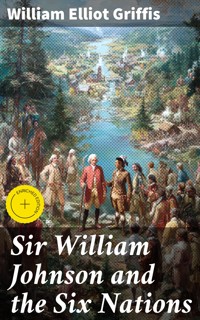
"Sir William Johnson and the Six Nations" by William Elliot Griffis Johnson lived much of his life in the fairest portion of the domain of the Six Nations of the Iroquois Confederacy. As 1st Baronet of New York, a British Army officer and colonial administrator from Ireland, he moved to the new world to help establish the colonies and make treaties with the Native Americans who already lived on the land. This pre-Revolutionary War era history is rarely discussed and is fascinating to anyone who is interested in the Americas.
Das E-Book können Sie in Legimi-Apps oder einer beliebigen App lesen, die das folgende Format unterstützen:
Veröffentlichungsjahr: 2023
Ähnliche














Sir William Johnson and the Six Nations
Table of Contents
PREFACE.
The Mohawk Valley in which Sir William Johnson spent his adult life (1738–1774) was the fairest portion of the domain of the Six Nations of the Iroquois Confederacy. In this valley I lived nine years, seeing on every side traces or monuments of the industry, humanity, and powerful personality of its most famous resident in colonial days. From the quaint stone church in Schenectady which he built, and in whose canopied pews he sat, daily before my eyes, to the autograph papers in possession of my neighbours; from sites close at hand and traditionally associated with the lord of Johnson Hall, to the historical relics which multiply at Johnstown, Canajoharie, and westward,—mementos of the baronet were never lacking. His two baronial halls still stand near the Mohawk. I found that local tradition, while in the main generous to his memory, was sometimes unfair and even cruel. The hatreds engendered by the partisan features of the Revolution, and the just detestation of the savage atrocities of Tories and red allies led by Johnson’s son and son-in-law, had done injustice to the great man himself. Yet base and baseless tradition was in no whit more unjust than the sectional opinions and hostile gossip of the New England militia which historians have so freely transferred to their pages.
In the following pages no attempt at either laudation or depreciation has been made. My purpose has been simply to set forth the actions, influence, and personality of Sir William Johnson, to show the character of the people by whom he was surrounded, and to describe and analyze the political movements of his time. I confess I have not depicted New York people in the sectional spirit and subjective manner in which they are so often treated by New England writers. The narrow and purely local view of some of these who have written what is called the history of the United States, greatly vitiates their work in the eyes of those who do not inherit their prejudices. Having no royal charter, the composite people of New York, gathered from many nations, but instinct with the principles of the free republic of Holland, were obliged to study carefully the foundations of government and jurisprudence. It is true that in the evolution of this Commonwealth the people were led by the lawyers rather than by the clergy. Constantly resisting the invasions of royal prerogative, they formed on an immutable basis of law and right that Empire State which in its construction and general features is, of all those in the Union, the most typically American. Its historical precedents are not found in a monarchy, but in a republic. It is less the fruit of English than of Teutonic civilization.
Living also but a few yards away from the home of Arendt Van Curler, the “Brother Corlaer” of Indian tradition, and immediately alongside the site of the old gate opening from the palisades into the Mohawk country, I could from my study windows look daily upon the domain of the Mohawks,—the places of treaties, ceremonies, and battles, of the torture and burning of captives, and upon the old maize-lands, even yet rich after the husbandry of centuries. Besides visiting many of the sites of the Iroquois castles, I have again and again traversed the scenes of Johnson’s exploits in Central New York, at Lake George, in Eastern Pennsylvania, and other places mentioned in the text. With my task is associated the remembrance of many pleasant outings as well as meetings with local historians, antiquarians, and students of Indian lore. I have treated more fully the earlier part of Johnson’s life which is less known, and more briefly the events of the latter part which is comparatively familiar to all. I trust I have not been unfair to the red men while endeavouring to show the tremendous influence exerted over them by Johnson; who, for this alone, deserves to be enrolled among the Makers of America.
My chief sources of information have been the Johnson manuscripts, which have been carefully mounted, bound, and are preserved in the State Library at Albany. They were indexed by my friends, the late Rev. Dr. H. A. Homes, and Mr. George R. Howell, the accomplished secretary of the Albany Institute. To the former I am especially indebted. The printed book to which I owe special obligations is Mr. William L. Stone’s “Life and Times of Sir William Johnson, Bart.” These two superbly written octavo volumes, richly annotated and indexed, make any detailed life of Johnson unnecessary, and form a noble and enduring monument of patient scholarship.
For generous assistance at various points and in details, I have to thank, and hereby do so most heartily, Mr. Edward F. De Lancey, of New York; Mr. William L. Stone, of Jersey City; Prof. A. L. Perry, of Williams College; Mr. Berthold Fernow, keeper of the State Archives, Albany; Rev. J. A. De Baun, D. D., of Fonda; Rev. J. H. Hubbs, of Grand Rapids, Mich.; Rev. Henry R. Swinnerton, of Cherry Valley; Mr. R. A. Grider, the chief American specialist and collector of powder-horns and their art and literature; Mr. A. G. Richmond, archæologist in Indian relics, of Canajoharie, N. Y.; Mrs. I. E. Wells of Johnson Hall at Johnstown; Mr. Ethan Akin, of Fort Johnson at Akin near Fonda; James Fuller, Esq., of Schenectady, N. Y.; and Major J. W. MacMurray, U. S. N.; besides various descendants of the militiamen who served under the illustrious Irishman who is the subject of the following pages.
W. E. G.
Boston, Mass.,
May 21, 1891.
CHRONOLOGICAL OUTLINE.
1400–1600
a. d.
Occupation of the region between
the Niagara and the Hudson
River by the Indian tribes
of the Long House.
{ July 29.
Defeat of the Iroquois near
{
Ticonderoga, N. Y., by
{
Champlain.
1609
,
{ Sept. 1-23.
Hendrick Hudson explores the
{
river as far as the Mohawk.
1613.
Hollanders build on Manhattan and Nassau Islands.
1617.
Iroquois form an alliance with the Dutch.
1623.
Jesse De Forest and the Walloons settle and found New York City.—Fort Orange built.—Settlement at Albany.
1630.
Patroon Kilian Van Rensselaer.—Arrival of Arendt Van Curler.
1642.
Van Curler enters the Mohawk Valley and ransoms Isaac Jogues.
1661.
Van Curler founds the city of Schenectady.
1664.
English Conquest of New Netherlands.
1667.
Kryn leads the Caughnawaga Indians to Canada.
1690.
Massacre at Schenectady.
1710.
Palatine Germans in New York.
1713.
The Tuscaroras join the Iroquois Confederacy.
1715.
Sir William Johnson born.
1722.
Palatines settle in Mohawk Valley.—Oswego founded.
1738.
Johnson settled at Warrensburgh, N. Y.
1740.
Johnson made head of the Indian Department.
1754.
The Congress and Council at Albany.
1755.
Battle of Lake George.
1757.
Massacre at German Flats.
1759.
Surrender of Niagara to Johnson.—Fall of Quebec and the French power in America.
1763.
Conspiracy of Pontiac.—Johnstown founded, and Johnson Hall built.
1768.
Treaty at Fort Stanwix.
1770.
January 18, First bloodshed of the Revolution.
1771.
First battle of the Revolution at Alamance, N. C.
1772.
Division of Albany County.—Johnstown made the county-seat of Tryon County.
1774.
Death of Sir William Johnson.
1777.
Battle of Oriskany.
1778.
Massacre at Cherry Valley.
1779.
Brant at Minnisink.—General Sullivan’s Expedition against the Six Nations.
1782.
New York’s Western lands transferred to the nation.
1783.
Tories banished from the Mohawk Valley.
CHAPTER I.THE FIRST SETTLERS OF THE MOHAWK VALLEY.
The Mohawk Valley was first settled by men escaping from feudalism. The manor-system, a surviving relic of the old days of lordship and villeinage, had long cursed England, Germany, and Holland, though first outgrown and thrown off in the latter country. It was from this system, almost as much as from Church laws, that the Pilgrim Fathers were glad to escape and find free labour as well as liberty of conscience in Holland,—the land where they “heard,” and found by experience, “that all men were free.”
The Netherlands was the political training-school of the Pilgrims, and of most of the leaders of the Puritans, who before 1640 settled New England. In America they were more fortunate than their more southern neighbours, in that they were freed from the semi-feudalism of the Dutch Patroons and the manor-lords of Maryland and Virginia. The Hollanders, on coming to New Netherland and settling under the Patroons, enjoyed far less liberty than when in their own country. They were practically under a new sort of feudalism unknown in their “Patria.” Their Teutonic instincts and love of freedom soon, however, drove them to relinquish their temporary advantages as manor-tenants, and to purchase land from the Indians and settle in the “Woestina,” or wilderness. These Dutch farmers cheerfully braved the dangers and inconveniences of “the bush,” in order to hold land in fee simple and be their own masters.
It was this spirit of independence that led a little company of worthy sons or grandsons of men who had fought under William the Silent, to settle in the “Great Flat,” or Mohawk Valley. They were led by Arendt Van Curler, who, though first-cousin of the absentee Patroon Van Rensselaer, of Rensselaerwyck, had educated himself out of the silken meshes of semi-feudalism. Finding men like-minded with himself, who believed that the patroon or manor-system was a bad reversion in political evolution, he led out the Dutch freemen, and founded the city of Schenectady. On the land made sacred to the Mohawks for centuries, by reason of council-fires and immemorial graves, this free settlement began. Here, not indeed for the first time in New Netherlands, and yet at a period when the proceeding was a novelty, the settlers held land in fee simple, and demanded the rights of trade.
It was before 1660 that these men, who would rather have gone back to Patria, or Holland, than become semi-serfs under a manor-lord, came to Van Curler, or “Brother Corlaer” as the Iroquois called him, and asked him to lead them westward. In Fort Orange, July 21, 1661, in due legal form, by purchase from and satisfaction to the Mohawk Indian chiefs, the Indian title was extinguished. Thus, by a procedure as honourable and generous as William Penn’s agreement with the Lenni Lenapes under the great elm at Shackamaxon, was signalized the entrance of Germanic civilization in the Mohawk Valley.
Early in the spring of 1662 Van Curler led his fourteen freemen and their families into their new possession. Travelling westward, up what is now Clinton Avenue in Albany, until they reached Norman’s Kill, they struck northward, following the Indian trail of blazed trees, until after a circuit of twenty miles they reached their future home, on a low plateau on the banks of the Mohawk. On this old site of an Indian village they began the erection of their houses, mill, church, and palisades. The aboriginal name of the village, from which the Mohawks had removed, pointed to the vast piles of driftwood deposited on the river-flats after the spring floods; but not till after the English conquest did any one apply the old Indian name of the site of Albany—that is, “Schenectady”—to Van Curler’s new settlement. Both French and Indians called the village “Corlaer,” even as they also called the Mohawk River “the river of Corlaer,” and the sheet of water in which he was drowned, not after its discoverer, Champlain, but “Corlaer’s Lake.” Nevertheless, since the Mohawks had already retired from the Hudson River, and “the place outside the door of the Long House” was no longer Albany, but “Corlaer,” they and the Europeans, soon after 1664, began to speak of the new settlement as “Schenectady;” especially, as by their farther retirement up the valley, “Corlaer” was now the true “Schenectady;” that is, outside the door of the Iroquois confederacy or Long House. Schenectady enjoys the honour of being more variously spelled than any other place in the United States; and its name has been derived from Iroquois, German, and Japanese, in which languages it is possible to locate the word as a compound. It is a softened form of a long and very guttural Indian word.
Then was begun, by these Dutch freeholders, the long fight of fifty years for freedom of trade with the Indians. Their contest was against the restrictive jealousy of Albany, including both Colony and Manor. With Dutch tenacity they held on, until victory at last crowned their persistence in 1727.
In a word, in its initiation and completion, the opening of the Mohawk Valley to civilization forms a noble episode in the story of American freedom. One of the first places in New York on which the forces representing feudalism and opposed to freeholding of land, and on which mediæval European notions arrayed against the ideas which had made America were beaten back, was at Schenectady, in the throat of the Mohawk Valley. Here was struck by liberty-loving Hollanders a key-note, of which the long strain has not yet ceased.
The immigrants who next followed the Dutch pioneers,—like them, as real settlers, and not as land-speculators and manor-builders,—and who penetrated still farther westward up the valley, were not English, but German. These people, who, as unarmed peasants in the Rhine Valley, had been unable to resist the invasion of Louis XIV. or to face the rigours of poverty in their desolated homeland, made the best sort of colonists in America. Brought by the British Government to settle on remote frontiers, to bear the brunt of contact with Indians, Spaniards, and Frenchmen, these sturdy Protestants soon proved their ability, not only to stand their ground, but to be lively thorns in the sides of despotic landlords, crown-agents, and governors.
The “first American rebel” Leisler, born at Mannheim in Germany, was a people’s man. In his own rude way he acted with the intent of making ideas dominant then, which are commonplace now. His “rebellion” grew out of a boast made by the British Lieutenant-Governor Nicholson, that the Dutch colonists were a conquered people, and not entitled to the right of English citizenship. Hanged, by order of a drunken English governor, near the site of the Tribune Building, May 16, 1691, it is more than probable that he will yet have his statue in the metropolitan city of America. He belongs to the list of haters of what is falsely named aristocracy, the un-American state-church combination, and other relics of feudalism which survive in England, but which had been cast off by the Dutch Republic, in whose service as a soldier he had come to America. His place in the list of the winners of American liberty is sure.[1]
Under Governor Hunter’s auspices, in 1710, nearly three thousand Germans from the Palatinate settled along the Hudson and in New York. By a third immigration, in 1722, ten per cent was added to the population by the Palatines, who settled all along the Mohawk Valley, advancing farther westward into the “Woestina.” At German Flats and at Palatine Bridge their “concentration” was greatest. So jealous were the money-loving English of their wool-monopoly, that these Germans were forbidden under extreme penalties to engage in the woollen manufacture. The same intense jealousy and love of lucre which, until the Revolution, kept at home all army contracts that could possibly be fulfilled in Great Britain, prescribed the ban which was laid on the Mohawk Valley Palatines. With chains thus forged upon the Germans, who were expected to furnish “naval stores,” there was no encouragement for them to raise sheep or improved stock. In this way it happened that Sir William Johnson was later enabled to boast that he was the first who introduced fine sheep and other live-stock in the Mohawk Valley.
The characteristics of these Germans were an intense love of liberty, and a deep-seated hatred against feudalism and the encroachments of monarchy in every form. The great land-owners, both Dutch and English, who wished to use these people as serfs, found that they possessed strange notions of liberty. Poor as they were, they were more like hornets to sting than blue-bottles to be trapped with molasses. The Hessian fly had a barb in his tail. Loyal to the Crown, they refused to submit to the tyranny of the great landlords. It was one of these Germans, a poor immigrant, that first fought and won the battle of the freedom of speech and of the press. Now, intrenched in the Constitution of the United States, it is to us almost like one of the numerous “glittering generalities” of the Declaration of Independence, at which Englishmen smile, but which Americans, including the emancipated negroes, find so real. Then the freedom of the press was a dream. In 1734 John Peter Zenger, who incarnated the spirit and conscience of these Palatine Germans, was editor of the “New York Weekly Journal.” He was reproached as a foreigner and immigrant, for daring to criticise the royal representatives, or ever to touch upon the prerogatives of Governor Cosby, the king’s foolish representative. Zenger was imprisoned, but managed to edit his paper while in jail. At his trial he was defended by Hamilton, a lawyer from a colony whose constitution had been written by the son of a Dutch mother, in Holland, where printing had been free a century or more before it was even partially free in England. James Alexander Hamilton was the Scottish lawyer who had left his European home, to the detriment of his fortune, in order to enjoy richer liberty in Pennsylvania. He it was who first purchased Independence Square in Philadelphia, for the erection thereon of the State House, in which the Liberty Bell was to hang, and “proclaim liberty to all the land, and to all the inhabitants thereof.” Going to New York at his own expense, he, without fee, defended Zenger and secured his acquittal. This event marks an important point in the making of America and in the story of American freedom. It was in its effects as significant as the skirmish at Lexington. The doctrine, novel at that time in England but not in Holland, was advanced, that the truth of the facts in the alleged libel could be set up as defence, and that in this proceeding the jury were judges both of the law and the facts.
Though hundreds of Germans left New York for the greater advantage of land and the liberty of Pennsylvania, which had been settled under republican influences, yet those Palatines who rooted themselves in the Schoharie and Mohawk Valleys proved one of the best stocks which have made the American people. They were never popular with the men or women who wanted to make America a new London or a new England, with courts and castles, aristocracy and nobles, so called, entail and primogeniture, the landlords of feudal domain, and other old-world burdens. Honest, industrious, brave, God-fearing, truthful, and clean, they soon dotted the virgin forest with clearings, farms, and churches. Whatever else in their wanderings they lost or were robbed of, they usually managed to hold to their hymn-books and Bibles, and, in the case of the Reformed Churchmen, their Heidelberg Catechism. Their brethren in Pennsylvania—the holy land of German-Americans—published the first Bible in America, printed in a European tongue; and many early copies found their way northward. They lived on terms of peace with the Indians, treating these sons of the soil with kindness, and helping them in generous measure to the benefits of Christianity. The most honest and influential of Johnson’s Indian interpreters were of Dutch or German stock.
Though other nationalities—Scottish, Irish, English—afterward helped to make the Mohawk Valley at first polyglot, and then cosmopolitan, it was by people of two of the strongest branches of the Teutonic race that this fertile region was first settled. The dominant idea of these people was freedom under law, reinforced by hearty contempt for the injustice which masquerades under the forms of prerogative and of “majesty.” For all the self-styled, insolent vicegerents of God, in both Church and State, they felt a detestation, and were glad to find in America none of these. If found, they felt bound to resist them unto the end. Theirs was the democratic idea in Church and State, and they expressed it strongly.
It was this spirit which explains the rude and rough treatment, by Germans of both sexes, of arrogant royal agents and landlords in the Schoharie Valley, and which at the erection of churches built by public money, in which only a liturgical sect could worship, led to turbulence and riot. Certain historic old edifices now standing were once finished only after the king’s bayonets had been summoned to protect masons and carpenters from people who hated the very sight of an established or government church, built even partly by taxation, but shut to those of the sects not officially patronized.
Among such a people, strong in the virtues of unspoiled manhood; exhilarant with the atmosphere and splendid possibilities of the New World; trained in the school of Luther’s Bible and the Heidelberg Catechism; taught by Dutch laws commanding purchase of land from the aborigines, and by the powerful example of Van Curler and their domines or pastors, to be kind to the Indians,—Sir William Johnson, one of the greatest of the makers of our America, came in 1738. It was the daughter of one of the people of this heroic stock that he married. At a susceptible age he learned their ideas and way of looking at things, especially at their method of justly treating the Indians of the Six Nations, who were looked upon as the rightful owners of the soil. Among these people Johnson lived all his adult life. He was ever in kindly sympathy with them, never sharing the supercilious contempt of those who were and who are ignorant alike of their language, abilities, and virtues.
See “The Leisler Troubles of 1689,” by Rev. A. G. Vermilye, D.D. New York. 1891.
CHAPTER II.JOHNSON AS AN INDIAN TRADER.
There is probably no good foundation for the local tradition, mentioned by Gen. J. Watts De Peyster, in his Life of Gen. John Johnson (Preface, p. ii, note), that the family name of William Johnson was originally “Jansen, and that the first who bore it and settled in Ireland was a Hollander, who, like many of his countrymen, went over afterward with William III. in 1690, won lands and established themselves in Ireland.” The subject is not mentioned in the Encyclopædia Britannica, and but slightly treated in English works of reference, while he has been unjustly slighted by American writers of history. According to his own account, William Johnson was born in Smithtown, County Meath, near Dublin, Ireland, in 1715.[2] His mother was Anne Warren, sister of the brothers Oliver and Peter, who became famous officers in the British Navy; and his father, Christopher Johnson, Esq. Writers and biographers enlarge upon the ancient and honourable lineage of his mother’s family, but say little about his father’s. To an American this matters less than to those who must have a long line of known ancestry, real, reputed, or manufactured.
After some schooling at a classical academy, William was trained to a mercantile career. When about twenty-two years old, he fell in love with a lass whom his parents refused to permit him to marry. This obstacle, like a pebble that turns the course of the rivulet that is to become a great river, shaped anew his life. The new channel for his energies was soon discovered.
His uncle, Capt. Peter Warren, R. N., who had just returned from a cruise, heard of his nephew’s unhappy experience, and made him the offer of a position promising both wealth and adventure. Land speculation was then rife; and Captain Warren, like many other naval officers, had joined in the rush for lucre by buying land in the fertile Mohawk Valley. This was in addition to land which was part of his wife’s dowry, so that his estate was large, amounting, it is said, to fifteen thousand acres. He appointed young Johnson his agent, to work his farm and sell his building-lots. The young Irishman at once responded to the proposition. He crossed the Atlantic, and promptly reported in New York.
Captain Warren, then about thirty years old, had married Susan, the oldest daughter of Stephen De Lancey; and it was probably to the old house, then thirty-eight years old, which still stands (in which Washington took farewell of his generals in 1783), that the young Irishman came. He was possessed of a fine figure, tall and strong, was full of ambition and energy, with a jovial temper, and a power of quick adaptation to his surroundings. In short, he was a typical specimen of that race in which generous impulses are usually uppermost, and one of the mighty army of Celtic immigrants who have helped to make of the American people that composite which so puzzles the insular Englishman to understand.
New York and Albany people were already getting rich by inland as well as foreign trade, and the naval officer wished to invest what cash he could spare from his salary or prize money in a mercantile venture, to be begun at first on a modest scale in a frontier store. “Dear Billy,” as his uncle addressed him in his letters, was not long in discovering that the ambition of nearly every young man was to get rich, either in the inland fur or West India trade, so as to own a manor, work it with negro slaves, and join in the pomp and social splendour for which the colony was already noted. It is more than probable that the ambition to be rich and influential was strongly reinforced during his stay on Manhattan Island.
The journey north, made according to the regular custom, was by sloop up the Hudson, past the Palisades, the Highlands, the Catskills, and the Flats, to Albany. After a few days in the only municipality north of New York,—a log city with a few smart brick houses,—spent in laying in supplies, the young immigrant would pass through the pine-barrens, and after a day’s journey reach the State Street gate of palisaded Schenectady.
In the house of the tapster, or innkeeper, he would probably stay all night. He would find the Street of the Martyrs (so named after the massacre of 1690), and of the Traders, together with Front, Ferry, Church, and Niskayuna Streets, lined with comfortable, one-storied, many-gabled dwellings, with here and there neat houses, all or partly of brick. Each house stood with its cosey bivalve door, shut at the bottom to keep out pigs and chickens and to keep in the babes, and open at the top to admit light and air. The scrupulously neat floors spoke of the hereditary Dutch virtue of cleanliness. On the table could be seen a wealth of plain but wholesome food, such as few farmer-folk in the old countries of Europe could boast of. The bill of fare would include the well-cured hams for which “the Dorp” was famous, all kinds of savoury products of the hog, besides every sort of bread, pie, cake, and plain pastry, baked to a shining brown in the ample ovens of stone or brick, which swelled like domes outside of the houses, at the rear of the kitchens. Savoury and toothsome were the rich “crullers” which Captain Croll, the good church-elder and garrison-commander of Rensselaerwyck, had invented during a winter-season of meat-famine. On many a house veered iron weathercocks, especially on the few brick fronts monogrammed with dates in anchors of iron; while on the new church, only four years old, but the third in the history of the growing town, glittered the cock of Saint Nicholas in gilt. It rested over a belfry which held a most melodious bell, cast at Amsterdam, in dear old “Patria,” in the rim of which, as well-founded tradition insisted, many a silver guilder, spoon, and trinket had been melted. Perhaps Johnson, like many a European and even New England militiaman, did not understand why the Dutch built their stone fortress-like churches at the intersection of two streets. Some even hinted at stupidity; but the Dutchmen, for the same reason that they loop-holed the walls, so located their chief public buildings at the centre of the village as to be able to sweep the cross streets with their gun-fire in case of an attack by French or Indians, or both.
In Schenectady, Johnson would find that many of the men were away in the Indian country, with their canoes and currency of strouds, duffels, and trinkets, trading for furs. He would soon learn that many could speak the Indian tongue, some of the younger men and girls being excellent interpreters; while he would notice that wampum-making, or “seewant,” for money, made by drilling and filing shells, was a regular and legitimate industry. Possibly the young churchman may have stayed over a Sunday, and in the large stone edifice, capable of seating over six hundred persons, heard, if he did not understand, the learned Domine Reinhart Erichzon preach. After the liturgy and psalms, read by the clerk or fore-reader, the domine, in gown and bands, ascended the wineglass-shaped pulpit to deliver his discourse.
In any event, whether Johnson’s stay was long or short in the Dorp, we should see him making exit through the north gate, and either going landward along the Mohawk, which is hardly possible, or, as is more probable, loading his goods and outfit on one of the numerous canoes always ready, and rowing or being rowed up the river. The twenty-four miles or so of distance could be easily covered, despite the rifts and possible portages, in a single day. Evening would find him, either in camp on the new estate or hospitably lodged in some log-house of the Dutch or German settlers. He was now in the heart of what the Dutch have been wont to call the Woestina, or wilderness, but which was now too much settled to be any longer so spoken of,—the term beginning to be then, as it is now, restricted to a locality near Schenectady.




