


Skeletal Trauma Analysis E-Book
100,99 €
Mehr erfahren.
- Herausgeber: John Wiley & Sons
- Kategorie: Wissenschaft und neue Technologien
- Sprache: Englisch
In the post-Daubert era, forensic science disciplines are increasingly informed by robust, statistically-sound experimental research. The educational value of the well-documented case study, however, remains as important as ever. Emphasizing known contextual information, this volume serves as a case-driven guide to skeletal trauma analysis through the unique perspective of each chapter's authors. Both forensic anthropologists and pathologists contribute skeletal trauma cases covering a range of topics including child abuse, blunt force trauma, descents from height, plane crashes, sharp force trauma and dismemberment, gunshot wounds, blast trauma, and burned body interpretation. Several chapters also include a discussion of potentially confounding taphonomic influences such as animal scavenging, water immersion, burning, and extended postmortem intervals. Detailed descriptions with multiple supporting images allow the practitioner's skeletal trauma interpretation to be compared to the "answer" as it pertains to the known circumstances surrounding the traumatic events of each case.
Sie lesen das E-Book in den Legimi-Apps auf:
Seitenzahl: 417
Veröffentlichungsjahr: 2015
Ähnliche




















Skeletal trauma analysis
Case studies in context
EDITED BY
Nicholas V. Passalacqua
Joint POW/MIA Accounting Command – Central Identification Laboratory, Joint Base Pearl Harbor – Hickam, HI, USA
Christopher W. Rainwater
New York City Office of Chief Medical Examiner and New York University, New York, NY, USA
This edition first published 2015 © 2015 by John Wiley & Sons, Ltd
Registered office: John Wiley & Sons, Ltd, The Atrium, Southern Gate, Chichester, West Sussex, PO19 8SQ, UK
Editorial offices:
9600 Garsington Road, Oxford, OX4 2DQ, UK
The Atrium, Southern Gate, Chichester, West Sussex, PO19 8SQ, UK
111 River Street, Hoboken, NJ 07030-5774, USA
For details of our global editorial offices, for customer services and for information about how to apply for permission to reuse the copyright material in this book please see our website at www.wiley.com/wiley-blackwell.
The right of the author to be identified as the author of this work has been asserted in accordance with the UK Copyright, Designs and Patents Act 1988.
All rights reserved. No part of this publication may be reproduced, stored in a retrieval system, or transmitted, in any form or by any means, electronic, mechanical, photocopying, recording or otherwise, except as permitted by the UK Copyright, Designs and Patents Act 1988, without the prior permission of the publisher.
Designations used by companies to distinguish their products are often claimed as trademarks. All brand names and product names used in this book are trade names, service marks, trademarks or registered trademarks of their respective owners. The publisher is not associated with any product or vendor mentioned in this book.
Limit of Liability/Disclaimer of Warranty: While the publisher and author(s) have used their best efforts in preparing this book, they make no representations or warranties with respect to the accuracy or completeness of the contents of this book and specifically disclaim any implied warranties of merchantability or fitness for a particular purpose. It is sold on the understanding that the publisher is not engaged in rendering professional services and neither the publisher nor the author shall be liable for damages arising herefrom. If professional advice or other expert assistance is required, the services of a competent professional should be sought.
Library of Congress Cataloging-in-Publication Data applied for
ISBN: 9781118384220
A catalogue record for this book is available from the British Library.
Wiley also publishes its books in a variety of electronic formats. Some content that appears in print may not be available in electronic books.
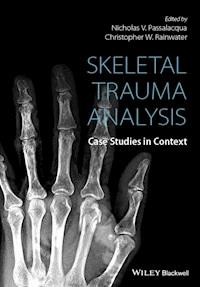
Cover image: Image courtesy of Elaine Rainwater.
Typeset in 10.5/14pt MeridienLTStd by Laserwords Private Limited, Chennai, India
Disclaimer: Any view or opinions in this volume are those of the respective contributors and do not necessarily represent the views and opinions of the United States Department of Defense or the City of New York.
1 2015
Contents
Cover
Title Page
Copyright
List of contributors
1
Introduction
Skeletal trauma analysis: case studies in context
References
2
Atypical gunshot and blunt force injuries: wounds along the biomechanical continuum
Introduction
Background
Gunshot trauma
Blunt force trauma
Biomechanical continuum
Case 1: depressed fracture of inner table from historic gunshot contusion
Case 2: depressed fracture from .32 caliber, short, Smith & Wesson projectile
Case 3: penetrating depressed fracture from detached umbrella tip
Case 4: depressed fracture from perforating blunt impact from edged metal foreign object
Conclusion
Acknowledgments
Disclaimer
References
3
Over-interpretation of bone injuries and implications for cause and manner of death
Introduction
The cases
Scene context
Autopsy and police investigation
Discussion and conclusions
Acknowledgments
References
4
Skeletal injuries in cases of child abuse: two case studies from the Harris County Institute of Forensic Sciences
Introduction
Case 1
Case 2
Conclusions
References
5
Blunt force trauma patterns in the human skull and thorax: a case study from northern California
Introduction
Case background
Biological profile
Antemortem trauma
Perimortem trauma
Trauma interpretation
Case resolution
Conclusions
Acknowledgments
References
6
Patterns of skeletal trauma inflicted during the Spanish Civil War
Introduction
The Spanish Civil War
Materials
Examples of trauma from Monte Costaján
Patterns of skeletal trauma
Conclusions
References
7
Shot and beaten to death? Suspected projectile and blunt force trauma in a case involving an extended period of postmortem water immersion
Introduction
Case description
Trauma analysis
Discussion and conclusions
Acknowledgments
References
8
Man’s best friend: a case study of ballistics trauma and animal scavenging
Introduction
Bone biomechanics
Case study
References
9
Skeletal evidence of violent sexual assault in remains with excessive evidence of scavenging
Introduction
Case history
Analysis
An additional finding
Discussion
Conclusions
References
10
Neurocranial fractures
Introduction
Case 1
Case 2
Understanding neurocranial fracture patterns
Experimental studies
Computer modeling
Case studies
Conclusions
References
11
Blunt force trauma associated with a fall from heights
Introduction
Trauma analysis
Summary
Case outcome
References
12
Low-velocity impact trauma: an illustrative selection of cases from the Joint POW/MIA Accounting Command – Central Identification Laboratory
Introduction
Case 1
Case 2
Case 3
Conclusions/takeaways
Disclaimer
References
13
Blast trauma
Introduction
Blast traumas
Experimental studies on skeletal blast trauma
Differentiating blast trauma from other types of trauma
Disclaimer
References
14
Case studies in skeletal blast trauma
Introduction
Case background
Case reports
Discussion
Conclusions
Disclaimer
Acknowledgments
References
15
Burned human remains in a double homicide: a forensic case in Cyprus
Introduction
Case study overview
Initial anthropological analysis
Pattern analysis and injury mechanism
Taking the next step: in search for the torso
Discussion
Acknowledgments
References
16
The utility of spatial analysis in the recognition of normal and abnormal patterns in burned human remains
Introduction
Classifying the severity of fire modification
Recognizing process signatures
Methods
Results
Discussion
Conclusions
Acknowledgments
Disclaimer
References
17
Three modes of dismemberment: disarticulation around the joints, transection of bone via chopping, and transection of bone via sawing
Introduction
Modes of dismemberment
Case 1: Disarticulation around the joints
Additional information
Case 2: Transection via chopping
Case 3: Transection via sawing
Conclusions
Disclaimer
References
18
Kreischer Mansion homicide
Introduction
Case background/investigation
Homicide details
Search and recovery efforts – I
Search and recovery efforts – II
Initial findings/interpretation
Search and recovery efforts – III
Findings/interpretations
Trial and conviction
Disclaimer
References
19
Postmortem trauma and the “CSI Effect:” is television making smarter criminals?
Introduction
The “CSI Effect”
Criminal behavior and forensic anthropology
The case
Conclusions
References
Index
Pages
iii
iv
vii
viii
ix
x
1
2
3
4
5
6
7
8
9
10
11
12
13
14
15
16
17
18
19
20
21
22
23
24
25
26
27
28
29
30
31
32
33
34
35
36
37
38
39
40
41
42
43
44
45
46
47
48
49
51
52
53
54
Lesen Sie weiter in der vollständigen Ausgabe!
Lesen Sie weiter in der vollständigen Ausgabe!
Lesen Sie weiter in der vollständigen Ausgabe!
Lesen Sie weiter in der vollständigen Ausgabe!
Lesen Sie weiter in der vollständigen Ausgabe!
Lesen Sie weiter in der vollständigen Ausgabe!
Lesen Sie weiter in der vollständigen Ausgabe!
Lesen Sie weiter in der vollständigen Ausgabe!
Lesen Sie weiter in der vollständigen Ausgabe!
Lesen Sie weiter in der vollständigen Ausgabe!
Lesen Sie weiter in der vollständigen Ausgabe!
Lesen Sie weiter in der vollständigen Ausgabe!
Lesen Sie weiter in der vollständigen Ausgabe!
Lesen Sie weiter in der vollständigen Ausgabe!
Lesen Sie weiter in der vollständigen Ausgabe!
Lesen Sie weiter in der vollständigen Ausgabe!
Lesen Sie weiter in der vollständigen Ausgabe!
Lesen Sie weiter in der vollständigen Ausgabe!
Lesen Sie weiter in der vollständigen Ausgabe!
Lesen Sie weiter in der vollständigen Ausgabe!
Lesen Sie weiter in der vollständigen Ausgabe!
Lesen Sie weiter in der vollständigen Ausgabe!
Lesen Sie weiter in der vollständigen Ausgabe!




