


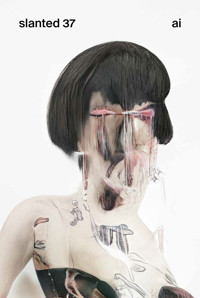
slanted 37 ai E-Book
19,99 €
Mehr erfahren.
- Herausgeber: Slanted Publishers
- Kategorie: Geisteswissenschaft
- Sprache: Englisch
Artificial Intelligence (A.I.) has become—besides being an over-hyped buzzword across industries (that the design world is no exception to)—a reality. We debate about the impacts of A.I. and its subsets, machine and deep learning, and consider everything from virtual to augmented realities, and how these technologies may change our lives, jobs, and social relationships altogether. We live in times where decisions about what we want are no longer under our control. While we believe to be free (at least in our western world), algorithms dictate our lives, hopes, and dreams. We are the parents and children, gods and slaves of the technology we invented: although it's a masterpiece, there is a great dependence. If "algorithms will liberate themselves entirely from us," Peter Weibel proposes, dystopian science fictions may help us clarify what we desire and do not want. l. More than ever this issue made us adventurers: looking with doubtful eyes at this new world of computation, numbers, and transhumanism, where (OMG!) machines are in many areas smarter than us and, occasionally, even encoded with higher ethical and moral standards than we will ever have. Künstliche Intelligenz (A.I.) ist – abgesehen davon, dass es sich um ein branchenübergreifendes, überhöhtes Schlagwort handelt (bei dem die Designwelt keine Ausnahme bildet) – zu einer Realität geworden. Wir debattieren über die Auswirkungen von A.I. und ihren Untergruppen, dem maschinellen und dem Deep Learning, und denken über alles nach, von virtuellen bis hin zu erweiterten Realitäten und wie diese Technologien unser Leben, unsere Arbeit und unsere sozialen Beziehungen insgesamt verändern könnten. Wir leben in Zeiten, in denen wir nicht mehr selbst entscheiden können, was wir wollen. Während wir glauben, frei zu sein (zumindest in unserer westlichen Welt), diktieren Algorithmen unser Leben, unsere Hoffnungen und Träume. Wir sind die Eltern und Kinder, Götter und Sklaven der Technologie, die wir erfunden haben: Obwohl sie ein Meisterwerk ist, besteht eine große Abhängigkeit. Wenn »Algorithmen sich völlig von uns befreien«, wie Peter Weibel vorschlägt, können dystopische Science-Fictions uns helfen zu verstehen, was wir wollen und was wir nicht wollen. Mehr denn je hat uns diese Ausgabe zu AbenteurerInnen gemacht: mit zweifelndem Blick auf diese neue Welt der Berechnung, der Zahlen und des Transhumanismus, in der (OMG!) Maschinen in vielen Bereichen schlauer sind als wir und gelegentlich sogar mit höheren ethischen und moralischen Standards kodiert sind, als wir sie jemals haben werden.
Das E-Book können Sie in Legimi-Apps oder einer beliebigen App lesen, die das folgende Format unterstützen:
Veröffentlichungsjahr: 2024
Ähnliche




















1
SLANTED #37—ARTIFICIAL INTELLIGENCE
Digital Culture
Author
JACK DIGNAM
Digital
Culture
To speak of ‘digital culture’ is to invoke ‘dematerialisation’, willingly or not. And despite our zeitgeist’s rabid obsession with the idea, dematerialisation has long been theorised in relation to art and culture. The term first gained momen-tum in light of Lucy Lippard and John Chandler’s The Dematerialisation of Artin relation to ‘ultra-conceptual art—art that is said to almost exclusively accen-tuate thought to the extent of its material becoming antiquated—and saw its philosophical underpinnings taken to the extreme in the work of Arthur Danto. But Walter Benjamin’s famous The Work of Art in the Age of Technological Repro-ducibilitycould retrospectively be said to first touch on the concept in its semi-nal claim that art’s aura is dead in the age of technological reproduction.
Yet there is something inherently different in dematerialisation as these theorists conceive it and how we interact with dematerialised culture today. Seeing tourists huddled around the Mona Lisa, basking in the warm glow of the camera’s flash and the security offered from their waist-wrapped fanny packs, and one can instantly understand what I mean here: mydematerialised culture—that which I played a hand in creating—finds an existence in the material world through a sort of ‘instance’ that bestows it with an artificial corporeality; if dematerialised culture has anything like an aura, this might just be it. Simulta-neously, the genesis of dematerialisation coincides with further commodifi-cation of art in the guise of entertainment industries, and in this later instance one sees no semblance of productive ownership like that found at the Louvre.
Human beings have a tricky time with imagining the immaterial: that we signify the end of life as we know it with reference to environmental quotas is telling enough. And this is where the metaphysical and political potentiality of dematerialisation lies today, that is in realising the imagination as explicit, or, in its inverse expression, inteorising the exterior world. If language can be said to reflect thought on a collective level, then its historical development must necessarily be tied to what we encounter inthe world; if what we can encounter today is no longer limited to such a material base, then the doors that define our conceptual limitations have been blown open. Thus, digital culture isn’t any-thing new per se, but with it comes a difference in emphasis, or the potential for a repetition of difference, perhaps. In other words, with dematerialised cul-ture comes the chance to read the world anew, that is the chance to read that which was neverwritten, through manifesting the previously unrealisable. Towards a radical and demythicised dematerialisation we trod.
01
2
SLANTED #37—ARTIFICIAL INTELLIGENCE
DEEP—FASTER FASHION
THE FABRICANT
NED
2018
P. 282 ←
3
SLANTED #37—ARTIFICIAL INTELLIGENCE
P. 275 ←
© →P. 283
The Transient Shadows
Depart
The work has been conceived as a site spe-cific audiovisual installation at the Hauptplatz Linz during the Ars Electronic Festival. At the square’s center, a baroque 18th century plague column poses as one of the city’s most prominent landmarks which the artistspicked as their main point of reference. Depart was intrigued equally by its aesthetic repertoire, its symbolic encoding, and by its new timeliness amidst the current pandemic. As a cloud column sculpted from stone, it’s at the tension of representing something vague and intangible in a monumental and concrete physicality. The fact that COVID-19
is transmitted through airborne particles which is broadly investigated through flow simulations presents an interesting formal similarity, in that (spoken) words and songs themselves become contagious. Therefore they constructed The Transient Shadowsas an elusive monument for breath where forms emerge out of elaborate gas simulations while constantly shifting between concrete and ephemeral, aggregate states. Like a respira-tory cycle it oscillates, expands and collapses while forming temporary lithoidal structures interwoven with linguistic fragments.
AUT
32
SLANTED #37—ARTIFICIAL INTELLIGENCE
P. 275 ←
© →P. 283
Depart
2020
The Transient Shadows
33
SLANTED #37—ARTIFICIAL INTELLIGENCE
DESIGN
INFLUENCES
SOCIETY—
Conversation
on
the
era
where
Artificial
Intelligence
and
Design
overlap
Peter Kabel:Yesterday I asked GPT-3, the currently impressive language model, to create a small website, with an input field and blue button, and the model started generating the Internet code, following my language instructions regarding its look and function.
Annika Schultz:Complex algorithms incorporating big data collections are increasingly taking on tasks that would have been almost inconceivable just a short time ago. We are undergoing another digital transformation: Big Data, Machine Learning and other artificial intelligence methods are becoming part of many products and services. Apart from the “language” field of application already mentioned, A.I. is currently finding practical expression above all in the field of image analysis and image creation. A subject that is traditionally particularly close to designers.
PK: A.I. is also increasingly becoming a part of design tools, which have always influenced the characteristics of the products and services they help to create.Therefore, the question of how design is influenced by A.I. and what impact A.I.-influenced design has on society is extremely relevant. Not only for designers and the creative industry, but for the entire society.
Peter Kabel, Annika Schultz, Tom-L. Säger
GER
P. 277, 281, 280 ←
34
SLANTED #37—ARTIFICIAL INTELLIGENCE
Tom-Lucas Säger:Recently, I read an article about the artificial intelligence model Miquela (@lilmiquela) which is famous for her posts on the social media platform Instagram. The whole fashion industry from Prada to the Vogue collaborates with the famous influencer account by letting her wear their clothes or make fashion-week-tours. The A.I.-model seems like any other, human model and let the follow-ers question, what’s real and what’s not.
A.I. INFLUENCES DESIGN
PK:Designers and design users often do not understand what artificial intelli-gence even is and can mean for them and their work methodology. The fear of soon being replaced by artificial intelligence is as widespread as the defiant assertion that humans, especially in creative environments, will always remain irreplaceable. In contrast, it is fascinating how well pattern recognition and machine learning work and open up completely new possibilities in many areas of creative work.
AS: Look at the field of Architecture: I have seen an example by the architect Stanislas Chaillou a while ago, in which he fed an M.L. with examples of ground plans and had the machine answer with new plans, that would even change given up or downscaling. This could give architects designers an advantage by producing a first draft from which one could start. I see designers and an “A.I.” working together as a team, with the A.I. taking away the hard parts of design. Letting the designer think more freely.
TS: An A.I. could help create the first design that the designer could build upon. I think A.I. could lead us in directions we would never think about on our own. I think it is also important that we still keep our own signature in the work. If A.I. always creates those sharp crisp designs, a blurry, dark image might be what we want to create.
WHAT IS THE FUTURE OF DESIGN ?
PK:Driven by increasingly powerful computers and more complex algorithms, a new wave of innovation is currently being built, in which the entire process chain of design (inspiration,production, distribution) will be captured. How is the rela-tionship between design and A.I. likely to evolve over the next 5–10 years? What attitudes are possible? What attitudes—from today’s perspective—are desirable and reasonable? What does the future of design look like? What does the design of the future look like? Questions that, for the most part, take on meaning much more quickly and are more relevant than the questions often discussed in discourses about whether self-driving cars are better off running over a grandmother, or chil-dren in the event of an accident, or whether general A.I. will rule us.
AS:We need to talk about it. And all of us together. Designers of all disciplines—not just graphic designers—and all ages. But if you want to have a voice, you should first develop a practice. That has always been the case in design. Anyone who tries to make design using algorithmic tools often experiences surprising miracles.
P. 277, 281, 280 ←
35
SLANTED #37—ARTIFICIAL INTELLIGENCE
Virtual Avatars
The Diigitals
In April 2017, a new figure stepped onto the world stage. Strikingly beautiful and instantly captivating, a mysterious model named Shuduappeared on Instagram, and she had the world wondering who she was. Shudu quickly attracted thousands of followers who wanted to know more about her identity. Who was this compelling woman and where did she come from? After some time, it became apparent that there was no Shudu. She was a digital fabrication created by a young fashion pho-tographer named Cameron-James Wilson, an art project to inspire him in a new virtual medium. After this revelation, Shudu became a social media phenomenon. Shudu’s creationwas almost accidental. An experiment while Cameron was trying out 3D modeling after becoming frustrated with his latest hobby, hand-painting Barbie dolls. It’s from these dolls
that Cameron gained his inspiration to createShudu. Modeling her on the Princess of South Africa Barbie, and other models he admired, Cameron brought Shudu into the world, withno idea about the impact she would make. Shudu incorporates many aspects of hercreator’s interests such as sci-fi, gaming andfashion, while utilizing skills from a decadeof retouching photographs. Now Shudu has a life of her own, and she hopes to champion
diversity in the fashion world, collaborate with creators from emerging economies and under-represented communities and get to-gether with up-and-coming designers. Nowthe questions asked are different. What does someone like Shudu mean for the world of fashion? What is she going to do next? Could there be others like her?
P. 282 ←
96
SLANTED #37—ARTIFICIAL INTELLIGENCE
Homemade RC Toy
At once tender and unsettling, the films, sculptures, installations, and performances of Geumhyung Jeong are often studies in animism of some sort. For her first solo exhi-bition in Switzerland, the South Korean artist and choreographer focused her attention on the erotics of technical animism. She cre-ated a large-scale installation comprised of
numerous robotic sculptures built from DIY technologies and short films demonstrating the strange choreographies to which she subjects her “homemade” bodies. Like so much of her work, the ensemble questions the boundaries between desire and control, human and machine, animate and inanimate.
Geumhyung Jeong
KOR
2019
P. 277 ←
© →P. 283
97
SLANTED #37—ARTIFICIAL INTELLIGENCE
Going Green
Shawn Maximo
With his degree in Architecture and Engineer-ing, Shawn Maximo produces theatrical sets, sculpture, wallpaper, furniture, interactive ex-hibition design, architectural renderings, andstock imagery, all of which pose “what if” scenarios of familiar yet incomprehensible scenes. In his work Going Greenfrom the series Neighboring Interestsphysical or algo-rithmic robots, both visible and invisible, are
everywhere. In a sterile environment they as-semble green technology with a mountainouslandscape as a backdrop. This place is seem-ingly not intended for humans, but signs of their presence can be found very prominently in the objects such as the folding chair, the air mattress and the trolley toilet in the front of the scene. This highly detailed and well-thought-out design shows an environment
CAN
P. 279 ←
© →P. 283
98
SLANTED #37—ARTIFICIAL INTELLIGENCE
which questions our interaction and coex-istence with robots. Humans are clearly not allotted for in this factory except for jobs like cleaning where it would be more expensive to hire a robot. So one possible scenario for this scene is such an employee who lives at his workplace and for this reason has all his nec-essary items put up in the factory. However, there is the second possibility of somebody
squatting amongst the robots as their space is unsupervised. In this way, Shawn Maximo’s creates a scenario which questions our in-teraction and coexistence with robots and invites us to think about the not-so-far future.
This work has been displayed in the exhibi-tion Hello, Robot. Design between Human and Machine at the Vitra Design Museum in Basel, Switzerland, in spring 2017.
Shawn Maximo
2016
Going Green
P. 279 ←
© →P. 283
99
SLANTED #37—ARTIFICIAL INTELLIGENCE
Do you know how many of your Facebook friends or social media followers are real or just programmed click bots and fake accounts? Does this make any difference to our hunger for likes, hearts, and comments? Why do people prefer to talk to their chatbots like Replikaor Xiaoicerather than to real people? Do we still find it eerie or strange when interacting with artificially intelligent (ro)bots—especially when they are human-like or even cute in their appearance and behavior? Isn’t the enormous-ly successful start-up app Replika, for example, already the ‘new normal’? Program-mer Eugenia Kuyda founded Replikaand launched it in 2017 “to create a personal A.I. that would help you express and witness yourself by offering a helpful conversa-tion. It’s a space where you can safely share your thoughts, feelings, beliefs, experi-ences, memories, dreams–your ‘private perceptual world.’” Do we trust intelligent 24 / 7 chatbots, which then gradually become our empathetic alter-ego due to new affective computing? After all, not only in the imaginary worlds of film, pop culture and art do human beings entrust their most intimate thoughts and feelings to these new virtual ‘A.I. friends’ today; many do so in real life with the use of the Luka, Inc.’s Replikaor any other similar A.I. chatbot apps. People are even touched emo-tionally when their virtual doubles and digital twins awaken to life with A.I. tech-nologies on the Internet: from a personal coach to a psychological therapist or a romantic lover, users can choose and then let their personal A.I. chatbot enter their private world (with a little help of A.R.) as close friends and most intimate confi-dants nowadays. The more human- and life-like the A.I. characters, designed and programmed with self-learning algorithms, appear to humans, the more accepted they become today in real life. Apart from the astonishing psychological effect, a new media ecology and global economy has emerged at the same time with these new computer-generated models and fictional characters. Moreover, the technolo-gy for creating compelling A.I.-enhanced avatars is evolving at a high rate, especially
As
Real
as
Rihanna?!
The
Curious
Case
of
Miquela
Sousa
Pamela C. Scorzin
GER
ITA
USA
100
SLANTED #37—ARTIFICIAL INTELLIGENCE
P. 281 ←
the ability to visualize human beings as animated digital dolls. A strongly growing field and lucrative business has been built for Tech investments worldwide.
Thus, I would like to outline the impact and importance of today’s human-machine friendships using the example of popular 3D / CGI influencers, A.I. ava-tars and so-called new ‘synthetic media’ in communications design. Moreover, algorithm-driven humanoid robots, as well as androids, are already used in health-care; robotic sex dolls compensate for the deficiencies of human relationships; smart devices like Sirilisten to our conversations and attend as stereotypically fe-male servants to our needs–we communicate more and more with our anthropo-morphized technologies than with other humans. Intelligent robots perform on these stages quite in a similar manner to marionettes and can act as if they were autonomous artificial beings.
Relationships between man and machine have long been imagined in the most diverse arts. What is new with the uprise of cyber-technologies and the In-ternet is the idea of friendship and emotional bonding, such as love. Until recently,however, a Frankensteintrauma has prevailed in this narrative. Fiction writers, in particular, have long dreamed of artificial creatures capable of replacing or even surpassing human beings. In the 19th century, Mary Shelley created the first sci-ence fiction hero, Dr. Victor Frankenstein, the inventor of a human-like monster that eventually threatened to destroy humanity. Throughout our visual culture, the human-machine / ‘Menschmaschine’ consistently embodies a perfidious threat to the human and natural: from Fritz Lang’sMetropolis(1927) to the popular HBO-series Westworld(2016–2020) or movies like Ex Machina(Director: Alex Garland, 2014) and Lucy(Director: Luc Besson, 2014), the artificial human is often portrayed as a seductive as well as a dangerous, beautiful female character. It remains “the un-canny other,” the deceptive machine. Simultaneously, the ambivalence of attrac-tion and repulsion has long shaped the fantasied relationship to these imaginative, life-like artificial or hybrid figures in modern history. Yet, when the artificiality is aesthetically marked, stylistically high-lighted, an optimized life-like resemblance can even be heightened to a cult idol-like quality–as we can observe in the world-wide success of pop figures like Hatsune Miku.
A whole generation of the Internet is thoroughly socialized with virtu-al doubles and digital twins these days. From Second Lifeand the Simsto popular computer games such as World of Warcraftor the A.R.-enhanced PokémonGOon our smartphones, nowadays almost everyone has experienced, at some point, bringing a digital avatar into virtual life through creative persona building and combinatory design. These avatars are human-like bots created by A.I.-powered technology to increase human interaction–often in a game-like way. While A.I. avatars do not only have a humanoid appearance, they can also communicate and even sympathize with their users with the help of self-learning intelligent algorithms. They expand reality to real virtuality: for example, during a pandemic lockdown, we can now use our self-designed A.I. avatars to go to concerts or museum venues.
101
SLANTED #37—ARTIFICIAL INTELLIGENCE
P. 281 ←
Echochamber
Echochambers arenot simply a bubble: if they were, they’d be easy to burst. They’re more than well curated Twitter-feeds and algorithmic biases that the user is an accomplice in producing; it’s not merely a matter of users being ex-posed to only one side, then. Echochambers actively corroborate and foster mistrust towards those outside of the echochamber, and in an era of increasing polarisation—think Trump, think Climate Change, think COVID-19 restrictions—and both national governments and supra-national institutions failingto curtail technological corporate giants, they represent something terrifying. Re-ferring to such a phenomenon as merely a bubble suggests that those outside of it are just unheard; in reality, such phenomena discredit outsiders altogether—that is to say they alter who their users trust—and that’s the real match to the flame that is polarisation.
Historically, technological advancements have generally served to give users more agency and control and social media is no exception, but that’s precisely the problem. Users across the web utilise that agency and control to better position themselves; to associate with like-minded individuals; to listen to voices they want to hear; to read the news that affirms their world-views. We thereby acquire the capability to silence what we dislike, but this very ‘ad-vancement’ is what both enables and conditions the chambers which we find ourselves imprisoned in today. Curiously, it’s the less advanced technologies that lack these problems. At the most archaic level, our meatspace life is littered with constraints that, in the language of technologies today, appear as ‘anti-smart’: we can’t talk to those further than the length our voices can travel; we can’t ignore the man preaching about the end of days on the street corner; we have to actually exert effort on travel if we want to socialise with people at all. Communication advancements in the form of social media have done away with such limitations, butthose limitations are what stopped us from creating chambers that lead to distrust and malign the most basic social relations. Unless you create a cult, you can’t ever surround yourself with a totally homogenised community because social life cannot function that way; constantly you would need to reach across the aisle and thereby trust those who didn’t align themselves with you to simply make it through your day. Yet, allow technology to advance far enough to remove such restrictions and you can reach that critical mass required so as to desensi-tise yourself to those with dissenting views, regardless of how ridiculously wild and crankof a position you hold. How smart are these advancements, then? How advanced are these changes? If this is what increased agency in a digital landscape implies, is it really more of the same that we want?
ECHOCHAMBER
jack dignam
05
162
SLANTED #37—ARTIFICIAL INTELLIGENCE
Zizi & Me
Jake Elwes
P. 276 ←
163
SLANTED #37—ARTIFICIAL INTELLIGENCE
Zizi & Me
The Ziziproject is a collection of works by Jake Elwes exploring the intersection of arti-ficial intelligence (A.I.) and drag performance. Drag challenges gender and explores other-ness, while A.I. is often mystified as a tool and
contains social biases. Zizicombines them through a deep fake, synthesized drag identity created using machine learning. The projectexplores what A.I. can teach us about drag, and what drag can teach us about A.I.
Jake Elwes
2020
GBR
P. 276 ←
164
SLANTED #37—ARTIFICIAL INTELLIGENCE
The Normalizing Machine
The Normalizing Machineis an interactive installation presented as an experimental research in machine-learning. It aims to identifyand analyze the image of social normalcy. Each participant is asked to point out who looks most normal from a line up of previouslyrecorded participants. The machine analyzes the participant decisions and adds them to its aggregated algorithmic image of nor-malcy. In the late 1800s the French forensics pioneer Alphonse Bertillon, the father of the mugshot, developed Le Portrait Parle(the
speaking portrait) a system for standardizing, indexing and classifying the human face. His statistical system was never meant to crimi-nalize the face but it was later widely adopted by both the Eugenics movement and by the Nazis to do precisely that. This work auto-mates Bertillon’s speaking portraits and visu-alizes how today’s systematic discrimination is aggregated, amplified and conveniently hidden behind the seemingly objective black box of artificial intelligence.
Mushon Zer-Aviv
ISR
2018
P. 283 ←
© →P. 285
165
SLANTED #37—ARTIFICIAL INTELLIGENCE
Dead Ends
Since the dawn of civilisations, long before we even had the technical capac-ities for building them, we imagined intelligent machines capable of great achievements and the most horrific destruction. From the ancient Greeks and the myth of the automated being Talos to today’s scenographies of artificial general intelligence, we gave these machines human emotions and physical traits. Indeed, the Royal Society denotes that prevalent narratives of artificial intelligence share dominant characteristics, amongst them a tendency to-wards utopian / dystopian extremes and humanoid-like personification. Now, as the fields of artificial intelligence and robotics converge, the promise of in-telligent machines begins to fulfill and arrive pre-loaded with expectations and associations—often disproportionate to their capabilites or even reality.
The conception we have of them is largely based on popular culture and shaped by extremes: exaggerated male bodies and aggressive tendencies, like the Terminator, or beautiful and gentle female forms such as Ava from Ex Machina.Either they are our friend and helper like Ironman’sJ.A.R.V.I.S. or in-stead, an evil supreme and dictator as depicted in The Matrixtrilogy. What do these narratives convey about ourselves? What is the fear of what we build that is deep inside of us? Is the human ego’s will to strive, that of consistently seeking supremacy on planet Earth and beyond, at odds with our will of de-veloping something “better”? Worrisome is that these extremes may actually distort from the core of debates surrounding artificial intelligence.
Maybe in our quest we lost sight of alternative paths, not the black nor the white, but the grey. One remains clear: general artificial intelligence (the ‘supremacy’ of A.I. over us) will come about sooner or later. Crucially, the ques-tion for us, as a society, is now that of alignment: how to ensure that this thing has the same goals as us, that it does notsee eliminating homo sapiens as thesolution to cancer, climate change or wars. Although many of us are yet to interact with the new technologies, stories from our childhood may relate. Prof. Stuart Russell writes, the problem of value alignment, “is essentially the old story of the genie in the lamp, or the sorcerer’s apprentice, or King Midas: you get exactly what you ask for, not what you want.”
DEAD ENDS
tom barbereau
08
218
SLANTED #37—ARTIFICIAL INTELLIGENCE
Amazon worker cage patent drawing as
virtual King Island Brown Thornbill cage
Simon Denny
NZL
2019
P. 275 ←
© →P. 285
219
SLANTED #37—ARTIFICIAL INTELLIGENCE
P. 275 ←
© →P. 285
Amazon worker cage patent drawing as virtual King Island Brown Thornbill cage
Simon Denny
Simon Denny is a frenemy of Silicon Valley. Driven by an ambivalent mix of curiosity and criticality, he centers his artistic inquiry on the ideological underpinnings and mechan-ical operations of the tech industry. Den-ny’s works, which often present as complex sculptural case studies, are frequently trig-gered by real-world events. These include the launch of the cryptocurrency Bitcoin in 2009; billionaire Peter Thiel’s 2011 appli-cation for citizenship to New Zealand, the artist’s place of origin; and the revelation of the Edward Snowden leaks in 2013–2014. Denny’s sculpture and collages included in this exhibition are partly a response to the 2018 essay “Anatomy of an A.I. System: The Amazon Echo as an Anatomical Map of Hu-man Labor, Data and Planetary Resources,” by Kate Crawford and Vladan Joler. In it, the authors trace the extractive properties of the Echo, Amazon’s voice-enabled A.I. device, which is disguised as the helpful personal assistant Alexa. Crawford and Joler expose how the Echo’s unobtrusive design (and that of similar products, like Google’s Nest) be-lies the massive environmental disruption caused by its production. They take the read-er from the environmentally harmful mining methods used to extract resources like lith-ium, used for batteries, in Salar de Uyuni in the Bolivian Altiplano, to the algorithmic min-ing of the end users’ behavior in the privacy of their homes. Crawford and Joler chart the human labor and exploitative practices that support the device’s production and enable its efficacy. Per an Amnesty International re-port cited by the authors, workers excavating cobalt for lithium batteries used by sixteen different multinational brands work in phys-ically hazardous conditions, where they are subjected to violence, extortion, and intim-idation and are paid an average of one US dollar per day. The detailed report is a wake-up call, alerting readers to the magnitude of
the ecological and humanitarian impact of a data-driven economy. In connecting phys-ical mining to data mining, its authors seek to make clear that our trade in data, which has replaced oil as the most valuable re-source on Earth, is just as detrimental to our planetary health—maybe even more so. In Extractor (2019), Denny highlights this up-heaval in the form of a board game that asks players to adopt the corporate goals and strategies behind this marketplace. Based on an Australian board game about sheep farming called Squatter, Extractor proceeds similarly to a game of Monopoly. However, instead of accumulating land and real es-tate, players attempt to grow a start-up into a world-dominating data behemoth, akin to Amazon and other megaplatforms. Like the games it is modeled after, Extractor rewards capital gain achieved at the expense of “chal-lenges” like regulation, which are presented as deterrents to corporate growth. Although the game taps into players’ competitiveness, it also aims to broaden their awareness by alerting them to the environmental and hu-man costs of their success. Denny’s Amazon worker cage patent drawing as virtual King Island Brown Thornbill cage (US 9,280,157 B2: System and method for transporting person-nel within an active workspace,2016) expands on these ideas. The stark sculpture is based on a patent filed by Amazon in 2013 for the construction of a warehouse worker’s cage, meant to hold and confine the employee as it is remotely steered by an automated system run by algorithms. The patent document itself is the subject and medium of Denny’s Doc-ument Relief works, 3-D prints that model parts of the patent using intricately cut-and-glued layers of printed patent pages. The construction of this worker cage was never pursued, yet it serves as an apt metaphor for the dehumanizing mechanisms of data capitalism. Placed inside Denny’s cage is a
2019
NZL
220
SLANTED #37—ARTIFICIAL INTELLIGENCE
P. 275 ←
© →P. 285
Simon Denny
pyramidal sculpture whose surface image links to an augmented-reality application. When triggered, the web-based app presents a small King Island Brown Thornbill, which fills the white encasing with its fluttering and tweeting presence. The King Island Brown Thornbill, a bird native to Australia, tops the country’s list of species at risk of extinction. A digital harbinger of ecological destruction, its presence inside the cage invokes the metaphor of the canary in a coal mine—an
analogy for early detection of an impending calamity. The usage derives from the use of canaries in mines in Britain, Germany, the United States and Canada to detect carbon monoxide and other toxic gases. Like the canary in the coal mine, Denny’s virtual bird serves in equal measures as an alarm, elegy, and omen of humanity’s own precariousness in the face of humans’ destructive industrial practices.
Amazon worker cage patent drawing as virtual King Island Brown Thornbill cage
221
SLANTED #37—ARTIFICIAL INTELLIGENCE
SOfIA CRESPO
TRAUMA DOLL
P. 275 ←
222
SLANTED #37—ARTIFICIAL INTELLIGENCE
SOFIA CRESPO
2017
GER
P. 275 ←
TRAUMA DOLL
223
SLANTED #37—ARTIFICIAL INTELLIGENCE
Index
INDEX
P 133, !Mediengruppe Bitnik, SUI
bitnik.org!Mediengruppe Bitnik are con-temporary artists working on, and with, the Internet. Their practice expands from the digital to affect physical spaces, of-ten intentionally applying loss of control to challenge established structures and mechanisms. They have been known to subvert surveillance cameras, bug an opera house and send a parcel contain-ing a camera to Julian Assange at the Ecuadorian embassy in London.
P 52, 404.zero, RUS, 404zero.comThe 404.zero are acclaimed digital artists. Media artist and designer Kristina Karpysheva and co-founder of Tundra audiovisual studio Alexander Lezius cre-ated the project in 2016. Since then they participated in the largest Russian and international festivals and exhibitions including MUTEK festival, GAMMA Festi-val, Electric Castle Festival, LACMA, etc.
P 205, Madeline GannonATONATON, USA, atonaton.comMadeline Gannon is a multidisciplinary designer inventing better ways to communicate with machines. In her research, Gannon blends art and technology to forge new futures for human-robot relations. Her work shows that robots can be more than useful—they can be meaningful to our everyday lives.
P 89, Aetherfon, GER, aetherfon.github.io The team behind Aetherfon consists of the students Tobias Braun, Charleen König, Hannah Pohlmann, and Moniek Wiese from HAW Hamburg.
P 107, Ava Aghakouchak, GBR
avakouchak.co.uk Ava Aghakouchak is a designer, researcher and creative technologist based in London. Her work focuses on the relationship between the human body-mind and spaces which it might inhabit. Ava creates science-fashion that blurs the boundaries be-tween tangible and intangible, human and machine, and internal and external worlds. She uses performing arts and films as mediums to speculate how her human-machine interfaces can help construct more immersive, adaptive and hybrid worlds for the man of the future.
P 193, Nouf Aljowaysir, KSA
noufaljowaysir.comNouf Aljowaysir is a Saudi-born NYC-based New Media Artist. Nouf blends art and Artificial Intel-ligence to create generative designs and speculative futures while questioning its underlying structure from an ethical perspective. Nouf is a ThoughtWorks Arts resident and a design technologist at Medium. Her work has been exhibited internationally.
P 16, Morehshin Allahyari, IRI / USA
civa.atMorehshin Allahyari is an artist, activist, writer, and educator. Her work deals with the political, social, and cultur-al contradictions we face every day. She thinks about technology as a philosophi-cal toolset to reflect on objects and as a poetic means to document our person-
al and collective lives and struggles in the 21st century. Morehshin is the co-author of The 3D Additivist Cookbookin collabo-ration with writer / artist Daniel Rourke.
P 44, Daniel Ambrosi, USA
danielambrosi.com Daniel Ambrosi is recognized as one of the founding cre-ators of the emerging A.I. art movement and is noted for the nuanced balance he achieves in human-A.I. hybrid art. Ambrosi combines computational photography and artificial intelligence to create exqui-sitely detailed artworks that move people visually, viscerally, and cognitively. His art-works have been exhibited internationally, installed in major tech offices, featured in multiple publications, and collected by enthusiastic patrons worldwide.
P 60 / 61, Refik Anadol, TUR
refikanadol.comIn his work, director and media artist Refik Anadol repeatedly explores how ubiquitous technologization and an increasingly programmed envi-ronment affect the fields of architecture and art, for example. His A.I. data sculp-tures, live audiovisual performances, and immersive installations take many forms and encourage us to rethink our engage-ment with the physical world, its temporal and spatial dimensions, and the creative potential of machines.
P 210, Pindar Van Arman, USA
cloudpainter.comPindar Van Arman is a painter who created artonomousto be his studio assistant. What began as an attempt to increase artistic productivity, however, soon became his art. Shortly after building his first painting robot he began teaching it the entirety of his artistic process. Over the next decade his A.I. art innovation led to a TEDx Talk on Teaching Creativity to Robotsand being awarded First Place in the Inter-national Robot Art Competition.
P 68, 249, Paolo Arraiano, POR
pauloarraiano.comPaulo Arraiano has a degree in Communication from ISCEM, and a degree in Visual Arts from Ar.Co—Centro de Arte e Comunicação Visual. He works as a visual artist, co-founder of re_act contemporary,an art laboratory and residence program based in the Azores Islands and of no.stereo,an independent artist-run platform. Paulo’s research re-lates to the idea of visual seismography, assessing surges concerning new natu-ral, social and cultural paradigms.
P 87, Art. Lebedev Studio, RUS
ironov.artlebedev.ru Art. Lebedev Studio was founded in 1995. Their main areas of work include design automation, graphic design, websites, urban design, archi-tecture, environment design, wayfinding systems, industrial design, interfaces, typefaces, patterns, and book publishing. They are a creative and technocratic company that combines wild ideas with research and analytics. They see their job as finding the most effective, simple and beautiful way to solve each problem.
P 126, Daniel Askill, AUS / USA
danielaskill.com New York-based Australian filmmaker Daniel Askill has an award winning body of work that spans film, music videos, commercials, video installation, and photography. His Grammy nominated music videos with Sia for Chandelier, Elastic Heart and The Greatest are some of the most watched and talked about of recent time. Daniel is also co-founder of the studio Collider, with offices in New York and Sydney.
Intro texts, Tom Barbereau GER / FRA / LUX, linkedin.com/in/tbarbereauTom Barbereau received his MSc degree in Science & Technology Studies, from the University of Edinburgh (Scotland), in 2020. As doctoral research-er, Tom joined the FINATRAX group at the University of Luxembourg. His research interests span from decentralized ledger technologies (blockchain) and the trans-actions it facilitates, to decentralized autonomous organizations and issues of information system governance.
P 196, Philip Beesley, CAN
philipbeesleyarchitect.com
Philip Beesley is a multidisciplinary artist and architect. Beesley’s research is rec-ognized for its pioneering contributions to the rapidly emerging field of responsive interactive architecture. He directs Living Architecture Systems Group (LASG), an international group of researchers and creators. He is a professor at the School of Architecture at the University of Waterloo and the European Graduate School. His upcoming work Grovewill be presented at the 2021 Venice Biennale of Architecture.
P 194 / 195, Guy Ben-Ary, AUS
guybenary.com Guy Ben-Ary is an inter-disciplinary researcher that is recognized internationally as a major artist and inno-vator working across science and media arts. He specializes in biotechnological artwork, which aims to enrich our under-standing of what it means to be alive.
P 56, Matthew Biederman, CAN / USA mbiederman.com Matthew Biedermanworks across media and milieus, architectures and systems, communi-ties and continents since 1990. He has served as artist-in-residence at a variety of institutions and institutes, including the Center for Experimental Television on numerous occasions, CMU’s CREATE lab, the Wave Farm and many more. He has co-founded the Arctic Perspective Initiative, a non-profit, international group of individuals and organizations and is currently represented by Art45.
P 18 / 19, Mladen Bizumic, AUT
mladenbizumic.netMladen Bizumic is an artist based in Vienna. He works in photography, sculpture, and video, and exposes the transformation of the analog / print-capitalism into the digital / photo-capitalism. His installations have been shown at renowned galleries and museums worldwide and are also a part of their public collections.
274
SLANTED #37—ARTIFICIAL INTELLIGENCE
INDEX
P 122 / 123, 152 / 153, Zach Blas, USA zachblas.infoZach Blas is an artist, film-maker, and writer whose practice spans moving image, computation, theory, per-formance, and science fiction. He is a Lecturer at the University of London.
P 78, Jean Böhm, GER
typo.systemgestaltung.info Jean Böhm is a freelance designer and web developer with a strong focus on typography. As part of his master’s degree, he explored the possible evolution of type design tools through artificial intelligence and developed various tools for this purpose.
P 105, brud, USA, brud.fyibrud is a next-gen entertainment and technology company that leverages cultural insights, creative minds and boundary-pushing technologies to develop fully-realized virtual characters who tell stories, cham-pion ideas, and connect with their audiences as they entertain and inspire. The hero of the Brud universe, Miquela,is a virtual pop star with a strong point of view designed to help fans navigate a complicated world. By building large, glo-bal audiences and cultivating passionate fandom among Gen Z, Brud is able to build businesses around these “robot” artists, delivering IP-driven entertain-ment in the form of music, video, TV etc.
P 147, Halsey Burgund, USA
moondisaster.orgHalsey Burgund is an artist and technologist focusing on the combination of modern technologies—from mobile phones to A.I.—with funda-mentally human “technologies,” primarily language, music, and spoken voices.
P 212 / 213, Michael Candy, AUS
michaelcandy.com Michael Candy works with a vocabulary of robotics, hardware hacking, intervention, and video. This didactic practice seeks to mediate the liminal realm that technology oppresses on the physical world. His installations and projects often emerge as social ex-periments or ecological interventions in public space.
P 10, 106, 117, 241, Grégory Chatonsky CAN / FRA, chatonsky.netSince the mid-1990s, Grégory Chatonsky has been working on the Web and mainly on his affectivity, leading him to question the identity and new narratives that emerge from the network. From 2001, he began a series on dislocation, aesthetics of the ruins and extinction as an artificial and natural phenomenon. Over the years, he has turned to the ability of machines to produce results that resemble a human creation in an almost autonomous way.
P 148, Shu Lea Cheang, TPE
3x3x6.comShu Lea Cheang is an artist working with various art mediums and film formats, including installation, per-formance, net art, public art, video instal-lation, feature length film, and mobile web serial. Her artistic pursuits demon-strate an imagination and desire to cross the boundaries of society, geography, politics, and economic structure, thus
redefining genders, roles, mechanisms, etc. Cheang’s BRANDONwas the first web art commissioned by the Solomon R. Guggenheim Museum in New York.
P 120, 171, Ian Cheng, USA, iancheng.com Ian Cheng is an artist living and work-ing in New York. Cheng has produced a series of simulations exploring an agent’s capacity to deal with an ever-changing environment. These works culminated in the Emissaries trilogy, which introduced a narrative agent whose motivation to enact a story was set into conflict with the open-ended chaos of the simulation.
P 127, Sougwen Chung, CAN / CHN sougwen.comSougwen Chung is a Chinese-Canadian artist and (researcher based in New York. Chung’s work ex-plores the mark-made-by-hand and the mark-made-by-machines an approach to understanding the dynamics of humans and systems. Chung is a former research fellow at MIT’s Media Lab and a pioneer in the field of human-machine collaboration.
P 138 / 139, 243, 244, Paolo Cirio, ITA paolocirio.netPaolo Cirio is a conceptual artist. He works with legal, economic, and cultural systems of the information society. He shows his research and inter-vention-based works through artifacts, photos, installations, videos, and public art. Cirio’s work embodies the contra-dictions, ethics, limits, and potentials inherent to the social complexity of information society through a provoca-tive, critical, and proactive approach.
P 211, Vicky Clarke, GBR, vickyclarke.orgVicky Clarke is a sound and electronic media artist from Manchester. Working with sound sculpture, DIY electronics, and human-machine systems, she explores our relationship to technology through sonic materiality, live A.V., and browser-based artwork.
P 230 / 231, Mat Collishaw, GBR
matcollishaw.comMat Collishaw is a key figure in the important generation of British artists who emerged from Goldsmiths’ College in the late 1980s. He participated in Freeze(1988) and since his first solo exhibition in 1990 has exhibited widely internationally.
P 238 / 239, Douglas Coupland, CAN
coupland.comDouglas Coupland is a Canadian writer and artist based in Vancouver. His fourteen novels have been published in most languages and his visual work has been the focus of several museum retrospectives.
P 46 / 47, 222 / 223, Sofia Crespo, GER
sofiacrespo.comSofia Crespo is an artist working on envisioning Artificial Life and generative lifeforms as a digital art practice. One of her main focal points is the way organic life uses artificial mech-anisms to simulate itself and evolve. This implies the idea that technologies are a biased product of the organic life that created them and not a completely
separated object. She is also hugely concerned with the dynamic change in the role of the artists working with ma-chine learning techniques.
Cover, p 6 / 7, CROSSLUCID, GER
foundation.app/crosslucid
CROSSLUCID are a hybrid practice and interdisciplinary collective. Appearing in a transitional reality and working across multiple platforms, their experience-led interventions aim to explore and in-stigate novel arrangements, interactions and emerging emotional tactilities in a post-digital future. Their client base includes Nike, Snapchat, Universal, NOWNESS, amongst others.
P 118, De Young Museum, USA, deyoung.famsf.org Founded in 1895 in San Fran-cisco’s Golden Gate Park, the De Young Museum has been an integral part of the cultural fabric of the city and a cher-ished destination for millions of residents and visitors.
P 219–221, Simon Denny, NZL
simondenny.netSimon Denny is a pro-fessor for time-related media at the Hamburg University of Fine Arts. Simon Denny graduated from the Academy of Fine Arts (Städelschule) in Frankfurt on the Main, Germany. His work has chal-lenged numerous themes entrenched in modern society’s globalized culture: the Internet, technological obsolescence, corporate culture, television broadcasting,and national identity. Simon Denny was the winner of Art Basel’s annual Baloise Art Prize in 2012.
P 31–33, Depart, AUT, depart.atDEPART is Leonhard Lass and Gregor Ladenhauf. Their core endeavor is the conception of poetic, audiovisual im-mersions. Deeply rooted in the digital they explore the ritualistic character of algorithms and venture deliberately into the uncanny—creating unique moments that are coined by formally rigorous and profound aesthetics. DEPART work in a poetic tradition: They strive to subvert languages—not just literal, word based languages but lan-guages as symbolic systems in general.
P 186–188, Heather Dewey-Hagborg USA, deweyhagborg.comHeather Dewey-Hagborg is an artist and biohacker who is interested in art as research and tech-nological critique. Her controversial bio-political art practice includes the project Stranger Visionsin which she created portrait sculptures from analyses of gen-etic material (hair, cigarette butts, chewed up gum) collected in public places. She is co-founder and co-curator of REFRESH,an inclusive and politically engaged col-laborative platform at the intersection of Art, Science, and Technology.
Intro texts, Jack Dignam, IRL
medium.com/@J_D_Jack is an aca-demic and writer, set to graduate from the Research Master’s in Philosophy at the University of Amsterdam this year. His interests lie in aesthetics, experience,
275
SLANTED #37—ARTIFICIAL INTELLIGENCE
Artist at The MIT Center for Art, Science & Technology (CAST) in 2019–21.
P 166, Martine Syms, USA
martinesy.msMartine Syms’ practice combines conceptual grit, humor and social commentary. Using a combination of video, installation and performance, Syms examines representations of black-ness and its relationship to vernacular, feminist thought, and radical traditions. Syms’ practice frequently references and incorporates theoretical models con-cerning performed or imposed identities, the power of the gesture, and embedded assumptions concerning gender and racial inequalities.
P 190 / 191, Synflux, JPN, synflux.io Syn-flux is a speculative fashion laboratory of fashion designers, machine learning en-gineers, web designers, design research-ers, architects, and service designers. They work as a contemplative design collective that crosses over seemingly conflicting concepts of research and practice, expression and implementation, prototyping and contemplation, and technology and craft to create the fashion of the next generation.
P 114, Maija Tammi, FIN
maijatammi.comMaija Tammi (b. 1985) is a Finnish artist and Doctor of Arts, whose photographs and videos examine the liminal areas of disgust and fascina-tion, science and art. She regularly collaborates with scientists and musi-cians. Tammi’s work has been exhibited extensively internationally, and she has four published books. Tammi cur-rently holds the title Artist Professor.
P 207, Terreform ONE, USA
terreform.orgTerreform ONE [Open Network Ecology] is a nonprofit architec-ture and urban design research-based consulting group. We endeavor to com-bat the extinction of all planetary species through pioneering acts of design. Our collaborative process includes specu-lating about the ways in which emerging technologies will impact future urban generations and local biodiversity. We strive to develop inclusive spaces and systems that manifest environmental and social justice for all beings.
P 175, 176, The Center for Spatial
Technologies, UKR, spatialtech.info
The Center for Spatial Technologies is a group of architects, researchers, and educators, who develop solutions for spatial problems; hacking economic, technological and political infrastruc-tures to shape the future city.
P 3 / 4, The Fabricant, NED, thefabricant.comWith a focus on the fashion industry, The Fabricant uses tools from the film visual effects industry such as motion capture, 3D animation, and body scan-ning to produce hyper-real digital fashion experiences. They combine talent from both the fashion and animation industries to produce captivating digital fashion content for digital physical channels.
P 13, 24 / 25, 28, 72, 128, 173, 181, 209, 228, 255, 256 / 257, Philipp Thesen, GER
philippthesen.dePhilipp Thesen is among the most prominent pioneers in the field of strategic design for digital transformation. He advises organizations in implementing design as a driving force for innovation and organizational transformation. Philipp is a professor for human-system interaction at the Darmstadt University. There he founded the Human Factors Lab and conducts research at the intersection of design and digital technologies.
P 194 / 195, Nathan Thompson, AUS guybenary.com/work/cellf/#Collaborators Nathan Thompson is a multi-disciplinary artist exploring the pos-sibilities of man / machine interaction and the hidden corners that arise from this relationship. Mostly he implements ma-chine / robots that play along the blurred edge of the interactive while showing in-dependent thought, only slightly tethered to the audiences actions.
P 91, Daniel Ting Chong, RSA
danieltingchong.comDaniel Ting Chong is a designer and illustrator based in Cape Town, South Africa. Daniel was born in 1987 in Cape Town and is a third generation South African Chinese. He studied graphic design at Vega School and is emerging as one of Cape Town’s top creative talents following a series of commissions from clients and design collaborations with leading brands.
P 189, Ultravioletto, ITA, ultraviolet.toUltravioletto is an office specialized in interactive design. It works at the multi-disciplinary junctions of architecture and design, narrative and installation, infusing them with emergent technologies. Ultra-violetto has a marked sensitivity in experi-mentation on an expressive research path that enhances all the communication projects and the artworks. The results are works in which the analog and digital dimensions merge to create a language capable of intensifying the human experience.
P 130, Universal Everything, GBR
universaleverything.comUniversal Everything is a visionary design collective exploring new forms of moving image. The collective’s experiential work is ex-ploring human movement and figurative forms, and pushing the boundaries of how human digital art can be. Universal Everything directs commissioned work for brands, artists, and cultural institu-tions and embraces collaborative think-ing to conduct pioneering research and development into new forms of natural representation and beneficial design.
P 71, Siebren Versteeg, USA
siebrenversteeg.com Siebren Versteeg scours digital space for content, creat-ing algorithmic programs that respond to and contextualize online content. Exhibitions of his work include bitforms, New York; The Wexner Center for the Arts, Columbus, and many more.
P 135, 136, Salvatore Vitale, ITA / SUI
salvatore-vitale.com Salvatore Vitale is a visual artist, editor, and educator. Vitale’s work focuses on the development of modern societies exploring power structures, visual politics, and technology, whilst making use of expanded docu-mentary analysis, including elements of fiction, speculative storytelling, and the use of multiple visual forms. His work incorporates photography, video, sound, writing, and oral discourse, commu-nicated through books, talks, editorial contexts, teaching, and exhibition design.
P 154–161, Patricia de Vries, NED
maastrichtuniversity.nl/p70071174
Patricia de Vries is an assistant professor of philosophy at Maastricht University. Her work resides at the intersection of philos-ophy, art and technology. She explores artistic, and social imaginaries of emerg-ing technologies, and the anxieties that often underpin our relation to them. She worked as a researcher and coordi-nator at the Institute of Network Cultures in Amsterdam, as a Research Fellow at Digital Asia Hub in Hong Kong, and was a visiting scholar at the Chinese University of Hong Kong.
P 81, Daniel Wenzel, GER
wenzeldaniel.com Daniel Wenzel works in the field of graphic and type design, specialized in utilizing animation-tools and code. He was raised in the Black Forest, studied at the University of Ap-plied Sciences Konstanz, and teaches typography at Elisava in Barcelona. He currently works as an independent art director and designer, among others, for and with DIA Studio and Dinamo.
P 39, Tom White, NZL, drib.netTom White is a visual artist who explores work that combines A.I. and sign sys-tems. He studied at MIT’s Aesthetics and Computation Group, where his MS Thesis explored the potential of multi-touch interfaces for better computer interfaces. His work on drawing frameworks led to influential software-such as Processing, etc. White’s computer art has been ex-hibited internationally, and he is currently a lecturer at the Victoria University of Wellington School of Design.
P 95, 96 Cameron-James Wilson GBR, thediigitals.comCameron-James Wilson is a British fashion photographer and visual artist with over a decade of experience in the industry. Seeking inspiration in a new medium, Cameron began experimenting in 3D modeling and CGI, and created Shudu—the World’s First Digital Supermodel. He has since founded The Diigitals, an all digital mod-eling agency created to demonstrate the potential of 3D fashion modeling and showcase its application for innovative brands. Cameron hopes to champion diversity in both the fashion and digital worlds and collaborate with creators from emerging economies and under-represented communities.
INDEX
282
SLANTED #37—ARTIFICIAL INTELLIGENCE
SLANTED #37—ARTIFICIAL INTELLIGENCE
282
P 39, YACHT, USA, teamyacht.comYACHT (an acronym for “Young Ameri-cans Challenging High Technology”) is Claire L. Evans, Jona Bechtolt, and Rob Kieswetter, a pop group based in Los Angeles who ask questions and answer them with records, texts, videos, objects, installations, scores and performances. They have released seven albums, tour worldwide.
P 226, Pinar Yoldas, USA
pinaryoldas.infoPinar Yoldas is an in-fradisciplinary architect / artist / researcher. Her work develops within biological sci-ences through architectural installations, kinetic sculpture, sound, video, and drawing with a focus on eco-nihilism, an-thropocene, and feminist technoscience. Yoldas has exhibited her work interna-tionally.
P 38, David Young, USA
triplecode.com David Young is an artist who has spent his entire career at the leading edge of emerging technologies. From projects using early supercom-puters and the dawn of the web to con-temporary global innovation and artistic initiatives, David has been a champion for new forms of creativity and expression enabled by technology.
P 121, Zairja Collective, USA, famsf.org/zairja-collective The Zairja Collective draws visitors’ attention to the concept of mining at the level of both data and physical resources. In the creation of wire-frame designs, they explore the functionality and manipulation of data mining, and what a mighty web they weave, enticing us to consider the precarious potential of corporate insinuation.
P 165, Mushon Zer-Aviv, ISR
mushon.comMushon Zer-Aviv is a de-signer, educator and media activist based in Tel Aviv. His love / hate relationship with data informs his design work, art pieces, activism, research, lectures, workshops, and city life. Mushon is an Eyebeam alumni and studied Interactive Media at NYU’s ITP and visual communication at Bezalel. He teaches Digital Media as a senior faculty member at Shenkar School of Engineering and Design.
P 8 / 9, 11, 13, 28, 72, 92, 125, 128, 145, 173, 181, 209, 229, Bettina Zerza, AUT / USA zerza.com Bettina Zerza is an architect, designer, and urbanist whose work focus-es on the intersection of architecture and technology. She is the founder of ZERZA, an international practice that explores how data shapes cities and how auton-omous buildings can contribute to a sustainable future. Her work has been exhibited in international institutions.
P 245–247, Lena Ziyal, GER
infotext-berlin.de, weneedtotalk.ai Lena Ziyal is a graphic designer and illustrator and part of the collectively-run content and design agency Infotext in Berlin, that offers journalistic services and design work for companies, associations, NGOs,
and publishers. She studied Graphic Arts and Visual Communication at the Kunsthochschule Berlin-Weißensee, the University of Arts (UdK) in Berlin, and at the Marmara University Istanbul. With the drawings of the comic essay We need to talk, A.I.she attracted great media atten-tion in 2019.
P 26, 76, ZKM, GER, zkm.de The ZKM (Center for Art and Media Karlsruhe) is a future lab for art and society in the digital age. The focus of the exhibitions is on the time based arts: film, video, media art, music, dance, theater, and performance. The ZKM, however, is not confined to presenting works of art; it has taken on the task of creating innovative and favor-able conditions for art to be created. In the ZKM’s Hertz-Lab guest artists, schol-ars, and scientists, research, develop, and produce works on Artificial Intelligence, Augmented Reality, Virtual Reality, etc.
P 10 ↑↓Installation: Alternative rÈalitÈ, Audi Talent, Palais de Tokyo, Paris. Curator: GaÎl Charbau
P 11 ↑↓ZERZA / CG. Artist: David Dura
P 14 ↓Martina Menegon, Enrico Zago, Area for Virtual Art, Virtual Reality Experience, Vienna
P 15 ↑Martina Menegon, Enrico Zago, Area for Virtual Art, Virtual Reality Experience, Vienna
P 15 ↓Marlene Kager, Maximilian Prag, All Alone Together, Yanchi Virtual Experience, Vienna
P 18 ↑Installation view. Photo: © Matthias Bildstein at MAK Museum, Vienna. Courtesy: artist
P 18 ↓STUDIO (A Conversation with Joan Levin Kirsch) 2. Chromogenic handprint on Kodak Endura premier paper, museum glass, 114 cm × 140 cm. Courtesy: artist
P 19 ↑Installation view.




