


Erhalten Sie Zugang zu diesem und mehr als 300000 Büchern ab EUR 5,99 monatlich.
- Herausgeber: BoD - Books on Demand
- Kategorie: Ratgeber
- Sprache: Englisch
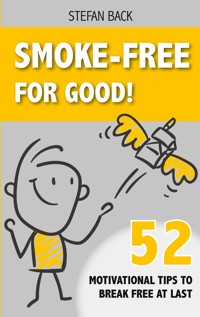
"It is not just about quitting - It is about staying smoke-free." Stefan Back Who would not want to quit smoking instantly - and stay smoke-free for good? This compact and motivating guide will help you finally turn that wish into reality. Stefan Back, who has supported countless smokers on their journey, shares 52 motivational tips on how to reprogram your brain and break free from addiction once and for all. No withdrawal symptoms, no psychological tricks, no relapse, and no weight gain. For life! Visit me online: www.stefan-back.com www.das-back-prinzip.de
Sie lesen das E-Book in den Legimi-Apps auf:
Seitenzahl: 90
Veröffentlichungsjahr: 2026
Das E-Book (TTS) können Sie hören im Abo „Legimi Premium” in Legimi-Apps auf:
Ähnliche



















About the Author
Stefan Back, born in Stuttgart in 1962, smoked up to 40 cigarettes a day for 22 years and had long considered himself a hopeless case. In 1999, however, he managed to overcome his addiction to smoking. Since then, he has dedicated himself to health and smoking cessation. Providers of smoking cessation seminars increasingly draw on his ideas.
Stefan Back's goal has always been to help smokers who have exhausted all other treatment options. Over the past 20 years, he has developed the back-principle: ™, a mental program designed to help smokers who have relapsed quit for good. Back lives and works in Stuttgart, Germany, and has published numerous books on addiction and career development.
For more information, visit:
www.stefan-back.com
www.das-back-prinzip.de
or write to
CONTENTS
Introduction
Discovery Phase
The Journey is the Destination
Be Well Informed
How your Subconscious is Constantly Influenced
Becoming a Non-Smoker
Lose Your Fears
Escape is no Solution
Your Advantage: Non-Smoker!
The Countdown is on...
Staying a Non-Smoker
The First Few Weeks
The Next Few Years
Other Books by the Author(Only available in German)
For Sabine
One day, a dog visits the Temple of a Thousand Mirrors. It climbs the high steps, enters the temple, looks into the mirrors, and sees a thousand dogs. Frightened, it growls. With its tail between its legs, it leaves the temple, convinced that the world is full of hostile dogs.
A short time later, another dog enters the same temple. It also climbs the steps, walks through the door, and looks into the mirrors. It sees a thousand other dogs, feels joyful, and wags its tail. A thousand dogs wag their tails back at it. This dog leaves the temple believing that the world is full of friendly dogs.
(Wisdom from India)
Introduction
Thank you for choosing this book. Welcome!
In these pages, I have compiled a variety of tips to effectively support you on your journey to becoming a non-smoker. The ultimate tip, of course, would be: stub out your last cigarette and be happy about it. Unfortunately, it is not quite that simple – although later, once you have been a nonsmoker long enough, you will realize that it truly is that simple. But there is still a certain path you must walk before you get there.
I am not saying the journey will be difficult, but you need to be clear about a few things.
You have probably already heard one or two pieces of advice on how best to quit smoking. If so, you may be quite surprised by my tips. They often go directly against common beliefs or expert recommendations. However, I am even more convinced that this book will genuinely help you fulfill your desire to become a non-smoker for good. Believe me, it’s not difficult—if you approach it with the right mindset and the right knowledge.
Three Phases of Becoming a Non-Smoker
Broadly speaking, there are three phases in your journey of becoming – and remaining – a non-smoker for life.
The first phase is the discovery phase. During this stage, you gradually become familiar with the idea of quitting - maybe for the first time, or once again. Your motivation is still developing, but you are starting to explore the topic and gather initial information. The danger in this phase lies in the subtle negative manipulation coming primarily from your subconscious – without you even realizing it.
That is why my tips are especially designed to help you get through this first phase with complete motivation and move on to the second phase: becoming a nonsmoker. In this phase, you will need support to help you overcome your fear of quitting, as well as practical guidance to move steadily toward your goal.
The third and final phase is the one that will, hopefully, last the longest: remaining a non-smoker. Here, you will find tips to help you stay smoke-free over the long term. Over many years working in smoking cessation, I've repeatedly seen how easily new non-smokers can become unsettled.
That is why this guide is designed to accompany you throughout your journey, starting today. You can return to the tips in this book whenever you need them— depending on which phase you're in.
And now, I hope you enjoy reading and gain plenty of new insights.
Yours, Stefan Back
DISCOVERY PHASE
The discovery phase begins with the first, usually fleeting thought, “I think I should quit sometime,” and ends with the determination, “Now I want to seriously try.” During this phase, you consciously, but above all unconsciously, absorb a lot of information that sets you back enormously in your goal of becoming a non-smoker. Many smokers never manage to move beyond this phase. They remain stuck with their initial weak resolution that it would be better to quit “sometime.” To prevent this from happening to you, follow tips 1 – 14.
No normal smoker would quit "just like that" overnight.
The Journey is the Destination
I consider myself qualified to give you advice on quitting smoking. After all, I was a heavy smoker for twenty-two years. It was often one pack a day, usually two. In my smoking world, I barely noticed when my then-partner, now my wife, stopped smoking for a while. Quite the opposite, I told her that I did not want to restrict myself because of her or even consider quitting out of solidarity. That was completely out of the question for me.
Anyone Can Do It
I have since woken up, because on September 29, 1999, I smoked my last cigarette. However, until that point, like almost all smokers, I thought that it would be incredibly difficult to quit smoking and that I would have to suffer "forever." I always assumed that I was "somehow" different from the many other ex-smokers who had managed to quit before me. It was clear to me that I would never be able to live without cigarettes, let alone live well. After twenty-two years as a smoker, I had nearly given up hope of ever kicking the habit.
"It is not because it is difficult that we do not dare, but because we do not dare that it is difficult."
Lucius Annaeus Seneca
But then something fantastic happened. Within seconds, I became a non-smoker. Something just clicked, and I was free! I had done it, and I had been wrong all those years. And how wrong I had been! Today I know that EVERY SMOKER can do it. And not only that, but I also know how much better life is as a non-smoker. It's just a question of having the right attitude and perspective toward smoking, nothing more.
Tip 1 Never get discouraged, because there is no such thing as a hopeless smoker. It only exists in your mind and is pure illusion. Anyone can do it; you simply have to believe in yourself!
Check Your Motivation
Motivation is defined as "a person's activated willingness to behave in a certain way in order to achieve certain goals." So, how willing are you to achieve the goal of becoming a non-smoker?
Don't worry if you are not feeling highly motivated yet. This book is still perfect for you, because motivation doesn't appear out of nowhere. Motivation builds through action. You learn, you reflect, you talk things through — and before you know it, you feel ready to take on the challenge. Keep looking for ideas and inspiration; that’s how progress starts.
Every Decision Has its Lead Time
When it comes to ending an addiction, including smoking, the lead time until you actually quit is usually very long. We are talking for decades rather than years. Unfortunately! No one quits smoking completely out of the blue. The inner pressure builds up slowly – over months or even years — until the moment feels right to make a change.
Tip 2 Don’t worry about those stories of people quitting “just like that” overnight. There’s always a history behind that moment, and you are already building yours.
How motivated are you right now? Are you determined to quit smoking soon, or are you still exploring your options and feeling unsure? If so, it’s worth looking at what might be holding you back.
You probably think: "I enjoy a cigarette with breakfast/coffee/after a meal, it helps me when I'm stressed, it's cozy, it helps me relax, it helps me cope with anger, etc." And yet, in the back of your mind, a quiet voice whispered: "Stop it, it's not good for you." In the evening your airways begin to whisper with wheezes; in the morning you wake up hacking and coughing – and once again, that quiet voice makes itself heard. This process is also known as a guilty conscience – the façade of the happy smoker is slowly falling apart.
This voice is unpleasant and gets louder and louder. "The voice is annoying," you think. And so, you start repressing everything again, smoke a cigarette to "calm down" and remain loyal to your cigarettes.
Tip 3 Trust your intuition. Listen to that inner voice — it’s on your side and often knows what you need before you do.
Reconsider Your Philosophy of Life
Many smokers manage to quit for a short time, but then they relapse. One important reason is that the rest of their lifestyle remains unchanged. They stop smoking for health reasons, but they still live in the same patterns that once drove them to smoke. Without a broader shift in attitude and habits, the cigarette often finds its way back.
Do Something for Your Health
Develop a sensitivity for healthy living. Fundamentally improve your lifestyle as a future non-smoker. For example, do more exercise, drink less or no alcohol, pay attention to your diet, get enough sleep, drink plenty of water, etc. Not only will this significantly improve your overall health, but it will also make it much easier for you to quit smoking for good.
Try to connect with your body and learn to love it. Every day, remind yourself how fortunate you are to have been born healthy. Just think about how hard your body has been working to deal with all the toxins you put into it day by day. It's not fair, and yet your body has been coping for years, even decades. But how much longer can it keep up?
"You should take things as they come. But you should also make sure that things come as you want them to."
Curt Goetz




