


125,99 €
Mehr erfahren.
- Herausgeber: John Wiley & Sons
- Kategorie: Wissenschaft und neue Technologien
- Serie: Wiley - IEEE
- Sprache: Englisch
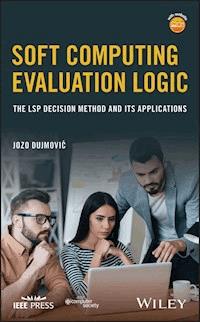
A novel approach to decision engineering, with a verified framework for modeling human reasoning Soft Computing Evaluation Logic provides an in-depth examination of evaluation decision problems and presents comprehensive guidance toward the use of the Logic Scoring of Preference (LSP) method in modeling complex decision criteria. Fully aligned with current developments in computational intelligence, the discussion covers the design and use of LSP criteria for evaluation and comparison in diverse areas, such as search engines, medical conditions, real estate, space management, habitat mitigation projects in ecology, and land use and residential development suitability maps, with versatile transfer to other similar decision-modeling contexts. Human decision making is rife with fuzziness, imprecision, uncertainty, and half-truths--yet humans make evaluation decisions every day. In this book, such decision processes are observed, analyzed, and modeled. The result is graded logic, a soft computing mathematical infrastructure that provides both formal logic and semantic generalizations of classical Boolean logic. Graded logic is used for logic aggregation in the context of evaluation models consistent with observable properties of human reasoning. The LSP method, based on graded logic and logic aggregation, is a vital component of an industrial-strength decision engineering framework. Thus, the book: * Provides detailed theoretical background for graded logic * Provides a theory of logic aggregators * Explains the LSP method for designing complex evaluation criteria and their use * Shows techniques for evaluation, comparison, and selection of complex systems, as well as the cost/suitability analysis, optimization, sensitivity analysis, tradeoff analysis, and missingness-tolerant aggregation * Includes a survey of available LSP software tools, including ISEE, ANSY and LSP.NT. With quantitative modeling of human reasoning, novel approaches to modeling decision criteria, and a verified decision engineering framework applicable to a broad array of applications, this book is an invaluable resource for graduate students, researchers, and practitioners working within the decision engineering realm.
Sie lesen das E-Book in den Legimi-Apps auf:
Seitenzahl: 1253
Veröffentlichungsjahr: 2018
Ähnliche



















Soft Computing Evaluation Logic
The LSP Decision Method and Its Applications
Jozo Dujmović
Department of Computer ScienceSan Francisco State University
This edition first published 2018© 2018 John Wiley & Sons, Inc.
All rights reserved. No part of this publication may be reproduced, stored in a retrieval system, or transmitted, in any form or by any means, electronic, mechanical, photocopying, recording or otherwise, except as permitted by law. Advice on how to obtain permission to reuse material from this title is available at http://www.wiley.com/go/permissions.
The right of Jozo Dujmović to be identified as the author of this work has been asserted in accordance with law.
Registered OfficesJohn Wiley & Sons, Inc., 111 River Street, Hoboken, NJ 07030, USA
Editorial Office111 River Street, Hoboken, NJ 07030, USA
For details of our global editorial offices, customer services, and more information about Wiley products visit us at www.wiley.com.
Wiley also publishes its books in a variety of electronic formats and by print‐on‐demand. Some content that appears in standard print versions of this book may not be available in other formats.
Limit of Liability/Disclaimer of WarrantyThe publisher and the authors make no representations or warranties with respect to the accuracy or completeness of the contents of this work and specifically disclaim all warranties; including without limitation any implied warranties of fitness for a particular purpose. This work is sold with the understanding that the publisher is not engaged in rendering professional services. The advice and strategies contained herein may not be suitable for every situation. In view of on‐going research, equipment modifications, changes in governmental regulations, and the constant flow of information relating to the use of experimental reagents, equipment, and devices, the reader is urged to review and evaluate the information provided in the package insert or instructions for each chemical, piece of equipment, reagent, or device for, among other things, any changes in the instructions or indication of usage and for added warnings and precautions. The fact that an organization or website is referred to in this work as a citation and/or potential source of further information does not mean that the author or the publisher endorses the information the organization or website may provide or recommendations it may make. Further, readers should be aware that websites listed in this work may have changed or disappeared between when this works was written and when it is read. No warranty may be created or extended by any promotional statements for this work. Neither the publisher nor the author shall be liable for any damages arising here from.
Library of Congress Cataloging‐in‐Publication DataNames: Dujmović, Jozo- author.Title: Soft computing evaluation logic : the LSP decision method and its applications / by Jozo Dujmović.Description: Hoboken, NJ : John Wiley & Sons, 2018. | Includes bibliographical references and index. |Identifiers: LCCN 2017039552 (print) | LCCN 2017046281 (ebook) | ISBN 9781119256465 (pdf) | ISBN 9781119256472 (epub) | ISBN 9781119256458 (cloth)Subjects: LCSH: Soft computing. | Evaluation–Methodology. | Artificial intelligence.Classification: LCC QA76.9.S63 (ebook) | LCC QA76.9.S63 D85 2018 (print) | DDC 006.3–dc23LC record available at https://lccn.loc.gov/2017039552
Cover design by WileyCover image: © g‐stockstudio/Getty Images
To KaćaWife, computer scientist, and partner in everything
Preface
Seek simplicity and distrust it.
—Alfred North Whitehead
This book is a monograph on evaluation, an area of soft computing. It can also serve as a toolbox for solving practical evaluation problems. The goal of this book is to develop mathematical logic that can answer fundamental questions related to problems of evaluation, comparison, and selection of complex alternatives. These problems are common and present in business, engineering, and in everyday personal decision making. Our objective is to integrate results scattered in research papers published over many years and to present an evaluation methodology that is strong enough to be used in professional decision making. The methodology draws on work in soft computing, fuzzy systems, multi‐criteria and multi‐attribute decision making, or generally, on work in computational intelligence.




