


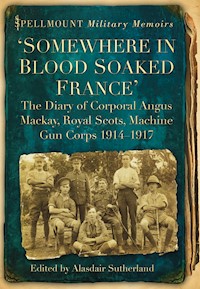
'Somewhere in Blood Soaked France' E-Book
18,49 €
Mehr erfahren.
- Herausgeber: The History Press
- Kategorie: Geisteswissenschaft
- Sprache: Englisch
From the heat and dust of the Dardanelles to the mud of the Western Front, Corporal Angus Mackay had one constant companion, his diary. He wrote of the battles and campaigns he fought in, names that would go down in history: Gallipoli, the Somme, Ypres and Arras. Serving in the 1st/5th Battalion (Queens Edinburgh Rifles) Royal Scots and later the 88th Brigade Machine Gun Corps, he left a record of one man's extraordinary and tragic war. In 'Somewhere in Blood Soaked France, Alasdair Sutherland reveals this previously unpublished account of the First World War, complete with historical context, orders of battle and extracts from official war diaries. This rare source – it was an offence to keep a record in case of capture – offers a stirring insight into the bravery of Mackay and his companions, who were not afraid to die for their country. 'If I go under it will be in a good cause, so roll on the adventure.'
Das E-Book können Sie in Legimi-Apps oder einer beliebigen App lesen, die das folgende Format unterstützen:
Veröffentlichungsjahr: 2011
Ähnliche




















Never More
On fame’s eternal camping ground
Their silent tents are spread
And glory guards in Solemn sound
The bivouac of the dead
‘Tis night far down our Northern Glens
The autumn breezes sigh
Afar the mountains echo back
The curlew’s lonely cry
The river onwards flows the way
Of centuries before
But tonight the waters seem to sob and whisper ‘Never More’
The drums of death are sounding across the Northern wave
And there’s weeping ’mong the Highland Homes
For our beloved brave
For those who knew and loved those hills
In boyhood days of yore
For those who died for home and King
Amid the battles roar
Ah! Where are now our kilted lads
So handsome brave and grand
Who marched away for honour’s sake
And love of this far land
’Tis o’er a strip of blue
Somewhere in blood soaked France
They sleep the ever lasting sleep
Behind the great advance
Elsie Spence Rae Banff, 7 November 1915
(Reproduced with permission of Press and Journal Newspapers, Aberdeen)
This book is dedicated to all soldiers killed at war fighting for their country.
The author wishes to thank the family of Angus Mackay for allowing him to write this book from the diaries which are now in the possession of Mrs Dorothy Johnson, St Andrews, Scotland.
Contents
Introduction
Glossary
1.
The Road to War
2.
Gallipoli
3.
Suvla Bay and Lemnos Island
4.
Egypt
5.
The Western Front
6.
Close Shaves in the Trenches
7.
The Battle of the Somme
8.
Holding the Ypres Salient
9.
The Landships of Flers-Courcellette
10.
Return to the Somme
11.
The Fighting at Gueudecourt
12.
The Battle of the Ancre
13.
Leave and the New Year
14.
A Frozen Winter
15.
Training at Étaples
16.
The Battle of Arras and the Last Entry
Appendix 1
29th Division Order of Battle
Appendix 2
29th Division Timeline
Bibliography
Plates
Copyright
Introduction
In June 1992, I visited the First World War battlefields in Belgium and northern France with my family; we had gone in search of our relative, Private Angus Sutherland of the 8th Battalion Seaforth Highlanders, killed in action on 23 April 1917, during the Battle of Arras. His battalion was attacking the village of Guemappe when he was killed; he is buried in a war grave near where he fell in Guemappe British Cemetery, Plot 1, Row B, Grave 11 alongside many of his comrades who fell that day.
My first real encounter with the First World War was at Farr Junior Secondary School, as I sat in my History ‘O’ Level class. As I listened to our teacher Emily Campbell talk about the battles at Ypres, Passchendaele and the Somme, I looked at a picture of a soldier standing in a trench covered in mud with a smile on his face. I always looked at that photograph and wondered what he had to smile about; over the years I have learned more about the Great War and have found the answer to that question.
When I left school I became a soldier myself, and just like the one in that photograph I have stood, covered in mud in a muddy trench in the pouring rain with a smile on my face. The only difference between the soldier in the photograph and I was that no one was trying to kill me; he was involved in the most terrible war ever seen, when industrialised murder was inflicted by man on fellow man in the fields of France and Flanders.
Many times during my twelve years of service I wondered how I would survive during war, but I never found out, as those years were ones of peace and stability in Europe. My comrades and I were never called upon to fight because our enemies were held at bay by the nuclear threat. The Russian armoured columns we were trained to fight never came, the chemical and biological weapons we learned to combat were never used against us. I never found out what I would have done if I had been subjected to heavy shelling or walked into machine-gun fire, watching as my mates fell dead and wounded all around me. Would I have cracked under the strain of it all or would I have been a hero?
As I walked around the battlefields in 1992 those names from my school years returned, the city of Ypres, the hell of the Somme and the mud and misery of Passchendaele, I wondered if anyone from my home village of Tongue in the Highlands of Scotland had walked this way before me. I looked in the museums, at the huge war cemeteries, at all the names carved on the battlefield memorials. I did not realise I was following in the footsteps of the man who had kept a remarkable diary. I was given the diary to read by Mrs Dorothy Johnson, as I researched my first book Never More, and I was fascinated by the exploits of her relative Angus Mackay. It was a definite link to the past and a living document recording one of history’s defining moments, an insight into the worst war ever fought.
Corporal Angus Mackay, who served in the 1st/5th Battalion of the Royal Scots and in the 88th Brigade, 29th Division Machine Gun Corps, was there over 70 years before me and had fought in the all the battles I had learned about in school, including the hellish first day of the Battle on the Somme at Beaumont-Hamel. This was a man who had experienced all the things I had thought about as a soldier and much much more. He was a Territorial Army volunteer, who fought in the broiling heat of the trenches in Gallipoli against the fierce Turkish Army and then served all over the Western Front in France. He served in the trenches from May 1915 until April 1917, when he was severely wounded and taken prisoner near Monchy le Preux in France. His diary entries stop the day before he entered the trenches for the final time, to take part in the attack that led to his fatal wounding and death in a prisoner of war camp in Germany.
Soldiers in the First World War were not allowed to keep diaries, in case they were captured and the enemy found secret information. They rarely kept a daily log of their activities, often just snippets written in journals, in letters home or on scraps of paper. Angus Mackay’s diary is unique in that it gives an almost day-by-day account of his life from the time he enlisted until he was captured.
This book gives us an insight into the life of the soldiers had at the front lines during the First World War. It was not always a life of death and destruction but often one of boredom, comradeship and doing your duty alongside your mates until the war was won. The suffering of soldiers who are named on war memorials all over this country must never be forgotten, their deeds must live on in history to ensure future generations never have to suffer as they did.
This is the story of one soldier’s life in the first truly global war ever fought; it is only one amongst the 9 million stories of men from every side who perished between 4 August 1914 and 11 November 1918. Of the over 70 million men mobilised in armies across the world, one man in eight was killed or died whilst on active service.
Glossary
Archies
heavy machine guns
brag
card game
bully
bully beef
C & R
Column of Route
C.O.
Commanding Officer
Ensign
Highland newspaper
F.M.O.
Field Marching Order
furlough
leave
Gold Flake
cigarette brand
G.P.
gun position
H.E.
high explosive
kilo
kilometre
MD
Medicine and Discharge
M.G.
machine gun
O.C.
Officer Commanding
P.C.
postcard
P.J.
Press and Journal
pom-pom
[anti aircraft] gun
tucker
food
1
The Road to War
Angus Mackay was born on 18 August 1895, the ninth child of Alexander and Isabella Mackay of ‘Holding 162’, Scullomie, Tongue, Sutherlandshire. Tongue is a small village in the Highlands of Scotland, about 100 miles north of Inverness; the small hamlet of Scullomie lies about three miles to the east of Tongue on the Thurso road. Angus’s father Alexander was born in Scullomie on 21 January 1847, the second son of crofter John Mackay and his wife Margaret. Alexander came from a large family of five boys and two girls, all born in the middle of the nineteenth century. He went on to became an agricultural labourer in Tongue, before he married Isabella on 23 January 1880 at Strathtongue Free Church. Their first son John was born on 23 January 1881, and was followed by five more sons before Angus was born: Donald (June 1885); William (July 1888); George (July 1890); Hugh (July 1891); and Robert (May 1893). After Angus came Magnus (February 1898) and Sandy (April 1901). Their two daughters Dolina (March 1883) and Margaret (1886), both died in infancy.
The family lived in the small community of Scullomie on a small croft or farm, run by Alexander to supplement the wage he earned as a farm labourer in the Tongue area. Alexander was known around Tongue as Alex ‘Bolt’ due to his upright posture. Isabella worked in Tongue as a domestic servant, which helped with the small family income.Their home was a small cottage built beside the dirt road leading down from the Thurso road to Scullomie pier; half the building was given up for use as a ‘byre’ or stable, holding the family’s livestock. Many crofters kept cows for milk and made their own cheese, in the form of sour crowdie, in a scullery at the side of the house. The crofters also kept a small flock of sheep and some chickens for eggs, to add to the family’s meagre diet.
In the fields below the cottage Alex and his sons grew potatoes and root vegetables, both for the family’s consumption and to sell on to other families or local shops in the area. The fields around the house were used to grow hay as feed for the family’s livestock and their horse, their only means of transport. The family horse was once nearly lost when Alex took some rubbish and stones from the old byre beside the house, down to the rocks to dump them in the sea. As he prepared to dump the debris over the cliff onto the beach below, his horse and cart fell over the edge and disappeared from view. Believing his horse to have been killed in the accident, Alex returned home to inform his wife what had happened. When he finished telling her of his misfortune, he came out of his house to find the horse standing waiting for him, with the shafts of the cart still attached to its harness. Somehow the horse had survived the fall and made its way back home, having had a very lucky escape.
The family home had fine views out over the blue-green water of the Kyle of Tongue, towards the Rabbit Islands and the village of Melness beyond. The front of the Mackay house faced the small village of Coldbackie and the heather-covered Watch Hill, so called from the days when local men kept look out for marauding bands of Vikings approaching from the north. If any were sighted then warning beacons were lit to alert local people. Below the house the golden sands at Coldbackie beach nestled in the lee of the land beside the ‘Rean’ burn, where Angus and his brothers played as children, fishing for small trout and sticklebacks.
Out beyond the Kyle of Tongue the rocky cliffs of Island Rhoan can be seen jutting out into the Pentland Firth. The island had a thriving community of herring fishermen in the days before the First World War; Alex ‘Bolt ‘must have purchased some of their catch when the small herring boats docked at Scullomie Pier. The nearest school for Angus and his brothers was at the small community of Rhi-Tongue, about halfway to Tongue village. This involved a daily walk from Scullomie of about two miles each way.
The scenery and landscapes in and around Scullomie today are much the same as when Angus was a child, the houses are still spread out alongside the road leading down towards the pier, only there are fewer occupied houses today; many lie in ruins. Today there are modern roads, telephone poles and television aerials beside the houses, but the problems faced by young people then are faced by the young people of today. There was and still is, little employment in Tongue and its surrounding area; if you couldn’t get a job in Burr’s new shop or at Tongue Hotel, then crofting or fishing were the only ways to earn a living.
As Alex’s sons grew and matured, they moved away from the family home in Scullomie to seek employment elsewhere, as there was precious little work beyond the small crofts. Many local men moved south into the Central Belt of Scotland seeking employment in ship building and other heavy industry, others travelled to take the Queen’s shilling in the Army or became civil servants. The two eldest sons John and William moved to Leith, near Edinburgh, where they joined the Police; John finished his service with the rank of Detective Inspector. George joined the British Army, serving in Sierra Leone, West Africa and in the trenches of the Western Front. Whilst he was serving with the 83rd Siege Battery of the Royal Garrison Artillery in France, he won the Distinguished Conduct Medal for bravery. He was badly gassed in 1918 and this affected his health for many years after the war. He married Catherine Bell Macleod from Invernaver on 30 December 1919, and lived with his wife and eight children at The Manse, 4 Claremont Park, Leith. He died in 1955.
Hugh also joined the army and served in Serbia and India during the First World War. At the end of his military service he also moved to Leith, where he lived with his wife Ina and three children. Robert similarly moved to Leith, where he became a worker in the docks, dying in Windygates in Fife. Donald moved to New Zealand and joined the New Zealand Armed Forces at the outbreak of war.
Angus had two younger brothers: Magnus joined the army in 1914 aged sixteen, lying about his age to enlist in the Argyll and Sutherland Highlanders. Alexander (Sandy) left Scullomie in 1926 to work on a sheep station in the Australia outback; he died in Australia in 1952.
Some time prior to the outbreak of the First World War, Angus travelled from Scullomie to join his brothers John and William in Leith. He stayed at 61 Restalrig Road with John and managed to gain employment in Leith’s huge dockyard; he also enlisted in the 1st/5th Battalion (Queens Edinburgh Rifles), Royal Scots. The 1st/5th Royal Scots was a Territorial Force (T/F) battalion with its drill hall close to Leith, where the battalion spent its time drilling and practising for its home defence role.
In early 1914 the threat of war hung over Europe. It was clear that war was coming and that all it would take was a spark, after a decade of tension. Many politicians anticipated the inevitable conflict with enthusiasm. Others knew the suffering it would bring. That spark was the death of a man in Sarajevo, one that would lead to the deaths of nine million others. The assassination of Archduke Franz Ferdinand by Gavrilo Principal on 28 June 1914, echoed around Europe. The Austrians threatened to invade Serbia; on 28 July Russia told Austria that any attempt to invade Serbia would mean war between the two countries. Germany then entered the war of words, saying that any war declared on Austria was a war on the German Empire.
On 31 July 1914 France came in on Russia’s side and mobilised her army against Germany on 1 August. The stage for war was now set as both sides formed up their armies ready to fight. Great Britain promised to defend the neutrality of Belgium and any attack by Germany. When the Germans failed to accept these proposals, Britain had no option but to declare war and deploy her troops overseas.
The British War Office knew war was coming and had prepared for it well; the 1st/5th Battalion Royal Scots were mobilised by telephone at 5.30pm on 4 August 1914. Men began to arrive in the battalion drill hall at Forest Road at 7.30am on 5 August, other men reporting to the battalion war station in the Maltings, at Moray Park in Lochend Road. The soldiers were issued with all their equipment including rifles, and stood to ready to join the British Expeditionary Force bound for France and Belgium.
Germany had declared war on Belgium on 4 August at 6.00am and invaded the country at 8.00am that day, quickly moving through Belgium towards Luxembourg and France. On 3 August the British Army had been officially ordered to mobilise, British Army unit commanders receiving detailed embarkation orders on 5 August with advance parties of the BEF secretly crossing to France to prepare assembly sites for the main body of the army on 7 August. The main BEF (80,000 men) then crossed to France on 12 August and began to march east from Amiens towards Belgium to meet the German attacks, making contact with the Germans at Mons in Belgium on 23 August.
The 1st/4th Royal Scots battalion remained in Forest Road and Lochend Road. They had a strength of 1250 men, made up of 800 on standby to move, the remainder being held in reserve. On 28 September 1914, the main battalion moved to the cavalry stables at Redford Barracks to join the Lothian Brigade, tasked with coastal defence east of Edinburgh.
As the BEF fought the German Army at Mons, Le Cateau and then at Battle of the Marne from 5–12 September, the 1st/5th Royal Scots deployed along the coast near Edinburgh. Battalion Headquarters was set up at Marine Gardens in Portobello; the remainder of the battalion was deployed on the coast east towards the town of Dunbar. Private Angus Mackay was deployed with part of ‘W’ Company to a blockhouse at Eskmouth near Musselburgh, where he remained for the whole of November and December 1914. The Scots Territorial units had been deployed on the coast in case of enemy invasion of the homeland. The soldiers in their blockhouses, bunkers and trenches would have also guarded against spies and Fifth Columnists coming ashore from enemy submarines, but their main enemy was the biting cold wind blowing in off the North Sea.
Over on the continent the regular soldiers of the BEF fought the enemy with their backs to the wall, around the city of Ypres in Belgium. In October, the Germans had began to move north from the river Marne in a race to the sea with the British; as the two armies moved the trench systems of the Western Front began to form.
The BEF fought desperate battles in the ‘race to the sea’, as they tried to stop the Germans taking the channel ports and the French coast. There were no reserves left by this time, and the BEF fought a frantic battle against massed German infantry attack; somehow the line was held and the British soldiers became known as the ‘Old Contemptibles’. The nickname came from the German Kaiser’s statement to his troops before the battle: he told his soldiers to attack and ‘walk all over General French [the BEF Commander] and his contemptible little army.’
2
Gallipoli
The 1st/5th Royal Scots remained along the coast east of Edinburgh for the next five months, as the war in Belgium and France bogged down into the stalemate of trench warfare. The war plans of both sides had not been effective and lay in tatters. The Germans had failed to capture France with their Shlieffen Plan but had captured a large part of French territory. The British Army had virtually ceased to exist, losing over 50,000 men blocking the German Army from reaching the channel ports. Meanwhile the French Army was in primitive trenches stretching from the river Aisne south to the Swiss border.
In March 1915, as the British prepared to attack the Germans at Neuve Chapelle in France, the Commanding Officer of the 1st/5th Royal Scots received orders from the War Office to prepare for embarkation. The battalion was ordered to join the 29th Infantry Division 88th Brigade in Leamington, England and prepare to go overseas to fight in the Middle East.
The 1st/5th Royal Scots left Portobello and marched to Waverley Station in Edinburgh on 8 March 1915, through crowds of people cheering them on their way. The pipes and drums led the battalion; the baggage train followed on at the rear. On 10 March the battalion arrived by troop train at Leamington Spa in Warwickshire and was billeted with the local population; Angus Mackay was placed with a local family at 4 Knebworth Street. The placing of soldiers in civilian houses was common practice in the early days of the war as there were insufficient barracks to accommodate all the troops under training.
The 1st/5th Battalion’s Territorial soldiers now began to train alongside their regular army counterparts in the 29th Division and soon attained a highly level of competency, putting them on a par with their highly trained opposite numbers. The days were spent carrying out route marches in full kit, improving rifle drill on the square and shooting on the firing range. The 29th Division was already very experienced, with most of its units drawn from the regular army stationed overseas; the division was under the command of Major-General A.J. Hunter-Weston and consisted of the following battalions arranged into brigades.
86th Brigade
2nd Royal Fusiliers
1st Lancashire Fusiliers
1st Royal Munster Fusiliers
1st Royal Dublin Fusiliers
87th Brigade
2nd South Wales Borderers
1st King’s Own Scottish Borderers
1st Royal Inniskilling Fusiliers
1st Border
88th Brigade
2nd Hampshires
4th Worcester
1st Essex
1st/5th Royal Scots
As a division of the regular army the men of the 29th were not used to a battalion of territorial soldiers in their midst and it would have taken some time for Angus and his fellow Royal Scots to settle in. The regular battalions had all served abroad before the outbreak of war, mainly in India and the Far East: the Royal Munster Fusiliers had been in Lahore, the Dublin Fusiliers in Bangalore, the Inniskilling’s at Secunderabad and the 4th Worcester in Malta.
Private Angus Mackay contracted measles in Leamington and spent the next twelve days in Heathcote Hospital; on his discharge he was found to be unfit for duty and was given leave. He spent his leave with his family in Scullomie and then visited his brothers in Edinburgh. He was not to be reunited with his battalion until 26 May, and they would go on to Gallipoli without him.
While Angus was on leave, his Divisional Commander received orders to proceed overseas. The British High Command had decided to attack Germany’s ally Turkey, in an effort to protect the Suez Canal and break the deadlock of trench warfare in France. Lord Kitchener and the First Lord of the Admiralty, Winston Churchill, also wanted to open a supply route to Russia through the Dardanelles from the Mediterranean. The task was initially to be carried out by the Royal Navy and French Navy with no army support; there would be no need to draw troops away from the Western Front.
On 18 March 1915 a Franco-British naval force tried to force its way up the Dardanelles and into the Sea of Marmora, in an attempt to shell the Turkish capital Constantinople. The attack failed resulting in the loss of two British and one French warships. Three other ships were also severely damaged by the mines laid along the strait by the Turkish defenders. When the War Office in London heard what had happened, the conclusion was reached that troops would be required to take the Gallipoli Peninsula, helping the naval force push on up the Dardanelle Strait. Australian and New Zealand troops in Egypt were put on standby to move to the Island of Lemnos in the Aegean, and a Mediterranean Expeditionary Force (MEF) was sent from England to assist with the task.
The 29th Division was reviewed near Dunchurch by the King, then left Leamington Spa on 20 March; the 1st/5th Royal Scots travelled to Avonmouth and were issued and fitted with Foreign Service helmets before boarding the troopships SS Caledonia and SS Melville. The battalion travelled to Egypt via Malta, joining up with the Australian and New Zealand Army Corps (ANZAC) as they trained near Suez. This made a force of over 70,000 men who were training for an attack which it was hoped would knock Turkey out of the war.
Once the battalion landed at Alexandria on 2 April 1915 it spent a few days recovering from the journey before embarking on seven small ships. It travelled to Mudros Bay on Lemnos Island, about 12 miles east of Gallipoli, to train in full kit for the forthcoming attack. For the next week the battalion practised descending rope ladders from ships into small boats.
On 25 April 1915 the British forces landed at the tip of the Gallipoli Peninsula; advance units of the 29th Infantry Division landed on Cape Helles in an attempt to capture the Kilid Bahr Plateau. Heavy casualties were sustained on ‘V’ Beach, as the first battalions ashore met withering fire from the Turkish defenders on the hills beyond the beach. ‘V’ Beach, east of the town of Sedd el Bahr, was very sandy and led up to an embankment below an old fort, which dominated the approaches from the sea.
The 1st/5th Royal Scots came ashore with the 88th Brigade, in the second wave of the attack formation. Soldiers found themselves going ashore in open boats, covered in the blood of men who had been hit as they tried to land on the beaches in the initial assault. As they landed on ‘W’ Beach, west of the main 29th Divisional landing area, the 88th Brigade found that they were totally unopposed by Turkish Forces.
The Royal Scots came ashore onto a beach of soft powdery sand about 350 yards wide, varying in width from 15 to 40 feet. The beach they stood on formed a perfect amphitheatre flanked by sheer inaccessible cliffs; the ground between ascended gradually up over sand dunes toward the lower levels of Achi Baba Ridge. Turkish troops had laid barbed wire on the beaches and were defending the area from trenches dug amongst the sand dunes. There were also redoubts built to the rear, so that Turkish snipers and riflemen could pick off the attackers as they scrambled through the wire.
The beaches were secure by the time the Royal Scots came ashore, so they were put to work unloading stores and ammunition. As the soldiers unloaded their transport ship, the SS Dongola, they did so in front of the gigantic battleship HMS Queen Elizabeth. Every discharge of the huge ship’s guns made the transport ships dance and reel in the water, causing the men to stop work and watch as salvoes of shells crashed onto the Turkish positions up on the headland beyond.
On the first day of the Gallipoli campaign the 1st/5th Royal Scots came ashore without losing a man and dug in along the folds of land near the edge of the beach. Other units had not been so lucky and had suffered heavy casualties at the other landing sites. As the Scots lay in their trenches waiting for their orders to move, over 8,000 other soldiers came ashore on the beaches behind them. However, the force was without coherent command or objective; its commanders were still out on the ships in the bay.
The British, ANZAC and French forces fought stubbornly to get off the beaches and by nightfall on the first day, were trying to force their way up into the barren rocky scrubland beyond. A landing by Australian and New Zealand forces to the north of the British at Gaba Tepe was a brilliant success and the Allies now had a foothold on the Turkish mainland but were not yet secure.
Turkish forces now began to pour fire down onto the invaders in an attempt to drive the attacking force back into the sea. Only one mile of Turkish territory was secure by the end of the day, but the cost had been heavy with over a thousand men killed or wounded for each 100 yards of front line taken. A badly mauled British and ANZAC force now prepared to try and take the line forward.
On 26 April 1915 the Royal Scots were still in reserve trenches, viewing the ground they would have to attack over and then assault up to the Achi Baba Ridge high above. The slope in front of them rose steadily through numerous tree-filled hollows, where Turkish snipers and machine-gun teams lay waiting. Several dry watercourses, known as nullahs, furrowed the ground ahead, dominated by Turkish troops commanding the slope with their fields of fire.
The battalion was eventually moved into the front line on the afternoon of 27 April; W and X Companies made an advance of two miles and meeting no opposition dug in below the ridge. A brigade of French, who had landed on ‘V’ beach, came up into the front beside the British and swung the line right, halfway towards the village of Krithia. Turkish troops – badly demoralised by shattering naval gunfire – withdrew to new positions, just in front of the village.
At 8.00am the following morning, the 29th Division attacked an area to the right of Gully Ravine, straight into the heavily defended Turkish front line trench. The 1st/5th Royal Scots were deployed for the attack opposite Fir Tree Wood on Fir Tree Spur, just to the left of Krithia village, beneath the formidable Achi Baba Ridge.
As the attack was pressed home the battalion was quickly called forward and into the reserve trenches, then began to advance; they had only gone a short distance before the first casualties were taken. The adjutant Captain Hepburn was shot in the head and killed by a Turkish sniper; he died as he directed the battalion forwards one mile from Krithia village.
Combat in the front line trenches went on for four hours until the infantry, weighed down by their heavy equipment, were exhausted and could fight no more. The attack on the village of Krithia and Achi Baba Ridge had failed. The objectives were just beyond their grasp and the Allied forces were forced to pull back from ground they had taken with a heavy loss of life.
Supplies could not be brought up quickly enough to exploit the gains made, forcing the attacking troops to dig in until the beachhead was consolidated and a breakout achieved. The campaign was beginning to bog down into the stalemate of trench warfare, which would lead to heavy loss of life from both enemy action and disease.
The troops from both sides dug in amongst the hills, gullies and ravines of the peninsula; the trench lines were sometimes only yards apart. The conditions were horrendous as there was little food and less water; men were seen lying about in the dust gasping for a drink. It was only a matter of time before soldiers began to suffer from dysentery and disease, spread by the flies feeding off the dead from both sides that littered the no man’s land between the trenches.
Turkish snipers, artillery fire and fanatical frontal attacks by enemy infantry battalions took a terrible toll on the Allied soldiers, as they tried to defend the narrow strip they held just inland from the beachhead. The Turks were proving to be tough fighters; in the hand-to-hand fighting as they defended their homeland from invasion, they died in their thousands as they bayonet charged the invader.
Two companies of the 1st/5th Royal Scots in the front line suffered heavy casualties; the battalion second in command Major Macdonald was wounded alongside many of the junior officers, the RSM F.J. Bailey was killed in action and the Commanding Officer Lieutenant-Colonel Wilson was wounded in the arm when the battalion was forced to withdraw. He then became detached from his men and was lucky not to be taken prisoner, rejoining the battalion later that night. Meanwhile the rest of the battalion, consisting of Y and Z companies, was engaged in unloading stores and ammunition from ships and onto the beaches. This backbreaking work was carried out under intermittent machine-gun and artillery fire, until the stores and ammunition dumps were established all along the shore area by early May.
At 10.00pm on 1 May, the Turks launched a surprise attack on the British line, and the Royal Scots – who were in reserve trenches astride the Achi Baba nullah (gully) and the Krithia road – came under heavy bombardment. An enemy infantry charge then broke through in several places; however one breakthrough in front of the Royal Scots position was repulsed by a brilliant counter-attack led by Captain McLagan. The Scots knew if they did not push the Turks back they may have broken the Allied line at that point managing to get into the British rear and cause havoc.
The 1st/5th Royal Scots counter-attacked the Turks with fixed bayonets and pushed the enemy back until only a few remained. Lieutenant Swinton Paterson’s platoon managed to capture three German and one Turkish officer. Fighting raged all along the line until 3.00am the following morning, when orders came down from High Command for a general advance to be made, following the enemy as they retired. The Turks were now in some disarray as they fell back but unfortunately the weary Allied troops were unable to exploit the advantage and the attack had to be cancelled. The Royal Scots however had been seen charging the enemy line by their Brigade General and had proved their worth; the Territorial soldiers were seen to be as good as their regular counterparts.
The 1st/5th Royal Scots became a whole battalion in the front lines on 2 May, when Y and Z companies came up from the beach to join W and X. On Monday 3 May a short truce fell on the line to bury the dead from the previous days of fighting; the newly arrived men from Z Company carried out this terrible task. The battalion then withdrew to rest trenches at Krithia Nullah on 4 May, to a place known as Clapham Junction, where they hoped to get some sleep and new equipment. However, at 8.00pm they had to rush forward and reinforce the Krithia road, digging in quickly for protection from heavy rifle and machine-gun fire pouring onto their positions.
At 8.00am on 5 May the battalion received orders to attack the enemy lines immediately to their front; this was the first time the Territorial Force soldiers from 1st/5th Royal Scots fought as a complete unit. A little over 600 men stood to that morning and fixed bayonets, preparing to attack Fir Tree Wood just in front of Krithia village. The attack went over the top at 10.00am and managed to penetrate the southern fringe of the wood, but the Royal Scots were unable to hold the ground. Shells howled into the wood all day, heavy machine-gun fire from the Turkish trench lines battered the battalion incessantly. Losses were heavy, including many of the surviving junior officers who were seen repeatedly leading charge after charge, in vain attempts to break the Turkish line.
The battered remains of Krithia remained outside the British grasp, enemy redoubts on the flanks poured heavy fire on the advancing Allied soldiers stalling any successful attack. At 5.00pm the Royal Scots attacked alongside the badly mauled South Wales Borderers; this attack was also a failure and the two battalions were forced to merge in the front line trench. X Company led by Lieutenant Swinton Paterson, managed to seize a slight ridge near Fir Tree Wood, but were too few in number to hold the ground. As the day went on the losses continued and Lieutenant Paterson was wounded alongside Captain F.W. Robertson as they crossed open ground swept by Turkish machine guns.
The attacks on Achi Baba Ridge had been another failure. ‘Johnny Turk’ fought hard over ever inch of land and would not give up his positions or retire, meaning that as the attacking Allied force could not break out from the beachheads they were forced to dig and await reinforcements. Fighting continued for the next few weeks; the 5th Royal Scots finally withdrew for a rest in reserve trenches on 16 and 17 May 1915. Whilst in reserve the battalion supplied a constant stream of men to the front, replacing the casualties as they fell from bullet, shellfire and disease. Finally a badly cut up 1st/5th Royal Scots withdrew to a relatively quiet rest area near a ruined house, which owing to the colour of its roof had been christened ‘Pink Farm’.
While his comrades in 1st/5th Royal Scots were battling in the Turkish heat, Private Angus Mackay arrived at Euston Station in London at the end of his leave on 10 May 1915; he reported to the military authority on the station and was then marched to Waterloo railway station. From there he travelled to Plymouth, where he was billeted in Raglan Barracks at Devonport.
British VIII Corps at Gallipoli
29th Division
86th Brigade
2nd Royal Fusiliers
1st Lancashire Fusiliers
1st Royal Munster Fusiliers
1st Royal Dublin Fusiliers
87th Brigade
2nd South Wales Borderers
1st King’s Own Scottish Borderers
1st Royal Inniskilling Fusiliers
1st Borderers
88th Brigade
2nd Hampshires
4th Worcestershires
1st Essex
5th Royal Scots
The Newfoundland Battalion (joined in early September 1915)
London Regiments (joined on 24 September 1915)
42nd East Lancashire Division
25th Brigade
5th Lancashire Fusiliers
6th Lancashire Fusiliers
7th Lancashire Fusiliers
8th Lancashire Fusiliers
126th Brigade
4th East Lancashires
5th East Lancashires
9th Manchesters
10th Manchesters
127th Brigade
5th Manchesters
6th Manchesters
7th Manchesters
8th Manchesters
52nd Lowland Division
155th Brigade
4th Royal Scots Fusiliers
5th Royal Scots Fusiliers
4th King’s Own Scottish Borderers
5th King’s Own Scottish Borderers
156th Brigade
4th Royal Scots
7th Royal Scots
7th Scottish Rifles
8th Scottish Rifles
157th Brigade
5th Highland Light Infantry
6th Highland Light Infantry
7th Highland Light Infantry
5th Argyll and Sutherland Highlanders
Royal Naval Division
1st Naval Brigade
Drake Battalion
Nelson Battalion
Hawke Battalion
Hood Battalion
2nd Naval Brigade
1st Battalion Royal Marine Light Infantry
2nd Battalion Royal Marine Light Infantry
Howe Battalion
Anson Battalion
On 11 May Angus boarded the P&O shipping lines troopship SS Osarera, sailing in a convoy bound for Egypt; he was finally on his way to join his battalion on the beaches at Gallipoli. The ship sailed to Gibraltar, then Malta before finally docking in the Egyptian port of Alexandria on 24 May. He then boarded the minelayer HMS Reindeer and proceeded to the island of Lemnos in Greece, about 12 miles from the Gallipoli Peninsula, used by the attacking force as a forward base and re-supply point. The island had huge stores depots and a military barracks located on it, there were also a number of large military hospitals and rest camps for the wounded.
On 26 May, Angus came ashore at ‘W’ Beach Gallipoli in a party of three officers and 97 soldiers under command of Lieutenant Wetherall. On the 28th they rejoined the remnants of the 1st/5th Royal Scots battalion in reserve trenches at Pink Farm. The battalion spent the next five days in the rest camp under heavy shrapnel fire, with 400 men building a mule track from ‘Clapham Junction’ supply track into the support trenches.
The reserve trenches were only just behind the lines and there was no real rest from the constant shellfire from Turkish artillery. Enemy observers could see into the Allied rear area from their positions high up on Achi Baba ridge, and the only respite the British soldiers could get was if they were badly wounded enough to be taken onto one of the hospital shops in the bay.
The battalion was then detailed to dig a track from the beachhead to the front line, spending the next two days on the task. On 3 June, the Royal Scots returned to the front line to make ready for a general advance on the morning of the next day. As the men took up their positions on the firing lines they were told that the line must be held at all cost. They were once again in position near Fir Tree Wood, and watched as the Allies laid down heavy artillery bombardment from 8.00am. The Allied artillery spotters concentrated the bombardment on identified Turkish positions and they also hit support trenches to the rear. Just before 11.40am the bombardment ceased and the British infantry watched as the Turks rushed fresh troops into their front line trenches. The artillery bombardment was then resumed, their ruse had worked; Turkish troops sent up to reinforce the front line were destroyed by the second wave of artillery fire.
At noon, the British troops hurled themselves forward as their artillery switched target from the Turkish front line to the rear, in order to prevent reinforcements moving up. The British took heavy casualties as they crossed no man’s land; some units were almost destroyed by the devastating Turkish machine-gun fire.
The 1st Battalion King’s Own Scottish Borderers and Worcester Regiment managed to reach the Turkish lines but had to fall back, finding no support units available on their flanks. The 1st/5th Royal Scots managed to advance well, although the right flank of the battalion did have some difficulty keeping in touch with the units on their right. Lieutenant Wetherall and his men found them themselves about 300 yards from and 50 yards in front of the support elements. The linking up of the two units was secured by the use of sentry posts, strung out along the trench line.
The Turks counter-attacked on 6 June, regaining all the ground they had lost and forcing the British to withdraw to their original lines. There was heavy fighting in the gullies and ravines on the Helles front, as British and Australian troops fought the Turks for control of the maze of trenches and dugouts. Further attacks on the Turkish lines were a failure, as over 6500 men became casualties; about 4500 of these were British. Frontal bayonet charges had been costly in the face of the heavily armed and well dug in Turkish defenders.
Angus Mackay was slightly wounded on 7 June during a Turkish counter-attack and taken to the battalion first aid post behind the lines; he was then evacuated to a casualty clearing station on the beach. He remained there until the 9th, before being taken off the beach and onto the hospital ship, Grantully Castle. The ship sailed to Alexandria in Egypt, where Angus was taken to the 15th General Hospital (Ward S11B), to recover from his wounds. He remained in hospital until 6 July when he was transferred to Cyprus, aboard the cruise ship SS Surada.
Angus remained in a rest camp on Mount Troodos in Cyprus recovering from his wounds until 3 August, then returned to Mustapha in Egypt. On 13 August he boarded the troopship SS Tunisia bound for Lemnos Island and Gallipoli to rejoin his unit; however the ship developed engine problems on the way and was forced to return to port. He then boarded another ship, the SS Deirflinger, and proceeded to Lemnos at 7.00pm on 20 August; Angus spent his time on ship performing guard duties.
On 24 August, he was transferred to the warship HMS Prince Edward and completed his journey back to Gallipoli, landing on the Peninsula at 4.00am on 26 August; he was with 27 other men under the command of Captain Radcliffe. The party rejoined the battalion in reserve trenches at Suvla Bay on the morning of 27 August 1915, the day on which he began his diary.
His battalion had been badly mauled in his absence and he found only a skeleton of the contingent which had left Edinburgh six months before. The reinforcements from Edinburgh had failed to bring the battalion up to full strength; casualties from the fighting, disease and deprivation had taken a terrible toll on the Lothian soldiers. The 1st/4th and 1st/7th Battalions of Royal Scots had both arrived on the Peninsula and immediately joined the fighting, however only two companies of the 1st/7th had made it to Gallipoli from Edinburgh; the remainder of the battalion had been on a troop train that ran into a local train at Gretna Green (Quintinshill Junction) on 22 May 1915. Signalmen then allowed the London to Glasgow express through the junction and it slammed into the wreckage of the first two trains. 227 people were killed, including 3 officers, 29 NCOs and 182 men of the Royal Scots. Few train crashes in Scotland can have had more of an impact upon one small community than the Gretna rail disaster. The special troop train carried the 7th Battalion, Royal Scots, Territorial Force bound for Liverpool on their way to Gallipoli as part of 156th Brigade of the 52nd (Lowland) Division.
The 7th Battalion, Royal Scots was made up of eight companies of local men with A to G Companies based in the drill hut at Dalmeny Street with H Company in Musselburgh. The Battalion had been mobilised at the outbreak of the First World War and had served on coastal defences. Bound for war and in high spirits they left Larbert near Stirling in two trains and headed south. It was the second of these trains that was involved in the crash. Of the 500 troops on the train, only 53 answered the roll call after the accident. On this one day the battalion lost 42 per cent of its total casualties for the whole of the war.
The 1st/5th battalion had also been back into the front lines at Helles on more than one occasion, repulsing heavy Turkish counter-attacks. On 28 June Lieutenant Steel had led Y Company up a sap on the left into the front line, while Lieutenant Wetherall had led W Company on the right. The sap ended in no man’s land near a ridge and it was from this point they assaulted the enemy trench. The attack was a failure; the Turks shot the Scots down when they topped the ridge.
The British had landed at Suvla Bay during the night of 6 August, in an attempt to take the Turkish flank by landing troops behind the enemy lines and breaking the stalemate. The landing was another disaster, even though the Turks only had a small detachment of troops on the beach with sentry posts at Nibrunesi Point and only a small force of men near Suvla Bay its self. At 2.00am the first of the Allied troops came ashore in force and began to cross the dried up salt lake behind the beaches, heading for the hill at Lala Baba. The 32nd Brigade quickly carried the hill from B Beach, but a Turkish outpost on Hill 10 checked the Yorkshire battalions, to the north of the lake.
Hard fighting took place as the British came ashore and began to fan out, attacking the Turks entrenched behind the landing beaches. The 31st Brigade took the largest share of the fighting with its battalions well to the fore; the 6th Royal Inniskilling Fusiliers, 6th Royal Irish Fusiliers and 6th Royal Dublin Fusiliers were forced to fight hand-to-hand with the enemy, as they pushed forward.
The British High Command dithered about what to do next, as chaos ensued when the reinforcement units began to land in the wrong place and became mixed up with the initial landing force. If the British and French forces had been issued with clear and precise orders at this time and pushed on into the hills, the plan might have succeeded. In the event, the attacking force only took the beach area and the foothills beyond, failing to carry on and take the hills at Teke Tepe, Anfarta Ridge and Chunuk Bair near the Australians at Anzac Cove.
The Turks quickly reinforced their forces at Suvla Bay and began to launch fanatical attacks towards the beaches; the British attack stalled and they had to dig in. Trench warfare returned to the front as the soldiers began to dig trench lines just a few miles inland from the beach; the British plan to break out at Suvla had failed.
On 20 August, the 29th Division landed at Suvla Bay from the Helles front, in an attempt to reinforce the line and give the attacking forces some momentum. The Division landed in the morning and after spending some time on the beach, were eventually sent to relieve units in the front line trenches on Chocolate Hill.
Chocolate Hill was on the right flank near Anzac Cove, an area of ground first captured on the night of 7 August. The 29th Division took over the front line trenches on the hill and began to dig in, preparing their defences for the advance they knew that they would have to make.
Angus Mackay rejoined his battalion sometime after the initial fighting at Suvla Bay was over and the fighting had bogged down into trench warfare. The first dated entry in his diary reads
27 August
Digging in. Water very scarce, went up to firing line at 11pm and improved the trenches for four hours. I then returned to camp and received letters from home. Wrote letter to Robert.
A little later that day Angus wrote in his diary
Memo
Lay about in reserve trenches fairly gasping for water, received half water bottle per man for all day. Officers however managed to get buckets of perfect drinking water for bathing purposes. Men get fatigues for four hours carrying sandbags, ammo, digging trenches and only got about two spoonfuls each when done. Cannot understand how officers could waste such precious stuff for washing purposes when men were in such a state.
The water was in short supply because it was coming ashore as part of the re-supply system and had to be carried into the front lines. Water cans were also in short supply as were carrying parties to take them into the lines. Ammunition was prioritised but without water the men could not function.




