


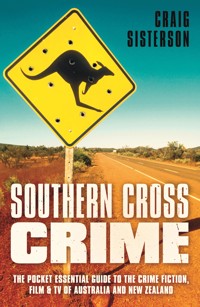
Southern Cross Crime E-Book
9,59 €
Mehr erfahren.
- Herausgeber: Oldcastle Books
- Kategorie: Geisteswissenschaft
- Sprache: Englisch
Australian and New Zealand crime and thriller writing is booming globally, with antipodean authors regularly featuring on awards and bestseller lists across Europe and North America, and overseas readers and publishers looking more and more to tales from lands Down Under. Hailing from two sparsely populated nations on the far edge of the former Empire - neighbours that are siblings in spirit, vastly different in landscape - Australian and New Zealand crime writers offer readers a blend of exotic and familiar, seasoned by distinctive senses of place, outlook, and humour, and roots that trace to the earliest days of our genre. Southern Cross Crime is the first comprehensive guide to modern Australian and New Zealand crime writing. From coastal cities to the Outback, leading critic Craig Sisterson showcases key titles from more than 200 storytellers, plus screen dramas ranging from Mystery Road to Top of the Lake. Fascinating insights are added through in-depth interviews with some of the prime suspects who paved the way or instigated the global boom, including Jane Harper, Michael Robotham, Paul Cleave, Emma Viskic, Paul Thomas, and Candice Fox.
Das E-Book können Sie in Legimi-Apps oder einer beliebigen App lesen, die das folgende Format unterstützen:
Seitenzahl: 398
Veröffentlichungsjahr: 2020
Ähnliche




















‘Out where the river broke
The bloodwood and the desert oak
Holden wrecks and boiling diesels
Steam in forty-five degrees’
Midnight Oil, ‘Beds Are Burning’
‘Out here on the edge,
The empire is fading by the day …
… There’s a woman with her hands trembling, haere mai,
And she sings with a mountain’s memory, haere mai,
There’s a cloud the full length of these isles,
Just playing chase with the sun,
And it’s black and it’s white and it’s wild,
All the colours are one.’
Dave Dobbyn, ‘Welcome Home’
Digging Up The Bodies
Michael Robotham
Thus far, I have killed more than forty people in my career. The exact number is verifiable, if I were to dig up the bodies or look back over my notes. I haven’t hidden my crimes. The details are written down in black and white, stored on bookshelves and e-readers across the world, documented in two dozen languages.
It might seem like a large body count, but I’ve been at this for a long time. I have shot, stabbed, suffocated, smothered, speared, squashed, drowned, poisoned and run-down my enemies and friends; good people and bad. On top of this have been numerous kidnappings, suicides, robberies and sex crimes.
I am a serial offender, killing for company and entertainment, feeding readers who like their crimes to be dark and twisty, with motives that are grand, or base, then never, ever (hopefully) boring.
Crime is in my blood. My great great great (I can’t count any higher) grandfather, George Robotham, was transported to Van Diemen’s Land (Tasmania) in 1827 after he robbed a cottage and stole a watch. He was only seventeen. Ten years later, he married an English girl, Anne Harris, who was also seventeen when she was transported for stealing a shawl. They had nine children and neither saw England again.
People have often made fun of Australia’s convict ancestry, most notably New Zealanders. It’s like when the Aussie customs officer asked a Kiwi if he had any criminal convictions and was told, ‘Why? Is it still necessary?’ An oldie but a goodie. Equally, it could be argued that we Aussies don’t miss importing our thieves and petty criminals from England, because now we get them from New Zealand. Touché.
The rivalry is alive and well, and not just on the sporting field, but when push comes to shove (I’m not talking rugby) Aussies and Kiwis have far more in common than we’ll ever readily admit. One of these things is that we punch way above our weight when it comes to crime fiction.
This book is evidence of that fact; a long overdue guide to the very best in Australian and New Zealand crime fiction, film and TV drama, put together by one of the world’s most knowledgeable and respected reviewers and interviewers, Craig Sisterson. The word ‘essential’ is in the title for good reason because few people know as much as Craig does about crime writing in Australasia or have devoted so much of their lives to their passion for stories that thrill, frighten, puzzle and surprise us.
All the usual suspects are within these pages, including the giants upon whose shoulders I have stood, such as Ngaio Marsh, Arthur Upfield and Fergus Hume. These pioneers laid the groundwork for those who followed – the next generation of writers like Peter Corris, Marele Day, Peter Temple, Paul Thomas, Vanda Symon and Paul Cleave, who showed Aussie and Kiwi readers that we didn’t have to look to America or Britain to find our whodunits and whydunits; our cosy crime reads and our thrillers.
When my first crime novel was published in 2004, the bestseller lists in Australia and New Zealand were dominated by Dan Brown, Patricia Cornwall, John Grisham, Michael Crichton and James Patterson. There wasn’t a single Aussie or Kiwi crime writer who got within cooee of the top fifty books, let alone the Top Ten. Now our lists are dominated by the likes of Liane Moriarty and Jane Harper, along with a growing list of equally brilliant young crime writers.
What has changed? I think we’ve grown up and no longer see ourselves as upstart younger siblings, who have to copy what has been successful overseas. Australia and New Zealand have our own unique landscapes and language, the dry humour and disrespect for authority. We have our own stories to tell, full of characters we recognise, set in places we know. Novels that explore the individualism of the outsider, as well as mateship, gender, race and justice.
Readers around the world are beginning to crave what we are offering: a unique sense of place and distinctive voices. We are not Nordic Noir, or Tartan Noir, or Emerald Noir. We are Outback Noir and Yeah Noir.
Our protagonists are a mixed bunch of whisky-soaked private eyes, ex-strippers, political fixers, hitmen, paramedics, pathologists, psychologists, detectives and outback policemen. The broken and the unbreakable. Heroes and anti-heroes.
If you want to know us better – this can be your guide. Follow the directions carefully and you will enter a world of suspense, tension, murder and intrigue, where you will be required to expose the lies, interrogate witnesses and interpret the evidence.
These aren’t just mysteries. They are laden with information about who we are; our politics, laws, police, and criminal underworld. And they will help us explore the dark side of our psyches. That’s why we love crime stories, because deep down, in places we don’t like to talk about, we wonder what it would be like to pull that trigger; or fear that someone we know might be lying beneath that white sheet.
You want bodies? Start digging.
Author’s Note and Introduction
Gidday and kia ora, thanks for dropping by. What you’re holding in your hands, or perusing onscreen, is something that several mates have told me is the inevitable result of my lifelong passion for mystery writing. Or more particularly the result of the last dozen years or so during which, among a rollercoaster of other adventures, shifts, and life changes, I’ve loitered around the crime scene on three continents as a feature writer, critic, awards judge, panel chair, event organiser, festival co-founder, and just general all-around nuisance.
Looking back, it’s been a crazy, random ride, full of memorable moments, unexpected opportunities, and hundreds of brilliant people. This mystery-loving kid from small-town New Zealand has been warmly welcomed by the crime writing community at home and abroad. I’ve got to wield a fiery torch while wearing a kilt and standing alongside Val McDermid, Denise Mina, and Liam McIlvanney as hundreds of mystery fans marched through historic Stirling. I’ve descended into the bowels of a medieval church in Dublin with John Connolly and Paul Cleave to tap fingers with an 800-year-old mummy. I’ve tried to keep my voice steady while speaking in Māori before elders and international guests as we opened the first-ever New Zealand crime and thriller writing festival on a Rotorua marae.
It all started with two libraries 7,000 miles apart, a legal magazine, and someone else not getting their article in by deadline, but that’s a story for another day. The key thing I want to say is that I feel amazingly lucky and very grateful to have become so involved in the crime writing tribe. There are too many people to thank – a sampling are listed in the acknowledgements. This reader’s guide is one way for me to pay all that forward.
Southern Cross Crime is designed to sit alongside my learned friend (sorry, once a lawyer…) Barry Forshaw’s excellent series of Pocket Essential guides to various slices of the international crime and thriller fiction pie. I’m here to bring the pavlova to Barry’s buffet.
Feel free to skip ahead and dive right in. The water’s warm and we have more than 300 Australian and New Zealand authors, television shows, and films for you to hang out with.
We’ve cleared out the crocs and things are reasonably signposted. But for those who are interested in a bit more background and context to Southern Cross Crime, read on.
The current state of antipodean crime writing
How ya goin’ mate? It wasn’t until I started travelling extensively in my 20s that I realised this common greeting Downunder wasn’t quite so typical elsewhere. I got some confused looks from new pals in America. But if we were to ask Australian and New Zealand crime writing just how it was going, the answer would be clear. Pretty good, mate, not too shabby.
Oh yeah, we do understatement a lot too. Antipodean crime is flying high internationally in recent years, arguably higher than it ever has in terms of a deep, wide pool of authors and books set Downunder catching the eye of publishers, awards judges, and hordes of readers.
We’ve always had some terrific crime writers in Australia and New Zealand, dating back 150 years (see below), but there certainly seems to be ‘something in the water’ lately.
The global success of The Dry, a sublime Outback mystery that won the CWA Gold Dagger in 2017, among many other awards, has certainly helped turn the eyes of northern hemisphere readers and publishers more and more towards lands ‘down under’.
Just as Ian Rankin and Val McDermid opened the sluices for Tartan Noir, and Henning Mankell and Stieg Larsson did the same for Scandi Crime, Jane Harper has become the crest of an increasingly powerful Downunder crime wave. Shortly before I typed these words, Canberra author Chris Hammer won the 2019 CWA John Creasey (New Blood) Dagger for his brilliant debut Scrublands. One of his fellow shortlistees was Vanda Symon, for the first in her terrific Sam Shephard series, Overkill. Dunedin author Liam McIlvanney was shortlisted for the Historical Dagger for The Quaker, which had already won Scotland’s crime writing prize and been shortlisted for other major awards in the United Kingdom and New Zealand.
The year before, Harper’s fellow Melbourne author Emma Viskic had her excellent debut about a deaf private investigator, Resurrection Bay, shortlisted for both the Gold Dagger and the New Blood Dagger, and Stella Duffy’s brilliant literary tag-team with a Queen of the Golden Age, Money in the Morgue, had been shortlisted for the Historical Dagger.
International bestseller status and overseas awards recognition are rolling in thick and fast for antipodean crime writers, whether they’re setting their tales at home or abroad. Beyond the UK, several other authors have won or been shortlisted for major American mystery writing prizes like the Edgar Awards and Barry Awards, and German and French prizes. Hit TV dramas and films have also sprung from the keyboards of Aussie and Kiwi storytellers.
For those of us who’ve been reviewing and writing about Australian and New Zealand crime writing for a while, it’s terrific to see overseas crime lovers jumping aboard. While there’s a bit of an ‘about bloody time’ feeling, given there have been some superb crime writers operating Downunder for many years before this recent ‘wave’, it’s also true that there’s been a surge in the numbers of people writing crime in Australia and New Zealand.
Entries for the Ned Kelly, Ngaio Marsh, and Davitt Awards have leapt significantly in recent years. Dozens of fresh voices are joining the Downunder crime tribe each year – a blend of first-time authors and storytellers from other spheres embracing their darker side. Crime (writing) is on the rise, and it’s bloody awesome. Our gang is growing.
While global recognition may be growing fast, antipodean noir is not a sudden trend or ‘overnight success’. The currents beneath this crime wave surging from the south run strong and deep; in fact, they can be traced back to the earliest days of the detective fiction genre.
A murderous history
‘What was the bestselling detective novel of the nineteenth century?’ is a good pub quiz question that may even stump many teams at the annual Theakston Old Peculier Crime Writing Festival quiz run by Mark Billingham and Val McDermid. Several years ago, I too would have guessed something like A Study in Scarlet, the first Sherlock Holmes novel, or thought I was clever by mentioning The Moonstone by Wilkie Collins.
Wrong, and wrong again.
The answer is, in fact, The Mystery of a Hansom Cab (1886), a still-very-readable tale set on the streets of ‘Marvellous Melbourne’, a city booming because of a gold rush and full of wealth and poverty rubbing up against each other. It was penned by theatre-loving Kiwi Fergus Hume who’d moved there from Dunedin hoping to become a playwright. Hume self-published the novel as a calling card, only to sell the copyright and then see his novel take off in the United Kingdom and United States, becoming the first-ever global blockbuster.
‘The success of Hansom Cab helped consolidate the emerging publishing genre of detective fiction, as well as drawing attention to the potential of antipodean writers,’ says Dr Lucy Sussex, a ‘literary archaeologist’ I first spoke to a few years ago when she published Blockbuster!: Fergus Hume and the Mystery of a Hansom Cab. It was more a biography of a book and its astounding success than about the author himself. ‘Hume understood that the setting, boomtown Melbourne, was as important as a character to crime fiction.’
As groundbreaking as Hume was on a global scale, he wasn’t the first antipodean crime writer. Sussex has long championed the importance of Mary Fortune, a trailblazing pioneer who began writing from remote goldfields and could be considered not only the mother of Australian crime writing, but the mother of the police procedural in a global sense. Under the pseudonyms Waif Wander and WW, Fortune penned more than 500 stories from the viewpoint of a police detective for the popular Australian Journal between 1865 and 1908.
Fortune’s use of a police narrator, her focus on realism, reliance on police procedure and ‘almost forensic depiction of violence’ predated and anticipated much of the more famous detective fiction that began emerging later in the nineteenth century, notes Sussex.
When Sisters in Crime Australia decided to establish their own crime writing awards on their tenth anniversary in 2001, specifically to celebrate female Australian crime novelists, they also honoured another rather forgotten but groundbreaking ancestor. ‘Ellen Davitt – who wrote one of the first crime novels ever published anywhere – by man or woman – was the natural fit for our own awards,’ says National Co-Convenor Lindy Cameron.
A few decades after Fortune, Davitt, and Hume were plying their trade, another theatre-loving Kiwi swept to global fame. From her home in the Cashmere Hills of Christchurch, an apartment in London, and on long steamship rides between New Zealand and Great Britain, Ngaio Marsh wrote 32 novels starring gentleman detective Inspector Roderick Alleyn, becoming one of the world’s bestselling authors of the mid twentieth century, earning a Grand Master Award from the Mystery Writers of America, and being acclaimed as one of the Queens of Crime.
While millions of mystery lovers around the world have read Dame Ngaio, fewer realise she wasn’t British like her fellow Queens of Crime (Agatha Christie, Margery Allingham, Dorothy Sayers), her detective, and most of her settings, but a ‘colonial’ from Christchurch.
Dame Ngaio stood out from her contemporaries and peers in several ways. Perhaps her love of theatre gave rise to her sharper dialogue and deeper characterisation. The Encyclopaedia Britannica credited Marsh with helping ‘raise the detective story to the level of a respectable literary genre by writing books that combine an elegant literary style with deftly observed characters and credible social settings.’ Her murder mysteries were massively popular. In 1949, one million copies were released on a single day. The only other authors to get that treatment were Christie, HG Wells, and George Bernard Shaw.
While the Mystery Writers of America bestowed its Grand Master Award for lifetime achievement on Ngaio Marsh in 1978 – making her the first author from outside North America or Europe to receive such an honour – she wasn’t the first antipodean author to earn an Edgar. In fact, the very first Edgar Award for Best Novel in 1954 went to Adelaide author Charlotte Jay for Beat Not the Bones, a psychological thriller set in New Guinea.
Four years later, The Bushman Who Came Back was shortlisted for the same prize. That was the 22nd of 29 mystery novels Arthur Upfield wrote starring Aboriginal detective and noted tracker Napoleon ‘Bony’ Bonaparte of the Queensland Police. Upfield began the series in 1929, during two decades he spent travelling through the Outback and learning about Aboriginal culture after he had served at Gallipoli and on the Western Front during the Great War. The books inspired a television series in the 1970s, after Upfield’s death, as well as a telemovie and spinoff series in the early 1990s.
While the early days of Australian and New Zealand mystery writing saw the likes of Fortune, Hume, and Marsh excel with antipodean spins on European traditions, the latter part of the twentieth century bled into the new millennium on more American influences.
In 1980, Peter Corris melded the hardboiled genre of Chandler and Hammett with distinctly Australian settings, characters, and voice in The Dying Trade, the first of more than 50 books starring Cliff Hardy. Upfield’s final Bony novel had been published in 1966, and publishers had lectured Corris that local readers didn’t want local mysteries, but he persevered, becoming the Godfather of modern Australian crime writing.
‘My enthusiasm for Sydney, tempered by all the things I know are wrong about it – the corruption, crime, political chicanery – all makes for interesting texture,’ Corris told me back in 2011. ‘‘You can’t just have action and character for a crime novel. There has to be backdrop, context to the story, and Sydney provides that for me in spades.’
Corris, who passed away in August 2018, broke new ground and opened doors for many Australian crime writers who are included among the pages of Southern Cross Crime, including encouraging the likes of Peter Temple and Michael Robotham (the first antipodeans to win the CWA Gold Dagger) early on in their crime writing careers.
About SouthernCross Crime
Putting together this reader’s guide to Australian and New Zealand crime writing, I had to set myself some parameters, for space constraints as much as anything. There are some fascinating stories about the early pioneers and the long history of antipodean crime writing. For those interested, I’d recommend you check out the books of Dr Lucy Sussex and Professor Stephen Knight, as well as Ngaio Marsh: Her Life in Crime by Joanne Drayton.
But for our purposes here, both in order to complement the fine works of Barry Forshaw in this Pocket Essentials series and to corral the contenders for inclusion while exploring the recent surge in global recognition and local numbers, I’ve focused on the ‘modern era’. I’ve chosen the establishment of the Australian Crime Writers Association and inaugural Ned Kelly Awards in 1996 as our starting point, giving us a pleasant quarter-century time span.
Perhaps fittingly, the first-ever Ned Kelly Award for Best Novel (named for the infamous Australian outlaw whose gang created suits of armour to wear in shootouts with police) was shared between Barry Maitland, an Australian author, and Paul Thomas, a New Zealander.
Our neighbouring countries – which share a frontier spirit, laidback attitude, and sense of humour that’s a little different to elsewhere, while having some stark differences in landscape, weather, and wildlife – have produced a range of fascinating crime writers over the years. I hope to give you a great taste of that within the pages of this pocket guide.
Within Southern Cross Crime you’ll find a diverse array of more than 300 Australian and New Zealand crime writers, television shows, and films. I’ve endeavoured to be as inclusive and wide-ranging as possible, covering the hugely popular bestsellers and highly regarded award-winners some of you may recognise, as well as plenty of hidden gems and lesser known authors, both fresh voices and those from the earlier days of our modern era.
I’ve also gone my own way a bit (sorry Barry), by including some historical crime written during this modern era alongside contemporary tales, and some examples of crime and mystery writing for younger readers. I fell in love with mystery fiction by reading the Hardy Boys and Enid Blyton tales as well as Sherlock Holmes and Hercule Poirot as a youngster.
Anyone who encourages kids to develop a love of reading, who opens those early doors to a whole world of learning and stories and imagination and possibility, is a rock star in my books. So, there’s no way I was going to write a book that didn’t include some of them.
In Section Three there are extended interviews with a baker’s dozen of leading Australian and New Zealand crime writing figures; some brand-new interviews conducted specifically for Southern Cross Crime, and some from different points over the past decade.
It’s been an absolute privilege (and slog) putting this readers’ guide together. The hardest part has been – despite including more than 300 storytellers and screen stories – leaving out others that readers and viewers would enjoy. So please consider Southern Cross Crime a comprehensive overview of the modern antipodean crime and thriller writing scene, but not the definitive final word. Come in, join the party, I hope you enjoy having a look around.
A note on locating authors in Southern Cross Crime
In order to bring some shape to this survey of modern Australian and New Zealand crime writing, you’ll see that I’ve divided things into sections, using a bit of a cocktail of geography, content, and intended readership. I’m usually more for inclusion than division, but hopefully these headings will provide some guidance for you to find things you may be particularly interested in, whether it be rural noir or mysteries for younger readers.
Of course, being the headstrong, multi-talented bunch they are, many Aussie and Kiwi crime writers resist pigeonholing, and spread their wings across multiple locations and styles. Authors living in one place write books set elsewhere: should they be placed with their hometown or their detectives? I’ve tended to lean to the latter. Rather than burdening you with footnotes and intricate cross-referencing that my old law professors would have loved but you might hate, I’ve tried to keep things relatively clean and simple.
With one exception, there’s one entry for each author in the main section of this book. I’ve aimed for common sense in terms of where I placed them, but some were 50:50 calls. If you want to find a particular author, the speediest way is to search.
Section One: The novels and the authors
Mean Streets – Big City Crime
Sydney
While clinical psychologist LEAH GIARRATANO harnesses her expertise in psychopathology and trauma counselling in her four crime novels, she doesn’t go as far as some crime writers whose main characters seem akin to author avatars, sharing the same profession. Instead, Giarratano’s series centres on ambitious Sydney detective Jill Jackson, who survived a traumatic childhood. In the third book Black Ice, Jill has shed her cop persona and is experiencing Sydney’s drug scene up close: working undercover in a dingy flat, befriending addicts, and aiming to take down one of Sydney’s most violent drug kingpins. But when Jill’s sister Cassie, a model dating a high-profile lawyer, overdoses and is hospitalised, plans fray. Cassie’s boyfriend is connected to the drug trade and being targeted by a vengeful ex, further complicating matters. Giarratano guides readers into a gritty world where addicts high and low will do anything for a fix, and amoral suppliers harvest profits from others’ suffering. Taut writing and memorable, authentic characters elevate a troubling tale that will make readers think about the lives behind the headlines.
* * *
For all the middle-aged aspiring crime writers out there who are worried they’ve left it too late, BARRY MAITLAND is an inspiration on two fronts: first, he’s a superb storyteller worth studying as well as reading for enjoyment; second, he’s had a fruitful career (16 novels and counting) since publishing his debut partway through his sixth decade. Following a dozen books starring Detectives Brock and Kolla and set in his childhood home of London (the second of which, TheMalcontenta, was co-winner of the inaugural Ned Kelly Award), Maitland launched a new series set in the land he’s called home for most of his adult life. CrucifixionCreek introduced maverick Aboriginal detective Harry Belltree, who carts plenty of baggage from his military service and the car crash that killed his parents and blinded his wife. When a Sydney journalist uncovers a link between three peculiar incidents – a meth-addled biker gunning down a woman during a siege, an elderly couple committing suicide, a tradesman being stabbed – Harry has to turn to the soldier inside himself as much as the cop. Maitland keeps the tension crackling with gripping action, characterisation, and setting, leaving readers wanting more of Harry Belltree. Thankfully, Ash Island and Slaughter Park followed.
* * *
Nowadays known for its exquisite Vietnamese cuisine, a generation ago the western Sydney suburb of Cabramatta was considered a ‘war zone’ by police, an open-air heroin market sparked by American servicemen and fought over in gang shootouts. PM NEWTON plunges readers into that maelstrom via Detective Nhu ‘Ned’ Kelly, a part-Vietnamese cop who stars in a very fine duology. In Beams Falling, the follow-up to Newton’s award-winning debut The Old School, Nhu’s body and mind are torn by past events. She’s seen as a hero by her bosses but not all her colleagues, and while struggling to recover is made the token Asian officer on a task force investigating Cabramatta’s immigrant population as part of the War on Drugs. Politics and personalities clash as teen killers roam the streets, but Nhu has an elderly kingpin in her sights, for personal vengeance. Newton, who was a Sydney detective herself, delivers a confronting tale brimming with veracity that spares few from suffering. A crime novel that’s as much about corruption, trauma, and healing as solving a mystery.
* * *
While the smash-hit HBO adaptation starring Nicole Kidman and Reese Witherspoon takes place in coastal California, LIANE MORIARTY’s novel Big Little Lies is set in Pirriwee, a fictional suburb in Sydney’s ritzy Northern Beaches. It’s an area known for its wealth and overwhelming ‘whiteness’ in an ethnically diverse and multicultural city. Big Little Lies is a captivating book that explores some disturbing issues (bullying, domestic violence, rape) beneath its chick-lit veneer. Opening with a shocking death at a school trivia evening, Moriarty then backtracks and takes readers through all that led up to the deadly night. Madeline, Celeste, and Jane are three kindergarten mothers, all with secrets and stresses, meeting at the school gate. It’s a world of competitive parenting, schoolyard scandals, and factions forming over children’s actions and accusations. Adult secrets, big and small, fester throughout an unusual murder mystery that’s not just a whodunnit, but a who-died? Moriarty melds humour and gossipy characters with sharp observations about parenting and the complexities of family life, crafting a clever tale that deepens and darkens as it unfolds.
* * *
From Rebus’s battered black Saab to Inspector Morse’s burgundy Jaguar (a Lancia in Colin Dexter’s original books), several famed fictional detectives have their favourite cars. Billy Lime, the anti-hero of MARK HOLLANDS’ delightfully caper-style novel Amplify, leans more Magnum PI or Miami Vice in his means of transport. The music promoter is notorious for racing around Sydney streets in his bright-green Lamborghini. When a legendary singer is poisoned ahead of a lucrative world tour, and a biker gang has stashed $100 million in cocaine in the band’s freighted equipment, Lime’s world implodes. Amplify takes readers backstage for an unvarnished look at the world of rock music and events promotion. A compelling debut that veers over-the-top on occasions, it’s a fresh and rip-roaring tale peppered with dark deeds and leavened by a fun, almost tongue-in-cheek vibe. Full of crazy characters, humour, and high-stakes action; Hollands does a fine job conducting the fray.
* * *
Long before the current, global ‘domestic noir’ boom, Sydney journalist and academic BUNTY AVIESON traversed such territory in her 2001 novel Apartment 255, an acute psychological thriller which went on to scoop two Ned Kelly Awards. It’s the story of best friends Sarah and Ginny, who’ve known each other since their school days. Sarah is cheerful, Ginny is shy; Sarah is protective of Ginny. Things begin to go awry when Sarah meets Tom, moves into a stunning apartment with him, and starts planning a marriage. Ginny wanted Tom for herself; she wants Sarah’s life, and starts stalking the couple. And worse. Sarah may be protective of Ginny, but perhaps she needs protection from her. A chilling tale of envy and obsession swirling around striking and indelible characters. Avieson followed Apartment 255 with two further psychological thrillers, The Affair and The Wrong Door.
* * *
There’s a rich tradition of campus mysteries in crime fiction, dating back to Golden Age queen Dorothy Sayers’ Gaudy Night set among Oxford’s spires in the 1930s. CATH FERLA offered a fresh spin on the pressures faced by students and teachers, and secrets cloistered within educational institutions, in her evocative debut Ghost Girls. When a Chinese student at a Sydney language school leaps to her death, only for it to be revealed that she’d stolen someone’s identity, new teacher Sophie Sandilands is driven to investigate. The trail leads her deep into the city’s Chinatown, a place of rich flavours and hidden networks that leaps off the page thanks to Ferla’s assured and sensory writing. There’s a pulsing authenticity throughout, from the scratching at the underbelly of Sydney and the exploitation of foreign students wanting to learn English to the times the tale flashes back to mainland China, where the author has lived and taught. An evocative and insightful first bow.
* * *
Long before Peter Temple, Michael Robotham, and Jane Harper were scooping CWA Gold Daggers and raising the flag for Australian crime writing on the global stage, a strong foundation was laid by the great PETER CORRIS. The prolific Sydney author singlehandedly kick-started the modern era Downunder in 1980 when he broke through after much publisher rejection with The Dying Trade. That tale was a distinctly Aussie version of the American hardboiled tales that Corris loved, with a distinctly Aussie hero: boxer and soldier and law school dropout turned private eye Cliff Hardy. By the time the Ned Kelly Awards were launched in the mid-1990s, Corris had already published 18 Cliff Hardy books. He was one of the early recipients of the Lifetime Achievement Award from the Australian Crime Writing Association, in 1999, and would go on to write dozens more. ‘The Demon Dog of American Crime Fiction’, James Ellroy, called Corris a true original and praised his ‘forceful, hard-driven, compassionate’ portrayals of Australian crime. In The Black Prince, the 22nd in the series, Corris delivers a pacy, engaging tale while exploring issues of sport and ethnicity in Australia as Hardy is called to investigate the disappearance of a star athlete, the son of the West Indian owner of Hardy’s gym. The Sydney private eye finds himself traversing rural New South Wales, a remote Aboriginal settlement in Far North Queensland, and the corrupt world of underground, illegal boxing. In the more recent Follow the Money, Hardy is aging and in a slump: he’s lost his private eye license and his entire life savings – embezzled by a dodgy financial adviser, who later wound up dead. But then Hardy’s unofficially ‘hired’ by a slick lawyer to find out whether the embezzler faked his own death, an assignment that has the budding granddad entwined with ethnic gangs and Sydney’s gritty underbelly. Sadly, Corris passed away in 2018, but he remains a giant on whose shoulders many have stood.
* * *
One of the pillars of the early years of Australian crime’s modern era, MARELE DAY made her name with a quartet of novels that subverted the masculine tropes of hardboiled private eye fiction. Her Claudia Valentine mysteries explored the seedier side of Sydney in the late 1980s to early 1990s, scooping a prestigious Shamus Award in the United States. In the last 25 years Day has largely focused on other types of storytelling, although she briefly revisited Valentine in 2000 with Mavis Levack, PI. A book of short stories centred on the nosy neighbour from Valentine’s first appearance, who desperately wants to be an investigator herself, Day’s swansong-so-far to crime fiction is cosier, more light-hearted, and amusing.
* * *
Given that crime fiction deals with the darkest of dark deeds, it’s no surprise that a decent seasoning of humour is also often part of the genre. From gallows to guffaws, many authors seek to balance out the bleakness. Former Sydney City councillor CS BOAG steers hard intothe laughs in his Mister Rainbow series, tongue-in-cheek modern noirs featuring a shabby, retro private eye who lives (illegally) on a boat in Sydney Harbour. Careening around the city’s dives, backstreets, and shady areas as he staggers towards solutions in tales full of quips, slang, and asides, Mister Rainbow is surrounded by an intriguing cast of characters. In The Case of a Death of a Ladies’ Man a neck tattoo helps identify a headless corpse in a Kings Cross alley as a much-hated member of Sydney’s underworld, but something fishier may be afoot. A clever, knowing spin on pulp tales from the past, Mister Rainbow’s adventures bring the zing.
* * *
What would you do if you were falsely accused of a horrifying crime, your family turned against you, and no one was looking for the real culprit? That’s the scenario facing David Kingsgrove, a single gay man in his 30s, in NIGEL BARTLETT’s hard-hitting King of the Road. David’s 11-year-old nephew Adam regularly visits him on weekends but vanishes one day after heading out of David’s door to play with a neighbour. Police and family suspicion turn towards the gay uncle, a fixation David knows will only worsen given someone has downloaded child pornography onto his computer. A virus, or is he being set up? Veering towards panic-stricken, and only believed by ex-cop and personal trainer Matty, David goes on the run, knowing that only makes him look even guiltier and will spark a police manhunt. Bartlett crafts a riveting, thought-provoking tale about a good man pushed beyond his limits into a dangerous place where he risks losing himself while trying to find his nephew.
* * *
Known as ‘Australia’s first lady of crime’, GABRIELLE LORD broke through in 1980 with Fortress, loosely based on the infamous Faraday School incident in Australia where a rural teacher and her students were kidnapped and held for ransom. Fortress was later adapted into an award-winning HBO telemovie. While Lord’s thriller career began in the backblocks, she subsequently built her legacy on character-centred tales set in and around Sydney’s eastern suburbs. Lord’s two series starring private eye Gemma Lincoln and forensic scientist Jack McCain contributed greatly to her receiving the Ned Kelly Lifetime Achievement Award in 2012. In Death Delights,former detective McCainreluctantly helps a detective mate investigate some grisly killings, while also following an anonymous tip about his own missing daughter. Links between crimes new and old spotlight the dysfunction within McCain’s own family. Lord blends police procedural, forensic elements, family drama and Australian sensibilities into a compelling tale that kick-started a fine series as well as making her the first female winner of the Ned Kelly Award for Best Novel. In more recent years Lord has focused on thrilling younger readers with her Conspiracy 365 and 48 Hours series.
* * *
There are few characters in Australian storytelling that epitomise the concept of ‘larrikin’ more than ROBERT G BARRETT’s long-running protagonist Les Norton. For those unfamiliar, larrikin is an antipodean term for a boisterous young (usually) bloke who blends a disregard for authority or propriety with an underlying good heart. A mischievous, uncouth maverick, Norton could be the poster child. He’s a strapping meat worker from rural Queensland who shifts to Sydney in the 1980s, plays rugby league and works as a bouncer for underground casinos while getting himself into all sorts of scrapes. Norton starred in 20 books over 25 years before Barrett’s death in 2012. (He was also belatedly brought to screen in 2019, with some of the roughest edges sanded off to reflect modern times.) Barrett firmly sets his phasers to fun in his series of pulp tales that are full of action, comedy, and crime. Delivered in distinctly Australian vernacular and full of irreverence and ‘old school’ attitudes, novels like Guns ‘N’ Rose, The Wind and the Monkey, and High Noon in Nimbin showed that Barrett and Norton remained an unforgettable duo even after the 1980s had long since passed.
* * *
Stroll into any second-hand bookshop around the world and you’re likely to find dozens and dozens of detectives – on the shelves, that is, not standing behind the counter. But in LENNY BARTULIN’s endearing trilogy of Jack Susko mysteries, it’s a bookseller who becomes an accidental sleuth. Following on from Death by the Book, Susko returned in The Black Russian, cash-strapped and in danger of losing his beloved bookshop. While visiting an art gallery in Sydney’s eastern suburbs to raise money by selling an old art catalogue, he interrupts a robbery, losing a valuable Ian Fleming first edition in the process. When the gallery owner offers to pay to keep things quiet, then reneges, Susko ends up bumbling and wisecracking his way through his own investigation, and into all sorts of danger. In Bartulin’s adroit hands, Sydney provides a vivid and evocative backdrop to Susko’s misadventures. Clever and exciting storytelling with a through-line of fun; De Luxe capped the trilogy.
* * *
When EMMA DARCY turned to crime as the millennium turned, it was fitting that the heroine of her first mystery, Who Killed Angelique?, was a romance novelist turned amateur sleuth. For Darcy herself, like the fictional KC Gordon, had previously penned dozens of romances under her pseudonym (which began as wife-and-husband writing team Wendy and Frank Brennan in the 1980s – before Frank passed away in 1995 – and collectively sold more than 60 million romance novels). In Who Killed Angelique? KC Gordon is sparked into sleuth-mode when her old school friend, an international model, is gunned down before she can reveal the ‘dirt’ she told KC she had to share. Darcy leans cosy rather than gritty in her crime debut, delivering a victim whom many may want dead, an engaging heroine, and plenty of suspects and red herrings while switching perspectives among those involved. KC Gordon continued her sleuthing side-gig in Who Killed Bianca? and Who Killed Camilla?
* * *
Forced to leave a 20-year career policing the Newtown, Kings Cross, and Bondi areas of Sydney after she was diagnosed with chronic post-traumatic stress disorder, KAREN M DAVIS decided to ‘write what she knew’. She first chronicled the highs and lows of her police experiences as therapy, then channelled her inside knowledge into a crime fiction series. Detective Lexie Rogers first appears in Sinister Intent as a freshly minted Bondi detective who has returned to duty after eight years patrolling Sydney’s notorious Kings Cross district and surviving a brutal attack. In the third in the series, Fatal Mistake, Rogers goes deep undercover as a drug distributor to infiltrate and expose a huge drugs ring in her city. Davis shows storytelling chops to match her authentic detail. Crisp writing conveys an exciting page-turner which illustrates the thrills and dangers of undercover work, the nature of organised crime, and the pressures and trauma faced by modern-day police officers.
* * *
When the Australian Crime Writers Association inaugurated its Ned Kelly Awards to reward excellence in the growing local genre in 1996, it named Sydneysider JON CLEARY as its first-ever recipient of the prestigious Lifetime Achievement Award. It was an apt choice. Cleary began writing for newspapers and working on his first novel, about an army deserter accused of murder, while stationed in the Middle East and the Pacific during the Second World War. He wrote more than 50 books over the next six decades, including 20 in his groundbreaking series starring Sydney homicide detective and family man Scobie Malone. In the years following his Lifetime Achievement honour, Cleary continued to write crime tales reflecting various aspects of modern Australia. In A Different Turf, Malone investigates a series of gay bashings and murders, shedding some prejudices. In Bear Pit a politician is murdered ahead of Sydney hosting the 2000 Summer Olympics, allowing Cleary to air issues he had with both the Olympics and the state of Australian politics. Fittingly, the ‘grandfather of Australian crime’ went out on top, with the final Scobie Malone novel, Degrees of Connection – about a murder case entwined with corporate crime and dodgy property developments – winning the 2004 Ned Kelly Award for Best Novel.
* * *
Sport is an intrinsic part of antipodean culture, and in Australia cricket is king. Some have even said that examining Australian cricket tells you a lot about Australian culture. MALCOLM KNOX, who was a renowned cricket correspondent then literary editor at the Sydney Morning Herald, tapped into that nexus in Adult Book (titled A Private Man in Australia). A respected Sydney doctor dies on the eve of a cricket test against South Africa; eldest son Davis is also a doctor and is suspicious. Middle son Chris is focused on playing in the test and salvaging his sporting career. Youngest son Hammett is a player in the porn industry, and shunned. Hypocritical, perhaps. A novel of grief and guilty secrets, blending sport, crime, and family drama. Knox brings a healthy verisimilitude to both the Sydney setting, from grimy red-light districts to wealthy suburbs, and moments of on-field action.
* * *
Crime fiction offers readers a huge range of private eyes, and ‘Crocodile Dundee in female form’ sounds pretty intriguing, eh? That’s what CLAIRE MCNAB delivers in her five novels starring Los Angeles-based Kylie Kendall, a gumshoe originally from the Outback. Delightfully entitled (The Wombat Strategy, The Platypus Ploy etc), they offer crime heavily laced with comedy, with Kendall the centrepiece of McNab’s third lesbian crime series, spanning almost 30 books dating back to 1988 when the then-Sydney author (she later moved to LA herself, for love) broke new ground locally with her first Detective Carol Ashton book. Talented, intense, glamorous, and closeted, Ashton solves crimes in Sydney and beyond in a long-running and popular series (17 books) threaded with underlying social and political themes and relationship woes. In Accidental Murder, Ashton is stressed by a tricky case where a series of unconnected people have suffered what seem like accidental deaths. In 2012, McNab and Ashton, now a Chief Inspector, took readers on a final ride in Lethal Care, which involved two puzzling deaths: that of a media star undergoing controversial cancer treatment, and the police inspector who had originally been investigating the case.
* * *
Crime fiction is a far broader landscape nowadays than the crossword-puzzle mysteries and mean streets noir of days gone by, and Sydney professor JOHN DALE has roamed across that landscape. His oeuvre includes an intense, award-winning tale about a violent, ambisexual casino bouncer, a bestselling true crime biography, a futuristic thriller, and editing the excellent Sydney Noir collection of varied short stories. The latest of Dale’s three crime novels, Detective Work, once again delves into issues of police corruption that have laced his earlier work. Young detective Dimitri Telegonus is paired with a senior detective who’s a bit of a dinosaur and previously worked under a commanding officer found guilty of multiple corruption charges. Part of a new taskforce investigating unsolved crime, the duo is tasked with solving the historical disappearance of an escort, only for the long-time prime suspect to vanish. There’s plenty of conflict between the detectives, and more broadly throughout this impressive novel. Dale does a good job reflecting the multicultural and increasingly stratified realities of modern-day Australia and tenders a fresh take on the common blueprint.
* * *
What would you do if you were a journalist who had an interview with famed chef Gordon Ramsay go so disastrously he threw you out of his house, topped only by another interview with deadly Australian gangster Chopper Read that became a yelling match? If you were MARK DAPIN, you’d seed those experiences into a short story, then propagate a novel. In King of the Cross, young Jewish journalist Anthony Klein has immigrated to Sydney from Britain and lives opposite the police station in the notorious Kings Cross inner-city suburb (shadowing Dapin’s own journey). The underworld boss of the Cross, Jacob Mendoza, chooses to unload his extraordinary life story onto Klein: it’s a confronting, slang-filled, sordid tale full of violence but also humour. Dapin’s gritty novel told in sharp prose may be too much for those who lean cosy but it’s a fresh and engaging take on local crime.
* * *
Back when I was at law school, we loved quoting rumpled lawyer Dennis Denuto from rollicking Australian comedy film The Castle, where he summed up a case with ‘it’s the constitution, it’s Mabo, it’s justice, it’s law, it’s the vibe’. Irreverent, yes, but also a nod to a key court decision that overturned the repugnant idea that Australia was terra nullius (empty land) before the arrival of Europeans, and recognised land rights of its indigenous peoples. I’m recalling that now as I think of groundbreaking crime writer PHILIP MCLAREN, not just because McLaren wrote some terrific thrillers entwined with race relations in the wake of Mabo, but because before the Kamilaroi tribe member came along the Australian crime fiction landscape was itself a pretty ‘empty land’ in terms of indigenous voices and perspectives. After an award-winning historical thriller, McLaren directed his considerable talents to contemporary Sydney crime in Scream Black Murder. Two Aboriginal detectives face scrutiny inside and outside the police department when they investigate the brutal murder of an Aboriginal couple in Redfern in a case that escalates into a hunt for a deranged killer targeting indigenous women. McLaren delivered a fine tale doused in social issues and a nuanced look at race relations. Later thrillers were set against the mining of sacred native land (Lightning Mine) and a deprived Aboriginal community in the Outback (Utopia).
* * *
After being made redundant from the public service, Canberra author ALEX PALMER turned to crime. Interested in the psychology of violence and its effects on both victims and those who constantly face violence in their jobs, Palmer wrote a trilogy of gritty crime tales starring detectives Paul Harrigan and Grace Riordan. In the first, Blood Redemption, the Sydney police duo face personal and professional demons while investigating a case where a son saw a teenage girl shoot his parents on a city backstreet. Things get even more personal for Harrigan when he discovers his own wheelchair-bound son has been emailing with the young killer. Palmer’s engaging first bow was followed by The Tattooed Man, where Harrigan and Riordan are drawn into the murders of four dinner guests in a ritzy Sydney suburb, and The Labyrinth of Drowning, ignited by a body in the Sydney bushland.
* * *
Thirty years ago, ALAN DUFF took his first steps towards a reputation as the enfant terrible of Māori novelists with his searing portrayal of New Zealand’s violent underbelly in Once Were Warriors. (His earlier attempt at a straight thriller was rejected by publishers; he burned the manuscript.) A harrowing tale of domestic violence and deprivation told with considerable literary panache, Duff’s debut and the hard-hitting film it spawned earned him international acclaim. In the years since, along with his charity that has distributed more than 12 million books to children in the poorest schools, Duff continued to explore the intersection of violence, crime, and family relationships in several fine novels (including two sequels to Once Were Warriors). In the recent Frederick’s Coat, Johno is a young Māori in Sydney with lawbreaking in his blood. After a stretch in prison he’s left to raise his sensitive and increasingly odd son Danny. Can Johno stay on the straight and narrow and prevent calamity? Duff has penned a moving, beautiful tale about love and loss, choice and consequences, the ripples created from criminal acts and the struggle to break free.
* * *
In recent years JEAN BEDFORD has been co-founder and editor of acclaimed Sydney online magazine TheNewtown Review of Books.




