


25,99 €
Mehr erfahren.
- Herausgeber: John Wiley & Sons
- Kategorie: Wissenschaft und neue Technologien
- Serie: RGS-IBG Book Series
- Sprache: Englisch
Examines the residential, policed, and infrastructural landscapes of New and Old Delhi under British Rule. * The first book of its kind to present a comparative history of New and Old Delhi * Draws on the governmentality theories and methodologies presented in Michel Foucault's lecture courses * Looks at problems of social and racial segregation, the policing of the cities, and biopolitical needs in urban settings * Undertakes a critique of colonial governmentality on the basis of the lived spaces of everyday life
Sie lesen das E-Book in den Legimi-Apps auf:
Seitenzahl: 529
Veröffentlichungsjahr: 2011
Ähnliche



















Contents
Figures
Tables
Abbreviations
Archival_References
Series Editors’ Preface
Preface
Chapter One Imperial Delhi
Security, Territory, Population
Colonial Governmentality
New Delhi: Showcase of Sovereignty
A case for urban regicide? Beyond the capital
The tombstone of the Raj?
Chapter Two Residential and Racial Segregation: A Spatial Archaeology
Archaeology
Colonial Spaces of Dispersion
The Spatial Administration of Precedence
The Spatial Dissolution of Order
Chapter Three Disciplining Delhi
New Delhi: Policing the Heart of Empire
Anti-colonial Nationalism and Urban Order
‘ReligiousNationalism’ and Urban Diagrams
Chapter Four Biopolitics and the Urban Environment
Population Expansion and Urban Disorder
Congestion Relief, Calculation and the ‘IntensityMap’
The Western Extension, Protest and Failed Relief
Slum Clearance and the Strictures of Imperial Finance
Chapter Five Conclusions: Within and Beyond the City
Interlinked Landscapes of Ordering
Beyond Colonial Delhi
Notes
bibiliography
index
RGS-IBG Book Series
The Royal Geographical Society (with the Institute of British Geographers) Book Series provides aforum for scholarly monographs and edited collections of academic papers at the leading edgeof research in human and physical geography. The volumes are intended to make significantcontributions to the field in which they lie, and to be written in a manner accessible to the widercommunity of academic geographers. Some volumes will disseminate current geographicalresearch reported at conferences or sessions convened by Research Groups of the Society.Some will be edited or authored by scholars from beyond the UK. All are designed to havean international readership and to both reflect and stimulate the best current research withingeography.
The books will stand out in terms of:
the quality of researchtheir contribution to their research fieldtheir likelihood to stimulate other researchbeing scholarly but accessible.For series guides go to www.blackwellpublishing.com/pdf/rgsibg.pdf
Published
Geomorphology of Upland Peat: Erosion, Form and Landscape Change
Martin Evans and Jeff Warburton
Spaces of Colonialism: Delhi’s Urban Governmentalities
Stephen Legg
People/States/Territories
Rhys Jones
Publics and the City
Kurt Iveson
After the Three Italies: Wealth, Inequality and Industrial Change
Mick Dunford and Lidia Greco
Putting Workfare in Place
Peter Sunley, Ron Martin and Corinne Nativel
Domicile and Diaspora
Alison Blunt
Geographies and Moralities
Edited by Roger Lee and David M. Smith
Military Geographies
Rachel Woodward
A New Deal for Transport?
Edited by Iain Docherty and Jon Shaw
Geographies of British Modernity
Edited by David Gilbert, David Matless and Brian Short
Lost Geographies of Power
John Allen
Globalizing South China
Carolyn L. Cartier
Geomorphological Processes and Landscape Change: Britain in the Last 1000 Years
Edited by David L. Higgitt and E. Mark Lee
Forthcoming
Politicizing Consumption: Making the Global Self in an Unequal World
Clive Barnett, Nick Clarke, Paul Cloke and Alice Malpass
Living Through Decline: Surviving in the Places of the Post-Industrial Economy
Huw Beynon and Ray Hudson
Swept up Lives? Re-envisaging ‘the Homeless City’
Paul Cloke, Sarah Johnsen and Jon May
Badlands of the Republic: Space, Politics and Urban Policy
Mustafa Dikec
Climate and Society in Colonial Mexico: A Study in Vulnerability
Georgina H. Endfield
Resistance, Space and Political Identities
David Featherstone
Complex Locations: Women’s Geographical Work and the Canon 1850–1970
Avril Maddrell
Driving Spaces
Peter Merriman
Geochemical Sediments and Landscapes
Edited by David J. Nash and Sue J. McLaren
Inclusionary Geographies? Mental Health and Social Space: Towards Inclusionary Geographies?
Hester Parr
Domesticating Neo-Liberalism: Social Exclusion and Spaces of Economic Practice in Post Socialism
Adrian Smith, Alison Stenning, Alena Rochovska and Dariusz ´ Swia˛tek
ValueChain Struggles: Compliance and Defiance in the Plantation Districts of South India
Jeffrey Neilson and Bill Pritchard
© 2007 by Stephen Legg
BLACKWELL PUBLISHING
350 Main Street, Malden, MA 02148-5020, USA
9600 Garsington Road, Oxford OX4 2DQ, UK
550 Swanston Street, Carlton, Victoria 3053, Australia
The right of Stephen Legg to be identified as the Author of this Work has been asserted in accordance with the UK Copyright, Designs, and Patents Act 1988.
All rights reserved. No part of this publication may be reproduced, stored in a retrievalsystem, or transmitted, in any form or by any means, electronic, mechanical, photocopying,recording or otherwise, except as permitted by the UK Copyright, Designs, and Patents Act1988, without the prior permission of the publisher.
First published 2007 by Blackwell Publishing Ltd
1 2007
Library of Congress Cataloging-in-Publication Data
Legg, Stephen.
Spaces of colonialism: Delhi’s urban governmentalities/
Stephen Legg.
p. cm. — (RGS-IBG book series)
Includes bibliographical references and index.
ISBN 978-1-4051-5633-2 (hardcover: alk. paper) —
ISBN 978-1-4051-5632-5 (pbk: alk. paper)
1. Delhi (India)—Politics and government—20th century, 2. New Delhi
(India)—Politics and government. 3. Delhi (India)—Historical
geography. 4. New Delhi (India)—Historical geography. I. Title.
DS486.D3L37 2007
320.954’5609041—dc22 2006033545
A catalogue record for this title is available from the British Library.
The publisher’s policy is to use permanent paper from mills that operate a sustainableforestry policy, and which has been manufactured from pulp processed using acid-free andelementary chlorine-free practices. Furthermore, the publisher ensures that the text paperand cover board used have met acceptable environmental accreditation standards.
For further information on
Blackwell Publishing, visit our website:
www.blackwellpublishing.com
Figures
2.1 Sanctioned layout of New Delhi and the use of land as in 1914 2.2 Actual layout of New Delhi and the use of land as in 1938 3.1 Police patrols in New Delhi, 1943 3.2 Pickets and patrols on 12 August 1942 3.3 Policing for Id, 1927 3.4 CRS, Appendix A 3.5 CRS, Appendix B 3.6 CRS, Appendix C 3.7 CRS, Magistrate’s Patrols 3.8 Map from the CRS booklet 3.9 Moharram processions and policing, 1935 3.10 Id pickets, 1940 3.11 Pickets along the Guru Tegh Bahadur Commemoration Route, 1940 3.12 Time–space Routes for the Guru Tegh Bahadur Commemoration Procession, 1940 4.1 1912 sketch map of Delhi. Reproduced with permission of the National Archives, New Delhi 4.2 Population intensity in Old Delhi, 1931 4.3 Trust schemes, 1937–9 4.4 Trust schemes, 1939–41 4.5 Ajmeri Gate 4.6 Slums inside the city wallTables
1.1 Analytical chapter structure 1.2 Colonial Indian governmentality 3.1 Relation of police, population and area in Delhi 4.1 Census returns: Population increase in Delhi City, 1881–1931 4.2 Expenditure (lakh Rs) from the Trust account, 1936–41 4.3 Expenditure (lakh Rs) from the Nazul account, 1936–41 4.4 Accumulated Trust expenditure, 1936–41Abbreviations
BCE Before the Common Era CRS Communal Riot Scheme DAGS Delhi–Ajmeri Gate Scheme DIT Delhi ImprovementTrust DMC Delhi Municipal Committee DTPC Delhi Town Planning Committee ICS Indian Civil Service IDC Imperial Delhi Committee ISA Imperial Secretariat Association NDDC New Delhi Development Committee NDMC New Delhi Municipal Committee PWD Public Works DepartmentArchival References
CC Chief Commissioner’s Files DA Delhi State Archives, New Delhi DC Deputy Commissioner’s Files EUR/MSS European Manuscripts Collection FR Fortnightly Reports on the Political Situation in Delhi Province IORL India Office Records and Library at the British Library, London IPI Indian Political Intelligence files (edited by A.J. Farrington, microfiche published by IDC, London, 2000) NA Indian National Archives, New Delhi NMML Nehru Memorial Museum and Library, New Delhi SASL Centre of South Asian Studies Library, CambridgeSeries Editors’ Preface
The RGS-IBG Book Series only publishes work of the highest internationalstanding. Its emphasis is on distinctive new developments in human andphysical geography, although it is also open to contributions from cognatedisciplines whose interests overlap with those of geographers. The Seriesplaces strong emphasis on theoretically-informed and empirically-strongtexts. Reflecting the vibrant and diverse theoretical and empirical agendasthat characterize the contemporary discipline, contributions are expectedto inform, challenge and stimulate the reader. Overall, the RGS-IBGBook Series seeks to promote scholarly publications that leave anintellectual mark and change the way readers think about particular issues,methods or theories.
For details on how to submit a proposal please visit:
www.rgsbookseries.com
Kevin Ward
University of Manchester, UK
Joanna Bullard
Loughborough University, UK
RGS-IBG Book Series Editors
Preface
My attention was first drawn to Delhi by the brash arrogance yet undeniablebeauty of the new capital city, constructed between 1911 and 1931. AsI became more aware of the post-colonial literature regarding the colonialarchive and at times, the unwitting complicity of present intellectual formationswith those of the past, I grew uneasy regarding the representationsof New Delhi. Portrayals of the city communicated little of the teeminglife, confusion and buzz that are the hallmarks of the urban condition, evensuch a fabricated and dispersed condition as that created in the capital. Moreimportantly, there was a marked absence of evidence regarding the resistancethat always accompanies such unabashed demonstrations of authoritarianpower. It became apparent during my visits to Delhi, in 1997, 2001 and2003, that not only was the story of New Delhi incomplete, but that sucha story would also have to incorporate the influence and history of the preexistingwalled city to the north.
As such, this manuscript traces three paths through the colonial spaces ofDelhi. The first orients a geographical route between the monumental andresidential spaces of New and Old Delhi. This path treks from the capitalinto New Delhi’s residential and policed zones and hierarchies, explores themilitary and cordon sanitaire between the two cities and terminates in thespaces of surveillance and improvement in Old Delhi.
This movement necessitates the negotiation of a second, historiographicaljourney. This pathway leads from the literature of architectural and townplanning history to the broader writings regarding colonial urbanism, andfrom there to the sprawling plains of post-colonial theory. The vastness of thelatter terrain and its tilt towards literary theory have justified only tentativeengagements with this work, although the influence of post-colonialism canbe felt throughout. While inflecting the nuance and much of the detail ofthis work, the complexity and range of data that was collected regarding thegovernment of New and Old Delhi could not be competently analysed usingpost-colonial theory alone. Rather, a system of analysis more persistentlyorientated towards practice, which could simultaneously incorporate theimportance of materiality, knowledge and power, was required.
The writings of Michel Foucault provide a structuring analytic with whichto negotiate the path from New to Old Delhi. His work on the ‘governmentalisationof the state’ combined an emphasis on the manoeuvrings oftraditional political figures with a focus on the technologies, techniques,rationalities and knowledge formations that constitute the state itself. However,the relationship of Foucault’s later works to his earlier writings is acomplex one, as is the suggested relationship between modern biopower andthe forms of power relation that pre-dated it. Such complexities necessitatea third path to be trodden through Foucault’s intellectual biography, selectinga toolkit with which to piece together Delhi’s spaces of colonialism. Thispath leads from his earlier, archaeological, work on classification and discourseto his later, genealogical, work on discipline and government. It alsoforces a mapping of Foucault’s travelling theory, charting his applicabilityto the colonial world. Yet, this route is also the least linear of the three paths.Drawing especially on Foucault’s lecture course of 1978, the co-constitutionof sovereign, disciplinary and governmental forms of power is stressed, asare the temporal continuities between his various writings. Special thanksmust go to Graham Burchell who kindly allowed me to consult a draft ofhis translation of Foucault’s Security, Territory, Population lecture course.The theoretical interconnections made in this translation helped me portraythe structured complexity of life in Delhi and also helped provide ageographically oriented guide to the empirical applicability of Foucault’swritings.
These three paths should prove interesting to a range of scholars, fromthose looking for a regional historical geography of the capital of Britain’smost-prized colony, to those interested in (post)colonial urbanism, or thoseseeking further evidence of the value of Foucault, and governmentality studiesspecifically, to critical, historical geographical analysis. Each of the threemain chapters combines empirical analysis of a particular governmentallandscape of ordering with an integrated discussion of the Foucauldianpower relation that informed that ordering. Chapter 1 sets the scene of theimperial capital, discussing the heightened importance of sovereign powerin Delhi and stressing the compatibility of such power with colonial governmentalities.Chapters 2–4 examine the residential landscape of New Delhiusing Foucault’s archaeological methodology, the policing of the two citiesin terms of disciplinary diagrams and the biopolitical improvement of OldDelhi. The partial unity and coherence of these landscapes and the functioningof Delhi as a node in national and international networks are commentedupon in Chapter 5 (Conclusion).
This research has drawn upon the support of innumerable people andinstitutions, not all of whom can be given the credit they deserve here. Themajority of the work was carried out at the Department of Geography in theUniversity of Cambridge, during a doctorate at Fitzwilliam College and aJunior Research Fellowship at Homerton College. The ESRC funded mydoctorate and also provided a 1-year Postdoctoral Research Fellowship. Extra support for research and travel came from the Smuts Fund and theAllen, Meek and Reed Award at Cambridge, the Dudley Stamp MemorialFund from the Royal Society and the Overseas Conference Fund of theBritish Academy. In Delhi, I enjoyed the support of Dr Sachidanand Sinhaat the Jawaharlal Nehru University and the Sarai Initiative at the Centre forthe Study of Developing Societies.
Special thanks must go to the staff who aided this research at the followinglocations; in the United Kingdom, the University Library, Centre of SouthAsian Studies and Department of Geography at Cambridge and the Orientaland India Office Collection at the British Library; in Delhi, the NationalArchives, the Nehru Memorial Museum and Library and, especially, theDelhi State Archives. Phillip Stickler was tirelessly patient in composing theexcellent diagrams for Chapters 3 and 4; thanks also go to Chris Lewis forthe extra help with diagrams throughout.
The three members of my doctoral supervisory committee haveimmensely influenced this research through their joint interest in colonialismand post-structural theory, and their friendship. Thanks go to Jim Duncan,for his guidance on post-colonial and landscape theory; Phil Howell, for hispersistent Foucauldianism; and Gerry Kearns, for his inspirational commitmentto political critique and urban historical geography. Alison Blunt andMike Heffernan proved to be great mentors since examining my thesis, andthanks go to Stephen Daniels, David Matless, Alex Vasudevan and CharlesWatkins for their support since my move to Nottingham.
This work has been discussed with various colleagues at conferences andsymposia over the years. Thanks go to John Agnew, Chris Bayly, RachelBerger, Stuart Corbridge, Nancy Duncan, Stuart Elden, Matt Gandy,David Gilbert, Derek Gregory, Narayani Gupta, Matthew Hannah (specialthanks for his detailed reading of Chapter 2), Philippa Levine, RajivNarain, Anthony King, Satish Kumar, Colin McFarlane, Miles Ogborn,Si Reid-Henry, Richard Smith, Karen Till and Hannah Weston.
Beyond these formal circuits of debate are the endless social and academicnetworks of support that have been vital to sustaining this project. Atthe very least, these networks have included Sara AlNajjar, Sumit Baudh,Andy Bradburn, Ed and Rosanna Cox, Mark Day, Sacha Deshmukh, NaomiDobraszczyc, Florent Le Flamanc, Millie Glennon, Hayley Milne, NickMegoran, Lucy Norton, Tom Nutt, Kate Pretty, Neil Sinclair, Aunty andUncle Singh, Mitu Sengupta and Robin Daniel Whittaker.
Finally, this manuscript could not have been completed without the helpof Mum, Dad and Emma. While their trials and tribulations during these(many) years have more than outstripped my own, their support in sicknessand in health for this absentee son/brother has been unwavering. Nice one.
Chapter One
Imperial Delhi
New Delhi was one of Britain’s most spectacular showcases of imperial modernity. It was commissioned in 1911 to facilitate the transfer of the capital of British India from Calcutta to Delhi and took 20 years to construct. It embodied the rationality of imperialism in its aesthetics (refined, functional classicism), science (a healthy, ordered landscape) and politics (an authoritarian, hierarchical society). As a node within a global, imperial network of sights, New Delhi represented Britain’s vision for an empire of legitimacy and longevity in the twentieth century.
The material reality of these utopic visions, however, did not prove acquiescent to imperial will. At the level of administration, bureaucracy and governance, Delhi’s colonial landscape was as much dominated by the older city to the north of the imperial headquarters. This was Shahjahanabad, the walled city that had functioned as the capital of the Mughal Empire from 1648 to 1857. As against the neo-classical monumentalism of the imperial capital, and the sterile, geometric spaces of New Delhi, ‘Old Delhi’ was depicted as an organic space of tradition and community. Urban life here was conducted in congested and winding streets between communities defined by historic location and caste. Temporal flows were dictated by calls to prayer and a thriving annual schedule of Hindu, Sikh, Jain and Muslim festivals. Bereft of extensive modern sanitation and infrastructure, Old Delhi was a haptic and sensory place of smells, sights and contact that bewildered and beguiled Western tourists and governors alike.
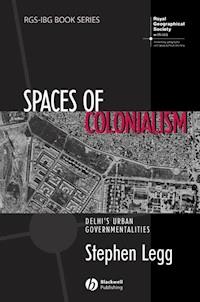
This, at least, is the popular conception of the colonial geography of Delhi; of dual cities. This is embodied in the now iconic aerial photo of the dividing line between the two cities (see cover image). This book will explore the extent to which the two cities were, in fact, governed as one and impacted upon each other in myriad ways. As a closer inspection of the aerial photo shows, the cordon sanitaire between the two cities was, in fact, traversed by multiple, well-worn tracks. Similarly, streets within the old city had been widened and cleared, whereas the plot of land within the walled city to the west had been demolished in the nineteenth century and was reconstructed in the 1920-30s. These spatial traces hint at the geographies of interaction and incursion between the two cities.
Rather than plotting an entire history of Delhi as the capital of the Raj (1911–47), three case studies will be used to explore the interactions between the cities. These will show that, in terms of residential accommodation, policing and infrastructural improvement, the two cities were intimately intertwined. While being very different projects, these landscapes of interconnection shared similar political rationalities of practice that must be explored. Likewise, each landscape presents evidence of a colonial government that sought security and profit for itself over the welfare and development of the Indian population, and thus demands some sort of critical commentary.
Lesen Sie weiter in der vollständigen Ausgabe!
Lesen Sie weiter in der vollständigen Ausgabe!
Lesen Sie weiter in der vollständigen Ausgabe!
Lesen Sie weiter in der vollständigen Ausgabe!
Lesen Sie weiter in der vollständigen Ausgabe!
Lesen Sie weiter in der vollständigen Ausgabe!
Lesen Sie weiter in der vollständigen Ausgabe!




