


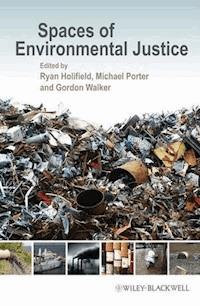
Spaces of Environmental Justice E-Book
20,99 €
Mehr erfahren.
- Herausgeber: John Wiley & Sons
- Kategorie: Wissenschaft und neue Technologien
- Serie: Antipode Book Series
- Sprache: Englisch
In this cutting-edge volume, leading scholars examine a diverse range of environmental inequalities from around the world. * Shows how far the field has moved beyond its original focus on uneven distributions of pollution in the USA * Considers the influence of critical geographical and social theory on environmental justice studies * Examines a range of possibilities for future research directions * Explores the challenges of investigating and pursuing environmental justice at a time of rapid economic and environmental change
Sie lesen das E-Book in den Legimi-Apps auf:
Seitenzahl: 537
Veröffentlichungsjahr: 2011
Ähnliche




















Contents
Notes on Contributors
Introduction: Spaces of Environmental Justice—Frameworks for Critical Engagement
Introduction
The Recent Evolution of Environmental Justice Research
Spaces of Environmental Justice
Future Directions in Unstable Times: Questions for a Critical Environmental Justice Research Agenda
References
Part I: Frameworks for Critical Environmental Justice Research
Chapter 1 Beyond Distribution and Proximity: Exploring the Multiple Spatialities of Environmental Justice
Introduction
Pluralising Scope and Meaning
Geographies of Distribution and Inequality
Geographies of Responsibility
Geographies of Recognition and Participation
Conclusion
Acknowledgements
References
Chapter 2 Actor-network Theory as a Critical Approach to Environmental Justice: A Case against Synthesis with Urban Political Ecology
Introduction
An Environmental Justice Case Study
Marxist Urban Political Ecology and Environmental Justice
Against Synthesis: Separating ANT from UPE
Revisiting the Case Study
The Political Usefulness of ANT
Conclusion
Acknowledgements
Endnotes
References
Chapter 3 Gendered Geographies of Environmental Injustice
Introduction
Women and the Environmental Justice Literature
Scale
Gendering of Institutions and Organizations
Conclusions: Gender Sensitive Ways Forward for Environmental Justice
Acknowledgements
References
Chapter 4 Acknowledging the Racial State: An Agenda for Environmental Justice Research
Introduction
Three Key Debates in the Environmental Justice Literature
Implications of the Racial State
Rethinking Environmental In/Justice Research
Acknowledgements
References
Part II: Spaces for Critical
Chapter 5 Digging Deep for Justice: A Radical Re-imagination of the Artisanal Gold Mining Sector in Ghana
Introduction
Theoretical Debates on the Plurality of Social and Environmental Injustice
Environmental and Social Injustice in Extractive Industries: The Case of Ghana
Creating “Contact Zones” through Participatory Research
Misrecognition and Exclusion at the Core of Ghana’s Mining Conflicts
Radical Re-imagination of Illegal Gold Mining: From Flush-Outs to Flourishing
Conclusion: Justice for Illegal Diggers is not an Oxymoron
Acknowledgements
References
Chapter 6 Benevolent and Benign? Using Environmental Justice to Investigate Waste-related Impacts of Ecotourism in Destination Communities
Introduction
Environmental Justice
Case Study: Tortuguero, Costa Rica
Framing Tortuguero’s Solid Waste Crisis Using Four Characteristics of Conventional Environmental Justice Communities
Discussion
Conclusions
Acknowledgements
References
Chapter 7 Assembling Justice Spaces: The Scalar Politics of Environmental Justice in North-east England
Introduction
The Scalar Politics of Environmental Justice
Assembling Environmental Justice in North-east England: Justice for Teesside
Scaling Environmental Justice: Expansion and Contraction
Rescaling Environmental Justice: Mobilising the Region
Conclusion
Acknowledgements
References
Chapter 8 Defining and Contesting Environmental Justice: Socio-natures and the Politics of Scale in the Delta
Introduction
Scaling Environmental Justice and Water in the Delta
Historical and Socio-Natural Formations in the Delta: 1850–1980
The Delta Vision and CALFED: Contesting the Politics of Scale, Process and Politics: 1980–2008
Environmental Justice and Socio-nature in the Delta
Conclusion: Imagining Ecological and Environmental Justice in the Delta
Acknowledgements
References
Index
Antipode Book Series
General Editor: Dr Rachel Pain, Reader in the Department of Geography, Durham University, UK.
Like its parent journal, the Antipode Book Series reflects distinctive new developments in radical geography. It publishes books in a variety of formats - from reference books to works of broad explication to titles that develop and extend the scholarly research base - but the commitment is always the same: to contribute to the praxis of a new and more just society.
Published
Spaces of Environmental Justice
Edited by Ryan Holifield, Michael Porter and Gordon Walker
The Point is to Change it: Geographies of Hope and Survival in an Age of Crisis
Edited by Noel Castree, Paul Chatterton, Nik Heynen, Wendy Larner and Melissa W. Wright
Practising Public Scholarship: Experiences and Possibilities Beyond the Academy
Edited by Katharyne Mitchell
Grounding Globalization: Labour in the Age of Insecurity
Edward Webster, Rob Lambert and Andries Bezuidenhout
Privatization: Property and the Remaking of Nature-Society Relations
Edited by Becky Mansfield
Decolonizing Development: Colonial Power and the Maya
Joel Wainwright
Cities of Whiteness
Wendy S. Shaw
Neoliberalization: States, Networks, Peoples
Edited by Kim England and Kevin Ward
The Dirty Work of Neoliberalism: Cleaners in the Global Economy
Edited by Luis L. M. Aguiar and Andrew Herod
David Harvey: A Critical Reader
Edited by Noel Castree and Derek Gregory
Working the Spaces of Neoliberalism: Activism, Professionalisation and Incorporation
Edited by Nina Laurie and Liz Bondi
Threads of Labour: Garment Industry Supply Chains from the Workers’ Perspective
Edited by Angela Hale and Jane Wills
Life’s Work: Geographies of Social Reproduction
Edited by Katharyne Mitchell, Sallie A. Marston and Cindi Katz
Redundant Masculinities? Employment Change and White Working Class Youth
Linda McDowell
Spaces of Neoliberalism
Edited by Neil Brenner and Nik Theodore
Space, Place and the New Labour Internationalism
Edited by Peter Waterman and Jane Wills
Forthcoming
Working Places: Property, Nature and the Political Possibilities of Community Land Ownership
Fiona D. Mackenzie
This edition first published 2010
Originally published as Volume 41, issue 4 of Antipode
Chapters © 2010 The Authors
Book compilation © 2010 Editorial Board of Antipode and Blackwell Publishing Ltd
Blackwell Publishing was acquired by John Wiley & Sons in February 2007. Blackwell’s publishing program has been merged with Wiley’s global Scientific, Technical, and Medical business to form Wiley-Blackwell.
Registered Office
John Wiley & Sons Ltd, The Atrium, Southern Gate, Chichester, West Sussex, PO19 8SQ, United Kingdom
Editorial Offices
350 Main Street, Malden, MA 02148–5020, USA
9600 Garsington Road, Oxford, OX4 2DQ, UK
The Atrium, Southern Gate, Chichester, West Sussex, PO19 8SQ, UK
For details of our global editorial offices, for customer services, and for information about how to apply for permission to reuse the copyright material in this book please see our website at www.wiley.com/wiley-blackwell.
The right of Ryan Holifield, Michael Porter and Gordon Walker to be identified as the authors of the editorial material in this work has been asserted in accordance with the Copyright, Designs and Patents Act 1988.
All rights reserved. No part of this publication may be reproduced, stored in a retrieval system, or transmitted, in any form or by any means, electronic, mechanical, photocopying, recording or otherwise, except as permitted by the UK Copyright, Designs and Patents Act 1988, without the prior permission of the publisher.
Wiley also publishes its books in a variety of electronic formats. Some content that appears in print may not be available in electronic books.
Designations used by companies to distinguish their products are often claimed as trademarks. All brand names and product names used in this book are trade names, service marks, trademarks or registered trademarks of their respective owners. The publisher is not associated with any product or vendor mentioned in this book. This publication is designed to provide accurate and authoritative information in regard to the subject matter covered. It is sold on the understanding that the publisher is not engaged in rendering professional services. If professional advice or other expert assistance is required, the services of a competent professional should be sought.
Library of Congress Cataloging-in-Publication Data
Spaces of environmental justice/edited by Ryan Holifield, Michael Porter and Gordon Walker.
p. cm. - (Antipode book series)
Includes bibliographical references and index.
ISBN 978-1-4443-3245-2 (pbk.: alk. paper)
1. Environmental justice. I. Holifield, Ryan. II. Porter, Michael. III. Walker, Gordon. GE220.S63 2010
363.7-dc22
2009053131
Notes on Contributors
Julian Agyeman is Associate Professor and Chair of Urban and Environmental Policy and Planning at Tufts University, Boston-Medford. He is co-founder and co-editor of Local Environment: The InternationalJournal of Justice and Sustainability, and his books include LocalEnvironmental Policies and Strategies (Longman, 1994), JustSustainabilities: Development in an Unequal World (MIT Press, 2003), Sustainable Communities and the Challenge of Environmental Justice (NYU Press, 2005), and The New Countryside? Ethnicity, Nation andExclusion in Contemporary Rural Britain (Policy Press, 2006).
Karen Bickerstaff is a lecturer in Geography at Durham University. Her research is located in the field of environmental social sciences, and increasingly at the interface of geography with science and technology studies. Much of this work has taken a socio-cultural approach to investigating the situated and contextual nature of citizens’ experiences of technological and environmental risks. This is linked to an interest in the relationship between space, place, and the construction of risk. She is currently involved in collaborative research (funding under the UK ESRC) concerned with rethinking waste in terms of transformations and flows of materials.
Susan Buckingham-Hatfield is a Senior Lecturer in Geography at Brunel University. Her research interests are primarily in gender/environment relationships, feminist analysis of women, and training and activist research in the academy. She has published a number of books in these areas, including Gender and Environment (Routledge, 2000) and Understanding Environmental Issues (with Mike Turner; Sage, 2008). Susan combines activism with her own research and teaching, and is on the Board of the Women’s Environmental Network. She also broadcasts widely on environmental debates.
Mary Cadenasso is an Assistant Professor in the Plant Sciences at the University of California, Davis, whose research focuses on understanding the ecological and social drivers of and responders to land cover in urban and urbanizing landscapes.
Lisa M. Campbell is the Rachel Carson Assistant Professor of Marine Affairs and Policy, Nicholas School of Environment and Earth Sciences, Duke University. Her work is broadly situated at the intersection of environment and development in rural areas of Latin American, the Caribbean, Southern Africa, and North Carolina. It is informed primarily by political ecology and science studies. She has focused on conservation of endangered species, and specifically of sea turtles, and how conservation conflicts with or enhances local community development. Her most recent research projects examine citizens working for wildlife conservation and their engagements with institutions of science, and local responses to tourism and amenity migration in coastal fishing communities in rural North Carolina.
Trina Filan is a PhD candidate in the Geography Graduate Group at the University of California, Davis. Her dissertation research will focus on whether and how an influx of women farm owner/operators into California agriculture affects individual agricultural practice, gendered professional and personal identities, regional agricultural discourses, and producer–consumer networks. She also is involved in climate change research at the California Energy Commission and in environmental justice research in partnership with UC Davis scholars and graduate students.
Gerardo Gambirazzio is a PhD candidate in the Geography Graduate Group at the University of California, Davis.
Ryan Holifield is an assistant professor in the Department of Geography at the University of Wisconsin – Milwaukee. His research investigates dimensions of environmental justice and injustice in the process of Superfund hazardous waste site remediation and risk assessment. He is also developing a project exploring the nexus between social justice and urban sustainability in Milwaukee.
Rakibe Kulcur is an experienced environmental, health and safety consultant with Enhesa. Since October 2006, she has been doing a PhD at Brunel University, West London. Her PhD focuses on gender structures of Environmental Non-Governmental Organizations in the United Kingdom and Turkey. She has prepared country profiles, audit profiles, regulatory registers, and monitoring reports for Turkey, Azerbaijan, and some European Union countries, and provides rapid-response regulatory research and analysis support to various multinational companies. She studied Public Administration in Izmir, Turkey, and Economics in Göttingen, Germany.
Hilda E. Kurtz is an Associate Professor of Geography at the University of Georgia. Her research explores various influences shaping the character and trajectory of environmental justice activism. To this end, she has theorized grassroots environmental justice organizing as a politics of scale, explored the ways in which multiple ideals of citizenship inform the strategies and goals of environmental justice activists, evaluated the iconography with which environmental justice organizations identify their agendas, and investigated the influence of gender on grassroots environmental justice politics.
Jonathan London is a rural sociologist and environmental planner and is the Director of the UC Davis Center for the Study of Regional Change.
Zoë A. Meletis is Assistant Professor of Outdoor Recreation and Tourism Management at the University of Northern British Columbia. Her academic interests include tourism (especially ecotourism and marine tourism); the relationship between community, environment, and development; speculation and development pressures and local responses to them in attractive locations (for example, coasts and mountains); consumption; and solid waste management, and creative re-use. Her current research projects include an evaluation of a first effort at “greening” The International Sea Turtle Symposium (January 2008), contributing to a project about local perceptions of amenity migrants, coastal gentrification and other development pressures in Down East, NC, and a collaborative paper on the choice of the 2010 Olympic mascots.
Michael Porter is a doctoral candidate in the Department of Earth and Environmental Sciences at the Graduate Center of the City University of New York. His research explores the discourses of brownfields and environmental justice in the context of urban socio-spatial change.
Fraser Shilling is an environmental scientist, with experience in the environmental justice implications of fish contamination, watershed assessment, and the use of geographic information systems (GIS) to provide decision-support for transportation system, pollution management, conservation, and watershed planning.
Julie Sze is an Assistant Professor of American Studies and Director of the Environmental Justice Project of the John Muir Institute of the Environment. Her book, Noxious New York: The Racial Politics of Urban Health and Environmental Justice (MIT Press, 2006) examines environmental justice activism in New York City, asthma politics, garbage, and energy policy in the age of privatization and deregulation.
Petra Tschakert is an Assistant Professor in Pennsylvania State University’s Department of Geography. Her research activities and practice focus broadly on human–environment interactions and more specifically on environmental change, development, sustainability, knowledge, inequality, and marginalization. Her main interest lies in the theoretical and empirical intersections of political ecology, environmental justice, complex systems science, and participatory research.
Gordon Walker is Chair of Environment, Risk and Justice in the Department of Geography at Lancaster University. He has developed research on environmental justice in the UK, defining an emerging research agenda and influencing its growing profile in policy. This work has included undertaking projects for the Environment Agency, Scottish Executive, Friends of the Earth, and Sustainable Development Research Network, jointly editing journal special issues (in Local Environment and Geoforum) and jointly convening an ESRC/NERC transdisciplinary seminar series, Addressing Environmental Inequalities.
Introduction: Spaces of Environmental Justice—Frameworks for Critical Engagement
Ryan Holifield, Michael Porter and Gordon Walker
Introduction
It is 13 years since the journal Antipode published a collection of papers on environmental justice (1996, volume 28, number 2). At the time the primary academic debates on environmental justice revolved around issues of measurement: is there empirical evidence supporting claims of distributional inequality and disproportionate exposure to environmental risk; is exposure a function of race or class; have poor populations moved to areas with a high concentration of toxic industry; or have toxic industries moved to areas with a high concentration of poor or minority residents? Each of the papers in the 1996 Antipode special issue examined these, at the time, exclusively American preoccupations through a refreshingly critical lens. In various ways they investigated how the discourse of environmental justice, along with the rationales, tools and techniques that this discourse enrolled, selectively and problematically represented the issues of concern. At stake was not only the question of whether or not environmental justice existed, but also a critical examination of what the term meant and how institutionalized understandings had impacts upon the practices of activism, research and regulation.
Our aim in 2009 in putting together another collection of critical environmental justice scholarship is to mark how far this has now developed and also to look ahead to how future research might evolve. As we will discuss further, the field has in many ways moved substantially beyond the particular preoccupations and methodologies of the mid1990s. The set of essays that we have included have their origins at the Association of American Geographers annual conference in Chicago in 2007, in a session specifically seeking critical, theoretically informed contributions. Our intentions were both to bring together various examples of recent critical environmental justice scholarship, and to explore how new insights might emerge by connecting the grounded normative concerns of environmental justice activism to varieties of current social science theory. Given the nature of the conference, the papers also had much to examine and to demonstrate about space and the spatial. The fascination and challenge here was for contributors to think through how space, place, and scale matter to the cases and contexts they examine, and how new frameworks for critical analysis reconfigure those spatialities.
We will have more to say about the particular contributions and insights of each of the chapters in this volume, but first we explore some of the ways in which environmental justice scholarship has recently evolved. Our review and discussion does not attempt to represent the field as a whole, but instead concentrates on the relatively small but growing body of research that attempts to interpret environmental justice activism in the context of critical theory. We contend that the elaboration of two major themes—which themselves overlap and intersect in multiple ways—characterize the development of environmental justice research since 1996: first, more complex and sophisticated conceptualizations of the generation of spaces of environmental inequality; second, ever-increasing scrutiny and analysis of the meanings of as a discursive frame for activism, policy, and research. These two themes and their intersections also constitute the core concerns of the contributions to this volume.
Lesen Sie weiter in der vollständigen Ausgabe!
Lesen Sie weiter in der vollständigen Ausgabe!
Lesen Sie weiter in der vollständigen Ausgabe!
Lesen Sie weiter in der vollständigen Ausgabe!
Lesen Sie weiter in der vollständigen Ausgabe!
Lesen Sie weiter in der vollständigen Ausgabe!
Lesen Sie weiter in der vollständigen Ausgabe!
Lesen Sie weiter in der vollständigen Ausgabe!
Lesen Sie weiter in der vollständigen Ausgabe!
Lesen Sie weiter in der vollständigen Ausgabe!
Lesen Sie weiter in der vollständigen Ausgabe!




