


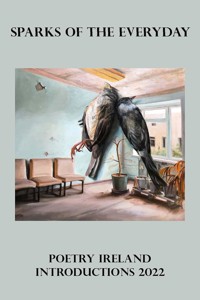
Sparks of the Everyday E-Book
Erhalten Sie Zugang zu diesem und mehr als 300000 Büchern ab EUR 5,99 monatlich.
- Herausgeber: Poetry Ireland
- Kategorie: Poesie und Drama
- Sprache: Englisch
Sparks of the Everyday: Poetry Ireland Introductions 2022 is an anthology of poetry from Poetry Ireland, the national poetry organisation. This anthology features the very best of Ireland's emerging poets for 2022, as chosen by Anthony Anaxagorou, award-winning poet, essayist, publisher, and poetry educator, along with renowned Irish-language poet Aifric Mac Aodha. In addition to a pair of superb poems, each poet provides an insightful prose piece on poetry, or on life, or on the overlap between poetry and life. Featuring Róisín Leggett Bohan, Meg Mulcahy, Pádraig Ó Cuinneagáin, Helen Fallon, Karson Lafferty, Caitríona Lane, K.S. Moore, Charles Lang, Art Ó Súilleabháin, Patrick Hopkins, Amy Abdullah Barry, Brian Ó Tiomáin, Phil Kingston, Jess McKinney, and HK Ní Shioradáin, along with author photos plus a superb cover image from artist Geraldine O'Neill. Quality poems and prose from Poetry Ireland: connecting poetry and people.
Sie lesen das E-Book in den Legimi-Apps auf:
Seitenzahl: 87
Veröffentlichungsjahr: 2021
Das E-Book (TTS) können Sie hören im Abo „Legimi Premium” in Legimi-Apps auf:
Ähnliche




















Poetry Ireland Introductions aims to encourage excellence in the craft of poetry by raising the profile of talented, emerging poets. The series offers poets in the early stages of their careers, writing in Irish or English, the opportunity to showcase their work through workshops and performance. The poets selected for the Introductions series participate in a workshop focused on poetic form and craft, as well as a masterclass on the art of reading and performing poetry in public, and a presentation on marketing and self-promotion for poets. These workshops culminate in a series of public readings.
www.poetryireland.ie/writers/introductions-series
This sampler of work from the poets who read for the Poetry Ireland Introductions series in 2022 is published by Poetry Ireland CLG / Éigse Éireann CTR, with the assistance of The Arts Council of Ireland / An Chomhairle Ealaíon and The Arts Council of Northern Ireland.
Introductions Adjudicators: Anthony Anaxagorou and Aifric Mac Aodha Introductions Readings Co-ordinator: Elizabeth Mohen Publication Co-ordinators: Paul Lenehan and Eoin Rogers, with the assistance of Kerrie O’Brien and Molly O’Toole
Cover image: Waiting Room (2021) by Geraldine O’Neill
ISBN: 978-1-902121-91-8
CONTENTS
Anthony Anaxagorou
INTRODUCTION
Aifric Mac Aodha
CÉADLÍNTE
Róisín Leggett Bohan
INSIDEPOCKET
IFIHADN’TBEENWEARINGMYHELMET ...
CONVERSINGWITHTHEDEAD
Meg Mulcahy
ALLGIANTDEERKINGSHAILFROMLIMERICK
BEFORETHINGSHAVETHEIRTEETH
THEREMUSTBEBETTERSONGSTOSING
Pádraig Ó Cuinneagáin
SCRÉACHÓGREILIGE
CODLADHNAHOÍCHE
DÚSHLÁINNASCRÍBHNEOIREACHTA
Helen Fallon
BOATPEOPLE
KNOCKPILGRIMAGE
POETRYINAPANDEMIC
Karson Lafferty
HOME
ILEARNEDEMPATHYONACOLDNIGHTINJANUARY
HOMECOMING
Caitríona Lane
ANNAOMHAGUSANNATHAIR
RÓGAIRERUAROSLIAG
MACALLA
K.S. Moore
COCOON
SHADOWMIRROR
THEADVENTUREYEARS
Charles Lang
THECHASE
DISTURBIA
THESWINGINGDOORS
Art Ó Súilleabháin
ANRÓS – ANSAOLIMBLÁTH
IASCAIRECOIRIBEACH
GAEILGEFORTHEFIRSTTIME
Patrick Hopkins
TALKOFWHAT’SOUTTHERE
WISHINGTREE
ROUGHPOTTERY
Amy Abdullah Barry
TOMBSTONE
ATGRANDMA’S
THESEDAYSIFINDMYSELFDOINGTHINGSITHOUGHTIWOULDNEVERDO
Brian Ó Tiomáin
AGCANADHDOM’INÍON
SINGINGTOMYDAUGHTER
IDTÍRNAGCLEITÍ
INTHELANDOFFEATHERS
TURASTEANGA: ALANGUAGEJOURNEY
Phil Kingston
WEEKENDTRIP
CNOCNANAOMH
HOWTOGETGIDDYFORDAYS
Jess McKinney
SEA/ #2E8B57
FERN / #4F7942
FORTHELOVEOFGREEN
HK Ní Shioradáin
AGLÁMHNASAOIRSE
LÚ
MOVINGHOUSEHASMETHINKING
Introduction
It’s a known fact that – ironically – poetry struggles with its own identity. What is it? Who should be writing it? How does it work? And what part does it play in contemporary life? All these questions dominate cultural and critical spaces where poets endeavour to learn and fortify their understanding of the craft. With so much writing being produced each year, and such few opportunities to have that work platformed, the Poetry Ireland Introduction series acts as a vital component in bringing new and exciting work to the fore.
When I sat down to read the submissions, I tried to wipe the board down, to clear my mind of any preconceptions I might have previously had – what I liked to read or the kind of poem I wanted to be written. I often feel that when we find ourselves in positions of adjudication, we run the risk of conjuring a version of the poem we want to read, rather than engaging with what the poem in front of us is actually doing.
As I read through the entries, I was struck by each poet’s relationship not only to their lives but to the natural world; how verdant the countryside and backwaters of Ireland could appear through a careful assemblage of language. The poems were formal, confessional and largely in first person – in such a way that I could feel the influence of MacNeice, or Heaney, or Boland reverberate through the syntax. There were also nods to poets of our current moment whose work speaks across geographies and generations.
Making the final selection was by no means easy. I agonised over the choices by compiling an initial long-list of the poems which most struck me, then whittling everything down into a short-list. Again, like the alchemy and mystery of a good poem, it’s impossible to pin down exactly what it is within a poem that compels and moves an individual. I think what I realised after was that each poet brought to my attention something beyond the teachable. If a poem lacked music or movement, I knew I’d be able to show how to incorporate that. If it seemed too clogged with verbs or surface adjectives, I knew of ways to help make the poet better aware of this. Yet what I don’t think can be taught is the subjective, a feel for language that goes beyond the way we understand words. It’s so magical and arbitrary and innate that a mere rhetorical device pales in comparison.
When I met the poets in early May, we sat and discussed many things, with the focus being on craft. It became clear to me that these were all writers who had, over their writing life, cultivated a profound love for language and poetry. Each subject was different, the relationship to words and expression, the lens used to explore. We wrote and spoke about our processes; we shared writing and considered the aspects we struggled with. By the end of the session the room was brimming with conversation and thought, with a giant future waiting up ahead for much more of the same.
– Anthony Anaxagorou
Céadlínte
Seo thíos línte tosaigh na ndánta éagsúla ó phinn an chúigir a roghnaíodh do scéim Éigse Éireann, ‘Céadlínte’, agus iad caite sa mhullach ar a chéile mar a bheadh i líon:
Tá na bláthanna go hálainn|Ní fhágann tú rian ar an gCoirib
Bíonn mo phit fliuch|Í ina luí, cois liom
Faoi gheasa ag scéalta m’athar|Caoinim glór bodhraitheach lachan,
fuaim na maidine caillte
Scréachóg reilige tusa|Ní héasca codladh nuair nach mian leat dúiseacht
Ba chóir duit casadh do d’iníon|Ag tuisliú timpeall …
Is léir ar a gcéadlínte féin gurbh fhiú cead seilge a thabhairt don ‘scréachóg reilige’ agus eile.
– Aifric Mac Aodha
Róisín Leggett Bohan
INSIDEPOCKET
I do not wear it now – his coat,
within the ox-blood lining
there is an inside pocket
and in it I hide his voice.
I used to slip my fingers
in and take it out,
watch the soft palate undulating,
enunciating the misshapen words
he once gave me.
I would hold it up to my ear,
hear its bending rhythm, its pace
as steady as a shovel slicing earth.
I placed it under my nose once, inhaled its sound,
its smell lay somewhere between pipe tobacco and honeysuckle-scented rain.
But I wanted more – his tone, his fluency, his articulation,
to feel the rush of air through his vocal cords,
for my voice to become his,
so, I pushed it into my mouth.
It sat there balanced on my tongue for a moment
until my throat tickled, then tightened,
I tried to swallow but only stuttered,
my mouth gaped open like an unfilled grave
before the words ‘let’ and ‘go’ plummeted
out, caught for breath I coughed it up,
it landed on the floor – broken.
I do not wear it now – his coat,
within the ox-blood lining
there is an inside pocket
and in it I hide his voice
stitched shut.
Róisín Leggett Bohan
IFIHADN’TBEENWEARINGMYHELMET …
when I crashed
toppled off my bicycle
hit my head
if my mind had broken open
this is what might have fallen out
the shadow of a crow on someone’s roof
a legless crab turned over by a wave
sheep’s wool caught on barbed wire
bladder wrack sticking out like a waving spine
a silent sonogram
a row of silver birches standing quiet
the web-veined lines of a fly’s wing
the throat of a dying starling
ten red umbrellas, opening
moths flapping their powder wings
an empty receiving blanket
a row of silver birches standing quiet
the wagging tail of a chained-up dog
a fox cub curled up at the side of the road
wrens flailing in clouds of earth-dust
insects swimming in the portholes of marooned jellyfish
the stitches on a christening gown
a row of silver birches standing quiet
Róisín Leggett Bohan
CONVERSINGWITHTHEDEAD
There is a little death
that hovers my days,
and in all I write
there remains
a trace of loss.
I remember the first time I laid someone out. I was nineteen, a first-year student nurse on ward F6, Addenbrooke’s. We were tending to Mr. Lawrence who had passed away a half hour earlier. The nurse I was with was from Wakefield, I can still hear her northern lilt.
“Now Will, just a freshen up love.”
She spoke to him as if he were still living.
“Rolling you over now Will, alright love.”
I was too upset at the time to dwell on how strange it was for this nurse to be speaking to a dead person. You see, I grew fond of my patients all too easily, and Mr. Lawrence was no exception.
“Dear girl, for heaven’s sake call me Will, no need for Mr. Lawrence.”
He had said this while I was helping him to the bathroom, weeks earlier.
Mr. Lawrence was an in-patient for four weeks of my six-week rotation and I was almost always allocated to his bay. I got to know him over prescribed walks in the corridor and the unprescribed sharing of boiled sweets from the hospital shop. We had two things in common: WW2 and reading habits. He had been a pilot officer in the RAF during the war, and my father had been in the Merchant Navy. I was always fascinated by the war and traded my father’s stories for his whilst monitoring his pulse, blood pressure, or fluid intake. And of course, we shared a love of the classics; Hardy, Eliot, and even a little Yeats.
‘Ah! The Irish nurse is back!’ he’d call out to his fellow patients after I returned from a day off.




