


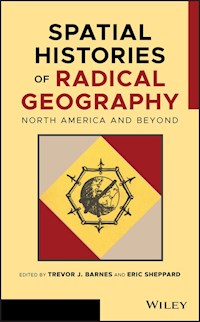
Spatial Histories of Radical Geography E-Book
20,99 €
Mehr erfahren.
- Herausgeber: John Wiley & Sons
- Kategorie: Wissenschaft und neue Technologien
- Serie: Antipode Book Series
- Sprache: Englisch
A wide-ranging and knowledgeable guide to the history of radical geography in North America and beyond. * Includes contributions from an international group of scholars * Focuses on the centrality of place, spatial circulation and geographical scale in understanding the rise of radical geography and its spread * A celebration of radical geography from its early beginnings in the 1950s through to the 1980s, and after * Draws on oral histories by leaders in the field and private and public archives * Contains a wealth of never-before published historical material * Serves as both authoritative introduction and indispensable professional reference
Sie lesen das E-Book in den Legimi-Apps auf:
Seitenzahl: 811
Veröffentlichungsjahr: 2019
Ähnliche




















Table of Contents
Cover
List of Figures
Notes on Contributors
Series Editors’ Preface
Preface
Acknowledgments
Introduction
“You Say You Want a Revolution:” American Radicalism and Radical Geography During the Long 1960s
Tensions within the project
Organization of the Book
Conclusion
References
Part I: Radical Geography within North America
1 Issues of “Race” and Early Radical Geography
Early Activism in the Discipline
Early Anti‐Racist Scholarship
Thelma Glass: Activist (1916–2012)
Harold Rose: The Flaming Liberal (1930–2016)
Anti‐Racism and Radicalism: A Re‐Mapping
James Blaut (1927–2000): Anti‐Racist Visionary
Conclusion
References
2 Myths, Cults, Memories, and Revisions in Radical Geographic History
Radical Geographic
HIS
tory
Radical Geographic
HER
story
Conclusions
References
3 Radical Paradoxes
“The Last Bulwark of Determinism”: The GSG from its Founding Through the 1950s
Saul Cohen and Keynesian Capitalism
“Our Goal is Radical Change”: 1960s Politics and the Founding of
Antipode
The Social Reproduction of
Antipode
Revolutionary Theory? Tenure and the Professionalization of
Antipode
Epilogue
References
4 A “Necessary Stop on the Circuit”
The Convergence
The Union of Socialist Geographers
The Vancouver Geographical Expedition
Feminist Geography and the Radical Project
Swirling Outwards: SFU’s Radical Moment in Context
Convergence and Connections: Radical SFU Geography, In and Of the World
Down from the Mountain: Legacies and Limits
References
5 The Life and Times of the Union of Socialist Geographers
Setting the Stage: North American Radical Geography in the 1960s and 1970s
1974: Formation of the USG
USG Locals
Newsletters and Other Publications
The USG as Radical Geographical Praxis
Conclusion
References
6 Baltimore as Truth Spot
Slouching toward Baltimore
Some Revelation is at Hand
Realizing the Truth Spot: The Circulation of Baltimore‐Style Radical Geography
Conclusion
References
7 Berkeley In‐Between
Cohort and Club
Crossings and Conjunctures
Conclusion: Passing Moments?
Acknowledgment
References
8 Radical Geography in the Midwest
Radical Geography at Minnesota: Origins and Development
USG Praxis: Phillips Neighborhood
The Reading Group
Regional USG Meetings
Producing the
USG Newsletter
The Madison Local
The University of Michigan
Conclusion: The After‐Party
References
9 Radical Geography Goes Francophone
1
Québec Geography Between Two Transitions
The Development of a Marxist Approach to the Analysis of Cities
The Construction and Implementation of a Research Program in Marxist Geography
Conclusion
References
Part II: Radical Geography beyond North America
10 Japan
The Long Heritage of Marxist Geography in Japan
The Progress of Critical Geography in Japan: 1950s–1960s
Advent of the Yada Faction: 1973 and After
Attempts to Associate with North American Radical Geography
Academic Seclusion from Global Trends in Radical Geography
Beyond Japan: The East Asian Regional Conferences in Alternative Geography
Conclusion
References
11 The Rise and Decline of Radical Geography in South Africa
Complicity in Legitimizing Apartheid
Decolonization and Progressive Approaches
Empowerment, Emancipation, and Transformation
Post‐Colonial Era: Radicals in Retreat
Advancing Critical Scholarship and Activism
Conclusion
References
12 The Geographies of Critical Geography
A Critical Perspective: A Few Preambles
Critical Geography in Mexico
Conclusion: What Might the Future of Mexican Critical Geography Look Like?
References
13 “Let’s here [sic] it for the Brits, You help us here”
1
Contemporary Issues in Geography and Education
Conclusions
References
14 “Can these words, commonly applied to the Anglo‐Saxon social sciences, fit the French?” Circulation, Translation, and Reception of Radical Geography in the French Academic Context
The Contemporary Emergence of Radical Geography in France
A New Space for Marxism in French Geography
Radical Geography “à la Française”
References
Conclusion
The Emergence of a Radical Geography Canon
Deconstructing the Canon
Radical Geography’s Contemporary Quandaries
References
Index
End User License Agreement
List of Tables
Chapter 5
Table 5.1 The USG locals and their members.
*
Table 5.2 Timeline of the formation of USG locals, AGMs, national, and regional ...
Chapter 9
Table 9.1 Theses either completed or initiated as part of the GREDIN research pr...
Table 9.2 Presentations researchers affiliated with GREDIN between 1976 and 1980...
List of Illustrations
Chapter 2
Figure 2.1 Rally protesting cuts to the Detroit Geographical Expedition and Ins...
Chapter 3
Figure 3.1
Antipode
cover, Volume 4, issue 1, February 1972.
Figure 3.2 “Qualifactus versus Quantifactus.” Poster hanging in the Clark Gradu...
Chapter 4
Figure 4.1 Nathan Edelson, Suzanne Mackenzie, Colm Regan – VGE 1975.
Figure 4.2 Machine space, Vancouver Geographical Expedition. Observations of ch...
Figure 4.3 Radical architecture.
Figure 4.4 Socialist geographers come to SFU.
Chapter 5
Figure 5.1 Members of the first meeting of the Union of Socialist Geographers o...
Figure 5.2 Mandate of the USG (written between May 1974 and 1975).
Figure 5.3 The USG and its Affiliates.
Figure 5.4 USG members at a meeting May 1978, Toronto.
Chapter 6
Figure 6.1 Teach‐in on the Economy at Johns Hopkins (including a lecture by Har...
Figure 6.2 The Progressive Action Center, Enoch Pratt Free Library building, Ro...
Chapter 7
Figure 7.1 Berkeley circles, circa 1978–1983.
Figure 7.2 Carter’s broken promises, 1978.
Chapter 8
Figure 8.1 Phillips Neighborhood Geographical Society softball team, the Pink F...
Figure 8.2 Where you’re at in geography*.
Chapter 13
Figure 13.1
CIGE
’s nine aims, found in every journal issue and used as editoria...
Guide
Cover
Table of Contents
Begin Reading
Pages
iii
iv
v
ix
x
xi
xii
xiii
xiv
xv
xvi
xvii
xix
xxi
1
2
3
4
5
6
7
8
9
10
11
12
13
14
15
16
17
18
19
20
21
22
23
24
25
26
27
28
29
30
31
32
33
34
35
36
37
39
40
41
42
43
44
45
46
47
48
49
50
51
52
53
54
55
56
57
58
59
60
61
62
63
64
65
66
67
68
69
70
71
72
73
74
75
76
77
78
79
80
81
82
83
84
85
87
88
89
90
91
92
93
94
95
96
97
98
99
100
101
102
103
104
105
106
107
108
109
110
111
112
113
114
115
117
118
119
120
121
122
123
124
125
126
127
128
129
130
131
132
133
134
135
136
137
138
139
140
141
142
143
144
145
146
147
149
150
151
152
153
154
155
156
157
158
159
160
161
162
163
164
165
166
167
168
169
170
171
172
173
174
175
176
177
178
179
180
181
183
184
185
186
187
188
189
190
191
192
193
194
195
196
197
198
199
200
201
202
203
204
205
206
207
208
209
211
212
213
214
215
216
217
218
219
220
221
222
223
224
225
226
227
228
229
230
231
232
233
234
235
236
237
238
239
240
241
242
243
244
245
246
247
248
249
250
251
252
253
254
255
256
257
258
259
260
261
262
263
264
265
266
267
268
269
270
271
273
274
275
276
277
278
279
280
281
282
283
284
285
286
287
288
289
290
291
292
293
294
295
296
297
298
299
301
303
304
305
306
307
308
309
310
311
312
313
314
315
316
317
318
319
320
321
322
323
324
325
326
327
328
329
330
331
332
333
334
335
336
337
338
339
340
341
343
344
345
346
347
348
349
350
351
352
353
354
355
356
357
358
359
360
361
362
363
364
365
366
367
368
369
371
372
373
374
375
376
377
378
379
380
381
382
383
384
385
386
387
389
390
391
392
393
394
395
396
397
398
399
400
401
402
403
404
405
406
407
408
409
410
411
412
413
414
415
416
Antipode Book Series
Series Editors: Vinay Gidwani, University of Minnesota, USA and Sharad Chari, University of California, Berkeley, USA
Like its parent journal, the Antipode Book Series reflects distinctive new developments in radical geography. It publishes books in a variety of formats – from reference books to works of broad explication to titles that develop and extend the scholarly research base – but the commitment is always the same: to contribute to the praxis of a new and more just society.
Published
Spatial Histories of Radical Geography: North America and BeyondEdited by Trevor J. Barnes and Eric Sheppard
The Metacolonial State: Pakistan, Critical Ontology, and the Biopolitical Horizons of Political IslamNajeeb A. Jan
Frontier Assemblages: The Emergent Politics of Resource Frontiers in AsiaEdited by Jason Cons and Michael Eilenberg
Other Geographies: The Influences of Michael WattsEdited by Sharad Chari, Susanne Freidberg, Vinay Gidwani, Jesse Ribot, and Wendy Wolford
Money and Finance After the Crisis: Critical Thinking for Uncertain TimesEdited by Brett Christophers, Andrew Leyshon, and Geoff Mann
Frontier Road: Power, History, and the Everyday State in the Colombian AmazonSimón Uribe
Enterprising Nature: Economics, Markets and Finance in Global Biodiversity PoliticsJessica Dempsey
Global Displacements: The Making of Uneven Development in the CaribbeanMarion Werner
Banking Across Boundaries: Placing Finance in CapitalismBrett Christophers
The Down‐deep Delight of DemocracyMark Purcell
Gramsci: Space, Nature, PoliticsEdited by Michael Ekers, Gillian Hart, Stefan Kipfer, and Alex Loftus
Places of Possibility: Property, Nature and Community Land OwnershipA. Fiona D. Mackenzie
The New Carbon Economy: Constitution, Governance and ContestationEdited by Peter Newell, Max Boykoff and Emily Boyd
Capitalism and ConservationEdited by Dan Brockington and Rosaleen Duffy
Spaces of Environmental JusticeEdited by Ryan Holifield, Michael Porter and Gordon Walker
The Point is to Change it: Geographies of Hope and Survival in an Age of CrisisEdited by Noel Castree, Paul Chatterton, Nik Heynen, Wendy Larner and Melissa W. Wright
Privatization: Property and the Remaking of Nature‐SocietyEdited by Becky Mansfield
Practising Public Scholarship: Experiences and Possibilities Beyond the AcademyEdited by Katharyne Mitchell
Grounding Globalization: Labour in the Age of InsecurityEdward Webster, Rob Lambert and Andries Bezuidenhout
Privatization: Property and the Remaking of Nature‐Society RelationsEdited by Becky Mansfield
Decolonizing Development: Colonial Power and the MayaJoel Wainwright
Cities of WhitenessWendy S. Shaw
Neoliberalization: States, Networks, PeoplesEdited by Kim England and Kevin Ward
The Dirty Work of Neoliberalism: Cleaners in the Global EconomyEdited by Luis L. M. Aguiar and Andrew Herod
David Harvey: A Critical ReaderEdited by Noel Castree and Derek Gregory
Working the Spaces of Neoliberalism: Activism, Professionalisation and IncorporationEdited by Nina Laurie and Liz Bondi
Threads of Labour: Garment Industry Supply Chains from the Workers' PerspectiveEdited by Angela Hale and Jane Wills
Life’s Work: Geographies of Social ReproductionEdited by Katharyne Mitchell, Sallie A. Marston and Cindi Katz
Redundant Masculinities? Employment Change and White Working Class YouthLinda McDowell
Spaces of NeoliberalismEdited by Neil Brenner and Nik Theodore
Space, Place and the New Labour InternationalismEdited by Peter Waterman and Jane Wills
Spatial Histories of Radical Geography
North America and Beyond
Edited by
Trevor J. Barnes and Eric Sheppard
This edition first published 2019© 2019 John Wiley & Sons Ltd
All rights reserved. No part of this publication may be reproduced, stored in a retrieval system, or transmitted, in any form or by any means, electronic, mechanical, photocopying, recording or otherwise, except as permitted by law. Advice on how to obtain permission to reuse material from this title is available at http://www.wiley.com/go/permissions.
The right of Trevor J. Barnes and Eric Sheppard to be identified as the authors of the editorial material in this work has been asserted in accordance with law.
Registered Office(s)John Wiley & Sons, Inc., 111 River Street, Hoboken, NJ 07030, USAJohn Wiley & Sons Ltd, The Atrium, Southern Gate, Chichester, West Sussex, PO19 8SQ, UK
Editorial Office9600 Garsington Road, Oxford, OX4 2DQ, UK
For details of our global editorial offices, customer services, and more information about Wiley products visit us at www.wiley.com.
Wiley also publishes its books in a variety of electronic formats and by print‐on‐demand. Some content that appears in standard print versions of this book may not be available in other formats.
Limit of Liability/Disclaimer of WarrantyWhile the publisher and authors have used their best efforts in preparing this work, they make no representations or warranties with respect to the accuracy or completeness of the contents of this work and specifically disclaim all warranties, including without limitation any implied warranties of merchantability or fitness for a particular purpose. No warranty may be created or extended by sales representatives, written sales materials or promotional statements for this work. The fact that an organization, website, or product is referred to in this work as a citation and/or potential source of further information does not mean that the publisher and authors endorse the information or services the organization, website, or product may provide or recommendations it may make. This work is sold with the understanding that the publisher is not engaged in rendering professional services. The advice and strategies contained herein may not be suitable for your situation. You should consult with a specialist where appropriate. Further, readers should be aware that websites listed in this work may have changed or disappeared between when this work was written and when it is read. Neither the publisher nor authors shall be liable for any loss of profit or any other commercial damages, including but not limited to special, incidental, consequential, or other damages.
Library of Congress Cataloging‐in‐Publication data has been applied for
ISBNs978‐1‐119‐40471‐2 (hardback)978‐1‐119‐40479‐8 (paperback)
Cover Design: WileyCover Image: Collage of the first and the most recent Antipode journal cover designs: First issue of Antipode edited by Ben Wisner; cover design by Jane Cooper Wisner. Current cover of Antipode, designed by Ray Zilli.
We dedicate this book to the community of scholars, students and activists who raised the flag to, shaped, and carried radical geography forward to its present wonderfully variegated state, and to future radical thinkers Charlotte and Jonah.
List of Figures
Figure 2.1
Rally protesting cuts to the Detroit Geographical Expedition and Institute.
Figure 3.1
Antipode
cover, Volume 4, issue 1, February 1972.
Figure 3.2
“Qualifactus versus Quantifactus.” Poster hanging in the Clark Graduate School of Geography in the late 1960s (Wisner 2015).
Figure 4.1
Nathan Edelson, Suzanne Mackenzie, Colm Regan – VGE 1975.
Figure 4.2
Machine space, Vancouver Geographical Expedition. Observations of children’s movement on March 5 1974 at different times of the day.
Figure 4.3
Radical architecture.
Figure 4.4
Socialist geographers come to SFU.
Figure 5.1
Members of the first meeting of the Union of Socialist Geographers on the steps of the Toronto Geographical Expedition House, 283 Brunswick Ave, Toronto May 1974.
Figure 5.2
Mandate of the USG (written between May 1974 and 1975).
Figure 5.3
The USG and its Affiliates.
Figure 5.4
USG members at a meeting May 1978, Toronto.
Figure 6.1
Teach‐in on the Economy at Johns Hopkins (including a lecture by Harvey).
Figure 6.2
The Progressive Action Center, Enoch Pratt Free Library building, Roland Park, Baltimore.
Figure 7.1
Berkeley circles, circa 1978–1983.
Figure 7.2
Carter’s broken promises, 1978.
Figure 8.1
Phillips Neighborhood Geographical Society softball team, the Pink Flamingos, outstanding on one leg (flamingo style).
Figure 8.2
Where you’re at in geography*. *Or could be.
Figure 13.1
CIGE’s nine aims, found in every journal issue and used as editorial and writing guide.
Notes on Contributors
Trevor J. Barnes completed an undergraduate degree at University College, London, and graduate degrees at the University of Minnesota, where Eric Sheppard was his doctoral supervisor. Barnes has been teaching at the Department of Geography, University of British Columbia, since 1983. Much of his research has been in economic geography, and, recently, in the history of human geography since the Second World War. In 2018, with Brett Christophers, he published Economic Geography: A Critical Introduction. He is a Fellow of the Royal Society of Canada, and of the British Academy.
Nicholas Blomley teaches, studies, and performs ideas and practices relating to the critical and often oppressive relationship between law and space. He is particularly interested in the political geographies of land and property. He has worked at Simon Fraser University’s Department of Geography for 30 years, and has long wanted to explore its sidelined radical past.
Mark J. Bouman is the Chicago Region Program Director in the Field Museum’s Keller Science Action Center, where he leads the Museum’s interdisciplinary conservation and cultural heritage work in the Chicago region. Previously, he was Professor and Chairperson of the Department of Geography at Chicago State University. He led the development of the University’s Neighborhood Assistance Center, its Calumet Environmental Resource Center, and GIS Laboratory.
Yann Calbérac is a Lecturer at the University of Reims (France). His work mainly concerns the history of geography and social sciences. His current research deals with the spatial turn and the use of the category of space in the social sciences.
Verónica Crossa is an Associate Professor in Urban Studies at the Centro de Estudios Demográficos, Urbanos y Ambientales, at El Colegio de Mexico. Her research, at the intersection of urban, cultural geography and critical theory, examines how “order” is (re)produced and performed on the streets of contemporary cities, with a particular focus on changing notions of urban order triggered by revitalization policies in Mexico City´s public spaces. Her recent book, Luchando por un Espacio en la Ciudad de México: Espacio público urbano y el comercio ambulante (COLMEX, 2018), examines how street vendors in Mexico City negotiate and struggle over changing power structures in their everyday lives.
Nik Heynen is a Professor in the Department of Geography at the University of Georgia. His research interests include urban political ecology, social movement theory and politics of social reproduction. His main research foci relate to the analysis of how uneven social power relations, including race, gender, and class are inscribed in the transformation of nature/space, and how in turn these processes contribute to interrelated connections between nature, space and uneven development. He is currently Editor at the Annals of the American Association of Geographers and Environment and Planning E: Nature and Space.
Bryan Higgins is an Emeritus Distinguished Service Professor of Geography at the State University of New York. Drafted into the U.S. Army in the Viet Nam era and stationed in the Chemical Corps at Edgewood Arsenal, MD, providing Army “volunteers” psychoactive agents in chemical warfare research radically changed his worldview. Under the GI Bill, he received a Ph.D. in geography from the University of Minnesota. His early writing focused on the geographical revolutions of American Indians, radical geographies in the People’s Republic of Burlington Vermont and revolutionary geographies in Nicaragua. His later work addresses political ecology and ecotourism. As Director of International Education at SUNY Plattsburgh, he established progressive study abroad programs throughout the world.
Matthew T. Huber is Associate Professor of Geography at Syracuse University. His research focuses on energy, climate change, and the political economy of capitalism. His first book, Lifeblood: Oil, Freedom, and the Forces of Capital (University of Minnesota Press, 2013), examines the role of oil and suburbanization in the neoliberalization of American politics. He is currently writing a book on the intersection of climate change and class politics.
Cindi Katz teaches at The Graduate Center of the City University of New York. Her work concerns social reproduction and the production of space, place and nature; managing insecurity in the domestic and public environment; the cultural politics of childhood; the consequences of global economic restructuring for everyday life; and the politics of knowledge. Antipode has been part of her life since she helped affix address labels to them back when they were held together with staples.
Juan‐Luis Klein (Ph.D. Université Laval) is a full Professor at the Geography Department of the University of Québec at Montreal and the former director of the Centre de recherche sur les innovations sociales (CRISES). His research projects are on economic geography, social innovation, and local and community development. He is a member of several editorial boards of scientific journals and is the director of the Géographie Contemporaine book series (Presses de l’Université du Québec).
Chris Knudson is a Postdoctoral Research Associate in the Institute of the Environment at the University of Arizona. He is a political ecologist whose research centers on the history, governance, and practice of managing ecological crises, particularly through the creation and use of financial risk management tools.
Audrey Kobayashi is a Professor of Geography and Queen’s Research Chair at Queen’s University. Her research and publications address a range of human rights issues including racialization, poverty, housing, and immigration, as well as the history of Geography. She recently co‐authored The Equity Myth: Racialization and Indigeneity at Canadian Universities and co‐edited The International Encyclopedia of Human Geography: People, the Earth, Environment, and Technology. She is currently the Editor for The Encyclopedia of Human Geography, 2nd edition, to be published in 2020.
Mickey Lauria is a Professor of City and Regional Planning and Director of the transdisciplinary Ph.D. program in Planning, Design, and the Built Environment at Clemson University. He has served as President of the Association of Collegiate Schools of Planning, has edited the Journal of Planning Education and Research and Town Planning Review, and serves on the editorial boards of four planning journals. He has published articles on urban schooling, urban redevelopment, and politics and planning. His recent research interests include professional planners’ ethical frameworks, neighborhood conditions, and planning issues involving race and class, and conservation easements and affordable housing.
Brij Maharaj is an urban political geographer at the University of KwaZulu‐Natal, Durban, South Africa. He has received widespread recognition for his research on megaevents and social impacts, segregation, local economic development, xenophobia and human rights, migration, and diasporas. He has published over 150 scholarly papers on these themes in journals such as Urban Studies, International Journal of Urban and Regional Studies, Political Geography, Urban Geography, Antipode, Polity and Space, Geoforum, Local Economy, and GeoJournal, as well as five co‐edited book collections. He is a B‐rated NRF researcher.
Kent Mathewson is the Fred B. Kniffen Professor in the Department of Geography and Anthropology at Louisiana State University. His research interests include cultural, historical, and Latin American geography and the history of geography. He is author, editor, and coeditor of a number of books including Re‐Reading Cultural Geography, Culture, Form and Place, Concepts in Human Geography, Dangerous Harvest, and Carl Sauer on Culture and Landscape. Topics of current collaborative book projects include photography of the Guatemalan civil war, Elisée Reclus’ travels in Latin America, and a culture history of the castor plant (emphasizing the African diaspora).
Eugene McCann is University Professor of Geography at Simon Fraser University. An urban political geographer, he researches policy mobilities, urban policy‐making, development, public space, and planning. He is co‐editor, with Kevin Ward, of Mobile Urbanism (Minnesota, 2011) and of Cities & Social Change, with Ronan Paddison (Sage, 2014). He is co‐author, with Andy Jonas and Mary Thomas, of Urban Geography: A Critical Introduction (Wiley, 2015). He is managing editor of the journal EPC: Politics & Space.
Fujio Mizuoka received his Ph.D. in geography from Clark University in 1986 after teaching at the University of Hong Kong from 1979 to 1981. He then joined the Faculty of Economics, Hitotsubashi University to teach economic geography, retiring in 2016. His research interests focus on the critical theories of economic geography, the history of critical thought in geography, Marxian economics, central‐place theory, British colonialism in Hong Kong, the concepts of contemporary capitalism, and human rights issues in Japan's child welfare policies. He has published various articles in English; his recent book Contrived Laissez‐faireism (Springer Verlag) examines the unique art of colonial rule in post‐WWII Hong Kong.
Joanne Norcup is a historical and cultural geographer currently based at the Centre for Caribbean Studies, University of Warwick. Informed by feminist and intersectional ideas, her research centers on geographies of education, learning, and knowledge‐making, focusing on vernacular, dissenting, and transgressive practices, ideas, and productions. Current research areas include public library geographies, DIY education publications & archives, popular culture (including TV comedy and crime fiction), and lay nature, and environmental knowledges. Jo is the founding director of Geography Workshop, a radio and education resource production company whose recent work has been broadcast by BBC Radio and Resonance FM.
Linda Peake is a professor in Urban Studies and director of the City Institute at York University, Toronto. She has written widely in the field of critical human geography with interests in urban theory, feminist methodologies and, more recently, mental health. She is chair of the AAG Task Force on Mental Health, co‐editor of the special issue on “An engagement with planetary urbanization” in Environment and Planning D: Society and Space (2018) and of Urbanization in A Global Context (2017, OUP) (with Alison Bain) and principal investigator of the SSHRC funded GenUrb: Gender, urbanization and the global south.
Jamie Peck is the Canada Research Chair in Urban & Regional Political Economy and Professor of Geography at the University of British Columbia, Canada, where he is a Distinguished University Scholar. His recent books include Doreen Massey: Critical dialogues (2018, Agenda, co‐edited with Marion Werner, Rebecca Lave and Brett Christophers); Offshore: Exploring the Worlds of Global Outsourcing (Oxford, 2017); Fast Policy: Experimental Statecraft at the Thresholds of Neoliberalism (Minnesota, 2015, with Nik Theodore); and Constructions of Neoliberal Reason (2010, Oxford University Press).
Eric Sheppard is a Professor of geography and Alexander von Humboldt chair at UCLA. His scholarship embraces geographical political economy, uneven geographies of globalization, urban transformations, and informality in Indonesia, neoliberalism and its urban contestations, social movements and their spatialities, geographic information technologies and society, geographical philosophies and methods, and environmental justice. He has co‐authored or co‐edited nine books, most recently Limits to Globalization (Oxford University Press, 2016). He was active in the Union of Socialist Geographers (1977–1982), and co‐edited Antipode (1980–1986) before it became a highly profitable enterprise.
Renee Tapp is the Pollman Fellow in Real Estate and Urban Development at the Harvard University Graduate School of Design. She received her Ph.D. in Geography from Clark University in 2018. Her research interests include the geographies of tax and finance, urban redevelopment, urban politics, and modernist architecture. Currently, she is examining the impact shell companies and tax evasion have on rental markets in the United States.
Gwendolyn C. Warren is a long‐time public sector administrator, who has distinguished herself as a leader in the areas of education, health, social and community services. She has worked in executive level capacities in city and county government in California, Florida, and Georgia, working with diverse populations that add unique and challenging issues to the provision of quality government services, and serving with the goal to maximize human capacity. She became Co‐Director of the Detroit Geographical Expedition and Institute at the age of 18, shaping many of its mapping projects, and serving as a key author of its Field Notes and leader of its educational component.
Series Editors’ Preface
The Antipode Book Series explores radical geography “antipodally,” in opposition, from various margins, limits, or borderlands.
Antipode books provide insight “from elsewhere,” across boundaries rarely transgressed, with internationalist ambition and located insight; they diagnose grounded critique emerging from particular contradictory social relations in order to sharpen the stakes and broaden public awareness. An Antipode book might revise scholarly debates by pushing at disciplinary boundaries, or by showing what happens to a problem as it moves or changes. It might investigate entanglements of power and struggle in particular sites, but with lessons that travel with surprising echoes elsewhere.
Antipode books will be theoretically bold and empirically rich, written in lively, accessible prose that does not sacrifice clarity at the altar of sophistication. We seek books from within and beyond the discipline of geography that deploy geographical critique in order to understand and transform our fractured world.
Vinay GidwaniUniversity of Minnesota, USA
Sharad ChariUniversity of California, Berkeley, USA
Antipode Book Series Editors
Preface
The idea for this book, marking the 50th Anniversary of Antipode: A Journal of Radical Geography, was hatched when one of us (Sheppard) was completing an essay with Linda Peake, commissioned for a putative edited book by Lawrence Berg.1 Our essay sought to deconstruct the Clark University‐centered history of Anglophone North American radical geography that is commonly narrated. Realizing that some of the early figures of the 1960s generation of radical geography had passed or were rapidly aging, Sheppard approached Barnes to tap his experience in interviewing first generation quantitative geographers and narrating their history. For both of us, it felt exciting to extend this methodology to the history of radical geography that had so profoundly shaped our lives. But the project felt too big. Gradually, we recruited others, notably that included bringing their own ideas to the project. We were able to benefit from a workshop in Vancouver in 2013 with Nik Heynen, Audrey Kobayashi, Linda Peake, Jamie Peck, and Bobby Wilson, funded by the Antipode Foundation. When we finally brought this project to the 2016 San Francisco Association of American Geographers’ annual meeting, the enthusiastic response from an engaged audience, including ghosts emerging from radical geography’s deep past, encouraged us to bring the project to print. Over the years, we broadened this multi‐nodal account to also incorporate voices from beyond Canada and the U.S., recruiting a second round of authors. Notably, virtually no‐one who we asked declined to participate; Linda Peake was unable to help with the editing, but contributed her own chapter. Authors went beyond any temptation to craft second‐hand accounts, interviewing early radical geographers and digging into gray literatures and departmental archives. Thus this book took some time to come together as a final product. The result, we think, catches the complex spirits of these times before they fade into the past, and their influence on the contemporary discipline is lost to memory.
Note
1
Our cover image captures this history by melding the very first Antipode cover with the latest.
Acknowledgments
We would like to acknowledge a $6,000 grant from the Antipode Foundation, making possible an early workshop that brought energy to this collective. We also wish to thank the many interviewees contacted during the research reported here for their willing and informative collaboration, as well as Matt Zebrowski, cartographer in the UCLA Department of Geography, for his help with improving some of the images.
Introduction
Trevor J. Barnes and Eric Sheppard
‘Something Better Change,’
The Stranglers (1977)1
Both of us have lived our entire academic lives under the aegis of radical geography. In 1971, Sheppard, a geography undergraduate at Bristol University, remembers the newly hired junior lecturer, Keith Bassett, having freshly returned from completing an M.A. degree at Penn State University, carrying into the classroom to show students a stack of Antipodes he recently brought back from America. Renowned for sardonic humor, even Bassett cracked a hopeful smile, unabashedly enthusiastic, when he showed and talked about Antipode and the new movement of radical geography in America and its possibilities.
Certainly, Barnes was enthusiastic when in 1976 as a second‐year undergraduate in geography and economics at University College, London (UCL), he held in his hands for the first time a copy of Antipode. It felt as if he was doing something illegal, perusing a smuggled underground publication, probably best done under the bed covers, read with a flashlight.2 The librarians in the Geography Reading Room at UCL treated it as seditious at least. It was kept behind the counter in a sturdy wooden cabinet under lock and key. The journal could be signed out but for just two hours and read at only designated tables under the scrutinizing gaze of the library beadle. Although such constraints permitted only relatively short snatches of reading, Antipode captured brilliantly the riven England in which Barnes lived, of strikes, protest marches, and Orwellian grimness. It connected even to punk rock, born during that same mid‐to‐late 1970s dyspeptic period, and the background music of Barnes’ undergraduate and, on occasion, academic life (Barnes 2019). Antipode looked like a punk publication, a fanzine of radical geography. The early issues were home‐made, DIY publishing, its typographical‐error‐strewn contents bound between one punk discordant garish cover or another: electric yellow, vibrant scarlet, pulsating green, shimmering gold. Bernard Sumner, a member of the band Joy Division, after first hearing punk rock said, it was “terrible. I thought [it was] … great. I wanted to get up and be terrible too” (quoted in Marcus 1989: 7). Reading Antipode for that first time made Barnes also want to get up and be terrible, but to be great too: to be a radical geographer.
Our edited volume is a history, or rather a set of histories of radical geography. It includes the beginning of Antipode and its lurid covers (Huber et al., this volume), but also much, much more. Geographically, the central focus of the book is the United States (US) and Canada. The first nine (long) chapters of the collection – Part I, Histories of Radical Geography in North America – are concerned with the emergence and practices of radical geography at a set of specific U.S. and Canadian sites (six chapters are mostly about the U.S., three mostly about Canada). The last five shorter chapters – Part II, International Perspectives – offer a set of histories, experiences and reflections about radical geography undertaken outside the U.S. and Canada: France, Japan, Mexico, South Africa, and the U.K. Radical geography in the U.S. and Canada had some influence in all those places, but it was not the same in each, and exactly how it influenced was a consequence of specific prior conditions – political, social, cultural, institutional, intellectual – found in each place, as well as often the presence of catalytic individuals. There certainly was no simple process of spatial diffusion. Even if it is granted that the most recent form of radical geography developed first in the U.S. and Canada,3 it did not steamroll across the world, crushing native intellectual traditions, turning every place into Clark or Johns Hopkins Universities. Rather, its course was contingent and variable, geographically and historically. Radical geography requires sensitive historical and geographical narration, a central purpose of this volume.
Historically, the volume covers the period from the origin of radical geography in the U.S. and Canada sometime during the mid‐1950s through to its intellectual consolidation in the early 1980s. We begin in the mid‐1950s with the first stirrings of radical activism by U.S. geographers, although hinged not around class but race. Audrey Kobayashi (this volume) recounts the involvement of the geographer Thelma Glass, based at the University of Alabama, in the Montgomery bus boycott of 1955–1956 (best associated with Rosa Parks). Race continues as a key theme during the early‐to‐mid‐1960s albeit within the unlikely formal structure of the Association of American Geographers, involving both geographers of color like Don Deskins and Harold Rose, and white geographers like Jim Blaut, Ron Horvath, and Richard Morrill (Kobayashi; and Peake, both this volume). Also in the early 1960s, issues of race and activism were central to William Bunge’s work in Detroit that began in the academy, at Wayne State University, but shifted to his own black inner‐city neighborhood of Fitzgerald and to community activists like Gwendolyn Warren (Warren et al., this volume). In 1969, Antipode was founded at Clark University (Huber et al., this volume). Initially eclectic in its topics and approaches, by the mid‐1970s it became increasingly aligned with a Marxism focused on capital and class, and best associated with David Harvey at Johns Hopkins University (Sheppard and Barnes, this volume). That said, even during this period there were other radical geographical organizations and publications, such as the Socially and Ecologically Responsible Geographers (SERGE) (founded in 1971) and its journal Transition, as well as the Union of Socialist Geographers (USG) (established 1974) and its Newsletter that typically published on a broader range of topics and approaches than Antipode (Peake, this volume). It was also then that radical geography expanded and consolidated in centers outside Clark and Johns Hopkins: Simon Fraser University in Vancouver (Blomley and McCann, this volume), the U.S. Midwest (Lauria et al., this volume), Quebec (Klein, this volume), and the University of California, Berkeley (Peck and Barnes, this volume). By the early 1980s with the publication of David Harvey’s 1982 Marxist theoretical compendium, The Limits to Capital, radical geography had unquestionably arrived.
It wasn’t as if radical geography was then set in stone, however, 1982 was just the end of the beginning. For the form that radical geography took from the early 1970s to the early 1980s especially in Antipode, and associated with classical Marxism, began to braid and diverge. Elements of the older Marxist geography were taken apart, critiqued, some thrown out, others joined with new elements, and put together again in novel combinations. This new version, increasingly known as critical geography, more and more became how human geography in the round was done (Castree 2000). The subsequent capaciousness and variegation of critical geography makes telling its story more difficult compared to the earlier radical geography, however. Presenting its history will likely require many volumes, many editors, and many contributors. We very much hope it will be undertaken, but it is not our project. While individual chapters in this book trace how earlier events helped shape critical geography, and our Conclusion will explicitly recount the relation between radical and critical geography, this volume is limited to the early development of radical geography. While we realize this period is only part of a larger story, it is no less necessary to recount, and has some urgency.
There already exist some excellent individual essays about the early history of radical geography. These tend, though, either to give the complete North American story based on secondary literature (often found in textbooks like Cloke et al. 1991, ch. 2, or Johnston and Sidaway 2016, ch. 6), or to focus on just one element or episode or individual within it (for example, on William Bunge’s contribution found in Merrifield 1995, or Heyman 2007). In contrast, our volume intends to provide not only the larger North American story of radical geography, but also to follow its relationship with selected places outside that core (the purpose of Part II). Further, rather than resting on secondary literature, many of the chapters draw on primary material. In this sense, the book aims to provide both the broader view and specificity, a larger story arc infused by history but also geography.
The use of primary source material in this volume is especially important. While the authors in our volume sometimes draw on traditional material archival sources (for example, in Huber et al. and Norcup, both this volume) a lot of information is gleaned from oral histories conducted with leading protagonists (for example, in Kobayashi, and Peck and Barnes, this volume). In part, the reliance on oral history is necessitated by a lack of formal archival sources. Materials relating to histories of radical geography have never been systematically collected, but remain scattered, found in people’s garages, or forgotten filing cabinets in university departmental basements. Of course, oral histories have their problems. Memories are fallible – Hemingway said memory is never true – they are only one person’s view, they can’t capture large‐scale historical, political, social and geographical events, and they are unsuitable for relating abstractions, conceptual schema, and dialectical niceties. They must be triangulated with other kinds of information, as our authors do. But given the dearth of other sources, oral histories remain one of the most important bases for telling histories of radical geography. Further, with aging and death – the earliest radical geographers are now in their eighties with Bunge, Deskins, and Rose having all recently passed, and Blaut and the relatively young Neil Smith (at 58) having died some time ago – the ability to gather this type of information is itself diminishing.
There is one other distinctive feature driving the organization of this collection. While we are concerned to provide histories of early radical geography, we want just as much to provide geographies of it too. John Agnew and David Livingstone (2011: 16) contend we must “think geographically about geography, and thereby ‘geographizing’ geography itself.” This book is an attempt to do just that. Strangely, this has often been a missing element in histories of the discipline told by geographers. The geographical setting becomes at best only color and background atmospherics for the history. The essays in this volume make a stronger claim, however: Geography goes all the way down. That imperative explains why we organized the book geographically, by place and nation. Running throughout the collection of essays are three fundamental organizing geographical ideas, making this book not just a history but also a geography of radical geographical knowledge.
The first is place, by which is meant the internal conditions at a site that enter into and shape the production in this case of radical geographical knowledge. Place might affect knowledge through: a specific geographical relation among participants, for example, between homeplace and workplace, or, as Peck and Barnes (this volume) explore in their chapter on Berkeley, the collapse of the two; or as a particular site of investigation that then structures the development of a conceptual framework, for example, the relation between Baltimore and David Harvey’s theoretical agenda (Sheppard and Barnes, this volume); or as a specific mix of pressing social issues found in a given urban neighborhood, along with the presence of galvanizing, energetic individuals eager to take them on, the case in Detroit’s inner‐city Fitzgerald neighborhood during the late 1960s (Warren, Katz, and Heynen, this volume).
The second is geographical connectivity. Knowledge does not remain fixed in place but circulates, moving from one site to another. Further, the very process of circulation reshapes the ideas that circulate. This is partly because they interact with other ideas, partly because they are interpreted differently in different locations, and partly because they are put to diverse uses at the various sites among which they travel. This is especially clear in
Part II
, but it also occurs as radical geographical knowledge travels within the U.S. and Canada, for example, as the idea of industrial change moves from the U.S. East Coast to the U.S. West Coast (Peck and Barnes, this volume); or as the idea of the “geographical expedition” is taken from Detroit to Vancouver and later to Sydney (Blomley and McCann, this volume); or as the idea of the circuit of capital migrates from Baltimore to Quebec City (Klein, this volume).
The third is geographical scale. We focus especially on cases where radical geographical knowledge is originally articulated at one scale, say, the urban (e.g., Baltimore), or the region (e.g., the San Francisco Bay Area), but then scales up and is applied nationally, or globally. While this bears particularly on theoretical concepts and frameworks, it also applies to the very project of radical geography. It begins at select urban sites like Detroit, Worcester or Baltimore, but scales up, becoming a global movement, replete with international conferences and journals, drawing readers and participants from around the world.
The remainder of this chapter is divided into four parts. In the first and longest section we lay out what we call the conditions of possibility for the development of radical geography in the U.S. and Canada. We describe the social, cultural, political, and intellectual ferment of the “long 60s”4 that provided fertile ground for the development of radical geography and set out some of key moments in that unfolding development (further elaborated in subsequent chapters). Second, we describe some of the tensions within the project of radical geography, often there from the beginning, which contorted and disrupted it, making it heterogenous, preparing it for what it was to later to become. Third, we discuss the rationale for the organization of the book, providing capsule descriptions of each chapter. Finally, we provide a short Conclusion.
“You Say You Want a Revolution:”5 American Radicalism and Radical Geography During the Long 1960s
In writing about the social sciences since 1945, Roger Backhouse and Philippe Fontaine (2010a: 11) make use of the idea of “the degree of [disciplinary] permeability to social change.” They categorize academic disciplines according to their differential social porosity, that is, their internal responsiveness to social events, movements, and interests that lay outside the academy. They argue that social permeability is highly variable by discipline. Some subjects like economics have hermetically sealed themselves from outside social change. While other subjects, including geography, act more like sponges, continually sopping up society’s discharge, leaks and spillage, which shape its internal structure and intellectual agenda.
That social porosity can change over time, however, as was the case for geography. Before the Second World, geography was isolated, seemingly immune from social change, doing its own thing. As Neil Smith (1989: 92) argued, geography’s strange hybrid form that rolled into one subject natural science, social science and humanities had isolated the subject, given it “a museum‐like existence,” as if it were some rare entity preserved under glass. From the mid‐1950s, however, that glass was smashed. As Smith (1989: 9) puts it, “The museum perimeter” that had been “jealously fenced by a ring of [past] conceptual distinctions, [which] kept geographers in and effectively discouraged would be intruders” was breached. Not only did geographers breakout in large numbers, taking ideas from and working with non‐geographers, but the external social and political world came crashing in. Initially, it was a Cold‐War‐inspired behavioral science and social physics that geographers transformed into spatial science or the “quantitative revolution,” with concomitant practices of mathematical modeling, abstract theorization, and statistical verification (Barnes and Farish 2006). During the 1960s, and our concern, it was loud outside social demands for relevance, activism and revolution that produced radical geography. That outside came rushing in at pell‐mell pace – Christopher Hitchens (1998: 101) said, “to blink was to miss something” – and was profoundly unsettling – David Horowitz (1970: 185) said America was “shaken to its roots.”6 And so was geography.
“The times they are a‐changin”7
If World War II invigorated and shaped American social sciences, the ensuing Cold War Americanized them. Before the Second World War, Germany was the most important home for social science. But after Germany’s crushing defeat, the center of gravity for social science moved across the Atlantic, especially to U.S. East Coast centers like Harvard, Yale, and Princeton universities. The Second World War also demonstrated to the U.S. that social science could be effectively mobilized to achieve military and political strategic ends (Barnes and Farish 2006). In this new model, social science was folded into the aims, interests, and bureaucracy of a militarized state. That state brought together different social scientists, setting them to work often in interdisciplinary groups on instrumental projects in the state’s interests, fully funding and resourcing them. That same model continued once the hot war of WWII ended, becoming even more entrenched, systematized and formalized within a Cold War in which two superpower states, America and the Soviet Union, played nuclear chicken. Further, the state became a larger assemblage that blurred lines between the military, industry and the academy, forming “a military‐industrial‐academic complex” in Senator William Fulbright’s term (Kay 2000: 10–11).8 American social sciences, and the sites where they were undertaken, became fully integrated within that complex (Solvey and Cravens 2012).
Social science was thus just another element in the American Cold War boom. Public funding for social sciences increased enormously, and membership in professional societies burgeoned (Crowther‐Heyek 2006). American social science became a client of the state, working for it sometimes directly, at other times at arm’s length. Further, the state demanded knowledge of a particular form, more scientific than social. Given that the natural sciences had seemingly won the Second World War with the radar, the earliest computer, and of course the atom bomb, social scientists should mimic the same scientific method. There was an attempt even to change the name of social science to behavioral science to indicate a more rigorous, clinical approach, shunning the messy and politically infused term, society.
That was impossible. Messiness and the political kept on reasserting themselves, pushing for attention, on occasion violently screaming for notice, and no more so than during the long decade of the 1960s. While that period highlighted continual experimentation and change, and the overturning of hitherto older imposed forms of constraint – intellectual, cultural, economic and especially political9 – strangely it hung together as a whole. As Watts (2001: 162) puts it, the long 1960s had
a homologous coherence across political philosophy, cultural production, economic cycles and political practice. Johnson’s decision to bomb North Vietnam, Dylan’s decision to go electric at Newport, and the appearance of Pynchon’s Crying of Lot 49 were somehow all of a piece.
Katznelson (1997) argues that this multiform roiling of the long 1960s increasingly seeped into at least the more permeable social sciences and humanities, producing significant intellectual change. Protests on the street entered the university lecture theater. “The sixties,” he writes, “were a ‘a volatile moment of madness’ when ordering rules, civilities, limits and expectations were suspended with important effects inside the academy” (Katznelson 1997: 312). That volatile moment was produced by a perfect storm of social unrest, fueled by the heated atmosphere around four turbulent social movements: civil rights, second‐wave feminism, environmentalism, and anti‐Vietnam War demonstrations. Each was itself powerful; collectively, working together, they constituted a force of cyclonic magnitude. Where they touched down – and American university campuses were a prime site – they could turn existing relations and ideas topsy‐turvey, inside‐out. Some social sciences and humanities, including human geography, quickly felt the effect. Things fell apart, the center no longer held. In Katznelson’s terms, volatile madness was awash.
Civil Rights in America were a longstanding issue, going back before even the formal declaration of the U.S. as a nation state. They became increasingly urgent and visible especially from the mid‐1950s and associated with escalating acts of non‐violent civil disobedience to protest against hateful, violent and sometimes murderous forms of racial prejudice and bigotry held by a predominantly white population against people of color. That disobedience included boycotts, sit‐ins, marches, and mass rallies. The larger end was to stop legalized racial segregation and discrimination found especially in the U.S. South, but also in large Northern inner cities where African Americans faced harsh prejudice particularly in employment and housing markets. Those acts included the Montgomery bus boycott by Rosa Parks (1955–1956) (Kobayashi, this volume), the Greenborough sit‐in at a Woolworth lunch counter (1960), the March on Washington (1963), Freedom Rides to the U.S. South by civil‐rights workers to increase voter registration (1964), and three Selma to Montgomery marches (1965). The assassination of Martin Luther King in April 1968 in Memphis provoked a storm of inner‐city riots, and mass arson in major U.S. cities. It was the greatest civil unrest since the American Civil War, with disturbances in over 100 cites, leading to 40 deaths and 20,000 arrests (Sheppard and Barnes, this volume, discuss the Baltimore case). Other inner cities had already gone up in flames, most famously Watts within Los Angeles in 1965 and Detroit in 1967 (Warren
et al
., this volume). If Martin Luther King’s strategy to realize civil rights was non‐violent disobedience, other black political movements urged more direct and confrontational tactics. These included the Nation of Islam and its leaders Elijah Muhammed and Malcolm X and, from 1966, the Black Panther Party that spread from Oakland, CA, to other cities, including Baltimore in 1968 (Sheppard and Barnes, this volume). As both Kobayashi and Peake (this volume) document, having voices of people of color heard in geography proved slow and difficult, including in radical geography, with the larger topic of race and civil rights marginalized despite their manifest geographies and radical political purpose.
The feminist movement was also longstanding, but from the early 1960s it became increasingly active in the form of second‐wave feminism, taking to the streets as the “women’s liberation movement.” Inspired in part by Simone de Beauvoir’s (2011 [1949])
The Second Sex
, where she argued women were “Other” to men in a patriarchal society, and so evident in early post‐War, Father‐Knows‐Best America, the feminist movement demanded legal changes and shifts in social and cultural norms around a series of issues that continued to produce gender inequality: sexuality, the family, the workplace, education, and reproductive rights among others. Betty Friedan’s (
1963
)
Feminist Mystique
further galvanized the movement, and in 1966 she founded and became the first President of the
National Organization of Women
(NOW). NOW saw itself as a necessary organization, like the
National Association for the Advancement of Colored People
, to lobby for changes in civil rights, albeit based on gender rather than race. Through marches and rallies, but also through political lobbying, speeches, writings, cultural performances, and myriad other interventions, feminism contributed to the tumult of the long 1960s. Even during this phase there were internal tensions, as in the civil‐rights movement, with second‐wave feminism criticized because of its narrow focus on the interests of predominantly white, middle‐class and straight women. By the late 1970s and early 1980s, a third‐wave feminism began to emerge that took heterogenous identities of women much more seriously both in practice and in theory. Both forms of feminism entered the academy, becoming part of university curriculum, reshaping existing disciplines including geography. Yet women often struggled to participate, including in radical geography, as many of the chapters document, suffering sexual harassment, discrimination, verbal slurs and put downs, a chilly departmental and university environment, a lack of role models, and often unsympathetic male colleagues intent on competitive superiority and noisy mansplaining.
The U.S. environmental movement had set down strong roots in the nineteenth century through writers like Henry David Thoreau, the geographer George Perkins Marsh, and the institution‐builder John Muir (founder of the Sierra Club in 1892). By the 1950s and early 1960s environmental concerns often turned on air and water pollution caused by large‐scale industrial and agricultural producers and their use of a bevy of toxic contaminants. Rachel Carson’s
1962
Silent Spring
brought especially widespread attention both to the heavy use of insecticides like DDT in American agriculture and its mortal effect on wildlife. Mixed into the 1960s environmental concerns was also the Malthusian worry that a rapidly burgeoning world population would exhaust the world’s resources within two or three generations. In 1968, the Stanford biologist Paul Ehrlich published
The Population Bomb
. Don Meadows’ subsequent co‐authored 1972 Club of Rome Report,
Limits to Growth
, elaborated on Ehrlich’s concerns, using leading‐edge computer simulation models to confirm its bleak conclusions, in some cases suggesting that they should be even bleaker (over 30 million copies of the book were sold, still a record for an environmental publication). The resulting environmental protests were less about global‐scale environmental Armageddon than about local environmental sites or features: a particular river, a given forested valley, or a specific animal species. On April 4, 1970, there was one mass event for everything environmental. Earthday brought out 22 million people in the U.S., the majority on university and college campuses. Environmental study had long been part of the very definition of academic geography, and so 1960s environmentalism easily entered disciplinary discussions, including in radical geography. It was a theme preoccupying early issues of
Antipode
, with David Harvey,
10
Richard Walker, and later, Neil Smith, all at Johns Hopkins at the time, writing from a Marxist perspective about nature and the environment. In 1971, Wilbur Zelinski (not a Marxist) and Larry Wolfe (who was), founded the journal
Transition
(1971–1986) to provide a critical understanding of the geography of environment (Peake, this volume).
Opposition to the Vietnam War was likely the most important of the four movements in setting U.S. radical geography in motion. Tariq Ali (
2018
: 7) said, “the anti‐war movement in the United States … has no equivalent in any other imperialist country. It was the highpoint of dissent in U.S. history.” Domestic anti‐war protests ensued quickly after the first U.S. air bombing of Vietnam on August 5, 1964 – the
de‐facto
beginning of a war that was framed as a retaliation for two North Vietnamese Navy boats having allegedly fired torpedoes the previous day at the USS Maddox, a U.S. Navy destroyer in the Gulf of Tonkin.
11
By the end of 1964 the radical Students for a Democratic Society, the most important of the War’s student oppositional groups, had approved a proposal to organize anti‐War demonstrations often but not exclusively on university campuses.
12
These began the following year. One of their features was “teach‐ins,” pop‐up classes run by professors and graduate students providing political, geographical, and historical information about Vietnam, and America’s increasingly belligerent involvement in southeast Asia. The anthropologist Marshall Sahlins led the first teach‐in at the University of Michigan in March 1965 (also see Watts’
2012




