


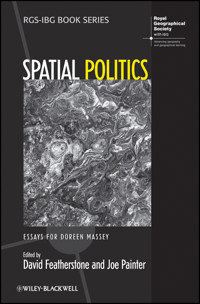
Spatial Politics E-Book
25,99 €
Mehr erfahren.
- Herausgeber: John Wiley & Sons
- Kategorie: Wissenschaft und neue Technologien
- Serie: RGS-IBG Book Series
- Sprache: Englisch
This critical engagement with Doreen Massey’s ground-breaking work in geographic theory and its relationship to politics features specially commissioned essays from former students and colleagues, as well as the artists, political figures and activists whose thinking she has helped to shape. It seeks to mark and take forward her compelling contributions to geographical theorizing and political debate.
- High profile contributors include Lawrence Grossberg, Chantal Mouffe, Jamie Peck and Jane Wills
- The global reach and significance of Massey’s work recommends this volume to a diverse readership
- Provides an agenda for work on spatial politics and critical geography
- Sets out the contours of a human geography informed by Doreen Massey’s work
Sie lesen das E-Book in den Legimi-Apps auf:
Seitenzahl: 644
Veröffentlichungsjahr: 2012
Ähnliche




















Contents
List of Figures
Notes on Contributors
Foreword
Series Editors’ Preface
Acknowledgements
The Lipman–Miliband Trust
Introduction
Space, Politics and Radical Democracy
Regions, Labour and Uneven Development
Reconceptualising Place
Political Trajectories
Part One Space, Politics and Radical Democracy
Chapter One Space, Hegemony and Radical Critique
Introduction
Critique as Withdrawal From
Critique as Hegemonic Engagement With
Conclusion
Chapter Two Theorising Context
Chapter Three Power-Geometry as Philosophy of Space
Introduction
Space as Open and Closed
Doreen Massey’s Philosophical Geography
Power-topology
For Marx
Conclusions
Chapter Four Spatial Relations and Human Relations
Introduction
The Categories of Space and Time
Relational Approaches in Psychoanalysis
Space and Time in Psychoanalysis
Space-Time Relations in Geography and Relational Approaches in Psychoanalysis
Chapter Five Space, Democracy and Difference: For a Post-colonial Perspective
Introduction
The Imperial Context
Democracy and the Geopolitics of Difference
For a Post-colonial Perspective on Democratic Politics
Concluding Remarks
Part Two Regions, Labour and Uneven Development
Chapter Six Spatial Divisions and Regional Assemblages
Introduction
Questioning the Assumptions
Conceptualising Spaces and Places
Re-thinking London and the South-East
What Is a Region?
Conclusion: Relational Thinking and Regional Assemblages
Chapter Seven Making Space for Labour
Introduction
Labour, Divided
Recovering Agency
Turning Points
Chapter Eight The Political Challenge of Relational Territory
Introduction
Conceptualising Territory
Territory as a Portion of Space
Territory as a Portion of Relational Space
Territory as a Bounded Portion of Relational Space
Interlude Your Gravitational Now
Epilogue
Part Three Reconceptualising Place
Chapter Nine Place and Politics
Introduction
Politics in Place
The Politics of Place
Politics and Place
Chapter Ten A Global Sense of Place and Multi-territoriality: Notes for Dialogue from a ‘Peripheral’ Point of View1
Chapter Eleven A Massey Muse
Prologue
Wendy Harcourt: Space, Place and the Body Politics of Development
Questions for Wendy
Alice Brooke Wilson: Food Politics and Geographies of Sustenance
Questions for Alice Brooke
Arturo Escobar: Relational Ontologies and Geographies of Responsibility
Questions for Arturo
Dianne Rocheleau: Rooted Networks and Geometries of Power
Questions for Dianne
Chapter Twelve A Physical Sense of World
Introduction
A Relational World
Beyond the Social
Conclusions: Beyond the Divide
Part Four Political Trajectories
Chapter Thirteen Working with Doreen Downunder: Antipodean Trajectories
Introduction
Myth, Politics and Relational Space-Time
Simultaneity and Linearity in Aotearoa New Zealand
Claims Making – Open and Closed spaces
A Closing and an Opening: Towards a Progressive Politics of Place in Aotearoa New Zealand?
Chapter Fourteen Doreen Massey: The Light Dances on the Water
Introduction
Habitat
Ecology
Cultivation
Conclusion
Chapter Fifteen Place, Space and Solidarity in Global Justice Networks
Introduction
Global Justice Networks, Flat Ontologies and Geographies of Responsibility
Spatiality, Responsibility and Solidarity
Place, Territory and History in the Politics of Social Movements
Conclusion
Chapter Sixteen The Socialist Transformation of Venezuela: The Geographical Dimension of Political Strategy
Introduction
The Geographical Time-Space as a Social Dimension
Traditional Approaches to the Spatial Theme
Direct Democracy: An Alternative Model for Addressing the Problem
Hegemony and Power
Geography as a Component of Revolutionary Strategy
Chapter Seventeen Place Beyond Place and the Politics of ‘Empowerment’
Introduction
Place Beyond Place
Flows and Counter-flows
Recombining Local and Global: Demonstrating that There Is an Alternative
The Struggle over Alternative Futures – a Local yet Global Experience
Who Is Empowered?
A Different Kind of State
Enabling the Market versus Strengthening Democratic Control
The Challenges of the GLC’s Unfinished Business
Chapter Eighteen ‘Stories So Far’: A Conversation with Doreen Massey
References
Index
RGS-IBG Book Series
Published
Spatial Politics: Essays for Doreen MasseyEdited by David Featherstone and Joe PainterThe Improvised State: Sovereignty, Performance and Agency in Dayton BosniaAlex JeffreyLearning the City: Knowledge and Translocal AssemblageColin McFarlaneGlobalizing Responsibility: The Political Rationalities of Ethical ConsumptionClive Barnett, Paul Cloke, Nick Clarke and Alice MalpassDomesticating Neo-Liberalism: Spaces of Economic Practice and Social Reproduction in Post-Socialist CitiesAlison Stenning, Adrian Smith, Alena Rochovská and Dariusz ŚwiątekSwept Up Lives? Re-envisioning the Homeless CityPaul Cloke, Jon May and Sarah JohnsenAerial Life: Spaces, Mobilities, AffectsPeter AdeyMillionaire Migrants: Trans-Pacific Life LinesDavid LeyState, Science and the Skies: Governmentalities of the British AtmosphereMark WhiteheadComplex Locations: Women’s Geographical Work in the UK 1850–1970Avril MaddrellValue Chain Struggles: Institutions and Governance in the Plantation Districts of South IndiaJeff Neilson and Bill PritchardQueer Visibilities: Space, Identity and Interaction in Cape TownAndrew TuckerArsenic Pollution: A Global SynthesisPeter Ravenscroft, Hugh Brammer and Keith RichardsResistance, Space and Political Identities: The Making of Counter-Global NetworksDavid FeatherstoneMental Health and Social Space: Towards Inclusionary Geographies?Hester ParrClimate and Society in Colonial Mexico: A Study in VulnerabilityGeorgina H. EndfieldGeochemical Sediments and LandscapesEdited by David J. Nash and Sue J. McLarenDriving Spaces: A Cultural-Historical Geography of England’s M1 MotorwayPeter MerrimanBadlands of the Republic: Space, Politics and Urban PolicyMustafa DikeçGeomorphology of Upland Peat: Erosion, Form and Landscape ChangeMartin Evans and Jeff WarburtonSpaces of Colonialism: Delhi’s Urban GovernmentalitiesStephen LeggPeople/States/TerritoriesRhys JonesPublics and the CityKurt IvesonAfter the Three Italies: Wealth, Inequality and Industrial ChangeMick Dunford and Lidia GrecoPutting Workfare in PlacePeter Sunley, Ron Martin and Corinne NativelDomicile and DiasporaAlison BluntGeographies and MoralitiesEdited by Roger Lee and David M. SmithMilitary GeographiesRachel WoodwardA New Deal for Transport?Edited by Iain Docherty and Jon ShawGeographies of British ModernityEdited by David Gilbert, David Matless and Brian ShortLost Geographies of PowerJohn AllenGlobalizing South ChinaCarolyn L. CartierGeomorphological Processes and Landscape Change: Britain in the Last 1000 YearsEdited by David L. Higgitt and E. Mark Lee
Forthcoming
Smoking Geographies: Space, Place and TobaccoRoss Barnett, Graham Moon, Jamie Pearce, Lee Thompson and Liz TwiggPeopling Immigration Control: Geographies of Governing and Activism in the British Asylum SystemNick GillThe Geopolitics of Expertise: Knowledge and Authority in an Integrating EuropeMerje KuusThe Geopolitics of Expertise in the Nature of Landscape: Cultural Geography on the Norfolk BroadsDavid MatlessWorking Memories – Gender and Migration in Post-war BritainLinda McDowellFashioning Globalisation: New Zealand Design, Working Women and the ‘New Economy’Maureen Molloy and Wendy LarnerOrigination: The Geographies of Brands and BrandingAndy PikeMaking Other Worlds: Agency and Interaction in Environmental ChangeJohn WainwrightDunes: Dynamics, Morphology and Geological HistoryAndrew WarrenScalar Politics of Food in Cuba: Traversing State and MarketMarisa Wilson
This edition first published 2013© 2013 John Wiley & Sons, Ltd
Wiley-Blackwell is an imprint of John Wiley & Sons, formed by the merger of Wiley’s global Scientific, Technical and Medical business with Blackwell Publishing.
Registered OfficeJohn Wiley & Sons, Ltd, The Atrium, Southern Gate, Chichester, West Sussex, PO19 8SQ, UK
Editorial Offices350 Main Street, Malden, MA 02148-5020, USA9600 Garsington Road, Oxford, OX4 2DQ, UKThe Atrium, Southern Gate, Chichester, West Sussex, PO19 8SQ, UK
For details of our global editorial offices, for customer services, and for information about how to apply for permission to reuse the copyright material in this book please see our website at www.wiley.com/wiley-blackwell.
The right of David Featherstone and Joe Painter to be identified as the authors of the editorial material in this work has been asserted in accordance with the UK Copyright, Designs and Patents Act 1988.
All rights reserved. No part of this publication may be reproduced, stored in a retrieval system, or transmitted, in any form or by any means, electronic, mechanical, photocopying, recording or otherwise, except as permitted by the UK Copyright, Designs and Patents Act 1988, without the prior permission of the publisher.
Wiley also publishes its books in a variety of electronic formats. Some content that appears in print may not be available in electronic books.
Designations used by companies to distinguish their products are often claimed as trademarks. All brand names and product names used in this book are trade names, service marks, trademarks or registered trademarks of their respective owners. The publisher is not associated with any product or vendor mentioned in this book. This publication is designed to provide accurate and authoritative information in regard to the subject matter covered. It is sold on the understanding that the publisher is not engaged in rendering professional services. If professional advice or other expert assistance is required, the services of a competent professional should be sought.
Library of Congress Cataloging-in-Publication Data
Spatial Politics: Essays for Doreen Massey / edited by David Featherstone and Joe Painter.p. cm.Includes bibliographical references and index.
ISBN 978-1-4443-3831-7 (cloth) – ISBN 978-1-4443-3830-0 (pbk.) 1. Political geography. 2. Massey, Doreen B. I. Massey, Doreen B. II. Featherstone, David, 1974– III. Painter, Joe, 1965–JC319.S616 2013320.12–dc23
2012025404
A catalogue record for this book is available from the British Library.
Cover image: © Ingrid PollardCover design by Workhaus
List of Figures
Figure 1
Spatial divisions of labour as card game
Figure 2
Representing
Spatial Divisions of Labour
, 1984 and 1995
Figure 3
Olafur Eliasson,
The glacier series
, 1999
Figure 4
Olafur Eliasson,
The glacier series
, 1999 (detail)
Figure 5
Olafur Eliasson,
The glacier mill series
, 2007
Figure 6
Olafur Eliasson,
Iceland series
, 2007
Cover: Quandan is one of a group of photographs which Ingrid Pollard exchanged with Doreen Massey after hearing her give a lecture at the Royal Institute of British Architects. Through the photographs, Ingrid and Doreen began an ongoing conversation about everything from space to geology. The images relish their duplicity in the developments of the rules of aesthetics, of astronomy, surveying and mapping, and geometry. Together they combine to produce a sense of wonder.
Ingrid Pollard
Doreen Massey and the editors of the collection offer many thanks to Ingrid for her permission to use this image for the cover.
Notes on Contributors
Ash Amin is the 1931 Chair in Geography at the University of Cambridge. Recent publications include Land of Strangers (Polity Press, 2012) and, with Nigel Thrift, The Politics of World-Making (Duke University Press, 2013).Sophie Bond is currently a lecturer in Environmental Studies and Geography at Victoria University, Wellington in Aotearoa New Zealand. She is interested in theories of radical democracy and how these might be mobilised to create spaces of contestation and opportunities for local mobilisation that can create alternative futures to contest the dominance of the apolitical neoliberal present.Allan Cochrane is Professor of Urban Studies at the Open University. His research interests lie at the junction of geography and social policy, and he has researched and published on a wide range of topics relating to urban and regional policy and politics. He was co-author (with John Allen and Doreen Massey) of Re-Thinking the Region (Routledge, 1998). His book Understanding Urban Policy: A Critical Approach was published by Blackwell in 2007.Andrew Cumbers is Professor in Geographical Political Economy at the University of Glasgow. Recent publications include Reclaiming Public Ownership: Making Space for Economic Democracy (Zed Books, 2012).Elena dell’Agnese is Chair of the Commission of Political Geography of the IGU, and teaches Political Geography at the University of Milano-Bicocca. Her main research interests are Political Geography, Gender and Media Studies. She published Geografia Politica Criticain 2005, and Paesaggied eroi. Cinema, nazione, geopolitica in 2009.Olafur Eliasson, born in 1967, represented Denmark at the 50th Venice Biennale in 2003 and later that year installed The weather project at Tate Modern. Take your time: Olafur Eliasson, a survey exhibition organised by SFMOMA in 2007, travelled until 2010, to the Museum of Modern Art, among other locations. Seu corpo da obra (Your Body of Work), which opened in September 2011, occupies three different venues in São Paulo and extends into the city itself. Your rainbow panorama, a 150-metre circular, coloured-glass walkway on top of the museum ARoS in Aarhus, Denmark, opened in May 2011. The facade for Harpa Reykjavik Concert Hall and Conference Centre, inaugurated in August 2011, was created by Eliasson in collaboration with Henning Larsen Architects. Established in 1995, his Berlin studio today numbers about 45 craftsmen, architects, geometers and art historians. In April 2009, as a professor at the Berlin University of the Arts, Olafur Eliasson founded the Institut für Raumexperimente (Institute for Spatial Experiments).Arturo Escobar is Distinguished Kenan Professor in Anthropology at the University of North Carolina, Chapel Hill. His most recent book is Territories of Difference: Place, Movements, Life, Redes (Duke University Press, 2008). He co-edits with Dianne Rocheleau the book series ‘New Ecologies for the Twenty-First Century’ for Duke University Press.David Featherstone is Senior Lecturer in Human Geography at the University of Glasgow. He has key research interests in space, politics and resistance in both the past and present. He is the author of Resistance, Space and Political Identities: The Making of Counter-Global Networks (Wiley-Blackwell, 2008) and Solidarity: Hidden Histories and Geographies of Internationalism (Zed Books, 2012).Lawrence Grossberg is Morris Davis Distinguished Professor of Communication Studies and Cultural Studies at the University of North Carolina. His recent publications include Caught in the Crossfire: Kids, Politics and America’s Future (Paradigm, 2005) and Cultural Studies in the Future Tense (Duke University Press, 2011).Rogério Haesbaert is Professor in Geography in the Instituto de Geociências, Universidade Federal Fluminense, Brazil. He has published extensively on political geography and multi-territoriality, including a book translated from Portuguese to Spanish, El mito de la Desterritorialización (Siglo Veintiuno Editores, 2011).Wendy Harcourt is senior lecturer in social policy at the International Institute of Social Studies of the Erasmus University, The Hague, and editor of the quarterly journal Development. She received the 2010 Feminist and Women’s Studies Association’s Prize for her book Body Politics in Development: Critical Debates in Gender and Development (2009). Her fifth edited collection, Women Reclaiming Sustainable Livelihoods: Spaces Lost, Spaces Gained (Palgrave) was published in April 2012, and she is completing a monograph titled Gender and Environment: An Introduction for Zed Books. She is editor of two book series, ‘Gender and Environment’ (Zed Books) and ‘Gender, Development and Social Change’ (Palgrave), and co-editor of the International Handbook on Transnational Feminism for OUPA.Steve Hinchliffe is Professor in Human Geography at Exeter University in the UK. Before this he was reader in Environmental Geography at the Open University, enjoying the constant intellectual challenge of working with Doreen Massey. He has written and edited a number of books and journal special editions, including Geographies of Nature (Sage, 2007). He is currently working on an ESRC-funded project entitled ‘Biosecurity Borderlands’, and on a European Union-funded ‘Science in Society’ project which develops research collaborations with civil society organisations on environmental problems in Europe.Sara Kindon lectures in Human Geography and Development Studies in the School of Geography, Environment and Earth Sciences, Victoria University of Wellington, Aotearoa New Zealand. She has published on participatory action research and the use of participatory video in geography. She is particularly interested in furthering the development of decolonising research practices as part of her ongoing work with Maori and refugee-background research partners.Ken Livingstone was leader of the Greater London Council from 1981 until its abolition in 1986, and Mayor of London between 2000 and 2008. He was MP for Brent East from 1987 to 2000.Ricardo Menéndez is the Minister of Science, Technology and Intermediate Industry in the Venezuelan government. Before this he was Professor of Geography at the Instituto de Urbanismo, Universidad Central de Venezuela in Caracas.Chantal Mouffe is Professor of Political Theory at the University of Westminster. She is co-author with Ernesto Laclau of Hegemony and Socialist Strategy: Toward a Radical Democracy (Verso, 1985.) Her most recent book is On The Political (Routledge, 2005).Joe Painter is Professor of Geography at Durham University. He mainly works in the fields of political and urban geography. His current research interests include the geographies of the state and governance, questions of citizenship and democracy, geographies of work and play, and theories of region and territory. He has published widely on these and other topics and is the co-author of Political Geography (Sage, 2009) and of Practising Human Geography (Sage, 2004).Jamie Peck is Canada Research Chair in Urban & Regional Political Economy and Professor of Geography at the University of British Colombia. A recipient of Guggenheim and Harkness fellowships, Peck has previously taught at the University of Manchester and the University of Wisconsin-Madison. He has research interests in the historical geographies of neoliberalism, labour geography and urban political economy. Recent publications include Constructions of Neoliberal Reason (Oxford University Press, 2010) and The Wiley-Blackwell Companion to Economic Geography (Wiley-Blackwell, 2012, co-edited with Trevor Barnes and Eric Sheppard).Dianne Rocheleau is Professor of Geography at the Graduate School of Geography, Clark University. Her interests include environment and development, political ecology, forestry, agriculture and landscape change, with an emphasis on the role of gender, class and ‘popular’ versus ‘formal’ science in resource allocation and land use. She is currently completing a book manuscript, The Invisible Ecologies of Machakos: Landscape, Livelihoods, and Life Stories 1890–1990. She co-edits with Arturo Escobar the book series ‘New Ecologies for the Twenty-First Century’.Paul Routledge is a Reader in Human Geography at the University of Glasgow. Recent publications include, with Andrew Cumbers, Global Justice Networks: Geographies of Transnational Solidarity (Manchester University Press, 2009).Michael Rustin is Professor of Sociology at the University of East London and a Visiting Professor at the Tavistock Clinic. He was a co-founder of Soundings with Stuart Hall and Doreen Massey. His recent publications include (with Margaret Rustin) Mirror to Nature: Drama, Psychoanalysis and Society (Karnac Books, 2002).Arun Saldanha is an Associate Professor at the University of Minnesota. His recent publications include Psychedelic White: Goa Trance and the Viscosity of Race (University of Minnesota Press, 2007).David Slater is Emeritus Professor of Political Geography at Loughborough University, and Associate Fellow of the Institute for the Study of the Americas, University of London. He is the author of Geopolitics and the Post-Colonial, and of a number of recent articles on imperial power, including ‘Rethinking the imperial difference’ in Third World Quarterly (2010) and ‘Latin America and the challenge to imperial reason’ in Cultural Studies (2011).Nigel Thrift is Vice Chancellor of the University of Warwick. He is the author of numerous influential books and papers. His most recent publications include (with P. Glennie) Shaping the Day (Oxford University Press, 2009) and Non-Representational Theory: Space, Politics, Affect (Routledge, 2007).Hilary Wainwright is Research Director of the New Politics Programme at the Transnational Institute and the editor of Red Pepper. Her recent publications include Reclaim the State: Adventures in Popular Democracy (Verso, 2003).Jane Wills is Professor of Human Geography at Queen Mary, University of London. Her recent publications include (with Kavita Datta, Yara Evans, Joanna Herbert, Jon May and Cathy McIlwaine) Global Cities at Work: New Migrant Divisions of Labour (Pluto, 2009); (with Angela Hale) Threads of Labour: Garment Industry Supply Chains From the Workers’ Perspective (Blackwell, 2005); (with Peter Waterman) Place, Space and the New Labour Internationalisms (Blackwell, 2001).Alice Brooke Wilson is an anthropology graduate student at the University of North Carolina, Chapel Hill, studying food politics and social movements in Mexico and the United States. She is also co-founder of Maverick Farms, an organic farm dedicated to food justice and education in the Appalachian Mountains (www.maverickfarms.com).
Foreword
Ken Livingstone
I am delighted to be writing the foreword to this collection recognising what Doreen Massey has done, especially given the importance to me of the connections we’ve had since we first met in 1976. I can remember the first time I saw Doreen. She was standing, on a cold November evening, outside the Tenant’s Hut in Kilburn in London where we were due to have our Labour Party ward meeting, as I had just been selected as the Labour candidate. It was an absolutely miserable night; there were about three of us there. I think she was the first professional geographer I’d ever met. And I’d never had any desire to meet any, because when I did O level geography (one of the few O levels I got before I dropped out of school), it mainly consisted of drawing maps, and remembering heights and mountains and rivers. As far as it ever got political was when our teacher told us the role that climate and coastline had played in holding back indigenous cultures from reaching the excellence of the British Empire. In fact, as I recall we only focused on those countries that had been part of the British Empire, though by the time I was at school most of them had escaped from it.
In the mid-1970s the debate on the left in Britain was between Stuart Holland’s Alternative Economic Strategy (The Socialist Challenge, 1975) and the wholesale nationalisation proposed by the far left. Against the background of North Sea oil to fund infrastructure and the modernisation of industry, everything seemed possible. Contrary to those who rewrote history to depict the 1970s as an ungovernable decade, this was the high point of the post-war social democratic settlement. The top rate of tax was down from 98 per cent after the war to just 80 per cent, but with death duties we had lived through 30 years of redistribution of wealth with the top 10 per cent earning just four times the bottom 10 per cent.
The strength of the trade unions was a restraint on excessive corporate pay and bonuses; the working day was cut by 40 minutes during that decade; holiday entitlement doubled; and women’s pay dramatically closed the gap on men’s. I believed we were on an irreversible journey to a socialist society, viewing Margaret Thatcher and her Friedmanite beliefs as a throwback to pre-Keynesian times. The idea that Thatcher, Reagan and their heirs would over 30 years wind the world back to levels of inequality not seen since the First World War was inconceivable. Even if Labour’s faltering leadership opened the way to a Thatcher government, I had no doubt the left would capture the party and return to power after one Thatcher term.
When I became leader of the Greater London Council (GLC) in 1981, Doreen was one of the first people I turned to for some input into our industry and employment policy. She was one of my appointees to the Greater London Enterprise Board which we set up to try to really analyse and then correct all the things that Doreen still thinks are wrong with the London economy. And they weren’t quite as bad then as they are now. We didn’t make a lot of progress on turning that round, but it wasn’t our fault because an evil tyranny abolished us.1
It was at about that time that Doreen got a job at the Open University, and that was very interesting. After she went for the interview, months had passed and they never announced who had been offered the job. There was discussion about why so much time had passed; people talked about whether she would have sufficient ‘gravitas’ for the post. Given that she had spiky multi-coloured hair at the time, she didn’t look like the typical professor they were used to. Then, shortly after it had been confirmed that she’d got the job, Margaret Thatcher’s Education Secretary, Keith Joseph, was wandering round another university and when he was introduced to the geography department there he said he was very worried about the coming politicisation of geography. That made us did think there might have been a political undercurrent to the delay.
After the abolition of the GLC in 1986 we decided it was worth carrying on the debates and the political project it had been part of. We formed the Ariel Road group – Ariel Road is where Doreen lives – and had very intense debates over many years about what was happening in this post-Fordist world and what we should do politically. Then, when I became Mayor of London in 2000, my relationship with Doreen became a bit strained. She was pounding on with her examination about what was rotten at the heart of the London economy and what it does to the rest of the world – and I was Mayor of the city. On one occasion she turned up to interview me and I felt she was about to leap over and bang my head on the table to make her point that ‘you’ve got to do more to change it’.
Such are the dynamics and contradictions of politics. I always used to say, when we were discussing the London economy, that this is not the world I would have created, it’s the world we’re stuck with. But not any longer, perhaps; and this is where our opportunities come today, because the scale of what has happened in the recent financial crisis dwarfs anything since the Great Depression.
So this book appears at a perfect point to reassess the past, with the post-war period dividing neatly into three social democratic decades and three neoliberal ones. Contrary to the right’s complaints that the public sector crowded out private investment and their promise that increased inequality of wealth would have a trickle-down effect, in Britain average incomes grew by 2.4 per cent per year in the 1960s and 1970s but dropped to 1.7 per cent per year in the last 20 years. In the world at large, growth during the social democratic era averaged 3 per cent a year, but was reduced to half that rate in the last 30 years.
Crushing the trade unions did not lead to a revival of our economy, but allowed a shift to short termism as manufacturing was wiped out and replaced by the growth of finance, which no longer provided funds for investment. Instead, almost every aspect of the economy was turned into an opportunity for speculation – or to be more honest, gambling. A Britain that once led the world in exporting manufactured goods now had the dubious honour of being the world’s hedge fund capital.
As the public utilities were privatised the public faced a huge increase in prices. Hundreds of thousands of skilled working-class jobs were eliminated whilst the utility bosses paid themselves vast increases in salary. Nowhere are the consequences of privatisation clearer than in the building societies. Not a single building society that demutualised remains as an independent institution. The New Labour government’s privatisations have been equally unsuccessful, with the catastrophic waste of billions of pounds on Tube privatisation and with the NHS now crippled by the obscene costs of funding the private finance initiative (PFI) scams.
Any objective person looking at these two periods cannot fail to recognise that the balance between the public and private sectors and the redistribution of wealth in the immediate post-war period produced not just a fairer society but a more economically successful one. Yet as the Thatcher/Reagan era imploded throughout 2008 and governments of all colours rushed to prevent the collapse of the banking system, creating a depression as bad as that of the 1930s, the right in both Britain and the USA seized the opportunity to make the case for a yet smaller state.
With breathtaking dishonesty (unchallenged by the bulk of the media), Prime Minister David Cameron and Chancellor of the Exchequer George Osborne justify their cuts by claiming that Britain now has the largest government deficit in British history, even though in real terms it is just a third of the size of that faced by the 1945 Labour government and, unlike the structure of Greek government debt, has an average repayment date 14 years in the future. Ireland is further down the road now taken by Cameron and Osborne. Ireland’s savage public sector cuts have actually seen the bond markets increase the cost of loans whilst the deficit has increased because workers thrown on the scrap heap are neither paying taxes nor generating GDP. The danger of our government’s cuts is that they will either push Britain back into a recession or leave us limping along for a decade or more with Japanese levels of low growth.
The success of the Cameron government is to have won the ‘spin’ battle over the deficit. Instead of massive public anger that bankers are once again lining their pockets whilst the majority of society bears the pain of their folly, the bulk of the public has been persuaded that we are in this mess because of high levels of public spending and ‘gold-plated’ public sector pensions. Those of us who believe in a different strategy are presently undermined by the complicity of some senior Labour politicians in supporting the Tory claim that deficit reduction must take priority over investment. The most significant speech by any politician in the months after the general election in May 2010 was Ed Balls’s address to journalists at Bloomberg on 27 August 2010. Drawing on the lessons of history, Balls systematically demolished the Tory case and laid out the alternative strategy of investment-generated growth. That speech provided the arguments for everyone seeking to challenge the government strategy and lays the foundation for the next Labour government to avoid repeating the mistakes of the Blair/Brown years.
In a way, the most surprising thing is that such a strategy did not underpin the last Labour government – the link between investment and economic success is clear throughout the entire period of modern capitalism. Britain achieved domination of the nineteenth century because it became the first nation in history to invest 7 per cent of its GDP. Following the American Civil War, an investment rate in the high teens guaranteed that the twentieth century would be American. After the Second World War, West Germany led the rest of Western Europe in a growth spurt which in the early 1970s saw the Germans investing 25 per cent of their GDP (Britain always lagged about 5% behind). Japan leapt from being a post-war bombsite to being the world’s second largest economy by 1968 by driving investment up to 38 per cent of GDP in its peak year.
The rest of Asia watched and learned. In India investment limped from 10 per cent of GDP at Independence to just 20 per cent in 2004 when the Singh government was elected. He oversaw a surge to 35 per cent and was overwhelmingly re-elected five years later. But the great investment success story is, of course, China. Thirty years after Deng Xiao Ping initiated the new economic policy, China has overtaken Japan as the second largest economy on Earth. Unlike the West, where the response to the banking crisis was a dramatic fall in investment, in China the rate was increased from 43 to 46 per cent. At this rate, ignoring the distortions of the exchange rate, in real terms China will become the world’s largest economy during the present decade.
As we cast about to find a way out of our economic problems, any strategy that ignores the lessons of investment is doomed to fail. Investment in infrastructure, plant and the education of the workforce is the key – and never more so. For 500 years the European empires and then America used their military power to rig the world economy in their interests, allowing us to live a lifestyle based on the exploitation of the majority of humanity. That period is closing. In devising a new strategy for our economy it has to be placed in the context of the new world that is being born in Asia, Africa and Latin America.
Given such geographical upheavals, there is a huge desire to rethink where we are, examine the problems we face and to come up with solutions. Doreen’s political and theoretical work over the past 40 years has been driven by attempts to forge such alternatives. As we analyse the forces coming into play, the work of Doreen Massey will remain indispensable.
Note
1 This is a reference to the abolition of the Greater London Council by Margaret Thatcher’s government in 1986. As Hilary Wainwright argues, in her chapter in this collection, ‘in most countries, the destruction of a level of government, against the will of the majority of citizens, is associated with authoritarianism verging on dictatorship’.
Reference
Holland, S. (1975) The Socialist Challenge. London: Quartet Books.
Series Editors’ Preface
The RGS-IBG Book Series only publishes work of the highest international standing. Its emphasis is on distinctive new developments in human and physical geography, although it is also open to contributions from cognate disciplines whose interests overlap with those of geographers. The series places strong emphasis on theoretically informed and empirically strong texts. Reflecting the vibrant and diverse theoretical and empirical agendas that characterise the contemporary discipline, contributions are expected to inform, challenge and stimulate the reader. Overall, the RGS-IBG Book Series seeks to promote scholarly publications that leave an intellectual mark and change the way readers think about particular issues, methods or theories.
For details on how to submit a proposal please visit: www.rgsbookseries.com
Neil CoeNational University of SingaporeJoanna BullardLoughborough University, UKRGS-IBG Book Series Editors
Acknowledgements
This book was instigated by John Allen, whose sage advice and gentle encouragement throughout the project have been indispensable. Steve Pile has offered very useful guidance, particularly in the final stages of the book. The Open University geography department in general has offered much help throughout the process and we would particularly like to thank Allan Cochrane, Gillian Rose and Jenny Robinson (now at UCL).
The Series Editors for the RGS-IBG, Kevin Ward and then Neil Coe, have been enthusiastic and have provided generous editorial engagement. Jacqueline Scott at Wiley-Blackwell has been a very supportive (and patient!) editor. We would like to thank an anonymous reader for their thoughtful and constructive comments on an earlier version of the manuscript. Robin Jamieson and Cheryl McGeachan both provided invaluable help with formatting and bibliographic work.
Dave Featherstone would like to thank Neil Gray, Hayden Lorimer, Danny MacKinnon, Richard Phillips and Chris Philo, who all made characteristically wise suggestions at crucial junctures of the project. Mo Hume’s help and support has been invaluable as ever, particularly in liaising with Ricardo Menéndez. Aoibhe and Marni have made the whole process much more enjoyable.
Joe Painter would mainly like to thank Dave Featherstone for his patience, as well as Rachel Woodward, Ruth and Patrick for their love and support.
We would both like to thank all the contributors for their enthusiasm, patience and engagement.
Most of all, we would like to thank Doreen herself for her enthusiasm and passion for the project. She has been generously engaged with what at times must have seemed a mysterious book and has answered many a query as the project has progressed. We hope she likes the end result and that there are not too many stray apostrophes.
David Featherstone and Joe PainterGlasgow and Durham, May 2012
The Lipman–Miliband Trust
Royalties from this book will be donated to the Lipman–Miliband Trust. This Trust, on which Doreen has served as a trustee for many years, exists to support socialist education and research. For more details see: www.lipman-miliband.org.uk/
Introduction
‘There is no point of departure’: The Many Trajectories of Doreen Massey
David Featherstone and Joe Painter
In late October of 2011 Doreen Massey addressed the Occupy London encampment outside St Paul’s Cathedral in the heart of London’s financial district. Part of the transnational movement seeking to shape a future beyond aggressive financial capitalism, Occupy London had set up camp in the City on 15 October. Massey attacked the ‘invasion of the imagination’ that has defined political reaction to the financial crisis.1 Contending that politicians are ‘scared’ of the financial centre and its power, she asserted the importance of the camp in challenging the social relations of the City. For Massey, such challenges to the ‘current construction and role of a place’ are integral to forging alternative political futures (Massey, 2004: 17).
Doreen Massey’s compelling contributions to geographical theorising and political debate have been animated by such insights and political commitments. Her official retirement from the Open University in September 2009 has in no sense slowed the dynamism of her political and theoretical work. It provided, however, an opportunity to reflect and take stock of her diverse contributions. This collection brings together former graduate students, colleagues, geographers and other social scientists with artists, political figures and activists. It seeks to honour, engage with and take forward Doreen Massey’s vital geographical and political contributions.
Lesen Sie weiter in der vollständigen Ausgabe!
Lesen Sie weiter in der vollständigen Ausgabe!
Lesen Sie weiter in der vollständigen Ausgabe!
Lesen Sie weiter in der vollständigen Ausgabe!
Lesen Sie weiter in der vollständigen Ausgabe!
Lesen Sie weiter in der vollständigen Ausgabe!
Lesen Sie weiter in der vollständigen Ausgabe!
Lesen Sie weiter in der vollständigen Ausgabe!
Lesen Sie weiter in der vollständigen Ausgabe!
Lesen Sie weiter in der vollständigen Ausgabe!
Lesen Sie weiter in der vollständigen Ausgabe!
Lesen Sie weiter in der vollständigen Ausgabe!
Lesen Sie weiter in der vollständigen Ausgabe!
Lesen Sie weiter in der vollständigen Ausgabe!
Lesen Sie weiter in der vollständigen Ausgabe!
Lesen Sie weiter in der vollständigen Ausgabe!
Lesen Sie weiter in der vollständigen Ausgabe!
Lesen Sie weiter in der vollständigen Ausgabe!
Lesen Sie weiter in der vollständigen Ausgabe!
Lesen Sie weiter in der vollständigen Ausgabe!
Lesen Sie weiter in der vollständigen Ausgabe!
Lesen Sie weiter in der vollständigen Ausgabe!
Lesen Sie weiter in der vollständigen Ausgabe!
Lesen Sie weiter in der vollständigen Ausgabe!
Lesen Sie weiter in der vollständigen Ausgabe!




