


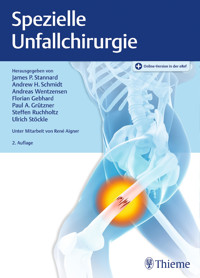
Spezielle Unfallchirurgie E-Book
199,99 €
Mehr erfahren.
- Herausgeber: Thieme
- Kategorie: Fachliteratur
- Sprache: Deutsch
Weit mehr als nur AO-Techniken
Alles in einem Buch: Kompakte und herstellerunabhängige Darstellung der Speziellen Unfallchirurgie. Der Inhalt geht weit über die Vermittlung der Osteosynthesetechniken hinaus - mit so wichtigen Themen wie Weichteil- und Organschäden, konservative Therapie sowie Infektionstherapie und -prophylaxe.
- evidenzbasierte klinische Expertise
- sehr große Methoden- und Behandlungsvielfalt
- mehr als 1500 Fotos und Zeichnungen zu den operativen Techniken
Das Buch vermittelt
- praktische Sicherheit durch hilfreiche "Tipps und Tricks" bei den jeweiligen Verfahren,
- detaillierte Anleitungen zum operativen Management,
- rasche Orientierung durch einheitlichen Aufbau der Kapitel.
Basierend auf den aktuellen Inhalten und Anforderungen zum Erwerb der Zusatzbezeichnung "Spezielle Unfallchirurgie".
Neu in dieser Auflage:
- durchgehend aktualisiert und erweitert
- Schritt-für-Schritt-Anleitungen
- die Behandlung von Frakturen geriatrischer Patienten
Ein hochkarätiges Herausgeber- und Autorenteam hat das Werk übersetzt und die Inhalte auf die Anforderungen im deutschsprachigen Raum anpasst.
Jederzeit zugreifen: Der Inhalt des Buches steht Ihnen ohne weitere Kosten digital in der Wissensplattform eRef zur Verfügung (Zugangscode im Buch). Mit der kostenlosen eRef App haben Sie zahlreiche Inhalte auch offline immer griffbereit.
Das E-Book können Sie in Legimi-Apps oder einer beliebigen App lesen, die das folgende Format unterstützen:
Seitenzahl: 2832
Veröffentlichungsjahr: 2020
Ähnliche




















Spezielle Unfallchirurgie
James P. Stannard, M.D., Andrew H. Schmidt, M.D., Andreas Wentzensen, Florian Gebhard, Paul A. Grützner, Steffen Ruchholtz, Ulrich Stöckle
Mark R. Adams, René Aigner, Peter A. Cole, Valeska Isabel Hofmann, Cory Collinge, Antonio Krüger, Brett D. Crist, Benjamin König, Gregory J. Della Rocca, Christian A. Kühne, Kyle F. Dickson, Martin Lucke, Nikola Marko Dobrasevic, Daniel Matte, Derek Dombroski, Markus Neumaier, Gregory Carl Fanelli, Peter Richter, Johan Charles France, Götz Röderer, Michael J. Gardner, Clemens Schopper, David P. Barei, Simon Bauknecht, Gertraud Gradl, Markus Schultheiß, Thomas J. Graham, Konrad Schütze, Christof Wagner, Matt L. Graves, Neil G. Harness, Keith Heier, James P. Higgins, Harry A. Hoyen, Aaron R. Jacobson, Stephen L. Kates, Carlo Bellabarba, Karl Friedrich Braun, Philip J. Kregor, Craig A. Kuhns, William D. Lack, Ari D. Levine, Frank A. Liporace, Jonathan B. Macknin, Meir Marmor, Steven L. Martin, Amir Matityahu, Samir Mehta, Richard J. Bransford, Benjamin Bücking, Erika J. Mitchell, Sean E. Nork, Brent L. Norris, Mark C. Reilly, David Ring, Thomas A. Russell, David W. Sanders, Andrew H. Schmidt, Stephen Andrews Sems, Ben Shamian, J. Scott Broderick, Christoph Dehner, Stephen H. Sims, Richard Southgate, James P. Stannard, Jared Joseph Stefanko, David Stephen, Michael D. Stover, Steven M. Theiss, David A. Volgas, J. Tracy Watson, Timothy G. Weber, Lance M. Brunton, Christian Frank, Richard S. Yoon, Michael P. Zlowodzki, Lisa K. Cannada, Jan Freiherr von Recum, John T. Capo, Thomas Freude, Theodore J. Choma
2., vollständig überarbeitete und erweiterte Auflage
1587 Abbildungen
Vorwort zur 2. deutschen Auflage
Nicht ohne Grund war bereits die erste englischsprachige Ausgabe der Speziellen Unfallchirurgie von Stannard und Koautoren auf großes Interesse in Deutschland gestoßen: Die Herausgeber der amerikanischen Erstausgabe sprachen von ihrer Vision eines idealen Lehrbuchs der Unfallchirurgie.
Nunmehr liegt die 2. Auflage des „Stannard“ auch in der deutschen Übersetzung vor. Das Buch hat an Umfang zugenommen und enthält jetzt 36 Kapitel. Es wurde ein Kapitel „Frakturbehandlung geriatrischer Patienten“ hinzugefügt und das Kapitel „Behandlungsstrategie für Pseudarthrosen und Fehlstellungen“ wurde in zwei Kapitel unterteilt.
Neben den Hinweisen auf Tipps und Tricks, Ergebnisse („Outcomes“) sowie „Pearls“, die in der ersten Ausgabe alle Kapitel durchgehend begleiteten, wurde ein neuer Abschnitt aufgenommen: „Überleben der Nacht“ („Surviving the Night“), durchlaufend in allen Kapiteln, wo dies von Bedeutung sein kann. Nach Ansicht der Autoren sollen gerade auch diese Kapitel die diensthabenden Ärzte darauf hinweisen, was als erstes am wichtigsten ist und keinesfalls versäumt werden darf.
Dabei werden nicht nur der Ablauf der Operation und die angewandten Techniken dargestellt, sondern jeder einzelne Schritt – von der Lagerung, Durchleuchtung, chirurgischen Zugangsmöglichkeiten, Repositionstechnik und Stabilisierung, einschließlich alternativer Techniken und die Begleit- und Nachbehandlung – beschrieben und gegebenenfalls auch kritisch gegeneinander abgewogen sowie durch umfangreiches Bildmaterial dokumentiert. Ein wichtiger Bestandteil sind die Hinweise auf Ergebnisse und die möglichen Komplikationen, die entsprechende aktuelle Literatur ist verzeichnet. Mit Hilfe dieses Buches soll es möglich sein, bei unterschiedlichen schweren Verletzungsmustern abzuwägen und rasch die richtigen Entscheidungen zu treffen.
Der präzise straff gefasste Text mit den Hinweisen in Praxistipp und “Merke-Boxen“ machen dieses Buch zu einem aktuellen Nachschlagewerk für die moderne Unfallchirurgie. Schon in der englischsprachigen Fassung war das Buch auf Interesse in Deutschland gestoßen, zumal es einen Bereich besetzte, der nicht durch eine vergleichbare deutschsprachige Publikation abgedeckt war.
Die deutschsprachigen Herausgeber und Autoren, die das Werk übersetzten, haben auf die Kompatibilität des Stoffes mit der Realität in Deutschland geachtet.
Erneut danken wir den Herausgebern und Autoren, die die Übersetzung der Kapitel einschließlich einiger Anpassungen, Überarbeitungen und Kapitelergänzungen vorgenommen haben. Wir danken den Mitarbeitern des Thieme Verlages für die zuverlässige redaktionelle Bearbeitung und wünschen dem Buche in den deutschsprachigen Ländern erneut eine weite Verbreitung.
Die Herausgeber der deutschsprachigen Ausgabe
Andreas WentzensenFlorian GebhardPaul A. GrütznerSteffen RuchholtzUlrich Stöckle
Geleitwort zur Originalausgabe
Orthopaedic trauma has evolved into a mature subspecialty of orthopaedic surgery, if not a specialty of its own. Thirty-five to forty years ago, a few centers in Europe and North America began to promote the concept that orthopaedic or fracture care of the injured patient required a more involved and detailed management than had previously been the standard. This was the result of the increased number of complex high-energy injuries, the development of trauma centers, and the quest for better results. Research showed the need for understanding the importance of fractures within the overall management of the injured patient, as well as the need to better understand fracture healing and the soft tissue response to both trauma and operative fracture fixation. As a result, our knowledge of injury and our armamentarium of management options have expanded. Surgical Treatment of Orthopaedic Trauma, edited by Stannard and Schmidt, provides an up-to-date and comprehensive treatise on the management of the injured patient with musculoskeletal injury.
The editors recognized the need for the reader to be aware of all important aspects of trauma care. Thus, the spectrum of the initial care for the injured patient is presented in an excellent chapter on the interaction of physiology and injury that discusses the range of management from early total care to damage control in a logical sequence. The importance of soft tissue and the sequelae of infection, compartment syndrome, and healing problems are mandatory reading before launching into the specific fracture management chapters. Finally, in-depth reviews of the problems of nonunion, malunion, and geriatric fracture care provide the reader with an understanding of what to do to in fracture fixation to avoid problems and how to manage them should they occur.
The chapters on specific fractures provide up-to-date, in-depth discussions of management for each type of fracture. Another section contains chapters on spine fractures and their operative stabilization; these are concisely written and worth reading for the nonspinal surgeon to gain an understanding of the current philosophy of spinal trauma. The chapters on specific fractures provide the important biological and mechanical information necessary to understand present-day therapy, along with excellent descriptions of the accepted techniques. These chapters demonstrate how acceptable outcomes can now be achieved using the principles of fracture healing and mechanics to perform safe and effective surgery for every type of fracture. These chapters present the evolution of orthopaedic trauma care in very practical terms, showing how operative fracture care is now the norm for nearly all fractures.
The editors have chosen to present this information so that the reader is presented with a variety of learning methods. The text is written by expert surgeons who are implementing their recommendations on a daily basis; this is important for the reader to appreciate, as what is presented and summarized in the tips and pearls is the result of a vast amount of hands-on experience. To support the text, each chapter is expertly illustrated and accompanied by videos of many of the described procedures. The opportunity to simultaneously read an expert’s description of a procedure and watch it being performed should provide the surgeon with the best learning environment possible next to being personally present at the procedure.
This book is probably best appreciated by the surgeon who has had some experience in the management of fractures and the injured patient. It is most definitely a book that the orthopaedic trauma surgeon will find interesting and helpful, as it brings together in an unbiased way the results of forty years of operative fracture care evolution. The surgeon who is interested in fracture care and taking call will also find this book extremely helpful, as it provides present-day treatment as well as important advice regarding what to do in the acute setting and when to refer a patient. For the more experienced resident, this book will aid in preparation for those more difficult cases during their senior years of training and will help as they enter practice and are on call.
Dr. Stannard and Dr. Schmidt are to be congratulated in undertaking the second edition of their text. It is an extremely difficult and a time-consuming task to manage dozens of authors, review their manuscripts, and assure video production of excellent quality. The chapter authors are also to be credited with producing very succinct yet indepth reviews of their topics and, most importantly, providing the reader with their valuable experience. Both the editors and authors have done a tremendous job offering the fracture surgeon a very worthwhile and important addition to our evolving knowledge in orthopaedic trauma. On behalf of all those who will have the opportunity to read the text, I want to thank Drs. Stannard and Schmidt and all their authors for the time and effort that they have put into creating a comprehensible and readable text of the state of the art of orthopaedic trauma.
James F. Kellam B.Sc., M.D., F.R.C.S.(C), F.A.C.S., F.R.C.S. (I) Hon.Visiting ProfessorDepartment of Orthopaedic SurgeryThe University of Texas Health Science Center Houston Medical SchoolHouston, Texas
Vorwort zur Originalausgabe
When we published the first edition of Surgical Treatment of Orthopaedic Trauma (STOT) in 2007, we did not know it would become a best-selling and award-winning comprehensive orthopaedic trauma text. The success of the first edition validated our opinion that orthopaedic surgeons needed a concise text that would guide the reader to the key elements of surgical treatment of skeletal trauma. However, much has changed in the clinical practice of orthopaedic trauma over the past 8 years. With that in mind, STOT has been revised and updated in order to remain current.
Our goal with this second edition was to keep the popular elements of the first edition intact, while adding some new features. In addition to the Tips and Tricks, Outcomes, and Pearls sections that were featured in the first edition, we have added a new section called Surviving The Night. The goal of this section is to provide a concise place in each chapter that the reader can go to find out what needs to be considered to make sure a patient with the injury featured “survives the night.” It should be a great benefit to residents who can turn to that area first, and make sure they don’t overlook key issues that must be addressed. We also believe it will be of great benefit to practicing orthopaedic surgeons who take call but do not consider trauma their primary subspecialty. It is our hope it will help those surgeons have a quick place they can turn and remind themselves regarding key issues that must be addressed to care for their patient in the first 24 hours.
We also recognize many surgeons learn best via visual instruction and that the videos of cases were extremely popular in the first edition. We have kept all of the prior 120+ videos and added an additional 32. Many of the new videos focus on complex reconstruction techniques or newer implants. All of them were shot in High Definition. We are again indebted to the Erwin Brothers motion pictures for helping us with this project. They have provided their expertise at a cost far below the normal commercial rate, because they are friends and believe in the project. They have done this while they are in the final stages of putting together their third feature length motion picture, a true story titled “Woodlawn.” We particularly want to thank Jon Erwin and Blake Benton for all of their support. Making these videos really appear professional required Jon’s guidance and resources and some very late nights with Blake editing the videos. They represent what we believe to be an enormous educational resource.
The first edition of STOT had Philip Kregor, MD, as an editor and key contributor. Phil has had a number of changes in his practice that required a great deal of time, and prevented him from full participation in this second edition. However, he did provide key contributions to both the first and second edition and so we have acknowledged that with his name on the front cover.
We hope you find this second version of Surgical Treatment of Orthopaedic Trauma even more valuable than the first edition. It has taken an enormous amount of time for many talented surgeons, writers, and videographers to put it together. The number of times we have been approached by residents, practicing surgeons, and even missionary physicians in remote third world locations and been told that the book was a major help in caring for their patients makes it all worthwhile. We greatly appreciate our families, who have borne much of the burden of the time required to complete this edition. We hope this book and the accompanying videos will help dedicated surgeons take great care of patients who have sustained skeletal trauma.
James P. Stannard, MDAndrew H. Schmidt, MD
Inhaltsverzeichnis
Titelei
Vorwort zur 2. deutschen Auflage
Geleitwort zur Originalausgabe
Vorwort zur Originalausgabe
1 Der schwerverletzte Patient
1.1 Einleitung
1.2 Untersuchung des schwerverletzten Patienten
1.3 Physiologische Veränderungen nach Trauma
1.3.1 Systemisches Inflammationsreaktionssyndrom (SIRS)
1.3.2 Multiorganversagen (MOV)
1.3.3 Frakturversorgung und SIRS – Second Hit
1.4 Prioritätenadaptiertes Therapiemanagement
1.4.1 Versorgungszeitpunkt
1.4.2 Damage Control Orthopaedics (DCO)
1.4.3 Besonderheiten bei Schädel-Hirn-Trauma-Patienten
1.4.4 Ergebnisse
1.4.5 Scoring-Systeme
1.4.6 Spezialfälle
1.4.7 Fallbeispiele
1.5 Zusammenfassung
1.6 Literatur
2 Weichteilbehandlung
2.1 Einleitung
2.2 Anatomie
2.3 Initiale Einschätzung und Klassifikation
2.3.1 Klassifikation von Weichteilschäden
2.3.2 Klassifikation offener Frakturen
2.4 Einzelne Aspekte der Weichteilbehandlung
2.4.1 Inzision
2.4.2 Instrumentierung
2.4.3 Tourniquet
2.4.4 Hämostase
2.4.5 Innere Frakturreposition
2.4.6 „No-Touch“-Technik
2.5 Wundkonditionierung
2.5.1 Zeitpunkt für Antibiose und Débridement von offenen Frakturen
2.5.2 Abschwellung
2.5.3 Hauttraktion (Gummibänder und Klammern)
2.5.4 Unterdruck-Wundtherapie
2.5.5 Antibiotikaketten
2.5.6 Spannungsblasen
2.6 Rekonstruktive Chirurgie
2.6.1 Zeitpunkt für die Deckung
2.6.2 Verfahrenswahl
2.6.3 Spalthauttransplantate
2.6.4 Gastrocnemiuslappen
2.6.5 Soleuslappen
2.6.6 Axialer oder frei geformter fasziokutaner Lappen
2.6.7 Zweistieliger Lappen
2.6.8 Suralislappen
2.6.9 Andere Optionen zur Deckung
2.6.10 Ergebnisse
2.7 Literatur
3 Muskuloskelettale Infektionen nach Trauma
3.1 Einleitung
3.2 Präventive Maßnahmen
3.2.1 Débridement und Spülung
3.2.2 Systemische Antibiotikagabe
3.2.3 Innere oder äußere Frakturstabilisierung
3.2.4 Perioperative Antibiotikaprophylaxe
3.2.5 Zeitpunkt des Wundverschlusses
3.2.6 Wahl des geeigneten Operationszeitpunkts
3.2.7 Temporäre externe Fixation
3.3 Diagnostik
3.3.1 Klinik
3.3.2 Laborparameter
3.3.3 Bildgebung
3.3.4 Kulturen
3.4 Stadieneinteilung und Klassifikation
3.5 Therapie
3.5.1 Grundlagen der Antibiotikatherapie bei muskuloskelettalen Infektionen
3.5.2 Subakute und akute Infektionen
3.5.3 Chronische Infektionen
3.6 Literatur
4 Akutes Kompartmentsyndrom
4.1 Pathogenetische Grundlagen
4.2 Diagnosestellung
4.2.1 Klinische Symptome
4.2.2 Intramuskuläre Druckmessung
4.2.3 Bildgebung
4.2.4 Weitere diagnostische Verfahren
4.3 Klassifikation
4.4 Therapie
4.4.1 Konservative Therapie
4.4.2 Operative Therapie
4.4.3 Prognose und Ergebnisse
4.4.4 Komplikationen
4.4.5 Neue Entwicklungen
4.5 Literatur
5 Entwicklung der Konzepte der Plattenosteosynthese
5.1 Einleitung
5.2 Geschichte und Entwicklung der Plattenosteosynthese
5.3 Praktische Anwendungen des Schraubendesigns
5.4 Konventionelle Kompressionsplatten
5.4.1 Neutralisation, Überbrückung, Abstützung: Platten als Repositionshilfen
5.5 Winkelstabile Platten-Schrauben-Konstruktionen
5.6 Minimalinvasive Verplattung
5.7 Winkelstabile Platten und Plattensysteme
5.7.1 Indikationen für winkelstabile Verplattung
5.7.2 Komplikationen winkelstabiler Platten
5.7.3 Repositionshilfen für die winkelstabile Verplattung
5.8 Ergebnisse
5.9 Literatur
6 Pseudarthrose
6.1 Einleitung
6.2 Klassifikation
6.3 Diagnosestellung
6.4 Operative Behandlung
6.4.1 Pseudarthrose der Klavikula
6.4.2 Pseudarthrose des Humerusschafts
6.4.3 Pseudarthrose des Femurhalses
6.4.4 Subtrochantäre Pseudarthrose
6.4.5 Pseudarthrose des Femurschafts
6.4.6 Pseudarthrose des distalen Femurs
6.4.7 Pseudarthrose der Tibia
6.5 Ergebnisse
6.6 Komplikationen
6.7 Literatur
7 Fehlstellungen
7.1 Einleitung
7.2 Ursachenfindung – Fehleranalyse
7.2.1 Basisprinzipien
7.2.2 Mitwirkende Faktoren
7.2.3 Management
7.3 Charakterisierung der Deformität
7.3.1 Darstellung auf Röntgenbildern
7.3.2 Management
7.4 Konservative Behandlung
7.5 Operative Behandlung
7.5.1 Indikationsstellung
7.5.2 Präoperative Planung
7.5.3 Chirurgische Zugänge
7.5.4 Auswahl der Osteotomie
7.5.5 Korrektur der Deformität
7.5.6 Implantate zur Stabilisierung
7.6 Ergebnisse
7.7 Komplikationen
7.8 Literatur
8 Frakturen bei geriatrischen Patienten
8.1 Demografie
8.2 Mortalität
8.2.1 Hochrasanztrauma
8.2.2 Niedrigrasanztrauma
8.3 Behandlungssetting
8.4 Unfallmechanismen
8.5 Physiologie und Nebenerkrankungen
8.6 Osteoporose
8.6.1 Prävalenz
8.6.2 Pathophysiologie und Diagnostik
8.6.3 Osteoporose-assoziierte Frakturen
8.6.4 Therapie
8.7 Sekundärprävention von Frakturen
8.7.1 Vitamin-D-Supplementation
8.7.2 Sturzprävention
8.8 Präoperatives Management
8.8.1 Optimierung der Medikation
8.8.2 Behandlung von Komorbiditäten
8.8.3 Interdisziplinäres Behandlungsmodell
8.8.4 Notwendigkeit einer kardiologischen Vorstellung
8.8.5 Flüssigkeitsmanagement
8.8.6 Anästhesiologische Überlegungen
8.8.7 Timing der Operation
8.9 Orthopädisch-unfallchirurgisches Management
8.9.1 Damage Control Orthopedics
8.9.2 Early Total Care
8.9.3 Periartikuläre Frakturen
8.9.4 Periprothetische Frakturen
8.9.5 Operationszeitpunkt
8.9.6 Implantatwahl
8.9.7 Weitere Überlegungen
8.10 Komplikationen und unerwünschte Ereignisse
8.10.1 Weichteile
8.10.2 Herz
8.10.3 Lunge
8.10.4 Niere
8.10.5 Leber
8.10.6 Delir
8.10.7 Infektion
8.10.8 Spezielles Management
8.11 Ergebnisse
8.12 Fazit
8.13 Literatur
9 Verletzungen der oberen Halswirbelsäule
9.1 Einleitung
9.2 Konservative Therapie
9.2.1 Allgemeine Konzepte
9.2.2 Zervikalstütze
9.3 Verletzungsklassifikation und Indikationen zur operativen Therapie
9.3.1 Okzipitale Kondylenfraktur
9.3.2 Kraniozervikale Dissoziation
9.3.3 Atlasfraktur
9.3.4 Atlantoaxiale Instabilität
9.3.5 Distraktionsverletzung
9.3.6 Densfraktur
9.3.7 Traumatische Spondylolisthese des Dens axis (Hangman-Fraktur)
9.4 Operative Therapie
9.4.1 Chirurgische Optionen
9.4.2 Patientenlagerung
9.4.3 Radiologische Bildgebung
9.4.4 Chirurgische Zugänge
9.4.5 Chirurgische Technik
9.5 Postoperative Nachbehandlung
9.6 Neue Technologien
9.7 Ergebnisse und Komplikationen
9.7.1 Verletzungsspezifische Ergebnisse und Komplikationen
9.7.2 Behandlungsspezifische Ergebnisse und Komplikationen
9.8 Literatur
10 Verletzungen der unteren Halswirbelsäule
10.1 Einleitung
10.2 Unfalleinschätzung und Klassifikation
10.2.1 Neurologischer Status
10.2.2 ASIA Impairment Scale
10.2.3 Mechanisch orientierte Klassifikation
10.2.4 Klassifikation nach Verletzungsmechanismus
10.2.5 Subaxial Cervical Spine Injury Classification (SLIC)
10.3 Konservative Behandlung
10.3.1 Dornfortsatz- und Querfortsatzfrakturen
10.3.2 Teardrop-Fraktur
10.3.3 Massa-lateralis-Fraktur
10.3.4 Nervenwurzelverletzung
10.3.5 Facettengelenkdislokation
10.3.6 Facettengelenkfraktur
10.3.7 Axiale Verletzungen
10.4 Indikationen zur operativen Therapie
10.4.1 Neurologisches Defizit
10.4.2 Stabilität
10.4.3 Facettengelenkdislokation
10.4.4 Berstungs- und Teardrop-Fraktur
10.4.5 Massa-lateralis-Fraktur
10.5 Erstversorgung von Subluxationen und Dislokationen der unteren Halswirbelsäule
10.6 Operative Behandlung
10.6.1 Behandlungsziel
10.6.2 Facettengelenkfrakturen und -dislokationen
10.6.3 Kompressions-, Berstungs- und Teardrop-Frakturen
10.6.4 Massa-lateralis-Frakturen
10.6.5 Ankylosierende Spondylitis
10.7 Ergebnisse
10.7.1 Faktoren für das Langzeitergebnis
10.8 Komplikationen
10.9 Literatur
11 Verletzungen der Brustwirbelsäule
11.1 Anatomie und Biomechanik
11.2 Verletzungsmuster und Klassifikation
11.3 Verletzungen mit neurologischer Schädigung
11.4 Aktuelle Behandlungsoptionen
11.4.1 Konservative Behandlung
11.4.2 Operative Behandlung
11.4.3 Komplikationen
11.5 Literatur
12 Trauma der Lendenwirbelsäule und des thorakolumbalen Übergangs
12.1 Einleitung
12.2 Klassifikation
12.2.1 Klassifikation nach Denis
12.2.2 Klassifikation nach Magerl et al.
12.2.3 Thoracolumbar Injury Severity Score (TLISS)
12.2.4 Thoracolumbar Injury Classification and Severity Score (TLICS)
12.2.5 Neue kombinierte Klassifikation
12.3 Konservative Behandlung
12.3.1 Kompressionsfrakturen
12.3.2 Berstungsfrakturen
12.3.3 Flexions-Distraktions-Verletzung
12.3.4 Dislozierte Frakturen
12.4 Indikationen zur operativen Behandlung
12.4.1 Kompressionsfrakturen
12.4.2 Berstungsfrakturen
12.4.3 Flexions-Distraktions-Verletzung
12.4.4 Dislozierte Frakturen
12.5 Operative Behandlung
12.5.1 Behandlungsziele
12.5.2 Chirurgische Zugangswege
12.5.3 Chirurgische Techniken
12.6 Komplikationen
12.6.1 Tiefe Beinvenenthrombose
12.6.2 Infektion
12.6.3 Duraverletzung
12.6.4 Pseudarthrose
12.6.5 Posttraumatische Deformität
12.6.6 Neurologische Schädigung
12.7 Referenzen
13 Verletzungen des Schultergürtels
13.1 Luxation des Akromioklavikulargelenks
13.1.1 Einleitung
13.1.2 Klassifikation
13.1.3 Klinische Untersuchung
13.1.4 Konservative Behandlung
13.1.5 Operative Behandlung
13.1.6 Ergebnisse
13.1.7 Komplikationen
13.2 Skapulafrakturen
13.2.1 Einleitung
13.2.2 Klassifikation
13.2.3 Klinische Untersuchung
13.2.4 Konservative Behandlung
13.2.5 Operative Behandlung
13.2.6 Ergebnisse
13.2.7 Komplikationen
13.3 Klavikulafrakturen
13.3.1 Einleitung
13.3.2 Klassifikation
13.3.3 Klinische Untersuchung
13.3.4 Konservative Behandlung
13.3.5 Operative Behandlung
13.3.6 Ergebnisse
13.3.7 Komplikationen
13.4 Literatur
14 Proximale Humerusfraktur und Schulterluxation
14.1 Einleitung
14.2 Proximale Humerusfrakturen
14.2.1 Klassifikation
14.2.2 Diagnostik
14.2.3 Konservative Behandlung
14.2.4 Operative Behandlung
14.2.5 Ergebnisse
14.2.6 Komplikationen
14.2.7 Neue Techniken
14.3 Schulterluxationen
14.3.1 Klassifikation
14.3.2 Konservative Behandlung
14.3.3 Operative Behandlung
14.3.4 Ergebnisse
14.3.5 Komplikationen
14.4 Literatur
15 Frakturen des Humerusschafts
15.1 Einleitung
15.2 Klassifikation
15.3 Konservative Behandlung
15.3.1 Indikation
15.3.2 Oberarmschiene
15.3.3 Funktioneller (Sarmiento-)Brace
15.3.4 Hängegips (Hanging Cast)
15.3.5 Andere konservative Therapieoptionen
15.4 Operative Behandlung
15.4.1 Indikation
15.4.2 Operationstechnik
15.5 Ergebnisse und Komplikationen
15.5.1 Frakturheilung in Fehlstellung
15.5.2 Pseudarthrose
15.5.3 Gefäß-Nerven-Verletzungen
15.5.4 Verfahrensspezifische Komplikationen
15.6 Literatur
16 Frakturen des distalen Humerus
16.1 Einleitung
16.2 Klassifikation
16.2.1 Koronare Abscherfrakturen
16.3 Diagnostik
16.3.1 Klinische Untersuchung
16.3.2 Bildgebung
16.4 Konservative Behandlung
16.5 Operative Behandlung
16.5.1 Ziele und Prinzipien
16.5.2 Präoperative Planung
16.5.3 Lagerung des Patienten
16.5.4 Chirurgischer Zugang
16.5.5 Management des Nervus ulnaris
16.5.6 Reposition und Osteosynthese
16.5.7 Nachbehandlung
16.5.8 Fixierung von koronaren Abscherfrakturen
16.6 Ergebnisse
16.7 Komplikationen
16.7.1 Osteosyntheseversagen
16.7.2 Pseudarthrose
16.7.3 Infektion
16.7.4 Neuropathie des N. ulnaris
16.7.5 Eingeschränkter Bewegungsumfang des Ellenbogengelenks
16.7.6 Heterotope Ossifikationen
16.7.7 Beschwerden nach Olekranonosteotomie
16.8 Literatur
17 Verletzungen des Ellenbogens
17.1 Einleitung
17.2 Anatomie
17.3 Radiusköpfchenfraktur
17.3.1 Klassifikation
17.3.2 Konservative Behandlung
17.3.3 Operative Behandlung
17.3.4 Ergebnisse
17.3.5 Komplikationen
17.4 Einfache Ellenbogenluxation
17.4.1 Klassifikation
17.4.2 Konservative Behandlung
17.4.3 Operative Behandlung
17.4.4 Ergebnisse
17.4.5 Komplikationen
17.5 Ellenbogenluxationsfraktur
17.5.1 Ellenbogenluxation mit Radiusköpfchenfraktur
17.5.2 Koronoidluxationsfraktur
17.5.3 Terrible-Triad-Luxationsfraktur
17.5.4 Verletzungen mit posteromedialer Varusrotationsinstabilität
17.6 Olekranonfraktur
17.6.1 Klassifikation
17.6.2 Konservative Behandlung
17.6.3 Operative Behandlung
17.6.4 Ergebnisse
17.7 Olekranonluxationsfraktur
17.7.1 Klassifikation
17.7.2 Operative Behandlung
17.7.3 Ergebnisse
17.7.4 Komplikationen
17.8 Rehabilitation
17.9 Komplikationen
17.10 Literatur
18 Unterarmfrakturen
18.1 Einleitung
18.2 Klassifikation
18.3 Konservative Behandlung
18.3.1 Indikation
18.3.2 Repositions- und Retentionstechnik
18.3.3 Funktionelles Bracing isolierter Ulnafrakturen
18.4 Operative Behandlung
18.4.1 Indikation
18.4.2 Präoperative Planung
18.4.3 Lagerung und Abdeckung
18.4.4 Bildgebung
18.4.5 Anatomie
18.4.6 Chirurgische Zugänge
18.4.7 Operationstechnik
18.4.8 Rehabilitation
18.5 Ergebnisse
18.6 Komplikationen
18.6.1 Pseudarthrose
18.6.2 Radioulnare Synostose
18.6.3 Kompartmentsyndrom
18.6.4 Refrakturen
18.7 Literatur
19 Frakturen des distalen Radius
19.1 Einleitung
19.2 Anatomie
19.3 Bildgebung
19.4 Klassifikation
19.5 Konservative Behandlung
19.6 Operative Behandlung
19.6.1 Indikation
19.6.2 Präoperative Planung
19.6.3 Chirurgische Zugänge für die interne Fixation
19.6.4 Fixateur externe am Handgelenk
19.6.5 Arthroskopisch assistierte interne Fixation
19.7 Begleitende Weichteilverletzungen
19.8 Begleitende distale Ulnafrakturen
19.9 Ergebnisse
19.10 Komplikationen
19.11 Literatur
20 Frakturen und Luxationen der Handwurzel
20.1 Karpale Instabilität
20.1.1 Anatomie
20.1.2 Diagnostik und Klassifikation
20.1.3 Konservative Behandlung
20.1.4 Operative Behandlung
20.1.5 Ergebnisse
20.1.6 Komplikationen
20.2 Kahnbeinfrakturen
20.2.1 Anatomie
20.2.2 Diagnostik und Klassifikation
20.2.3 Konservative Behandlung
20.2.4 Operative Behandlung
20.2.5 Ergebnisse
20.2.6 Komplikationen
20.3 Weitere Frakturen der Handwurzel
20.3.1 Fraktur des Os triquetrum
20.3.2 Fraktur des Os trapezium
20.3.3 Fraktur des Os hamatum
20.3.4 Fraktur des Os lunatum
20.3.5 Fraktur des Os capitatum
20.3.6 Fraktur des Os trapezoideum
20.4 Literatur
21 Hand- und Fingerverletzungen
21.1 Einleitung
21.2 Endphalanx
21.2.1 Konservative Behandlung
21.2.2 Operative Behandlung
21.3 Grund- und Mittelphalanx (extraartikulär)
21.3.1 Konservative Behandlung
21.3.2 Operative Behandlung
21.4 Proximales Interphalangealgelenk
21.4.1 Dorsale Luxationen
21.4.2 Laterale und palmare Dislokationen
21.4.3 Kondylenfrakturen
21.5 Metakarpophalangealgelenk
21.5.1 Konservative Behandlung
21.5.2 Operative Behandlung
21.6 Metakarpalia
21.6.1 Basisfrakturen und Luxationsfrakturen des Karpometakarpalgelenks
21.6.2 Subkapitale Metakarpalefrakturen
21.6.3 Diaphysäre Metakarpalefrakturen
21.7 Literatur
22 Beckenringverletzungen
22.1 Einleitung
22.2 Anatomie
22.3 Diagnostik
22.4 Klassifikation
22.5 Konservative Behandlung
22.6 Operative Behandlung
22.6.1 Indikation
22.6.2 Präoperative Planung
22.6.3 Verletzungen des vorderen Beckenrings
22.6.4 Verletzungen des hinteren Beckenrings
22.6.5 Rehabilitation
22.6.6 Neue Techniken
22.7 Ergebnisse
22.8 Komplikationen
22.9 Literatur
23 Azetabulumfrakturen
23.1 Einleitung
23.2 Diagnostik
23.3 Klassifikation
23.4 Konservative Behandlung
23.5 Operative Behandlung
23.5.1 Indikation
23.5.2 Präoperative Planung
23.5.3 Vorbereitung des Patienten
23.5.4 Chirurgische Zugänge
23.5.5 Operationstechnik
23.5.6 Rehabilitation
23.5.7 Neue Techniken
23.6 Ergebnisse
23.6.1 Qualität der Reposition
23.6.2 Radiologische und klinische Ergebnisse nach operativ versorgten Azetabulumfrakturen
23.6.3 Ergebnisse nach operativer Reposition und Osteosynthese von Frakturen der hinteren Wand
23.6.4 Ergebnisse nach verzögerter Versorgung oder Revisionsversorgung von Azetabulumfrakturen
23.6.5 Funktionelles Ergebnis
23.7 Komplikationen
23.7.1 Tiefe Venenthrombose
23.7.2 Infektionen
23.7.3 Neurologische Verletzungen
23.7.4 Gefäßverletzungen
23.7.5 Posttraumatische Arthrose
23.7.6 Avaskuläre Nekrose
23.7.7 Heterotope Ossifikationen
23.8 Literatur
24 Traumatische Hüftluxation und Femurkopffraktur
24.1 Einleitung
24.2 Diagnostik und Klassifikation
24.3 Konservative Behandlung
24.3.1 Geschlossene Reposition der hinteren Hüftluxation
24.3.2 Geschlossene Reposition der vorderen und inferioren Hüftluxation
24.4 Operative Behandlung
24.4.1 Chirurgische Zugänge
24.4.2 Pipkin-I- und -II-Frakturen
24.4.3 Pipkin-III-Frakturen
24.4.4 Pipkin-IV-Frakturen
24.5 Ergebnisse
24.6 Komplikationen
24.7 Literatur
25 Frakturen des Schenkelhalses
25.1 Einleitung
25.2 Klassifikation
25.3 Konservative Behandlung
25.4 Operative Behandlung
25.4.1 Indikation
25.4.2 Implantatwahl
25.4.3 Behandlungsgrundlagen bei geriatrischen Patienten
25.4.4 Hemiprothetischer Gelenkersatz
25.4.5 Totalendoprothetischer Gelenkersatz (TEP)
25.4.6 Chirurgisch relevante Anatomie
25.4.7 Chirurgische Zugänge
25.4.8 Operationstechnik
25.4.9 Alloplastischer Gelenkersatz
25.5 Komplikationen
25.5.1 Medizinische Komplikationen
25.5.2 Heilungsstörungen
25.5.3 Femurkopfnekrosen
25.6 Literatur
26 Pertrochantäre Femurfrakturen
26.1 Einleitung
26.2 Anatomie
26.3 Diagnostik
26.4 Klassifikation
26.5 Konservative Behandlung
26.6 Operative Behandlung
26.6.1 Indikation
26.6.2 Implantatwahl
26.6.3 Platten- und Schraubenfixierung
26.6.4 Zephalomedulläre Fixation
26.7 Ergebnisse
26.7.1 Mortalität
26.7.2 Funktionelle Ergebnisse
26.7.3 Frakturkollaps
26.8 Komplikationen
26.8.1 Medizinische Komplikationen
26.8.2 Psychosoziale Komplikationen
26.8.3 Thromboembolische Komplikationen
26.8.4 Pseudarthrose und mechanisches Implantatversagen
26.8.5 Infektion
26.9 Literatur
27 Subtrochantäre Femurfrakturen
27.1 Einleitung
27.2 Anatomie
27.3 Klassifikation
27.3.1 Russell-Taylor-Klassifikation
27.3.2 AO/OTA-Klassifikation
27.3.3 Atypische subtrochantäre Femurfrakturen
27.4 Konservative Behandlung
27.5 Operative Behandlung
27.5.1 Indikation
27.5.2 Nagelosteosynthese
27.5.3 Plattenosteosynthese
27.5.4 Operationstechnik
27.5.5 Rehabilitation
27.6 Ergebnisse
27.7 Komplikationen
27.8 Literatur
28 Femurschaftfrakturen
28.1 Einleitung
28.2 Klassifikation
28.3 Konservative Behandlung
28.4 Operative Behandlung
28.4.1 Indikation
28.4.2 Versorgungsoptionen
28.4.3 Chirurgische Anatomie
28.4.4 Operationstechnik
28.4.5 Spezielle Fälle
28.4.6 Neue Techniken
28.5 Ergebnisse
28.6 Komplikationen
28.6.1 Infektionen
28.6.2 Übersehene Begleitverletzungen
28.6.3 Refrakturen
28.6.4 Verzögerte Knochenheilung/Pseudarthrosenbildung
28.6.5 Fehlstellungen
28.6.6 Implantatirritation
28.6.7 Kompartmentsyndrom
28.6.8 Nervenschäden
28.6.9 Heterotope Ossifikationen
28.7 Atypische Femurfrakturen
28.8 Literatur
29 Distale Femurfrakturen
29.1 Einleitung
29.2 Klassifikation
29.3 Konservative Behandlung
29.4 Operative Behandlung
29.4.1 Indikation
29.4.2 Chirurgische Anatomie
29.4.3 Chirurgische Zugänge
29.4.4 Operationstechnik
29.5 Rehabilitation
29.5.1 Typ-A-Frakturen
29.5.2 Typ-B- und Typ-C-Frakturen
29.6 Neue Techniken
29.7 Ergebnisse
29.8 Komplikationen
29.9 Literatur
30 Verletzungen des Kniegelenkstreckapparats
30.1 Einleitung
30.2 Patellafrakturen
30.2.1 Anatomie
30.2.2 Pathophysiologie
30.2.3 Diagnostik
30.2.4 Klassifikation
30.2.5 Konservative Behandlung
30.2.6 Operative Behandlung
30.2.7 Ergebnisse
30.2.8 Komplikationen
30.3 Rupturen der Quadrizepssehne oder der Patellarsehne
30.3.1 Pathophysiologie
30.3.2 Diagnostik
30.3.3 Konservative Behandlung
30.3.4 Operative Behandlung
30.3.5 Ergebnisse
30.3.6 Komplikationen
30.4 Literatur
31 Kniegelenkluxation und Bänderverletzungen
31.1 Einleitung
31.2 Klassifikation
31.3 Konservative Behandlung
31.3.1 Indikation
31.3.2 Techniken
31.3.3 Rehabilitation
31.4 Operative Behandlung
31.4.1 Indikation und Behandlungsalgorithmus
31.4.2 Chirurgische Anatomie
31.4.3 Chirurgische Zugänge
31.4.4 Operationstechnik
31.4.5 Rehabilitation
31.4.6 Neue Techniken
31.5 Ergebnisse
31.5.1 Bewegungsumfang
31.5.2 Instabilität
31.5.3 Schmerz
31.5.4 Wiederaufnahme von Aktivität/Beruf
31.6 Komplikationen
31.6.1 Gefäßverletzungen
31.6.2 Nervenverletzungen
31.6.3 Infektionen und Wundheilungsstörungen
31.6.4 Heterotope Ossifikationen
31.6.5 Osteonekrose des medialen Femurkondylus
31.6.6 Arthrose
31.6.7 Falsche oder verzögerte Diagnosestellung
31.7 Literatur
32 Tibiakopffrakturen
32.1 Einleitung
32.2 Klassifikation
32.2.1 Schatzker-Klassifikation
32.2.2 Modifikation der Schatzker-Klassifikation
32.2.3 AO/OTA-Klassifizierung der Tibiakopffrakturen
32.2.4 Drei-Säulen-Theorie
32.2.5 Modifizierte Einteilung der Luxationsfrakturen nach Schenck
32.3 Diagnostik
32.3.1 Knieluxationsfrakturen
32.4 Konservative Behandlung
32.5 Operative Behandlung
32.5.1 Indikation
32.5.2 Anlage eines temporären Kniegelenk-überbrückenden Fixateur externe
32.5.3 Chirurgische Anatomie
32.5.4 Chirurgische Zugänge
32.5.5 Operationstechnik
32.5.6 Technische Hilfsmittel
32.5.7 Rehabilitation
32.6 Ergebnisse
32.7 Komplikationen
32.8 Literatur
33 Tibiaschaftfrakturen
33.1 Einleitung
33.2 Klassifikation
33.3 Konservative Behandlung
33.4 Operative Behandlung
33.4.1 Indikation
33.4.2 Chirurgische und radiologische Anatomie
33.4.3 Operationstechnik
33.5 Ergebnisse
33.5.1 Die verstümmelte Extremität
33.6 Komplikationen
33.6.1 Knieschmerz
33.6.2 Pseudarthrose
33.6.3 Infektion
33.7 Literatur
34 Distale Tibiafrakturen
34.1 Einleitung
34.2 Klassifikation
34.3 Konservative Behandlung
34.4 Operative Behandlung
34.4.1 Indikation
34.4.2 Generelle Strategie zur offenen Reposition und inneren Fixierung
34.4.3 Chirurgische Anatomie
34.4.4 Chirurgische Zugänge und Operationstechnik
34.4.5 Rehabilitation und postoperatives Management
34.4.6 Neuere Behandlungsmethoden
34.5 Ergebnisse
34.6 Komplikationen
34.7 Literatur
35 Sprunggelenkfrakturen und -luxationen
35.1 Einleitung
35.2 Diagnostik
35.3 Klassifikation
35.4 Konservative Behandlung
35.5 Operative Behandlung
35.5.1 Indikation
35.5.2 Funktionelle und chirurgische Anatomie
35.5.3 Zeitpunkt der Operation
35.5.4 Untersuchung
35.5.5 Implantatwahl
35.5.6 Präoperative Behandlung und Planung
35.5.7 OP-Setup
35.5.8 Isolierte Außenknöchelfrakturen
35.5.9 Innenknöchelfrakturen
35.5.10 Bimalleolarfrakturen
35.5.11 Fraktur des Volkmann-Dreiecks
35.5.12 Syndesmosenverletzungen
35.5.13 Offene Frakturen
35.5.14 Sprunggelenkfrakturen bei Osteoporose
35.5.15 Sprunggelenkfrakturen bei Diabetes mellitus
35.5.16 Sprunggelenkluxationen
35.5.17 Postoperatives Management
35.6 Ergebnisse
35.7 Komplikationen
35.7.1 Wundheilungsstörung und Infektion
35.7.2 Pseudarthrosen
35.7.3 Fehlverheilung
35.7.4 Arthrose
35.7.5 Bewegungseinschränkung
35.7.6 Symptomatisches Osteosynthesematerial
35.7.7 Neurapraxie und Neurome
35.7.8 Osteochondrale Frakturen
35.8 Ergebnisse
35.8.1 Sprunggelenkluxationen
35.9 Literatur
36 Frakturen des Fußes
36.1 Einleitung
36.2 Talusfrakturen
36.2.1 Anatomie und Biomechanik
36.2.2 Talushalsfrakturen
36.2.3 Taluskorpusfrakturen
36.2.4 Taluskopffrakturen
36.2.5 Frakturen des Processus posterior
36.3 Kalkaneusfrakturen
36.3.1 Primäre Untersuchung
36.3.2 Weichteilmanagement
36.3.3 Klassifikation
36.3.4 Konservative Behandlung
36.3.5 Operative Behandlung
36.3.6 Offene Fersenbeinfrakturen
36.3.7 Ergebnisse
36.3.8 Komplikationen
36.4 Navikularefrakturen
36.4.1 Klassifikation
36.4.2 Konservative Behandlung
36.4.3 Operative Behandlung
36.4.4 Ergebnisse und Komplikationen
36.5 Kuboidfrakturen
36.5.1 Klassifikation
36.5.2 Konservative Behandlung
36.5.3 Operative Behandlung
36.5.4 Komplikationen
36.5.5 Ergebnisse
36.6 Verletzungen der Lisfranc-Gelenkreihe
36.6.1 Klassifikation
36.6.2 Konservative Behandlung
36.6.3 Operative Behandlung
36.6.4 Ergebnisse
36.6.5 Komplikationen
36.7 Frakturen der Mittelfußknochen
36.7.1 Os metatarsale I
36.7.2 Ossa metatarsalia II–IV
36.7.3 Os metatarsale V
36.8 Verletzungen der Metatarsophalangealgelenke
36.8.1 MTP-1-Gelenk
36.8.2 MTP-2- bis -5-Gelenke
36.9 Zehenfrakturen
36.9.1 Großzehe
36.9.2 Kleinzehen
36.10 Literatur
Anschriften
Sachverzeichnis
Impressum/Access Code




