


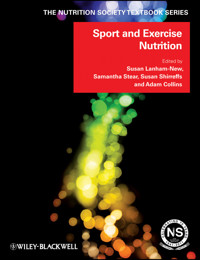
Sport and Exercise Nutrition E-Book
56,99 €
Mehr erfahren.
- Herausgeber: John Wiley & Sons
- Kategorie: Fachliteratur
- Serie: The Nutrition Society Textbook
- Sprache: Englisch
Please note that digital editions do not include all the illustrations found in the printed book.
Now widely adopted on courses throughout the world, the prestigious Nutrition Society Textbook series provides students with the scientific basics in nutrition in the context of a systems and disease approach rather than on a nutrient by nutrient basis. In addition books provide a means to enable teachers and students to explore the core principles of nutrition and to apply these throughout their training to foster critical thinking at all times.This NS Textbook on Sport and Exercise Nutrition has been written to cover the latest information on the science and practice of sport and exercise nutrition. A key concept behind this textbook is that it aims to combine the viewpoints of world leading nutrition experts from both academia/research and a practical stand point. Plus where necessary there are additional practitioner based authors to ensure theory is translated into practice for each chapter in the form of either ‘practice tips' or ‘information sheets' at the end of relevant chapters.
The textbook in essence can be divided into three distinct but integrated parts:
- Part 1: covers the key components of the science that supports the practice of sport and exercise nutrition including comprehensive reviews on: nutrients both in general and as exercise fuels; exercise physiology; hydration, micronutrients; and supplements.
- Part 2: moves into focusing on specific nutrition strategies to support different types of training including: resistance; power/sprint; middle distance/speed endurance; endurance; technical/skill, team; and specific competition nutrition needs.
The unique format of this textbook is that it breaks down nutrition support into training specific as opposed to the traditional sport specific support. This reflects the majority of current sport and exercise requirements of the need to undertake concurrent training and therefore facilitating targeted nutrition support to the different training components through the various macro and micro training cycles. - Part 3: explores some of the practical issues encountered in working in the sport and exercise nutrition field and includes key sport related topics such as: disability sport; weight management; eating disorders; bone and gut health; immunity; injury; travel; and special populations and situations.
READERSHIP: Students of nutrition and dietetics at both undergraduate and postgraduate level. All those working in the field of nutrition and related health sciences.
Sie lesen das E-Book in den Legimi-Apps auf:
Seitenzahl: 1196
Veröffentlichungsjahr: 2011
Ähnliche




















Contents
Contributors
Series Foreword
Preface
The Nutrition Society Textbook Series Editors
1 Nutrient Basics
1.1 Introduction
1.2 Carbohydrates
1.3 Protein
1.4 Alcohol
1.5 Fat
1.6 Assessing dietary intake
1.7 Dietary and healthy eating guidelines
1.8 Food labelling
1.9 Perspectives on the future
2 Exercise Physiology
2.1 Introduction
2.2 Homeostasis
2.3 Acute responses to exercise
2.4 Adaptations to exercise training
2.5 Concluding remarks
3 Exercise Biochemistry
3.1 Introduction
3.2 Control and regulation of metabolic reactions
3.3 Carbohydrate, fat and protein metabolism
3.4 Metabolic responses to environmental stress
3.5 Metabolic adaptations to training
3.6 Cellular/molecular drivers for adaptations in skeletal muscle metabolism
3.7 Concluding remarks
4 Carbohydrate
4.1 Introduction
4.2 Carbohydrate metabolism
4.3 Dietary carbohydrate
4.4 Carbohydrate nutrition and performance
4.5 Post exercise, recovery and glycogen synthesis
4.6 Summary
5 Protein and Amino Acids
5.1 Introduction
5.2 Complete protein foods
5.3 Dietary requirements versus dietary recommendations
5.4 Protein needs for athletes
5.5 Dietary protein timing
5.6 Dietary protein type
5.7 Summary
6 Fat Metabolism
6.1 Introduction and historical perspective
6.2 Fat as an energy source for contracting skeletal muscle: effects of endurance training (Figure 6.1)
6.3 Interaction of diet and exercise on fatty acid metabolism
6.4 Summary
7 Fluids and Electrolytes
7.1 Introduction
7.2 Disturbances in body water
7.3 Effects of changes in hydration on exercise performance
7.4 Effects of drinking on exercise
8 Micronutrients
8.1 Introduction
8.2 Micronutrients that regulate energy metabolism and muscle function
8.3 Nutrients involved in blood health, particularly red blood cell production and function
8.4 Micronutrients involved in bone health
8.5 Micronutrients involved in antioxidant defence
8.6 Potential adverse effects of vitamin and mineral supplement use in healthy people
8.7 Summary
9 Supplements and Ergogenic Aids
9.1 Introduction
9.2 The dietary supplements market
9.3 Prevalence of dietary supplement use
9.4 Common sports nutrition supplements
9.5 Reasons for dietary supplements usage
9.6 Who recommends dietary supplements
9.7 Efficacy of dietary supplements
9.8 Classification of dietary supplements: the APRID framework
9.9 Supplement assessment and monitoring in practice
9.10 Risks and benefits of dietary supplements
9.11 Summary
10 Nutrition for Weight and Resistance Training
10.1 Introduction
10.2 Protein feeding and resistance exercise
10.3 Practical considerations
10.4 Conclusions and remaining questions
11 Nutrition for Power and Sprint Training
11.1 Introduction
11.2 General nutritional guidelines for sprint and power-trained athletes
11.3 Power-type exercises and muscle protein synthesis
11.4 Sprint-type exercises and muscle protein synthesis
11.5 Creatine supplementation
11.6 General conclusions
12 Nutrition for Middle-Distance and Speed-Endurance Training
12.1 Introduction
12.2 Energy systems in middle-distance athletes
12.3 Periodised nutrition to match periodised training programmes
12.4 Post-training nutritional recovery
12.5 Specific body composition requirements
12.6 Supplements for the middle-distance athlete
12.7 Perspectives on future research directions
12.8 Conclusion
13 Nutrition for Endurance and Ultra-Endurance Training
13.1 Introduction
13.2 Energy systems for endurance and ultra-endurance training and events
13.3 Common nutritional issues and challenges
13.4 Nutritional strategies to optimise endurance or ultra-endurance training
13.5 Achieving low body fat mass (Table 13.7)
13.6 Nutrition to enhance immunity
13.7 Gastrointestinal problems
13.8 Iron deficiency
13.9 Key supplements for endurance and ultra-endurance training/events (Table 13.10)
13.10 Future research areas and conclusions
14 Nutrition for Technical and Skill-Based Training
14.1 Introduction
14.2 Optimising skill and technique and the concept of adaptation
14.3 Principles of periodisation
15 Nutrition for Disability Athletes
15.1 Introduction
15.2 Disability sport
15.3 Classification in disability sport
15.4 Energy requirements
15.5 Carbohydrate requirements
15.6 Protein and amino acid requirements
15.7 Fat
15.8 Fluid and electrolytes
15.9 Micronutrients and other nutrients
15.10 Supplements and ergogenic aids
15.11 Body composition assessment
15.12 Practical aspects
15.13 Daily life
15.14 Travel
16 Competition Nutrition
16.1 Introduction
16.2 Nutrition and fatigue during competition
16.3 Pre-competition fuelling
16.4 The pre-event meal
16.5 Fluid intake during exercise
16.6 Fuel intake during competition
16.7 Recovery between events
16.8 Summary
17 Losing, Gaining and Making Weight for Athletes
17.1 Introduction
17.2 Sports-specific evidence linking physique attributes to athletic performance
17.3 Challenges for optimising physique
17.4 Strategies to promote weight and fat loss
17.5 Making weight
17.6 Risks of weight/fat loss and making weight
17.7 Strategies for weight gain
17.8 Role of physique assessment
17.9 Adjunctive agents for weight/fat loss or lean mass gain
18 Eating Disorders and Athletes
18.1 Introduction
18.2 The disordered eating continuum
18.3 Prevalence of disordered eating and eating disorders in athletes
18.4 Risk factors for the development of disordered eating and eating disorders
18.5 Why are athletes dieting?
18.6 Health and performance consequences of disordered eating and eating disorders
18.7 How to approach athletes with symptoms of disordered eating and eating disorders
18.8 The athlete and the healthcare team
18.9 Training, energy expenditure and energy intake during treatment
18.10 Prevention of disordered eating and eating disorders
18.11 Summary
19 Bone Health
19.1 Introduction
19.2 Bone physiology
19.3 Diagnostic techniques
19.4 Optimal nutrition for bone health
19.5 Sport, exercise and bone health
19.6 Female Athlete Triad
19.7 Stress fractures
19.9 Prevention, screening and treatment recommendations for the Female Athlete Triad and stress fractures
19.10 Nutrition care process for athletes throughout the life cycle
19.11 Summary
Acknowledgements
20 Nutrition and the Gastrointestinal Tract for Athletes
20.1 Introduction: gastrointestinal symptoms and exercise
20.2 Gastrointestinal tract
20.3 The effects of exercise on the gastrointestinal tract
20.4 Low-residue diets and sports performance
20.5 Substances potentially altering GI comfort (Table 20.4)
20.6 Sports food, practices and GI distress
20.7 Summary
21 Immunity
21.1 Introduction: exercise and immunity
21.2 Immune system and immune functions
21.3 Impact of exercise (and other stressors)
21.4 Effects of nutrition
21.5 Potential immune monitoring in athletes
21.6 Summary and future directions
22 Travel
22.1 Introduction
22.2 Travel planning
22.3 Meal service options when travelling
22.4 Typical nutrition issues during travel
22.5 Travel-associated illness
22.6 Acclimatisation
22.7 Key tips for travelling athletes
23 Population Groups: I
23A.1 Introduction
23A.2 Factors affecting nutritional intake
23A.3 Energy requirements
23A.4 Protein
23A.5 Carbohydrate
23A.6 Fat
23A.7 Micronutrients
23A.8 Use of performance-enhancing substances
23A.9 Fluids
23A.10 Dental caries
23A.11 Eating behaviours
23A.12 Summary
23B.1 Introduction
23B.2 Gender differences in metabolism and performance
23B.3 Energy
23B.4 Carbohydrates
23B.5 Protein
23B.6 Fat
23B.7 Micronutrients
23B.8 The menstrual cycle of female athletes
23B.9 The Female Athlete Triad
23B.10 Summary
23C.1 Introduction
23C.2 Energy
23C.3 Macronutrients
23C.4 Micronutrients
23C.5 Fluid
23C.6 Medications
23C.7 Summary of key dietary recommendations
23C.8 Conclusions
24 Population Groups: II
24A.1 Introduction
24A.2 Major classification of ethnic groups in Southeast Asia
24A.3 Cultural considerations
24A.4 Working with athletes of different ethnicities
24A.5 General skills for practitioners
24A.6 Special topic: Ramadan fasting and sports performance
24B.1 Introduction
24B.2 Nutritional considerations for athletes
24B.3 Effects on performance
24B.4 Summary
24C.1 Introduction
24C.2 Injury
24C.3 Trauma and malnutrition
24C.4 Nutrients for better wound healing
24C.5 Fasting
24C.6 Exercise-induced muscle damage
24C.7 Summary
25 Training and Competition Environments
25.1 Introduction
25.2 The physiological challenge of exercising at altitude
25.3 Training and competition at altitude
25.4 Nutrition for training and competition at altitude
25.5 Training and competition at altitude: summary
25.6 The physiological challenge of exercising in the heat
25.7 Training and competition in the heat
25.8 Nutrition for training and competition in the heat
25.9 Training and competition in the heat: summary
25.10 The physiological challenge of exercising in the cold
25.11 Training and competition in the cold
25.12 Nutrition for training and competition in the cold
25.13 Training and competition in the cold: summary
25.14 Other environmental challenges
Index
The Nutrition Society Textbook Series
Introduction to Human Nutrition
Introduction to human nutrition: a global perspective on food and nutrition
Body composition
Energy metabolism
Nutrition and metabolism of proteins and amino acids
Digestion and metabolism of carbohydrates
Nutrition and metabolism of lipids
Dietary reference standards
The vitamins
Minerals and trace elements
Measuring food intake
Food composition
Food and nutrition: policy and regulatory issues
Nutrition research methodology
Food safety: a public health issue of growing importance
Food and nutrition-related diseases: the global challenge
Public Health Nutrition
An overview of public health nutrition
Nutrition epidemiology
Food choice
Assessment of nutritional status at individual and population level
Assessment of physical activity
Overnutrition
Undernutrition
Eating disorders, dieting and food fads
PHN strategies for nutrition: intervention at the level of individuals
PHN strategies for nutrition: intervention at the ecological level
Food and nutrition guidelines
Fetal programming
Cardiovascular disease
Cancer
Osteoporosis
Diabetes
Vitamin A deficiency
Iodine deficiency
Iron deficiency
Maternal and child health
Breast feeding
Adverse outcomes in pregnancy
Nutrition and Metabolism
Core concepts of nutrition
Molecular aspects of nutrition
Integration of metabolism 1: Energy
Integration of metabolism 2: Macronutrients
Integration of metabolism 3: Protein and amino acids
Pregnancy and lactation
Growth and aging
Nutrition and the brain
The sensory systems and food palatability
The gastrointestinal tract
The cardiovascular system
The skeletal system
The immune and inflammatory systems
Phytochemicals
The control of food intake
Overnutrition
Undernutrition
Exercise performance
Clinical Nutrition
General principles of clinical nutrition
Metabolic and nutritional assessment
Overnutrition
Undernutrition
Metabolic disorders
Eating disorders
Adverse reactions to foods
Nutritional support
Ethical and legal issues
Gastrointestinal tract
The liver
The pancreas
The kidney
Blood and bone marrow
The lung
Immune and inflammatory systems
Heart and blood vessels
The skeleton
Traumatic diseases
Infectious diseases
Malignant diseases
Pediatric nutrition
Cystic fibrosis
Clinical cases
Water and electrolytes
This edition first published 2011© 2011 by The Nutrition Society
Wiley-Blackwell is an imprint of John Wiley & Sons, formed by the merger of Wiley’s global Scientific, Technical and Medical business with Blackwell Publishing.
Registered OfficeJohn Wiley & Sons, Ltd, The Atrium, Southern Gate, Chichester, West Sussex, PO19 8SQ, UK
Editorial Offices9600 Garsington Road, Oxford, OX4 2DQ, UKThe Atrium, Southern Gate, Chichester, West Sussex, PO19 8SQ, UK2121 State Avenue, Ames, Iowa 50014-8300, USA
For details of our global editorial offices, for customer services and for information about how to apply for permission to reuse the copyright material in this book please see our website at www.wiley.com/wiley-blackwell.
The right of the author to be identified as the author of this work has been asserted in accordance with the UK Copyright, Designs and Patents Act 1988.
All rights reserved. No part of this publication may be reproduced, stored in a retrieval system, or transmitted, in any form or by any means, electronic, mechanical, photocopying, recording or otherwise, except as permitted by the UK Copyright, Designs and Patents Act 1988, without the prior permission of the publisher.
Designations used by companies to distinguish their products are often claimed as trademarks. All brand names and product names used in this book are trade names, service marks, trademarks or registered trademarks of their respective owners. The publisher is not associated with any product or vendor mentioned in this book. This publication is designed to provide accurate and authoritative information in regard to the subject matter covered. It is sold on the understanding that the publisher is not engaged in rendering professional services. If professional advice or other expert assistance is required, the services of a competent professional should be sought.
Library of Congress Cataloging-in-Publication Data
Sport and exercise nutrition / edited on behalf of the Nutrition Society by Susan Lanham-New ... [et al.]. p. cm. – (The Nutrition Society textbook series) Includes bibliographical references and index.
ISBN-13: 978-1-4443-3468-5 (pbk. : alk. paper) ISBN-10: 1-4443-3468-9 (pbk. : alk. paper)1. Exercise–Physiological aspects. 2. Sports–Physiological aspects. 3. Nutrition. I. Lanham-New, S. (Susan) II. Nutrition Society (Great Britain) III. Series: Human nutrition textbook series. [DNLM: 1. Exercise–physiology. 2. Sports–physiology. 3. Nutritional Physiological Phenomena. 4. Nutritional Sciences. 5. Physical Fitness–physiology. QT 260] RC1235.S64 2011 613.7′1–dc23
2011015206
A catalogue record for this book is available from the British Library.
This book is published in the following electronic formats: ePDF 9781444344875; Wiley Online Library 9781444344905; ePub 9781444344882; Mobi 9781444344899
Contributors
Bethanie AllansonSports Dietitian and NutritionistAustralia
Dr Adrian J AllsoppInstitute of Naval MedicineUK
Dr Keith BaarUniversity of California DavisUSA
Associate Professor Andrew BoschUniversity of Cape TownSouth Africa
Hans BraunGerman Sport University CologneOlympic Training Centre RhinelandGermany
Dr Elizabeth BroadAustralian Institute of SportAustralia
Dr Nicholas A BurdMcMaster UniversityCanada
Professor Louise M BurkeAustralian Institute of SportAustralia
Dr Adam L CollinsUniversity of SurreyUK
Jeanette CroslandRegistered Dietitian and Sports NutritionistUK
Dr Kevin CurrellEnglish Institute of SportUK
Dr Glen DavisonUniversity of KentUK
Associate Professor Vicki DeakinUniversity of CanberraAustralia
Professor Nancy M DiMarcoTexas Woman’s UniversityUSA
Dr Joanne L FallowfieldInstitute of Naval MedicineUK
Dr Stuart DR GallowayUniversity of StirlingUK
Ina GartheNorwegian School of Sport ScienceNorwegian Olympic Sports CentreNorway
Professor John A HawleyRMIT UniversityAustralia
Neil HopkinsConditioning Coach and BiokineticistSouth Africa
Penny J HunkingSports DietitianEnergise Nutrition, UK
Professor John O HunterConsultant Physician Addenbrookes Hospital and University of CranfieldUK
Professor Asker JeukendrupUniversity of BirminghamUK
Professor Bente KiensUniversity of CopenhagenDenmark
Professor Susan A Lanham-NewUniversity of SurreyUK
Dr Joseph DJ LaydenInstitute of Navel MedicineUK
Dr Peter WR LemonThe University of Western OntarioCanada
Nathan LewisEnglish Institute of SportUK
Bronwen LundyEnglish Institute of SportUK
Professor Nicola MaffulliUniversity of LondonUK
Wendy Martinson OBERegistered Dietitian and Sports NutritionistUK
Shelly MeltzerShelly Meltzer & AssociatesSports Science Institute of South AfricaSouth Africa
Nanna L MeyerUniversity of Colorado and United States Olympic Committee, Colorado SpringsUSA
Associate Professor David L NicholsTexas Woman’s UniversityUSA
Dr Helen O’ConnorUniversity of SydneyAustralia
Jeni PearceEnglish Institute of SportUK
Dr Fiona PellyUniversity of the Sunshine CoastAustralia
Professor Stuart M PhillipsMcMaster UniversityCanada
Weileen PngSingapore Sports InstituteSingapore
Professor Charlotte (Barney) SanbornTexas Woman’s UniversityUSA
Dr Susan M ShirreffsLoughborough UniversityUK
Dr Richard J SimpsonUniversity of HoustonUSA
Dr Gary SlaterUniversity of the Sunshine CoastAustralia
Karlien M SmitShelly Meltzer & AssociatesSports Science Institute of South AfricaSouth Africa
Filippo SpieziaCampus Bio Medico University of Rome Italy
Dr Samantha J StearPerformance Influencers Limited (Formerly, English Institute of Sport, 2005–2009)UK
Dr Trent StellingwerffNestlé Research CentreSwitzerland
Professor Jorunn Sundgot-BorgenNorwegian School of Sport ScienceNorway
Professor Clyde WilliamsLoughborough UniversityUK
Series Foreword
The early decades of the twentieth century were a period of intense research on constituents of food essential for normal growth and development, and saw the discovery of most vitamins, minerals, amino acids and essential fatty acids. In 1941, a group of leading physiologists, biochemists and medical scientists recognised that the emerging discipline of nutrition needed its own Learned Society and the Nutrition Society was established. The Nutrition Society’s mission was and remains, “to advance the scientific study of nutrition and its application to the maintenance of human and animal health”. It is the largest Learned Society for nutrition in Europe and has close to 2500 members worldwide. You can find out more about the Society and how to become a member by visiting the website at www.nutritionsociety.org.
Throughout its history, a primary objective of the Society has been to encourage nutrition research and to disseminate the results of such research. This is reflected in the several scientific meetings with the Nutrition Society, often in collaboration with sister Learned Societies in Europe, Africa, Asia and the USA, organised each year.
The Society’s first journal, The Proceedings of the Nutrition Society, published in 1944 and recorded, as it still does, the scientific presentations made to the Society. Shortly afterwards in 1947, the British Journal of Nutrition was established to provide a medium for the publication of primary research on all aspects of human and animal nutrition by scientists from around the world. Recognising the needs of students and their teachers for authoritative reviews on topical issues in nutrition, the Society began publishing Nutrition Research Reviews in 1988. The journal Public Health Nutrition, the first international journal dedicated to this important and growing area, was subsequently launched in 1998.
Just as in research, having the best possible tools is an enormous advantage in teaching and learning. This series of human nutrition textbooks is designed for use worldwide and this was achieved by launching the first series in multiple languages including Spanish, Greek, Portuguese and Indonesian. This fifth textbook in the series, under the Editor-in-Chief Professor Susan Lanham-New (University of Surrey), brings together the latest information on the science and practice of sport and exercise nutrition. The textbook combines the viewpoints of world-leading nutrition experts from academia and research from a practical standpoint.
Life in the world of sport revolves around training and competition. As a former athlete and having worked closely with competing athletes in my role as Chief Medical Officer for the British Olympic Team at eight Olympic Games, I know first-hand that diet is absolutely vital in supporting athletes towards their goals. To strive for performance improvements – be it skill, power, strength, speed or endurance – requires physical training, and correct nutrition is essential to this training effect. This Textbook brings together science and practice for students and those working in sports nutrition and exercise physiology and is a valuable resource to all those working in the field.
Dr Richard Budgett OBEChief Medical Officer for the London 2012 Olympic and Paralympic Games
Preface
The Nutrition Society Textbook Series was first created over a decade ago and we are indebted to Professor Michael Gibney (University College Dublin), the Founder of the Series, for his tremendous vision and hard work in those early days. The four established Textbooks: Introduction to Human Nutrition (IHN); Nutrition & Metabolism (N&M); Clinical Nutrition (CN); Public Health Nutrition (PHN) have proved to be an enormously successful venture, with sales of over 30,000 copies as of 2011 for the first editions of the four Textbooks and the second editions of IHN and N&M respectively.
It is a great honour for me to be the new Editor-in-Chief of the Series. In taking my office in 2009, I have moved quickly to establish a fifth Textbook to the Series, namely Sport and Exercise Nutrition (SEN). This title is unique in providing, under one single textbook, all the core aspects around the effect of nutrition on different sports and under different exercises. With the Olympic Games coming to London in 2012, our timing of this Textbook is perfect.
This NS textbook on Sport and Exercise Nutrition has been designed to provide the reader with the latest information on the science and practice of sport and exercise nutrition. One of the very key concepts behind SEN is the aim to combine the viewpoints of world-leading nutrition experts from both academia and research, and a practical standpoint.
Sport and Exercise Nutrition is divided into three distinct but integrated parts. At the start of each chapter there are key ‘take home’ messages and each chapter is concluded with a list of further reading material.
Chapters 1 to 9 cover the key components of the science that supports the practice of sport and exercise nutrition including comprehensive reviews on: nutrients both in general and as exercise fuels; exercise physiology; hydration; micronutrients; and supplements.
Chapters 10 to 14 move into focusing on specific nutrition strategies to support different types of training including: resistance; power/sprint; middle-distance/speed-endurance; endurance; technical/skill; team; and specific competition nutrition needs. The unique format of this textbook is that it breaks down nutrition support into training-specific as opposed to the traditional sport-specific support. This reflects the majority of current sport and exercise requirements of the need to undertake concurrent training and therefore facilitating targeted nutrition support to the different training components through the various macro and micro training cycles.
Chapters 15 to 25 explore some of the practical issues encountered in working in the sport and exercise nutrition field and includes key sport-related topics such as: disability sport; weight management; eating disorders; bone and gut health; immunity; injury; travel; and special populations and situations.
The NS textbook on Sport and Exercise Nutrition is aimed at students interested in a career in sport and exercise nutrition, along with allied sport and exercise professionals such as nutritionists, coaches, physiotherapists and doctors who need to translate or understand the science into their practice with sports, athletes and other exercise enthusiasts.
We are very honoured indeed that the Foreword for Sport and Exercise Nutrition has been written by Dr Richard Budgett OBE, Chief Medical Officer for London 2012 and himself an Olympic Gold Medalist as part of the British rowing coxed fours squad at the 1984 Los Angeles Olympic Games, alongside Sir Steven Redgrave, Martin Cross and the late Andy Holmes. We thank him most sincerely for his support and commitment to this Textbook venture.
The Nutrition Society Textbook Series is hugely indebted to Wiley-Blackwell, who have proved to be extremely supportive publishers and we thank Nick Morgan and Sara Crowley-Vigneau from Wiley-Blackwell, as well as Vedavalli Karunagaran from the typesetter, SPi Publisher Services, for their help with the production of this SEN book. Particular thanks are also due to the Sport and Exercise Nutrition specific Editors Dr Samantha Stear, Dr Susan Shirreffs and Dr Adam Collins for all their hard work. I gratefully acknowledge the encouragement of our NS President, past and present, Professor Ian Macdonald and Professor Sean J.J. Strain. I would particularly like to express my thanks to Professor Gillian Nicholls (Deputy Vice-Chancellor, University of Surrey) and Professor John Hay (Dean, Faculty of Health and Medical Sciences, University of Surrey) for their support and encouragement in the production of this book. Final thanks are due to Sharon Hui (Assistant Editor, NS Textbook Series) and Jennifer Norton (NS Business Manager) for being there every step of the way with this Textbook and for their immense hard work in making it all possible.
I really hope that you will find the book of great use… Please enjoy!
My warm regards.
Professor Susan A. Lanham-NewHead, Department of Nutrition and Metabolism, University of Surrey and Editor-in-Chief, Nutrition Society Textbook Series
The Nutrition Society Textbook Series Editors
Editor-in-Chief
Susan A Lanham-NewUniversity of Surrey, UKBusiness ManagerJennifer NortonThe Nutrition Society, UK
Assistant EditorSharon S HuiThe Nutrition Society, UK




