


25,19 €
Mehr erfahren.
- Herausgeber: Packt Publishing
- Kategorie: Wissenschaft und neue Technologien
- Sprache: Englisch
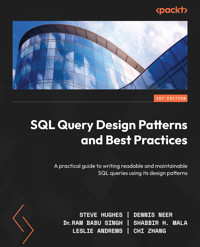
SQL has been the de facto standard when interacting with databases for decades and shows no signs of going away. Through the years, report developers or data wranglers have had to learn SQL on the fly to meet the business needs, so if you are someone who needs to write queries, SQL Query Design and Pattern Best Practices is for you.
This book will guide you through making efficient SQL queries by reducing set sizes for effective results. You’ll learn how to format your results to make them easier to consume at their destination. From there, the book will take you through solving complex business problems using more advanced techniques, such as common table expressions and window functions, and advance to uncovering issues resulting from security in the underlying dataset. Armed with this knowledge, you’ll have a foundation for building queries and be ready to shift focus to using tools, such as query plans and indexes, to optimize those queries. The book will go over the modern data estate, which includes data lakes and JSON data, and wrap up with a brief on how to use Jupyter notebooks in your SQL journey.
By the end of this SQL book, you’ll be able to make efficient SQL queries that will improve your report writing and the overall SQL experience.
Das E-Book können Sie in Legimi-Apps oder einer beliebigen App lesen, die das folgende Format unterstützen:
Seitenzahl: 276
Veröffentlichungsjahr: 2023
Ähnliche




















SQL Query Design Patterns and Best Practices
A practical guide to writing readable and maintainable SQL queries using its design patterns
Steve Hughes
Dennis Neer
Dr. Ram Babu Singh
Shabbir H. Mala
Leslie Andrews
Chi Zhang
BIRMINGHAM—MUMBAI
SQL Query Design Patterns and Best Practices
Copyright © 2023 Packt Publishing
All rights reserved. No part of this book may be reproduced, stored in a retrieval system, or transmitted in any form or by any means, without the prior written permission of the publisher, except in the case of brief quotations embedded in critical articles or reviews.
Every effort has been made in the preparation of this book to ensure the accuracy of the information presented. However, the information contained in this book is sold without warranty, either express or implied. Neither the authors, nor Packt Publishing or its dealers and distributors, will be held liable for any damages caused or alleged to have been caused directly or indirectly by this book.
Packt Publishing has endeavored to provide trademark information about all of the companies and products mentioned in this book by the appropriate use of capitals. However, Packt Publishing cannot guarantee the accuracy of this information.
Publishing Product Manager: Arindam Majumdar
Senior Editor: Tiksha Abhimanyu Lad
Technical Editor: Sweety Pagaria
Copy Editor: Safis Editing
Project Coordinator: Farheen Fathima
Proofreader: Safis Editing
Indexer: Sejal Dsilva
Production Designer: Arunkumar Govinda Bhat
Marketing Coordinator: Nivedita Singh
First published: February 2023
Production reference: 2190423
Published by Packt Publishing Ltd.
Livery Place
35 Livery Street
Birmingham
B3 2PB, UK.
ISBN 978-1-83763-328-9
www.packtpub.com
Contributors
About the authors
Steve Hughes is a senior director of data and analytics at 3Cloud. In this role, he focuses on growing the teams’ skills and capabilities to deliver data projects with Azure. He has worked with technology for over 20 years, with much of that time spent on creating business intelligence (BI) solutions and helping customers implement leading BI and cloud solutions. He is passionate about using data effectively and helping customers understand that data is valuable and profitable. Steve has recently been diagnosed with ALS but continues to work and share with others what he has learned. Steve is also the founder of Data on Wheels where he blogs with one of his daughters on topics such as data, analytics, and work enablement.
I want to thank my family, friends, and peers for supporting me through my health changes, and I am especially thankful to Sheila, my wife. I could not do this without her support and encouragement.
Dennis Neer is a senior architect of data and analytics at 3Cloud. In this role, he focuses on working with clients to design Azure solutions for their data and analytic needs so that they may use that data to make business decisions based on that data. This includes using tools such as SQL Server databases, Synapse, data lakes, and Power BI. He has worked with technology for over 30 years, with 25 years in designing and building database and visualization solutions. He is passionate about data and helping businesses to understand the information contained in their data and how it can be used to make important decisions regarding their business to improve the strength of their business.
I want to thank my wife, Jeanie, for all of the support and encouragement she has given me throughout my career, and while working on this book; I couldn’t do this without you.
Dr. Ram Babu Singh is an accomplished data analytics and data science professional with a Ph.D. in computer science and a Microsoft Certified Professional designation. With over 2 decades of experience in data platforms, he is recognized as an expert in his field. As the lead data architect at 3Cloud, he has developed complex data analytics and data science solutions for high-profile clients such as Microsoft, Accenture, and HP. An accomplished academic with published papers in international journals, he has a patent in artificial intelligence, highlighting his innovative problem-solving approach. With over 10 years of leadership experience in data and analytics, he has earned a reputation as a thought leader and mentor in the industry.
I want to thank my wife, Dr. Nirmal Lodhi, for supporting me throughout my journey, and my son Rudra and daughter Riddhima for letting me steal their family time. I also want to thank my colleagues for their support.
Shabbir H. Mala is a director of data and analytics at 3Cloud. He has over 23 years of experience in thought leadership and consulting, developing complex data solutions, business systems, and processes using Azure Data Services and Power BI. He currently manages a data architecture team of over 40 principals and senior architects focusing on business growth, successful project delivery, and client experience. He loves and has done talks at Power BI conferences and local Power BI user groups. He has been awarded Microsoft FastTrack Solution Architect for the last 2 consecutive years, in 2021 and 2022. He was born and raised in Mumbai (India), and came to the United States in 2006 and is currently living in Chicago. He is married with three kids.
Leslie Andrews is a lead data architect of data and analytics at 3Cloud. Working in the IT sector for over 20 years in local government, electrical supply, law enforcement, and healthcare, she has broad experience to draw from to assist clients in making data more accessible for end users. Leslie’s expertise includes SQL development, ETL, data warehousing, data modeling, and analytics. Leslie currently holds several Microsoft certifications related to Azure technologies for data engineering. She approaches each day as an opportunity to use data and technology to make it easier for others to do their daily work. Leslie has been doing public speaking since 2015, was an IDERA ACE in 2019, and is a supporter of and contributor to the SQL community.
Chi Zhang is a lead data architect at 3Cloud. After completing her master’s degree at Carnegie Mellon University, she worked in data consulting for the past 5 years. She has helped clients from various industries to deliver customized data solutions within Azure. Focusing on ETL, data warehousing, data modeling, and BI reporting, Chi solves data problems for clients and builds data solutions that provide business users with better operational insights and a smoother experience. Recently, she has continued to grow her footprint in the Azure community: earning certifications in Azure data engineering and data science, giving her first public tech talk, co-authoring a technical book, and becoming an active contributor to the SQL community.
I want to thank my husband, Joey, for all the help and company he has been giving me throughout my life so far. You push me to be a better person, and I'd do this all over again with you.
About the reviewers
Paul Turley is a competency lead director for the 3Cloud solutions BI&A practice, and Microsoft Data Platform MVP. He consults, writes, speaks, teaches, and blogs about BI and reporting solutions. He works with companies to model data and visualize and deliver critical information to make informed business decisions, using the Microsoft Data Platform and business analytics tools. He is the director of the Oregon Data Community PASS chapter and user group, the author and lead author of Professional SQL Server 2016 Reporting Services, and 14 other titles from Wrox & Microsoft Press. Paul is a FastTrack Recognized Solution Architect and holds several certifications related to the Microsoft Data Platform and BI.
Christopher J Knapp is a cloud solutions director at 3Cloud. For the last 17 years, he has worked primarily in the healthcare industry in all aspects of data, including transformation, storage, data modeling, BI, advanced analytics, and machine learning. He has spoken in multiple settings across the nation on various data topics. More recently, CJ has focused on Spark-based ETL and analytical methods, as well as cloud-based data platform systems at scale for healthcare. He is a father, husband, polyglot, and constant consumer of culture outside of work. He spends the majority of his free time having adventures with his family, traveling, and mixing craft cocktails at home. Sometimes, he even manages to mix them well.
Andie Letourneau is a cloud solution consultant with over 25 years of experience specializing in MS SQL Server databases, data warehousing, and BI. She has Azure Data Fundamentals and Azure Administrator Associate Microsoft certifications. She has presented at numerous SQL user group meetings and SQL Saturday events. She lives with her husband in beautiful Cave Creek, AZ.
Table of Contents
Preface
Part 1: Refining Your Queries to Get the Results You Need
1
Reducing Rows and Columns in Your Result Sets
Technical requirements
Identifying data to remove from the dataset
Reducing the amount of data
Understanding the value of creating views versus removing data
Exploring the impact of row and column reductions on aggregations
Summary
2
Efficiently Aggregating Data
Technical requirements
Identifying data to be aggregated
Determining when data should be aggregated
The AVG() function
The SUM() function
The COUNT() function
The MAX() function
The MIN() Function
Improving performance when aggregating data
Summary
3
Formatting Your Results for Easier Consumption
Technical requirements
Using the FORMAT() function
Format() with culture
Format() with custom formatting strings
Formatting dates and numbers with functions
Formatting dates and numbers with CONVERT() and CAST()
Formatting numbers with ROUND() and CEILING()
Comparing FORMAT(), CONVERT(), and CAST()
Alias columns with meaningful names
Summary
4
Manipulating Data Results Using Conditional SQL
Technical requirements
Using the CASE statement
Using a simple CASE expression in a SELECT statement
Using a searched CASE expression in a SELECT statement
Using CASE in an ORDER BY statement
Using CASE in an UPDATE statement
Using CASE in a HAVING statement
Using the COALESCE() expression
How to use COALESCE()
Comparing COALESCE() and CASE()
Using ISNULL() function
How to use ISNULL()
Comparing ISNULL() and COALESCE()
Summary
Part 2: Solving Complex Business and Data Problems in Your Queries
5
Using Common Table Expressions
Technical requirements
Creating CTEs
Set theory for queries
Creating a more complex CTE
Creating a recursive CTE
Creating the hierarchical data
Creating the recursive CTE
Recursive alternative
Summary
6
Analyze Your Data Using Window Functions
Technical requirements
Understanding window functions
Using a window function in a query
Adding a partition to the results
Window functions with frames
Scenarios and business problems
Days between orders
Finding a pattern
Finding first N records of every group
Running totals
First and last record in the partition
Year-over-year growth
7
Reshaping Data with Advanced Techniques
Technical requirements
Working with the PIVOT operator
Using PIVOT dynamically
Working with the UNPIVOT operator
Understanding hierarchical data
Summary
8
Impact of SQL Server Security on Query Results
Technical requirements
Why is data missing from my result set?
Understanding SQL Server security
Validating security settings
Summary
Part 3: Optimizing Your Queries to Improve Performance
9
Understanding Query Plans
Technical requirements
Understanding query optimization techniques
Understanding the Query Optimizer
Understanding and exploring the Query Execution Plan
Comparing execution plans
Analyzing the query plan
Summary
10
Understanding the Impact of Indexes on Query Design
Technical requirements
Understanding index and index types
Using CREATE to create an index
The DROP index
Using RENAME to rename an index
Modifying indexes
The ALTER index
Exploring the types of indexes
Clustered indexes
The NONCLUSTERED index
The UNIQUE index
The filtered index
The covering index
The impact of indexes on query design
Understanding index maintenance
The REBUILD index
The REORGANIZE index
Caution
Summary
Further reading
Part 4: Working with Your Data on the Modern Data Platform
11
Handling JSON Data in SQL Server
Technical requirements
Introducing JSON functionality built into SQL Server
The basics of JSON
JSON functions in SQL Server
JSON as data in SQL Server
JSON path in SQL Server
Formatting results as JSON in SQL Server
Using FOR JSON
Filling the table
Working with JSON data in SQL queries
Discovering JSON data in SQL Server
Extracting JSON data in SQL Server
Modifying JSON data in SQL Server
Building tabular results from JSON data in SQL Server
Summary
12
Integrating File Data and Data Lake Content with SQL
Technical requirements
Understanding the OPENROWSET (BULK..) function
Required security and storage permissions
Understanding external tables
Summary
13
Organizing and Sharing Your Queries with Jupyter Notebooks
Technical requirements
Creating Jupyter notebooks in Azure Data Studio
Understanding notebooks in Azure Data Studio
Creating a notebook in Azure Data Studio
Creating the Jupyter book
Adding a notebook to your Jupyter book
Adding queries in your Jupyter notebooks
Creating connections in your notebook
Creating and executing SQL code in your notebook
Formatting results
Exporting results
Resetting results
Documenting your code with markdown in your notebooks
Adding a text block to your notebook
Creating a header for your notebook
Using basic markdown for documentation
Adding images and links to your documentation
Managing and sharing your queries with Jupyter notebooks
Simple sharing of Jupyter books and notebooks
Using GitHub to collaborate on your notebook
Integrating third-party Jupyter books
Summary
Appendix
Preparing Your Environment
Prerequisites for running the exercises
Choosing a platform
Setting up the Azure environment
Setting up the SQL Server developer environment
Index
Other Books You May Enjoy
Preface
SQL was created to support relational database management systems (RDBMSs). It was not created just for SQL Server. SQL, or as it is typically pronounced sequel, has been the de facto standard for working with relational databases for nearly 50 years. The structure and understanding of this language have been established as a standard in both ANSI and ISO.
While the language has a standard and well-established set of syntax rules and capabilities, it has been implemented in many ways throughout the years by various RDBMS vendors. Microsoft implemented Transact-SQL (T-SQL) in SQL Server and has continued to use it as the primary SQL version, used in the various Azure SQL Database implementations.
While the focus of our book is primarily around retrieving data from databases efficiently, SQL is not limited to just data retrieval. SQL can be used to manipulate the database structure, manipulate data, and retrieve data. SQL can also be used to issue commands to the underlying database system depending on what the language supports.
As we move into the modern data estates, relational data is not the only data within the environment. We are seeing more document-style databases and other non-relational datasets used in common practice. What is interesting about this is that there is always a push to get back to SQL-supported datasets. The tabular nature of the data returned by SQL is the easiest data to consume in numerous tools available in the marketplace today and is easy for users to understand. Languages and document sets such as JSON are highly flexible and support a less structured version of data. However, those sets often must be converted to a tabular format to be easily consumed by various tools and understood by the users consuming that data. Think of it like JSON a machine and developer-friendly data storage format, but tabular formats used by SQL make it easy for you to understand what is in it.
As we move into some of these modern scenarios and even in some older scenarios such as MDX, we find the SELECT... FROM... WHERE format of the SQL language has been implemented to make it easier to work with data. As a developer, it is important for you to understand the best formats and most efficient methods of writing these queries to get the results you need. A lot of these efficiencies are true for whatever database system you work in. This book will focus on working with SQL Server and T-SQL in particular; however, many of the principles will apply across all relational systems.
Who this book is for
This book is for the SQL developer who is ready to take their query development skills to the next level. This includes report writers, data scientists, or similar data gatherers and allows users to expand their skills for complex querying and build more efficient and performant queries. This book also seeks to advance their knowledge of the modern data estate and introduce query techniques for pulling data from data lakes. For those just learning SQL, this book can help you accelerate your learning and prevent you from making common mistakes.
What this book covers
The book is organized into four parts, with multiple chapters in each part. The book is designed to grow your experience from beginning to end if you choose to read it in that fashion. One of the greatest values is that each chapter is self-standing and can be used as a reference if you come across a situation where you need to improve your query writing specifically with that scenario. This also allows you to engage this book at whichever point makes the most sense for your query writing capabilities and skills.
In Chapter 1, Reducing Rows and Columns in Your Result Sets, the focus is on reducing your rows and columns to build an efficient dataset that can be used in reporting and other use cases.
The focus shifts to aggregating your results in Chapter 2, Efficiently Aggregating Data in Your Results. You can return a much more refined dataset that is easier to consume by effectively aggregating results to the right granularity in the content you need to pass along.
In Chapter 3, Formatting Your Results for Easier Consumption, the focus shifts to formatting your results. Often when working with data coming from a database, it must support levels of granularity or specific types of data to be efficient or inclusive. However, this comes at the price of storing data in a format that is not necessarily conducive to end users. Common formatting difficulties include handling currencies and dates. In this chapter, you will learn how to effectively format your data for more efficient use outside the database.
We expand on query efficiency by using conditional SQL in Chapter 4, Manipulating Your Data Results Using Conditional SQL. This will allow you to refine results even further for your end user. SQL Server supports several conditional logic statements that will be explored in this chapter.
Chapter 5, Using Common Table Expressions, delves into the world of common table expressions (CTEs) as they are commonly referred to. This technique is used to reduce subqueries and support other complex scenarios. In this chapter, you will learn how to build efficient CTEs to solve complex business problems.
Chapter 6, Analyze Your Data Using Window Functions, introduces you to window functions inside SQL. These functions allow you to do inline query aggregations or other techniques, such as row numbers. Some of the problems that are solved using window functions include building and running totals in your results.
Chapter 7, Reshaping Your Data with Advanced Techniques, dives into advanced techniques for reshaping your data. This includes handling hierarchical data and working with the PIVOT and UNPIVOT commands.
Chapter 8, Impact of SQL Security on Query Results, helps you deal with the impact of security on your query results. Citizen developers are often unaware of the impact security might have on the data they are pulling into their results. This chapter looks at the various implications of security and how to understand that impact on the results that you get and deliver to your end user.
Chapter 9, Understanding Query Plans, describes how to understand query plans. In this chapter, you will be introduced to the query plan itself and how to read it to determine what you can do to improve the performance and the query that you’re writing.
We then move on to understanding the impact of indexes on your query design in Chapter 10, Understanding the Impact of Indexes on Your Query Design. While we will not dive into authoring indexes, understanding the impact of indexes, including which indexes will improve your query performance, is the focus here. This will help you communicate your index needs to those that own the database design.
JSON data or NoSQL data has been disruptive to SQL writers around the world. In Chapter 11, Handling JSON Data in SQL Server, we will walk through the various functions and capabilities of SQL in SQL Server that supports JSON.
In Chapter 12, Integrating File Data and Data Lake Content with SQL, we will walk through techniques to integrate file and data lake content in your queries. This more complex technique is becoming very necessary in the new modern data platform.
We then have Chapter 13, Organizing and Sharing Your Queries with Jupyter Notebooks, covering Jupyter notebooks. Jupyter notebooks are available in Azure Data Studio and Synapse Workspace. These notebooks can be used to organize and share queries and their results more efficiently than SQL Server Management Studio (SSMS). In this chapter, we will walk you through notebook creation and sharing.
In the Appendix, Preparing Your Environment, we will walk you through setting up your environment to support the exercises in this book.
To get the most out of this book
Software/hardware covered in the book
Operating system requirements
Microsoft Azure Storage Explorer
Windows, macOS, or Linux
SQL Server 2022 or Azure SQL Database
Windows, macOS, or Linux
Azure Data Studio
Windows, macOS, or Linux
This book covers many illustrations and examples of working with SQL to improve your overall writing and performance. To make this simple for all our users, we have chosen to use the Wide World Importers sample databases available from Microsoft. Therefore, depending on the nature of the query that we are constructing and providing examples for, one of the two databases (operational: WideWorldImporters; data warehouse: WideWorldImportersDW) provided by Microsoft will be used. Bear in that means you will have two databases to run the exercises created within this book.
It is recommended that you install the following tools on your device, as these will be used with the exercises in this book:
SSMS and Azure Data Studio installation. You’ll find the installation instructions at the following location: https://learn.microsoft.com/en-us/sql/ssms/download-sql-server-management-studio-ssms. Be sure to install both SQL Server Management Studio and Azure Data Studio in the installation process.Microsoft Azure Storage Explorer is used to move files in and out of Azure. You’ll find the installation instructions at this location: https://azure.microsoft.com/en-us/products/storage/storage-explorer/.You can use either SQL Server 2022 or Azure SQL Database for your database platform. If you need to install SQL Server 2022 or set up Azure SQL Database, refer to the Appendix for detailed instructions.All examples in this book will be using the Wide World Importers sample databases provided by Microsoft and found here: https://github.com/Microsoft/sql-server-samples/releases/tag/wide-world-importers-v1.0. We will be using the full backups for SQL Server and the standard backups for Azure SQL DB.If you are using the digital version of this book, we advise you to type the code yourself or access the code from the book’s GitHub repository (a link is available in the next section). Doing so will help you avoid any potential errors related to the copying and pasting of code.
Full instructions for installation and database configuration can be found in the Appendix.
Download the example code files
You can download the example code files for this book from GitHub at https://github.com/PacktPublishing/SQL-Query-Design-Best-Practices. If there’s an update to the code, it will be updated in the GitHub repository.
We also have other code bundles from our rich catalog of books and videos available at https://github.com/PacktPublishing/. Check them out!
Download the color images
We also provide a PDF file that has color images of the screenshots and diagrams used in this book. You can download it here: https://packt.link/Xxotr.
Conventions used
There are a number of text conventions used throughout this book.
Code in text: Indicates code words in text, database table names, folder names, filenames, file extensions, pathnames, dummy URLs, user input, and Twitter handles. Here is an example: “All window functions can utilize the PARTITION BY expression of the OVER clause, which is always optional.”
A block of code is set as follows:
SELECT TOP (3) [Order Key] ,[Description] FROM [Fact].[Order]When we wish to draw your attention to a particular part of a code block, the relevant lines or items are set in bold:
SELECT TOP(3) FORMAT( [Date], 'D', 'en-US' ) 'US English' ,FORMAT( [Date], 'D', 'en-gb' ) 'British English' ,FORMAT( [Date], 'D', 'de-de' ) 'German' ,FORMAT( [Date], 'D', 'zh-cn' ) 'Chinese Simplified (PRC)' FROM [Dimension].[Date]Bold: Indicates a new term, an important word, or words that you see onscreen. For instance, words in menus or dialog boxes appear in bold. Here is an example: “Next you will expand the Security and Users folders and find your login ID.”
Tips or important notes
Appear like this.
Get in touch
Feedback from our readers is always welcome.
General feedback: If you have questions about any aspect of this book, email us at [email protected] and mention the book title in the subject of your message.
Errata: Although we have taken every care to ensure the accuracy of our content, mistakes do happen. If you have found a mistake in this book, we would be grateful if you would report this to us. Please visit www.packtpub.com/support/errata and fill in the form.
Piracy: If you come across any illegal copies of our works in any form on the internet, we would be grateful if you would provide us with the location address or website name. Please contact us at [email protected] with a link to the material.
If you are interested in becoming an author: If there is a topic that you have expertise in and you are interested in either writing or contributing to a book, please visit authors.packtpub.com.
Share Your Thoughts
Once you’ve read SQL Query Design Pattern Best Practices, we’d love to hear your thoughts! Please click here to go straight to the Amazon review page for this book and share your feedback.
Your review is important to us and the tech community and will help us make sure we’re delivering excellent quality content.
Download a free PDF copy of this book
Thanks for purchasing this book!
Do you like to read on the go but are unable to carry your print books everywhere? Is your eBook purchase not compatible with the device of your choice?
Don’t worry, now with every Packt book you get a DRM-free PDF version of that book at no cost.
Read anywhere, any place, on any device. Search, copy, and paste code from your favorite technical books directly into your application.
The perks don’t stop there, you can get exclusive access to discounts, newsletters, and great free content in your inbox daily
Follow these simple steps to get the benefits:
Scan the QR code or visit the link belowhttps://packt.link/free-ebook/9781837633289
Submit your proof of purchaseThat’s it! We’ll send your free PDF and other benefits to your email directlyPart 1: Refining Your Queries to Get the Results You Need
The goal of the four chapters in this part is to help you become a more efficient query writer. One of the areas we commonly see where people struggle is building queries to get the results that they need without including additional content in their query results just because they might need it later:
Chapter 1, Reducing Rows and Columns in Your Result SetsChapter 2, Efficiently Aggregating Data in Your ResultsChapter 3, Formatting Your Results for Easier ConsumptionChapter 4, Manipulating Your Data Results Using Conditional SQL




