


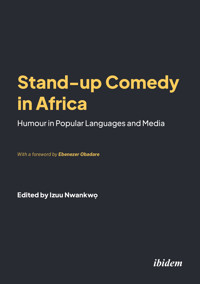
Stand-up Comedy in Africa E-Book
26,99 €
Mehr erfahren.
- Herausgeber: ibidem
- Kategorie: Geisteswissenschaft
- Sprache: Englisch
African cultural productions of humour have increased even in the face of myriad economic foibles and social upheavals. For instance, from the 1990s, stand-up comedy emerged across the continent and has maintained a pervasive presence since then. Its specificities are related to contemporary economic and political contexts and are also drawn from its pre-colonial history, that of joking forms and relationships, and orality. Izuu Nwankwọ's fascinating collected volume offers a transnational appraisal of this unique art form spanning different nations of the continent and its diasporas. The book engages variously with jokesters, their materials, the mediums of dissemination, and the cultural value(s) and relevance of their stage work, encompassing the form and content of the practice. Its ruling theoretical perspective comes from theatre and performance, cultural studies, linguistics, and literary studies.
Das E-Book können Sie in Legimi-Apps oder einer beliebigen App lesen, die das folgende Format unterstützen:
Seitenzahl: 518
Veröffentlichungsjahr: 2022
Ähnliche




















ibidem-Verlag, Stuttgart
Table of Contents
Acknowledgements
Foreword
Part I Resisting and Reinventing the Status Quo
Chapter 1: Confronting Racism and Colonialism in Cécile Djunga’s and Trevor Noah’s Stand-up Comedy
Chapter 2: South African Vernacular Stand-Up Comedy as Performative Resistance
Chapter 3: The People’s Joker: The Popularity of Mr Jokes’ Stand-up Comedy in Malawi
Chapter 4: Resisting Shame and the Male Gaze: Humour Evocations in the Acts of Noha Kato and Real Warri Pikin
Chapter 5: Discourse and Humour Strategies in Two-Person Stand-up Art in Nigeria
Part II Circumventing Censorship and Taboo
Chapter 6: In the Shadow of the 1994 Genocide: Arthur Nkusi and Stand-up Comedy in Rwanda
Chapter 7: The Afterlife of Ugandan Stand-up Comedy: Examining the Multiple Roles and Jocular Devices of Teacher Mpamire
Chapter 8: Scripted and Non-Scripted Humour in Stand-up Comedy: Techniques of Egypt’s Comedian Ali Quandil
Chapter 9: Reinventing Taboo in Kenyan Stand-up Comedy
Part III Mechanics of being a Comedian
Chapter 10: Africa on the British Stage: Laughter-Making Mechanics of Andi Osho and Daliso Chaponda
Chapter 11: There’s No Such Thing as ‘Too Soon’ Here: Taking Stock of South Africa’s Comedy Boom
Chapter 12: The Many-Sides of Kenyan Stand-up Comedy: A Stylistic Interrogation of the Acts of Jemutai, Professor Hamo and Oga Obinna
Chapter 13: Nigeria’s The Mock News with Pararan: The Poetics of its Punchline
About the Contributors
Endorsements
Copyright
ibidem-Verlag
Acknowledgements
The Stellenbosch Institute for Advanced Studies (STIAS) is central to the conception, writing, and eventual emergence of this book. I appreciate your award of the Iso Lomso Postdoctoral Fellowship under which this project was carried out. Most of the chapters originated from a colloquium I convoked in 2019 borne out of the desire to draw scholarly attention to stand-up art sponsored by the Stellenbosch Institute for Advanced Studies (STIAS) of the Stellenbosch University, South Africa. I appreciate all contributors, attendees at the event, and the excellent staff and board members of STIAS who believed in this project from the onset. I am indebted to many other people: Chukwuma Okoye, Daria Tunca, Matthias Krings, Ifeyinwa Okolo, Laura S. Martin, Tracie Utoh-Ezeajugh, Chielozona Eze, Rowland Amaefula, and many more, for past, present, and future works. Thanks to my Iso Lomso cohorts and the excellent work you are all doing across the continent and beyond. To the DMGS Class of ’94, thanks for the ways we inspire each other. Keep winning!
The Alexander von Humboldt Foundation deserves special mention for awarding me the Georg Forster Postdoctoral Fellowship in Germany in 2019. It is during this fellowship that the book was completed. I am grateful to the wonderful faculty and students of the Department of Anthropology and African Studies, Johannes Gutenberg University Mainz, Germany, for the different ways our interactions have shaped this work. Thanks for your support and comradeship. To the wonderful team at ibidem Verlag, thank you for the impressive work.
Special thanks and love to my wife, Chinenye, and our two sons, Daniel and Chidubem, for bearing the many travels and understanding the many ‘absences’ even when I am home and locked up in the study. Most importantly, to the Giver of life, the Most High God, thank You from the depth of my heart! Without You, none of these would have been accomplished!
Foreword
By all indications, Africans should have little to laugh about. The economy, in the doldrums and, minus a handful of exceptions, trending southward for as long as anyone can remember, offers nary a cause for cheer. The politics has been no different. For all the positivity that greeted the embrace of democratic rule in the early 1990s, the familiar pattern of gross unaccountability and casual plunder has proved resilient. How, given the prevailing gloom, can Africans continue to laugh?
Studies about other regions of the world, and tellingly among those on the social margins, confirm that this paradox—of apparent gaiety amid despondency—is not unique to Africa. In those communities, be it in Colombo, Rio de Janeiro or Cape Town, laughter is the first and ultimate proof of people’s humanity, and the jokes they exchange, whether or not intended as such, are the first line of resistance against the savage brutalities of everyday life. The answer, therefore, to the question of how Africans can afford to laugh is that they laugh not because they are insensitive to pain, but because they are human, and thus, they recognise absurdity, and know that laughter, as a popular Yoruba saying goes, is the only riposte to an issue or a situation so grim that grieving is inadequate. Here, one laughs in the face of sorrow.
There is a familiar worry that those who insist on confronting degradation with jollity may be prone to political apathy. If everything is regarded with levity, the thinking goes, why would politics, a matter of life and death apparently, be regarded with the seriousness it deserves? It’s not an unreasonable fear, but it misses the point nonetheless. For one thing, there is scant evidence that people cannot be jolly and politically serious at the same time. Politics—whether as issues or personalities—frequently provides the material backdrop and target of the most devastating humour. Generally speaking, strategies of political resistance are hardly ever mutually exclusive. Second, anxiety misses the point of laughter, which admittedly is not simply political defiance or contempt. If Orwell is right that ‘Every joke is a tiny political revolution’, those for whom humour is the ultimate weapon are nothing but political revolutionaries.
Wondering how people manage to laugh in the face of unrelenting political assault is one thing; puzzling at the explosion of stand-up comedy across Africa is another. With the former, one ponders the question of social resilience among agents desperate to rescue and preserve dignity and self-worth; with the latter, one launches a sociological inquest into the emergence and diverse facets of an industry that has taken full advantage of all the affordances of the emergent techno-media.
Rigorously edited, Stand-up Comedy in Africa is a timely, interdisciplinary survey of an art form whose ubiquity prompts sundry technical, artistic, and political questions. For those seeking critical guidance on the ethics and praxes of popular performance in Africa, this is as good a place as any to start.
Ebenezer Obadare
Lawrence, Kansas, United States
May 2021.
Introduction
Old Wine in a New Bottle: Stand-up Comedy and its Dispersal across Africa
Izuu Nwankwọ
Growing up in the south-eastern Nigerian city of Onitsha, I was exposed to various joke relationships—ịkọọnụand njakịrị—which were modes of playful insults for kids and adults, respectively.1 These forms of ridicule, ingrained in the consciousness of the Igbo-speaking people of Nigeria from early in life, have been studied variously as peculiar entertainment arts for laughter, a test of jesting capabilities, and a veritable means of socialisation.2 While folks enjoyed being around funny people, most parents did not necessarily want their children turning out as humourists because it was not considered a serious profession at the time. By the turn of the 21st century, however, following successes in emergent popular arts like stand-up comedy in the preceding decade, jokesters acquired immense social and economic capital, becoming influential individuals in society. From being poorly paid MCs in the 1980s, Nigerian comedians are now almost inalienable in all social events, including politics and corporate business, for very steep fees. Thus, stand-up comedy has become one of Nigeria’s most preferred entertainment genres (Taiwo 2017, Owojaiye 2019), and in most African countries (Seirlis 2011, Parker 2002, Oleimy and Lotfy 2016). Its growth is mainly for its economic advantages—relative ease of enactment—and the enormous demand for laughter occasioned by myriad socio-political problems. Though the route for stand-up’s development in different parts of the continent is varied and diverse, just like the constituent peoples and cultures, contemporary practice has received little scholarly attention. Globally, stand-up art has surprisingly met with relatively marginal interrogations, unlike humour, which has elicited tremendous multidisciplinary critical attention. For its continuing minority status, stand-up comedy is considered the ‘Rodney Dangerfield of the literary world’ (Tafoya 2009, 18), a statement that equates it with the ‘loser status’ that the American comedian Dangerfield portrays on stage.
Nevertheless, stand-up comedy is currently one of the most visible genres of joke generation globally. It is essentially the type of performance wherein an artist mounts the stage to entertain people with jocular narratives, song renditions, mimicry, and sundry forms of amusement, primarily to induce laughter. Its success, or otherwise, is determined by the level of humour the comedian can instigate. Thus, in a bid to keep up humorousness, comedians ideally employ an inexhaustible array of comedic forms as there appears to be no limit to what they can appropriate. Moreover, even though most comedians are naturally gifted at making people laugh, to be a professional practitioner, one has ‘to be funny on demand, regardless of your emotional state’ (Ajaye 2002, 10). However, laughter evocation is just one part of stand-up art because comedians can hardly be considered funny outside audience response. Principally also, a joke’s risibility is determined by the amount and type of audience reaction. All these make stand-up comedy one of the most instantaneous and direct art genres at present.
John Limon, a humour scholar, identifies and discusses three theorems that distinguish stand-up comedy from other laughter-creating situations: (1) ‘If you think something is funny, it is’, (2) ‘A joke is funny if and only if you laugh at it’, and (3) ‘Your laughter is the single end of stand-up’ (2000, 11–13). In each of these cases, ‘you/r’ refers to the second person plural, thus placing the audience at the centre of the stand-up experience. Like its criticism, which is instant, the art itself is contemporaneous in its use of subjects and materials, which are mutually recognisable to both the performer and his/her live audience. Additionally, for its overabundant dependence on ridicule, grotesque and not-very-normal conditions and situations, stand-up comedy requires audiences to defer offence in the same manner that theatre is dependent on the suspension of disbelief. In doing this, the audience is not powerless but incredibly empowered. As Michael Billig shows, the ‘rhetorical opposite of laughter’—dubbed ‘unlaughter’ (2005, 177)—is one way in which audiences show disapproval, an indication that they have found whatever was said not funny. Stand-up art is thus an exchange; at best, it
… combines genuine challenge with a relaxed approach to the concern for truth and a relaxation of everyday standards of decency. This delightfully irresponsible combination both allows the opportunity for nasty ideas to slip past our usual constraints, to be released and enjoyed, and broadens the scope for debate beyond the confines of ‘normal’ viewpoints in a way that has been helpful to the progression of societal attitudes. (Quirk 2015, 208)
Quirk’s privileging of ‘nasty ideas’ slipping through regular conversations is also encapsulated in what has been dubbed Benign Violation Theory (BVT), which holds that ‘humor occurs when (1) a circumstance is appraised as a violation, (2) the circumstance is appraised as benign, and (3) both appraisals occur simultaneously’ (McGraw and Warren 2014, 75). Though BVT and three other emergent humour theories have been castigated for sundry forms of insufficiency (Oring 2016, 214–215), its centralisation of benignity is key to understanding what stand-up comedians do. Specifically, the work of humourists entails challenging and questioning the status quo, critiquing through ridicule, and providing alternative ways of seeing, thereby presenting minority perspectives. They do all these playfully, with the collaboration and endorsement or otherwise of the audience.
According to humour scholar Lawrence E. Mintz, one can hardly find a more revealing index of various aspects of culture than ‘the relatively undervalued genre of stand-up comedy … the most interesting of all manifestations of humor in the popular culture’ (1985, 71). He avers, in his editorial piece to a stand-up comedy essay collection, that the comedian performs two roles in society. The first role is that of a licensed spokesperson ‘permitted to say things about our society that we want and need to have uttered publicly, but which would be too dangerous and too volatile if done so without the mediation of humor’ (Mintz 1977, 1). The second is that the comedian functions as a ‘negative exemplar’—enacting ‘through caricature, those negative traits which we wish to hold up to ridicule, to feel superior to, and to renounce through laughter’ (Mintz 1977, 1). Of course, for the dominance of political correctness in contemporary perspectives, Mintz’s claims here become a rehash of everything wrong with humour and comedy. Nevertheless, the role of the comedian remains the same: being a licensed spokesperson who uses caricature to re-present those undersides of contemporary living that humanity does not wish to see. The difference now is how, when, and what things are said or represented and by whom, especially in terms of who the performer and the audiences are, particularly concerning ethnic, racist, and/or other jokes that stem from or highlight actual and contrived notions of difference.3 Other essays in Mintz’s collection include an insightful interview with the comedian Robert Klein (Eisenberg and Klein 1977); an interrogation of different phases of female stand-up in the US between 1960 and 1976 (Stoddard 1977); a review of Richard Pryor’s comedy as social satire (Williams 1977); and a historical purview of stand-up videos in the US (Shifreen 1977). These essays provide an extensive scholarly review of stand-up practice for the preceding decades when such studies were seldom. Succeeding explications pursued other endeavours, like Koziski’s, which conflates the anthropologist and the stand-up comic, positing them as social critics because by exteriorising ‘the hidden underpinnings of [a] culture’, they can raise ‘audience’s level of conscious awareness’ and as such elevate it ‘to a new cultural focus’ (1984, 57). Summarily, enquiries in the following decades advanced the understanding of the historical development of stand-up (Tafoya 2009, Daube 2009); its nature, personae, and gendered manifestations (Pershing 1991, Fraiberg 1994, Greenbaum 1997, Ajaye 2002, Wuster 2006, Scarpetta and Spagnolli 2009); as well as its multifaceted nature as a form of postmodernism (Auslander 1992); a product of mass culture (Marc 1997, Donian 2019); rhetoric for altering audience perspectives (Rutter 1997, Greenbaum 1999, Brodie 2008, Meier and Schmitt 2017); displayer of abjection (Limon 2000); and we are beginning to see more interrogations of stand-up acts outside the US (Lockyer and Pickering 2009, Quirk 2018, Double 2020, Chaturvedi 2018). However, none of these studies concerns itself with the practice and immense contributions of African humourists both at home and in the diaspora.
Admittedly, a few academic works discuss jokes and humour in Africa, but none engage explicitly with stand-up comedy from a continent-wide perspective. Aside from Newell and Okome (2014), Chukwumah (2018) and Filani (2018), with a chapter, a section of two chapters and three essays, respectively, most publications on popular arts and culture in Africa do not specifically interrogate stand-up. From older works like Barber, which professes the ‘sheer undeniable assertive presence’ of popular arts (1987, 1), to more recent studies on variegated African popular arts and humour, they mostly either marginally mention or completely elide stand-up performances.4 Thus, music and film continue to attract more attention even with the recent celebratory stance of Africa’s entry on the global stage in its expanding presence on Netflix (Krings and Simmert 2020). Even though these two art forms are on a par with stand-up comedy in terms of popularity—frequency of enactment, and widespread patronage across Africa,academic enquiries into each of them surpass the amount of attention stand-up art has received. Donian (2019) appears to be the only book-length study of stand-up comedy in an African country that is available internationally, with its discussion of the mitigating influence of mass culture on the ability of stand-up art to resist hegemony—the author examines the works of South Africa’s Pieter-Dirk Uys and Trevor Noah, as well as US performer Ellen DeGeneres. My book (Nwankwọ 2022) drawn from my doctoral dissertation (Nwankwọ 2014) at the University of Ibadan, is the first PhD that interrogates the art of stand-up practice in Nigeria. However, the paucity of a continent-wide book-length scholarly inquiry does not foreclose the existence of pivotal essays within specific countries and regions of the continent. Musila (2014) and Seirlis (2011) variously address the ambivalences of racialised cleavages and the precariousness of the relations between comedy and power in post-apartheid South Africa, while Filani (2015 and 2016) explore the diverse linguistic aspects of Nigerian stand-up acts. For diaspora performers, despite the immense popularity and contributions of comedians like Trevor Noah—aside from Aston and Harris’ (2013) book with a chapter that comparatively discusses Andi Osho and Shappi Khorsandi—there is seemingly no other dedicated study of African diaspora humourists.5 This book is a contribution to the growing body of African stand-up comedy literature.
In Africa, there existed several humour-making genres, from standalone joke performances to ludicrous storytelling, within the continent’s constituent communities before the dawn of western civilisation. Hence, what is new is not the art of making people laugh but the nomenclature ‘stand-up comedy’ used to designate a specific cultural production of humour across the continent within which a solo artist tells jokes to mostly live audiences. With the migration (from the 1990s onwards) from artistic expressions in conventional forms such as theatre and cinema to genres that require less capital for their execution, stand-up comedy became popular across the continent, mainly because, a) it is easier to finance; b) it responds to people’s need to laugh; c) it has a substantial critical (democratic/participatory) potential due to ease of access, and mass participation; d) it affords people an opportunity to ridicule power and its excesses—to punch up; e) it is at the vanguard of youth economic empowerment. African comics increasingly broach taboo and contentious subjects, sometimes making politically incorrect statements with subjects ranging from banal to overtly sacred ones. Depending largely on the liminality of joke-telling, they examine socio-cultural issues from the perspectives of satire and humour. Thus, the scope and specificities of African stand-up emanate from the prevalent economic and political contexts both at home, in the diaspora, and globally,as well as borrowings of forms and perspectives from the wealth of pre-existing joking relationships and orality.
The term ‘stand-up comedy’ was first used (for the present genre of standing in front of an audience behind a microphone) in the United States around 1948 (Double 2017, 107–108). It became prevalent from the 1990s across sub-Saharan Africa, due to the inability to sustain expressions in more expensive genres. Before that, various forms of cultural productions of humour, some of which started in precolonial times, existed. These comedic performances were fused into folk songs, dances, masquerade, and festival theatres of different communities across the continent (Finnegan 1970/2012, 269). Increasing demands for laughter, possibly due to persistent economic hardships and political upheavals, and the liberalisation of media outlets across the continent aided the rise of stand-up art and the emergence of a diverse range of stage humourists. Besides entertaining audiences, stand-up comedy has also become a source of livelihood for many African youths, some of whom were homeless before entering the industry. A good example is the former street boy, MCA Tricky, who has become a sensational stand-up artist in Kenya. These comics speak to local and multiple audiences, using African motifs and, in most cases, indigenous, pidginised and/or emergent popular languages. They say the ‘unsayable’, running commentaries on happenings with their communities and elsewhere in various ways. Their productions are presently streamed globally with the help of the internet and social media to locations and people outside the geographical spaces in which they were made. This book explicates African stand-up art as an emergent genre that combines existing and received joke production/reception forms in diverse languages and mediums.
Of all the delineating factors variously separating Africans—religious, ethnic, and political affiliations, one major limitation to the global spread of African stand-up is language. Invariably, it is chiefly enclosed within silos of colonial (often with a mixture of local and/or derivative) languages. There is little or no intra-continental mobility across (colonial) linguistic divides, with the implication that performers are better known within the language blocs of Franco-/Anglo-/Lusophone countries. Except for Morocco and Tunisia that maintain relations with French-speaking sub-Saharan states, North Africa, especially Egypt and Sudan, operates almost entirely on its own, tilting more towards developments in the Gulf States than in other parts of Africa. Despite the proclivity towards encasement in European languages, African stand-up is also expressed in largely derivative and indigenous languages—Kiswahili and Sheng in Kenya, Pidgin English in Nigeria, Chichewa in Malawi, and the emergent use of vernac languages to displace the dominance of English and Afrikaans performances in South Africa. Expressions in these specialised languages have restricted the global access of African stand-up, but making it readily available to diaspora audiences to the point that it has also become the norm for home jokesters to perform in western spaces, albeit to African peoples.
Within the continent, Kenya, Nigeria, and South Africa have produced more comedians and performances than others among English-speaking countries due to population size, economy, and media dominance. For instance, South Africa’s M-net disseminates various entertainment productions across the continent through its cable television services, thereby enabling the spread of dominant genres in films, comedy and other art varieties. It strictly allocates the television channels it hosts based on colonial languages affiliations of every African country where it operates. With a wide array of jokesters made up of a sizeable number of female comics—Jemutai, Mammito, Teacher Wanjiku, Nasra Yusuf (who is of Somali origin), Njambi McGrath (UK-based), and an elaborate stand-up platform, Churchill Show, Kenya’s stand-up industry is dominant in East Africa. Nigeria is a giant of popular culture on the continent with its video film (Nollywood) influence and the overarching successes of its music stars. Riding on the back of these achievements, the country’s comedians have garnered immense popularity, affluence, and relevance, with some staging shows in the west while participating in events across the continent. Furthermore, aside from the attainments within these countries, it is pertinent to note the political state of specific sites, especially government censorship, that have inhibited the growth of stand-up art there. Rwanda and Egypt stand out primarily due to the entrenchment of dictatorship and crackdown on dissent following the 1994 genocide, and the 2011 Arab Spring, respectively. These variegated peculiarities and contours underscore the heterogeneity of African stand-up practice, defining its themes, personae, mechanics, and modes of enactment.
Professional practice in Africa took different routes due to the peculiar socio-political happenings in individual countries. The restrictive nature of South Africa’s apartheid policy ensured that black comedians did not receive any form of mainstream visibility before 1994. Al Debbo, the TV series Biltong and Potroast, and the multiple comedic enactments of Pieter-Dirk Uys dominated humour performance spaces during the apartheid era. The beginning of South Africa’s post-1994 professional stand-up industry is ascribed to Eddy Cassar for his Smirnoff Comedy Festival, held at the Baxter Theatre, Cape Town, in 1997. A couple of years later, comedy clubs started springing up across the country, including Kurt Schoonraad’s Cape Town Comedy Club and Joe Parker’s Parkers in Johannesburg. South Africa’s comedy scene has become increasingly multiracial since 1994, moving away ‘from the anger of political protest under the severe strictures of apartheid to the possibility of enjoyment in the freedoms promised by democracy’ (Seirlis 2011, 528). On the global scene, Trevor Noah, discussed in Chapter 1, is South Africa’s most visible comedian due to his US late-night television programme, The Daily Show. Others like Loyiso Gola, with appearances in Australia and the United Kingdom, and Urzila Carson, who emigrated to New Zealand in 2006, are also internationally recognised for their enactments of being African in the west.
Kenya has also had an impressive run from precolonial humour presentations to several outstanding comedians during the country’s colonial and early post-colonial periods. Kipanga Athumani, Aisha Suleiman (Mama Tofi), and Omar Suleiman (Mzee Pembe) were among the earliest comedians to emerge and gain popularity across the country after independence in 1963. Kenyan comedy of the 1960s to the early 1990s was dominated by several performers who featured in television and radio programmes and live dramatic comedy renditions on the streets of Nairobi and in different communities across the country (Daily Nation n.d.). Comedy became prominent in Kenyan entertainment with the emergence of the Redykyulass group, formed in 1999 by Tony Njuguna, John Kiarie, and Walter Mongare, who held a weekly comedy show on national television. The group used ‘parody to offer satirical critique of key personalities and topical issues in Kenyan socio-political landscape’ (Musila 2012, 164), especially against the Moi government (Ogola 2011, 131; Michieka and Muaka 2016, 561–562). It is reputed to be the first set of humourists to satirise then President Daniel Arap Moi and not end up in detention (Ochwada 2012, 201). Their comedy brand eventually became famous so that as their performances began to fizzle out, many succeeding comedy troupes quickly emerged. One of its successors, Churchill Show, eventually instantiated the stand-up boom in Kenya. Established by comedian Daniel Ndambuki in 2007, Churchill Show has contributed plenty to the development and growth of the genre and the emergence of numerous humourists around East Africa. The success of this art form in Kenya has been credited to Ndambuki’s ‘business model of creating opportunities for upcoming comedians’, something that has
worked perfectly, filling a gap for both audience and corporate [bodies] eager to be associated with a marketable comedy brand. […] In Churchill, Kenya got a new-age godfather of comedy, and one whose dominance of the business end of the industry is unmatched. (Owaahh 2014)
Churchill Show is also at the nexus of cross-regional cooperation between comedians across the continent. As stated earlier, the Nairobi stand-up stage remains dominant in the sub-region and for all comedians from elsewhere who seek to break into the East African comedy space.
Nigerian professional stand-up commenced around the mid-1990s, right on the heels of the emergence of Nollywood. Before then, several comedic traditions existed, starting from the precolonial yan kama and wawan sarki in the north (Kofoworola 2007, 103); the efe and yeye in the south-west (Lawal 1996, 38); and the njakịrịand ịkọọnụ of the south-east (Ebeogu 1991, 29), which in turn influenced Baba Sala and his Alawada Theatre group (Obafemi 1996, 55–57). This comedy troupe won a ‘Talent Hunt’ organised by NTA Ibadan station in 1965 and earned a thirty-minute weekly slot on prime-time television (Haynes 1994, 17). In the 1980s, Baba Sala was joined by several comedy soap operas on national television (Fiofori 2010). Soon afterwards, there emerged a range of celebrity MCs who became most sought after due to their comedic renditions while anchoring events. Even with the existence of several, sometimes contradictory accounts, there are consistencies in giving credit to John Chukwu for his significant influence on Nigerian stand-up art, Atunyota Alleluia Akpobomeriere (Ali Baba) for professionalising it, and Opa Williams for providing the first platform through his Nite of a Thousand Laughs in 1995 in Lagos (Nwankwo 2015, Anyanwu 2016, Taiwo 2017, Owojaiye 2019). Today, the country has so many comedians, including Basket Mouth, Ali Baba, AY, Helen Paul, and Klint da Drunk, to mention but a few, some of whom have staged shows across the continent and elsewhere. Basket Mouth, for example, has performed on more stages within Africa than most other, even more internationally-recognised, comedians (Nwankwọ Forthcoming 2022).
Egypt has also had a remarkable run in the evolution of its stand-up activities. Before now, the nation has experienced various forms of humour performances, some of which were common to most Arab states (Freedman 2009, 142–145). Egyptian comedy has been versatile and deep-rooted in the people’s culture as expressed chiefly on television and literature (Morris 2006). Bassem Youssef’s El-Bernameg, a satirical news-format television programme that ran between 2011 and 2014 across the Arab world, was the most significant comedy event to emerge from the revolution. Kingsley describes Youssef as ‘a poster boy for post-revolutionary Egypt’, eventually becoming the most popular of those ‘who took advantage of the freer political landscape to broadcast thoughts and jokes from their bedrooms to the internet’ (2014, my emphasis). He is also regarded as Egypt’s Jon Stewart for his immense contributions to political satire on television in the Arab world (Gordon and Arafa 2014, 35). Sadly, he was forced to leave Egypt in 2014 owing to increasing censorship (Damir-Geisdorf and Milich 2020, 30). Stand-up comedy began emerging there in the mid-2000s, featuring a mixture of international and local amateur humourists (Bradley 2009). By 2010, it began gaining popularity in the country (Khalil 2010), picking up eventually during the Revolution of January 2011, when people gathered at Tahrir Square in Cairo, demanding the resignation of their long-time leader, Hosni Mubarak. Several comedians performed during the sit-in, entertaining and building up the morale of protesters until Mubarak’s government collapsed. In the same year, ‘Hashem El Garhy founded the Al-Hezb El-Comedy (“Comedy party”)’ to encourage the participation of young, unknown performers in Cairo and Alexandria (Heerbaart 2020, 117). Comedians such as Noha Kato and Ali Quandil, discussed in Chapters 4 and 8 respectively, belong to the crop of post-2011 emergent comedians. Interestingly, the comedy space has become highly censored, causing Kato to remark that where other artists can freely talk about politics in Egypt, ‘(i)f you do it with a microphone and you don’t use a band, it is not accepted. You are in the dark zone’ (Heerbaart 2020, 118).
Alongside comedians performing within Africa, there are innumerable humourists of African descent practising in the west. There are different categories of these artists: some were born in the west to parents of African origin or mixed parentage. The rest were either taken out of Africa as children or migrated themselves at an older age. Depending on their experience of the homeland, African diaspora comedians often deploy their ‘Africanness’ towards differentiating themselves from the highly populated western stage. They also use it to gain the credibility needed for making jokes about Africa and its people in the highly political-correctness-suffused milieu of western nations. African diaspora comedy has also started emerging in countries with little or no colonial presence on the continent. Hence, there are peoples of African origin now performing in languages other than English, French, Portuguese, and Spanish. Today, western Europe is being treated to Dutch-, Swedish-, and German-speaking comedians with relatively recent migration history from Africa. Incidences of routines for mostly diaspora audiences by Africa-based jokesters have increased in the past as immigrant communities and population enlarge within specific western communities.
This volume offers introductory perspectives towards understanding the specificities of African stand-up comedy. It offers a multidisciplinary overview from academics working both within and outside Africa in different disciplines. Part I, ‘Resisting and reinventing the status quo’, comprises five chapters that deal with the subject of challenging normative traditions, especially hegemonic ones. Chapter 1 examines the acts of two African diaspora jokesters: Cécile Djunga, a Belgian comedienne born to immigrants originally from the Democratic Republic of the Congo (DRC), and Trevor Noah, a South African, currently the host of US late-night satiric television programme, The Daily Show. This chapter from Daria Tunca and Izuu Nwankwọ assesses how these two diaspora comedians repeatedly problematise racism, slavery, (neo-)colonialism and their varied effects on Africans to foreground the continued presence of oppressive tendencies in today’s world. With increasing political correctness, the comedic space is fast becoming restricted, so much so that jokes about Africa(ns) may only be more tolerant when borne by bodies with relatively recent direct connections with the continent. Nevertheless, many of these diasporic humourists’ contributions continue to receive little or no critical attention. Thus, through performance analysis and close reading of purposively selected stage acts by Djunga and Noah, this chapter examines two African diaspora jokesters’ acts. It highlights the relevance of their acts in enlivening and eliciting newer questions and discussions on racism and the negative bequests of colonialism. Specifically, Djunga makes jokes about discrimination and colonial bestiality, notably the cutting of hands in the Congo, while Noah resurrects and conflates apartheid with racism in the US today. Tunca and Nwankwọ concern themselves with answering the question of whether one can laugh about Africa’s painful past, especially concerning atrocious acts such as the severing of limbs in colonial Congo, institutional racism, and official emasculation of black people in apartheid South Africa, as well as the ongoing racist rhetoric and actions globally. In summary, the duo postulates, using Limon’s (2000) idea, that diaspora stand-up performances/acts are, at once, predominantly ‘abjected’ texts designed to create laughter and also to ridicule their mostly western audiences for both present and past racist acts against peoples of colour. Diaspora routines are equally designated as acts geared towards buttressing and asserting the significance of Africa’s history and people in a fast-globalising world.
Chapter 2, a contribution from Jennalee Donian, posits emergent South African vernacular comedy as acts of resistance against the dominance of English and Afrikaans performances. With the end of apartheid and the emergence of multiparty, multiracial democracy in 1994, joke performances by blacks and other marginalised groups became emboldened and more ubiquitous. Much of these emergent gigs are in English, even though up to 80% of the population speak an African language or some combination of the nine indigenous ones as their mother tongue, thus causing African languages to remain disempowered. Donian avers that in recent times, live comedy has seen the increased presence of native language routines, known as ‘vernac’ comedy. She specifically analyses the acts of two Zulu performers, Simphiwe Shembe and Celeste Ntuli, showing their comedic juxtapositions of local belief systems and observances, as well as code-mixes of Zulu and English in their stage acts. Using Jacques Rancière’s notion of ‘the distribution of the sensible’, Donian designates vernac comedy as a form of radical emancipatory politics, or what Rancière calls ‘dissensus’. For Rancière, politics is predicated on a given text’s ability to reconfigure hierarchical relations premised on the idea that the social-sensible world is (unequally) ‘distributed’ by lines of inclusion and exclusion, subordination and elevation. Consequently, by way of interpretive textual/audio-visual image-sequence analysis of the selected comedians’ routines in terms of a poststructuralist sign-oriented semiotic approach, Donian explores ways in which the usurpation of dominant comedy spaces by vernac variants alters what/who can be seen/heard, and further calls into question the distribution of roles and languages, as well as how all these are manifestations of ‘aesthetic dissensus’. More precisely, she portrays South African vernac comedy as a form of emancipation of formerly marginalised indigenous languages and traditions in South Africa.
In Chapter 3, Ken Junior Lipenga discusses the comedic acts of Malawi’s Mr Jokes’, paying particular attention to why his work has drawn many fandoms from ordinary people. He opines that stand-up comedy has not taken hold as a prevalent art form or a career choice in Malawi, meaning that most performers have other jobs, primarily being part of theatre groups. Where not much is known about Malawian jokesters and their work outside the country, the relatively recent success of Daliso Chaponda, a UK-based Malawian comedian, has suddenly put this southern African nation on the global comedy map. Unlike Chaponda, Andrea Thonyiwa, popularly known as Mr. Jokes, performs in Chichewa instead of English. His choice of Chichewa is antithetical to the language preferences of the elites who are more attracted to foreign-based and non-Malawian comics. Inversely, Thonyiwa’s use of a local language over English ensures that he is patronised mostly by ordinary Malawians. The bulk of his income comes from selling DVD recordings of his jokes. His critics, generally mainstream media, see him as a man without comedy skills, often disparaging his work and describing him, for instance, as thriving on ‘stale’, ‘tired and flat’ jokes, and even calling the artist himself ‘a joke’. Despite this, his discourses on the everyday lives of Malawians, such as domestic relations, religion, poverty, and ethnicity, continue to endear him to the people. The chapter thus explores these themes and a few more in select performances of Mr. Jokes to underscore how his use of Chichewa, local motifs, and ethnic stereotypes make him more popular ultimately increasing patronage for his work rather than for that of English-speaking, foreign-based professionals.
Chapter 4 is a transnational collocation of the stage acts of two female humourists, Nigeria’s Real Warri Pikin and Egypt’s Noha Kato, contributed by Nkechi Okadigwe and Amany El-Sawy. The near absence of women on the African stand-up stage is evident in Egypt and Nigeria, where more than 97% of performers are male. In both nations, the conditions of becoming and sustaining a career in joke-telling are easier for men than for women. Despite women’s invisibility, discourses about femininity are rife, and some of them reiterate and reinforce patriarchal views about the visibility of women in public spaces, especially as humourists. Therefore, Okadigwe and El-Sawy’s chapter is essentially an exploration and juxtaposition of the varying socio-cultural backgrounds and joking relationships that engender and enable these two jokesters. Through performance analyses of select joke renditions of the two comediennes, the authors interrogate how they resist patriarchy and the male gaze through humour evocation. The focus is on underscoring ways in which patriarchal repression of women’s presence and visibility in public spaces and the overall misrepresentations perpetuated by male comedians are rolled back in the acts of Noha Kato and Real Warri Pikin. Owing to socio-cultural differences, the approaches used by the two comediennes differ. Kato retains her hijab and a dress sense that does not flout the culturally acceptable women’s clothing in Egypt. Her subjects are much more revolutionary, bringing up issues bothering women in Egyptian society, some of which can be considered taboo. However, Kato handles much of such sensitive subjects so well that she can elicit laughter while also making salient commentaries and observations about them. In contrast, Real Warri Pikin calls attention and highlights her body’s sensuality in a bid to mock the male gaze. She overtly satirises what one considers male-centred and boys-locker-room humour, which often objectifies femininity by rendering women as sex objects. Through her jokes, the hitherto dominant male views of women are ridiculed as she finds ways to mainstream the female perspective in joke generation and consumption.
In Chapter 5, Ibukun Osuolale-Ajayi discusses two Nigerian double-act groups, Still-Ringing and Sam and Song, analysing their performance methods for eliciting laughter. This chapter’s uniqueness is its focus on specialised language use in double-act comedy, a relatively understudied category of stand-up. Double-act comedy is a less popular variant of stand-up art where two comedians perform side by side. The Japanese Manzai is an excellent example of this kind of humour performance, where one of the two maintains the regular bona fide personality and demeanour, and the other deviates from those standards, thus creating humour.6 In this chapter, Osuolale-Ajayi analyses the intercultural pragmatic strategies of the duos. In each of the two groups, humour is derived from one comedian telling an ordinary tale in standard English and the other (mis-)interpreting in either a local language or Pidgin English. The duos’ engagement of (non-)verbal script opposition hinges on assumptions about audiences’ worldviews which form the basis for the alteration of the bona fide contexts from which (mis-)representations and (mis-)interpretations are derived to create the emergent meanings/punchlines that trigger laughter. Consequently, understanding the joke is, at once, predicated on shared knowledge of the languages used and the cultural motifs deployed. Osuolale-Ajayi’s study focuses on the duos’ language and delivery patterns, with specific interrogation of the discourse (turn management, call for speech repairs, turn interruption, topic change, addressivity) and humour (mimicry, props, and script oppositions) strategies. She identifies the linguistic indicators of humour in the translations, often imbued with ‘non-sense’ in the discourse’s actual situational context. She further examines the role of socio-cognitive conditioning in the encoding and decoding of the meanings and humour intended in the comedians’ exchanges. The study finds that script opposition—manifested via exaggeration, polysemy, mimicry, and pun—is predominantly used by the duos.
Part II, entitled ‘Circumventing censorship and taboo’, contains four essays that discuss political and cultural limitations to stand-up comedy and the various inventive ways comedians are overcoming them. Chapter 6, contributed by Ebtesam M. El-Shokrofy, interrogates the stand-up artistry of Rwanda’s Arthur Nkusi, detailing the comedic styles deployed by this comic to negotiate the strictures of gruesome memories of the genocide, on the one hand, and government censorship, on the other. Following the 1994 genocide, the long-serving leadership of Paul Kagame imposed stringent rules, which have muzzled individual opinions and dissenting voices. For its offence-laden techniques and themes, stand-up comedy finds itself in rugged terrain in Rwanda, first, on sensitivities surrounding the genocide, and next, government censorship. As a result, more than two decades after the Rwandan genocide, the laughter business is just beginning to take off. El-Shokrofy shows how Nkusi deploys adjacency pairs to coax audiences into call-and-response situations and direct exchanges, as well as his use of subtle political satire, taboo subjects, and entertainment with dance moves and outlandish body contortions. Furthermore, the chapter identifies other typical enactment mechanics like the specific manner in which Nkusi applies his joke premise, fillers, punchlines, tags, verbal and non-verbal signs, repetition, allusion, and alternations in speech patterns. Amidst these numerous subjects and performance styles, Nkusi makes veiled references to some of the extreme measures the government has taken to keep Rwandans in check, cautiously employing allusions and irony in inventive ways.
In Chapter 7, Danson Kahyana discusses the multidimensional nature of Uganda’s Herbert Mendo Ssegujja (Teacher Mpamire) and the several comedic roles he enacts. Uganda’s foremost and better-known humourists have been Anne Kansiime and Pablo. In recent times, several other performers have emerged in the East African nation, such as Salvador, Agnes Akita, and Pablo. Ssegujja performs as a teacher who turns audiences into his pupils, performs impressions of Uganda’s president, Yoweri Museveni, and conducts real-life comedic interviews with random people on the streets. Specifically, Ssegujja engages his audiences in fast-paced adjacency pairs bursting with multiple punchlines and taglines. His comedic journalism called ‘Teacher Mpamire on the Streets’ is broadcast on his YouTube page. For his mimicry of Uganda’s President Museveni, he uses matching costumes, gait, and speech mannerisms of the sit-tight leader. Ssegujja also performs in adverts and music videos in which he features as Teacher Mpamire. In this chapter, Kahyana investigates two interrelated issues: the stand-up styles deployed in select commercials and music videos (that is to say, the convergences between stand-up comedy proper and its afterlife in the advertisements and music videos), and the uniqueness of the advertisements and music videos as performances in their own right. He additionally interrogates Teacher Mpamire’s stage acts, primarily how the comedian uses audiences as school pupils from whom he elicits responses in the same way that regular teachers do. From the analyses of purposively selected stand-up acts and commercials of Teacher Mpamire, Kahyana argues that the inclusion of comedians in advertisements attest to the increasing social capital of stand-up comedy in Uganda, and it also demonstrates the economic capital of the genre in driving up the marketability of products. Moreover, the chapter posits that Teacher Mpamire hyperbolises his mimicry of President Museveni’s personality as a subterranean mockery and ridicule with which the ludicrousness of the sit-tight leader’s personality is exposed.
In Chapter 8, Nohayer E. Lotfy examines one of Egypt’s most successful comedians, Ali Quandil. Following the 2011 revolution, which ousted the three-decade-long regime of Hosni Mubarak, stand-up comedy became quite popular in Egypt because of its contributions in building up the morale of protesters at the Tahrir Square throughout the sit-in. Social media channels, television networks, and other forms of media outlets in Egypt embraced comedy in one form or another. However, the ouster of the succeeding democratically elected president, Mohammed Morsi, and his replacement by his military commander in 2013 birthed stricter censorship, with a heavy clampdown on dissent and freedom of expression. Within this context, Lotfy examines the acts of Ali Quandil using three datasets: scripts submitted to the theatre administration and the unedited videos of his live shows High Copy and Ṭifl Kibīr (Big Child), and a semi-structured interview with Quandil. She identifies and discusses how Quandil establishes peculiar joking relationships with his audience and how he outwits overbearing censorship laws. Her work highlights Quandil’s dependence on improvisation techniques, acting (such as adopting a different stage persona through voice modulation, pauses and silence), as well as body and spatial movements. These devices and strategies are comparatively evaluated to reach a matrix of the different performance techniques used by Quandil in achieving his comedic goals amidst Egypt’s heavy censorship culture.
Chapter 9 is Charles Kebaya’s discussion of how East African comedians reinvent taboo subjects, making them less offensive for audiences. Kenyan stand-up is dominant in the region, which also sees activities from Uganda, Tanzania, and Rwanda. One of the most significant advancements that Kenyan comedy received in its developmental path can be located in the acts of the Redykyulass comedy group, which variously satirised the dictator, Daniel Arap Moi. Though the Redykyulass group is no longer together, they helped to entrench comedy as a national pastime in Kenya, creating a more open society where artists are free to air their opinions. Since the dawn of multiparty democracy and less repression of the media in the early 1990s, Kenya has witnessed several stand-up events such as Churchill Show, Kenya Kona, Crazy Comedy, and The Comedy Club. These shows have been at the vanguard of hosting the ever-growing body of performers in East Africa. Jokes are taken from different backgrounds and ideologies in Kenya and beyond. Kebaya’s chapter analyses the stage acts of Daniel Ndambuki (known as Churchill), Eric Omondi, and Uganda’s Salvador to show how the production, reception, and appreciation of taboo in comedy are intricately linked to various socio-cultural and ethnographic contexts within the region. Kebaya finds that recently, there has been a deployment of sexual inferences, swear words, obscenities, incest jokes, and other taboo subjects, interestingly, to audiences’ amusement. Couched in aspects of cultural and performance analyses, the chapter presents a textual exegesis of how stand-up comedians in Kenya reinvent, refigure, and attenuate taboo by either increasing a sense of their ludicrousness or by tangling them through the process of convolution to create multiple comic effects. He also notes that even though these are sometimes complicated, innumerable, and intractable due to divergences in beliefs and affiliations in society, comedians often find linguistic and performance devices with which they ameliorate inherent offence, eliciting laughter instead, in the taboo subjects they broach.
Part III of the book contains four chapters grouped under the subject: ‘Mechanics of being a comedian’, and they explore the variegated peculiarities of being a stand-up artist—social capital and demands of place, personae, and performance tools—in select parts of the continent. In Chapter 10, Rowland Chukwuemeka Amaefula writes an exposé on African stand-up in the UK, with two comics of African descent, Andi Osho and Daliso Chaponda, as his primary study subjects. Chaponda came to international prominence after a stellar performance that got him the third position on Britain’s Got Talent (2017). Andi Osho cut her teeth working in the London stand-up circuits in the 2000s and then appeared on television programmes as an actress. Unlike Chaponda, who has also performed in different parts of Africa—Malawi, Rwanda, and Kenya, Osho’s performances have been mainly restricted to the UK and US, where she has appeared on late-night TV and live stand-up shows. The chapter lays bare the themes of racism, politics and social life in the UK and Africa,as discussed in the acts of the humourists he studies. Amaefula designates Chaponda’s acts as being mainly self-deprecatory, and Osho’s as depending mainly on stereotypes about Africans often spruced with jokes about Nigerian mothers and her other relatives. Their perspectives vary in that Osho was born in the UK, and Chaponda migrated as a young adult seeking greener pastures. However, each of these backgrounds strengthens their narratives in accurately juxtaposing British and African viewpoints in very intriguing ways. This discourse on their laughter-eliciting mechanics discloses ways in which these artists project their bodies into their jokes, at once ameliorating the offensiveness and shocking their mainly British audiences with the actual realities of discrimination of black people in the UK. This chapter concludes that in transporting Africa’s lived experiences to the British stage, both performers deploy and debunk African stereotypes, colonial history and British colonialism, and their dual identities as British and African, to satirise and make jokes about living in the UKas non-white citizen and resident, respectively.
In Chapter 11, Robin K. Crigler situates stand-up comedy in South Africa in its proper historical context by drawing from the testimonies of twenty-three South African comedians (seventeen men and six women) taken from interviews conducted over several months in 2019. It contributes to a richer understanding of South Africa’s vibrant humour traditions, ultimately demonstrating how the life histories of the country’s stand-up comedians comprise a crucial tool in making sense of the increasingly indigenised contemporary practice. Crigler observes that despite its extraordinary growth, little has been written about this in academic circles, and what has been written has tended to focus more on questions of language and critical discourse analysis than questions of ethnography and historical development. He writes that stand-up comedy in South Africa has grown exponentially for the past quarter-century, transforming from a small, overwhelmingly white scene into one of the country’s most racially and linguistically diverse performance genres. Inspired by the classic work of scholars like David Coplan and Stephen Gray on indigenous South African artistic traditions, as well as the recent rising tide of interest in the satirical dimension of African popular culture, Crigler posits a more mixed terrain of South Africa’s comedy scene explicitly drawn from the perspectives of its racially diverse practitioners themselves.
In Chapter 12, Jacqueline Ojiambo discusses performance techniques, linguistic peculiarities, and specialised use of humour devices on the Kenyan stand-up stage. Kenya’s dominance in East Africa is without question given the increasing number of comedic talents produced, especially on Daniel Ndambuki’s Churchill Show. Here, Ojiambo comparatively x-rays the piebald stage characterisations of the trio of Herman Gakobo Kago (Professor Hamo), Stella Bunei Koitie (Jemutai), and Mollis Obinna Ike Igwee (Oga Obinna) showing how they create in-group and culture-specific jokes that speak directly to situations within their immediate environment and situations. For Ojiambo, Professor Hamo dresses like a teacher and often co-opts audiences, as his students, into call and response renditions— as Teacher Mpamire, studied in Chapter 7, does. Jemutai adorns the garb, accent, and stereotypical behaviour of the Kalenjin, aptly presenting herself as a naïve village girl awed by the city. Oga Obinna comes on stage with a Nigerian typecast, adopting the intonation, clothing and personality traits popularised mainly by Nollywood. Ojiambo then presents their language preferences as humorously code-mixing Sheng, Kiswahili, and English in the generation of punch- and taglines, deploying specialised humour devices, and creating in-group ethnic jokes—about happenings in Kenya, other East African countries, and elsewhere in Africa and around the globe. By interrogating purposively selected renditions of the trio, the chapter advances these jokesters’ composite performance mechanics as representing a greater range of comedic characterisations on the Kenyan stage. It also establishes that beyond the understanding of the language and content of jokes, the manner of their enactment, which is couched in the stage artistry and proficiency of each comedian, is what ultimately makes stand-up renditions successful or otherwise. Ojiambo’s chapter contributes to the steadily growing body of literature on Kenyan stand-up comedy, especially for its expansive, multilateral view and, most importantly, its study of a female African performer, Jemutai.
Comedy in Nigeria is full of diverse talents, and in a bid to carve out niches for themselves, many jokesters have been moving their art in different directions. Chapter 13, contributed by Ignatius Chukwumah, explores another Nigerian stand-up variant dubbed comicast, a portmanteau term derived from ‘comic’ and ‘broadcast’, which was popularised around the 2015 general elections in Nigeria. It is a joke mode that entails caricature rendition, reporting, and relaying of news bulletins. The chapter studies The Mock News with Pararan, discussing its punchlines, and designating it as an extension of Nigeria’s stand-up comedy. This form of comedy, spread predominantly on YouTube, has NaijasCraziest and The Mock News with Pararan as significant examples in Nigeria. Pararan, also a regular comedian, adopts The Daily Show format of news-reading through which he now runs commentaries on several events both within and outside the country. With his use of Pidgin English and code-mixing of his native Urhobo, the artist characterises this pseudo-journalistic endeavour with jocular remarks often suffused with harsh criticisms of the happenings being discussed. The chapter, in distinct ways, offers a two-part description of The Mock News. The first part describes the linguistic and comedic features, and the scope of the memes provoking its humour, cast, use of electronic technology, and its delivery of the punchline while pinpointing the historical factors motivating these performance indices. The second part describes and characterises the poetics of The Mock News’ punchline, drawing similarities and differences between its deployment of punchlines and those of stand-up comedy. This chapter designates The Mock News as an extension of Nigeria’s stand-up space, which is overflowing with innumerable comedic talents. Thus, Pararan is presented as a comedian who speaks to a broader audience (through online dissemination of its productions) than what the stage offers.
Most of the chapters in the volume evolved from presentations made at the Colloquium on African Stand-Comedy, held at the Stellenbosch Institute for Advanced Studies (STIAS) in October 2019. The event was geared towards catalysing more scholarly interest in the study of stand-up comedy on the continent. Essentially, this book addresses specificities of performances both within the continent and in its diaspora; thus, providing multifocal, cross-border/interdisciplinary perspectives on the practice of stand-up comedy in Africa. Therefore, the concatenation of multiple perspectives in the constituent thirteen chapters represents the diversified outlook of the practice both within individual countries and on the whole continent itself, showing the geographical expanse of stand-up art through discourses on history, practitioners, subjects, audiences, and enactment mechanics.
References
Ajaye, Franklyn. 2002. Comic Insights: The Art of Stand-up Comedy. Beverly Hills, CA: Silman-James Press.
Anyanwu, Chukwuma. 2016. ‘The Changing Scene of the Nigerian Stage.’ International Review of Humanities Studies 1 (2): 231–239. www.irhs.ui.ac.id.
Aston, Elaine, and Geraldine Harris. 2013. A Good Night Out for the Girls: Popular Feminisms in Contemporary Theatre and Performance. Basingstoke, Hampshire, UK: Palgrave Macmillan.
Auslander, Philip. 1992. ‘Comedy about the Failure of Comedy: Stand-up Comedy and Postmodernism.’ In Critical Theory and Performance, edited by Janelle G. Reinelt and Joseph R. Roach, 196–207. Ann Arbor: The University of Michigan Press.
Barber, Karin. 1987. ‘Popular Arts in Africa.’ African Studies Review 30 (3): 1–78. DOI: 10.2307/524538.
Barber, Karin, ed. 1997. Readings in African Popular Culture. Bloomington: Indiana University Press.
Barber, Karin. 2017. A History of African Popular Culture. Cambridge: Cambridge University Press. DOI: 10.1017/9781139061766.
Billig, Michael. 2005. Laughter and Ridicule: Towards a Social Critique of Humour. London: Sage Publication.
Binsbergen, W. M. J. van. 1995. Popular Culture, the Dynamics of African Cultural and Ethnic Identity in a Context of Globalization. Utrecht: CERES.
Bradley, Matt. 2009. ‘Egypt’s Comedy Scene Just Got Funnier.’ N World. April 24. Accessed February 15, 2021. https://www.thenationalnews.com/world/mena/egypt-s-comedy-scene-just-got-funnier-1.532520.
Brodie, Ian. 2008. ‘Stand-up Comedy as a Genre of Intimacy.’ Ethnologies 30 (2): 153–180. DOI: https://doi.org/10.7202/019950ar.
Chaturvedi, Jagdish. 2018. One Year of Stand up Comedy: Journey in India. Chennai: Notion Press.
Chukwumah, Ignatius, ed. 2018. Joke-Performance in Africa: Mode, Media and Meaning. New York & Oxon: Routledge.
Cox, Lara. 2015. ‘Standing Up against the Rape Joke: Irony and Its Vicissitudes.’ Signs 40 (4): 963–984. DOI: 10.1086/680330.
Daily Nation. n.d. ‘Making Laughs for a Living.’ Daily Nation. Accessed June 22, 2020. https://www.nation.co.ke/kenya/life-and-style/weekend/making-laughs-for-a-living-500930.
Damir-Geisdorf, Sabine, and Stephan Milich. 2020. ‘Introduction: Forms and Functions of Political Humor in Arab Societies: Historical and Contemporary Perspectives.’ In Creative Resistance: Political Humor in the Arab Uprisings, edited by Sabine Damir-Geisdorf and Stephan Milich, 9–50. Bielefeld: transcript-Verlag.
Daube, Matthew. 2009. ‘Laughter in Revolt: Race, Ethnicity, and Identity in the Construction of Stand-up Comedy.’ PhD Dissertation, Department of Drama, Stanford University. Ann Arbor, MI: ProQuest LLC, November. Accessed July 20, 2020. https://pqdtopen.proquest.com/doc/305230275.html?FMT=AI.
Donian, Jennalee. 2019. Taking Comedy Seriously: Stand-Up’s Dissident Potential in Mass Culture. Lanham, MD: Lexington Books.
Double, Oliver. 2017. ‘The Origin of the Term “Stand-up Comedy”.’ Comedy Studies 8 (1): 106–109. DOI: 10.1080/2040610X.2017.1279912.
Double, Oliver. 2020. Alternative Comedy: 1979 and the Reinvention of British Stand-Up. London and New York: Methuen.
Ebeogu, Afam. 1991. ‘Njakiri: The Quintessence of the Traditional Igbo Sense of Satire.’ In Spoken in Jest, edited by Gillian Bennett, 29–46. Sheffield: Academic Press.
Ebeogu, Afam. 2017. ‘Njakiri, The Quintessence of Traditional Igbo Sense of Satire.’ In Ethnosensitive Dimensions of African Oral Literature: Igbo Perspectives, edited by Afam Ebeogu, 364–383. New York: African Heritage Press.
Eisenberg, Diane U., and Robert Klein. 1977. ‘Mind Over Matter: An Interview with Robert Klein.’ American Humor 4 (2): 3–10. http://www.jstor.com/stable/42594581.
Falola, Toyin, and Augustine Agwuele. 2009. Africans and the Politics of Popular Culture. Rochester, NY and Woodbridge, Suffolk: Boydell & Brewer. DOI: 10.7722/j.ctt81ktv.
Filani, Ibukun. 2015. ‘Discourse Types in Stand-up Comedy Performances: An Example of Nigerian Stand-up Comedy.’ European Journal of Humour Studies 3 (1): 41–60. DOI: 10.7592/EJHR2015.3.1.filani.
Filani, Ibukun. 2016. ‘The Use of Mimicry in Nigerian Stand-up Comedy.’ Comedy Studies 7 (1): 89–102. DOI: 10.1080/2040610X.2016.1139810.
Filani, Ibukun, ed. 2018. ‘Special Issue on Nigerian Humour.’ The European Journal of Humour Research 6 (4): 1–144.
Finnegan, Ruth. 1970/2012. Oral Literature in Africa. Cambridge: Open Book Publishers.
Fiofori, Tam. 2010. ‘Is it Funny?’ Next. March 01. Accessed December 09, 2011. http://234next.com/csp/cms/sites/Next/ArtsandCulture/Art/5526748-147/story.csp.
Fox, Jesse David. 2018. ‘Cameron Esposito is Taking Rape Jokes Back for Survivors.’ New York Vulture. May 28. Accessed July 20, 2020. https://www.vulture.com/2018/05/cameron-esposito-rapes-jokes-survivors-sexual-assault.html.
Fraiberg, Allison. 1994. ‘Between the Laughter: Bridging Feminist Studies through Women’s Stand-up Comedy.’ In Look Who’s Laughing: Gender and Comedy, edited by Gail Finney, 315–334. Langhorne, PA: Gordon and Breach.
Freedman, Leonard. 2009. The Offensive Art: Political Satire and Its Censorship around the World from Beerbohm to Borat. Westport, CT: Paeger Publishers.
Gordon, Joel, and Heba Arafa. 2014. ‘“Stuck with Him”: Bassem Youssef and the Egyptian Revolution’s Last Laugh.’ Review of Middle East Studies 48 (1/2): 34–43. http://www.jstor.org/stable/24331328.
Greenbaum, Andrea. 1997. ‘Women’s Comic Voices: The Art and Craft of Female Humor.’ American Studies 38 (1): 117–138. https://www.jstor.org/stable/40642861.
Greenbaum, Andrea. 1999. ‘Stand-up Comedy as Rhetorical Argument: An Investigation of Comic Culture.’ Humor 12 (1): 33–46. DOI: 10.1515/humr.1999.12.1.33.
Hamada, Rachel. 2014. ‘Nigerians Turn on Comic for “Rape Joke”.’ The Guardian. January 08. Accessed July 20, 2020. https://www.theguardian.com/world/2014/jan/08/nigeria-basketmouth-rape-joke.
Haynes, Jonathan. 1994. ‘Structural Adjustments of Nigerian Comedy: Baba Sala.’ Evanston, IL: Program of African Studies, Northwestern University 8: 17–18, 20. Accessed June 23, 2020. http://hdl.handle.net/2027/spo.4761530.0008.010
Heerbaart, Fabian. 2020. ‘“We Started to Celebrate Being Egyptian”: Humor in the Work of Younger Egyptian Artists.’ In Creative Resistance, edited by Sabine Damir-Geilsdorf and Stephan Milich, 103–130. Bielefeld: transcript-Verlag. DOI: 10.14361/9783839440698-004.
Hibberd, James. 2012. ‘Daniel Tosh Apologizes for Rape Jokes at Comedy Club.’ CNN. July 11. Accessed July 20, 2020. https://edition.cnn.com/2012/07/11/showbiz/daniel-tosh-jokes-apology-ew/index.html.
Holpuch, Amanda. 2012. ‘Daniel Tosh Apologises for Rape Joke as Fellow Comedians Defend Topic.’ The Guardian. July 11. Accessed July 20, 2020. https://www.theguardian.com/culture/us-news-blog/2012/jul/11/daniel-tosh-apologises-rape-joke.
Katayama, Hanae. 2009. ‘A Cross-Cultural Analysis of Humor in Stand-Up Comedy in the United States and Japan.’ JoLIE 2 (2): 125–142. https://pdfs.semanticscholar.org/b152/3b0ce804fe2b3e0780e01c319a8ee6ba388e.pdf.
Khalil, Ashraf. 2010. ‘In Search of (Stand-up) Comedy in the Arab World.’ Egypt Independent. February 02. Accessed February 15, 2021. https://egyptindependent.com/search-stand-comedy-arab-world/.
Kingsley, Patrick. 2014. ‘Egypt’s Censorship of Comedian Bassem Youssef Sends “Wrong Message”.’ The Guardian. January 26. Accessed June 23, 2020. https://www.theguardian.com/world/2014/jan/26/egypt-censorship-bassem-youssef-tv-satirist.
Kofoworola, Kayode Gboyega. 2007. ‘The Court Jester in Nigerian Drama.’ In Clowns, Fools and Picaros: Popular Forms in Theatre, Fiction and Film, edited by David Robb, 101–114. Amsterdam and New York: Brill-Rodopi. DOI: 10.1163/9789401205399_009.
Koziski, Stephanie. 1984. ‘The Standup Comedian as Anthropologist: Intentional Culture Critic.’ Journal of Popular Culture 18 (2): 57–76. DOI: 10.1111/j.0022-3840.1984.1802_57.x.
Kramer, Elise. 2011. ‘The Playful is Political: The Metapragmatics of Internet Rape-joke Arguments.’ Language in Society 40 (2): 137–168. www.jstor.org/stable/23011805.
Krings, Matthias, and Tom Simmert. 2020. ‘African Popular Culture Enters the Global Mainstream.’ Current History 119 (817): 182–187. DOI: 10.1525/curh.2020.119.817.182.
Lawal, Babatunde. 1996. The Gelede Spectacle: Art, Gender and Social Harmony in an African Culture. Seattle: University of Washington Press.
Limon, John. 2000. Stand-up Comedy in Theory, or, Abjection in America. Durham: Duke University Press.
Lockyer, Sharon, and Michael Pickering. 2009. ‘Breaking the Mould: Conversations with Omid Djalili and Shazia Mirza.’ In Beyond a Joke: The Limits of Humour, edited by Sharon Lockyer and Michael Pickering, 100–127. Basingstoke and New York: Palgrave Macmillan.
Marc, David. 1997. Comic Visions: Television Comedy and American Culture. 2nd. Boston: Unwin Hyman.
Mbembe, Achille. 1997. ‘The “Thing” and its Double in Cameroonian Cartoons.’ In Readings in African Popular Culture, edited by Karin Barber, 151–163. Bloomington: Indiana University Press.




