


112,99 €
Mehr erfahren.
- Herausgeber: John Wiley & Sons
- Kategorie: Wissenschaft und neue Technologien
- Sprache: Englisch
This book provides an essential understanding of statistical concepts necessary for the analysis of genomic and proteomic data using computational techniques. The author presents both basic and advanced topics, focusing on those that are relevant to the computational analysis of large data sets in biology. Chapters begin with a description of a statistical concept and a current example from biomedical research, followed by more detailed presentation, discussion of limitations, and problems. The book starts with an introduction to probability and statistics for genome-wide data, and moves into topics such as clustering, classification, multi-dimensional visualization, experimental design, statistical resampling, and statistical network analysis.
- Clearly explains the use of bioinformatics tools in life sciences research without requiring an advanced background in math/statistics
- Enables biomedical and life sciences researchers to successfully evaluate the validity of their results and make inferences
- Enables statistical and quantitative researchers to rapidly learn novel statistical concepts and techniques appropriate for large biological data analysis
- Carefully revisits frequently used statistical approaches and highlights their limitations in large biological data analysis
- Offers programming examples and datasets
- Includes chapter problem sets, a glossary, a list of statistical notations, and appendices with references to background mathematical and technical material
- Features supplementary materials, including datasets, links, and a statistical package available online
Statistical Bioinformatics is an ideal textbook for students in medicine, life sciences, and bioengineering, aimed at researchers who utilize computational tools for the analysis of genomic, proteomic, and many other emerging high-throughput molecular data. It may also serve as a rapid introduction to the bioinformatics science for statistical and computational students and audiences who have not experienced such analysis tasks before.
Sie lesen das E-Book in den Legimi-Apps auf:
Seitenzahl: 660
Veröffentlichungsjahr: 2011
Ähnliche




















Contents
PREFACE
CONTRIBUTORS
CHAPTER 1 ROAD TO STATISTICAL BIOINFORMATICS
CHALLENGE 1: MULTIPLE-COMPARISONS ISSUE
CHALLENGE 2: HIGH-DIMENSIONAL BIOLOGICAL DATA
CHALLENGE 3: SMALL-n AND LARGE-p PROBLEM
CHALLENGE 4: NOISY HIGH-THROUGHPUT BIOLOGICAL DATA
CHALLENGE 5: INTEGRATION OF MULTIPLE, HETEROGENEOUS BIOLOGICAL DATA INFORMATION
REFERENCES
CHAPTER 2 PROBABILITY CONCEPTS AND DISTRIBUTIONS FOR ANALYZING LARGE BIOLOGICAL DATA
2.1 INTRODUCTION
2.2 BASIC CONCEPTS
2.3 CONDITIONAL PROBABILITY AND INDEPENDENCE
2.4 RANDOM VARIABLES
2.5 EXPECTED VALUE AND VARIANCE
2.6 DISTRIBUTIONS OF RANDOM VARIABLES
2.7 JOINT AND MARGINAL DISTRIBUTION
2.8 MULTIVARIATE DISTRIBUTION
2.9 SAMPLING DISTRIBUTION
2.10 SUMMARY
CHAPTER 3 QUALITY CONTROL OF HIGH-THROUGHPUT BIOLOGICAL DATA
3.1 SOURCES OF ERROR IN HIGH-THROUGHPUT BIOLOGICAL EXPERIMENTS
3.2 STATISTICAL TECHNIQUES FOR QUALITY CONTROL
3.3 ISSUES SPECIFIC TO MICROARRAY GENE EXPRESSION EXPERIMENTS
3.4 CONCLUSION
REFERENCES
CHAPTER 4 STATISTICAL TESTING AND SIGNIFICANCE FOR LARGE BIOLOGICAL DATA ANALYSIS
4.1 INTRODUCTION
4.2 STATISTICAL TESTING
4.3 ERROR CONTROLLING
4.4 REAL DATA ANALYSIS
4.5 CONCLUDING REMARKS
ACKNOWLEDGEMENTS
REFERENCES
CHAPTER 5 CLUSTERING: UNSUPERVISED LEARNING IN LARGE BIOLOGICAL DATA
5.1 MEASURES OF SIMILARITY
5.2 CLUSTERING
5.3 ASSESSMENT OF CLUSTER QUALITY
5.4 CONCLUSION
REFERENCES
CHAPTER6 CLASSIFICATION: SUPERVISED LEARNING WITH HIGH-DIMENSIONAL BIOLOGICAL DATA
6.1 INTRODUCTION
6.2 CLASSIFICATION AND PREDICTION METHODS
6.3 FEATURE SELECTION AND RANKING
6.4 CROSS-VALIDATION
6.5 ENHANCEMENT OF CLASS PREDICTION BY ENSEMBLE VOTING METHODS
6.6 COMPARISON OF CLASSIFICATION METHODS USING HIGH-DIMENSIONAL DATA
6.7 SOFTWARE EXAMPLES FOR CLASSIFICATION METHODS
REFERENCES
CHAPTER 7 MULTIDIMENSIONAL ANALYSIS AND VISUALIZATION ON LARGE BIOMEDICAL DATA*
7.1 INTRODUCTION
7.2 CLASSICAL MULTIDIMENSIONAL VISUALIZATION TECHNIQUES
7.3 TWO-DIMENSIONAL PROJECTIONS
7.4 ISSUES AND CHALLENGES
7.5 SYSTEMATIC EXPLORATION OF LOW-DIMENSIONAL PROJECTIONS
7.6 ONE-DIMENSIONAL HISTOGRAM ORDERING
7.7 TWO-DIMENSIONAL SCATTERPLOT ORDERING
7.8 CONCLUSION
REFERENCES
CHAPTER 8 STATISTICAL MODELS, INFERENCE, AND ALGORITHMS FOR LARGE BIOLOGICAL DATA ANALYSIS
8.1 INTRODUCTION
8.2 STATISTICAL/PROBABILISTIC MODELS
8.3 ESTIMATION METHODS
8.4 NUMERICAL ALGORITHMS
8.5 EXAMPLES
8.6 CONCLUSION
REFERENCES
CHAPTER 9 EXPERIMENTAL DESIGNS ON HIGH-THROUGHPUT BIOLOGICAL EXPERIMENTS
9.1 RANDOMIZATION
9.2 REPLICATION
9.3 POOLING
9.4 BLOCKING
9.5 DESIGN FOR CLASSIFICATIONS
9.6 DESIGN FOR TIME COURSE EXPERIMENTS
9.7 DESIGN FOR eQTL STUDIES
REFERENCES
CHAPTER 10 STATISTICAL RESAMPLING TECHNIQUES FOR LARGE BIOLOGICAL DATA ANALYSIS
10.1 INTRODUCTION
10.2 RESAMPLING METHODS FOR PREDICTION ERROR ASSESSMENT AND MODEL SELECTION
10.3 FEATURE SELECTION
10.4 RESAMPLING-BASED CLASSIFICATION ALGORITHMS
10.5 PRACTICAL EXAMPLE: LYMPHOMA
10.6 RESAMPLING METHODS
10.7 BOOTSTRAP METHODS
10.8 SAMPLE SIZE ISSUES
10.9 LOSS FUNCTIONS
10.10 BOOTSTRAP RESAMPLING FOR QUANTIFYING UNCERTAINTY
10.11 MARKOV CHAIN MONTE CARLO METHODS
10.12 CONCLUSIONS
REFERENCES
CHAPTER 11 STATISTICAL NETWORK ANALYSIS FOR BIOLOGICAL SYSTEMS AND PATHWAYS
11.1 INTRODUCTION
11.2 BOOLEAN NETWORK MODELING
11.3 BAYESIAN BELIEF NETWORK
11.4 MODELING OF METABOLIC NETWORKS
REFERENCES
CHAPTER 12 TRENDS AND STATISTICAL
12.1 INTRODUCTION
12.2 ALLELES, LINKAGE DISEQUILIBRIUM, AND HAPLOTYPE
12.3 INTERNATIONAL HapMap PROJECT
12.4 GENOTYPING PLATFORMS
12.5 OVERVIEW OF CURRENT GWAS RESULTS
12.6 STATISTICAL ISSUES IN GWAS
12.7 HAPLOTYPE ANALYSIS
12.8 HOMOZYGOSITY AND ADMIXTURE MAPPING
12.9 GENE ´ GENE AND GENE ´ ENVIRONMENT INTERACTIONS
12.10 GENE AND PATHWAY-BASED ANALYSIS
12.11 DISEASE RISK ESTIMATES
12.12 META-ANALYSIS
12.13 RARE VARIANTS AND SEQUENCE-BASED ANALYSIS
12.14 CONCLUSIONS
ACKNOWLEDGMENTS
REFERENCES
CHAPTER 13 R AND BIOCONDUCTOR PACKAGES IN BIOINFORMATICS: TOWARD SYSTEMS BIOLOGY
13.1 INTRODUCTION
13.2 BRIEF OVERVIEW OF THE BIOCONDUCTOR PROJECT
13.3 EXPERIMENTAL DATA
13.4 ANNOTATION
13.5 MODELS OF BIOLOGICAL SYSTEMS
13.6 CONCLUSION
13.7 ACKNOWLEDGMENTS
REFERENCES
COLOR PLATE
INDEX
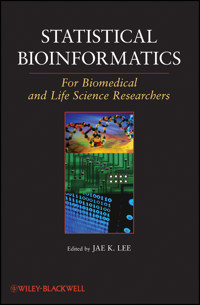
The cover figure signifies the statistical analysis and biological interpretation of high-throughput molecular data. It is the logo of Dr. John N. Weinstein’s former research group at the US National Cancer Institute (in which Dr. Jae Lee worked) and his current Genomics & Bioinformatics Group at the M. D. Anderson Cancer Center.
Copyright © 2010 Wiley-Blackwell. All rights reserved
Published by John Wiley & Sons, Inc., Hoboken, New Jersey
Published simultaneously in Canada
No part of this publication may be reproduced, stored in a retrieval system, or transmitted in any form or by any means, electronic, mechanical, photocopying, recording, scanning, or otherwise, except as permitted under Section 107 or 108 of the 1976 United States Copyright Act, without either the prior written permission of the Publisher, or authorization through payment of the appropriate per-copy fee to the Copyright Clearance Center, Inc., 222 Rosewood Drive, Danvers, MA 01923, (978) 750–8400, fax (978) 750–4470, or on the web at www.copyright.com. Requests to the Publisher for permission should be addressed to the Permissions Department, John Wiley & Sons, Inc., 111 River Street, Hoboken, NJ 07030, (201) 748–6011, fax (201) 748–6008, or online at http://www.wiley.com/go/permission.
Limit of Liability/Disclaimer of Warranty: While the publisher and author have used their best efforts in preparing this book, they make no representations or warranties with respect to the accuracy or completeness of the contents of this book and specifically disclaim any implied warranties of merchantability or fitness for a particular purpose. No warranty may be created or extended by sales representatives or written sales materials. The advice and strategies contained herein may not be suitable for your situation. You should consult with a professional where appropriate. Neither the publisher nor author shall be liable for any loss of profit or any other commercial damages, including but not limited to special, incidental, consequential, or other damages.
For general information on our other products and services or for technical support, please contact our Customer Care Department within the United States at (800) 762–2974, outside the United States at (317) 572–3993 or fax (317) 572–4002.
Wiley also publishes its books in variety of electronic formats. Some content that appears in print may not be available in electronic format. For more information about Wiley products, visit our web site at www.wiley.com.
Library of Congress Cataloging-in-Publication Data:
Statistical bioinformatics: a guide for life and biomedical science researchers/edited by Jae K. Lee. p. cm.
Includes bibliographical references and index. ISBN 978-0-471-69272-0 (cloth)
1. Bioinformatics—Statistical methods. I. Lee, Jae K.
QH324.2.S725 2010 570.285—dc22
2009024890
For Sue, Irene, and Kevin
PREFACE
This book has been constructed primarily as a textbook for a one- or two-semester course in statistical bioinformatics. We hope that it will first serve as a comprehensive introduction to a broad range of topics in this area for life science students and researchers who are motivated to learn statistical analysis concepts and techniques in bioinformatics. Statistical and quantitative science audiences who have not yet dealt with challenging statistical issues in recent information-rich biological and biomedical data analysis may also benefit from this book by efficiently reviewing the different statistical concepts and techniques in such analyses. In particular, the four separate blocks in this book—statistical foundation, high-dimensional analysis, advanced topics, and multigene systems analysis—can be somewhat independently studied and taught in a course based on relevant needs and time restrictions for an effective learning purpose.
A similar outline as organized in this book has been used for several years in a one-semester graduate course which is open to students with diverse backgrounds at the University of Virginia. By publishing this book, we felt that these contents could be significantly enhanced by direct contributions of more specialized experts in the broad field of bioinformatics. In this multiauthor book, we have yet tried to maintain the need of a high-level mathematical and statistical understanding at a minimum. Readers of this book are thus assumed to have not much more than a basic college calculus level of mathematical understanding. A knowledge of matrix algebra would also be useful but is not a prerequisite.
This book is certainly a tribute to the contributions and support of many people. Acknowledgments are first due to the succeeding life science editors of John Wiley & Sons: Luna Han, Thomas Moore, and Karen Chambers. Without their continuous support and encouragement, the publication of this book would not have been possible. Also, all the efforts made by the expert authors who were willing to participate in this book should be highly acknowledged for its successful completion. Finally, the students who have taken this initial course and provided valuable feedback on various topics in this area over the last several years are also significant contributors to the current form of the book. The preparation of this book was supported in part by the National Institutes of Health Research Grant R01 HL081690.
J. K. Lee
Division of Biostatistics and Epidemiology
Charlottesville, Virginia
CONTRIBUTORS
HongshikAhn, Department of Applied Mathematics and Statistics, SUNY at Stony Brook, Stony Brook, NY, USA
Merav Bar, Fred Hutchinson Cancer Research Center, Program in Computational Biology, Division of Public Health Sciences, Seattle, WA, USA
Nabil Belacel, National Research Council Canada, Institute for Information Technology, Moncton, NB, Canada
Sooyoung Cheon, KU Industry-Academy Cooperation Group Team of Economics and Statistics, Korea University, Jochiwon 339–700, Korea
Hyung Jun Cho, Department of Statistics, Korea University, Seoul, Korea
Xiangqin Cui, Department of Biostatistics, University of Alabama, Birmingham, AL, USA
Miroslava Cupelovic-Culf, National Research Council Canada, Institute for Information Technology, Moncton, NB, Canada
Ginger Davis, Department of Systems and Information Engineering, University of Virginia, Charlottesville, VA, USA
Robert Gentleman, Fred Hutchinson Cancer Research Center, Program in Computational Biology, Division of Public Health Sciences, Seattle, WA, USA
Debashis Ghosh, Departments of Statistics and Public Health Sciences, Penn State University, University Park, PA, USA
Haseong Kim, Intelligent Systems and Networks Group, Department of Electrical and Electronic Engineering, Imperial College, London, UK
Youngchul Kim, Division of Biostatistics and Epidemiology, University of Virginia, Charlottesville, VA, USA
Michael Lawrence, Fred Hutchinson Cancer Research Center, Program in Computational Biology, Division of Public Health Sciences, Seattle, WA, USA
Jae K. Lee, Division of Biostatistics and Epidemiology, University of Virginia, Charlottesville, VA, USA
Seungyeoun Lee, Department of Applied Statistics, Sejong University, Seoul, Korea
Nolweim LeMeur, Fred Hutchinson Cancer Research Center, Program in Computational Biology, Division of Public Health Sciences, Seattle, WA, USA xiv CONTRIBUTORS
Karen Lostritto, Yale School of Public Health, Yale University, New Haven, CT, USA
Annette M. Molinaro, Yale School of Public Health, Yale University, New Haven, CT, USA
Hojin Moon, Department of Mathematics and Statistics, California State University, Long Beach, CA, USA
Annamalai Muthiah, Department of Systems and Information Science, University of Virginia, Charlottesville, VA, USA
Taesung Park, Department of Statistics, Seoul National University, Seoul, Korea
Jinwook Seo, Visual Processing Laboratory, School of Computer Science and Engineering, Seoul National University, Gwanak-gu, Seoul, Korea
Wonseok Seo, Department of Statistics, Korea University, Seoul, Korea
Ben Sheiderman, Human-Computer Interaction Lab & Department of Computer Science, University of Maryland, College Park, MD, USA
Ning Sun, Department of Epidemiology and Public Health, Yale University School of Medicine, New Haven, CT, USA
Muneesh Tewari, Fred Hutchinson Cancer Research Center, Program in Computational Biology, Division of Public Health Sciences, Seattle, WA, USA
Christa Wang, National Research Council Canada, Institute for Information Technology, Moncton, NB, Canada
Paul D. Williams, Department of Public Health Science, University of Virginia, Charlottesville, VA, USA
Hongyu Zhao, Department of Epidemiology and Public Health, Yale University School of Medicine, New Haven, CT, USA
CHAPTER 1
ROAD TO STATISTICAL BIOINFORMATICS
Jae K. Lee
Department of Public Health Science, University of Virginia,
Charlottesville, Virginia, USA
There has been a great explosion of biological data and information in recent years, largely due to the advances of various high-throughput biotechnologies such as mass spectrometry, high throughput sequencing, and many genome-wide SNP profiling, RNA gene expression microarray, protein mass spectrometry, and many other recent high-throughput biotechniques (Weinstein et al., 2002). Furthermore, powerful computing systems and fast Internet connections to large worldwide biological databases enable individual laboratory researchers to easily access an unprecedentedly huge amount of biological data. Such enormous data are often too overwhelming to understand and extract the most relevant information to each researcher’s investigation goals. In fact, these large biological data are information rich and often contain much more information than the researchers who have generated such data may have anticipated. This is why many major biomedical research institutes have made significant efforts to freely share such data with general public researchers. Bioinformatics is the emerging science field concerned with the development of various analysis methods and tools for investigating such large biological data efficiently and rigorously. This kind of development requires many different components: powerful computer systems to archive and process such data, effective database designs to extract and integrate information from various heterogeneous biological databases, and efficient analysis techniques to investigate and analyze these large databases. In particular, analysis of these massive biological data is extremely challenging for the following reasons.
CHALLENGE 1: MULTIPLE-COMPARISONS ISSUE
Analysis techniques on high-throughput biological data are required to carefully handle and investigate an astronomical number of candidate targets and possible mechanisms, most of which are false positives, from such massive data (Tusher et al., 2001). For example, a traditional statistical testing criterion which allows 5% false-positive error (or significance level) would identify ~500 false positives from 10K microarray data between two biological conditions of interest even though no real biologically differentially regulated genes exist between the two. If a small number of, for example, 100, genes that are actually differentially regulated exist, such real differential expression patterns will be mixed with the above 500 false positives without any a priori information to discriminate the true positives from the false positives. Then, confidence on the 600 targets that were identified by such a statistical testing may not be high. Simply tightening such a statistical criterion will result in a high false-negative error rate, without being able to identify many important real biological targets. This kind of pitfall, the so-called multiple-comparisons issue, becomes even more serious when biological mechanisms such as certain signal transduction and regulation pathways that involve multiple targets are searched from such biological data; the number of candidate pathway mechanisms to be searched grows exponentially, for example, 10! for 10-gene sequential pathway mechanisms. Thus, no matter how powerful a computer system can handle a given computational task, it is prohibitive to tackle such problems by exhaustive computational search and comparison for these kinds of problems. Many current biological problems have been theoretically proven to be NP (nonpolynomial) hard in computer science, implying that no finite (polynomial) computational algorithm can search all possible solutions as the number of biological targets involved in such a solution becomes too large. More importantly, this kind of exhaustive search is simply prone to the risk of discovering numerous false positives. In fact, this is one of the most difficult challenges in investigating current large biological databases and is why only heuristic algorithms that tightly control such a high false positive error rate and investigate a very small portion of all possible solutions are often sought for many biological problems. Thus, the success of many bioinformatics studies critically depends on the construction and use of effective and efficient heuristic algorithms, most of which are based on probabilistic modeling and statistical inference techniques that can maximize the statistical power of identifying true positives while rigorously controlling their false positive error rates.
CHALLENGE 2: HIGH-DIMENSIONAL BIOLOGICAL DATA
The second challenge is the high-dimensional nature of biological data in many bioinformatics studies. When biological data are simultaneously generated with many gene targets, their data points become dramatically sparse in the corresponding high-dimensional data space. It is well known that mathematical and computational approaches often fail to capture such high-dimensional phenomena accurately (Tamayo et al., 1999). For example, many statistical algorithms cannot easily move between local maxima in a high-dimensional space. Also, inference by combining several disjoint lower dimensional phenomena may not provide the correct understanding on the real phenomena in their joint, high-dimensional space. It is therefore important to understand statistical dimension reduction techniques that can reduce high-dimensional data problems into lower dimensional ones while the important variation of interest in biological data is preserved.
CHALLENGE 3: SMALL-n AND LARGE-p PROBLEM
The third challenge is the so-called “small-n and large-p” problem. Desired performance of conventional statistical methods is achieved when the sample size, namely n, of the data, the number of independent observations of event, is much larger than the number of parameters, say p, which need to be inferred by statistical inference (Jain et al., 2003). In many bioinformatics problems, this situation is often completely reversed. For example, in a microarray study, tens of thousands of gene transcripts’ expression patterns may become candidate prediction factors for a biological phenomenon of interest (e.g., tumor sensitivity vs. resistance to a chemotherapeutic compound) but the number of independent observations (e.g., different patient biopsy samples) is often at most a few tens or smaller. Due to the experimental costs and limited biological materials, the number of independent replicated samples can be sometimes extremely small, for example, two or three, or unavailable. In these cases, most traditional statistical approaches often perform very poorly. Thus, it is also important to select statistical analysis tools that can provide both high specificity and high sensitivity under these circumstances.
CHALLENGE 4: NOISY HIGH-THROUGHPUT BIOLOGICAL DATA
The fourth challenge is due to the fact that high-throughput biotechnical data and large biological databases are inevitably noisy because biological information and signals of interest are often observed with many other random or biased factors that may obscure main signals and information of interest (Cho and Lee, 2004). Therefore, investigations on large biological data cannot be successfully performed unless rigorous statistical algorithms are developed and effectively utilized to reduce and decompose various sources of error. Also, careful assessment and quality control of initial data sets is critical for all subsequent bioinformatics analyses.
CHALLENGE 5: INTEGRATION OF MULTIPLE, HETEROGENEOUS BIOLOGICAL DATA INFORMATION
The last challenge is the integration of information often from multiple heterogeneous biological and clinical data sets, such as large gene functional and annotation databases, biological subjects’ phenotypes, and patient clinical information. One of the main goals in performing high-throughput biological experiments is to identify the most important critical biological targets and mechanisms highly associated with biological subjects’ phenotypes, such as patients’ prognosis and therapeutic response (Pittman et al., 2004). In these cases, multiple large heterogeneous datasets need to be combined in order to discover the most relevant molecular targets. This requires combining multiple datasets with very different data characteristics and formats, some of which cannot easily be integrated by standard statistical inference techniques, for example, the information from genomic and proteomic expression data and reported pathway mechanisms in the literature. It will be extremely important to develop and use efficient yet rigorous analysis tools for integrative inference on such complex biological data information beyond the individual researcher’s manual and subjective integration.
In this book, we introduce the statistical concepts and techniques that can overcome these challenges in studying various large biological datasets. Researchers with biological or biomedical backgrounds may not be able, or may not need, to learn advanced mathematical and statistical techniques beyond the intuitive understanding of such topics for their practical applications. Thus, we have organized this book for life science researchers to efficiently learn the most relevant statistical concepts and techniques for their specific biological problems. We believe that this composition of the book will help nonstatistical researchers to minimize unnecessary efforts in learning statistical topics that are less relevant to their specific biological questions, yet help them learn and utilize rigorous statistical methods directly relevant to those problems. Thus, while this book can serve as a general reference for various concepts and methods in statistical bioinformatics, it is also designed to be effectively used as a textbook for a semester or shorter length course as below. In particular, the chapters are divided into four blocks of different statistical issues in analyzing large biological datasets (Fig. 1.1):
I.Statistical Foundation Probability theories (Chapter 2), statistical quality control (Chapter 3), statistical tests (Chapter 4)
II.High-Dimensional Analysis Clustering analysis (Chapter 5), classification analysis (Chapter 6), multidimensional visualization (Chapter 7)
IIIAdvanced Analysis Topics Statistical modeling (Chapter 8), experimental design (Chapter 9), statistical resampling methods (Chapter 10)
IVMultigene Analysis in Systems Biology Genetic network analysis (Chapter 11), genetic association analysis (Chapter 12), R Bioconductor tools in systems biology (Chapter 13)
Figure 1.1 Possible course structure.
The first block of chapters will be important, especially for students who do not have a strong statistical background. These chapters will provide general backgrounds and terminologies to initiate rigorous statistical analysis on large biological datasets and to understand more advanced analysis topics later. Students with a good statistical understanding may also quickly review these chapters since there are certain key concepts and techniques (especially in Chapters 3 and 4) that are relatively new and specialized for analyzing large biological datasets.
The second block consists of analysis topics frequently used in investigating high-dimensional biological data. In particular, clustering and classification techniques, by far, are most commonly used in many practical applications of high-throughput data analysis. Various multidimensional visualization tools discussed in Chapter 7 will also be quite handy in such investigations.
The third block deals with more advanced topics in large biological data analysis, including advanced statistical modeling for complex biological problems, statistical resampling techniques that can be conveniently used with the combination of classification (Chapter 6) and statistical modeling (Chapter 8) techniques, and experimental design issues in high-throughput microarray studies.
The final block contains concise description of the analysis topics in several active research areas of multigene network and genetic association analysis as well as the R Bioconductor software in systems biology analysis. These will be quite useful for performing challenging gene network and multigene investigations in the fast-growing systems biology field.
These four blocks of chapters can be followed with the current order for a full semester-length course. However, except for the first block, the following three blocks are relatively independent of each other and can be covered (or skipped for specific needs and foci under a time constraint) in any order, as depicted in Figure 1.1. We hope that life science researchers who need to deal with challenging analysis issues in overwhelming large biological data in their specific investigations can effectively meet their learning goals in this way.
REFERENCES
Cho, H., and Lee, J. K. (2004). Bayesian hierarchical error model for analysis of gene expression data. Bioinformatics,20(13): 2016–2025.
Jain, N., et al. (2003). Local-pooled-error test for identifying differentially expressed genes with a small number of replicated microarrays. Bioinformatics,19(15): 1945–1951.
Pittman, J., et al. (2004). Integrated modeling of clinical and gene expression information for personalized prediction of disease outcomes. Proc. Natl. Acad.Sci. U.S.A.,101(22): 8431–8436.
Tamayo, P., et al. (1999). Interpreting patterns of gene expression with self-organizing maps: Methods and application to hematopoietic differentiation. Proc. Natl. Acad.Sci. U.S.A.,96(6): 2907–2912.
Tusher, V. G., Tibshirani, R., and Chu, G. (2001). Significance analysis of microarrays applied to the ionizing radiation response. Proc. Natl. Acad.Sci. U.S.A.,98(9): 5116–5121.
Weinstein, J. N., et al. (2002). The bioinformatics of microarray gene expression profiling. Cytometry,47(1): 46–49.




