


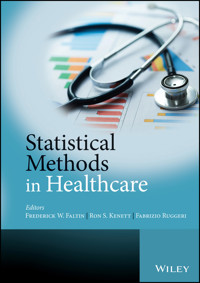
Statistical Methods in Healthcare E-Book
105,99 €
Mehr erfahren.
- Herausgeber: John Wiley & Sons
- Kategorie: Wissenschaft und neue Technologien
- Sprache: Englisch
Statistical Methods in Healthcare In recent years the number of innovative medicinal products and devices submitted and approved by regulatory bodies has declined dramatically. The medical product development process is no longer able to keep pace with increasing technologies, science and innovations and the goal is to develop new scientific and technical tools and to make product development processes more efficient and effective. Statistical Methods in Healthcare focuses on the application of statistical methodologies to evaluate promising alternatives and to optimize the performance and demonstrate the effectiveness of those that warrant pursuit is critical to success. Statistical methods used in planning, delivering and monitoring health care, as well as selected statistical aspects of the development and/or production of pharmaceuticals and medical devices are also addressed. With a focus on finding solutions to these challenges, this book: * Provides a comprehensive, in-depth treatment of statistical methods in healthcare, along with a reference source for practitioners and specialists in health care and drug development. * Offers a broad coverage of standards and established methods through leading edge techniques. * Uses an integrated case study based approach, with focus on applications. * Looks at the use of analytical and monitoring schemes to evaluate therapeutic performance. * Features the application of modern quality management systems to clinical practice, and to pharmaceutical development and production processes. * Addresses the use of modern statistical methods such as Adaptive Design, Seamless Design, Data Mining, Bayesian networks and Bootstrapping that can be applied to support the challenging new vision. Practitioners in healthcare-related professions, ranging from clinical trials to care delivery to medical device design, as well as statistical researchers in the field, will benefit from this book.
Sie lesen das E-Book in den Legimi-Apps auf:
Seitenzahl: 1030
Veröffentlichungsjahr: 2012
Ähnliche




















Contents
Cover
Title Page
Copyright
Dedication
Foreword
Preface
Editors
Contributors
Part One: Statistics In The Development Of Pharmaceutical Products
Chapter 1: Statistical aspects in ICH, FDA and EMA guidelines
Synopsis
1.1 Introduction
1.2 ICH guidelines overview
1.3 ICH guidelines for determining efficacy
1.4 ICH quality guidelines
1.5 Other guidelines
1.6 Statistical challenges in drug products development and manufacturing
1.7 Summary
Chapter 2: Statistical methods in clinical trials
Synopsis
2.1 Introduction
2.2 Hypothesis testing, significance levels, p-values, power and sample size
2.3 Bias, randomization and blinding/masking
2.4 Covariate adjustment and Simpson's paradox
2.5 Meta-analysis, pooling and interaction
2.6 Missing data, intent-to-treat and other analyses cohorts
2.7 Multiplicity, subgroup and interim analyses
2.8 Survival analyses
2.9 Propensity score
2.10 Bayesian versus frequentist approaches to clinical trials
2.11 Adaptive designs
2.12 Drugs versus devices
Chapter 3: Pharmacometrics in drug development
Synopsis
3.1 Introduction
3.2 Pharmacometric components
3.3 Pharmacokinetic/pharmacodynamic analysis
3.4 Translating dynamic processes into a mathematical framework
3.5 Nonlinear mixed-effect modeling
3.6 Model formulation and derivation of the log-likelihood
3.7 Review of the most important pharmacometric software characteristics
3.8 Maximum likelihood method of population analysis
3.9 Case study: Population PK/PD analysis in multiple sclerosis patients
3.10 Mathematical description of the dynamic processes characterizing the PK/safety/efficacy system
3.11 Summary
Chapter 4: Interactive clinical trial design
Synopsis
4.1 Introduction
4.2 Development of the Virtual Patient concept
4.3 Use of the Virtual Patient concept to predict improved drug schedules
4.4 The Interactive Clinical Trial Design (ICTD) algorithm
4.5 Summary
Acknowledgements
Chapter 5: Stage-wise clinical trial experiments in Phases I, II and III
Synopsis
5.1 Introduction
5.2 Phase I clinical trials
5.3 Adaptive methods for Phase II trials
5.4 Adaptive methods for Phase III
5.5 Summary
Chapter 6: Risk management in drug manufacturing and healthcare
Synopsis
6.1 Introduction to risks in healthcare and trends in reporting systems
6.2 Reporting adverse events
6.3 Risk management and optimizing decisions with data
6.4 Decision support systems for managing patient healthcare risks
6.5 The hemodialysis case study
6.6 Risk-based quality audits of drug manufacturing facilities
6.7 Summary
Chapter 7: The twenty-first century challenges in drug development*
Synopsis
7.1 The FDA's Critical Path Initiative
7.2 Lessons from 60 years of pharmaceutical innovation
7.3 The challenges of drug development
7.4 A new era in clinical development
7.5 The QbD and clinical aspects
Part Two: Statistics In Outcomes Analysis
Chapter 8: The issue of bias in combined modelling and monitoring of health outcomes
Synopsis
8.1 Introduction
8.2 Example I: Re-estimating an infection rate following a signal
8.3 Example II: Correcting estimates of length-of-stay measures to protect against bias caused by data entry errors
8.4 Discussion
Chapter 9: Disease mapping
Synopsis
9.1 Introduction
9.2 Epidemiological design issues
9.3 Disease tracking
9.4 Spatial data
9.5 Maps
9.6 Statistical models
9.7 Hierarchical models for disease mapping
9.8 Multivariate disease mapping
9.9 Special issues
9.10 Summary
Chapter 10: Process indicators and outcome measures in the treatment of acute myocardial infarction patients
Synopsis
10.1 Introduction
10.2 A semiparametric Bayesian generalized linear mixed model
10.3 Hospitals’ clustering
10.4 Applications to AMI patients
10.5 Summary
Chapter 11: Meta-analysis
Synopsis
11.1 Introduction
11.2 Formulation of the research question and definition of inclusion/exclusion criteria
11.3 Identification of relevant studies
11.4 Statistical analysis
11.5 Extraction of study-specific information
11.6 Outcome measures
11.7 Estimation of the pooled effect
11.8 Exploring heterogeneity
11.9 Other statistical issues
11.10 Forest plots
11.11 Publication and other biases
11.12 Interpretation of results and report writing
11.13 Summary
Part Three: Statistical Process Control In Healthcare
Chapter 12: The use of control charts in healthcare
Synopsis
12.1 Introduction
12.2 Selection of a control chart
12.3 Implementation Issues
12.4 Certification and governmental oversight applications
12.5 Comparing the performance of healthcare providers
12.6 Summary
Acknowledgements
Chapter 13: Common challenges and pitfalls using SPC in healthcare
Synopsis
13.1 Introduction
13.2 Assuring control chart performance
13.3 Cultural challenges
13.4 Implementation challenges
13.5 Technical challenges
13.6 Summary
Chapter 14: Six Sigma in healthcare
Synopsis
14.1 Introduction
14.2 Six Sigma background
14.3 Development of Six Sigma in healthcare
14.4 The phases and tools of Six Sigma
14.5 DMAIC overview
14.6 Operational issues of Six Sigma
14.7 The way forward for Six Sigma in healthcare
14.8 Summary
Chapter 15: Statistical process control in clinical medicine
Synopsis
15.1 Introduction
15.2 Methods
15.3 Clinical applications
15.4 A cautionary note on the risk-adjustment of observational data
15.5 Summary
Appendix A
Acknowledgements
Part Four: Applications To Healthcare Policy And Implementation
Chapter 16: Modeling kidney allocation: A data-driven optimization approach
Synopsis
16.1 Introduction
16.2 Problem description
16.3 Proposed real-time dynamic allocation policy
16.4 Analytical framework
16.5 Model deployment
16.6 Summary
Acknowledgement
Chapter 17: Statistical issues in vaccine safety evaluation
Synopsis
17.1 Background
17.2 Motivation
17.3 The self-controlled case series model
17.4 Advantages and limitations
17.5 Why use the self-controlled case series method
17.6 Other case-only methods
17.7 Where the self-controlled case series method has been used
17.8 Other issues that were explored in improving the SCCM
17.9 Summary of the chapter
Chapter 18: Statistical methods for healthcare economic evaluation
Synopsis
18.1 Introduction
18.2 Statistical analysis of cost-effectiveness
18.3 Inference for cost-effectiveness data from clinical trials
18.4 Complex decision analysis models
18.5 Further extensions
18.6 Summary
Chapter 19: Costing and performance in healthcare management
Synopsis
19.1 Introduction
19.2 Theoretical approaches to costing healthcare services: Opportunity cost and shadow price
19.3 Costing healthcare services
19.4 Costing for decision making: Tariff setting in healthcare
19.5 Costing, tariffs and performance evaluation
19.6 Discussion
19.7 Summary
Part Five: Applications To Healthcare Management
Chapter 20: Statistical issues in healthcare facilities management
Synopsis
20.1 Introduction
20.2 Healthcare facilities management
20.3 Operating expenses and the cost savings opportunities dilemma
20.4 The case for baselining
20.5 Facilities capital … is it really necessary?
20.6 Defining clean, orderly and in good repair
20.7 A potential objective solution
20.8 Summary
Chapter 21: Simulation for improving healthcare service management
Synopsis
21.1 Introduction
21.2 Talk-through and walk-through simulations
21.3 Spreadsheet modelling
21.4 System dynamics
21.5 Discrete event simulation
21.6 Creating a discrete event simulation
21.7 Data difficulties
21.8 Complex or simple?
21.9 Design of experiments for validation, and for testing robustness
21.10 Other issues
21.11 Case study no. 1: Simulation for capacity planning
21.12 Case study no. 2: Screening for vascular disease
21.13 Case study no. 3: Meeting waiting time targets in orthopaedic care
21.14 Case Study no. 4: Bed Capacity Implications Model (BECIM)
21.15 Summary
Chapter 22: Statistical issues in insurance/payor processes
Synopsis
22.1 Introduction
22.2 Prescription drug claim processing and payment
22.3 Case study: Maximizing Part D prescription drug claim reimbursement
22.4 Looking ahead
22.5 Summary
Chapter 23: Quality of electronic medical records
Synopsis
23.1 Introduction
23.2 Quality of electronic data collections
23.3 Data quality issues in electronic medical records
23.4 Procedure to enhance data quality
23.5 Form design and on-entry procedures
23.6 Quality of data evaluation
23.7 Summary
Index
This edition first published 2012 © 2012 John Wiley & Sons, Ltd
Registered officeJohn Wiley & Sons Ltd, The Atrium, Southern Gate, Chichester, West Sussex, PO19 8SQ, United Kingdom
For details of our global editorial offices, for customer services and for information about how to apply for permission to reuse the copyright material in this book please see our website at www.wiley.com.
The right of the author to be identified as the author of this work has been asserted in accordance with the Copyright, Designs and Patents Act 1988.
All rights reserved. No part of this publication may be reproduced, stored in a retrieval system, or transmitted, in any form or by any means, electronic, mechanical, photocopying, recording or otherwise, except as permitted by the UK Copyright, Designs and Patents Act 1988, without the prior permission of the publisher.
Wiley also publishes its books in a variety of electronic formats. Some content that appears in print may not be available in electronic books.
Designations used by companies to distinguish their products are often claimed as trademarks. All brand names and product names used in this book are trade names, service marks, trademarks or registered trademarks of their respective owners. The publisher is not associated with any product or vendor mentioned in this book. This publication is designed to provide accurate and authoritative information in regard to the subject matter covered. It is sold on the understanding that the publisher is not engaged in rendering professional services. If professional advice or other expert assistance is required, the services of a competent professional should be sought.
Library of Congress Cataloging-in-Publication Data
Statistical methods in healthcare / [edited by] Frederick W. Faltin, Ron S. Kenett, Fabrizio Ruggeri. p. ; cm. Includes bibliographical references and index. ISBN 978-0-470-67015-6 (cloth) I. Faltin, Frederick W. II. Kenett, Ron S. III. Ruggeri, Fabrizio. [DNLM: 1. Statistics as Topic–methods. 2. Data Collection–methods. 3. Delivery of Health Care–statistics & numerical data. WA 950] 362.102′1–dc23 2012009921
A catalogue record for this book is available from the British Library.
ISBN: 978-0-470-67015-6
To Donna, Erin, Travis and Madeline – Frederick W. Faltin
To Jonathan, Alma, Tomer, Yadin, Aviv and Gili – Ron S. Kenett
To Anna, Giacomo and Lorenzo – Fabrizio Ruggeri
Foreword
Twenty-five years ago we launched an interesting experiment, ‘The National Demonstration Project for Quality Improvement in Healthcare’. It was a modest experiment bringing together twenty-one healthcare providers with twenty-one top industrial companies to explore whether industrial quality methods would work in healthcare settings. The results of this experiment were published as Curing Health Care: New Strategies for Quality Improvement. The statistical methods used by most of these healthcare providers were fairly basic tools of quality improvement; yet, many of the improvements were significant.
Looking back this many years later, there was no reason to be surprised by these results. Statistical methods had been used in many areas of healthcare for almost as many years as statistical methods had been used by any organization. Florence Nightingale was one of the first honorary members of the American Statistical Association, an organization that celebrated its 150th anniversary twenty-two years ago. Her pioneering work using clear, simple graphical methods to discover causes of death in hospitals during the Crimean War and alter British barracks was well known and celebrated. Basic, simple statistical methods to explore, understand and present data are as effective in healthcare applications as in any other endeavour.
But somehow, the science of quality control and quality improvement had passed healthcare by. Starting with Shewhart's control chart in 1924, statistical quality control had progressed quickly during the Second World War, and had been widely adopted and used by post-war Japan to become a leading producer of high-quality products. It had been rediscovered in the United States in the 1980s, and widely applied throughout the world in the 1980s and 1990s by companies in almost every competitive industry. Healthcare had evolved many methods of quality assurance, risk management and quality measurement, for the most part independent of what was happening in industry.
In some areas of healthcare, particularly in drug and medical device development and production, sophisticated methods had been created and widely used. Researchers in biostatistics, biometrics and clinical trials had developed and employed some of the most advanced statistical methods, and in turn contributed much to the statistical literature. These methods, however, did not seem to translate easily to the practice of continuous quality improvement in hospital-based care or general clinical practice. There was a considerable gap between what we knew how to do and what we were doing.
The National Demonstration Project evolved into the Institute for Healthcare Improvement, and the growing network of healthcare providers became increasingly adept in learning from sources outside of healthcare, adapting these methods to healthcare applications, and sharing encouraging results with each other. It was not only the statistical tools. The healthcare organizations picked up the methods of putting these tools to use in a scientific approach to improvement using PDSA (Plan-Do-Check/Study-Act), Juran's Quality Improvement Steps, Motorola/General Electric's Define-Measure-Analyse-Improve-Control (Six Sigma Quality), and full-scale implementations of the Toyota Production System (Lean).
Healthcare organizations around the world have formed collaboratives, networks and not-for-profit organizations to share these methods and statistical tools. Thousands of doctors, nurses and other practitioners now routinely attend healthcare quality conferences and daily participate in online courses, web-based sharing and local working groups. Organizations such as the Institute for Healthcare Improvement have tried to structure some of this learning through devices such as IHI's Improvement Roadmap and the Open School, but there has not been a simple place to find the statistical tools used in healthcare improvement until now.
Faltin, Kenett and Ruggeri have brought together leading researchers and practitioners in statistical methods to provide a wealth of methods in one place. Starting with some of the most sophisticated methods used in the development of pharmaceutical products and medical devices, and ending with applications to healthcare management, they have managed to cover amazing ground. The chapters on control charts bring together some of the best methods of statistical process control (SPC) in healthcare, and even cover some of the abuses in the use of control charts. The chapter ‘Six Sigma in Healthcare’ gives a remarkably thorough discussion of both Six Sigma and how it is being applied by many healthcare organizations in Europe and the USA.
But this book goes much further than the typical statistics text and addresses serious policy issues such as kidney allocation and offers advanced statistical methods as an approach to this critical problem. Another critical issue in healthcare, vaccine safety evaluation, is also addressed. In this time of crises in healthcare costs, the economics of healthcare is becoming a major issue. Here too, statistical methods have a large part to play.
The core of healthcare is, of course, clinical outcomes. Statistical methods play a critical role in outcomes analysis. Bias in modelling and monitoring health outcomes are addressed in a chapter by Grigg. Biggeri and Catelan discuss disease tracking. Guglielmi, Ieva, Paganoni and Ruggeri address process indicators and outcome measures in an important area, and Negri gives an excellent discussion of the special tool of meta-analysis.
We no longer need to discuss the value of statistical tools and quality improvement methods in healthcare. The value has been demonstrated thousands of times. What is needed is a comprehensive compilation of these tools in one place written by careful, knowledgeable authors. We should all be grateful to Faltin, Kenett and Ruggeri for providing it.
A. Blanton Godfrey Dean, College of Textiles and Joseph D. Moore Distinguished University Professor North Carolina State University and Chair of the Board of Directors (2009–2012) Institute for Healthcare Improvement
Preface
This book has its origins in the confluence of two realizations. First, that the availability and quality of healthcare is the defining issue of our time. And second, that statistics as a discipline pervades every aspect of the healthcare field.
Statistical Methods in Healthcare illustrates the spectrum of statistical applications to healthcare. From pharmaceuticals to health economics, drug product development to facilities management, clinical outcomes to electronic medical records, risk assessment to organ allocation, statistics has permeated every corner of healthcare. Accordingly, we have assembled here an array of chapters, prepared by a broadly international group of leading authors, which address all of these topics, and many more. Our objective was not to touch upon every area of statistical application in healthcare – that would be impossible. Rather, our purpose has been to span, as best we can, the diverse domains to which statistics has been applied and, thereby, to contribute to the evolution of statistical methods in healthcare applications.
The book consists of 23 chapters organized in five parts:
Not surprisingly, such an effort has been the work of contributors from many fields. Statistical Methods in Healthcare integrates contributions from statisticians, economists, physicians, epidemiologists, operations researchers, actuaries and managers, among others. The outcome captures perspectives from all of these disciplines, providing an integrated interdisciplinary view reflecting the richness and complexity of healthcare applications.
Our hope and belief is that this collective effort will prove valuable to those in a wide array of professions which in some way touch upon healthcare. Not only statisticians, but researchers, physicians and administrators will find here statistical applications with detailed examples representing a variety of problems, models and methodologies. Students and practitioners alike will discover opportunities to innovate via the use of statistical methods.
We'd like to acknowledge and thank the many people whose contributions have made this work possible. These include, first and foremost, our esteemed colleagues who have contributed chapters to the work, and the outstanding editorial, production and copy-editing teams at Wiley, who followed up our work together on The Encyclopedia of Statistics in Quality and Reliability with another successful outing. And of course, our thanks go especially to our families, for their patience with us while we were preoccupied or otherwise disengaged throughout the duration of this project.
This book includes an accompanying website www.wiley.com/go/statistical_methods_healthcare
Editors
Frederick W. FaltinFounder and Managing Director The Faltin Group 25 Casper Drive Cody, WY 82414, USA
Ron S. KenettChairman and CEO, The KPA Group KPA Ltd, PO Box 2525 Hattaassia Street, 25 Raanana 43100, Israel and Research Professor Università degli Studi di Torino 10134 Turin, Italy
Fabrizio RuggeriResearch Director CNR IMATI Via Bassini 15 I-20133 Milano, Italy
Contributors
Benjamin M. AdamsDepartment of Information Systems Statistics and Operations Management University of Alabama Tuscaloosa, AL USA
Zvia AgurOptimata Ltd. Ramat Gan, Israel and Institute for Medical Biomathematics (IMBM) Bene Ataroth, Israel
Robert BauerICON Development Solutions University Blvd. Ellicot City, MD USA
James C. BenneyanHealthcare Systems Engineering Institute Northeastern University Boston, MA USA
Paola BerchiallaDepartment of Public Health and Microbiology University of Torino Turin Italy
Annibale BiggeriDepartment of Statistics ‘G. Parenti’ University of Florence Florence, Italy and Biostatistics Unit ISPO Cancer Prevention and Research Institute Florence, Italy
Dolores CatelanDepartment of Statistics ‘G. Parenti’ University of Florence Florence, Italy and Biostatistics Unit ISPO Cancer Prevention and Research Institute Florence, Italy
Shirley Y. ColemanIndustrial Statistics Research Unit Newcastle University Newcastle upon Tyne UK
Caterina ConiglianiDepartment of Economics University of Roma Tre Rome Italy
Anja DrescherOperations Analytics Integrated Facilities Management Jones Lang LaSalle Americas, Inc. Minnetonka, MN USA
Dario GregoriUnit of Biostatistics, Epidemiology and Public Health Department of Cardiac, Thoracic and Vascular Sciences University of Padova Padua Italy
Olivia A. J. GriggCHICAS School of Health and Medicine Lancaster University Lancaster UK
Alessandra GuglielmiDepartment of Mathematics Politecnico di Milano Milan Italy
Serge GuzyPOPPHARM Albany, CA USA
Francesca IevaDepartment of Mathematics Politecnico di Milano Milan Italy
Telba IronyGeneral and Surgical Devices Branch Center for Devices and Radiological Health US Food and Drug Administration Silver Spring, MD USA
Victoria JordanOffice of Performance Improvement University of Texas MD Anderson Cancer Center Houston, TX USA
Caiyan LiBaxter Healthcare Corporation Round Lake, IL USA
Andrea MancaCentre for Health Economics The University of York, York UK
Patrick MusondaSchool of Medicine, Norwich Medical School University of East Anglia Norwich, UK and Centre for Infectious Disease Research in Zambia (CIDRZ) Lusaka, Zambia
Eva NegriDepartment of Epidemiology Istituto di Ricerche Farmacologiche ‘Mario Negri’ Milan Italy
Daniel P. O’NeillHealthcare Solutions Jones Lang LaSalle Americas, Inc. Chicago, IL USA
Anna Maria PaganoniDepartment of Mathematics Politecnico di Milano Milan Italy
Melissa PopkoskiPharmacy Administrative Services Horizon Blue Cross Blue Shield of New Jersey Newark, NJ USA
Allan SampsonDepartment of Statistics University of Pittsburgh Pittsburgh, PA USA
Anne ShadeGood Decision Partnership Ingleneuk, Strathdrynie Dingwall, Scotland UK
Phyllis SilvermanGeneral and Surgical Devices Branch Division of Biostatistics Center for Devices and Radiological Health US Food and Drug Administration Silver Spring, MD USA
Yafit StarkInnovative R&D Division TEVA Pharmaceutical Industries, Ltd. Netanya Israel
Andrea TancrediDepartment of Methods and Models for Economics, Territory and Finance University of Roma ‘La Sapienza’ Rome Italy
Rosanna TarriconeDepartment of Policy Analysis and Public Management Centre for Research on Health and Social Care Management – CERGAS Università Bocconi Milan Italy
Aleksandra TorbicaDepartment of Policy Analysis and Public Management Centre for Research on Health and Social Care Management – CERGAS Università Bocconi Milan Italy
Per WinkelThe Copenhagen Trial Unit Centre for Clinical Intervention Research Rigshospitalet, Copenhagen University Hospital Copenhagen Denmark
William H. WoodallDepartment of Statistics Virginia Tech Blacksburg, VA USA
Inbal YahavThe Graduate School of Business Department of Information Systems Bar Ilan University Israel
Shelemyahu ZacksDepartment of Mathematical Sciences Binghamton University Binghamton, NY USA
Nien Fan ZhangStatistical Engineering Division National Institute of Standards and Technology Gaithersburg, MD USA
Part One
STATISTICS IN THE DEVELOPMENT OF PHARMACEUTICAL PRODUCTS
1
Statistical aspects in ICH, FDA and EMA guidelines
Allan Sampson1 and Ron S. Kenett2
1Department of Statistics, University of Pittsburgh, Pittsburgh, PA, USA 2KPA Ltd, Raanana, Israel
Synopsis
This chapter introduces the regulatory guidelines affecting drug product development and manufacturing that were published by the International Conference on Harmonization of Technical Requirements for Registration of Pharmaceuticals for Human Use (ICH) and other regulatory agencies such as the Food and Drug Administration (FDA) and the European Medicines Authority (EMA). The focus of the chapter is on statistical aspects of these documents, thereby setting the stage for the whole book. These guidelines, collectively, deal with quality, safety and efficacy issues in clinical and pre-clinical research, chemistry, manufacturing and controls (CMC). In essence, they link patient clinical outcomes, drug product critical quality attributes, process parameters and raw material attributes. Establishing the link between patient, product and process is the most important challenge of biopharmaceutical companies and regulatory agencies for ensuring safe, effective and economic healthcare. This challenge is being addressed by the recent Quality by Design (QbD) initiatives of the FDA and ICH, which are also discussed.
1.1 Introduction
Healthcare is the treatment and prevention of illness. Healthcare delivery requires both innovators and manufacturers of drug products and medical devices, as well as healthcare providers such as hospitals and family medicine. This book, Statistical Methods in Healthcare, covers a wide range of activities where statistics impacts on the quality of healthcare, starting with the development of drug products and medical devices, followed by the handling of clinical trials, surveillance and statistical process control of health-related outcomes, economics of healthcare, and healthcare management. The book consists of five parts:
This chapter is about the fundamentals in drug development and manufacturing as defined by the regulatory agencies that determine what can be marketed to healthcare consumers. We begin with a general introduction to the organizations that produce such guidelines and regulations.
The pharmaceutical industry became more global in the 1960s and 1970s in parallel with worldwide development of pharmaceutical regulations. Moreover, contemporaneous with these developments, increased societal concerns were voiced for faster development of new biopharmaceutical compounds and for reduction of costs of healthcare and new drug development. One of the perceived roadblocks for expeditiously and efficiently developed new drugs was the fragmentation of pharmaceutical regulations among the United States, Japan and Europe. In the 1980s, the European Community initiated harmonization of European national drug regulations and demonstrated that harmonization of national regulations is possible.
Lesen Sie weiter in der vollständigen Ausgabe!
Lesen Sie weiter in der vollständigen Ausgabe!
Lesen Sie weiter in der vollständigen Ausgabe!
Lesen Sie weiter in der vollständigen Ausgabe!
Lesen Sie weiter in der vollständigen Ausgabe!
Lesen Sie weiter in der vollständigen Ausgabe!
Lesen Sie weiter in der vollständigen Ausgabe!
Lesen Sie weiter in der vollständigen Ausgabe!
Lesen Sie weiter in der vollständigen Ausgabe!
Lesen Sie weiter in der vollständigen Ausgabe!
Lesen Sie weiter in der vollständigen Ausgabe!
Lesen Sie weiter in der vollständigen Ausgabe!
Lesen Sie weiter in der vollständigen Ausgabe!
Lesen Sie weiter in der vollständigen Ausgabe!
Lesen Sie weiter in der vollständigen Ausgabe!
Lesen Sie weiter in der vollständigen Ausgabe!
Lesen Sie weiter in der vollständigen Ausgabe!
Lesen Sie weiter in der vollständigen Ausgabe!
Lesen Sie weiter in der vollständigen Ausgabe!
Lesen Sie weiter in der vollständigen Ausgabe!
Lesen Sie weiter in der vollständigen Ausgabe!
Lesen Sie weiter in der vollständigen Ausgabe!
Lesen Sie weiter in der vollständigen Ausgabe!
Lesen Sie weiter in der vollständigen Ausgabe!
Lesen Sie weiter in der vollständigen Ausgabe!
Lesen Sie weiter in der vollständigen Ausgabe!
Lesen Sie weiter in der vollständigen Ausgabe!




