


77,99 €
Mehr erfahren.
- Herausgeber: John Wiley & Sons
- Kategorie: Wissenschaft und neue Technologien
- Serie: Wiley Series in Probability and Statistics
- Sprache: Englisch
A thoroughly revised and updated edition of this introduction to modern statistical methods for shape analysis
Shape analysis is an important tool in the many disciplines where objects are compared using geometrical features. Examples include comparing brain shape in schizophrenia; investigating protein molecules in bioinformatics; and describing growth of organisms in biology.
This book is a significant update of the highly-regarded Statistical Shape Analysis by the same authors. The new edition lays the foundations of landmark shape analysis, including geometrical concepts and statistical techniques, and extends to include analysis of curves, surfaces, images and other types of object data. Key definitions and concepts are discussed throughout, and the relative merits of different approaches are presented.
The authors have included substantial new material on recent statistical developments and offer numerous examples throughout the text. Concepts are introduced in an accessible manner, while retaining sufficient detail for more specialist statisticians to appreciate the challenges and opportunities of this new field. Computer code has been included for instructional use, along with exercises to enable readers to implement the applications themselves in R and to follow the key ideas by hands-on analysis.
- Offers a detailed yet accessible treatment of statistical methods for shape analysis
- Includes numerous examples and applications from many disciplines
- Provides R code for implementing the examples
- Covers a wide variety of recent developments in shape analysis
Shape Analysis, with Applications in R will offer a valuable introduction to this fast-moving research area for statisticians and other applied scientists working in diverse areas, including archaeology, bioinformatics, biology, chemistry, computer science, medicine, morphometics and image analysis.
Sie lesen das E-Book in den Legimi-Apps auf:
Seitenzahl: 750
Veröffentlichungsjahr: 2016
Ähnliche




















WILEY SERIES IN PROBABILITY AND STATISTICS
Established by WALTER A. SHEWHART and SAMUEL S. WILKS
Editors: David J. Balding, Noel A. C. Cressie, Garrett M. Fitzmaurice,
Geof H. Givens, Harvey Goldstein, Geert Molenberghs, David W. Scott,
Adrian F. M. Smith, Ruey S. Tsay, Sanford Weisberg
Editors Emeriti: J. Stuart Hunter, Iain M. Johnstone, Joseph B. Kadane,
Jozef L. Teugels
A complete list of the titles in this series appears at the end of this volume.
Statistical Shape Analysis
with Applications in R
Second Edition
Ian L. Dryden
The University of Nottingham, UK
Kanti V. Mardia
University of Leeds and University of Oxford, UK
This edition first published 2016 © 2016 John Wiley and Sons Ltd
Registered officeJohn Wiley & Sons Ltd, The Atrium, Southern Gate, Chichester, West Sussex, PO19 8SQ, United Kingdom
For details of our global editorial offices, for customer services and for information about how to apply for permission to reuse the copyright material in this book please see our website at www.wiley.com.
The right of the authors to be identified as the author of this work has been asserted in accordance with the Copyright, Designs and Patents Act 1988.
All rights reserved. No part of this publication may be reproduced, stored in a retrieval system, or transmitted, in any form or by any means, electronic, mechanical, photocopying, recording or otherwise, except as permitted by the UK Copyright, Designs and Patents Act 1988, without the prior permission of the publisher.
Wiley also publishes its books in a variety of electronic formats. Some content that appears in print may not be available in electronic books.
Designations used by companies to distinguish their products are often claimed as trademarks. All brand names and product names used in this book are trade names, service marks, trademarks or registered trademarks of their respective owners. The publisher is not associated with any product or vendor mentioned in this book.
Limit of Liability/Disclaimer of Warranty: While the publisher and authors have used their best efforts in preparing this book, they make no representations or warranties with respect to the accuracy or completeness of the contents of this book and specifically disclaim any implied warranties of merchantability or fitness for a particular purpose. It is sold on the understanding that the publisher is not engaged in rendering professional services and neither the publisher nor the authors shall be liable for damages arising herefrom. If professional advice or other expert assistance is required, the services of a competent professional should be sought.
Library of Congress Cataloging-in-Publication Data
Names: Dryden, I. L. (Ian L.), author. | Mardia, K. V., author. Title: Statistical shape analysis with applications in R / Ian L. Dryden and Kanti V. Mardia. Other titles: Statistical shape analysis | Wiley series in probability and statistics. Description: Second edition. | Chichester, UK ; Hoboken, NJ : John Wiley & Sons, 2016. | Series: Wiley series in probability and statistics | Originally published as: Statistical shape analysis, 1998 | Includes bibliographical references and index. Identifiers: LCCN 2016011608 (print) | LCCN 2016016288 (ebook) | ISBN 9780470699621 (cloth) | ISBN 9781119072508 (pdf) | ISBN 9781119072515 (epub) Subjects: LCSH: (1) Shape theory (Topology)--Statistical methods (2) Statistics, multivariate analysis. Classification: LCC QA612.7 .D79 2016 (print) | LCC QA612.7 (ebook) | DDC 514/.24--dc23 LC record available at https://lccn.loc.gov/2016011608
A catalogue record for this book is available from the British Library.
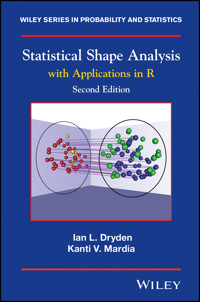
Cover image: Shape analysis of two proteins 1cyd (left) and 1a27 (right) from the Protein Data Bank
ISBN: 9780470699621
To my wife Maria and daughter Sophia(Ian Dryden)
To my grandsons Ashwin and Sashin(Kanti Mardia)
Shapes of all Sort and Sizes, great and small, That stood along the floor and by the wall; And some loquacious Vessels were; and some Listen'd perhaps, but never talk'd at all.
Edward FitzGerald, 3rd edition (1872), Quatrain 83, Rubaiyat of Omar Khayyam
CONTENTS
Preface
Preface to the first edition
Acknowledgements for the first edition
1 Introduction
1.1 Definition and motivation
1.2 Landmarks
1.3 The
shapes
package in R
1.4 Practical applications
2 Size measures and shape coordinates
2.1 History
2.2 Size
2.3 Traditional shape coordinates
2.4 Bookstein shape coordinates
2.5 Kendall’s shape coordinates
2.6 Triangle shape coordinates
3 Manifolds, shape and size-and-shape
3.1 Riemannian manifolds
3.2 Shape
3.3 Size-and-shape
3.4 Reflection invariance
3.5 Discussion
4 Shape space
4.1 Shape space distances
4.2 Comparing shape distances
4.3 Planar case
4.4 Tangent space coordinates
5 Size-and-shape space
5.1 Introduction
5.2 Root mean square deviation measures
5.3 Geometry
5.4 Tangent coordinates for size-and-shape space
5.5 Geodesics
5.6 Size-and-shape coordinates
5.7 Allometry
6 Manifold means
6.1 Intrinsic and extrinsic means
6.2 Population mean shapes
6.3 Sample mean shape
6.4 Comparing mean shapes
6.5 Calculation of mean shapes in R
6.6 Shape of the means
6.7 Means in size-and-shape space
6.8 Principal geodesic mean
6.9 Riemannian barycentres
7 Procrustes analysis
7.1 Introduction
7.2 Ordinary Procrustes analysis
7.3 Generalized Procrustes analysis
7.4 Generalized Procrustes algorithms for shape analysis
7.5 Generalized Procrustes algorithms for size-and-shape analysis
7.6 Variants of generalized Procrustes analysis
7.7 Shape variability: principal component analysis
7.8 Principal component analysis for size-and-shape
7.9 Canonical variate analysis
7.10 Discriminant analysis
7.11 Independent component analysis
7.12 Bilateral symmetry
8 2D Procrustes analysis using complex arithmetic
8.1 Introduction
8.2 Shape distance and Procrustes matching
8.3 Estimation of mean shape
8.4 Planar shape analysis in R
8.5 Shape variability
9 Tangent space inference
9.1 Tangent space small variability inference for mean shapes
9.2 Inference using Procrustes statistics under isotropy
9.3 Size-and-shape tests
9.4 Edge-based shape coordinates
9.5 Investigating allometry
10 Shape and size-and-shape distributions
10.1 The uniform distribution
10.2 Complex Bingham distribution
10.3 Complex Watson distribution
10.4 Complex angular central Gaussian distribution
10.5 Complex Bingham quartic distribution
10.6 A rotationally symmetric shape family
10.7 Other distributions
10.8 Bayesian inference
10.9 Size-and-shape distributions
10.10 Size-and-shape versus shape
11 Offset normal shape distributions
11.1 Introduction
11.2 Offset normal shape distributions with general covariances
11.3 Inference for offset normal distributions
11.4 Practical inference
11.5 Offset normal size-and-shape distributions
11.6 Distributions for higher dimensions
12 Deformations for size and shape change
12.1 Deformations
12.2 Affine transformations
12.3 Pairs of thin-plate splines
12.4 Alternative approaches and history
12.5 Kriging
12.6 Diffeomorphic transformations
13 Non-parametric inference and regression
13.1 Consistency
13.2 Uniqueness of intrinsic means
13.3 Non-parametric inference
13.4 Principal geodesics and shape curves
13.5 Statistical shape change
13.6 Robustness
13.7 Incomplete data
14 Unlabelled size-and-shape and shape analysis
14.1 The Green–Mardia model
14.2 Procrustes model
14.3 Related methods
14.4 Unlabelled points
15 Euclidean methods
15.1 Distance-based methods
15.2 Multidimensional scaling
15.3 Multidimensional scaling shape means
15.4 Euclidean distance matrix analysis for size-and-shape analysis
15.5 Log-distances and multivariate analysis
15.6 Euclidean shape tensor analysis
15.7 Distance methods versus geometrical methods
16 Curves, surfaces and volumes
16.1 Shape factors and random sets
16.2 Outline data
16.3 Semi-landmarks
16.4 Square root velocity function
16.5 Curvature and torsion
16.6 Surfaces
16.7 Curvature, ridges and solid shape
17 Shape in images
17.1 Introduction
17.2 High-level Bayesian image analysis
17.3 Prior models for objects
17.4 Warping and image averaging
18 Object data and manifolds
18.1 Object oriented data analysis
18.2 Trees
18.3 Topological data analysis
18.4 General shape spaces and generalized Procrustes methods
18.5 Other types of shape
18.6 Manifolds
18.7 Reviews
Exercises
Appendix
References
Index
WILEY SERIES IN PROBABILITY AND STATISTICS
EULA
List of Tables
Chapter 4
Table 4.1
Table 4.2
Chapter 6
Table 6.1
Chapter 7
Table 7.1
Chapter 9
Table 9.1
Table 9.2
Table 9.3
Table 9.4
Chapter 12
Table 12.1
Guide
Cover
Table of Contents
Preface
Pages
xix
xx
xxi
xxii
xxiii
xxv
1
2
3
4
5
6
7
8
9
10
11
12
13
14
15
16
18
19
20
21
22
23
24
25
26
28
29
30
31
32
33
34
35
36
37
38
39
40
41
42
43
44
45
46
47
48
49
50
51
52
53
54
55
56
57
59
60
61
62
63
64
65
66
67
68
69
70
71
72
73
74
75
76
77
78
79
80
81
82
83
84
85
86
87
88
89
90
91
92
93
94
95
96
97
99
100
101
102
103
104
105
106
107
108
109
111
112
113
114
115
116
117
118
120
121
122
123
125
126
127
128
129
131
132
133
134
135
136
138
139
140
141
142
143
144
145
146
147
148
149
150
151
152
153
154
155
158
160
161
163
164
165
166
167
168
169
171
172
173
175
176
177
178
179
180
181
182
183
184
185
186
187
188
189
191
192
193
194
195
196
197
198
199
200
201
202
203
204
205
206
207
208
209
210
211
212
213
214
215
216
217
218
219
220
221
222
223
224
225
226
227
228
229
230
231
232
233
234
235
236
237
239
240
241
242
243
244
245
246
247
248
249
250
251
252
253
254
255
256
257
258
259
260
261
262
263
264
265
266
267
269
270
271
272
273
274
275
276
277
278
279
280
281
282
283
284
285
287
288
289
290
291
292
293
295
296
297
298
299
300
301
302
303
304
305
306
307
308
309
310
311
312
313
314
315
317
318
319
320
321
322
323
324
325
326
327
328
329
330
331
332
333
334
335
336
337
338
339
341
342
343
344
345
346
347
348
349
350
351
352
353
354
355
356
357
358
359
360
361
362
363
364
365
366
367
368
369
370
371
372
373
374
375
376
377
378
379
380
381
382
383
384
385
386
387
388
389
390
391
392
393
394
395
396
397
399
400
401
402
403
404
405
407
408
409
410
411
412
413
414
415
416
417
418
419
420
421
422
423
424
425
426
427
428
429
430
431
432
433
434
435
436
437
438
439
440
441
442
443
444
445
446
447
449
450
451
452
453
454
455
Preface
Since the publication of the first edition of this book (Dryden and Mardia 1998) there have been numerous exciting novel developments in the field of statistical shape analysis. Although a book length treatment of the new developments is certainly merited, much of the work that we discussed in the first edition still forms the foundations of new methodology. The shear volume of applications of the methodology has multiplied significantly, and we are frequently amazed by the breadth of applications of the field.
The first edition of the book primarily discussed the topic of landmark shape analysis, which is still the core material of the field. We have updated the material, with a new focus on illustrating the methodology with examples based on the shapes package (Dryden 2015) in R (R Development Core Team 2015). This new focus on R applications and an extension of the material has resulted in the new title ‘Statistical Shape Analysis, with Applications in R’ for this second edition. There is more emphasis on the joint analysis of size and shape (form) in this edition, treatment of unlabelled size-and-shape and shape analysis, more three-dimensional applications and more discussion of general Riemannian manifolds, providing more context in our discussion of geometry of size and shape spaces. All chapters contain a good deal of new material and we have rearranged some of the ordering of topics for a more coherent treatment. Chapters 6, 13, 14, 16 and 18 are almost entirely new. We have updated the references and give brief descriptions of many of the new and ongoing developments, and we have included some exercises at the end of the book which should be useful when using the book as a class text.
In Chapter 1 we provide an introduction and describe some example datasets that are used in later chapters. Chapter 2 introduces some basic size and shape coordinates, which we feel is an accessible way to understand some of the more elementary ideas. Chapter 3 provides a general informal introduction to Riemannian manifolds to help illustrate some of the geometrical concepts. In Chapter 4 we concentrate on Kendall’s shape space and shape distances, and in Chapter 5 the size-and-shape (form) space and distance.
After having provided the geometrical framework in Chapters 2--5, statistical inference is then considered with a focus on the estimation of mean shape or size-and-shape in Chapter 6. Chapter 7 provides a detailed discussion of Procrustes analysis, which is the main technique for registering landmark data. Chapter 8 contains specific two-dimensional methods which exploit the algebraic structure of complex numbers, where rotation and scaling are carried out via multiplication and translation by addition. Chapter 9 contains the main practical inferential methods, based on tangent space approximations. Chapter 10 introduces some shape distributions, primarily for two-dimensional data. Chapter 11 contains shortened material on offset normal shape distributions compared with the first edition, retaining the main results and referring to our original papers for specific details. Chapter 12 discusses size and shape deformations, with a particular focus on thin-plate splines as in the first edition.
In Chapter 13 we have introduced many recent developments in non-parametric shape analysis, with discussion of limit theorems and the bootstrap. Chapter 14 introduces unlabelled shape, where the correspondence between landmarks is unknown and must be estimated, and the topic is of particularly strong interest in bioinformatics. Chapter 15 lays out some distance-based measures, and some techniques based on multidimensional scaling. Chapter 16 provides a brief summary of some recent work on analysing curves, surfaces and volumes. Although this area is extensive in terms of applications and methods, many of the basic concepts are extensions of the simpler methods for landmark data analysis. Chapter 17 is a more minor update of shapes in images, which is a long-standing application area, particularly Bayesian image analysis using deformable templates. Chapter 18 completes the material with discussion of a wide variety of recent methods, including statistics on other manifolds and the broad field of Object Data Analysis.
There are many other books on the topic of shape analysis which complement our own including Bookstein (1991); Stoyan and Stoyan (1994); Stoyan et al. (1995); Small (1996); Kendall et al. (1999); Lele and Richtsmeier (2001); Grenander and Miller (2007); Bhattacharya and Bhattacharya (2008); Claude (2008); Davies et al. (2008b); da Fontoura Costa and Marcondes Cesar J. (2009); Younes (2010); Zelditch et al. (2012); Brombin and Salmaso (2013); Bookstein (2014) and Patrangenaru and Ellingson (2015). A brief discussion of other books and reviews is given in Section 18.7.
Our own work has been influenced by the long-running series of Leeds Annual Statistical Research (LASR) Workshops, which have now been taking place for 40 years (Mardia et al. 2015). A strong theme since the 1990s has been statistical shape analysis, and a particularly influential meeting in 1995 had talks by both Kendall and Bookstein among many others (Mardia and Gill 1995), and the proceedings volume was dedicated to both David Kendall and Fred Bookstein.
We are very grateful for the help of numerous colleagues in our work, notably at the University of Leeds and The University of Nottingham. We give our special thanks to Fred Bookstein and John Kent who provided many very insightful comments on the first edition and we are grateful for Fred Bookstein's comments on the current edition. Their challenging comments have always been very helpful indeed. Also, support of a Royal Society Wolfson Research Merit Award WM110140 and EPSRC grant EP/K022547/1 is gratefully acknowledged.
We would be pleased to hear about any typographical or other errors in the text.
Ian Dryden and Kanti Mardia Nottingham, Leeds and Oxford, January 2016
Preface to the first edition
Whence and what art thou, execrable shape?John Milton (1667) Paradise Lost II, 681
In a wide variety of disciplines it is of great practical importance to measure, describe and compare the shapes of objects. The field of shape analysis involves methods for the study of the shape of objects where location, rotation and scale information can be removed. In particular, we focus on the situation where the objects are summarized by key points called landmarks. A geometrical approach is favoured throughout and so rather than selecting a few angles or lengths we work with the full geometry of the objects (up to similarity transformations of each object). Statistical shape analysis is concerned with methodology for analysing shapes in the presence of randomness. The objects under study could be sampled at random from a population and the main aims of statistical shape analysis are to estimate population average shapes, to estimate the structure of population shape variability and to carry out inference on population quantities.
Interest in shape analysis at Leeds began with an application in Central Place Theory in Geography. Mardia (1977) investigated the distribution of the shapes of triangles generated by certain point processes, and in particular considered whether towns in a plain are spread regularly with equal distances between neighbouring towns. Our joint interest in statistical shape analysis began in 1986, with an approach from Paul O’Higgins and David Johnson in the Department of Anatomy at Leeds, asking for advice about the analysis of the shape of some mouse vertebrae. Some of their data are used in examples in the book.
In 1986 the journal Statistical Science began, and the thought-provoking article by Fred Bookstein was published in Volume 1. David Kendall was a discussant of the paper and it had become clear that the elegant and deep mathematical work in shape theory from his landmark paper (Kendall 1984) was of great relevance to the practical applications in Bookstein’s paper. The pioneering work of these two authors provides the foundation for the work that we present here. The penultimate chapter on shape in image analysis is rather different and is inspired by Grenander and his co-workers.
This text aims to introduce statisticians and applied researchers to the field of statistical shape analysis. Some maturity in Statistics and Mathematics is assumed, in order to fully appreciate the work, especially in Chapters 4, 6, 8 and 9. However, we believe that interested researchers in various disciplines including biology, computer science and image analysis will also benefit, with Chapters 1–3, 5, 7, 8, 10 and 11 being of most interest.
As shape analysis is a new area we have given many definitions to help the reader. Also, important points that are not covered by definitions or results have been highlighted in various places. Throughout the text we have attempted to assist the applied researcher with practical advice, especially in Chapter 2 on size measures and simple shape coordinates, in Chapter 3 on two-dimensional Procrustes analysis, in Section 5.5.3 on principal component analysis, Section 6.9 on choice of models, Section 7.3.3 on analysis with Bookstein coordinates, Section 8.8 on size-and-shape versus shape and Section 9.1 on higher dimensional work. We are aware of current discussions about the advantages and disadvantages of superimposition type approaches versus distance-based methods, and the reader is referred to Section 12.2.5 for some discussion.
Chapter 1 provides an introduction to the topic of shape analysis and introduces the practical applications that are used throughout the text to illustrate the work. Chapter 2 provides some preliminary material on simple measures of size and shape, in order to familiarize the reader with the topic. In Chapter 3 we outline the key concepts of shape distance, mean shape and shape variability for two-dimensional data using Procrustes analysis. Complex arithmetic leads to neat solutions. Procrustes methods are covered in Chapters 3–5. We have brought forward some of the essential elements of two-dimensional Procrustes methods into Chapter 3 in order to introduce the more in-depth coverage of Chapters 4 and 5, again with a view to helping the reader. In Chapter 4 we introduce the shape space. Various distances in the shape space are described, together with some further choices of shape coordinates. Chapter 5 provides further details on the Procrustes analysis of shape suitable for two and higher dimensions. We also include further discussion of principal component analysis for shape.
Chapter 6 introduces some suitable distributions for shape analysis in two dimensions, notably the complex Bingham distribution, the complex Watson distribution and the various offset normal shape distributions. The offset normal distributions are referred to as ‘Mardia–Dryden’ distributions in the literature. Chapter 7 develops some inference procedures for shape analysis, where variations are considered to be small. Three approaches are considered: tangent space methods, approximate distributions of Procrustes statistics and edge superimposition procedures. The two sample tests for mean shape difference are particularly useful.
Chapter 8 discusses size-and-shape analysis – the situation where invariance is with respect to location and rotation, but not scale. We discuss allometry which involves studying the relationship of shape and size. The geometry of the size-and-shape space is described and some size-and-shape distributions are discussed. Chapter 9 involves the extension of the distributional results into higher than two dimensions, which is a more difficult situation to deal with than the planar case.
Chapter 10 considers methods for describing the shape change between objects. A particularly useful tool is the thin-plate spline deformation used by Bookstein (1989) in shape analysis. Pictures can be easily drawn for describing shape differences in the




