


44,99 €
Mehr erfahren.
- Herausgeber: John Wiley & Sons
- Kategorie: Wissenschaft und neue Technologien
- Sprache: Englisch
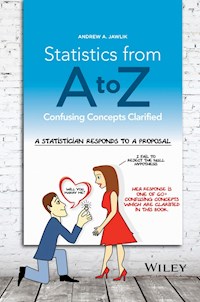
Statistics is confusing, even for smart, technically competent people. And many students and professionals find that existing books and web resources don't give them an intuitive understanding of confusing statistical concepts. That is why this book is needed. Some of the unique qualities of this book are: * Easy to Understand: Uses unique "graphics that teach" such as concept flow diagrams, compare-and-contrast tables, and even cartoons to enhance "rememberability." * Easy to Use: Alphabetically arranged, like a mini-encyclopedia, for easy lookup on the job, while studying, or during an open-book exam. * Wider Scope: Covers Statistics I and Statistics II and Six Sigma Black Belt, adding such topics as control charts and statistical process control, process capability analysis, and design of experiments. As a result, this book will be useful for business professionals and industrial engineers in addition to students and professionals in the social and physical sciences. In addition, each of the 60+ concepts is covered in one or more articles. The 75 articles in the book are usually 5-7 pages long, ensuring that things are presented in "bite-sized chunks." The first page of each article typically lists five "Keys to Understanding" which tell the reader everything they need to know on one page. This book also contains an article on "Which Statistical Tool to Use to Solve Some Common Problems", additional "Which to Use When" articles on Control Charts, Distributions, and Charts/Graphs/Plots, as well as articles explaining how different concepts work together (e.g., how Alpha, p, Critical Value, and Test Statistic interrelate). ANDREW A. JAWLIK received his B.S. in Mathematics and his M.S. in Mathematics and Computer Science from the University of Michigan. He held jobs with IBM in marketing, sales, finance, and information technology, as well as a position as Process Executive. In these jobs, he learned how to communicate difficult technical concepts in easy - to - understand terms. He completed Lean Six Sigma Black Belt coursework at the IASSC - accredited Pyzdek Institute. In order to understand the confusing statistics involved, he wrote explanations in his own words and graphics. Using this material, he passed the certification exam with a perfect score. Those statistical explanations then became the starting point for this book.
Sie lesen das E-Book in den Legimi-Apps auf:
Seitenzahl: 557
Veröffentlichungsjahr: 2016
Ähnliche



















STATISTICS FROM A TO Z
Confusing Concepts Clarified
ANDREW A. JAWLIK
Copyright © 2016 by John Wiley & Sons, Inc. All rights reserved.
Published by John Wiley & Sons, Inc., Hoboken, New Jersey. Published simultaneously in Canada.
No part of this publication may be reproduced, stored in a retrieval system, or transmitted in any form or by any means, electronic, mechanical, photocopying, recording, scanning, or otherwise, except as permitted under Section 107 or 108 of the 1976 United States Copyright Act, without either the prior written permission of the Publisher, or authorization through payment of the appropriate per-copy fee to the Copyright Clearance Center, Inc., 222 Rosewood Drive, Danvers, MA 01923, (978) 750-8400, fax (978) 750-4470, or on the web at www.copyright.com. Requests to the Publisher for permission should be addressed to the Permissions Department, John Wiley & Sons, Inc., 111 River Street, Hoboken, NJ 07030, (201) 748-6011, fax (201) 748-6008, or online at http://www.wiley.com/go/permission.
Limit of Liability/Disclaimer of Warranty: While the publisher and author have used their best efforts in preparing this book, they make no representations or warranties with respect to the accuracy or completeness of the contents of this book and specifically disclaim any implied warranties of merchantability or fitness for a particular purpose. No warranty may be created or extended by sales representatives or written sales materials. The advice and strategies contained herein may not be suitable for your situation. You should consult with a professional where appropriate. Neither the publisher nor author shall be liable for any loss of profit or any other commercial damages, including but not limited to special, incidental, consequential, or other damages.
For general information on our other products and services or for technical support, please contact our Customer Care Department within the United States at (800) 762-2974, outside the United States at (317) 572-3993 or fax (317) 572-4002.
Wiley also publishes its books in a variety of electronic formats. Some content that appears in print may not be available in electronic formats. For more information about Wiley products, visit our web site at www.wiley.com.
Library of Congress Cataloging-in-Publication Data
Names: Jawlik, Andrew. Title: Statistics from A to Z : confusing concepts clarified / Andrew Jawlik. Description: Hoboken, New Jersey : John Wiley & Sons, Inc., [2016]. Identifiers: LCCN 2016017318 | ISBN 9781119272038 (pbk.) | ISBN 9781119272007 (epub) Subjects: LCSH: Mathematical statistics–Dictionaries. | Statistics–Dictionaries. Classification: LCC QA276.14 .J39 2016 | DDC 519.503–dc23 LC record available at https://lccn.loc.gov/2016017318
To my wonderful wife, Jane, who is a 7 Sigma*.
CONTENTS
Other Concepts Covered in the Articles
Why This Book is Needed
What Makes this Book Unique?
How to Use This Book
ALPHA,
Alpha and Beta Errors
Alpha,
p
, Critical Value, and Test Statistic – How They Work Together
Alternative Hypothesis
Analysis of Means (ANOM)
ANOVA – Part 1 (of 4): What it Does
ANOVA – Part 2 (of 4): How it Does it
ANOVA – Part 3 (OF 4): 1-Way (AKA Single Factor)
ANOVA – Part 4 (OF 4): 2-Way (AKA 2-Factor)
ANOVA vs. Regression
Binomial Distribution
Charts/Graphs/Plots – Which to Use When
Chi-Square – The Test Statistic and Its Distributions
Chi-Square Test for Goodness of Fit
Chi-Square Test for Independence
Chi-Square Test for the Variance
Confidence Intervals – Part 1 (of 2): General Concepts
Confidence Intervals – Part 2 (of 2): Some Specifics
Control Charts – Part 1 (of 2): General Concepts and Principles
Control Charts – Part 2 (of 2): Which to Use When
Correlation – Part 1 (of 2)
Correlation – Part 2 (of 2)
Critical Value
Degrees of Freedom
Design of Experiments (DOE) – Part 1 (of 3)
Design of Experiments (DOE) – Part 2 (OF 3)
Design of Experiments (DOE) – Part 3 (OF 3)
Distributions – Part 1 (OF 3): What They Are
Distributions – Part 2 (of 3): How They Are Used
Distributions – Part 3 (of 3): Which To Use When
Errors – Types, Uses, and Interrelationships
Exponential Distribution
F
Fail to Reject the Null Hypothesis
Hypergeometric Distribution
Hypothesis Testing – Part 1 (of 2): Overview
Hypothesis Testing – Part 2 (of 2): How To
Inferential Statistics
Margin of Error
Nonparametric
Normal Distribution
Null Hypothesis
p
,
p
-Value
p
,
t
, and
F
: “>” or “<” ?
Poisson Distribution
Power
Process Capability Analysis (PCA)
Proportion
r
, Multiple
R
,
r
2
,
R
2
,
R
Square,
R
2
Adjusted
Regression – Part 1 (of 5): Sums of Squares
Regression – Part 2 (of 5): Simple Linear
Regression – Part 3 (of 5): Analysis Basics
Regression – Part 4 (of 5): Multiple Linear
Regression – Part 5 (of 5): Simple Nonlinear
Reject the Null Hypothesis
Residuals
Sample, Sampling
Sample Size – Part 1 (of 2): Proportions for Count Data
Sample Size – Part 2 (of 2): For Measurement/Continuous Data
Sampling Distribution
Sigma
Skew, Skewness
Standard Deviation
Standard Error
Statistically Significant
Sums of Squares
t
– The Test Statistic and Its Distributions
t
-Tests – Part 1 (of 2): Overview
t
-Tests – Part 2 (of 2): Calculations and Analysis
Test Statistic
Variables
Variance
Variation/Variability/ Dispersion/Spread
Which Statistical Tool to Use to Solve Some Common Problems
Z
How to Find Concepts in This Book
EULA
Guide
Cover
Table of Contents
Chapter
Pages
xi
xii
xiii
xiv
xv
xvi
xvii
xix
xx
xxi
xxiii
xxiv
xxv
xxvi
1
2
3
4
5
6
7
8
9
10
11
12
13
14
15
16
17
18
19
20
21
22
23
24
25
26
27
28
29
30
31
32
33
34
35
36
37
38
39
40
41
42
43
44
45
46
47
48
49
50
51
52
53
54
55
56
57
58
59
60
61
62
63
64
65
66
67
68
69
70
71
72
73
74
75
76
77
78
79
80
81
82
83
84
85
86
87
88
89
90
91
92
93
94
95
96
97
98
99
100
101
102
103
104
105
106
107
108
109
110
111
112
113
114
115
116
117
118
119
120
121
122
123
124
125
126
127
128
129
130
131
132
133
134
135
136
137
138
139
140
141
142
143
144
145
146
147
148
149
150
151
152
153
154
155
156
157
158
159
160
161
162
163
164
165
166
167
168
169
170
171
172
173
174
175
176
177
178
179
180
181
182
183
184
185
186
187
188
189
190
191
192
193
194
195
196
197
198
199
200
201
202
203
204
205
206
207
208
209
210
211
212
213
214
215
216
217
218
219
220
221
222
223
224
225
226
227
228
229
230
231
232
233
234
235
236
237
238
239
240
241
242
243
244
245
246
247
248
249
250
251
252
253
254
255
256
257
258
259
260
261
262
263
264
265
266
267
268
269
270
271
272
273
274
275
276
277
278
279
280
281
282
283
284
285
286
287
288
289
290
291
292
293
294
295
296
297
298
299
300
301
302
303
304
305
306
307
308
309
310
311
312
313
314
315
316
317
318
319
320
321
322
323
324
325
326
327
328
329
330
331
332
333
334
335
336
337
338
339
340
341
342
343
344
345
346
347
348
349
350
351
352
353
354
355
356
357
358
359
360
361
362
363
364
365
366
367
368
369
370
371
372
373
374
375
376
377
378
379
380
381
382
383
384
385
386
387
388
389
390
391
392
393
394
395
396
397
398
399
400
401
402
403
404
405
406
407
408
412
413
414
415
416
417
418
419
Why This Book is Needed
Statistics can be confusing – even for smart people, and even for smart technical people.
As an illustration, how quickly can we figure out whether the woman pictured above agreed to get married? (For the answer, see the article in this book, “Fail to Reject the Null Hypothesis.”)
This is understandable, not only because some of the concepts are inherently complicated and difficult to understand, but also because:
Different terms are used to mean the same thing
For example, the Dependent Variable, the Outcome, the Effect, the Response, and the Criterion are all the same thing. And – believe it or not – there are at least seven different names and 18 different acronyms used for just the three Statistics: Sum of Squares Between, Sum of Squares Within, and Sum of Squares Total.
Synonyms may be wonderful for poets and fiction writers, but they confuse things unnecessarily for students and practitioners of a technical discipline.
Conversely, a single term can have very different meanings
For example, “SST” is variously used for “Sum of Squares Total” or “Sum of Squares Treatment.” (The latter is actually a component part of the former.)
Sometimes, there is no single “truth”
The acknowledged experts sometimes disagree on fundamental concepts. For example, some experts specify the use of the Alternative Hypothesis in their methods of Hypothesis Testing. Others are “violently opposed” to its use. Other experts recommend avoiding Hypothesis Testing completely, because of the confusing language.
Words can have different meanings from their usage in everyday language
The meaning of words in statistics can sometimes be very different from, or even the opposite of, the meaning of the same words in normal, everyday language.
For example, in a Bernoulli experiment on process quality, a quality failure is called a “success.” Also, for Skew or Skewness, in statistics, “left” means right.
A confusing array of choices
Which Distribution do I use when? Which Test Statistic? Which test? Which Control Chart? Which type of graph?
There are several choices for each – some of which are good in a given situation, some not.
And the existing books don't seem to make things clear enough
Even those with titles targeting the supposedly clueless reader do not provide sufficient explanation to clear up a lot of this confusion. Students and professionals continue to look for a book which would give them a true intuitive understanding of statistical concepts.
Also, if you look up a concept in the index of other books, you will find something like this:
“Degrees of freedom, 60, 75, 86, 91–93, 210, 241”
So, you have to go to six different places, pick up the bits and pieces from each, and try to assemble for yourself some type of coherent concept. In this book, each concept is completely covered in one or more contiguous short articles (usually three to seven pages each). And we don't need an index, because you find the concepts alphabetically – as in a dictionary or encyclopedia.
What Makes this Book Unique?
It is much easier to understand than other books on the subject, because of the following:
Alphabetically arranged
, like a mini-encyclopedia, for immediate access to the specific knowledge you need at the time.
Individual articles which completely treat one concept per article (or series of contiguous articles). No paging through the book for bits and pieces here and there.
Almost all the articles start with a one-page summary of five or so Keys to Understanding, which gives you the whole picture on a single page. The remaining pages in the article provide a more in-depth explanation of each of the individual keys.
Unique graphics that teach:
–
Concept Flow Diagrams:
visually depict how one concept leads to another and then another in the step-by-step thought process leading to understanding.
–
Compare-and-Contrast Tables:
for reinforcing understanding via differences, similarities, and any interrelationships between related concepts – e.g.,
p
vs. Alpha,
z
vs.
t
, ANOVA vs. Regression, Standard Deviation vs. Standard Error.
–
Cartoons
to enhance “rememberability.”
Highest ratio of visuals to text
– plenty of pictures and diagrams and tables. This provides more concrete reinforcement of understanding than words alone.
Visual enhancing of text
to increase focus and to improve “rememberability.” All statistical terms are capitalized. Extensive use of short paragraphs, numbered items, bullets, bordered text boxes, arrows, underlines, and bold font.
Repetition:
An individual concept is often explained in several ways, coming at it from different aspects. If an article needs to refer to some content covered in a different article, that content is usually repeated within the first article, if it's not too lengthy.
A
Which Statistical Tool to Use
article: Given a type of problem or question, which test, tool, or analysis to use. In addition, there are individual
Which to Use When
articles for Distributions, Control Charts, and Charts/Graphs/Plots.
Wider Scope – Statistics I and Statistics II and Six Sigma Black Belt. Most books are focused on statistics in the social sciences, and – to a lesser extent – physical sciences or management. They don't cover statistical concepts important in process and quality improvement (Six Sigma or industrial engineering).
Authored by a recent student, who is freshly aware of the statistical concepts that confused him – and why. (The author recently completed a course of study for professional certification as a Lean Six Sigma black belt – a process and quality improvement discipline which uses statistics extensively. He had, years earlier, earned an MS in Mathematics in a concentration which did not include much statistics content.)
How to Use This Book
Use this book when:
– you're confused about a specific statistical concept or which statistical tool to use
– you need a refresher on a statistical concept or method, just to be sure
– you want help in making things easier to understand when communicating with others
It can be useful:
– while studying or while taking an open-book exam
– on the job
– as a reference, when developing presentations or writing e-mails
To find a subject, you can flip through the book like an old dictionary or encyclopedia volume. If the subject you are looking for does not have an article devoted to it, there is likely a glossary description for it. And/or it may be covered in an article on another subject. In an alphabetically-organized book like this, the Contents and the Other Concepts pages make an Index unnecessary.
See the Contents at the beginning of this book for a list of the articles covering the major concepts. Following the Contents is a section called “Other Concepts Covered in the Articles.” Here, you can find concepts which do not headline their own articles, for example:
Acceptance Region: see the article Alpha, α.
If you have a statistical problem to solve or question to answer and don't know how to go about it, see the article Which Statistical Tool to Use to Solve Some Common Problems. There are also Which to Use When articles for Distributions, Control Charts, and Charts/Graphs/Plots.
This book is designed for use as a reference for looking up specific topics, not as a textbook to be read front-to-back. However, if you do want to use this book as a single source for learning statistics, not just a reference, you could read the following articles in the order shown:
Inferential Statistics
Alpha, p, Critical Value, and Test Statistic – How They Work Together
Hypothesis Testing, Parts 1 and 2
Confidence Intervals, Parts 1 and 2
Distributions, Parts 1 – 3
Which Statistical Tool to Use to Solve Some Common Problems
Articles on individual tests and analyses, such as
t-Tests
,
F
,
ANOVA
, and
Regression
At the end of these and all other articles in the book is a list of Related Articles which you can read for more detail on related subjects.




