


38,99 €
Mehr erfahren.
- Herausgeber: John Wiley & Sons
- Kategorie: Wissenschaft und neue Technologien
- Serie: Chemistry At a Glance
- Sprache: Englisch
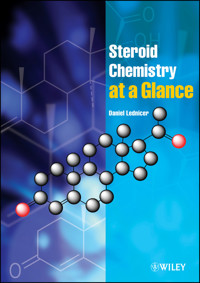
The term steroid has become virtually synonymous with drug abuse in sport to the majority of the public. However these steroids - androgens - actually comprise only a single relatively small class of biologically active steroids, and are overshadowed by a large collection of compounds, a sizeable number of which are commercial drugs that share the same structural carbon skeleton. The development of these drugs has led to a large body of organic chemistry often denoted as "Steroid Chemistry". Steroid Chemistry At A Glance provides a concise overview of the main principles and reactions of steroid chemistry. Topics covered include: * history, isolation and structure determination of steroids * steroid nomenclature and stereochemistry * natural sources of steroids * synthesis and reactions of aromatic a-ring steroids, androstanes, and pregnanes * steroids with a spirolactone at position 17 * steroids with hetrocyclic ring A * compounds derived from cholesterol Based on the highly successful and student friendly "at a glance" approach, the information is presented in integrated, self contained double page spreads of text and illustrative material. Students of chemistry and pharmacy using Steroid Chemistry at a Glance will find they have a resource with which they can quickly, concisely and confidently acquire, regularly review and revise the basic facts that underpin the properties, synthesis and reactions of this important class of natural products. It will also serve as a handy bench reference for postgraduates and professional chemists.
Sie lesen das E-Book in den Legimi-Apps auf:
Seitenzahl: 237
Veröffentlichungsjahr: 2011
Ähnliche


















Contents
Preface
Introduction
Nomenclature
Non-proprietary Names
Biological Activity of Steroids
1 Steroids: a Brief History
1.1 Structure Determination
2 Sources of Steroids
2.1 Biosynthesis
2.2 Commercial Steroid Starting Materials
3 Estranes: Steroids in Which Ring A is Aromatic
3.1 Biological Activity
3.2 Sources of Estranes
3.3 Chemical Reactions of Estranes
3.4 Some Drugs Based on Estranes
4 Gonanes or 19-nor-Steroids
4.1 Preparation of Gonane Starting Materials
4.2 Anabolic-Androgenic Gonanes
4.3 Progestational Gonanes
4.4 Some Drugs Based on Gonanes
5 Androstanes, C19 Steroids and Their Derivatives
5.1 Biological Activity
5.2 Sources of Androstanes
5.3 Modified Anabolic-Androgenic Androstanes
5.4 17-Spirobutyrolactone Aldosterone Antagonists
5.5 Some Drugs Based on Androstanes
6 Pregnanes, Part 1: Progestins
6.1 Biological Activity
6.2 Sources of Progesterone
6.3 Modified Pregnanes
6.4 Some Drugs Based on Progestins
7 Pregnanes, Part 2: Corticosteroids
7.1 Biological Activity
7.2 Sources of Corticoids
7.3 Modified Corticoids
7.4 Some Drugs Based on Corticoids
8 Miscellaneous Steroids
8.1 Heterocyclic Steroids
8.2 Cardenolides
8.3 Compounds Related to Cholesterol
Subject Index
Reactions Index
Other Titles Available in the Chemistry at a Glance series:
Chemical Thermodynamics at a Glance
H. Donald Brooke Jenkins
ISBN: 978-1-4051-3997-7
Natural Product Chemistry at a Glance
Stephen P. Stanforth
ISBN: 978-1-4051-4562-6
Heterocyclic Chemistry at a Glance
John A. Joule, Keith Mills
ISBN: 978-1-4051-3918-2
Environmental Chemistry at a Glance
Ian Pulford, Hugh Flowers
ISBN: 978-1-4051-3532-0
The Periodic Table at a Glance
Mike Beckett, Andy Platt
ISBN: 978-1-4051-3299-2
Organic Chemistry at a Glance
Laurence M. Harwood, John E. McKendrick, Roger Whitehead
ISBN: 978-0-86542-782-2
Chemical Calculations at a Glance
Paul Yates
ISBN: 978-1-4051-1871-2
Stereochemistry at a Glance
Jason Eames, Josephine M Peach
ISBN: 978-0-632-05375-9
Reaction Mechanisms at a Glance: A Stepwise Approach to Problem-Solving in Organic Chemistry
Mark G. Moloney
ISBN: 978-0-632-05002-4
This edition first published 2011
© 2011 John Wiley & Sons Ltd
Registered office
John Wiley & Sons Ltd, The Atrium, Southern Gate, Chichester, West Sussex PO19 8SQ, United Kingdom
For details of our global editorial offices, for customer services and for information about how to apply for permission to reuse the copyright material in this book please see our website at www.wiley.com.
The right of the author to be identified as the author of this work has been asserted in accordance with the Copyright, Designs and Patents Act 1988.
All rights reserved. No part of this publication may be reproduced, stored in a retrieval system, or transmitted, in any form or by any means, electronic, mechanical, photocopying, recording or otherwise, except as permitted by the UK Copyright, Designs and Patents Act 1988, without the prior permission of the publisher.
Wiley also publishes its books in a variety of electronic formats. Some content that appears in print may not be available in electronic books.
Designations used by companies to distinguish their products are often claimed as trademarks. All brand names and product names used in this book are trade names, service marks, trademarks or registered trademarks of their respective owners. The publisher is not associated with any product or vendor mentioned in this book. This publication is designed to provide accurate and authoritative information in regard to the subject matter covered. It is sold on the understanding that the publisher is not engaged in rendering professional services. If professional advice or other expert assistance is required, the services of a competent professional should be sought.
The publisher and the author make no representations or warranties with respect to the accuracy or completeness of the contents of this work and specifically disclaim all warranties, including without limitation any implied warranties of fitness for a particular purpose. This work is sold with the understanding that the publisher is not engaged in rendering professional services. The advice and strategies contained herein may not be suitable for every situation. In view of ongoing research, equipment modifications, changes in governmental regulations, and the constant flow of information relating to the use of experimental reagents, equipment, and devices, the reader is urged to review and evaluate the information provided in the package insert or instructions for each chemical, piece of equipment, reagent, or device for, among other things, any changes in the instructions or indication of usage and for added warnings and precautions. The fact that an organization or Website is referred to in this work as a citation and/or a potential source of further information does not mean that the author or the publisher endorses the information the organization or Website may provide or recommendations it may make. Further, readers should be aware that Internet Websites listed in this work may have changed or disappeared between when this work was written and when it is read. No warranty may be created or extended by any promotional statements for this work. Neither the publisher nor the author shall be liable for any damages arising here from.
Library of Congress Cataloging-in-Publication Data
Lednicer, Daniel, 1929-
Steroid chemistry at a glance/Daniel Lednicer.
p. cm.
Includes index.
ISBN 978-0-470-66085-0 (cloth)
1. Steroids. I. Title.
QD426.L43 2010 5470.7-dc22
2010025742
A catalogue record for this book is available from the British Library.
Print ISBN: 9780470660850 (hb), 9780470660843 (pb) ePDF ISBN: 9780470973622
oBook ISBN: 9780470973639
Preface
The term ‘steroid’ has become virtually synonymous with androgenic-anabolic compounds (mainly analogues of testosterone) to the majority of the public. The sport sections of many newspapers carry almost daily exposes of the usage of these drugs by athletes seeking to enhance their performance. The androgens in question, however, comprise only a single, relatively small, class of biologically active steroids. What may be called the athletic androgens are in reality overshadowed by a large universe of compounds that share the same tetracyclic nucleus. The term ‘androgen’ in fact represents only one-tenth (1.4 × 10⁶ versus 13.5 × 10⁶) of the hits when Googling the term ‘steroid’. The very sizeable number of steroids that are approved by regulatory agencies as therapeutic drugs eclipses the group of legal androgenic-anabolic drugs.
By the 1940s, about a decade after their structure had been firmly established, it became evident that steroids might well comprise a structural lead for drug design. Preliminary results from pharmacological studies, carried out at that time, suggested that selected steroids could potentially lead to drugs aimed at targets as diverse as oral contraceptives on the one hand and inflammation on the other. The potential markets for such drugs spurred major chemical efforts in industrial and to some extent in academic laboratories. Research that led to steroid-based therapeutic agents was carried out largely in the laboratories of ‘Big Pharma’ over the two decades following the end of World War 2. This resulted in the accretion of a large body of organic chemistry often denoted ‘Steroid Chemistry’, and also a sizable number of new therapeutic agents. The assignment of a USAN designation, more familiarly known as a generic name, to a potential drug indicates that the sponsor intends to take the initial steps to assess the clinical activity of the compound. Close to 130 steroids have been assigned official USAN non-proprietary names.
Reports of side-effects that accumulated as the drugs became more widely used led chemists to go back to modify the structures of the offending agent in the hope of producing better tolerated entities.It would be naïve to dismiss the aim of obtaining a place in the market by means of one’s own proprietary and patented entity as additional motivation for that task. It became evident by the mid-1970s that many of the undesired properties, that is, side-effects, were often simply another aspect of the desired hormonal activity. Research aimed at novel steroid-based drugs consequently decreased markedly. The preceding chemical research in the area had by the accumulated a significant body of specialized reactions.
All steroids, be they derived from natural sources or produced by total synthesis, share the same rigid, fixed, three dimensional framework. Many of the chemical properties of steroids, such as the dependence of the reactivity of functional groups on their specific location, are determined by steric properties of the steroid nucleus. That nucleus incorporates over half a dozen chiral centers not counting the side chain. Cholesterol, for example, can in theory consist of no fewer than 512 stereo isomers. This compound actually occurs as a single chiral species, as do virtually all other steroid-based products. The chemistry of these compounds thus provides a rich source for the study of the effects of stereochemistry on chemical reactivity. The reactivity of a pair of ketones in the same molecule, for example, will often differ markedly due to differences in their steric milieu. Structural features of steroids generally determine biological activity. Steroids with an aromatic A ring will, for example, act as estrogens. Differing structural features found in each of those groups has a marked influence on the reactions and reaction sequences used in preparing potential drugs. A text on steroid chemistry could in theory be organized either on the basis of reactions or alternatively by structural class. Grouping compounds by reaction-based sections it is felt would lead to somewhat jumbled presentations. Many of the organic reaction schemes in used steroid chemistry are characteristic of one or another of the broad structural classes. This volume is accordingly divided into the traditional broad structural chapters. The circumstance that biological activity follows the same organization merely illustrates the concordance of structure and activity.
Rules of nomenclature appear early on in many beginning organic chemistry texts. In somewhat the same vein, the Introduction to this book starts with the conventions for naming steroids. This is followed by a concise account of the molecular mechanism of action by which many steroids exert their biological effects. More detailed descriptions of the activity of these compounds will be found in the opening paragraphs of the individual structural classes.
Chapter 1 describes the history of steroids with particular attention to the research aimed defining the chemical structure of what were at the time fairly complex molecules. The reader may find it convenient to skim over this section at first reading and to then return after acquiring more familiarity with steroid chemistry.
Chapter 2 opens with a description of the biosynthesis of naturally occurring steroids. The conversion of two very different phytochemicals to steroids that can be elaborated to potential drugs follows. The narrative focuses on a discussion of the chemistry whereby these steroidal natural products are modified into steroid starting materials. Specifically, this describes first the chemistry used to convert diosgenin from Mexican yam roots to dehydropregnenolone and then a discussion of the preparation of pregnenolone from stigmasterol obtained from soybeans.
Chemical manipulations of aromatic A-ring steroids, the estranes, are described in Chapter 3. The relative simplicity of the structure of estranes has led to the development of close to half a dozen syntheses that differ in approach, starting from laboratory chemicals. One of these total syntheses, in contrast to those found in subsequent chapters, is used in actual practice to prepare intermediates for the gonanes discussed in Chapter 4. There follows a description of the process long used to prepare aromatic A-ring steroids from phytochemical-derived sources. Chemical reactions of estranes close this chapter.
The chemistry of gonanes, more familiarly known as 19-nor steroids, constitutes the subject matter of Chapter 4. This chapter opens with a discussion the general methods used to prepare the gonane nucleus. Those methods include two syntheses starting from laboratory chemicals that differ markedly in their approach. The description of the chemistry of the gonanes is divided according the disparate biological activity structural variants. These comprise a section on compounds that act as androgenic-anabolic agents and another that includes progestational agents. This last section includes most of the oral contraceptives. A discussion of the newer 11-arylgonane progesterone antagonist concludes Chapter 4.
The androstanes, often called C-19 steroids in that they include methyl groups at each of the angular carbons at C10 and C13, are described in Chapter 6. This section, like the preceding one, also starts with a description of the chemistry used to provide starting material. It also includes a discussion of a total synthesis based on an electrocyclic reaction. The bulk of the chapter comprises of a ring-by-ring description of the chemistry that has been used to prepare modified C-19 androstanes. The bulk of the compounds in this first part of the chapter exhibit androgenic-anabolic activity. Incorporation of a spirobutyrolactone at C17 of the C-19 androstanes leads to compounds that act as diuretics as a result of their aldosterone blocking activity. A brief section on those compounds completes Chapter 5.
Pregnanes in essence comprise androstanes that in addition feature a two-carbon side chain, almost exclusively acetyl, at C17. This carbon skeleton is common to both progestins and corticosteroids. Chapter 6 is devoted to a discussion of the chemistry used to prepare derivatives of the simpler of the two, progesterone. Sources of starting materials for modified progestins from both diosgenin and stigmasterol are discussed at the beginning of the chapter. This is followed by a total synthesis that includes a cascade electrocyclization reaction that somewhat resembles the biosynthetic process by which squalane goes to lanosterol. There follows a ring-by-ring examination of the chemistry used to modify the basic pregnane nucleus.
Structurally more complex corticosteroids, commonly called corticoids, are grouped in Chapter 7,the second section on pregnanes. The biological activity of this class of pregnanes depends on the presence of an oxygen atom, either as a ketone or as an alcohol, at C11 in ring C. The rarity of this structural feature in Nature placed high priority on developing methods for adding that feature to more abundant steroids from Nature. Chapter 7, as in the preceding chapter, opens with a discussion of the methods that have been developed for preparing the starting 11-oxypreganes required for both clinical supplies and research on analogues. Methods for preparing analogues that include single modifications are considered first. Corticoids comprise one of the rare classes of compounds in which the potentiating effects of structural changes are additive. The closing sections of Chapter 7 discuss the chemistry for preparing compounds with multiple modification.
Groups of steroids that are too small for a full chapter are to be found in the seemingly inevitable chapter termed Miscellaneous. The first section considers steroids in which one of the ring carbon atoms is replaced by a heteroatom, more specifically oxygen or nitrogen. Two compounds in this class, both androstanes, are approved for use in humans. Cardenolides, the steroid-based compounds obtained on removal of the sugars from the so-called cardiac glycosides, are considered in the next section. The chapter closes with a brief discussion of the chemistry involved in modifying the unsaturated cholestanes related to vitamin D.
Dan Lednicer
North Bethesda, MD
Introduction
The isoprene unit (Figure 1) is one of the ubiquitous naturally occurring hydrocarbons. This five carbon latent diene serves as starting material for a host of natural products in both plants and animals. The reactive diphosphate of this five carbon unit, often called isoprene pyrophosphate (IPP), readily couples with itself to form dimers that comprise a bewildering variety of open chain, cyclic, polycyclic and bridged polycyclic compounds known collectively as terpenes. The first coupling product, the straight chain C dimer may react further by either adding another isoprene or by condensing with other activated terpenes. Products from IPP range all the way at one extreme of a single isoprene to the polyisoprenoid, rubber, at the other extreme.
Lesen Sie weiter in der vollständigen Ausgabe!
Lesen Sie weiter in der vollständigen Ausgabe!
Lesen Sie weiter in der vollständigen Ausgabe!
Lesen Sie weiter in der vollständigen Ausgabe!
Lesen Sie weiter in der vollständigen Ausgabe!
Lesen Sie weiter in der vollständigen Ausgabe!
Lesen Sie weiter in der vollständigen Ausgabe!
Lesen Sie weiter in der vollständigen Ausgabe!
Lesen Sie weiter in der vollständigen Ausgabe!
Lesen Sie weiter in der vollständigen Ausgabe!




