


103,99 €
Mehr erfahren.
- Herausgeber: John Wiley & Sons
- Kategorie: Wissenschaft und neue Technologien
- Sprache: Englisch
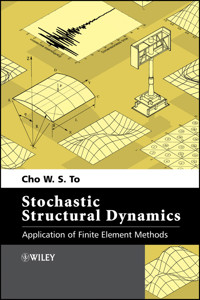
One of the first books to provide in-depth and systematic application of finite element methods to the field of stochastic structural dynamics
The parallel developments of the Finite Element Methods in the 1950’s and the engineering applications of stochastic processes in the 1940’s provided a combined numerical analysis tool for the studies of dynamics of structures and structural systems under random loadings. In the open literature, there are books on statistical dynamics of structures and books on structural dynamics with chapters dealing with random response analysis. However, a systematic treatment of stochastic structural dynamics applying the finite element methods seems to be lacking. Aimed at advanced and specialist levels, the author presents and illustrates analytical and direct integration methods for analyzing the statistics of the response of structures to stochastic loads. The analysis methods are based on structural models represented via the Finite Element Method. In addition to linear problems the text also addresses nonlinear problems and non-stationary random excitation with systems having large spatially stochastic property variations.
- A systematic treatment of stochastic structural dynamics applying the finite element methods
- Highly illustrated throughout and aimed at advanced and specialist levels, it focuses on computational aspects instead of theory
- Emphasizes results mainly in the time domain with limited contents in the time-frequency domain
- Presents and illustrates direction integration methods for analyzing the statistics of the response of linear and nonlinear structures to stochastic loads
Under Author Information - one change of word to existing text: He is a Fellow of the American Society of Mechanical Engineers (ASME)........
Sie lesen das E-Book in den Legimi-Apps auf:
Seitenzahl: 336
Veröffentlichungsjahr: 2013
Ähnliche



















Contents
Cover
Half Title page
Title page
Copyright page
Dedication
Preface
Acknowledgments
Chapter 1: Introduction
1.1 Displacement Formulation-Based Finite Element Method
1.2 Element Equations of Motion for Temporally and Spatially Stochastic Systems
1.3 Hybrid Stress-Based Element Equations of Motion
1.4 Incremental Variational Principle and Mixed Formulation-Based Nonlinear Element Matrices
1.5 Constitutive Relations and Updating of Configurations and Stresses
1.6 Concluding Remarks
References
Chapter 2: Spectral Analysis and Response Statistics of Linear Structural Systems
2.1 Spectral Analysis
2.2 Evolutionary Spectral Analysis
2.3 Evolutionary Spectra of Engineering Structures
2.4 Modal Analysis and Time-Dependent Response Statistics
2.5 Response Statistics of Engineering Structures
References
Chapter 3: Direct Integration Methods for Linear Structural Systems
3.1 Stochastic Central Difference Method
3.2 Stochastic Central Difference Method with Time Co-ordinate Transformation
3.3 Applications
3.4 Extended Stochastic Central Difference Method and Narrow-band Force Vector
3.5 Stochastic Newmark Family of Algorithms
References
Chapter 4: Modal Analysis and Response Statistics of Quasi-linear Structural Systems
4.1 Modal Analysis of Temporally Stochastic Quasi-linear Systems
4.2 Response Analysis Based on the Melosh-Zienkiewicz-Cheung Bending Plate Finite Element
4.3 Response Analysis Based on High Precision Triangular Plate Finite Element
4.4 Concluding Remarks
References
Chapter 5: Direct Integration Methods for Response Statistics of Quasi-linear Structural Systems
5.1 Stochastic Central Difference Method for Quasi-linear Structural Systems
5.2 Recursive Covariance Matrix of Displacements of Cantilever Pipe Containing Turbulent Fluid
5.3 Quasi-linear System under Narrow-band Random Excitations
5.4 Concluding Remarks
References
Chapter 6: Direct Integration Methods for Temporally Stochastic Nonlinear Structural Systems
6.1 Statistical Linearization Techniques
6.2 Symplectic Algorithms of Newmark Family of Integration Schemes
6.3 Stochastic Central Difference Method with Time Co-ordinate Transformation and Adaptive Time Schemes
6.4 Outline of steps in computer program
6.5 Large Deformations of Plate and Shell Structures
6.6 Concluding Remarks
References
Chapter 7: Direct Integration Methods for Temporally and Spatially Stochastic Nonlinear Structural Systems
7.1 Perturbation Approximation Techniques and Stochastic Finite Element Methods
7.2 Stochastic Central Difference Methods for Temporally and Spatially Stochastic Nonlinear Systems
7.3 Finite Deformations of Spherical Shells with Large Spatially Stochastic Parameters
7.4 Closing Remarks
References
Appendix 1A: Mass and Stiffness Matrices of Higher Order Tapered Beam Element
Appendix 1B: Consistent Stiffness Matrix of Lower Order Triangular Shell Element
1B.1 Inverse of Element Generalized Stiffness Matrix
1B.2 Element Leverage Matrices
1B.3 Element Component Stiffness Matrix Associated with Torsion
References
Appendix 1C: Consistent Mass Matrix of Lower Order Triangular Shell Element
Reference
Appendix 2A: Eigenvalue Solution
References
Appendix 2B: Derivation of Evolutionary Spectral Densities and Variances of Displacements
2B.1 Evolutionary Spectral Densities Due to Exponentially Decaying Random Excitations
2B.2 Evolutionary Spectral Densities Due to Uniformly Modulated Random Excitations
2B.3 Variances of Displacements
References
Appendix 2C: Time-dependent Covariances of Displacements
Appendix 2D: Covariances of Displacements and Velocities
Appendix 2E: Time-dependent Covariances of Velocities
Appendix 2F: Cylindrical Shell Element Matrices
Reference
Appendix 3A: Deterministic Newmark Family of Algorithms
Reference
Index
STOCHASTIC STRUCTURAL DYNAMICS
This edition first published 2014© 2014 John Wiley & Sons, Ltd
Registered officeJohn Wiley & Sons Ltd, The Atrium, Southern Gate, Chichester, West Sussex, PO19 8SQ, United Kingdom
For details of our global editorial offices, for customer services and for information about how to apply for permission to reuse the copyright material in this book please see our website at www.wiley.com.
The right of the author to be identified as the author of this work has been asserted in accordance with the Copyright, Designs and Patents Act 1988.
All rights reserved. No part of this publication may be reproduced, stored in a retrieval system, or transmitted, in any form or by any means, electronic, mechanical, photocopying, recording or otherwise, except as permitted by the UK Copyright, Designs and Patents Act 1988, without the prior permission of the publisher.
Wiley also publishes its books in a variety of electronic formats. Some content that appears in print may not be available in electronic books.
Designations used by companies to distinguish their products are often claimed as trademarks. All brand names and product names used in this book are trade names, service marks, trademarks or registered trademarks of their respective owners. The publisher is not associated with any product or vendor mentioned in this book.
Limit of Liability/Disclaimer of Warranty: While the publisher and author have used their best efforts in preparing this book, they make no representations or warranties with respect to the accuracy or completeness of the contents of this book and specifically disclaim any implied warranties of merchantability or fitness for a particular purpose. It is sold on the understanding that the publisher is not engaged in rendering professional services and neither the publisher nor the author shall be liable for damages arising herefrom. If professional advice or other expert assistance is required, the services of a competent professional should be sought.
Library of Congress Cataloging-in-Publication Data
To, Cho W. S. Stochastic structural dynamics : application of finite element methods / Cho W. S. To. — First edition. pages cm Includes bibliographical references and index. ISBN 978-1-118-34235-0 (hardback) 1. Structural dynamics–Engineering. 2. Finite element method. 3. Stochastic analysis. I. Title. TA654.T59 2014 624.1’70151922–dc23 2013023517
A catalogue record for this book is available from the British Library.
ISBN 9781118342350
Lidong Leighton and Lizhen Jane
Preface
Stochastic structural dynamics is concerned with the studies of dynamics of structures and structural systems that are subjected to complex excitations treated as random processes. In engineering practice, many structures and structural systems cannot be dealt with analytically and therefore the versatile numerical analysis techniques, the finite element methods (FEM) are employed.
The parallel developments of the FEM in the 1950’s and the engineering applications of stochastic processes in the 1940’s provided a combined numerical analysis tool for the studies of dynamics of structures and structural systems under random loadings. In the open literature, there are books on statistical dynamics of structures and books on structural dynamics with chapter(s) dealing with random response analysis. However, a systematic treatment of stochastic structural dynamics applying the FEM seems to be lacking. The present book is believed to be the first relatively in-depth and systematic treatment on the subject. It is aimed at advanced and specialist level. It is suitable for classes taken by master’s degree level post-graduate students and specialists.
The present book has seven chapters and ten appendices. Chapter 1 introduces the displacement-based FEM, element equations of motion for temporally and spatially stochastic systems, hybrid stress-based element equations of motion, incremental variational principle and mixed formulation-based nonlinear element matrices, constitutive relations and updating of configurations and stresses.
Chapter 2 is concerned with the spectral analysis and response statistics of linear structural systems. It includes evolutionary spectral analysis, evolutionary spectra of engineering structures, modal analysis and time-dependent response statistics, and response statistics of engineering structures.
Direct integration methods for linear structural systems are presented in Chapter 3. The stochastic central difference method with time co-ordinate transformation and its application, extended stochastic central difference method for narrow-band excitations, stochastic Newmark family of algorithms, and their applications to plate structures are presented in this chapter.
Modal analysis and response statistics of quasi-linear structural systems are covered in Chapter 4. Modal analysis of temporally stochastic quasi-linear systems and the bi-modal approach are included. Response analysis of plate structures by the Melosh-Zienkiewicz-Cheung bending plate element, and the high precision triangular plate element are presented.
Chapter 5 is concerned with the application of the direct integration methods for response statistics of quasi-linear structural systems. Recursive covariance matrices of displacements of cantilever pipes containing turbulent fluids and subjected to modulated white noise as well as narrow-band random excitations are derived in this chapter.
Direct integration methods for temporally stochastic nonlinear structural systems subjected to stationary and nonstationary random excitations are presented in Chapter 6. A brief introduction to the statistical linearization techniques is included. Symplectic members of the deterministic and stochastic versions of the Newmark family of algorithms are identified. The stochastic central difference method with time co-ordinate transformation and adaptive time schemes are introduced and applied to the computation of large responses of plate and shell structures.
Chapter 7 is concerned with the presentation of the direct integration methods for temporally and spatially stochastic nonlinear structural systems. The stochastic FEM or probabilistic FEM is introduced. The stochastic central difference method for temporally and spatially stochastic structural systems subjected to stationary and nonstationary random excitations are developed. Application of the method to spatially homogeneous and non-homogeneous shell structures is made.
Finally, a word about symbols is in order. Mathematically, random variables and random processes are different. But without ambiguity the same symbols for random variables and processes are applied in the present book, unless it is stated otherwise.
Acknowledgments
Thanks are due to the author’s several former graduate students, Gregory Zidong Chen, Sherwin Xingling Dai, Derick Hung, Meilan Liu, Irewole Raphael Orisamolu, and Bin Wang who provided various drawings in this book.
The author would like to express his sincere thanks to Paul Petralia, Senior Editor and his project team members, Tom Carter, Sandra Grayson, Anna Smart, and Liz Wingett.
Finally, the author would also like to thank Elsevier Science for permission to reproduce the following figures. Figures 1.1 and 1.2 are from To, C. W. S. (1979): Higher order tapered beam finite elements for vibration analysis, Journal of Sound and Vibration, 63(1), 33–50. Figures 1.3 and 1.4 are from To, C. W. S. and Liu, M. L. (1994): Hybrid strain based three-node flat triangular shell elements, Finite Elements in Analysis and Design, 17, 169–203. Figures 2.1 through 2.3 are from To, C. W. S. (1982): Nonstationary random responses of a multi-degree-of-freedom system by the theory of evolutionary spectra, Journal of Sound and Vibration, 83(2), 273–291. Figures 2.12, 2.13, and 2B.1 are from To, C. W. S. (1984): Time-dependent variance and covariance of responses of structures to non-stationary random excitations, Journal of Sound and Vibration, 93(1), 135–156. Figures 2.14 through 2.19 are from To, C. W. S. and Wang, B. (1993): Time-dependent response statistics of axisymmetrical shell structures, Journal of Sound and Vibration, 164(3), 554–564. Figures 2.20 through 2.26 are from To, C. W. S. and Wang, B. (1996): Nonstationary random response of laminated composite structures by a hybrid strain-based laminated flat triangular shell finite element, Finite Elements in Analysis and Design, 23, 23–35. Figures 3.2 through 3.10 are from To, C. W. S. and Liu, M. L. (1994): Random responses of discretized beams and plates by the stochastic central difference method with time co-ordinate transformation, Computers and Structures, 53(3), 727–738. Figures 3.11 through 3.15, and Figures 5.9 through 5.14 are from Chen, Z. and To, C. W. S. (2005): Responses of discretized systems under narrow band nonstationary random excitations, Journal of Sound and Vibration, 287, 433–458. Figures 4.1 through 4.7 are from To, C. W. S. and Orisamolu, I. R. (1987): Response of discretized plates to transversal and in-plane non-stationary random excitations, Journal of Sound and Vibration, 114(3), 481–494. Figures 6.1 through 6.7, and 6.10 through 6.13 are from To, C. W. S. and Liu, M. L. (2000): Large nonstationary random responses of shell structures with geometrical and material nonlinearities, Finite Elements in Analysis and Design, 35, 59–77.
Chapter 1
Introduction
The parallel developments of the finite element methods (FEM) in the 1950’s [1,2] and the engineering applications of the stochastic processes in the 1940’s [3, 4] provided a combined numerical analysis tool for the studies of dynamics of structures and structural systems under random loadings. There are books on statistical dynamics of structures [5, 6] and books on structural dynamics with chapter(s) dealing with random response analysis [7, 8]. In addition, there are various monographs and lecture notes on the subject. However, a systematic treatment of the stochastic structural dynamics applying the FEM seems to be lacking. The present book is believed to be the first relatively in-depth and systematic treatment of the subject that applies the FEM to the field of stochastic structural dynamics.
Before the introduction to the concept and theory of stochastic quantities and their applications with the FEM in subsequent chapters, the two FEM employed in the investigations presented in the present book are outlined in this chapter. Specifically, Section 1.1 is concerned with the derivation of the temporally stochastic element equation of motion applying the displacement formulation. The consistent element stiffness and mass matrices of two beam elements, each having two nodes are derived. One beam element is uniform and the other is tapered. The corresponding temporally and spatially stochastic element equation of motion is derived in Section 1.2. The element equations of motion based on the mixed formulation are introduced in Section 1.3. Consistent element matrices for a beam of uniform cross-sectional area are obtained. This beam element has two nodes, each of which has two degrees-of-freedom (dof). This beam element is applied to show that stiffness matrices derived from the displacement and mixed formulations are identical. The incremental variational principle and element matrices based on the mixed formulation for nonlinear structures are presented in Section 1.4. Section 1.5 deals with constitutive relations and updating of configurations and stresses. Closing remarks for this chapter are provided in Section 1.6.
Lesen Sie weiter in der vollständigen Ausgabe!
Lesen Sie weiter in der vollständigen Ausgabe!
Lesen Sie weiter in der vollständigen Ausgabe!
Lesen Sie weiter in der vollständigen Ausgabe!
Lesen Sie weiter in der vollständigen Ausgabe!
Lesen Sie weiter in der vollständigen Ausgabe!
Lesen Sie weiter in der vollständigen Ausgabe!
Lesen Sie weiter in der vollständigen Ausgabe!
Lesen Sie weiter in der vollständigen Ausgabe!
Lesen Sie weiter in der vollständigen Ausgabe!
Lesen Sie weiter in der vollständigen Ausgabe!
Lesen Sie weiter in der vollständigen Ausgabe!
Lesen Sie weiter in der vollständigen Ausgabe!
Lesen Sie weiter in der vollständigen Ausgabe!
Lesen Sie weiter in der vollständigen Ausgabe!
Lesen Sie weiter in der vollständigen Ausgabe!
Lesen Sie weiter in der vollständigen Ausgabe!




