


91,99 €
Mehr erfahren.
- Herausgeber: John Wiley & Sons
- Kategorie: Wissenschaft und neue Technologien
- Sprache: Englisch
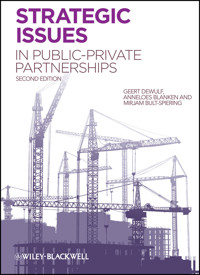
Managing PPP projects is not a routine job, as every PPP project is different and should be managed accordingly. These projects require considerable capability and skills from both public sector and private sector managers involved, Strategic Issues in Public Private Partnerships, Second Edition, delivers the insight and tools necessary to assist those managers. As Public private partnership (PPP) arrangements become an increasingly popular way for national governments to fund and develop public infrastructure and urban areas with private sector contributions, a better understanding of the risks involved is crucial. The second edition of Strategic Issues in Public Private Partnerships : * Provides an international overview of the application of concessions - the most common form of PPP [eg PFI (Private Finance Initiative); BO(O)T (Build/Own/Operate/Transfer) or DBFMO (Design/Build/Finance/ Maintain/Operate)]. * Focusses on the introduction of concessions and the problems encountered, the solutions found for these problems, and the different approaches to concessions chosen across different countries. * Provides a strategic overview for those involved in setting up and managing PPP projects. * Illustrates lessons from different national backgrounds and gives managers the insight and tools to manage PPP projects effectively. Essential reading for Contractors & funding organizations involved in PPP projects as well as Researchers in construction management and public administration.
Sie lesen das E-Book in den Legimi-Apps auf:
Seitenzahl: 330
Veröffentlichungsjahr: 2011
Ähnliche



















Contents
Glossary
Acknowledgments
Introduction
1 The Emergence of Concessions
1.1 The rise of public-private partnerships
1.2 Different forms of public-private partnerships
1.3 Concessions
1.4 Overview
2 Procurement of Concessions
2.1 Procurement strategies
2.2 The concession structure
2.3 Decision-making process
2.4 Tendering concessions
2.5 Institutional procurement guidelines
2.6 Contracts and cooperation
3 Infrastructure Concessions
3.1 Overview of developments
3.2 International comparison
3.3 Lessons learnt
4 Social Infrastructure
4.1 Overview of development of concessions in health
4.2 Explanation of the similarities and differences between countries
4.3 Lessons learned and challenges
5 Concession PPPs and Flexibility
5.1 The incompleteness of contracts
5.2 Flexibility in hospital concessions
5.3 The way forward
6 Economic Context and Concessions
6.1 Financing of concessions
6.2 Project finance
6.3 The influence of the economic situation on concessions
6.4 Looking forward
7 Concessions and the Public Interest
7.1 Introduction
7.2 Public interest and concessions
7.3 Institutional arrangements to safeguard the public interest
7.4 Project governance strategies and the public interest
8 Value for Money Revisited
8.1 Value for Money: an introduction
8.2 Ex-ante VFM assessment: the Public Sector Comparator
8.3 Criticisms of VFM assessment using the PSC
8.4 Concessions evaluated
8.5 Defining an improved VFM framework
9 Conclusion – PPPs and Future Developments
9.1 Concession arrangements in perspective
9.2 Concession arrangements revisited
9.3 Towards a successful implementation of concession PPPs
9.4 The future of concession PPPs
9.5 Research and education on concessions
References
Index
This edition first published 2012 © 2012 by John Wiley & Sons, Ltd.
Blackwell Publishing was acquired by John Wiley & Sons in February 2007. Blackwell’s publishing program has been merged with Wiley’s global Scientific, Technical and Medical business to form Wiley-Blackwell.
Registered OfficeJohn Wiley & Sons, Ltd, The Atrium, Southern Gate, Chichester, West Sussex, PO19 8SQ, UK
Editorial Offices9600 Garsington Road, Oxford, OX4 2DQ, UKThe Atrium, Southern Gate, Chichester, West Sussex, PO19 8SQ, UK2121 State Avenue, Ames, Iowa 50014-8300, USA
For details of our global editorial offices, for customer services and for information about how to apply for permission to reuse the copyright material in this book please see our website at www.wiley.com/wiley-blackwell.
The right of the author to be identified as the author of this work has been asserted in accordance with the UK Copyright, Designs and Patents Act 1988.
All rights reserved. No part of this publication may be reproduced, stored in a retrieval system, or transmitted, in any form or by any means, electronic, mechanical, photocopying, recording or otherwise, except as permitted by the UK Copyright, Designs and Patents Act 1988, without the prior permission of the publisher.
Designations used by companies to distinguish their products are often claimed as trademarks. All brand names and product names used in this book are trade names, service marks, trademarks or registered trademarks of their respective owners. The publisher is not associated with any product or vendor mentioned in this book. This publication is designed to provide accurate and authoritative information in regard to the subject matter covered. It is sold on the understanding that the publisher is not engaged in rendering professional services. If professional advice or other expert assistance is required, the services of a competent professional should be sought.
Library of Congress Cataloging-in-Publication Data
Dewulf, Geert.Strategic issues in public-private partnerships / Geert Dewulf, Anneloes Blanken, Mirjam Bult-Spiering. – 2nd ed.p. cm.Prev. ed. cataloged under Bult-Spiering, Mirjam.Includes bibliographical references and index.
ISBN 978-0-470-65635-8 (hardback)1. Public-private sector cooperation. 2. Public-private sector cooperation–Europe.3. Public-private sector cooperation–United States. I. Blanken, Anneloes.II. Bult-Spiering, Mirjam. Strategic issues in public-private partnerships. III. Title. HD2961.B79 2011303.3–dc23
2011034250
A catalogue record for this book is available from the British Library.
Wiley also publishes its books in a variety of electronic formats. Some content that appears in print may not be available in electronic books.
Glossary
BAFO
Best and Final Offer
BLT
Build Lease Transfer
BOO
Build Own Operate
BOOT
Build Own Operate Transfer
BOT
Build Operate Transfer
CD
Competitive Dialogue
CEDR
Conference of European Directors of Roads
CGF
Credit Guarantee Finance
CM
Construction Management
DB
Design-Build
DBB
Design-Bid-Build
DBFM
Design Build Finance Maintain
DBFMO
Design Build Finance Maintenance and Operate
DBFO
Design Build Finance Operate
DBO
Design-Build-Operate
DBOM
Design-Build-Operate-Maintain
DBOT
Design-Build-Operate-Transfer
DfT
Department for Transport
DHS
Department of Health Services
EIB
European Investment Bank
EPEC
European PPP Expertise Center
EPPPC
European PPP Center
FAR
Federal Acquisition Regulation
FBC
Full Business Case
FT
Fast Track
GAO
General Accounting Office
GDP
Gross Domestic Product
GHT
Greenwich Healthcare (NHS) Trust
IPFA
International Project Finance Association
IPPR
Institute for Public Policy Research
KPI
Key Performance Indicator
LEA
Local Education Authority
LIFT
Local Improvement Finance Trust
LROT
Lease Renovate Operate Transfer
MEAT
Most Economically Advantageous Tender
NAO
National Audit Office
NGO
Nongovernmental Organisation
NHS
National Health Service
NPM
New Public Management
OBC
Outline Business Case
OGC
Office of Government Commerce
PANE
Programma Autopistas Nacionales de Espana
PbR
Payment-by-Results
PFI
Private Finance Initiative
PPC
Public Private Comparator
PP
Parallel Prime
PPP
Public Private Partnerships
PSC
Public Sector Comparator
PUK
Partnerships UK
PV
Partnerships Victoria
PWC
PriceWaterhouseCoopers
QEH
Queen Elisabeth Hospital
RFI
Request For Information
RFQ
Request For Qualification
SCUT
Sem Conbranca aos Utilizadores (‘without charge for users’)
SEM
Societé d’Economie Mixte
SPC
Special Purpose Company
SPV
Special Purpose Vehicle
Ten-T
Trans-European Transport Network
TIFU
The Infrastructure Finance Unit
TKY
Turnkey
UDAG
Urban Development Action Grant
UFP
Unita Tecnica Finanza di Progetto
VAG
Victoria Auditor General
VAT
Value Added Tax
VFM
Value for Money
WRR
Wetenschappelijke Raad voor het Regeringsbeleid (Scientific Council for Government Policy)
Acknowledgments
We are indebted to many people and institutions. We had the chance to discuss the topic of concession PPPs with many colleagues, practitioners, students, and politicians. Several workshops and symposia have delivered input and material for this book. The authors also supervised numerous graduate students and PhD students working on related themes. Working with students and practitioners not only provided information and insight, it also helped us to formulate the need for further knowledge on concessions and set up a demand-oriented agenda. Also, this book would not have been possible without the sponsors of many research projects undertaken in recent years.
It is impossible to list all those who have been supportive. Special thanks go to Marnix Smit, Mieke Hoezen, and Julieta Matos Castano for their comments and input. Nina Zaalberg did a fantastic job with the editing of this book.
Paul Sayer of Wiley has been unstinting in his patience and support. Thanks, Paul!!
We would like to thank Dan Leissner for his terrific work on copyediting the book.
Introduction
On the day we wrote this introduction the media reported that one of the most prestigious projects in Brazil, the major high speed rail link between the major cities of Sao Paulo and Rio, has failed to attract bidders. The high speed link is a cornerstone infrastructure project from the perspective of Brazil’s economic development program and is important for Rio in getting ready to host the Olympic Games in 2016. It is now very unlikely that the construction will be completed in 2016. The project was procured as a concession contract entailing the construction, operation, and maintenance of the line.
Worldwide, governments are depending increasingly on private investment for the development of large infrastructure projects. Government budgets are limited and the involvement of the private sector enables governments to carry out their ambitious plans. The Brazil project, however, illustrates the complexity of procuring concession PPPs. The investments required and the complexity of the project put off private investors from bidding. It also shows the impact of a failed project on the economic development of a country.
Concession PPPs are launched all over the world in order to generate Value for Money. Put simply, the procurement routes that are employed are aimed at optimizing the cost benefit balance. Value for Money is the key rationale underlying concession policies. It is a concept that is politically easy to sell but hard to quantify. Not surprisingly, the political and public debate on the value of concessions is mostly a normative one and is not based on empirical insights. Notwithstanding the continuing implementation of concession contracts such arrangements have been criticized by many academics and politicians, and concession PPP is a constant topic of public and political debate. Major criticisms concern the high transaction costs, the low level of contract flexibility, and the impact on the public interest in general. Despite the broad scope of projects and programs, and the numerous policy documents and debates in newspapers and journals, there is yet little understanding of the complex concept of concession PPPs. A conclusive answer as to whether concessions generate more value for money can simply not be provided.
Most of the articles and reviews focus on the way concessions are procured and on the transfer of risks. The success of a concession depends on various institutional factors and project characteristics. A concession PPP is, however, more than just a form of contract, as a new procurement approach or a new financial model it requires a new means of relationship building, different competences and skills, and new market relationships.
The many misconceptions and the confusion about the aims and content of concession PPPs jeopardize the well-considered employment of concession PPPs in realizing infrastructure projects. This book is dedicated to improving the performance of concession PPPs. Motives and starting points for the enhancement of concession PPPs are presented based on the findings of several research projects, thorough reviews of the literature and case studies in different countries and sectors. The book also provides a theoretical foundation for the analysis of the creation and functioning of concession PPPs.
The reader is provided with a broad picture of PPP developments world-wide, an insight into the various forms of concession PPPs, and information about the rationale and motives behind concession PPPs, so as to enable greater strategic decision-making. Based on lessons learnt in various countries and sectors the starting points for the enhancement of concession projects and policies are presented.
The book starts with a description of the emergence of concession PPPs worldwide. The history, motives, and rationale for the launch of concessions are described. The second chapter elaborates on the procurement of concession PPPs. The different procurement approaches and institutional frameworks have a large impact on the evolution and success of concession contracts.
The next two chapters expand on two major application fields: hard infrastructure such as roads, airports, and rail infrastructure (Chapter 3), and soft infrastructure projects as schools and hospitals (Chapter 4). These chapters provide an historical overview of developments in both of these domains and give various examples of concession projects around the world. The lessons learnt are derived from these best practices.
The public and private debate concentrates on three core elements: the level of flexibility, finance including the impact of the current economic crisis, and safeguarding public interest. Chapter 5 discusses the impact of concession PPPs on flexibility and the ways of dealing with uncertainties and contingencies. Chapter 6 is concerned with the impact of the financial and economic situation on concession PPPs. The impact of concession contracts on the public interest and how the public interest can be safeguarded are analyzed in Chapter 7.
Concession contracts are launched in order to generate Value for Money. The concept of VFM forms the core of the procurement routes. Chapter 8 is dedicated to this concept and elaborates on the different approaches designed to assess VFM in public procurement. A new tool for assessing VFM is developed.
The book closes with a concluding chapter which includes a view on the future.
Concession PPPs and Public Private Partnerships in general are taught at universities and in various courses for practitioners as concepts of modern governance. The purpose of this book is to provide researchers with a better understanding of the concession concept. The book is also aimed at developing more capable government and private management of concession projects. The book is not written as a manual, since concession contract management is not a routine job. Every concession PPP project is different and the way the process should be managed will differ in each case. Managing concessions requires considerable capabilities and skills from both client organizations and private managers. The book further seeks to launch a strategic debate and to develop a research agenda for the future. There is still a large gap in our knowledge of concession PPPs and much work remains to be done. This book fills only a small part of the gap.
1
The Emergence of Concessions
Governments throughout the world have been involved in public-private partnerships. The public and private sector are increasingly interdependent for the implementation of their ambitions. The boundaries between public and private organisations are therefore blurring, and public management is changing. Output and performance now are the key criteria for evaluating the public sector. The attention on Public Private Partnerships (PPPs) fits this context: the public and private sector combine their efforts.
Lesen Sie weiter in der vollständigen Ausgabe!
Lesen Sie weiter in der vollständigen Ausgabe!
Lesen Sie weiter in der vollständigen Ausgabe!
Lesen Sie weiter in der vollständigen Ausgabe!
Lesen Sie weiter in der vollständigen Ausgabe!
Lesen Sie weiter in der vollständigen Ausgabe!
Lesen Sie weiter in der vollständigen Ausgabe!
Lesen Sie weiter in der vollständigen Ausgabe!
Lesen Sie weiter in der vollständigen Ausgabe!
Lesen Sie weiter in der vollständigen Ausgabe!




