


192,99 €
Mehr erfahren.
- Herausgeber: John Wiley & Sons
- Kategorie: Wissenschaft und neue Technologien
- Sprache: Englisch
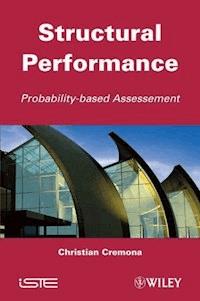
This book covers the development of efficient methods for the assessment and the management of civil structures is today a major challenge from economical, social and environmental aspects. Tools for handling uncertainties in loads, geometry, material properties, construction and operating conditions are nowadays essential.
Covers the key concepts across topics including probability theory and statistics, structural safety, performance-based assessment, modelling uncertainties and principles of decision theory.
Sie lesen das E-Book in den Legimi-Apps auf:
Seitenzahl: 480
Veröffentlichungsjahr: 2012
Ähnliche




















Table of Contents
Preface
Chapter 1. Concepts from Probability Theory and Statistics
1.1. The role of probability in civil engineering
1.2. Physical and statistical uncertainties
1.3. Axiomatics
1.4. Random variables – distributions
1.5. Useful random variables
1.6. Limit theorems
1.7. Modeling random variables
1.8. Distribution of extremes
1.9. Significance testing
1.10. Bayesian analysis
1.11. Stochastic processes
Chapter 2. Structural Safety, Performance and Risk
2.1. Introduction
2.2. Safety and risk
2.3. Risk evaluation and acceptable risk
2.4. Risk-based management
2.5. Examples of failure: bridges
2.6. From safety to performance
2.7. Human errors
Chapter 3. Performance-based Assessment
3.1. Analysis methods and structural safety
3.2. Safety and performance principles
3.3. Invariant measures
3.4. Reliability theory
3.5. General formulation
3.6. System reliability
3.7. Determination of collapse/failure mechanisms
3.8. Calibration of partial factors
3.9. Nature of a probabilistic calculation
3.10. Failure probabilities and acceptable risks
Chapter 4. Structural Assessment of Existing Structures
4.1. Introduction
4.2. Assessment rules
4.3. Limits when using design rules
4.4. Main stages in structural assessment
4.5. Structural safety assessment
4.6. General remarks on the methods
Chapter 5. Specificities of Existing Structures
5.1. Loads
5.2. Resistance
5.3. Geometric variability
5.4. Scale effects
Chapter 6. Principles of Decision Theory
6.1. Introduction
6.2. The decision model
6.3. Controls and inspections
6.4. Maintenance optimization
6.5. Life cycle cost analysis
6.6. Maintenance strategies
Bibliography
Index
First published 2011 in Great Britain and the United States by ISTE Ltd and John Wiley & Sons, Inc.
Apart from any fair dealing for the purposes of research or private study, or criticism or review, as permitted under the Copyright, Designs and Patents Act 1988, this publication may only be reproduced, stored or transmitted, in any form or by any means, with the prior permission in writing of the publishers, or in the case of reprographic reproduction in accordance with the terms and licenses issued by the CLA. Enquiries concerning reproduction outside these terms should be sent to the publishers at the undermentioned address:
ISTE Ltd27-37 St George’s RoadLondon SW19 4EUUK
John Wiley & Sons, Inc.111 River StreetHoboken, NJ 07030USA
www.iste.co.uk
www.wiley.com
© ISTE Ltd 2011
The rights of Christian Cremona to be identified as the author of this work have been asserted by him in accordance with the Copyright, Designs and Patents Act 1988.
Library of Congress Cataloging-in-Publication Data
Cremona, Christian.
Structural performance : probability-based assessment / Christian Cremona
p. cm.
Includes bibliographical references and index.
ISBN 978-1-84821-236-7 (hardback)
1. Structural analysis (Engineering)--Statistical methods. 2. Structural failures--Risk assessment-- Statistical methods. I. Title.
TA640.2.C84 2011
624.1'71--dc22
2011003204
British Library Cataloguing-in-Publication Data
A CIP record for this book is available from the British Library
ISBN 978-1-84821-236-7
Preface
“When one admits that nothing is certain one must, I think, also admit that some things are much more nearly certain than others.”
Bertrand Russell, Am I An Atheist Or An Agnostic?
The development of useful and relevant methods for assessing and managing structures has become an important challenge today. The economic, societal, and environmental stakes attached to this development are a growing concern for public or private owners and stakeholders. The need for relevant and efficient approaches, taking into account the uncertainties to do with loading, geometry, material properties, design and construction, and their operating conditions, is widely felt. The reliability theory, which is based on a probabilistic formulation of structural performances, conceptually answers these questions, in an adapted way. Nevertheless, it often raises difficulties, on the theoretical front as well as the numerical and practical front. However, the theory provides an original alternative for requalifying structures.
This book has been designed to provide students, engineers, and researchers with a panorama of methods in order to implement a probabilistic approach to structural performance in their respective frameworks. This book is the product of much teaching in engineering schools, or in continuing education. Also, it presents different concepts by giving examples which, mostly, can be carried out by hand. Based on measuring the possible on concrete examples, these concepts try both to illustrate theoretical approaches and to demonstrate their interest and practical implementation. This book is then, neither a textbook on reliability theory, nor a technical set of guidelines for assessing structure’s performances. It is something in between, passing through the field of theoretical concepts, as well as exploring practical problems found in structural assessments.
This book is divided into six chapters. The reader may be surprised to find a long chapter (Chapter 1), referring back to probabilities and statistics. This cannot be overlooked as the reader needs to have a minimum theoretical knowledge in this domain, in order to approach the following chapters peacefully. Chapter 2 presents a whole series of concepts on hazards and performances. It summarizes the basic concepts used in the other chapters. Chapters 1 and 2 form the backbone of this book, with the other chapters develop or branching off from previously presented concepts. Chapter 3 introduces the concepts of reliability theory. It does not try to present its theoretical elements as exhaustively as possible, but to highlight its practical implementation. It is, then, intended for students, engineers and researchers, who – across the range of problems that they are studying – want to translate their studied problems into the principles of reliability theory. Chapter 4 defines performance ratings, and their practical implementation. To a certain extent, it draws the link between probabilistic concepts and the reliability theory of structures, as well as the problems of structural assessment. As this type of study requires a probabilistic description of variables, Chapter 5 therefore proposes various models and data, allowing an a priori performance study that could be updated as soon as knowledge is gradually improved. The book ends on a chapter (Chapter 6) devoted to decision theory. A series of concepts for maintenance and inspection are presented within this chapter, along with their contribution, their integration into performance assessment and their help for the management of structures.
This book is the fruit of many exchanges and contributions, both in France and abroad. The list would be too long to name them all, and some names risk being forgotten: let them all be assured that they have my most sincere gratitude. Nonetheless, I would like to directly thank C. Bois from the Conseil général des Ponts et Chaussées, T. Kretz and J. Raoul at the Service d’études sur les transports, les routes et leurs aménagements, B. Godart, B. Mahut, A. Orcesi, A. Patron (today Consultora Mexicana de Ingenieria) and M. Thiery from the Laboratoire central des Ponts et Chaussées (today Institut Français des Sciences et Technologies des Transports, de l’Aménagement et des Réseaux) for their encouragement and advice for the introduction and development of a probabilistic approach to the assessment and management of existing bridges. Many ex-students have also greatly contributed to making this book: G. Byrne, M. Lukic, S. Mohammadkhani, O. Rasson, B. Richard, C. Santerelli, H. Sempere. Their contribution has been considerable in the creation of this book. In terms of producing this manuscript, I am grateful to C. Ménascé and A. Toulze from Hermes-ISTE for their effort to publish this book. Also K. Docwra did a valiant job translating a mass of French texts. The book would certainly not exist in this form without the effort of these people.
I would finally like to thank my wife, Françoise, for her patience and encouragement during the weekends and holidays spent dedicated to writing this book.
Christian CREMONA
Chapter 1
Concepts from Probability Theory and Statistic
1.1. The role of probability in civil engineering
Today, the civil engineering domain has many quantitative modeling and analysis methods at its disposal. According to their degree of sophistication, these methods rely on idealized hypotheses, meaning that the information retrieved from these models may more or less reflect reality. In the development of structural design, but also in its management (which is the framework for this book), decisions are made independently of the information quality. In this sense, the consequences of a decision may be determined with perfect confidence. Not counting the fact that this information is deduced by modeling processes or imperfect knowledge, many problems in civil engineering involve phenomena which are, essentially, random. The effect of these uncertainties on the performance of structures must be approached with appropriate mathematical methods, and the theory of probability is one of these methods.
The theory of probability is an essential element for apprehending structural safety. Yet, if many engineers in the civil engineering domain recognize the rationality and importance of probabilistic modeling and certain phenomena (studies in the behavior of bridges towards wind have familiarized the technical community with the random nature of certain physical phenomena), the number of engineers familiar with probability theory is still low.
The importance of probabilistic and statistical concepts gives us reason to approach them in the first chapter of this book, rather than in an appendix which is often the case. These concepts are an invaluable prerequisite for fully understanding the principles of structural safety. It is not, however, the objective of this chapter to propose a lesson on the subject, but to present a sufficiently exhaustive panorama. For this, the chapter is strewn with application examples taken from practical examples that the engineer may encounter.
1.2. Physical and statistical uncertainties
When a particular phenomenon is studied (load variability, for example), it is therefore necessary to distinguish two types of uncertainty: intrinsic uncertainty and statistical uncertainty. Intrinsic or physical uncertainty concerns the random nature of physical phenomena. Physical variables are described by random variables or stochastic processes. Statistical uncertainty is used for assessing the parameters which describe the probabilistic models taken from sampling.
Statistical analysis is the most traditional method of characterizing physical uncertainties. To study a random phenomenon, firstly we must specify the conditions necessary to observe it. When these conditions are fixed by the observer, they define a randomized experiment. In the opposite case, they characterize a random test during which the phenomenon takes place (wind, rain, etc.).
When defining an experiment known as , the experimenter must list the set of all the possible outcomes or observations, called sample set. Here, there is a real difficultly which we must be wary of. Another phenomenon of the same nature may help to define many randomized experiments. In addition, the set of possible results from a randomized experiment may be an infinite countable or an uncountable set. Very often, the envisaged experiment will be comprised of many stages: for example, measuring the temperature each day. Each stage, by itself, is an experiment with a corresponding sample set. The sample set i is associated with the i-th stage; it is, then, clear that the sample set of the complete experiment is , the Cartesian product of i. When each stage is indexed (per each day of measurement, as for temperature for example), the succession of experiments is called the process.
EXAMPLE 1.1. Let us consider fifteen reinforced concrete beams, made from the same concrete. These beams are subject to a three points bending test. For each test, the load corresponding to the appearance of the first crack is recorded. Each loading test constitutes a randomized test . The set of possible results, or sample set is a priori the set of real possible outcomes (uncountable). A test provides a result or a sample point. Carrying out 15 tests constitutes an experiment whose the set for possible outcomes is made up of 15 values, (F ,, ) where is the outcome or observation (load making the first crack appear, rounded to the nearest kN) from the -th test.
Lesen Sie weiter in der vollständigen Ausgabe!
Lesen Sie weiter in der vollständigen Ausgabe!
Lesen Sie weiter in der vollständigen Ausgabe!
Lesen Sie weiter in der vollständigen Ausgabe!
Lesen Sie weiter in der vollständigen Ausgabe!
Lesen Sie weiter in der vollständigen Ausgabe!
Lesen Sie weiter in der vollständigen Ausgabe!




