


248,99 €
Mehr erfahren.
- Herausgeber: John Wiley & Sons
- Kategorie: Wissenschaft und neue Technologien
- Sprache: Englisch
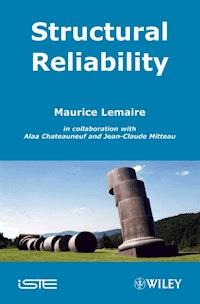
This book describes the main methods used in the reliability of structures and their use in the design process leading to reliable products. This title provides the understanding needed to implement the variety of new reliability software programs.
Sie lesen das E-Book in den Legimi-Apps auf:
Seitenzahl: 566
Veröffentlichungsjahr: 2013
Ähnliche



















Contents
Foreword
Preface
Chapter 1. Introduction
1.1 An old history
1.2 A modern attitude
1.3 Reliability: a definition
1.4 Which risk is acceptable?
1.5 Today
1.6 A little glossary
1.7 The structure of this book
Chapter 2. Preliminary Approach to Reliability in Mechanics
2.1 General points
2.2 Theoretical reliability in mechanics
2.3 Stochastic modeling
2.4 Mechanical modeling
2.5 Mechanical-reliability coupling
2.6 Fields of application
2.7 Conclusion
Chapter 3. ElementaryR − SCase
3.1 Presentation of the problem
3.2 Definitions and assumptions
3.3 Random vector: a reminder
3.4 Expressions of the probability of failure
3.5 Calculation of the probability of failure
3.6 Rod under tension
3.7 Concept of reliability index
3.9 Exercises for illustration
Chapter 4. Isoprobabilistic Transformation
4.1 Recapitulation of the problem and the notation
4.2 Case of independent variables
4.3 Rosenblatt transformation
4.4 Approximation using a normal distribution
4.5 Nataf transformation
4.6 Example: correlated loads on a beam
4.7 Nataf transformation: example
4.8 Transformation by Hermite polynomials
4.9 Conclusion
Chapter 5. Reliability Index
5.1 An optimization problem
5.2 Optimization algorithms
5.3 First order methods
5.4 First order algorithms for the SDP
5.5 Second order algorithms for the SDP
5.6 Special problems
5.7 Illustration using a simple example
5.8 Conclusion
Chapter 6. Products of Reliability Analysis
6.1 Sensitivity factors
6.2 Importance factors in reliability
6.3 Omission factors
6.4 Representation of the results: an example
6.5 Conclusion
Chapter 7. Probability of Failure
7.1 Methodological framework
7.2 Approximation using a hyperplane: FORM
7.3 Approximation using a second-order hypersurface
7.4 ‘Asymptotic’ SORM method
7.5 Exact SORM method in quadratic form
7.6 RGMR method
7.7 Numerical examples
7.8 Conclusions
Chapter 8. Simulation Methods
8.1 Introduction
8.2 Uniform pseudo-random numbers
8.3 Generators of non-uniform distributions [Rub81, Dea90]
8.4 Simulation methods
8.5 Sampling methods using P∗
8.6 Illustration of the methods
8.7 Conclusion
Chapter 9. Reliability of Systems
9.1 Combination of failure modes
9.2 Bounds of the failure probability of a system
9.3 First-order approximation bounds
9.4 First-order system probability
9.5 Second-order system probability
9.6 System of two bars in parallel
9.7 Conclusion
Chapter 10. ‘Safety’ Coefficients
10.1 Bases of design
10.2 Safety coefficients – elementary case
10.3 General definition of partial coefficients
10.4 Calibration of partial coefficients
10.5 Application examples
10.6 Conclusion
Chapter 11. Mechanical-Reliability Coupling
11.1 Introduction
11.2 General information on the coupling with a FEM code
11.3 Direct method
11.4 Response surface method
11.5 Two applications as examples
11.6 Optimization method
11.7 Example: isostatic truss
11.8 Conclusion
Chapter 12. Stochastic Finite Elements
12.1 Introduction
12.2 Spatial discretization of a random field
12.3 Series expansion of a random field
12.4 Finite element method and gradient calculation
12.5 Perturbation method
12.6 Polynomial chaos expansion
12.7 Continuous random field methods
12.8 An illustration
12.9 Conclusion
Chapter 13. A Few Applications
13.1 Design of a wind bracing
13.2 Modeling of a mandrel
13.3 Failure of a cracked plate
13.4 Cooling of a cracked plate
13.5 Boiler casing subjected to a thermal field
13.6 Pressurized tank
13.7 Stability of a cylindrical shell
13.8 Reliability sensitivity for a cooling tower
13.9 Lifespan of an exhaust manifold
Chapter 14. Conclusion
14.1 Reliability methods in mechanics
14.2 Application of the methods
14.3 Perspectives
14.4 Reliability analysis and sensitivity analysis
Bibliography
Annotations
A.1 Vectors and matrices
A.2 Operators
A.3 Random values
Index
First published in France in 2005 by Hermes Science/Lavoisier entitled Fiabilité des structures : couplage mécano-fiabiliste statique © LAVOISIER, 2005
First published in Great Britain and the United States in 2009 by ISTE Ltd and John Wiley & Sons, Inc.
Apart from any fair dealing for the purposes of research or private study, or criticism or review, as permitted under the Copyright, Designs and Patents Act 1988, this publication may only be reproduced, stored or transmitted, in any form or by any means, with the prior permission in writing of the publishers, or in the case of reprographic reproduction in accordance with the terms and licenses issued by the CLA. Enquiries concerning reproduction outside these terms should be sent to the publishers at the undermentioned address:
ISTE Ltd 27-37 St George’s Road London SW19 4EUUKwww.iste.co.ukJohn Wiley & Sons, Inc.111 River StreetHoboken, NJ 07030USAwww.wiley.com© ISTE Ltd, 2009
The rights of Maurice Lemaire to be identified as the author of this work have been asserted by him in accordance with the Copyright, Designs and Patents Act 1988.
Library of Congress Cataloging-in-Publication Data
Lemaire, Maurice.
[Fiabilité des structures. English]
Structural reliability / Maurice Lemaire.
p. cm.
Includes bibliographical references and index.
ISBN 978-1-84821-082-0
1. Structural engineering--Mathematics. 2. Reliability (Engineering) 3. Structural failures. I. Title. TA640.L4613 2009
624.1--dc22
2008043201
British Library Cataloguing-in-Publication Data
A CIP record for this book is available from the British Library
ISBN: 978-1-84821-082-0
Foreword
My colleague Maurice Lemaire has invited me to write a few words as a foreword to this treatise on structural reliability. The importance of the subject is obvious to everybody. Undertaking a scientific study of it requires a superior mastery of two disciplines, namely mechanics and probabilities. Maurice Lemaire was inspired by a remark made by the authors of the report that the President of the Republic Giscard d’Estaing had requested in 1980 from the Académie des Sciences, titled ‘Les sciences mécaniques et l’avenir industriel de la France’ (‘Mechanical sciences and the industrial future of France’). The report in fact observed that it was quite rare to find in French laboratories a team in which skills in these two disciplines mixed. This observation caught Lemaire’s attention and motivated him to orient his research and that of his students in order to remedy the situation. This book testifies to the undeniable success of the decision made by Maurice Lemaire. I thank him for this opportunity to convey my heartfelt congratulations, and express my satisfaction in seeing that young researchers have found in this report an inspiration that has proved to be so fruitful.
The preface and the introduction present the content of this book as is customary, and also indicate its place in the history of mechanics. The reader can also discover how the book has been developed by its author, who has made good use of his lectures enriched by his personal reflections, tested his developments with his students and discussed his progress with colleagues abroad in international meetings and thus earned a well-merited reputation. That is why I believe that this book is a treatise, which I think will be a reference in this discipline for a long time to come.
Paul Germain
Honorary Permanent Secretary
Académie des Sciences
Preface
On 25 September 1975, I defended, before the Claude Bernard University and the National Institute of Applied Sciences of Lyon, a doctoral thesis in which I discussed how the new possibilities offered by computers in the numerical resolution of mechanical models opened up wide-ranging perspectives for developing behavior models of reinforced concrete and constructing their numerical implementation. At the end of this research work, one conclusion was obvious: a numerical solution consists of concatenating millions of operations performed with about 14 digits, whereas the knowledge of data is an uncertainty limited to two or three significant digits only.
It was this observation that inspired my approach on my arrival at the University of Clermont in September 1976. The spirit of Blaise Pascal still lingers here and perhaps made me aware of probabilities. But it was in 1980 that a founding text confirmed me in my approach. The President of the Republic had asked the Académie des Sciences for a report that was published under the title ‘Les sciences mécaniques et l’avenir industriel de la France’. It said:1
It is evident that the stochastic point of view must play an increasingly greater role in mechanics and not only in academic research, but more importantly in industrial applications. While taking into account that developers are already introducing probability calculation into their reliability studies, and without forgetting research such as that undertaken for the definition of offshore oil platforms and the prediction of their resistance to sea and wind, we can no doubt say that it is quite rare in France (except for turbulence specialists) to find in laboratories a team in which skills in mechanics and in probability mix fully in equal parts.
All the calculations and all the predictions on safety coefficients must be definitively replaced by reasonable estimations of probabilities of failure. The French situation is a cause for concern and it seems advisable to promote the formation of cutting-edge teams in the mechanical laboratories of the CNRS, engineering schools or universities.
Boosted by this direct confirmation of my conclusion, I strove from that day on to develop scientific research, and to set up a teaching program, on the theme of the marriage between models in mechanics and those in probability and statistics. A contribution to research gave me access to international debate, particularly through the International Conference on Applications of Statistics and Probability. It nurtured my teaching, firstly through a Master’s course in Materials, Structures, and Reliability at the Blaise Pascal University.
In 1991, I was part of the creation of the Institut Français de Mécanique Avancée (IFMA). I then had the opportunity to promote the teaching of mechanical reliability as part of the curriculum for engineering students. It was the first time that such a course was offered, and I would like to thank Claude G. Bonthoux, founder and first director of IFMA, for placing his trust in me, and his successor Didier Marquis for his continued support.
More than 10 years after the publication of the report of the Académie des Sciences, during the inauguration of IFMA on 7 January 1994, I was able to demonstrate to the President of the Republic and to the Permanent Secretary of the Académie des Sciences the modest result of the reflection that the former had kindled and the latter fueled.
This book therefore embodies the experience acquired in a field in which we had to construct pedagogy and prove the relevance of such a degree course in an engineering school. As knowledge developed, numerical tools made lightning progress. If, even today, mechanical-reliability models consume considerable calculation resources, we have adequate means to actually address industrial problems. The development of methods and the increase in calculation power will make these models the routine tools of the designer in 10 or 15 years. If we are not convinced, we only need to ask ourselves whether the engineers of the 1970s could have imagined the non-linear calculations that are now possible thanks to finite elements.
Apart from IFMA and l’Ecole Doctorale Sciences pour l’Ingénieur de Clermont, this course, through my intervention or those of our team, also spread to other establishments, where it has been introduced in the last few years (Pôle Universitaire Léonard de Vinci, Institut National Polytechnique de Grenoble, Ecole des Mines Paris, Ecole Centrale Paris, etc.), and as a part of continuing education (Institut pour la Promotion des Sciences de l’Ingénieur, Ecole Polytechnique, etc.). It was also the basis for intervention in companies, going as far as to convince Jean-Marc Bourinet to join us.
The permanent dialog with engineering students proved to be a powerful driving force in the creation of this course, as it is true that everyone understands fully only what he is capable of teaching.
That is why I have great pleasure in thanking first of all the inner circle of engineering students of the Materials and Structures discipline at IFMA who, through the course and the projects, forced me to the limits of my resources to obtain satisfactory answers to their queries.
A second circle was made up of doctoral students who trusted me enough to venture onto the new path that I was showing them. They contributed extensively to the elaboration of this expertise. In order of appearance, my sincere thanks to Michel, Jean-Pierre, Ghassan (Claude), Alaa, Oscar, Nicolas, Clair, Pierre, Maurice, Céline, Nicolas, Ghias, Zakoua, Sébastien, Marc, Anthony, Lukas, François. . . That is why this book refers to their research.
My colleagues have also made precious contributions through the scientific and friendly discussions that we have had for so many years. Bernard Jacob, from the Laboratoire Central des Ponts et Chaussées, has been a particularly efficient accomplice in convincing ICASP to hold its congress in France. Jean Goyet, the delegate to the Bureau Veritas research department, allowed me to make use of his rich experience in his critique of my writing regarding ‘safety’ coefficients.
Jean-Claude Mitteau and Alaa Chateauneuf (Mohamed) joined the Laboratoire de Recherches et Applications en Mécanique Avancée (Institut Français de Mécanique Avancée and Blaise Pascal University), which has today become the Laboratoire de Mécanique et Ingénieries (LaMI), and were kind enough to associate themselves with my research. As colleagues, they have made particularly significant contributions, and have shared their experience and their observations. They are naturally part of this book.
For the last few years, we have forged a collaboration with Electricité de France, firstly under the impetus of Patrick Hornet, joined thereafter by Bruno Sudret. This collaboration was formalized by a partnership agreement signed on 16 June 2000 and extended since. The meeting of industrial, pedagogical and scientific preoccupations has also been a powerful motor in the development of mechanical-reliability methods.
These methods are now reaching sufficient maturity to form a tool of industrial performance. Maurice Pendola was so convinced of this that he created PHIMECA Engineering S.A. to develop this knowhow.
I take this opportunity to express my sincere gratitude to all, students, teachers, researchers and industrialists, for all that they have contributed.
This book deals with mechanical reliability, and of course it can be judged by the reliability of its writing, and as the French proverb says, a man is punished by the very things through which he sins! Is this book reliable? It is perhaps reliable with a sufficiently weak probability of failure. The electronic file contains 17 MB. A reasonable target failure of 10−5 would result in 170 typing errors. The reality is much lower, we hope!
Nurtured by contact with mechanical engineering students, this book is based on standard knowledge in the fields of mechanics (continuous media, structures) and numerical modeling (finite elements). It requires at least some knowledge of probability and statistics (random variables, distributions). These basic concepts are not repeated in the book as they can be found in classic textbooks. The ambition of the book is to allow an engineering student or an engineer to discover the advantages of reliability methods, to understand the approach and the tools: that is why, in addition to theoretical developments, simple examples describe how results are obtained. This is also the reason why the book not only describes the methods that are the most widely used today, but also presents methods that have made their contribution to the current doctrine, as it is true that, just as in politics, we can understand current affairs only in the light of history. Then everyone can move on to applications, first academic and then industrial, with the help of general or dedicated tools, and also access the international literature on the subject.
Preface to the English edition
The translation of this book, published in French over four years ago, was a daunting task, undertaken at the suggestion of and with the help of the publisher. It was possible thanks to the faultless collaboration of David Turner, a linguist capable of accepting the compromises which are inevitable in a scientific text. I would particularly like to thank him for his open-mindedness and for the care with which he accomplished this task.
A translation is not the same as writing a book directly in the target language. It conserves a style and a presentation which, showing a certain ‘French touch’, reveal its origin. Its context is a set of references which underline the contribution of French studies to the field, although they are of course not exclusive. The author begs the readers to excuse him for this, certain that they will easily find the necessary standard works in their own environment, especially in mechanics, probability and statistics.
Some useful changes have been made to the original French text, and some points have been explained in more detail. The book has largely contributed to the initiation of numerous students and engineers working in France. I hope that tomorrow it will play the same role for those who are about to discover it.
Maurice Lemaire
1 La Documentation Française, September 1980, p. 198.
Chapter 1
Introduction
1.1 An old history
It would be fascinating to take some time to go back in history in order to understand how man gradually conquered enough ‘certainties’ to accept rationally the risk of his uncertainties. We will find that great personalities have reflected on this question and contributed to the gradual acquisition of more comprehensive heuristic and axiomatic information, which has made it possible to design more and more ambitious structures and systems.
It is certainly Hammurabi’s code that first established rules governing the acceptance of risk in construction.1 Around 1755 B.C., this Babylonian sovereign put together a set of prescriptions, dictated by the gods, constituting the first legal code ever known. It remained in force in Mesopotamia for a thousand years. The code related to the construction of houses, and the mason’s responsibility was strongly binding.2 Let us judge for ourselves:
Article 229: If a mason has constructed a house for someone but has not strengthened his construction, and if the house that he has constructed collapses and kills the house owner, that mason shall be put to death.
Article 230: If it is the child of the house owner that has been killed, one of the mason’s children shall be put to death.
It is interesting to note that the insistence on safety was then based on the transfer onto the builder of a risk that related to his own security: linking the notion of risk to the outcome of the feared event remains quite a contemporary mindset.
In fact, risk is defined by the existence of a feared event that has a probability (or a possibility) of occurrence, and by the gravity of the consequences of this event.
The following equation is often given:
In order to diminish the probability of an event feared by the user, the penalty should be increased for the person who takes the responsibility for the construction. This is a direct application of the Farmer graph illustrated in Figure 1.1, according to which the mason will try to reduce the probability of the occurrence of a feared event if its consequences are disastrous for him.3
Figure 1.1Farmer graph (1967): probability-gravity.
Hammurabi imposed responsibility for results and left the choice of the means of achieving them open. He anticipated what the European Union would much later call directives. Today this practice seems barbaric, whereas it essentially aimed at limiting the effects of an endless vendetta between the concerned parties due to the application of the law of ‘an eye for an eye’.
Humanity’s scientific quest therefore consisted of accumulating experience and constructing projected models that give today, not for one man but collectively to engineers, the possibility of taking on the risks of civil and mechanical constructions on behalf of society with real success, in a context in which great catastrophes are a reminder that humility is always necessary.
1.2 A modern attitude
If the knowledge of geometry and static mechanics advanced rapidly in ancient times, the mastery of the uncertain in the construction of cathedrals in the Middle Ages proceeded by trial and error and led to well-known failures.4 Leonardo da Vinci (1452–1519) was one of the first to look for a relationship between load effect and resistance in the case of beams. A little later, Galileo was particularly interested in the optimization of the resistance of a cantilever beam, thereby initiating the first modeling.5
We know the great developments in modeling the behavior of materials and constructions that followed. This conquest could lead us to believe that one day the knowledge of laws, models and solutions will attain such perfection that engineers will be able to trust them completely. However, in parallel and sometimes simultaneously, scientists explained that we should live with chance.
Lesen Sie weiter in der vollständigen Ausgabe!
Lesen Sie weiter in der vollständigen Ausgabe!
Lesen Sie weiter in der vollständigen Ausgabe!
Lesen Sie weiter in der vollständigen Ausgabe!
Lesen Sie weiter in der vollständigen Ausgabe!
Lesen Sie weiter in der vollständigen Ausgabe!
Lesen Sie weiter in der vollständigen Ausgabe!
Lesen Sie weiter in der vollständigen Ausgabe!
Lesen Sie weiter in der vollständigen Ausgabe!
Lesen Sie weiter in der vollständigen Ausgabe!
Lesen Sie weiter in der vollständigen Ausgabe!
Lesen Sie weiter in der vollständigen Ausgabe!
Lesen Sie weiter in der vollständigen Ausgabe!
Lesen Sie weiter in der vollständigen Ausgabe!
Lesen Sie weiter in der vollständigen Ausgabe!
Lesen Sie weiter in der vollständigen Ausgabe!




