


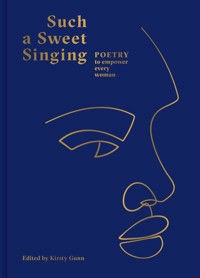
Such a Sweet Singing E-Book
10,79 €
Mehr erfahren.
- Herausgeber: Batsford
- Kategorie: Poesie und Drama
- Sprache: Englisch
A beautiful collection of poems to nourish, inspire and change the women who read them. This transformative collection of poems by female poets through the ages sing to us across the centuries. These poems span the worlds of desire, love and friendship, of responsibility, hardship and care, of family and friends and lovers. Their words empower us with strength and courage, fill us with verve and spirit, and inspire creativity and imagination. Contemporary voices of Fiona Benson and Jane Yeh join the evocative imagery of Christina Rossetti, Anna Akhmatova and Emily Dickinson. Even the haunting voices of ancient Sappho, Venmaniputti and Li Qingzhao touch today's generation. Here are poems written by women, with women's lives in mind. As Gertrude Stein writes, 'such a sweet singing' is in the poetry that comes to us clear and lovely from out of the dark. Read these poems aloud. Remember them. Share them.
Das E-Book können Sie in Legimi-Apps oder einer beliebigen App lesen, die das folgende Format unterstützen:
Seitenzahl: 65
Veröffentlichungsjahr: 2022
Ähnliche




















Speaking, Singing, Living: An Introduction
Courage
Love
Imagination
Family
Home
Life
Notes on Poets, Poetry and Further Reading
Index of Poets
Index of Poems
Acknowledgements
Speaking, Singing, Living:An Introduction
In the middle of the night a woman wakes. Is that a child’s cry she’s heard? Or the memory of someone she holds dear calling to her from the past? Is this a friend or lover who has come to mind, and disturbed her from sleep? Or a husband, a partner, a colleague, a neighbour, who wants her to come quickly? To come now? To be near?
How women are alert and awake to the needs of others. How we listen out. How we do hear. Whether someone at work is asking for advice, or the person you’ve known since you were five years old needs your help in making a big decision; whether you’re responding to political and professional debates, to representations or high-level strategic planning, or just aware of a young mother in the street struggling to board a bus: can you help her with the buggy, hold the baby, take her toddler by the hand? Always, always women are moving across worlds, relocating seamlessly from the isolated country of our own desires and dreams to the highly populated land of responsibility, routine and care. It’s as though to be ever-emerging from deep within our imagined and familiar lives to the wide-awake world where we also live ... Is what it is to be a daughter, sister, mother, girlfriend, aunt, companion. And here we are, with this book of poetry you now hold in your hands, a guidebook we might call it, to help us navigate the journey from the here to the there, from the known to the unknown – as Sapphire says in her poem ‘Going Home’, ‘right now I’m trees and windows, moving.’ That is what this book is. A means of going forwards. A map to guide us on our way that sings and sounds with the voices of women.
Poems for all kinds of readers
Every poetry collection, as well as being a gathering of varying voices and interests, is a reflection of a set of values. Editors ask themselves: what is interesting about the work that might justify it for inclusion according to their own literary priorities? Why this verse over another? Might the selection chime with recent publications or deliberately be quite different from other anthologies of the day? With this book it was clear to me from the start that I wanted to bring together writers, irrespective of the nature of their individual poetic practice, to mark out a space on behalf of the rest of us in which we could congregate and mingle. I wanted to display work by women that would call to all kinds of readers, of all ages and backgrounds, to bring out onto the page in beautiful form those expressions and responses poets have made out of the experience of their own lives – about families and work and home and intimacy. About love. About our fears and lonelinesses as well as our joys and celebrations. I wanted to hear these poems sing.
There really is about this collection a feeling of adventure, of heading off into somewhere new. This book is not a showcase. It is to be used ... By busy women everywhere, old and young, with children and without, working in offices or in gardens, in the boardroom or the kitchen. To have at hand poems to sit alongside daily life and enrich it, to deepen the experience of the ordinary so that it becomes extraordinary. To have a collection you can turn to every day and find something that will add to your world and help you live in it.
We go to poetry to be nourished. And nourishing us is what poetry can do. ‘In all the rooms of this year/I have entered one red room,’ says Muriel Rukeyser in ‘King’s Mountain’, describing how, by taking a few moments out of our busy lives, we can enter into these houses of words and be cared for, invigorated, inspired and changed by what we read there. We need ‘to feel alive’, says Chantal Maillard in her poem ‘Writing’. We need this energy, this life force to be reminded of our female agency and point of view. We need ‘writing ... from the beginning of the world’.
So here are poems written by women, with women’s lives in mind. Here is a poem about getting older, noticing the first touch of grey in the hair – ‘white blossoms’ as the 11th-century poet Li Qingzhao describes it – and here another about a young girl taking a dive in front of her mother as she leaves childhood behind and plunges into adolescence and adulthood: ‘You at fifteen, poised on the high board’ writes Jane Draycott in ‘The Longest Day’, ‘arms toward heaven’. There are poems for the everyday – ‘She saw his face, waiting, his hands on the table’ from Jayne Anne Phillips’ ‘Kitchen’ – and poems for the exceptional, like Anna Akhmatova’s ‘Fragment from the First Notebook’. A poem about an elevator that takes you to the six thousandth floor sits alongside another about a deep, Scottish loch. There is the solemn – Emily Dickinson’s ‘After great pain, a formal feeling comes –’ – and there is the wonderful, with Sappho’s shining light. There is the joyous – ‘She’s dancing to a song you can’t hear’ of Lavinia Greenlaw’s ‘Silent Disco’ – and the grave, with the ‘darkling way’ of Charlotte Smith’s ‘Huge Vapours Brood above the Clifted Shore’. And as we read the words of each of these, of strength and hope and of practicality and great verve and spirit, we take those same words inside us. The poem comes to live within us and its pulse and feeling, its motifs and music, become our own.
Where are all the women?
With all of this in mind, how strange it was, then, to begin putting together this collection by going back through all my old poetry anthologies from school and university days, looking for poems by women and reading nothing but silence there. Even until relatively recently those great bibles of books – poetry for the world, poetry for today, poetry for life, a history of poetry in verse – all those volumes and editions that were published through the years, across the ages, that were supposed to speak for all of us, actually showed that we are barely there. The few poems available to read in those popular old collections are scattered in a couple of stanzas or less through the massed volume of male representation. Where are all the women? As Irina Dumitrescu wrote recently, in a review of early English poetry, ‘It’s difficult to find women authors ...’. No doubt much work was made collaboratively, she concludes, women helping men do the writing. But in the end what we have for certain are only folios upon folios of invisible texts.




