


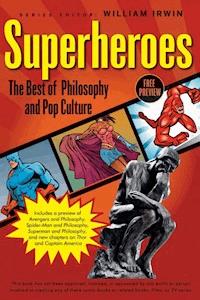
Superheroes E-Book
0,99 €
Mehr erfahren.
- Herausgeber: John Wiley & Sons
- Kategorie: Geisteswissenschaft
- Serie: The Blackwell Philosophy and Pop Culture Series
- Sprache: Englisch
Explore the philosophical depths of Batman, Superman, CaptainAmerica, and your other favorite superheroes--FOR FREE! Behind the cool costumes, special powers, and unflaggingdetermination to fight evil you'll find fascinatingphilosophical questions and concerns deep in the hearts and mindsof your favorite comic book heroes. Why doesn't Batman just kill the Joker and end everyone'smisery? Does Peter Parker have a good life? What can Iron Man teachus about the role of technology in society? Bringing together keychapters from books in the Blackwell Philosophy and Pop Cultureseries, this free superhero sampler engages the intellectual mightof big thinkers like Aristotle and Kant to answer these questionsand many others, giving you new insights on everything from whetherSuperman is truly an American icon to whether Wolverine is the sameperson when he loses his memory. * Features exclusive bonus content: all-new chapters on CaptainAmerica and Thor * Gives you a sneak peek at upcoming books: Avengers andPhilosophy, Spider-Man and Philosophy, and Superman andPhilosophy * Includes superheroes from both the DC and Marvel universes: theAvengers, Batman, Captain America, Green Lantern, Iron Man,Spider-Man, Superman, Thor, Watchmen, and the X-Men * Gives you a perfect introduction to the Blackwell Philosophyand Pop Culture series (learn more at www.andphilosophy.com) FORFREE! Whether you're looking for answers or looking for fun, thisclassic compilation will save the day by helping you gain a deeperappreciation of your favorite comics with an introduction to basicphilosophical principles.
Sie lesen das E-Book in den Legimi-Apps auf:
Seitenzahl: 226
Veröffentlichungsjahr: 2011
Ähnliche




















Contents
About the Book
Introduction: Taking Superheroes Seriously
Part One: Superheroes Exclusive
Chapter 1: Lord Odin Have Mercy: Justice and Punishment in Asgard
Odin of Asgard, Meet Anselm of Canterbury
Aristotle vs. Seidring the Merciless
Well Met, Seneca
Mercy, Mercy Me
Oh, Balder, We Hardly Knew Ye . . .
Verily, the Vizier Gets the Vinal Final Word
Chapter 2: Captain America and the Virtue of Modesty
I’m Modest—Isn’t That Great?
Modesty Isn’t Just About You, You Know
The Egalitarians Have Landed
If Batroc Knows One Philosophe, It Would Be . . .
Kant We Do Better, Though?
Tales of Modesty
Part Two: DC Superheroes
Chapter 3: Is Superman an American Icon?
Is Superman Giving Up on the American Way?
My Country, Right or Wrong—But Mostly Right
Can Superman Be a Citizen of the World?
Cosmopolitanism Then and Now
The Appearance of Impropriety
Act Locally, Think Globally
Chapter 4: The Blackest Night for Aristotle’s Account of Emotions
Color-Coded Morality
Finding the Perfect Mean: A Job for Golden Lanterns?
The Rainbow of Emotions and the Prism of the Will
John Stuart Mill’s Green Approach to Emotion and Reason
Triumph of the Will
Chapter 5: Why Doesn’t Batman Kill the Joker?
Meet the Joker
Is Batman a Utilitarian or Deontologist? (Or None of the Above?)
To the Bat-Trolley, Professor Thomson!
Hush Will Love This Next Story . . .
Top Ten Reasons the Batmobile Is Not a Trolley . . .
“I Want My Lawyer! Oh, That’s Right, I Killed Him Too”
So, Case Closed—Right?
Chapter 6: Can We Steer This Rudderless World?: Kant, Rorschach, Retributivism, and Honor
Evil Must Be Punished: Retributivism, Basically
Kant and Rorschach on Respect and Dignity
Order and Value in a Morally Blank World
Honor Is Like the Hawk . . .
This Last Entry
Part Three: Marvel Superheroes
Chapter 7: Forgivers Assemble!
Time Travel, Retcons, and Forgiveness
Can Cap Forgive the Rest of His Kooky Quartet?
Who Will Forgive the Mutants?
Forgive Me!
Forgiveness in the House of M
The Paradox of Forgiveness
Avengers, Forgive!
Chapter 8: Does Peter Parker Have a Good Life?
Paul Kurtz: A Life of Pleasure and Care for Others
Ayn Rand: Life and Integrity
Epictetus: Self-Control, Duty, and Knowledge of the World
Viktor Frankl: Meaning and Sacrifice
Thomas Aquinas: God and Virtue
What Next?
Chapter 9: The Stark Madness of Technology
“A Heart of Gold and an Appearance to Match”
“Masters of Nature”
It’s Not All in the Hardware
The Heroism of Generosity
“The Body Is Wrong”
“How Many Have Drawn Blood with My Sword?”
Jet Boots and Clay Feet
Chapter 10: Amnesia, Personal Identity, and the Many Lives of Wolverine
What Is Personal Identity?
Cassandra Nova, Charles Xavier, and John Locke
Bringing It All Back to Wolverine
Jamie Madrox and Derek Parfit
Bringing It All Back to Wolverine (Again)
Be Slow to Judge
Part Four: About the Series
New!
Green Lantern and Philosophy: No Evil Shall Escape This Book
Also Available!
Iron Man and Philosophy: Facing the Stark Reality
The Blackwell Philosophy and Pop Culture Series
The Blackwell Philosophy and Pop Culture Series
Series Editor: William Irwin
South Park and Philosophy
Edited by Robert Arp
Metallica and Philosophy
Edited by William Irwin
Family Guy and Philosophy
Edited by J. Jeremy Wisnewski
The Daily Show and Philosophy
Edited by Jason Holt
Lost and Philosophy
Edited by Sharon Kaye
24 and Philosophy
Edited by Jennifer Hart Weed, Richard Davis, and Ronald Weed
Battlestar Galactica and Philosophy
Edited by Jason T. Eberl
The Office and Philosophy
Edited by J. Jeremy Wisnewski
Batman and Philosophy
Edited by Mark D. White and Robert Arp
House and Philosophy
Edited by Henry Jacoby
Watchmen and Philosophy
Edited by Mark D. White
X-Men and Philosophy
Edited by Rebecca Housel and J. Jeremy Wisnewski
Terminator and Philosophy
Edited by Richard Brown and Kevin Decker
Heroes and Philosophy
Edited by David Kyle Johnson
Twilight and Philosophy
Edited by Rebecca Housel and J. Jeremy Wisnewski
Final Fantasy and Philosophy
Edited by Jason P. Blahuta and Michel S. Beaulieu
Alice in Wonderland and Philosophy
Edited by Richard Brian Davis
Iron Man and Philosophy
Edited by Mark D. White
True Blood and Philosophy
Edited by George Dunn and Rebecca Housel
Mad Men and Philosophy
Edited by James South and Rod Carveth
30 Rock and Philosophy
Edited by J. Jeremy Wisnewski
The Ultimate Harry Potter and Philosophy
Edited by Gregory Bassham
The Ultimate Lost and Philosophy
Edited by Sharon Kaye
Green Lantern and Philosophy
Edited by Jane Dryden and Mark D. White
The Girl with the Dragon Tattoo and Philosophy
Edited by Eric Bronson
Arrested Development and Philosophy
Edited by Kristopher Phillips and J. Jeremy Wisnewski
Copyright © 2011 by John Wiley and Sons. All rights reserved
Published by John Wiley & Sons, Inc., Hoboken, New Jersey
Published simultaneously in Canada
No part of this publication may be reproduced, stored in a retrieval system, or transmitted in any form or by any means, electronic, mechanical, photocopying, recording, scanning, or otherwise, except as permitted under Section 107 or 108 of the 1976 United States Copyright Act, without either the prior written permission of the Publisher, or authorization through payment of the appropriate per-copy fee to the Copyright Clearance Center, 222 Rosewood Drive, Danvers, MA 01923, (978) 750-8400, fax (978) 646-8600, or on the web at www.copyright.com. Requests to the Publisher for permission should be addressed to the Permissions Department, John Wiley & Sons, Inc., 111 River Street, Hoboken, NJ 07030, (201) 748-6011, fax (201) 748-6008, or online at http://www.wiley.com/go/permissions.
Limit of Liability/Disclaimer of Warranty: While the publisher and the author have used their best efforts in preparing this book, they make no representations or warranties with respect to the accuracy or completeness of the contents of this book and specifically disclaim any implied warranties of merchantability or fitness for a particular purpose. No warranty may be created or extended by sales representatives or written sales materials. The advice and strategies contained herein may not be suitable for your situation. You should consult with a professional where appropriate. Neither the publisher nor the author shall be liable for any loss of profit or any other commercial damages, including but not limited to special, incidental, consequential, or other damages.
For general information about our other products and services, please contact our Customer Care Department within the United States at (800) 762-2974, outside the United States at (317) 572-3993 or fax (317) 572-4002.
Wiley also publishes its books in a variety of electronic formats and by print-on-demand. Some content that appears in standard print versions of this book may not be available in other formats. For more information about Wiley products, visit us at www.wiley.com.
ISBN 978-1-118-15347-5 (ebk); ISBN 978-1-118-15348-2 (ebk)
About the Book
This is a compilation of some of our best superhero essays in the Blackwell Philosophy and Pop Culture series with a preview of some of our forthcoming books and two essays that are exclusive to this sampler.
Part One: Superheroes Exclusives
1. Lord Odin Have Mercy: Justice and Punishment in Asgard
Mark D. White
2. Captain America and the Virtue of Modesty
Mark D. White
Part Two: DC Superheroes
3. Is Superman an American Icon?
Andrew Terjesen
From Superman and Philosophy, edited by Mark D. White
4. The Blackest Night for Aristotle’s Account of Emotions
Jason Southworth
From Green Lantern and Philosophy, edited by Jane Dryden and Mark D. White
5. Why Doesn’t Batman Kill the Joker?
Mark D. White
From Batman and Philosophy, edited by Mark D. White and Robert Arp
6. Can We Steer This Rudderless World?: Kant, Rorschach, Retributivism, and Honor
Jacob M. Held
From Watchmen and Philosophy, edited by Mark D. White
Part Three: Marvel Superheroes
7. Forgivers Assemble!
Daniel P. Malloy
From Avengers and Philosophy, edited by Mark D. White
8. Does Peter Parker Have a Good Life?
Neil Mussett
From Spider-Man and Philosophy, edited by Jonathan J. Sanford
9. The Stark Madness of Technology
George A. Dunn
From Iron Man and Philosophy, edited by Mark D. White
10. Amnesia, Personal Identity, and the Many Lives of Wolverine
Jason Southworth
From X-Men and Philosophy, edited by Rebecca Housel and J. Jeremy Wisnewski
Introduction
Taking Superheroes Seriously
William Irwin
Philosophy can change your life, but it may take a superhero for you to realize it. Superman, Batman, Spider-Man, and company don’t just entertain us; they prompt us to think. I mean, why doesn’t Batman just kill the Joker and be done with it? Sure, that would be bad for future comic book sales, but, as we’ll see in this book, the Dark Knight has his philosophical reasons, too.
Philosophers specialize in theory, but people tend to learn better when something unfamiliar, such as philosophy, is explained in terms of something familiar, such as television, movies, comic books, music, or videogames. The philosophers of old understood this and came up with their own memorable examples to illustrate their theories, from Plato’s (428–348 BCE) allegory of the cave to Descartes’ (1596–1650) evil deceiver and beyond. In this book, we continue that long tradition by using examples from the realm of superheroes.
Why? Because superheroes are complex characters and have become the mythology of our time (literally, in the case of Thor!). Like the gods, superheroes tend to have basic origin stories and character traits, which set the stage for a limitless number and variety of tales. And like the gods of mythology, superheroes are not perfect; they are not like the all-loving, all-good, all-powerful God of Western religion. Still, our flawed heroes can act as moral exemplars. For those not inclined to ask W.W.J.D.?, it can make sense to ask W.W.C.A.D.? What would Captain America do?
Some people might worry that we can’t learn anything from superheroes since they’re just make-believe, but, like the ancient myths, tales of superheroes don’t need to be true or realistic to be inspiring. You don’t need to have been bitten by a radioactive spider to realize that with great power comes great responsibility. Heck, you don’t even need to have great power to learn and appreciate that lesson—kids and grown-ups alike have gotten that lesson from Spidey for decades.
Ultimately, this book aims to shed light on the hidden depth of superheroes, while at same time illustrate the importance of philosophy. Superman and Batman are not replacements for Plato and Aristotle, but they can inspire you to read Plato and Aristotle, who will challenge you to think deeply. This looks like a job for Superman, or at least Superheroes: The Best of Philosophy and Pop Culture. From there, the rest is up to you!
Part One
Superheroes Exclusive
Lesen Sie weiter in der vollständigen Ausgabe!
Lesen Sie weiter in der vollständigen Ausgabe!
Lesen Sie weiter in der vollständigen Ausgabe!
Lesen Sie weiter in der vollständigen Ausgabe!
Lesen Sie weiter in der vollständigen Ausgabe!
Lesen Sie weiter in der vollständigen Ausgabe!
Lesen Sie weiter in der vollständigen Ausgabe!
Lesen Sie weiter in der vollständigen Ausgabe!
Lesen Sie weiter in der vollständigen Ausgabe!
Lesen Sie weiter in der vollständigen Ausgabe!
Lesen Sie weiter in der vollständigen Ausgabe!
Lesen Sie weiter in der vollständigen Ausgabe!
Lesen Sie weiter in der vollständigen Ausgabe!
Lesen Sie weiter in der vollständigen Ausgabe!
Lesen Sie weiter in der vollständigen Ausgabe!
Lesen Sie weiter in der vollständigen Ausgabe!
Lesen Sie weiter in der vollständigen Ausgabe!
Lesen Sie weiter in der vollständigen Ausgabe!




