


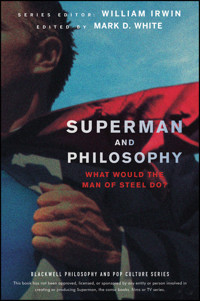
Superman and Philosophy E-Book
16,99 €
Mehr erfahren.
- Herausgeber: John Wiley & Sons
- Kategorie: Geisteswissenschaft
- Serie: The Blackwell Philosophy and Pop Culture Series
- Sprache: Englisch
Go beyond the cape and into the mind of the Man of Steel, in time for release of Zack Snyder's Man of Steel movie and Superman's 75th anniversary
He has thrilled millions for 75 years, with a legacy that transcends national, cultural, and generational borders, but is there more to the Man of Steel than just your average mythic superhero in a cape? The 20 chapters in this book present a fascinating exploration of some of the deeper philosophical questions raised by Superman, the Last Son of Krypton and the newest hero in the Blackwell Philosophy and Pop Culture arsenal.
Sie lesen das E-Book in den Legimi-Apps auf:
Seitenzahl: 433
Veröffentlichungsjahr: 2013
Ähnliche




















Contents
Introduction: It’s a Bird, It’s a Plane … It’s Philosophy!
Part One: THE BIG BLUE BOY SCOUT
Chapter 1: Moral Judgment
The Trinity of Moral Philosophy
But Like Superpowers, Ethics Only Gets You So Far
Tragic Dilemma in Your Pocket (Universe)
I’m Walkin’, Yes Indeed
Superman Did What?
What Makes Superman Human
Chapter 2: Action Comics!
It’s Practically Reasonable
More Powerful Than a Locomotive
We Could Be Heroes …
Superman vs. the Calculator
Faster Than a Speeding Bullet
The Virtues of Being Super
So Whom Does He Save?
Chapter 3: Can the Man of TomorrowBe the Journalist of Today?
The Face and the Voice
A Reporter’s Story
The Reporter of Steel
Superman Confidential: Seek Truth and Report It
The Big Forget: Act Independently
Wicked Business! Minimize Harm
Fatal Flaw?
Chapter 4: Could Superman Have Joined the Third Reich?
… Or Not
The Moral Education of a Superman
Superman: Son of the Third Reich
In the End, Hitler Still Loses
Part Two: TRUTH, JUSTICE, AND THE AMERICAN WAY
Chapter 5: Clark Kent Is Superman!
What Is the Secret?
Superman for President!
The Secret Revealed!
Opening the Shirt
Letting in Lois
In the Vault
Chapter 6: Superman and Justice
It’s All About Personal Liberty
Truth, Libertarian Justice, and the American Way
Great Rawls!
Behind the (Lead-Lined) Veil of Ignorance
Occupy Metropolis
Superman’s Greatest Foe?
Chapter 7: Is Superman an American Icon?
Is Superman Giving Up on the American Way?
My Country, Right or Wrong—But Mostly Right
Can Superman Be a Citizen of the World?
Cosmopolitanism Then and Now
The Appearance of Impropriety
Act Locally, Think Globally
Part Three: THE WILL TO SUPERPOWER
Chapter 8: Rediscovering Nietzsche’s Übermensch in Superman as a Heroic Ideal
Truth, Justice, and the Nietzschean Way
Putting the Über into the Übermensch
The Nietzschean Superman
Superman vs. Clark Kent
S Is for Savior
Kneel Before Zod!
Perhaps … Lex Luthor?
Nietzschean Übermensch, American Christ, or Both?
Chapter 9: Superman or Last Man
Survival of the Weakest
Introducing Superman—Whether We Need Him or Not
Waiting for Superman
Resignation Superman
Singer vs. Nietzsche
It Ain’t Easy Being Blue
Is He Worth It?
Chapter 10: Superman
Übermensch as Anti-Christ
Lex Luthor: Super-Man?
Jesus Without the Christ
Moral Illumination
Trinitarian Movie Mythos
Is Superman Christ or a Christ-Type?
Seduction of the Innocent?
Chapter 11: Superman Must Be Destroyed!
A Man Who Writes His Own Script
An Iconoclast
One Man Is an Island
The Anti-Hero of Faith
Existentialists Gone Wild!
Part Four: THE ULTIMATE HERO
Chapter 12: Superman’s Revelation
The Never-Ending Battle
Things Hidden Since the Foundation of the World2
Kingdom Come
Superman’s Dilemma
Good Violence vs. Bad Violence
Sacred Violence
Caution: Mythology at Work
The Truth About Truth and Justice
Chapter 13: A World Without a Clark Kent?
Goodbye, Clark?
Golden Age Limits
The Humanity of Martha Kent
Jor-El’s Higher Calling
Lex Luthor, Villain or Hero?
Man and Superman
Chapter 14: The Weight of the World
Know Your Role!
Superhindsight
There’s Demanding and Then There’s Demanding
It Ain’t Right, I Tell Ya, It Ain’t Right
The Big Blue Boy Scout
Superman Meets His Match: Supererogatory!
The Weight of the World
Part Five: SUPERMAN AND HUMANITY
Chapter 15: Superman and Man
Mystery of the Bizarro World!
Strange Visitor to Earth-P!
Civilizing Earth-P
The Super-Men of Earth-O!
Humanity’s Greatest Power!
Chapter 16: Can the Man of Steel Feel Our Pain?
Growing Up a Super Boy
Men Are from Earth, Supermen Are from Krypton
Just Another Kid from Smallville
There’s Pain and Then There’s Pain
I Am Curious (Superman)
Kneel Before Zod
What the “S” Really Means
Sympathy for the Hero
Chapter 17: World’s Finest Philosophers
Batman, Hobbes, and the War of All Against All
Batman and the Sovereign
The Most Perfect Line
You Matter—To Me
Securing Recognition
Batman or Superman? Hobbes or Hegel?
Part Six: OF SUPERMAN AND SUPERMINDS
Chapter 18: “It’s a Bird, It’s a Plane, It’s … Clark Kent?”
The Question-Begger, the Greatest Villain in Philosophy
Is It My Super-Body?
Memories of You, Superman
Hole-y Personality Superman!
Would the Real Superman Please Stand Up!
So Let’s Give Lois a Break!
Chapter 19: Superman Family Resemblance
The Eternal Superman
The Challenge of the Supermen
Ludwig Wittgenstein’s Family Values
But Families Also Disagree a Lot
Having Fun With Big Blue
Chapter 20: Why Superman Should Not Be Able to Read Minds
The Mind of Superman
Great Caesar’s Ghost: The Problem of Other Minds!
Solving the Kryptonian Knot
What Are You Thinking?
Zombie Superman: Even Worse Than Bizarro
Too Close for Comfort
Luthor’s Razor
Forget It, Supes
Contributors: Trapped in the Philosophy Zone
Index: From Brainiac’s Files
The Blackwell Philosophy and Pop Culture Series
Series Editor: William Irwin
A spoonful of sugar helps the medicine go down, and a healthy helping of popular culture clears the cobwebs from Kant. Philosophy has had a public relations problem for a few centuries now. This series aims to change that, showing that philosophy is relevant to your life—and not just for answering the big questions like “To be or not to be?” but for answering the little questions: “To watch or not to watch South Park?” Thinking deeply about TV, movies, and music doesn’t make you a “complete idiot.” In fact it might make you a philosopher, someone who believes the unexamined life is not worth living and the unexamined cartoon is not worth watching.
Already published in the series:
24 and Philosophy: The World According to JackEdited by Jennifer Hart Weed, Richard Brian Davis, and Ronald Weed
30 Rock and Philosophy: We Want to Go to ThereEdited by J. Jeremy Wisnewski
Alice in Wonderland and Philosophy: Curiouser and CuriouserEdited by Richard Brian Davis
Arrested Development and Philosophy: They’ve Made a Huge MistakeEdited by Kristopher Phillips and J. Jeremy Wisnewski
The Avengers and Philosophy: Earth’s Mightiest ThinkersEdited by Mark D. White
Batman and Philosophy: The Dark Knight of the SoulEdited by Mark D. White and Robert Arp
Battlestar Galactica and Philosophy: Knowledge Here Begins Out ThereEdited by Jason T. Eberl
The Big Bang Theory and Philosophy: Rock, Paper, Scissors, Aristotle, LockeEdited by Dean Kowalski
The Big Lebowski and Philosophy: Keeping Your Mind Limber with Abiding WisdomEdited by Peter S. Fosl
Black Sabbath and Philosophy: Mastering RealityEdited by William Irwin
The Daily Show and Philosophy: Moments of Zen in the Art of Fake NewsEdited by Jason Holt
Downton Abbey and Philosophy: The Truth Is Neither Here Nor ThereEdited by Mark D. White
Family Guy and Philosophy: A Cure for the PetardedEdited by J. Jeremy Wisnewski
Final Fantasy and Philosophy: The Ultimate WalkthroughEdited by Jason P. Blahuta and Michel S. Beaulieu
Game of Thrones and Philosophy: Logic Cuts Deeper Than SwordsEdited by Henry Jacoby
The Girl With the Dragon Tattoo and Philosophy: Everything is FireEdited by Eric Bronson
Green Lantern and Philosophy: No Evil Shall Escape this BookEdited by Jane Dryden and Mark D. White
Heroes and Philosophy: Buy the Book, Save the WorldEdited by David Kyle Johnson
The Hobbit and Philosophy: For When You’ve Lost Your Dwarves, Your Wizard, and Your WayEdited by Gregory Bassham and Eric Bronson
House and Philosophy: Everybody LiesEdited by Henry Jacoby
The Hunger Games and Philosophy: A Critique of Pure TreasonEdited by George Dunn and Nicolas Michaud
Inception and Philosophy: Because It’s Never Just a DreamEdited by David Johnson
Iron Man and Philosophy: Facing the Stark RealityEdited by Mark D. White
Lost and Philosophy: The Island Has Its ReasonsEdited by Sharon M. Kaye
Mad Men and Philosophy: Nothing Is as It SeemsEdited by James South and Rod Carveth
Metallica and Philosophy: A Crash Course in Brain SurgeryEdited by William Irwin
The Office and Philosophy: Scenes from the Unfinished LifeEdited by J. Jeremy Wisnewski
South Park and Philosophy: You Know, I Learned Something TodayEdited by Robert Arp
Spider-Man and Philosophy: The Web of InquiryEdited by Jonathan Sanford
Terminator and Philosophy: I’ll Be Back, Therefore I AmEdited by Richard Brown and Kevin Decker
True Blood and Philosophy: We Wanna Think Bad Things with YouEdited by George Dunn and Rebecca Housel
Twilight and Philosophy: Vampires, Vegetarians, and the Pursuit of ImmortalityEdited by Rebecca Housel and J. Jeremy Wisnewski
The Ultimate Harry Potter and Philosophy: Hogwarts for MugglesEdited by Gregory Bassham
The Ultimate Lost and Philosophy: Think Together, Die AloneEdited by Sharon M. Kaye
The Walking Dead and Philosophy: Shotgun. Machete. Reason.Edited by Christopher Robichaud
Watchmen and Philosophy: A Rorschach TestEdited by Mark D. White
X-Men and Philosophy: Astonishing Insight and Uncanny Argument in the Mutant X-VerseEdited by Rebecca Housel and J. Jeremy Wisnewski
Forthcoming:
Avatar and PhilosophyEdited by George Dunn
Dungeons and Dragons and PhilosophyEdited by Christopher Robichaud
Ender’s Game and PhilosophyEdited by Kevin Decker
Sons of Anarchy and PhilosophyEdited by George Dunn and Jason Eberl
Supernatural and PhilosophyEdited by Galen Foresman
The Ultimate Daily Show and Philosophy: More Moments of Zen, More Moments of Indecision TheoryEdited by Jason Holt
The Ultimate South Park and Philosophy: Respect My Philosophah!Edited by Robert Arp and Kevin Decker
This edition first published 2013© 2013 John Wiley & Sons, Inc.
Wiley-Blackwell is an imprint of John Wiley & Sons, formed by the merger of Wiley’s global Scientific, Technical and Medical business with Blackwell Publishing.
Registered OfficeJohn Wiley & Sons, Ltd, The Atrium, Southern Gate, Chichester, West Sussex, PO19 8SQ, UK
Editorial Offices350 Main Street, Malden, MA 02148-5020, USA9600 Garsington Road, Oxford, OX4 2DQ, UKThe Atrium, Southern Gate, Chichester, West Sussex, PO19 8SQ, UK
For details of our global editorial offices, for customer services, and for information about how to apply for permission to reuse the copyright material in this book please see our website at www.wiley.com/wiley-blackwell.
The right of Mark D. White to be identified as the author of the editorial material in this work has been asserted in accordance with the UK Copyright, Designs and Patents Act 1988.
All rights reserved. No part of this publication may be reproduced, stored in a retrieval system, or transmitted, in any form or by any means, electronic, mechanical, photocopying, recording or otherwise, except as permitted by the UK Copyright, Designs and Patents Act 1988, without the prior permission of the publisher.
Wiley also publishes its books in a variety of electronic formats. Some content that appears in print may not be available in electronic books.
Designations used by companies to distinguish their products are often claimed as trademarks. All brand names and product names used in this book are trade names, service marks, trademarks or registered trademarks of their respective owners. The publisher is not associated with any product or vendor mentioned in this book. This publication is designed to provide accurate and authoritative information in regard to the subject matter covered. It is sold on the understanding that the publisher is not engaged in rendering professional services. If professional advice or other expert assistance is required, the services of a competent professional should be sought.
Library of Congress Cataloging-in-Publication Data
Superman and philosophy : what would the Man of Steel do? / edited by Mark D. White.pages cm. – (The Blackwell philosophy and popCulture series)Includes bibliographical references and index.
ISBN 978-1-118-01809-5 (pbk. : alk. paper) 1. Superman (Fictitious character) 2. Philosophy in literature. 3. Comic books, strips, etc–Moral and ethical aspects. I. White, Mark D., 1971–PN6728.S9S866 2013741.5′9–dc23
2012050375
A catalogue record for this book is available from the British Library.
Cover image: © PeskyMonkey/istockphotoCover design by www.simonlevyassociates.co.uk
Introduction
It’s a Bird, It’s a Plane … It’s Philosophy!
Superman may not have been the first superhero, but ever since his introduction in Action Comics #1 in 1938, he has been the model for every superhero to follow. For the past 75 years, Superman has thrilled millions with his adventures in comic books, movies, and television shows. His legacy transcends national, cultural, and generational borders, mainly because he strikes so many universal themes. He’s a strange visitor from another planet who longs to be human. He’s a mild-mannered farm boy from Kansas who wins the heart of a cosmopolitan reporter from the big city. He’s the idealistic big blue boy scout who befriends a cynical dark knight detective. Finally, he’s the ultimate hero who serves as an inspiration for the rest of the world’s costumed protectors—and a few of its best philosophers.
Many people struggle to identify with Superman, regarding him as too perfect, too noble, too good. These qualities just make him an ideal, though, not something to reject but something to aspire to. When we scratch the surface, we find Superman is not that simple. In fact, he raises a lot of intriguing philosophical questions. If Superman is that good, why does he so often resort to violence? Why does he lie to protect his secret identity, and how does he reconcile this with a reporter’s devotion to the truth? Could Lex Luthor be right in telling us Superman is the real threat to humanity? Is Superman the realization of Nietzsche’s Übermensch—and is that a good or bad thing? Just how important is the big red “S,” the cape, and the spit-curl to who Superman is? And is there a good reason why Lois can’t tell that Clark Kent is really Superman?
Superman and Philosophy addresses all these questions and more. It doesn’t matter whether you’re a casual Superman fan or if you’ve read all the comics, seen all the movies, and watched all the live-action TV shows and cartoons. The 20 chapters in this book will answer some questions you’ve always had, make you think about Superman in ways you never realized were possible, and teach you a little philosophy along the way. So tell the Chief you’re taking the day off, find your own Fortress of Solitude, and start reading. Up, up, and away!
I would like to thank Bill Irwin, the real Superman behind the Blackwell Philosophy and Pop Culture series, for giving me the honor of editing this landmark volume. (I really didn’t need to see him in the costume, though. The Supergirl costume, I mean.) I also thank Connie Santisteban and Jeff Dean at Wiley-Blackwell for supporting this book from start to finish. Special thanks go out to my contributors, who have a job at my large metropolitan newspaper whenever they want. Finally, all my thanks to the wonderful creators who have made Superman such a symbol of heroism for the last 75 years, especially the two who started it all, Jerry Siegel and Joe Shuster.
Part One
THE BIG BLUE BOY SCOUT
ETHICS, JUDGMENT, AND REASON
Chapter 1
Moral Judgment
The Power That Makes Superman Human
Mark D. White
“Do whatever you think is best. I trust you.”
Lois Lane to Superman 1
Superman has incredible powers and, luckily for us, he chooses to use them for good. But good intentions are not enough to actually do good with his powers—he must know what to do with them as well. Most of the time this is simple: see bank robber, catch bank robber. Hear Jimmy Olsen’s signal watch, get him out of trouble. Find out Doomsday is threatening Metropolis, fight Doomsday (even to the death).
But not all choices are so clear-cut. Often there will be two or more disasters Superman needs to prevent. His enemies put him in such situations—“What will you do now, Superman: save the bus full of schoolchildren or your precious Lois?”—because that’s one of the few ways the writers of Superman can challenge him (aside from using kryptonite or magic). Sometimes he can find a way to save both the kids and Ms. Lane—after all, he is Superman—but other times he must make a choice. In such cases, all the superpowers in the world don’t matter, and it all comes down to judgment, the ability to make tough choices in difficult situations. The need for judgment is what brings all superheroes down to Earth, and what ultimately makes them relatable to their fans despite their fantastic abilities.
Lesen Sie weiter in der vollständigen Ausgabe!
Lesen Sie weiter in der vollständigen Ausgabe!
Lesen Sie weiter in der vollständigen Ausgabe!
Lesen Sie weiter in der vollständigen Ausgabe!
Lesen Sie weiter in der vollständigen Ausgabe!
Lesen Sie weiter in der vollständigen Ausgabe!
Lesen Sie weiter in der vollständigen Ausgabe!
Lesen Sie weiter in der vollständigen Ausgabe!
Lesen Sie weiter in der vollständigen Ausgabe!
Lesen Sie weiter in der vollständigen Ausgabe!
Lesen Sie weiter in der vollständigen Ausgabe!
Lesen Sie weiter in der vollständigen Ausgabe!
Lesen Sie weiter in der vollständigen Ausgabe!
Lesen Sie weiter in der vollständigen Ausgabe!
Lesen Sie weiter in der vollständigen Ausgabe!
Lesen Sie weiter in der vollständigen Ausgabe!
Lesen Sie weiter in der vollständigen Ausgabe!
Lesen Sie weiter in der vollständigen Ausgabe!
Lesen Sie weiter in der vollständigen Ausgabe!
Lesen Sie weiter in der vollständigen Ausgabe!
Lesen Sie weiter in der vollständigen Ausgabe!
Lesen Sie weiter in der vollständigen Ausgabe!
Lesen Sie weiter in der vollständigen Ausgabe!
Lesen Sie weiter in der vollständigen Ausgabe!
Lesen Sie weiter in der vollständigen Ausgabe!
Lesen Sie weiter in der vollständigen Ausgabe!




