


17,99 €
Mehr erfahren.
- Herausgeber: John Wiley & Sons
- Kategorie: Geisteswissenschaft
- Sprache: Englisch
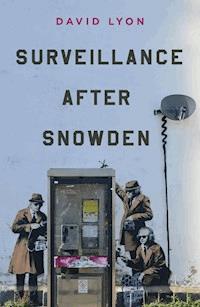
In 2013, Edward Snowden revealed that the NSA and its partners had been engaging in warrantless mass surveillance, using the internet and cellphone data, and driven by fear of terrorism under the sign of ’security’.
In this compelling account, surveillance expert David Lyon guides the reader through Snowden’s ongoing disclosures: the technological shifts involved, the steady rise of invisible monitoring of innocent citizens, the collusion of government agencies and for-profit companies and the implications for how we conceive of privacy in a democratic society infused by the lure of big data. Lyon discusses the distinct global reactions to Snowden and shows why some basic issues must be faced: how we frame surveillance, and the place of the human in a digital world.
Surveillance after Snowden is crucial reading for anyone interested in politics, technology and society.
Sie lesen das E-Book in den Legimi-Apps auf:
Seitenzahl: 263
Veröffentlichungsjahr: 2015
Ähnliche


















Copyright page
Copyright © David Lyon 2015
The right of David Lyon to be identified as Author of this Work has been asserted in accordance with the UK Copyright, Designs and Patents Act 1988.
First published in 2015 by Polity Press
Polity Press
65 Bridge Street
Cambridge CB2 1UR, UK
Polity Press
350 Main Street
Malden, MA 02148, USA
All rights reserved. Except for the quotation of short passages for the purpose of criticism and review, no part of this publication may be reproduced, stored in a retrieval system, or transmitted, in any form or by any means, electronic, mechanical, photocopying, recording or otherwise, without the prior permission of the publisher.
ISBN-13: 978-0-7456-9084-1
ISBN-13: 978-0-7456-9085-8(pb)
A catalogue record for this book is available from the British Library.
Typeset in 10.75 on 14 pt Adobe Janson
by Toppan Best-set Premedia Limited
Printed and bound in the United States by Courier Digital Solutions
The publisher has used its best endeavours to ensure that the URLs for external websites referred to in this book are correct and active at the time of going to press. However, the publisher has no responsibility for the websites and can make no guarantee that a site will remain live or that the content is or will remain appropriate.
Every effort has been made to trace all copyright holders, but if any have been inadvertently overlooked the publisher will be pleased to include any necessary credits in any subsequent reprint or edition.
For further information on Polity, visit our website:
politybooks.com
Preface
This is a book about surveillance, lit up brilliantly by revelations made by Edward Snowden. Since he started to release documents taken from the National Security Agency we know much more about global mass surveillance. It spreads invisibly, capturing gargantuan amounts of personal information from ordinary citizens in its data dragnet. Governments scramble to come to terms with the revelations, sometimes sparking serious policy responses, sometimes diverting attention from the issues or dismissing Snowden as misguided and worse.
Snowden's concern is surveillance, an ancient set of practices but a very prominent means of power today. Governments, corporations, police, indeed organizations of whatever kind, make use of surveillance, intentionally or unintentionally, for good or ill. Surveillance has seeped so far into the very arteries, the capillaries of culture, that it is often seen as an unquestioned requirement of modern life.
The Snowden revelations, although they are clearly about high-level surveillance carried out by security and intelligence agencies, also reflect this resort to surveillance in many contexts. Surveillance occurs in the most high-tech ways and at the pinnacles of power but depends on the humdrum, mundane communications and exchanges that we all make using online media and communication devices such as cellphones. The little messages in tweets and posts are connected with international security in ways that would have been unimaginable to the surveillance novelists and commentators of yesterday.
Some have lauded Snowden as a whistleblower. In the US, former security officers from the NSA, CIA, FBI and the Justice Department recognized his work with the Sam Adams award in October 2013. He also won the 2013 Whistleblower Award in Germany1 and Sweden's alternative Nobel Prize, the Right Livelihood Honorary Award in 2014.2 Snowden has quickly become known everywhere as a controversial figure who dared speak out against mass surveillance in a post-9/11 world. A global public now has surveillance on its radar as never before.
However, at a time when terrorist attacks are frequently in the news – one thinks of the Boston Marathon bombing in 2013 or the Paris attacks on the staff of satirical magazine Charlie Hebdo in 2015 – government reflexes, amplified by shrill media, call for more surveillance, more security. While urgent action is indeed vital to prevent such appalling bloodshed, this book shows that the kinds of mass surveillance Snowden has revealed at the NSA do not work and also carry major risks for ordinary citizens. This suggests that it is more, not less, important to heed Snowden at a time of intensified attacks.
This book is one kind of response. It aims to place the Snowden revelations in context. It shows how our apparently inconsequential little routines and habits and our very life-chances are affected – especially when the social group to which we belong is a minority or for some reason is already singled out for special treatment. And it highlights how surveillance enables or constrains our ability to live freely in democratic societies. So knowing about it – what it is, who practises it and why, and what difference it makes to our lives – is extremely important. As an academic I believe passionately that the fruit of our work should be open and available to the public and also that it should be clear about where it is coming from and what sorts of values it espouses.
So let me come out with it here. Surveillance raises questions of analysis, yes, but also, unavoidably, of politics and ethics. On the analysis side, the issues are huge because they concern global power alignments that skew surveillance in negative ways. The internet is itself a key arena where this plays out. But the sheer scope of the issues is not an excuse for despair, withdrawal or complacency. Human beings are still active agents who can make a difference, especially when they work in concert. Look no further than Edward Snowden, aged just 29, who rocked the world. There are grounds for hope.
On the politics-and-ethics side – they are the other face of the coin whose analytic face I just sketched – surveillance is a site of struggle, of controversy. Its currency is terms such as privacy, civil liberties, human rights. Each of these is profoundly ethical and thus confronts us with questions that are unavoidably philosophical and even spiritual as well as political. What rights do government bodies, the police, or other organizations have to gain access to our private, personal or intimate lives? What are the limits to using categories of suspicion to name someone who may have committed a crime? Why should anyone care about what is done with personal data?
This book takes us from some world-historic events that continue to make headlines to the trends that underlie them and then to the deeper questions lying below the surface. How do I approach these? I acknowledge and try to be aware of what influences my work. I live in Canada, and of course geography affects one's outlook. I write not only as someone interested in the headlines – a citizen – and in explaining trends – a sociologist – but also as one who identifies as a believer, in my case a Christian. This is not the place to explain more fully how this works out in practice, but I have tried to indicate elsewhere why I do what I do in the way I do and if you are interested, please check it out.3
On the trends and sociology side, I have included notes for you to check things for yourself, if you wish, but I have not discussed theory. If that is what you are looking for, the underlying explanations are implied in the text and explored in the works to which the notes refer. I know that for many, the important thing is to get a sense of why there is such a widespread and heated response to the Snowden revelations, what the disclosed documents mean and what can be done about them in an everyday context as well as in law and policy.
My contribution aims to show why Snowden's revelations are so significant, by exposing and exploring the conditions that gave rise to the kinds of surveillance specific to the twenty-first century. What is happening in the world of digital communications that connects our daily doings with worldwide flows of power? What legal limits, policies and practices already exist to help us and what new attitudes and actions are called for?
I deliberately juxtapose the global with the personal, the structural with the active, to show just what the dangers of mass surveillance are and how they can be countered and curbed. It is a call to realism about the risks, which are tremendous, but also to action that might turn the tide. The future is not foreclosed by technology, government or corporate power. However, we can be sure that their negative impacts are enabled by complacency.
Notes
1
The award presented every two years by the Vereinigung Deutscher Wissenschaftler and the German Section of the International Association of Lawyers against Nuclear Arms.
2
See V. Kessler, ‘Edward Snowden wins Sweden's “Alternative Nobel Prize” ’, Reuters, 24 Sept. 2014, at http://in.reuters.com/article/2014/09/24/sweden-snowden-award-nobel-idINKCN0HJ1O920140924/.
3
See, as a starting point, D. Lyon, ‘Surveillance and the eye of God’,
Studies in Christian Ethics
27.1 (2014): 1–12.
Acknowledgements
So-called sole-authored books are seldom such. I depend heavily on many family members, friends and colleagues for their support and patience as well as their direct assistance. I take the blame for blemishes and blunders, of course, but if I can see anything clearly it is because I stand on the shoulders of others. Warm thanks to those who kindly and critically read drafts of this book: Colin Bennett, Andrew Clement, Chiara Fonio, Miriam Lyon, Midori Ogasawara, Chris Prince, Charles Raab, Priscilla Regan, Emily Smith, Valerie Steeves, Didier Bigo and Steve Anderson. Andrea Drugan and the readers for Polity Press also gave valuable direction. Some ideas from published articles found their way into this book, particularly ‘Surveillance, Snowden and Big Data’ in Big Data & Society 1.1 (2014) and ‘The Snowden Stakes’ in Surveillance & Society (2015). I am constantly grateful for the encouragement and help of Joan Sharpe and, especially. Emily Smith, as well as graduate students, postdocs and visiting scholars – this time, Marta Kanashiro – in the Surveillance Studies Centre at Queen's University, which is itself an affirming context. Our children and, now, grandchildren, display a buoying interest in my work. And although this is not the only or best time or place for acknowledging Sue's steadfast support, consistently expressed for well over four decades, I cannot but mention her here. To miss her out would be to miss the most.
Citizenfour Alert!
For now, know that every border you cross, every purchase you make, every call you dial, every cellphone tower you pass, friend you keep, site you visit and subject line you type is in the hands of a system whose reach is unlimited, but whose safeguards are not.
Edward Snowden to Laura Poitras, 2013
The day after the Snowden story broke in The Guardian newspaper in June 2013, I was reading the breathless reports on a flight to Victoria, British Columbia, where I was scheduled to give a conference lecture on ‘The Emerging Culture of Surveillance’. The mass media were clearly reeling from the scope of the scoop: some astounding revelations – the largest leaks ever – about the activities of the highly secretive National Security Agency (NSA) in the US. Many had suspected for some time that the sprawling NSA was responsible for very widespread, rather intrusive but surreptitious surveillance of ordinary citizens.
Lesen Sie weiter in der vollständigen Ausgabe!
Lesen Sie weiter in der vollständigen Ausgabe!
Lesen Sie weiter in der vollständigen Ausgabe!
Lesen Sie weiter in der vollständigen Ausgabe!
Lesen Sie weiter in der vollständigen Ausgabe!
Lesen Sie weiter in der vollständigen Ausgabe!
Lesen Sie weiter in der vollständigen Ausgabe!
Lesen Sie weiter in der vollständigen Ausgabe!




