


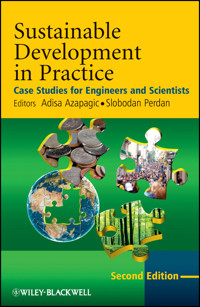
Sustainable Development in Practice E-Book
53,99 €
Mehr erfahren.
- Herausgeber: John Wiley & Sons
- Kategorie: Wissenschaft und neue Technologien
- Sprache: Englisch
Sustainable Development in Practice: Case Studies for Engineers and Scientists, Second Edition explores the concept of sustainable development and its implications for science and engineering. It looks at how sustainability criteria can be combined with traditional scientific and engineering considerations to design and operate industrial systems in a more sustainable manner. Taking a life cycle approach to addressing economic, environmental and social issues, the book presents a series of new practical case studies drawn from a range of sectors, including mining, energy, food, buildings, transport, waste, and health. Written in an accessible style, the book opens with a general introduction to the concept of sustainable development and explores its practical implications for technical experts. Recognising that practical application of sustainable development depends on the context, the second part of the book is devoted to case studies. The case studies explore scientific and technical aspects alongside relevant environmental economic and social issues. The key features of this completely revised and updated second edition include: * Twelve new chapters, including the case studies on nuclear energy, biofuels, aviation, buildings, urban transport, food, sanitation and health. * Six completely revised chapters * Coverage of a wide range of sustainability issues in both developed and developing countries * Integration of scientific and technical aspects with economic, environmental and social considerations * Discussion of policy implications * Communication with the non-engaging and non-scientific audience Considered essential reading for all engineers and scientists concerned with sustainable development, Sustainable Development in Practice: Case Studies for Engineers and Scientists, Second Edition also provides key reading and learning materials for undergraduate and postgraduate science and engineering students.
Sie lesen das E-Book in den Legimi-Apps auf:
Seitenzahl: 983
Veröffentlichungsjahr: 2011
Ähnliche




















Contents
About the Editors
List of Contributors
Preface
Part 1
1 The Concept of Sustainable Development and its Practical Implications
Slobodan Perdan
1.1 Introduction
1.2 Development of the Concept
1.3 Sustainable Development: Implementation
1.4 Economic Growth, Environmental Constraints and Social Concerns
1.5 Equity and Sustainable Development
1.6 Conclusions
References and Further Reading
2 Measuring Sustainable Development: An Overview
Slobodan Perdan and Adisa Azapagic
2.1 Introduction
2.2 Measuring Sustainability at International Level
2.3 National-Level Indicators
2.4 Local-Level Indicators
2.5 Measuring Corporate Sustainability
2.6 Conclusions
References and Further Reading
3 Assessing Environmental Sustainability: Life Cycle Thinking and Life Cycle Assessment
Adisa Azapagic
3.1 Life Cycle Thinking
3.2 Life Cycle Assessment
3.3 Using LCA as an Environmental Sustainability Tool: Some Examples
3.4 Conclusions
References and Further Reading
Part 2
4 Translating the Principles of Sustainable Development into Business Practice: An Application in the Mining and Minerals Sector
Adisa Azapagic and Slobodan Perdan
4.1 Introduction
4.2 Corporate Sustainability Management System
4.3 Case Study: An Application of the CSR Management System in the Mining and Minerals Sector
4.4 Conclusions
5 References and Further Reading
5 Climate Change and Policy: The Case of Germany
Wolfram Krewitt and Hans Müller-Steinhagen
5.1 Energy in the Sustainability Context
5.2 From Principles to Practice: Successful Policy Support for Renewable Energy in Germany
5.3 A Long-Term Strategy for Increasing the Use of Renewable Energies in Germany
5.4 Conclusions
Acknowledgements
References and Further Reading
6 Sustainability Assessment of Biofuels
Adisa Azapagic and Heinz Stichnothe
6.1 Introduction
6.2 Production of Biofuels
6.3 Sustainability Assessment of Biofuels
6.4 Conclusions
Acknowledgements
References and Further Reading
7 Scenario Building and Uncertainties: Options for Energy Sources
Richard Darton
7.1 Sustainability and the Need to Look Ahead
7.2 Thinking about the Future
7.3 General Approach to Formulating Strategies
7.4 Dealing with Uncertainty: The Scenario Approach
7.5 Energy Scenarios: Glimpsing the Future?
7.6 Implications of Different Energy Scenarios for Sustainable Development
7.7 Conclusions
References and Further Reading
8 Fuel Cells in Stationary Applications: Energy for the Future?
Martin Pehnt
8.1 Energy Today: Why a Substantial Transformation is Necessary
8.2 Fuel Cells: An Old Invention
8.3 Case Study: Fuel Cells for Distributed Power Generation
8.4 Conclusions
Acknowledgement
References and Further Reading
9 Sustainability of Nuclear Power
Adisa Azapagic and Slobodan Perdan
9.1 Introduction
9.2 Nuclear Power
9.3 The Life Cycle of Nuclear Power
9.4 Environmental Impacts of Nuclear Power
9.5 Economic Aspects of Nuclear Power
9.6 Social Considerations
9.7 Conclusions
Acknowledgements
References and Further Reading
10 Municipal Solid Waste Management: Recovering Energy from Waste
Adisa Azapagic
10.1 Introduction
10.2 Integrated MSW Management
10.3 Energy Recovery from MSW
10.4 Case Study: A Proposal for a New EfW Plant
10.5 Final Considerations: Stakeholders’ Views and the County Council Decision
10.6 Conclusions
References and Further Reading
11 Sustainability Issues in Food Provisioning Systems
Adisa Azapagic, Heinz Stichnothe and Namy Espinoza-Orias
11.1 Introduction
11.2 Environmental Issues
11.3 Economic Issues
11.4 Social and Ethical Issues
11.5 Case Studies
11.6 Conclusions
Acknowledgements
References and Further Reading
12 Providing Sustainable Sanitation
Richard Fenner and Amparo Flores
12.1 Providing Sustainable Sanitation Solutions
12.2 The Need for Alternatives to Conventional Sanitation
12.3 Incorporating Sustainability Considerations into Sanitation Provision
12.4 Sustainability Features of Sanitation Systems
12.5 Sanitation Technologies
12.6 Sustainability Evaluations of Sanitation Systems
12.7 Case Study: Rural/Peri-Urban Provision of Sanitation in eThekwini Municipality, South Africa
12.8 Conclusions
Acknowledgements
References and Further Reading
13 Sustainable Process Design: The Case of Vinyl Chloride Monomer (VCM)
Adisa Azapagic
13.1 Design, Systems and Life Cycles
13.2 Sustainable Process Design
13.3 Case Study: Designing a More Sustainable Vinyl Chloride Monomer (VCM) Process
Acknowledgements
References and Further Reading
14 Urban Sustainability: The Case of Transport
Slobodan Perdan and Adisa Azapagic
14.1 Introduction
14.2 Environmental and Social Impacts of Urban Transport
14.3 Car Dependency and its Implications for Sustainability of Urban Transport
14.4 Measures to Promote Sustainable Transport
14.5 Conclusions
Acknowledgements
References and Further Reading
15 Aviation and its Response to Environmental Pressure
Alice Bows and Kevin Anderson
15.1 Aviation and its Response to Environmental Pressure
15.2 Climate Change and Evolving Context
15.3 Aviation and Evolving Context
15.4 Aviation and Climate Change Conflict
15.5 Global Context
15.6 Conclusions
Acknowledgments
References and Further Reading
16 Health Impact Assessment of Urban Pollution
Zaid Chalabi and Tony Fletcher
16.1 Introduction
16.2 Health Impact Assessment
16.3 Health Impact Assessments of Urban Pollution
16.4 Case Study: Health Impact Assessment of Schiphol Airport
16.5 Conclusions
Acknowledgements
References and Further Reading
17 Social and Ethical Dimensions of Sustainable Development: Mining in Kakadu National Park
Slobodan Perdan
17.1 Introduction
17.2 Mining and Sustainable Development
17.3 Case Study: Mining in Kakadu National Park
17.4 Role-Play Exercise
17.5 Conclusions
17.6 Post Scriptum
References and Further Reading
Index
To
Wolfram Krewitt (1962–2009)
whose passion for sustainable development will be greatly missed
This edition first published 2011 © 2011 by John Wiley & Sons, Ltd.
Wiley-Blackwell is an imprint of John Wiley & Sons, formed by the merger of Wiley’s global Scientific, Technical and Medical business with Blackwell Publishing.
Registered office:
John Wiley & Sons Ltd, The Atrium, Southern Gate, Chichester, West Sussex, PO19 8SQ, UK
Editorial offices:
9600 Garsington Road, Oxford, OX4 2DQ, UKThe Atrium, Southern Gate, Chichester, West Sussex, PO19 8SQ, UK111 River Street, Hoboken, NJ 07030-5774, USA
For details of our global editorial offices, for customer services and for information about how to apply for permission to reuse the copyright material in this book please see our website at www.wiley.com/wiley-blackwell.
The right of the author to be identified as the author of this work has been asserted in accordance with the UK Copyright, Designs and Patents Act 1988.
All rights reserved. No part of this publication may be reproduced, stored in a retrieval system, or transmitted, in any form or by any means, electronic, mechanical, photocopying, recording or otherwise, except as permitted by the UK Copyright, Designs and Patents Act 1988, without the prior permission of the publisher.
Designations used by companies to distinguish their products are often claimed as trademarks. All brand names and product names used in this book are trade names, service marks, trademarks or registered trademarks of their respective owners. The publisher is not associated with any product or vendor mentioned in this book. This publication is designed to provide accurate and authoritative information in regard to the subject matter covered. It is sold on the understanding that the publisher is not engaged in rendering professional services. If professional advice or other expert assistance is required, the services of a competent professional should be sought.
Library of Congress Cataloguing-in-Publication Data
Sustainable development in practice : case studies for engineers and scientists / editors,Adisa Azapagic and Slobodan Perdan. – 2nd ed.p. cm.Includes index.ISBN 978-0-470-71871-1 (cloth) – ISBN 978-0-470-71872-8 (pbk.)1. Engineering–Research. 2. Sustainable development. I. Azapagic, Adisa. II. Perdan, Slobodan.TA160.S87 2011620.0028’6–dc222010029203
About the Editors
Adisa Azapagic is Professor of Sustainable Chemical Engineering at The University of Manchester. Her research interests are in the areas of engineering for sustainable development, life cycle assessment, sustainable consumption and production and corporate sustainability. She has published widely in these areas, including the book on Polymers, the Environment and Sustainable Development, also published by Wiley. Adisa has held a number of international honorary appointments, such as: Erskine Fellow at University of Canterbury; UNESCO/ICSU/TWAS Fellow at ITAM, Mexico City; and Royal Academy of Engineering & Leverhulme Trust Scholar at University of Sydney.
Dr. Slobodan Perdan is Research Fellow at the University of Manchester. He is a philosopher by background with expertise and interests in the areas of sustainable development and moral philosophy. He has written on a variety of issues concerning sustainable development and has researched a wide range of subjects, including environmental philosophy, engineering ethics and corporate sustainability.
List of Contributors
Kevin Anderson School of Mechanical, Aerospace and Civil Engineering, The University of Manchester, Manchester M13 9PL, UK
Adisa Azapagic School of Chemical Engineering and Analytical Science, The University of Manchester, Manchester M13 9PL, UK
Alice Bows School of Earth, Atmospheric and Environmental Sciences and Sustainable Consumption Institute, The University of Manchester, Oxford Road, Manchester M13 9PL, UK
Zaid Chalabi London School of Hygiene & Tropical Medicine, Keppel Street, London WC1E 7HT, UK
Richard Darton Keble College, Oxford University, Oxford OX1 3PG, UK
Namy Espinoza-Orias School of Chemical Engineering and Analytical Science, The University of Manchester, Manchester M13 9PL, UK
Richard Fenner Centre for Sustainable Development, Department of Engineering, University of Cambridge, Trumpington Street, Cambridge CB2 1PZ, UK
Tony Fletcher London School of Hygiene & Tropical Medicine, Keppel Street, London WC1E 7HT, UK
Amparo Flores Centre for Sustainable Development, Department of Engineering, University of Cambridge, Trumpington Street, Cambridge CB2 1PZ, UK
Wolfram Krewitt German Aerospace Centre, Institute of Technical Thermodynamics, Pfaffenwaldring 38–40, 70569 Stuttgart, Germany
Hans Müller-Steinhagen German Aerospace Centre, Institute of Technical Thermodynamics, Head of Institute, Pfaffenwaldring 38–40, 70569 Stuttgart, Germany
Martin Pehnt Institut für Energie- und Umweltforschung, Heidelberg, Germany
Slobodan Perdan School of Chemical Engineering and Analytical Science, The University of Manchester, Manchester M13 9PL, UK
Heinz Stichnothe School of Chemical Engineering and Analytical Science, The University of Manchester, Manchester M13 9PL, UK and vTI, Institut für Agrartechnologie und Biosystemtechnik, Bundesallee 50, 38116 Barunschweig, Germany
Preface
This book is about sustainable development and its implications for science and engineering practice. It is aimed at engineering and science students and educators, as well as practising engineers and scientists.
Part 1 of the book explores the concept of sustainable development and its practical implications, gives an overview of the main approaches to measuring sustainability and introduces life cycle thinking, the approach applied throughout the book.
Recognising that practical interpretation of sustainable development depends on the context, Part 2 of the book is devoted to case studies. These are drawn from a range of sectors, including mining and minerals, energy, waste, food, health, sanitation, and transport. They explore scientific and technical aspects of different systems, but also consider relevant economic, environmental and social ramifications to position engineering and scientific practice in the context of sustainable development.
As demonstrated throughout the book, sustainable development poses significant challenges to science and engineering. However, we hope that the book also shows that meeting these challenges provides engineers and scientists with an opportunity to contribute to a better quality of life for everyone, now and in the future.
Adisa Azapagic and Slobodan Perdan
Manchester, April 2010
PART 1
1
The Concept of Sustainable Development and its Practical Implications
Slobodan Perdan
Sustainable development is an approach to development which focuses on integrating economic activity with environmental protection and social concerns. This chapter describes the emergence of the concept of sustainable development as a response to destructive social and environmental effects of the prevailing approach to economic growth and discusses its practical implications. The chapter argues that the transition to a more sustainable society requires new ways of meeting our needs which can reduce the level of material consumption and reduce environmental damage without affecting quality of life. This will require, above all, limiting the throughput of materials and energy in the economy and finding less wasteful ways of meeting needs through increasing efficiency, reusing materials and using sustainable technologies. However, as the chapter points out, meeting the objective of sustainable development requires not only reducing the scale of polluting activities and excessive levels of consumption, but also calls for well-planned actions to alleviate poverty and achieve greater equity and distribution of opportunities both within and between countries.
1.1 Introduction
Around the world we see signs of severe stress on our interdependent economic, environmental and social systems. Population is growing – it topped 6 billion in 2000, up from 4.4 billion in 1980, and it is expected to reach 8 billion by 2025 (UNCSD, 2002). Excessive consumption and poverty continue to put enormous pressure on the environment. In many areas, the state of the environment is much more fragile and degraded than it was a few decades ago. Despite notable improvements in areas such as river and air quality in places like Europe and North America, generally there has been a steady decline in the environment, especially across large parts of the developing world (UNEP, 2002, 2007).
There are some alarming trends underway. Most recent global environmental assessments (UNEP, 2002, 2007, 2009; MA, 2005; Solomon et al., 2007) put them into stark figures, characteristic examples of which include:
Twenty per cent of Earth’s land cover has been significantly degraded by human activity and 60% of the planet’s ecosystems are now damaged or threatened (UNEP, 2009).Species are becoming extinct at rates which are a 100 times faster than the rate shown in the fossil record, because of land-use changes, habitat loss, overexploitation of resources, pollution and the spread of invasive alien species (MA, 2005; UNEP, 2007). Of the major vertebrate groups that have been comprehensively assessed, over 30% of amphibians, 23% of mammals and 12% of birds are threatened (UNEP, 2007).Concentrations of carbon dioxide, the main gas linked with global warming, currently stand at 386 parts per million, or more than 25% higher than in 150 years ago. Concentrations of other greenhouse gases, such as methane and halocarbons, have also risen (Solomon et al., 2007).Global average temperatures have risen by about 0.74 °C since 1906, and the rise this century is projected to be between 1.8 and 4 °C; some scientists believe a 2 °C increase would be a threshold beyond which the threat of major and irreversible damage becomes more plausible (Solomon et al., 2007; UNEP, 2007).Available freshwater resources are declining: some 80 countries, amounting to 40% of the world’s population, are suffering serious water shortages; by 2025, 1.8 billion people will live in countries with absolute water scarcity (UNEP, 2007).Around half of the world’s rivers are seriously depleted and polluted (UNEP, 2002).More than 2 million people worldwide are estimated to die prematurely every year from indoor and outdoor air pollution (UNEP, 2007).Other noteworthy trends include:
Around 1.4 billion people are living in extreme poverty (measured as $1.25 a day) (UN, 2009);The number of hungry people worldwide grew to 963 million, or about 14.6% of the world population of 6.6 billion, representing an increase of 142 million over the figure for 1990–1992 (FAO, 2009);More than 100 million primary school age children remain out of school (UN, 2009);Around 1.1 billion people still lack access to safe drinking water and an estimated 2.6 billion people today lack improved sanitation facilities (UNEP, 2007);Poverty claims the lives of 25 000 children each day (UNICEF, 2000).These and a host of other trends suggest that our current development course is unsustainable. The high and increasing consumption of scarce resources, the resulting pollution compounded by population growth and the growing imbalance in development between different countries pose unacceptable risks to communities, nations and humanity as a whole. It has become clear that economic development that disregards environmental and social impacts can bring unintended and unwanted consequences, as evidenced by the threat of climate change, overuse of freshwater resources, loss of biological diversity and raising inequalities.
The concept of sustainable development has grown out of concerns about these adverse trends. In essence, it is an approach to development which focuses on integrating economic activity with environmental protection and social concerns.
1.2 Development of the Concept
The concept of sustainable development as we know it today emerged in the 1980s as a response to the destructive social and environmental effects of the prevailing approach to ‘economic growth’.
The idea originated within the environmental movement. One of the earliest formulations of the concept of sustainable development can be found in the 1980’s World Conservation Strategy jointly presented by the UN Environment Programme, the World Wildlife Fund and the International Union for Conservation of Nature and Natural Resources (IUCN/UNEP/WWF, 1980). This early formulation emphasized that:
Lesen Sie weiter in der vollständigen Ausgabe!
Lesen Sie weiter in der vollständigen Ausgabe!
Lesen Sie weiter in der vollständigen Ausgabe!
Lesen Sie weiter in der vollständigen Ausgabe!
Lesen Sie weiter in der vollständigen Ausgabe!
Lesen Sie weiter in der vollständigen Ausgabe!
Lesen Sie weiter in der vollständigen Ausgabe!
Lesen Sie weiter in der vollständigen Ausgabe!
Lesen Sie weiter in der vollständigen Ausgabe!
Lesen Sie weiter in der vollständigen Ausgabe!
Lesen Sie weiter in der vollständigen Ausgabe!
Lesen Sie weiter in der vollständigen Ausgabe!
Lesen Sie weiter in der vollständigen Ausgabe!
Lesen Sie weiter in der vollständigen Ausgabe!
Lesen Sie weiter in der vollständigen Ausgabe!
Lesen Sie weiter in der vollständigen Ausgabe!
Lesen Sie weiter in der vollständigen Ausgabe!
Lesen Sie weiter in der vollständigen Ausgabe!




