


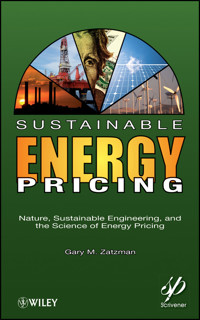
Sustainable Energy Pricing E-Book
164,99 €
Mehr erfahren.
- Herausgeber: John Wiley & Sons
- Kategorie: Wissenschaft und neue Technologien
- Sprache: Englisch
This is the first book to address the issues of affordable power, sustainable energy, and reduced environmental impact through the science of energy pricing. Looking at the availability of natural resources from an engineering perspective, and determining how they can be priced to achieve sustainability in the energy sector, is the aim of this groundbreaking new work. Most current models used in energy pricing are based on linear analyses. While these models work well for targeted scenarios within a short time frame, they do not provide one with a scientific tool that can include many facets of the information age. The existing models do not include environmental sustainability in an integrated fashion. This is mainly because environmental costs are still considered to be intangible, and intractable with conventional economic analysis tools. Though one existing model acknowledges some possible theoretical truth to concerns expressed about the onset of 'peak oil'--the period in which new oil production must begin a decline of unknown and indefinite duration --this model has little or nothing to say about continuing practices in the extraction and production of fossil fuel that are themselves based on denying any significance or role for such thinking in the immediate future. A serious limitation of that discourse is its insistence on polarizing opinions "for" or "against" environmental sustainability, peak oil, and affordable energy prices. This book proceeds instead to isolate the absence of any agreed criteria for what would constitute inherently sustainable development and examines the main outlines of the history and political economy of energy resource exploration and development since the 1850s from this standpoint. It proposes specific directions in which to take some of the leading alternatives and amendments to current energy pricing practices (as well as some of the most promising energy development alternatives) in order to fulfill the time criteria required for an inherently sustainable trend. The author shows how, and why, identifying unsustainable practices and consequences can make a case for closing down particular oil and gas production operations, while averting the time-wasting approach of trying to fix what really has gone beyond fixing. However, it is possible, necessary, and actually far better to replace these methods with newer, scientifically based methods for achieving overall energy sustainability.
Sie lesen das E-Book in den Legimi-Apps auf:
Seitenzahl: 1105
Veröffentlichungsjahr: 2012
Ähnliche




















Contents
Cover
Half Title page
Title page
Copyright page
Dedication
Acknowledgements
Preface
Introduction
0.1 Requirements of a Sustainable Energy Pricing Model
0.2 Outline of the Contents of this Volume
Chapter 1: Fundamental Notions
1.1 “Energy Crunch” or: The Problems and Issues of Modeling an Energy Price
1.2 Matter, Energy, and Efficiency from Scientific Standpoint
1.3 Truth as a Scientific Frame of Reference
1.4 Phenomenally-based Sustainability: The Nature-science Criterion
1.5 Value Assessment, Value Addition and Phenomenally-based Energy Pricing
1.6 Newtonian ‘Mechanism’ and Mystification of How Value is Transformed into Price
1.7 Risk Assessment & Management and Aphenomenal Energy Pricing
1.8 The Temporal Criterion of Long-term Sustainability and its Implications
Documents
A. Timeline of Critical Events for Enron in the Period August 2001 to December 2001
B. Enron Segment and Stock Market Performance 1993-2000
C. The Temporal Horizon In Which Diligence Can Become Undue
D. Darwinian Pessimism and the Foreshortening of Temporal Horizons
E. Enron and the Foreshortening of Temporal Horizons
Chapter 2: Newtonian Mechanism and the Deconstruction of Scientific Disinformation
2.1 Introduction
2.2 Einstein’s Relativity and Newton’s Mechanism Compared
2.3 Newton’s First Assumption
2.4 Fundamental Assumptions of Electromagnetic Theory
2.5 The Engineering Approach and Its Significance
2.6 First Conclusions
2.7 Continuity and Linearity
Chapter 3: Offshore Networks of Control: Providing Short-Term Multi-Entity International Oil and Gas Plays with a Guarantee
Chapter 4: Current Energy Pricing Models: Origins & Problems
4.1 Consumption without Production
4.2 Imposed Energy Pricing
4.3 Inherent Features of the Current Energy-Pricing Model: Matters Affecting Individuals’ Daily Existence
4.4 Societal Implications of the Current Energy-pricing Model for the Long Term
4.5 Long-term vs Short-term Returns-on-investment [ROI] from Energy Exploration & Development
4.6 Resource “Renewability” and ‘Sustainable Negative Rent’
Chapter 5: The Role of Coal in the Modern Evolution of Energy Pricing
5.1 Introduction
5.2 Significance of Commodifying Labor-time & All Material Production — Including its Energy Source
5.3 From “Law of Supply & Demand” (at the margin) to “Consumption without Production”
Document
A. History of U.S. Coal Use [extract]
Chapter 6: Carbon Emission Credits — Theory & Practice
6.1 Introduction
Documents
A. The Kyoto Clean Development Mechanism Gold Standard
B. Thoughts on the Relative Merits of Cap-and-Trade Versus Emission Taxes for Controlling Carbon Emissions
C. U.S. House Passes Repeal of EPA Carbon Rules Over White House Objections
D. Carbon Trading: A Method for Preserving the Environment and Reducing Poverty
E. Canadian Law with Regard to Carbon Emission Regulation
F. Carbon Capture and Storage - Identified Challenges to Implementation
G. North America Bets on “Carbon Capture and Storage” (CCS)
H. Canadian Implications of U.S. Climate Change Regulation
I. The Taxation of Tradable Permits
J. Ottawa Unveils Carbon-offset System
K. Ontario Introduces Cap-and-trade Legislation
L. Canada Moves Forward on Domestic Emissions Trading Market
M. Carbonmail?
Executive Summary
Distribution of fossil fuel reserves between stock exchanges
Chapter 7: “Peak Oil” and Other Fits of Pique Among Resource Economists
7.1 Introduction
7.2 Human Factor Social Consciousness & “Abstracting Absence”
Document
The Achnacarry Agreement and the “As Is” System
The Entry of Kuwait onto the World Market
Aramco and the Containment of Saudi Arabian Expansion
Notes
Bibliography
Introductory Note
I. Bibliography
II. Websites
Appendix: Disinformation in the Social & Historical Sciences: Concerning Time Functions and Sustainability of Resource Development
A.1 Introduction
A.2 Detaching Canada’s East Coast Fishery from its History: Causes and Consequences
A.3 The Mishandling of Temporal Factors Analysed as a Problem of Method
A.4 Social Science and the Problem of Linearised Time
A.5 Placing tLINEAR on Life Support
A.6 Merchant’s Capital — Key Historic Intangible of the East Coast Fishery
A.7 The 800-Pound Gorilla
Index
Sustainable Energy Pricing
Scrivener Publishing3 Winter Street, Suite 3Salem, MA 01970
Scrivener Publishing Collections Editors
James E. R. Couper
Ken Dragoon
Richard Erdlac
Rafiq Islam
Norman Lieberman
Peter Martin
W. Kent Muhlbauer
Andrew Y. C. Nee
S. A. Sherif
James G. Speight
Publishers at ScrivenerMartin Scrivener (martin@scrivenerpublishing.com)Phillip Carmical (pcarmical@scrivenerpublishing.com)
Copyright © 2012 by Scrivener Publishing LLC. All rights reserved.
Co-published by John Wiley & Sons, Inc. Hoboken, New Jersey, and Scrivener Publishing LLC, Salem, Massachusetts.Published simultaneously in Canada.
No part of this publication may be reproduced, stored in a retrieval system, or transmitted in any form or by any means, electronic, mechanical, photocopying, recording, scanning, or otherwise, except as permitted under Section 107 or 108 of the 1976 United States Copyright Act, without either the prior written permission of the Publisher, or authorization through payment of the appropriate per-copy fee to the Copyright Clearance Center, Inc., 222 Rosewood Drive, Danvers, MA 01923, (978) 750-8400, fax (978) 750-4470, or on the web at www.copyright.com. Requests to the Publisher for permission should be addressed to the Permissions Department, John Wiley & Sons, Inc., 111 River Street, Hoboken, NJ 07030, (201) 748-6011, fax (201) 748-6008, or online at http://www.wiley.com/go/permission.
Limit of Liability/Disclaimer of Warranty: While the publisher and author have used their best efforts in preparing this book, they make no representations or warranties with respect to the accuracy or completeness of the contents of this book and specifically disclaim any implied warranties of merchantability or fitness for a particular purpose. No warranty may be created or extended by sales representatives or written sales materials. The advice and strategies contained herein may not be suitable for your situation. You should consult with a professional where appropriate. Neither the publisher nor author shall be liable for any loss of profit or any other commercial damages, including but not limited to special, incidental, consequential, or other damages.
For general information on our other products and services or for technical support, please contact our Customer Care Department within the United States at (800) 762-2974, outside the United States at (317) 572-3993 or fax (317) 572-4002.
Wiley also publishes its books in a variety of electronic formats. Some content that appears in print may not be available in electronic formats. For more information about Wiley products, visit our web site at www.wiley.com.
For more information about Scrivener products please visit www.scrivenerpublishing.com.
Library of Congress Cataloging-in-Publication Data:
Zatzman, Gary.Sustainable energy pricing / Gary Zatzman.p. cm.Includes bibliographical references and index.ISBN 978-0-470-90163-21. Petroleum products--Prices. 2. Natural gas--Prices. 3. Petroleum industry and trade. 4. Gas industry. 5. Energy consumption. 6. Energy development. I. Title.HD9560.4.Z38 2012333.79--dc23 2011043328
ISBN 978-0-470-90163-2
The following work is dedicated to all those men and women of science, and of conscience, who continue in all conditions to seek truth from facts to serve people
Acknowledgements
All judgments and any potential errors expressed in this book (and in the companion volume entitled Sustainable Resource Development: How to Achieve Zero-Waste and Sustainability in Energy Engineering) are entirely my own. Along the way down this path, however, I have shared the company of various personal, intellectual and professional fellow-travelers. Here is where I acknowledge publicly my appreciation and thanks — some personally, some collectively but anonymously, some even posthumously — for their inspiration, help and support through the processes of this book’s eventual gestation and birth pangs.
First and foremost there is the incredible patience and support, ‘through thick and thicker,’ as she would put it, of fellow writer and professional colleague Rhoda Shapiro, the woman with whom I happily share a life sentence as well as a life of sentences. The love and support of our various networks of family and friends also proved critical for surmounting many obstacles along the way. The support at all levels of Isaac Saney, academic colleague and friend, has been constant and appreciated also beyond words, as has that of Charles Spurr, a salt-of-the-earth friend who always seems to be there when we need him.
A dense and often toxic fog of disinformation engulfs the truth about how the modern economy actually robs Humanity of so much of its true potential. The inspiration to produce a work about sustainable development that would cut through all that originated personally for me from the life and work of Hardial Bains (1939-1997). With his co-workers, he elaborated the “necessity for change” analysis more than 45 years ago that continues — among its many other benefits too numerous to catalogue here in this brief space — to open the eyes of new generations about the tricks, traps and prejudices of Eurocentric outlook in world politics and economics.
The idea of taking such an outlook and applying it to examine how the economics and engineering of resource development could be turned towards genuinely sustainable development that would no longer rape the natural environment was the gift of Prof. Mohamed Rafiq Islam, the editor of the series of which the present book forms part. His confidence in my ability to nail the question squarely and his unflagging personal, academic and intellectual support, along with that of his sons Jaan and Ali Omar, produced a number of life-altering moments en route to delivery of the final version of this book’s manuscript to the publisher.
Through Professor Islam’s research group, I enjoyed the rare privilege to work closely with Shabbir Mustafiz, who happily served as a sounding-board and effective puncturer of some of my more absurd balloons, as well as to hold many discussions about “true sustainability” with Mohamed Ibrahim Khan (the “M.I. Khan” of this book’s Bibliography), which is gone into in some depth in the second volume.
On a closing professional note, I have been very lucky to be able to collaborate professionally with Phil Carmical and his team at Scrivener Publishing, whose confidence in my abilities sustained us through one or two darker moments.
Preface
This volume, like its companion volume (Sustainable Resource Development), is organized into an introductory chapter, seven chapters of content and an appendix. The underlying question posed throughout this book is: Does resource extraction — and the subsequent economic development patterns dependent on those processes of primary energy-source production — have to end badly for the natural environment? Accordingly, the chapters create their dissonant atonal symphony, exploring a number of aspects of economic theory and where they fit — or more properly: fail to fit — any rational plan of sustainable development. The appendix supplies the coda, in the form of an exploration of aspects of the 500-year history of commercial exploitation of the ocean fisheries on the Continental Shelf of the northwest Atlantic. It is not an understatement to say that, for the first 470 years, the harvesting of these resources posed little or no threat either to the marine environment nor to the present or future prospects of the coastal communities most involved in this activity. However, in the last 30 years of that half-millennium, what remained was literally raped from stem to stern at unprecedented speed. The historical exegesis brings out in striking manner how far off-base both the promoters of this fishery and its critics actually were with regard to the conduct of this fishery in modern economic conditions of vertically-integrated resource extraction. None of them manifested the slightest awareness of how this fishery could have averted the dramatic collapse that eventually destroyed the livelihood of the families of more than 40,000 commercial fishermen from the Canadian provinces of Newfoundland and Labrador, Quebec and Nova Scotia after 1992. This dialogue of the deaf was manifest not only in the late 1970s — as the struggle over the northwest Atlantic fisheries’ future heated up to become one of the sideshows of the global confrontation between the U.S. and Soviet superpowers over control of the world’s oceanic spaces. The same thinking that failed to address the problems of that time was being repeated 30 years later by some of the most vociferous critics of the antics of the trawling fleets, Canadian and foreign, back in the 1970s.
Finally, a word about the subtitle of this book: “Creating A Sustainable Environment and Economy Through a New Science of Energy Pricing.” Just to clarify the matter up front for the reader: the author does not actually set out a “science of energy pricing.” The aim of this book is to initiate that process by preparing the necessary groundwork.
The late Nobel physics laureate Richard Feynman, in his 1985 autobiographical memoir ‘Surely You’re Joking, Mr. Feynman’ : Memoirs of a Curious Character, set forth his vision of the meaningful content of the notion of “scientific integrity” in an arresting manner, with an anecdote from the annals of actual scientific research in the field of behavioral psychology. Although students in the field are carefully schooled in the concept of “conditioned stimulus - conditioned response” (CS-CR) including spending hours in the laboratory with mice running various experiments premised on the truth of this fundamental notion, what Feynman learned was that students are never steered towards actually testing the veracity of the CS-CR hypothesis itself, viz., that the response of the mammalian brain can be trained or conditioned by a consciously-planned series of stimuli. Looking further into the matter, he uncovered a research paper published before the Second World War whose author deliberately attempted to replicate the original experiments of John Watson purporting to demonstrate the CS-CR hypothesis. The investigator relaxed the condition that CS-CR be assumed true and sought alternative explanations for the lab mice’s responses to various conditioned stimuli. He narrowed down one-by-one all other possible physical causes for the stampeding of the mice through the experiment’s “maze” apparatus to get their “food” reward. He found the strongest and most positive correlation existed between the level of vibration of the boards of the raceways in the apparatus and when mice from various points inside the apparatus found their way through the correct series of tunnels in the maze to the reward-point. As he removed all possible sources of vibratory transmission from inside the apparatus, he reached a point where the response of the mice could no longer be said to correspond to the original stimulus. Feynman noted that he could find no references to this experiment anywhere in the literature: it disappeared, or perhaps was “disappeared” by those who sniffed its devastating implication that the CS-CR hypothesis itself was unproven. Feynman hailed the experiment for its profound pædagogical value as a basic primer in scientific integrity — and for teaching everything one would need to know about how to verify the CS-CR hypothesis experimentally.
In this book and the above-mentioned companion work, neither is any cookbook recipe provided for guaranteeing sustainable pricing of energy, nor is it suggested that there is any guaranteed or specific way of arriving at sustainable energy pricing. However, every effort has been made to supply the reader with everything needed for implementing a positive intention to develop and implement practical steps of various kinds towards such a goal.
Introduction
Within the real-life subject-matter of this book and its companion volume, Sustainable Resource Development, a serious if largely silent struggle carries on beneath the surface of the exploration and production of fossil fuels, or “alternative” energy sources, in their original state. It is a war that is under way between the real value of these energy sources as “gifts of nature” on the one hand, and the nominal value they acquire in the form of a market price on the other.
Many features of this struggle lie as hidden from view or otherwise just beyond our full understanding as the earth’s reservoirs of oil and gas themselves, the atmospherics driving the world’s wind farms, or the solar fluxes reaching our planet. The veil concealing some of the processes of research and engineering applications is being gradually lifted. That is the mission, for example, of the work to simulate exploration and production prospects as a “virtual reservoir” (Islam et al., 2006). This line of investigation has also provided a starting-point from which to re-examine many aspects of energy pricing that have long been taken for granted. An entire “futuristic” energy-pricing model is implicit in the virtual reservoir, for example. This is a model that incorporates solutions to many other problems, from tackling “global warming"/"climate change” to accomplishing a zero-waste lifestyle. Hence this work’s subtitle: Creating A Sustainable Environment and Economy Through a New Science of Energy Pricing. The solutions incorporated in the concept of the “virtual reservoir” are emblematic of something more general incorporated in that subtitle and provoking widespread debate.
Sustainable energy pricing is inconceivable without sustainable development of energy resources of all kinds, beyond fossil fuels or the conversion of thermal energy into electricity in various forms. At the core of serious efforts to frame solutions to this problem stands a profound epistemological issue that all societies have been grappling with. Serious differences have emerged over how to collect, summarize or even make use of a wide range of sources of knowledge about, on the one hand, what works (or has worked) in the natiural environment without much if any conscious human-engineered intervention and about, on the other hand, what seems to work at laboratory scale but goes on to perform poorly when taken out of the lab to be applied ‘in the field.’
When it comes to broad society-wide problems with energy sufficiency, there is a class of solutions that depends in the first place on a deliberate decision to render, as consciously as possible, all the knowledge gathered about available energy resources. This human factor, or what might be better described as “understanding based on acts of finding out,” is decisive.1 Repeatedly, society emerges from a stage of seeming beset by various problems to a stage of accomplishing solutions. Subsequent developments disclose how partial and incomplete previous solutions were. This movement itself becomes fundamental to how human beings socialize their relations in the realm of material production. At the level of theory and its cognition, this fundamental movement expresses itself as a process, or processes, of becoming conscious. Although the dawn of awareness is conventionally represented as a light bulb going on above the head, the movement being spoken of here expresses itself as a struggle waged to establish actual knowledge of a way forward to solutions. This process emerges as a two-phase movement: there is a “theory” phase and a “practice” phase. The work of Theory elaborates the essential principles of a solution. At the same time, Practice develops as the realm in which humans individually and in society sort out precisely how principles elaborated at the level of theory are to be applied in any particular case or cases. However, these phase-pairs are not necessarily comprised of equal amounts of theory and practice. The length of time each phase consumes is not predictable in advance. As a result, it must in reality be highly non-linear and studded with numerous discontinuities. These discontinuities follow from the fact that this movement’s departure from whatever was previously being followed or developed is what serves to identify and distinguish the genuinely novel “breakthrough” innovation from merely incremental change.
The relationship between theory, or theories, developed with a view to solving actual problems on the one hand, and the practice that implements solutions based on that theory on the other, cannot be expected to be linear, gradual or monotonic. Does this mean the relationship must lack analytical content? On the contrary: the particular reality of such discontinuity in each case serves to confirm how symbiotic the relationship is between theory and practice in any given case. The way that the movement itself from theory to practice uncovers new pathways to innovative solutions — on the basis of upholding the authority of what has been found out in the actual conditions — stands as proof of the existence of such symbiosis. This moves forward above and against gaps in our knowledge that have been maintained up to this point on the basis of previously received, or preconceived, notions of the status quo. These gaps could be the product of ignorance, absence of sufficient data or erroneous understandings of data previously collected. Nevertheless, this movement itself becomes detectable as a movement from some earlier state of knowledge to a new stage massively enriched with new information and data. This information-enriched environment incorporates a multiplicity of possible or potentially feasible solutions. Its foundation includes whatever actually exists plus whatever is unfolding within whatever is known to exist. At the same time, however, it excludes anything predicted by theory but not yet determined to actually exist.
Lesen Sie weiter in der vollständigen Ausgabe!
Lesen Sie weiter in der vollständigen Ausgabe!
Lesen Sie weiter in der vollständigen Ausgabe!
Lesen Sie weiter in der vollständigen Ausgabe!
Lesen Sie weiter in der vollständigen Ausgabe!
Lesen Sie weiter in der vollständigen Ausgabe!
Lesen Sie weiter in der vollständigen Ausgabe!
Lesen Sie weiter in der vollständigen Ausgabe!
Lesen Sie weiter in der vollständigen Ausgabe!
Lesen Sie weiter in der vollständigen Ausgabe!
Lesen Sie weiter in der vollständigen Ausgabe!
Lesen Sie weiter in der vollständigen Ausgabe!




