


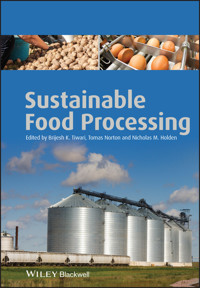
Sustainable Food Processing E-Book
193,99 €
Mehr erfahren.
- Herausgeber: John Wiley & Sons
- Kategorie: Fachliteratur
- Sprache: Englisch
Sustainable Food Processing
Food processors face numerous challenges from ever-changing economic, social and environmental conditions. With global inequalities increasing, ingredient costs climbing, and global climate change becoming a major political issue, food producers must now address environmental concerns, social responsibility and economic viability when shaping their food processing techniques for the future.
Food production, preservation and distribution contribute to greenhouse gas emissions from the agri-food sector, therefore food producers require detailed, industrially relevant information that addresses these challenges. The food industry, as one of the world’s largest users of energy, must embrace new ways of meeting the needs of the present without compromising future viability. It is important that the industry does not merely focus on simple indicators of sustainability that are relatively easy to calculate and hold appeal for governments and the public, but which do not properly address the many dimensions of sustainability.
This book provides a comprehensive overview of both economic sustainability and the environmental concerns that relate to food processing. It is divided into four sections. Part one deals with principles and assessment of sustainability in the context of food processing; Part two summarises sustainability in various food processing applications within the food industry; Part three considers sustainability in food manufacturing operations that are vital in food production systems; and Part four addresses sustainable food distribution and consumption. As the most comprehensive reference book for industry to date, this book will provide engineers, educators, researchers, policy makers and scientists working in the food industry with a valuable resource for their work.
Sie lesen das E-Book in den Legimi-Apps auf:
Seitenzahl: 1088
Veröffentlichungsjahr: 2013
Ähnliche




















Contents
Cover
Title Page
Copyright
List of Contributors
List of Figures
List of Tables
Chapter 1: Introduction
1.1 Introduction
1.2 Key Drivers for Sustainable Food Processing
1.3 Book Objective
1.4 Book Structure
References
Section 1: Principles and Assessment
Chapter 2: Current Concepts and Applied Research in Sustainable Food Processing
2.1 Introduction
2.2 Sustainable Procurement
2.3 Sustainable Food Supply Management
2.4 Concluding Observations
References
Chapter 3: Environmental Sustainability in Food Processing
3.1 Introduction
3.2 Environmental Issues Related to Food Processing
3.3 Greenhouse Gas (GHG) Emissions from Food Processing
3.4 Impact of Climate Change on Food Processing
3.5 Discussion
3.6 Conclusions
References
Chapter 4: Life Cycle Assessment and Sustainable Food Processing
4.1 Introduction
4.2 The LCA methodology
4.3 What has LCA revealed about the sustainability of food processing?
4.4 Life Cycle Assessment and the Sustainability of Food Processing
References
Chapter 5: Environmental Impact Assessment (EIA)
5.1 Introduction
5.2 Defining the Objectives
5.3 Wastes from Food Processing
5.4 EIA Methodology
5.5 Environmental Indicators
5.6 Functional Units
5.7 Evaluation of Results
5.8 Conclusions
References
Chapter 6: Risk Analysis for a Sustainable Food Chain
6.1 Introduction
6.2 Approaches to Risk Analysis for a Sustainable Food Chain
6.3 Risk Assessment (RA) Strategies in the Food Chain
6.4 Risk Management (RM)
6.5 Risk Communication (RC) Strategies
6.6 Role of Risk Analysis from Farm to Fork
6.7 Conclusion
References
Section 2: Food Processing Applications
Chapter 7: Dairy Processing
7.1 Introduction
7.2 Drivers for Sustainability in the Dairy Processing Sector
7.3 Sustainability Initiatives in Dairy Processing Operations
7.4 Sustainability Initiatives in Dairy Packaging
7.5 Sustainability Initiatives in Utilities and Services
7.6 Sustainability Initiatives in Transportation
7.7 Future Strategies for Environmental Sustainability
7.8 Conclusions
Acknowledgements
References
Chapter 8: Meat Processing
8.1 Introduction
8.2 Economics of the Meat Industry
8.3 Sustainability Issues in Meat Processing
8.4 Sustainable Meat Processing and Future Opportunities
References
Chapter 9: Seafood Processing
9.1 Introduction
9.2 Sustainable Seafood Products and Their Processing
9.3 Resource Management Strategies
9.4 Future Opportunities
9.5 Conclusions
References
Chapter 10: Sustainable Processing of Fresh-Cut Fruit and Vegetables
10.1 Introduction
10.2 Unit Operations for Fresh-Cut Fruit and Vegetable Processing
10.3 Eco-Friendly Alternative Sanitations Techniques to Preserve Quality and Safety
10.4 Revalorization of Fresh-Cut by-Products
10.5 Future Research Needs
Acknowledgements
References
Chapter 11: Sustainable Food Grain Processing
11.1 Introduction
11.2 Drying of Food Grains
11.3 Pre-Storage Grain Treatments
11.4 Post-Harvest Value Addition
11.5 Traceability System and Sustainability
References
Chapter 12: Sustainable Brewing
12.1 Introduction
12.2 Sustainable Coffee Brewing
12.3 Brewing of Beer
12.4 Future Opportunities
12.5 Acknowledgements
References
Chapter 13: Sustainable Processed Food
13.1 Early Food Processing
13.2 Contemporary Food Processing
13.3 Consumer Conceptions of Processed Food
13.4 The Food Processing Industry
13.5 Defining Sustainability for Food Processing
13.6 Primary Produce: A Key Resource for Food Manufacturing
13.7 Technological Innovation for Sustainability
13.8 Health and Well-Being
13.9 Food Security and Sustainability
13.10 Communications with Consumers: Labelling and Marketing
13.11 Stakeholder Participation
13.12 Reporting and Risk Management
13.13 Tools for Assessing Sustainability
13.14 Conclusions
References
Section 3: Food Manufacturing Operations
Chapter 14: Concept of Sustainable Packaging System and Its Development
14.1 Introduction
14.2 History of Sustainable Packaging and Definition
14.3 Concept of Sustainable Packaging
14.4 Strategies for Sustainable Packaging
14.5 Advantages of Sustainable Packaging
14.6 Packaging Types and Recyclability
14.7 Life Cycle Assessment (LCA) and Sustainable Packaging
14.8 Consideration of Package Design
14.9 Effect of Design on Sustainability
14.10 Environmental Impact of Packaging and Food Losses in a Life Cycle
14.11 Concern of Safety and Health Hazard During Sustainable Packaging Life Cycle
14.12 Global Legislative Guidelines of Sustainability
14.13 Conclusions
References
Chapter 15: Sustainable Cleaning and Sanitation in the Food Industry
15.1 Introduction
15.2 Developing an Effective and Sustainable Cleaning Programme
15.3 Cleaning in Place
15.4 Health and Safety Issues
15.5 Using Ozone in Industrial Cleaning Procedures
15.6 Ozone Applications in Food Processing
References
Chapter 16: Energy Consumption and Reduction Strategies in Food Processing
16.1 Introduction
16.2 Energy Consumption in the Food Industry
16.3 Energy Efficiency in the Food Industry
16.4 Energy Conservation in the Food Industry
16.5 Energy Conservation in Energy-Intensive Unit Operations
16.6 Summary
References
Chapter 17: Water Consumption, Reuse and Reduction Strategies in Food Processing
17.1 Introduction
17.2 Sustainable Water Consumption
17.3 Water Reuse in the Food Industry
17.4 Water Consumption Reduction Strategies
17.5 Challenges and Opportunities
References
Chapter 18: Food Industry Waste Management
18.1 What is Food Waste?
18.2 The Food Supply Chain
18.3 What Happens to Food Waste?
18.4 The Causes of Food Waste
18.5 How to tackle food waste
18.6 Conclusions
References
Chapter 19: Sustainable Cold Chain
19.1 Introduction
19.2 Cold-Chain Management
19.3 The Impact of the Cold-Chain on Climatic Change
19.4 Climate Change Impacts on the Cold-Chain
19.5 Sustainable Refrigeration Systems in the Cold-Chain
19.6 Conclusions
References
Section 4: Food Distribution and Consumption
Chapter 20: National and International Food Distribution: Do Food Miles Really Matter?
20.1 Introduction
20.2 Food Miles and National Food Distribution
20.3 Food Miles and International Food Distribution
20.4 Conclusion
References
Chapter 21: Sustainable Global Food Supply Networks
21.1 Introduction
21.2 What is Sustainability
21.3 Sustainability Strategic Development
21.4 A Technological Approach to Sustainable Global Supply Networks
21.5 Conclusion
References
Chapter 22: Sustainable Food Consumption
22.1 Introduction
22.2 Global food security
22.3 Factors affecting sustainable food consumption
22.4 Trends in the sustainable utilization of resources
22.5 Future challenges
22.6 Conclusion
References
Index
This edition first published 2014 © 2014 by John Wiley & Sons, Ltd
Registered office: John Wiley & Sons, Ltd, The Atrium, Southern Gate, Chichester, West Sussex, PO19 8SQ, UK
Editorial offices: 9600 Garsington Road, Oxford, OX4 2DQ, UK The Atrium, Southern Gate, Chichester, West Sussex, PO19 8SQ, UK 111 River Street, Hoboken, NJ 07030-5774, USA
For details of our global editorial offices, for customer services and for information about how to apply for permission to reuse the copyright material in this book please see our website at www.wiley.com/wiley-blackwell.
The right of the author to be identified as the author of this work has been asserted in accordance with the UK Copyright, Designs and Patents Act 1988.
All rights reserved. No part of this publication may be reproduced, stored in a retrieval system, or transmitted, in any form or by any means, electronic, mechanical, photocopying, recording or otherwise, except as permitted by the UK Copyright, Designs and Patents Act 1988, without the prior permission of the publisher.
Designations used by companies to distinguish their products are often claimed as trademarks. All brand names and product names used in this book are trade names, service marks, trademarks or registered trademarks of their respective owners. The publisher is not associated with any product or vendor mentioned in this book.
Limit of Liability/Disclaimer of Warranty: While the publisher and author(s) have used their best efforts in preparing this book, they make no representations or warranties with respect to the accuracy or completeness of the contents of this book and specifically disclaim any implied warranties of merchantability or fitness for a particular purpose. It is sold on the understanding that the publisher is not engaged in rendering professional services and neither the publisher nor the author shall be liable for damages arising herefrom. If professional advice or other expert assistance is required, the services of a competent professional should be sought.
Library of Congress Cataloging-in-Publication Data
Sustainable food processing / edited by Brijesh K. Tiwari, Tomas Norton, and Nicholas M. Holden.
pages cm
Includes index.
ISBN 978-0-470-67223-5 (cloth)
1. Food industry and trade. 2. Processed foods. 3. Food industry and trade–Environmental aspects. 4. Sustainable agriculture. I. Tiwari, Brijesh K. II. Norton, Tomas. III. Holden, Nicholas M.
TP370.5.S935 2013
664–dc23
2013018939
A catalogue record for this book is available from the British Library.
Wiley also publishes its books in a variety of electronic formats. Some content that appears in print may not be available in electronic books.
Cover image: Egg Factory: Istock © Choja
Agricultural Storage: Istock © YinYang
Sorting Potatoes: Istock © bluebird13
Cover design by Meaden Creative
List of Contributors
Belarmino Adenso-Díaz, Escuela Politécnica de Ingenieros, Universidad de Oviedo, Gijon, Spain
Encarna Aguayo, Postharvest and Refrigeration Group, Department of Food Engineering, Universidad Politécnica de Cartagena, Murcia, Spain; Institute of Plant Biotechnology, Universidad Politécnica de Cartagena, Murcia, Spain
Imran Ahmad, Food Engineering and Bioprocess Technology, Asian Institute of Technology, Bangkok, Thailand
Jasim Ahmed, Food & Nutrition Program, Kuwait Institute for Scientific Research, Kuwait
Tanweer Alam, Indian Institute of Packaging, Delhi, India
Anil Kumar Anal, Food Engineering and Bioprocess Technology, Asian Institute of Technology, Bangkok, Thailand
Dr. Daniel M. Anang, Department of Food and Consumer Technology, Manchester Metropolitan University, Manchester, UK
Francisco Artés, Postharvest and Refrigeration Group, Department of Food Engineering, Universidad Politécnica de Cartagena, Murcia, Spain
Francisco Artés-Hernández, Postharvest and Refrigeration Group, Department of Food Engineering, Universidad Politécnica de Cartagena, Murcia, Spain
Francis Butler, UCD School of Biosystems Engineering, College of Engineering and Architecture, University College Dublin, Belfield, Dublin, Ireland
David Coley, Department of Architecture and Civil Engineering, University of Bath, UK
Gerard Corkery, UCD School of Biosystems Engineering, College of Engineering and Architecture, University College Dublin, Belfield, Dublin, Ireland
Enda Cummins, School of Biosystems Engineering, Agriculture and Food Science Centre, University College Dublin, Belfield, Dublin, Ireland
Shantanu Das, Riddet Institute, Massey University, Palmerston North, New Zealand
Anant Dave, Riddet Institute, Massey University, Palmerston North, New Zealand
Lakshmi Dave, Riddet Institute, Massey University, Palmerston North, New Zealand
Colm D. Everard, School of Biosystems Engineering, University College Dublin, Dublin, Ireland
Colette C. Fagan, Department of Food and Nutritional Sciences, University of Reading, Whiteknights, Reading, UK
Dr Tim Finnigan, Technical Director, Quorn Foods Ltd, Stokesley, North Yorkshire, UK
Perla A. Gómez, Postharvest and Refrigeration Group, Department of Food Engineering, Universidad Politécnica de Cartagena, Murcia, Spain
Nicholas M. Holden, School of Biosystems Engineering, Agriculture and Food Science Centre, University College Dublin, Belfield, Dublin, Ireland
Mark Howard, Centre for Rural Policy Research, Department of Politics, University of Exeter, Exeter, UK
Christian James, Food Refrigeration & Process Engineering Research Centre (FRPERC), The Grimsby Institute (GIFHE), Grimsby, North East Lincolnshire, UK
Stephen J. James, Food Refrigeration & Process Engineering Research Centre (FRPERC), The Grimsby Institute (GIFHE), Grimsby, North East Lincolnshire, UK
Magalie Laniel, Department of Electrical Engineering, University of South Florida, Tampa, Florida, USA
Dr Kritika Mahadevan, Department of Food and Consumer Technology, Hollings Faculty, Manchester Metropolitan University, Manchester, UK
Dr Wayne Martindale, Corporate Social Responsibility Group, Sheffield Business School, Sheffield Hallam University, Sheffield, UK
Ultan McCarthy, Department of Electrical Engineering, University of South Florida, Tampa, Florida, USA
Kevin P. McDonnell, UCD School of Agriculture, University College Dublin, Belfield, Dublin, Ireland
Carlos Mena, Cranfield School of Management, Cranfield, Bedford, UK
N. N. Misra, School of Food Science and Environmental Health, Dublin Institute of Technology, Dublin, Ireland
Kasiviswanathan Muthukumarappan, Department of Agricultural and Biosystems Engineering, South Dakota State University, Brookings, South Dakota, USA
Nobutaka Nakamura, Distribution Engineering Laboratory, National Food Research Institute, Tsukuba, Ibaraki, Japan
Louise Needham, Quorn Foods Ltd, Stokesley, North Yorkshire, UK
Athapol Noomhorm, Food Engineering and Bioprocess Technology, Asian Institute of Technology, Bangkok, Thailand
Tomas Norton, Department of Engineering, Harper Adams University, Shropshire, UK
Dr Hülya Ölmez, TÜBTAK Marmara Research Center, Food Institute, Kocaeli, Turkey
Takahiro Orikasa, Miyagi University, Sendai, Miyagi, Japan
Graham Purnell, Food Refrigeration & Process Engineering Research Centre (FRPERC), The Grimsby Institute (GIFHE), Grimsby, North East Lincolnshire, UK
Poritosh Roy, School of Engineering, University of Guelph, Guelph, Ontario, Canada
Anwesha Sarkar, Riddet Institute, Massey University, Palmerston North, New Zealand
Takeo Shiina, Distribution Engineering Laboratory, National Food Research Institute, Tsukuba, Ibaraki, Japan
Dr Anne Sibbel, Science, Engineering and Technology Portfolio, RMIT University, Melbourne, Australia
Jiraporn Sripinyowanich, Food Engineering and Bioprocess Technology, Asian Institute of Technology, Bangkok, Thailand
Brijesh K. Tiwari, Department of Food Biosciences, Teagasc Food Research Centre, Dublin, Ireland
Uma Tiwari, School of Biosystems Engineering, Agriculture and Food Science Centre, University College Dublin, Belfield, Dublin, Ireland
Alejandro Tomás-Callejas, Postharvest and Refrigeration Group, Department of Food Engineering, Universidad Politécnica de Cartagena, Murcia, Spain
Ismail Uysal, Department of Electrical Engineering, University of South Florida, Tampa, Florida, USA
Lijun Wang, Biological Engineering Program, North Carolina Agricultural and Technical State University, Greensboro, North Carolina, USA
Shane Ward, UCD School of Biosystems Engineering, College of Engineering and Architecture, University College Dublin, Belfield, Dublin, Ireland
Michael Winter, Centre for Rural Policy Research, Department of Politics, University of Exeter, Exeter, UK
Ming-Jia Yan, School of Biosystems Engineering, Agriculture and Food Science Centre, University College Dublin, Belfield, Dublin, Ireland
List of Figures
Figure 3.1Relationship between relative LCI and loss in food supply (Shiina, 1998) (The relative LCI = (x1 + x2)/x3; where x1 is production LCI, x2 is post-harvest LCI and x3 is production LCI without loss, if x2 = x3/loss in decimal).Figure 3.2Trend of food supply from different sources in different regions.Figure 3.3Trend of energy intake from different food source in Japan (*includes potatoes, legumes, seeds and nuts).Figure 3.4Trend of protein intake from different food source in Japan (*includes potatoes, legumes, seeds and nuts).Figure 3.5Food supply and intake in Japan.Figure 3.6Food supply in different countries and in the world.Figure 3.7Relationship between GDP and food supply in Japan and USA.Figure 4.1An example of a generic cradle-to-grave/cradle LCA system.Figure 4.2Schematic of the system included in the Environmental Product Declaration for liquid milk.Figure 4.3Schematic representation of a typical design process.Figure 4.4Schematic representation of attributional LCA (left) and consequential LCA (right).Figure 4.5Schematic representation of the general requirements for defining the system boundary, processes stages and flows for LCA following ISO standards.Figure 4.6Schematic illustration of allocation (top) vs. system expansion with avoided burden (bottom).Figure 4.7Schematic of broad general processes for LCI.Figure 4.8Schematic of processes closely related to mechanism for LCI.Figure 4.9Material balance for processes.Figure 4.10The link between emissions, midpoint impacts and endpoint impacts.Figure 4.11Schematic representation of the food chain and the place of processing within it.Figure 5.1Schematic of the European Union (EU) Environmental Impact Assessment (EIA) process.Figure 6.1Components of risk analysis.Figure 6.2Qualitative risk matrix.Figure 6.3Schematic representation of the possible entry route for chemical hazards (dioxins, PCBs and PCDDs) in human food.Figure 6.4Steps in risk management.Figure 6.5Risk analysis for sustainability in the food chain.Figure 7.1Schematic diagram showing milk processing, from the farm until the product reaches the consumer.Figure 7.2Flow chart of dairy processing operations.Figure 7.3Flow chart of the operations in the manufacture of fluid milk.Figure 7.4Flow chart of the operations in the manufacture of cream and butter.Figure 8.1Meat processing and associated operations and greenhouse gases emissions.Figure 8.2Flow diagrams of livestock slaughter and waste generation.Figure 8.3Flow diagram of poultry slaughter and waste generation.Figure 10.1Usual steps and unit operations for processing and commercialization of fresh-cut plant produce.Figure 10.2Estimation of Vmax values of in vitro PPO activity as a function of initial O2 concentration, using chlorogenic acid as substrate (bars indicate 95% confidence limits).Figure 11.1Rice processing and its co-products.Figure 12.1Process Flow chart of Instant Coffee Production.Figure 12.2Traditional Brewing Process.Figure 12.3Operations and resources involved in the production of beer.Figure 12.4Value added brewery process.Figure 12.5Water network, heating and cooling system in a typical brewery. Steam is used for mashing and boiling; part of the waste vapour produced during boiling is utilized for wort preheating, while the unused waste vapour is ejected to the atmosphere. Within the packaging area, the steam is used by a Clean-in-Place (CIP) system for the sterilization of filling lines and for pasteurization. Cooling is needed for the preparation of clarified wort for fermentation (chilled water), and during fermentation and maturation.Figure 14.1The four levels and principles of sustainable packaging.Figure 14.2Life Cycle Assessment (LCA) flow diagram for fruit juice packed in polylactide based nanopackaging.Figure 14.3Schematic illustration of the food supply.Figure 15.1Sinner's circle illustrating the energy required to remove soil from a surface with contribution from time, temperature (temp.), detergent (chem.), and mechanical force (mech.).Figure 15.2Results from cleaning of a T-piece that was carried out during the PathogenCombat project (PathogenCombat, 2010). Modelling results of predicted wall shear stress are shown in the top left and right corners with the experimental evidence in the figure below. In this experiment the orange agar depicts uncleaned zones whereas the purple agar represents the clean areas.Figure 16.1Delivered energy consumption by the type of fuels in the food manufacturing industry in the United State in 2002.Figure 16.2Energy consumption by the end users.Figure 16.3Schematic diagram of a liquid-liquid heat pump system for pasteurization of milk.Figure 17.1Global water resources.Figure 17.2The dependence of sectoral breakdown of annual freshwater withdrawals to income levels based on the values for the year 2009.Figure 17.3Water fluxes within boundaries of the food and beverage industry.Figure 17.4Determination of the historical technological change in water intensity of the manufacturing of food products, beverages and tobacco, considering two time periods (1953–1983 and 1983–1998).Figure 17.5Scheme for establishing a HACCP plan for reconditioning of process water to be reused in the food industry.Figure 17.6A zero liquid discharge scheme.Figure 17.7Water utilization systems in process plants.Figure 17.8Three-step procedures for SWE minimization.Figure 17.9Types of batch water using processes: (a) truly batch, (b) semi-continuous.Figure 18.1Tonnes of total food waste generation in manufacturing, household and catering in EU27 during 2006.Figure 18.2Per capita tonnes of total food waste generation in EU27 during 2006.Figure 18.3The food supply chain.Figure 18.4Food processing unit operations and associated waste.Figure 18.5The waste hierarchy.Figure 18.6Waste ranges for different products.Figure 19.1Energy consumption of refrigeration systems of transport vehicles.Figure 19.2Energy used in refrigeration systems in catering establishment pre and post refit.Figure 19.3Energy used prior to and after installation of fibre optic lighting on retail display.Figure 19.4Energy consumed by different types of CSCs in different types of catering establishments.Figure 19.5Electrical energy consumption per week in 2009.Figure 20.1Main sources of fossil fuel related carbon emissions and flow of product for the large-scale system. Only those with double borders are considered and used to form Md.Figure 20.2Main sources of fossil fuel related carbon emissions and flow of product for the small-scale system. Only those with double borders are considered and used to form Md.Figure 20.3CO2 emissions generated by different modes of freight transport.Figure 20.4Mode and location for UK food transport.Figure 20.5A selection (for clarity) of source and mode-weighted emissions (gCO2 /kg imported) estimated for a single farm in each of the 26 countries studied. (Note although the locations are identified by country, they are specific to the farm and supplier used by the retailer in each country and they should not necessarily be seen as representative of the whole country.)Figure 20.6Scatter plot of distance vs. CO2 emissions for international sourcing routes (and all 55 farms in the study), note the low R2 value, indicating a poor correlation.Figure 20.7Scatter plot of distance vs. CO2 separated into routes relying predominantly on road transport and those relying predominantly on sea.Figure 20.8Visual representation of the CO2 emissions associated with the import of fresh produce into the UK, some source countries have been separated into regions to represent different locations within the country itself.Figure 21.1Illustration of biometric traceability systems for animals and poultry: a) facial recognition of sheep, b) muzzle identification of cattle, c) retina identification of sheep and d) comb identification of poultry.Figure 22.1Four dimensions of food security.Figure 22.2Barriers to sustainable food consumption.Figure 22.3Per capita food losses and waste, at consumption and pre-consumption stages, in different regions (FAO, 2011).List of Tables
Table 2.1Trends in production for selected agricultural products obtained from FAOSTAT (2011) data that provide key ingredients in the food production systemTable 4.1Summary of example environmental assessment tools that can be used for the food chain indicating the focus, scale at which it can be deployed and overlap with economic analysisTable 4.2Examples of LCA databases (open access and commercial) that can be used to build LCI data tables for specific LCA projectsTable 4.3Examples of LCIA methodologies that can be used for LCA projectsTable 4.4Guiding principles of the Food SCP Round TableTable 6.1Main principles of food safety risk managementTable 8.1Per capita meat consumption (Kg per person) in selected countriesTable 8.2Meat production and the meat trade (import and export) of selected countriesTable 8.3Characteristics of wastewater generated from livestock and poultry slaughterTable 8.4Positive and negative nutrition and health aspects of consumption of processed meatTable 8.5Water usage and wastewater generation from the production of salami and sausagesTable 9.1Energy performance of industrial fisheriesTable 9.2Energy required to manufacture ice kWh/tonneTable 9.3Relative contribution (%) of ice production to AP, ADP, EP, GWP, OLP, METP in relation to the catching of Atlantic mackerelTable 11.1Approximated composition of paddy and its milling fractions at the moisture content of 14%w.bTable 11.2Vitamin and mineral contents of paddy and its milling fractions at the moisture content of 14%w.bTable 11.3Effects of the proposed techniques on insect mortality, milled rice quality and the storability of packaged riceTable 12.1Cellular wall constituents and structural polysaccharides (%) in coffee pulpTable 12.2Amino acid content of coffee pulp protein compared to other important protein sourcesTable 12.3Composition (%) of mucilageTable 14.1The principle and levels of sustainable packageTable 14.2General strategies and key performance indicators for the design, procurement or evaluation of sustainable packagingTable 14.3Life cycle environmental impact indicators reported in PIQETTable 14.4The environmental impact from food, F, and environmental impact from packaging, T, and the ratio F/TTable 16.1Energy use and indicator in different food manufacturing sectors in the United States in 2006Table 16.2Energy use for production of different food products in the Netherlands in 2001Table 16.3Potential energy savings in British industryTable 16.4Summary of some energy savings identified in a Nestle factoryTable 17.1Water quantity and quality as a function of use by food and beverage industryTable 17.2Industry shares of emissions of organic pollutants measured in terms of BOD (% of total) in 2007Table 17.3Overview of representative unit processes and operations used in water reclamationTable 17.4Wastewater disinfection technologiesTable 17.5Water consumption and wastewater generation rates in food industryTable 17.6Examples of water conservation and effluent minimization practices for food processing industriesTable 17.7Advantages and limitations of disinfection methods proposed for fresh-cut organic vegetablesTable 17.8Drivers, barriers, challenges and solutions to implementation of water reuse in the food industryTable 18.1Classification of food waste based on Lebersorger and Schneider (2011) and WRAP (2011)Table 18.2Retail formats and causes of wasteTable 18.3Main causes of wastageTable 18.4Summary of causes and main links of the food supply chain affectedTable 18.5Retailer's waste hierarchy for product disposalTable 19.1Refrigeration requirements and losses due to lack of refrigerationTable 19.2Transport emissions estimated for transporting food from its source to UK stores and on to consumers homesTable 19.3Energy consumed by each cold storeTable 19.4Best estimate of the top ten food refrigeration processes ranked in terms of their potential for total energy saving (basis of estimations provided on www.grimsby.ac.uk/documents/defra/usrs-top10users.pdf)Table 19.5Specific energy required (MJ/t) to chill, freeze and process (cutting and deboning) meatTable 19.6Characteristics and applications of new/alternative refrigeration technologiesTable 19.7Refrigeration loads (kW) in factoryTable 20.1The negative externalities of UK agriculture (year 2000). For comparison the UK's GDP in 2005 was around £1.2TTable 20.2National Travel Survey data about personal travel for shopping in the UK, 1998–2000Table 20.3Carbon emissions from the large-scale box systemTable 20.4Sources of Embedded Energy in Box SystemTable 20.5Emission factors used in the studyTable 22.1Undernourishment in the developing regions 1990–92 to 2010–12Table 22.2Global and regional per capita food consumption (kcal per capita per day)Table 22.3Rating system developed by Marine Conservation Society as advice for choosing the most environmentally sustainable fishTable 22.4Summary of impacts of framework guidelines for ‘sustainable’ and healthy diets1
Introduction
Brijesh K. Tiwari1, Tomas Norton2 and Nicholas M. Holden3
1Department of Food Biosciences, Teagasc Food Research Centre, Dublin, Ireland
2Department of Engineering, Harper Adams University, Shropshire, UK
3School of Biosystems Engineering, Agriculture and Food Science Centre, University College Dublin, Belfield, Dublin, Ireland
1.1 Introduction
Sustainability is defined as ‘to endure ’, but this definition does not properly capture the sense in which it is used globally to address how human activity impacts on societies, economics and the environment. The terms ‘sustainability’ and ‘sustainable development’ have increasingly appeared ‘on the radar’ of many industries (Leadbitter, 2002). They were first coined by the Brundtland Commission (formally the World Commission on Environment and Development of the United Nations) in 1983. The Brundtland Commission defined “Sustainable Development” as the ‘social and economic advance to assure human beings a healthy and productive life, but one that did not compromise the ability of future generations to meet their own needs’. When related to food processing, this concept suggests that the process should:
Maintaining a sustainable food processing chain is now more important to food producers than ever before. With global inequalities becoming more pronounced, ingredient costs climbing, and global change becoming a major political issue, food producers must now take the opportunity to address environmental concerns, social responsibility and economic viability when shaping their food processing techniques for the future. However, it must also be said that food processing faces numerous challenges in changing economic and environmental conditions. Therefore, new ways of meeting the needs of the present without comprising future viability have to be embraced by the food industry.
The achievement of rational energy use, sufficient food production, avoiding needless food waste and appropriate management of necessary environmental impacts underpins well-being, health and longevity for human populations and the world's environment. There is perhaps a trend emerging in the agrifood sector to try to simplify the ‘sustainability question’. Indicators such as carbon footprint, energy audit and nutritional indices are variously used to support claims of sustainability, but these mono-dimensional methods cannot really address the complexity inherent in sustainability. An indicator of the sustainability of food systems such as the ratio of energy outputs in terms of the energy content of a food product (calories) to the energy input (energy required in food production and processing), with the latter being all the energy consumed in producing, processing, packaging and distribution, might be useful, but ignores the question of the value of the calories provided (and even whether these should be expressed on a raw or cooked basis). It also ignores the contribution of renewable energy to the energy inputs. The quantification of this metric might be regarded as essential for food producers looking to make a positive economic and environmental impact in the future, especially given that the food industry is one of the world's largest users of energy, and considering this one index will only address one dimension of sustainability. Greenhouse gas emissions, which have increased remarkably in recent decades have resulted in global warming, perhaps the most serious problem that humankind faces today. Food production, preservation and distribution contribute greatly to total global greenhouse gas emission. These impacts are commonly described using carbon footprint, but such a measure provides no indication of the social or economic dimensions of sustainability, or even non-correlated environmental impacts. It is important that the food industry does not just focus on simple indicators of sustainability that are relatively easy to calculate, have appeal to governments and the public, but do not properly address the many dimensions of sustainability. The threat of limited food security has been highlighted globally by the coincidence of environmental degradation, economic growth, population increase and climate change. All these factors have impacted on the world food system (Headey and Fan, 2008). Questions about sustainability and corporate social responsibility are being seriously considered and implemented in many countries around the globe. Given that these highlighted concerns cause a considerable challenge for food processors and technologists, there is a requirement for detailed industrially relevant information that addresses these challenges.
1.2 Key Drivers for Sustainable Food Processing
1.2.1 Food Security
Food production and processing is essential to the global economy and to the health and welfare of its citizens. The core objective of global food security is to match the supply of food with the nutritional demand of the world's burgeoning population (to reach 9 billion by 2050) in the most sustainable way possible (i.e. in a way that can continue for centuries). Through technological progression in food storage and transportation it has become possible to ensure that reliable food supply chains are operational all over the world. These food chains reflect a balance between the commodity value of food and the human right to nutrition. Unless these sometimes-contradictory pressures can be balanced, sustainable food supply and food security cannot be achieved.
1.2.2 Population Health
It is difficult to envisage how to link processing to sustainability and then to health, but this is going to be a key driver in the future. The economic and social cost of supplying excessive amounts of processed food to limited sections of the global population will perhaps ultimately be the main driver of the transformation of our current food chains from being predominantly market driven (in terms of consumer spending and a desire for cheap food) to being sustainability driven, where the cost to national economies of providing the inappropriately processed food to a society is regarded as unacceptable, and we transition to eating geographically appropriate, higher quality foods. Societal demand for safe, traceable food also has the potential to impact on the types of food processing and ingredient redistribution that occurs in the food chain.
1.2.3 Social Justice
The welfare and rights of humans (and animals) at all stages of the food chain (production, processing, distribution, consumption and waste management) are usually not thought of in terms of sustainability. Demand for large volumes of low cost, processed foods has implications for those supplying the raw materials and those consuming the products that emerge. In this book we will not consider these issues in detail, but as governments increasingly seek value for the farmer (in some parts of the world) and acceptable health costs, social justice will become an increasingly important driver of food system sustainability.
1.2.4 Global Change
While it is generally known that agricultural production is a significant greenhouse gas emitter it must also be recognized that food processing and the distribution sector contribute to emissions, via energy used in processing, transportation and also the emission from food waste dumped in landfills. As well as climate change, the knock on effect of change in water availability is also a significant driver for sustainable food processing. Changing global climates means that more innovation is required in cooling and refrigeration technologies to extend the shelf-life of perishable foods without using too much energy and more efficient water use. The potential impact of global change on water availability will present challenges to the food processing industries, particularly of developing countries, where natural drying methods are still employed.
1.2.5 Resource Depletion
There are many resource depletion impacts arising from food consumption, some of which, while not directly caused by processing, are driven by processing because of demand for ingredients with specific characteristics on a year round basis. Within the whole food system depletions of water, soil, nutrients, air and water quality and energy are all quite obvious. Food processing, and the demand for processed food is one of the key drivers of resource redistribution around the globe in an agrifood context. The long-term sustainability of systems that extract soil nutrients, or cause erosion in one country, in order to provide processed food in another has to be questioned. While this book will not focus on these issues, it will address some of the tools available to evaluate them.
1.2.6 Environmental Impact
For many consumers the impact of processing on the environment is not clear. Tools such as Life Cycle Assessment allow specialists to understand the interactions, and simplified outputs such as carbon footprint can be used to inform consumers. Society, and in many cases scientists are at the very early stages of understanding the real impacts (both direct, such as discharges to air, water and soil; and indirect, such as transport energy emissions) of food processing on the environment. However, as the environment is a key stakeholder in the sustainability concept (along with social, economic and productivity issues) it is clear that unwanted impacts need to be minimised and reduced. The geographically distributed nature of modern food chains, with processing at their heart, mean that consumers are not always affected by the choices they make, but others elsewhere in the world are.
1.2.7 Eco-Labelling
There are now hundreds of eco-labels in use around the world. These range from certification of the type of production (e.g. organic) through to certified origin or carbon footprint. At present few consumers seem to really understand what the labels mean and how they should be used. Retailers also seem to be struggling with how to use them, but it is clear that they are here to stay and will become a key driver of sustainability in the future. It remains to be seen how this impacts food processing.
1.3 Book Objective
The overarching objective of this book on Sustainable Food Processing is to provide information to scientists and the industry that will assist in understanding and finding ways of increasing sustainability in the food industry, particularly that part focused on added value processing. Future developments must ensure more efficient food production, processing and distribution alongside responsible consumption to limit intake to ‘fair share’, to reduce waste and to mitigate future environmental and socio-economic concerns. With the estimated increase in food supply needing to rise by 70% by 2050 there will be more innovations in primary agriculture, food processing, supply chain infrastructure, public health and education. The focus has to be on meeting the demands of the present by not undermining our ability to produce more in the future. This requires attention to the current adverse environmental, social and economic impacts of food production, processing and supply through the exploitation of science and technology and a recognition that food processing, while founded in science, technology and engineering, has an impact on the environment and on society.
1.4 Book Structure
The book is divided into four sections. Section One deals with principles and assessment of sustainability in the context of food processing, Section Two summarizes sustainability in various food processing applications within the food industry, Section Three considers sustainability in food manufacturing operations that are vital in food production systems and finally Section Four addresses sustainable food distribution and consumption.
1.4.1 Section One: Principles and Assessment of Sustainability
The concepts of sustainability, life cycle assessment and risk assessment in the food chain are approached from a food production system perspective. Sustainability is a complex concept, which involves judicious use of various resources as discussed in Chapter 2. Use of both renewable and non-renewable resources in food production systems has resulted in various environmental issues. Their impact on the sustainability of various food processing industries is dealt with in Chapter 3. Ensuring sustainability in food production systems requires a holistic approach to assess the impacts of a food product, process or service. Chapter 4 emphasizes the theoretical basis for Life Cycle Assessment in food production systems with specific examples from the food industry. Environmental impact assessment of food processing operations to produce food for an increasing world population without causing depletion of natural resources and severe pollution problems is highlighted in Chapter 5. Risk analysis in a food chain to reduce food related health issues along the entire food chain, and to ensure sustainability in food production, processing and consumption is covered in Chapter 6.
1.4.2 Sustainability and Food Processing Applications
Application of sustainability concepts in various food processing sectors are detailed for various food processing operations used in the manufacture of a range of food products in terms of environmental issues and consequently on traditional and current efforts for dealing with sustainability issues. The application areas considered are dairy processing (Chapter 7), meat processing (Chapter 8), seafood processing (Chapter 9), fresh-cut fruit and vegetables processing (Chapter 10), food grain processing (Chapter 11), brewing (Chapter 12) and processed food industries (Chapter 13).
1.4.3 Sustainability in Manufacturing Operations
Food production systems require input from various allied industries involved in food manufacturing operations. Food packaging and storage operations are necessary for delivering safe food for consumers. Environmental impacts and sustainability issues related to packaging and ways to reduce environmental impacts are discussed in Chapter 14. Cleaning and sanitation within the food industry is an important operation with a significant impact on environment. Chapter 15 deals with the issues specific to the sustainability of cleaning and sanitization. The importance of cold chain management in food facilities needs to be considered when specifying and optimising sustainable food refrigeration systems and the need for effective cold management as discussed in Chapter 16. Consumption of water and energy in the food processing sector is important. The food industry needs to reduce both the water and energy consumption for food manufacturing. Analysis of energy and water consumption and various strategies to reduce their use are presented in Chapters 17 and 18. Chapter 19 is devoted to the analysis of the types of waste arising from the food supply chain, the main causes of waste generation and its fate and reduction strategies.
1.4.4 Distribution and Consumption of Food
Food travelling greater distances is likely to be stored in greater volumes and the usual economies of scale will apply, with carbon emissions per kg of product possibly being lower as volumes/mass increases. Chapter 20 discusses the concept of both national and international food distribution. Chapter 21 outlines the need for sustainable food supply networks and the final chapter (Chapter 22) deals with the food security and consumption. Achieving sustainability in food consumption is vital to provide a good quality of life, while reducing the environmental, economic, social and political impacts of food production and consumption.
References
Headey, D., and Fan, S. (2008). Anatomy of a crisis: the causes and consequences of surging food prices. Agricultural Economics, 39 (s1), 375–391.
Leadbitter, J. (2002) PVC and sustainability. Progress in Polymer Science27(10), 2197–2226.
Section 1
Principles and Assessment
2
Current Concepts and Applied Research in Sustainable Food Processing
Wayne Martindale, Tim Finnigan and Louise Needham
Lesen Sie weiter in der vollständigen Ausgabe!
Lesen Sie weiter in der vollständigen Ausgabe!
Lesen Sie weiter in der vollständigen Ausgabe!
Lesen Sie weiter in der vollständigen Ausgabe!
Lesen Sie weiter in der vollständigen Ausgabe!
Lesen Sie weiter in der vollständigen Ausgabe!
Lesen Sie weiter in der vollständigen Ausgabe!
Lesen Sie weiter in der vollständigen Ausgabe!
Lesen Sie weiter in der vollständigen Ausgabe!
Lesen Sie weiter in der vollständigen Ausgabe!
Lesen Sie weiter in der vollständigen Ausgabe!
Lesen Sie weiter in der vollständigen Ausgabe!
Lesen Sie weiter in der vollständigen Ausgabe!
Lesen Sie weiter in der vollständigen Ausgabe!
Lesen Sie weiter in der vollständigen Ausgabe!
Lesen Sie weiter in der vollständigen Ausgabe!
Lesen Sie weiter in der vollständigen Ausgabe!
Lesen Sie weiter in der vollständigen Ausgabe!
Lesen Sie weiter in der vollständigen Ausgabe!
Lesen Sie weiter in der vollständigen Ausgabe!
Lesen Sie weiter in der vollständigen Ausgabe!
Lesen Sie weiter in der vollständigen Ausgabe!
Lesen Sie weiter in der vollständigen Ausgabe!
Lesen Sie weiter in der vollständigen Ausgabe!




