


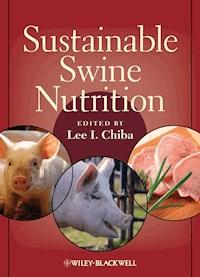
Sustainable Swine Nutrition E-Book
176,99 €
Mehr erfahren.
- Herausgeber: John Wiley & Sons
- Kategorie: Wissenschaft und neue Technologien
- Sprache: Englisch
Finding sustainable means of swine nutrition is important to both pork industry personnel and the environment alike. This reference comprehensively covers the most recent advancements in sustainability that results in more efficient diets, thus reducing both production costs and waste. Chapters include information on alternative feedstuffs, feed additives, bioavailabity of nutrients, and management of wastes and odors. Written by internationally recognized experts in the field, Sustainable Swine Nutrition will be a valuable reference for those involved in all aspects of pork production. * Comprehensively covers the most recent advancements in sustainability to promote reduced pork production costs and waste * Covers recent topics such as alternative feedstuffs, feed additives, and bioavalability * Discusses environmental topics such as waste and odor management * Written by an international team of experts in the field
Sie lesen das E-Book in den Legimi-Apps auf:
Seitenzahl: 1304
Veröffentlichungsjahr: 2012
Ähnliche




















Contents
Cover Page
Title Page
Copyright
Dedication
Contributors
Preface
Editor
Part I: Fundamental Nutrition
Chapter 1: Water in Swine Nutrition Fundamental Nutrition
Introduction
Water Content of the Body
Water as a Nutrient
Water Balance
Water Requirement
Water Delivery to the Pig
Water Management
Water Quality
Water Treatment
Water Quality Effects on Performance
References
Chapter 2: Energy and Energy Metabolism in Swine
Introduction
Energy Utilization in Swine
Energy Requirements
Response to Energy Intake
Feed Efficiency in Growing Pigs
Regulation of Energy Intake in Pigs
Summary
References
Chapter 3: Lipids and Lipid Utilization in Swine
Introduction
Primary Sources of Lipids in Swine Diets
Biological Characteristics of Lipid Utilization in Swine
Lipid Metabolism By Newborn Suckling Pigs
Lipid Utilization By Growing Swine
Lipid Utilization By Producing Swine
References
Chapter 4: Amino Acids and Amino Acid Utilization in Swine
Introduction
Cellular Amino Acid Transport: Passport to Amino Acid Utilization
Intestinal Amino Acid Utilization
Amino Acid Utilization During Growth
Amino Acid Partitioning During Gestation
Amino Acid Partitioning During Lactation
References
Chapter 5: Carbohydrates and Carbohydrate Utilization in Swine
Introduction
Carbohydrate Terminology and Classification
Physiochemical Properties of Fiber
Measurements of Dietary Carbohydrates and Lignin
Carbohydrates and Lignin in Feedstuffs
Processing of Feedstuffs and Common Feeds
Digestion of Carbohydrates in the Small Intestine
Digestion of Carbohydrates in the Large Intestine
Quantitative Digestion of Nutrients in the Small and Large Intestines
Absorption of Products Deriving from Carbohydrate Assimilation
Utilization of Absorption Products from Carbohydrate Assimilation
Implication
References
Chapter 6: Vitamins and Vitamin Utilization in Swine
Introduction
Vitamins and Reproduction in Pigs
Vitamins and Growth in Pigs
Summary
References
Chapter 7: Minerals and Mineral Utilization in Swine
Introduction
Sulfur
Calcium
Phosphorus
Calcium and Phosphorus
Phytase
Magnesium
Electrolytes
Interactions of Elements
Iron
Zinc
Copper
Manganese
Selenium
Chromium
Iodine
References
Chapter 8: Nutrition and Gut Health in Swine
Introduction
Inflammation and Gastrointestinal Function
Nutritional Implications and Strategies
Summary
References
Part II: Nutrition for Successful and Sustainable Swine Production
Chapter 9: Diet Formulation and Feeding Programs Nutrition for Successful and Sustainable Swine Production
Introduction
Diet Formulation
Feeding Programs
Summary
References
Chapter 10: Alternative Feedstuffs in Swine Diets
Introduction
Feed Formulation and Risk Management
Crops
Co-products
Summary
References
Chapter 11: Fiber in Swine Nutrition
Introduction
Definition of Dietary Fiber
Analysis of Fiber in Animal Feed Ingredients
Physiological Properties of Dietary Fiber
Qualitative Aspects of Dietary Fiber Digestibility
Factors Affecting Energy Value of Dietary Fiber
Contribution of Energy from Fermentation
Negative Effects of Fiber on Energy and Nutrient Digestibility
Summary
References
Chapter 12: Enzymes and Enzyme Supplementation of Swine Diets
Introduction
Brief Overview of the Digestive Process in the Pig
Antinutritive Factors in Feedstuffs for Swine
Limitations of Microbial Activities in the Intestine of Pigs
Studies on Enzymes Used in Swine Nutrition
Future of Enzyme Use in Swine Nutrition
Summary
References
Chapter 13: Feed Additives in Swine Diets
Introduction
Antimicrobial Agents
Microbial Supplements
Oligosaccharides
Pharmaceutical Trace Minerals
Acidifiers
Phytogenic Products
Enzymes
Flavors
Odor-Control Agents
Antioxidants
Pellet Binders and Flow Agents
Carcass Modifiers
Anthelmintics
References
Chapter 14: Bioavailability of Amino Acids, Lipids, and Carbohydrates in Feedstuffs
Introduction
Amino Acid Bioavailability
Bioavailability of Lipids
Bioavailability of Carbohydrates
Summary
References
Chapter 15: Bioavailability of Minerals and Vitamins in Feedstuffs
Introduction
Mineral Bioavailability
Vitamin Bioavailability
Summary
References
Chapter 16: Swine Nutrition and Environment
Introduction
Dietary Origins of the Major Environmental Concerns
Strategies for Mitigating the Major Environmental Concerns
Summary
References
Chapter 17: Swine Nutrition and Pork Quality
Introduction
Manipulating Postmortem Metabolism and Pork Quality
Dietary Modifications to Increase Intramuscular Fat Content
Dietary Modifications on Pork-Fat Quality
Dietary Modifications on Lipid and Color Stability
Dietary Modifications on Cooked Pork Palatability
Organic Pork Production
References
Chapter 18: Feeding Growing and Breeding Swine
Introduction
Breeding Swine
Growing Swine
Summary
References
Index
This edition first published 2013 © 2013 by John Wiley & Sons, Inc.
Wiley-Blackwell is an imprint of John Wiley & Sons, formed by the merger of Wiley's global Scientific, Technical and Medical business with Blackwell Publishing.
Editorial Offices 2121 State Avenue, Ames, Iowa 50014-8300, USA The Atrium, Southern Gate, Chichester, West Sussex, PO19 8SQ, UK 9600 Garsington Road, Oxford, OX4 2DQ, UK
For details of our global editorial offices, for customer services and for information about how to apply for permission to reuse the copyright material in this book please see our website at www.wiley.com/wiley-blackwell.
Authorization to photocopy items for internal or personal use, or the internal or personal use of specific clients, is granted by Blackwell Publishing, provided that the base fee is paid directly to the Copyright Clearance Center, 222 Rosewood Drive, Danvers, MA 01923. For those organizations that have been granted a photocopy license by CCC, a separate system of payments has been arranged. The fee codes for users of the Transactional Reporting Service are ISBN-13: 978-0-8138-0534-4/2013.
Designations used by companies to distinguish their products are often claimed as trademarks. All brand names and product names used in this book are trade names, service marks, trademarks or registered trademarks of their respective owners. The publisher is not associated with any product or vendor mentioned in this book. This publication is designed to provide accurate and authoritative information in regard to the subject matter covered. It is sold on the understanding that the publisher is not engaged in rendering professional services. If professional advice or other expert assistance is required, the services of a competent professional should be sought.
Library of Congress Cataloging-in-Publication Data
Sustainable swine nutrition / edited by Lee I. Chiba. pages cm Includes bibliographical references and index. ISBN 978-0-8138-0534-4 (hardback : alk. paper) - ISBN 978-1-118-48582-8 (mobi) (print) - ISBN 978-1-118-48583-5 (epdf/ebook) (print) - ISBN 978-1-118-48585-9 (epub) (print) - ISBN 978-1-118-49145-4 (obook) (print) 1. Swine-Nutrition. 2. Swine-Feeding and feeds. I. Chiba, Lee, editor of compilation. SF396.5.S87 2013 636.4-dc23
2012030223
A catalogue record for this book is available from the British Library.
Wiley also publishes its books in a variety of electronic formats. Some content that appears in print may not be available in electronic books.
Disclaimer The publisher and the author make no representations or warranties with respect to the accuracy or completeness of the contents of this work and specifically disclaim all warranties, including without limitation warranties of fitness for a particular purpose. No warranty may be created or extended by sales or promotional materials. The advice and strategies contained herein may not be suitable for every situation. This work is sold with the understanding that the publisher is not engaged in rendering legal, accounting, or other professional services. If professional assistance is required, the services of a competent professional person should be sought. Neither the publisher nor the author shall be liable for damages arising herefrom. The fact that an organization or Website is referred to in this work as a citation and/or a potential source of further information does not mean that the author or the publisher endorses the information the organization or Website may provide or recommendations it may make. Further, readers should be aware that Internet Websites listed in this work may have changed or disappeared between when this work was written and when it is read.
Dedication
This book is dedicated with appreciation to my wife, Shoko. Her continuous support, patience, and willingness to give me “space” to take on challenges such as this are forever cherished!
Contributors
Olayiwola Adeola, Ph.D.Dept. of Animal Sciences Purdue University West Lafayette, IndianaJason K. Apple, Ph.D.Dept. of Animal Science University of Arkansas Fayetteville, ArkansasMichael J. Azain, Ph.D.Dept. of Animal and Dairy Science University of Georgia Athens, GeorgiaKnud Erik Bach Knudsen, Ph.D.Dept. of Animal Science Aarhus University DK-8830 Tjele, DenmarkSam K. Baidoo, Ph.D.Southern Research and Outreach Center University of Minnesota Waseca, MinnesotaDavid H. Baker, Ph.D. (Deceased)Dept. of Animal Sciences University of Illinois Urbana, IllinoisEduardo Beltranena, Ph.D.Ag Research Division Alberta Agriculture and Rural Development Edmonton, Alberta, CanadaSarah K. Cervantes-Pahm, Ph.D.Schillinger Genetics Des Moines, IowaGary L. Cromwell, Ph.D.Dept. of Animal and Food Sciences University of Kentucky Lexington, KentuckyMing Z. Fan, Ph.D.Dept. of Animal and Poultry Science University of Guelph Guelph, Ontario, CanadaJeffrey A. Hansen, Ph.D.Murphy-Brown, LLC Warsaw, North CarolinaGretchen M. Hill, Ph.D.Dept. of Animal Science Michigan State University East Lansing, MichiganJoshua A. Jendza, Ph.D.Southern Research and Outreach Center University of Minnesota Waseca, MinnesotaLee J. Johnston, Ph.D.West Central Research and Outreach Center University of Minnesota Morris, MinnesotaHenry Jørgensen, Ph.D.Dept. of Animal Science Aarhus University DK-8830 Tjele, DenmarkDong Y. Kil, Ph.D.Dept. of Animal Science and Technology Chung-Ang University Anseong-si, Gyeonggi-do, Republic of KoreaSung Woo Kim, Ph.D.Dept. of Animal Science North Carolina State University Raleigh, North CarolinaHelle Nygaard Lærke, Ph.D.Dept. of Animal Science Aarhus University DK-8830 Tjele, DenmarkCharlotte Lauridsen, Ph.D.Dept. of Animal Science Aarhus University DK-8830 Tjele, DenmarkGita Malik, Ph.D.Dept. of Animal and Poultry Science University of Saskatchewan Saskatoon, Saskatchewan, CanadaRodrigo Manjarín, Ph.D.Dept. of Animal Science Michigan State University East Lansing, MichiganJ. Jacques Matte, Ph.D.Dairy & Swine Research & Development Centre Agriculture and Agri-Food Canada Sherbrooke, Quebec, CanadaJean Noblet, Ph.D.INRA F-35590 Saint-Gilles FranceJack Odle, Ph.D.Dept. of Animal Science North Carolina State University Raleigh, North CarolinaOluyinka A. Olukosi, Ph.D.Dept. of Animal Sciences Purdue University West Lafayette, IndianaJohn F. Patience, Ph.D.Dept. of Animal Science Iowa State University Ames, IowaHans H. Stein, Ph.D.Dept. of Animal Sciences University of Illinois Urbana, IllinoisNathalie L. Trottier, Ph.D.Dept. of Animal Science Michigan State University East Lansing, MichiganPedro E. Urriola, Ph.D.Cargill Animal Nutrition Elk River, MinnesotaAndrew G. Van Kessel, Ph.D.Dept. of Animal and Poultry Science University of Saskatchewan Saskatoon, Saskatchewan, CanadaJaap van Milgen, Ph.D.INRA F-35590 Saint-Gilles FranceMark H. Whitney, Ph.D.University of Minnesota Extension University of Minnesota Mankato, MinnesotaBenjamin P. Willing, Ph.D.Dept. of Animal and Poultry Science University of Saskatchewan Saskatoon, Saskatchewan, CanadaLin Xi, Ph.D.Dept. of Animal Science North Carolina State University Raleigh, North CarolinaRuurd T. Zijlstra, Ph.D.Dept. of Animal, Food and Nutritional Science University of Alberta Edmonton, Alberta, CanadaPreface
Swine nutrition is a dynamic and rapidly changing science. New information is generated and added to the field of swine nutrition continuously, expanding the fundamental knowledge base. Obviously, all the information would be extremely important for successful and sustainable commercial swine production. To utilize the information effectively, all those recent developments or current advances in swine nutrition must be put into a proper context simply because of the diversity of such information. We have many books that cover various aspects of swine nutrition, but, unfortunately, there are not many books that are specifically designed to address pertinent issues necessary for “successful and sustainable swine production.” I am hoping that this book will fill the void and make contributions to the development of environmentally friendly feeding strategies for successful and sustainable swine production.
In commercial swine production, the main objective of diet formulation and feeding strategy is to maximize profits, which does not necessarily imply maximal animal performance. To maximize the economic efficiency, therefore, it is advantageous to supply energy and indispensable nutrients as close as possible to meeting but not exceeding the requirements of the pig. Such optimum feeding strategies would contribute greatly to the efficiency of energy and nutrient utilization, which helps ensure continuous availability of quality sources of energy and nutrients for future swine production, and produce a positive impact on today's environmentally conscious society by reducing the excretion of unutilized nutrients. The development of such feeding strategies involves consideration of a multitude of factors such as genetic variations in the pig, variability, availability, and stability of nutrients in feed ingredients, interactions among nutrients and non-nutritive factors, voluntary feed intake, physical and social environment, and others, and thorough, comprehensive reviews on some of those factors are, obviously, warranted.
The competition between humans and animals for quality sources of energy and nutrients is likely to increase continuously in the future because of ever-increasing world population and an increase in the economic development of both newly industrialized and less economically developed countries. Clearly, it is important for us to find alternative sources of energy and nutrients for swine production. Alternative feed ingredients have different feeding values because of variations in nutrient content and other factors such as bioavailability and stability, anti-nutritional factors, interactions among the nutrients and possibly with non-nutritive factors, and palatability. To utilize potential alternative sources effectively or efficiently can be, therefore, challenging, and we obviously need all the fundamental and applied nutritional information to accomplish such a daunting task. Furthermore, satisfying consumer demands for healthy and nutritious food and alleviating public concerns on the environmental issues are an integral part of successful and sustainable swine production. Therefore, addressing not only the nutritional issues associated with maximizing growth performance and the utilization of energy and nutrients but also the issues associated with the carcass and pork quality and impacts of swine production on the environment are extremely important.
As a comprehensive book on swine nutrition, it is, obviously, important to cover some basic or fundamental aspects of nutrition, i.e., water, protein or amino acids, lipids, carbohydrates, energy metabolism, vitamins, minerals, and also nutrition and immunology. The emphasis of the present book is, however, on recent developments or current advances or some pertinent issues in each of those major areas. Therefore, some fundamental aspects will be reviewed briefly, and the focus of review is on the latest up-to-date information. Then, the remaining book is dedicated to the discussion of some specific, pertinent issues that may contribute to the ultimate goal or theme of the book, that is, to provide a comprehensive review on each pertinent area necessary for “successful and sustainable swine production.”
It is with the deepest sorrow to acknowledge the loss of Dr. David H. Baker, one of the contributing authors. Dr. Baker was Professor Emeritus of Nutritional Sciences and Animal Sciences at the University of Illinois at Urbana-Champaign. He was elected to membership in the National Academy of Sciences in 2005, which is considered as one of the highest and most prestigious honors that can be accorded to a scientist, in 2005. Dr. Baker received six major awards from the American Society of Animal Science, five major awards from the Poultry Science Association, and two major awards from the American Society of Nutrition. In addition, along with countless others, Dr. Baker received USDA Distinguished Service Award in Research and Charles A. Black Award from the Council for Agricultural Science and Technology. Dr. Baker published almost 600 peer-reviewed journal articles, a record that is not approached by anyone in the field today. Dr. Baker was a Fellow of the American Society of Animal Science, the Poultry Science Association, and the American Society of Nutrition. His legacy will certainly continue to inspire further research in the field of nonruminant nutrition and beyond.
This book would not have been possible without the help of my colleagues, and I would like to thank our contributors for their willingness to participate in this endeavor. I sincerely appreciate their time and dedicated effort on this book project. Also, I would like to thank my graduate students, Sean D. Brotzge and Chhabi K. Adhikari, for their assistance in reviewing and (or) formatting a reference section for each chapter.
Editor
Lee I. Chiba is a professor of animal science in the Department of Animal Sciences at Auburn University, Auburn, Alabama. He received his B.S. in animal science and M.S. and Ph.D. in nonruminant nutrition from the University of Nebraska, Lincoln, Nebraska. Dr. Chiba teaches undergraduate courses in animal nutrition and swine production and graduate courses in nonruminant nutrition and vitamin and mineral metabolism. His research interests are in the areas of dietary manipulations to improve leanness and efficiency of growing pigs and organoleptic quality of pork and also nutritional management to improve reproductive performance of sows. Dr. Chiba has served as a member of the Editorial Board for three terms and an associate editor of the Journal of Animal Science for two terms. He is currently serving his second term as a division editor of the Journal of Animal Science and a section editor of the Livestock Science.
Part 1
Fundamental Nutrition
1
Fundamental Nutrition
John F. Patience
Introduction
Water is a critical component of the pig's diet. Therefore, it seems incongruous that water receives so little attention, either in the popular press or in the scientific literature. It has earned the title of the “forgotten nutrient” because it rarely attracts attention unless problems arise. The classic phrase expressing the importance of water to the body can be attributed to Maynard (1979) who stated, “The body can lose practically all of its fat and over half of its protein and yet live, while a loss of ten percent of its water results in death.”
In most major pork-producing regions of the world, water is abundant, inexpensive, and not traded commercially, making it a rare focus of research (Fraser et al., 1990). This helps to explain the dearth of information on a topic of such importance, relative to many other nutrients. However, to give credit to the research community, water is also a particularly difficult nutrient to study. Classical approaches to the study of energy, amino acids, minerals, and vitamins are extremely difficult, if not impossible, to apply to water.
Water is also surprisingly difficult to measure in the laboratory. The water in feed, fecal, urine, or carcass samples is in continuous exchange with the surrounding air, such that samples may either accumulate or lose substantial quantities of water over time. Furthermore, methods to determine the dry matter content of a sample may remove not only water but also volatile compounds, such as ammonia and short-chained fatty acids, introducing yet another source of error. Whereas the measurement of dry matter requires the simplest of laboratory equipment, its determination is anything but simple. For such a simple molecule, water is a very complicated nutrient to study!
Water Content of the Body
The water molecule is by far the most abundant in the pig's body, representing some 99% of the total (Shields et al., 1983). By weight, water ranges from about 82.5% at birth to 53% of the body at market weight; the difference is explained largely by declining lean and increasing lipid in the carcass (Shields et al., 1983). Water in the body is distributed among three pools: the intracellular space, representing about 69% of the total; the interstitium, representing about 22% of the total; and the remainder, which is found in the vascular system (Mroz et al., 1995). Maintaining proper water balance for the total body, as well as within cells and tissues, is a critical requirement of life in terrestrial species. This is intimately related to electrolyte balance within and among cells and organs, another essential homeostatic process (Patience et al., 1989).
Regulation of drinking in the pig is not well understood. Although hypovolemia and hypertonicity appear to be involved, other signals related to food consumption must also exist (Mroz et al., 1995). Furthermore, behavioral stimulation is well known in the pig, leading to luxury consumption of water during periods of boredom, hunger, and other stressors (Fraser et al., 1990).
Water is absorbed from, and secreted into, all sections of the intestinal tract, except the stomach. Absorption occurs by both active and passive processes (Argenzio, 1984). As the chyme passes progressively through the small and large intestines, the osmotic gradient increases, allowing for removal of most water by the terminal colon. The osmotic balance can be disturbed, for example, by the presence of large quantities of osmotically active ions in the intestine. This is the cause of the diarrhea (Fraser et al., 1990).
Water as a Nutrient
Functional Properties of Water
There are few processes in the body that do not involve water directly or indirectly. It is no coincidence that water is central to all living things. Its unique structure elegantly matches its chemistry with its role in physiology, biochemistry, and nutrition.
Its high specific heat makes it ideally suited to its role in thermal homeostasis. For example, the heat of vaporization of water is 540 cal/g, more than double that of other liquids like alcohols and five times that of solvents such as hexane and benzene (Lehninger, 1982). This high specific heat is also 2.5 times that of the dry matter in the body. Under heat-stress conditions, water can absorb much larger quantities of heat energy than other liquids or solids with less consequent change in temperature. In this way, it effectively contributes to constant internal body temperature. Because of its heat of vaporization, it also serves an essential role in the dissipation of heat from the body, through evaporation from the lungs.
Lesen Sie weiter in der vollständigen Ausgabe!
Lesen Sie weiter in der vollständigen Ausgabe!
Lesen Sie weiter in der vollständigen Ausgabe!
Lesen Sie weiter in der vollständigen Ausgabe!
Lesen Sie weiter in der vollständigen Ausgabe!
Lesen Sie weiter in der vollständigen Ausgabe!
Lesen Sie weiter in der vollständigen Ausgabe!
Lesen Sie weiter in der vollständigen Ausgabe!
Lesen Sie weiter in der vollständigen Ausgabe!
Lesen Sie weiter in der vollständigen Ausgabe!
Lesen Sie weiter in der vollständigen Ausgabe!
Lesen Sie weiter in der vollständigen Ausgabe!
Lesen Sie weiter in der vollständigen Ausgabe!
Lesen Sie weiter in der vollständigen Ausgabe!
Lesen Sie weiter in der vollständigen Ausgabe!
Lesen Sie weiter in der vollständigen Ausgabe!
Lesen Sie weiter in der vollständigen Ausgabe!
Lesen Sie weiter in der vollständigen Ausgabe!
Lesen Sie weiter in der vollständigen Ausgabe!




