


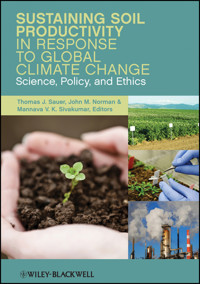
Sustaining Soil Productivity in Response to Global Climate Change E-Book
203,99 €
Mehr erfahren.
- Herausgeber: John Wiley & Sons
- Kategorie: Fachliteratur
- Sprache: Englisch
Sustaining Soil Productivity in Response to Global Climate Change: Science, Policy, and Ethics is a multi-disciplinary volume exploring the ethical, political and social issues surrounding the stewardship of our vital soil resources. Based on topics presented by an international group of experts at a conference convened through support of the Organization for Economic Co-operation and Development, chapters include scientific studies on carbon sequestration, ecosystem services, maintaining soil fertility, and the effects of greenhouse gas emissions, as well as ethical issues ranging from allocation of land use to policies needed for climate change adaptation and mitigation.
Bringing together the latest research in soil science and climatology, Sustaining Soil Productivity in Response to Global Climate Change is a valuable resource for soil and plant scientists, agronomists and environmental scientists, as well as agricultural and natural resources engineers and economists, environmental policy makers and conservationists.
Key Features:
- Written by an international group of authors representing a cross-section of scientists, thought leaders, and policy-makers
- Includes chapters on the potential effects of climate change on forest soil carbon, microbial function, and the role of soils and biogeochemistry in the climate and earth system
- Explores historical development of land use ethics and stewardship
Sie lesen das E-Book in den Legimi-Apps auf:
Seitenzahl: 636
Veröffentlichungsjahr: 2011
Ähnliche




















Contents
Contributors
Foreword
Introduction
1 Science, Ethics, and the Historical Roots of Our Ecological Crisis
1.1 Introduction
1.2 Historical Perspective on Soil Degradation
1.3 The New Challenge of Global Climate Change
1.4 White
1.5 Other Views on the Ethics of Land Use: Leopold et al.
1.6 Ethical Considerations of Strategies for Climate Change Mitigation: An Example
1.7 Conclusions
Acknowledgements
2 Intellectual Inertia
2.1 Introduction
2.2 Defining Intellectual Inertia
2.3 Examples of Intellectual Inertia
2.4 Intellectual Inertia is Unavoidable But Requires Vigilance
2.5 Intellectual Inertia and Climate Change Science
2.6 Optimizing Intellectual Inertia
3 The Ethics of Soil
3.1 Introduction
3.2 Private Property and Personal Ethics
3.3 Common Pool Resources
3.4 Public Policy
3.5 Instrumental Values of Soil
3.6 Beyond Instrumental Value
3.7 Conclusion and Next Steps
4 Aldo Leopold and the Land Ethic
4.1 Introduction
4.2 The Shaping of a Progressive
4.3 Erosion as a Menace
4.4 Standards of Conservation
4.5 Conservation as a Moral Issue
4.6 Wildlife and Soils
4.7 The Conservation Ethic
4.8 An Adventure in Cooperative Conservation
4.9 Land Pathology
4.10 Land Health
4.11 The Land Ethic
4.12 Epilogue
5 Rural Response to Climate Change in Poor Countries
5.1 Introduction
5.2 Ethics
5.3 Policies
5.4 Scientific Support Systems
5.5 Conclusions
6 Soil and Human Health
6.1 Introduction
6.2 Essential Trace Elements
6.3 Concerns for the Future
7 Agroecological Approaches to Help “Climate Proof” Agriculture While Raising Productivity in the Twenty-First Century
7.1 Introduction
7.2 Agroecological Approaches
7.3 The System of Rice Intensification
7.4 Effects of SRI Practices on Agriculture Affected by Climate Change
7.5 Applications to Crops Other than Rice
7.6 Climate-Proofing Agriculture
8 Ecological Integrity and Biological Integrity
8.1 Introduction
8.2 Ecological Integrity and Food Production Today
8.3 The Legal Status of Genetically Modified Organisms
8.4 Western Diets and Lifestyle Preferences: Vegan versus Carnivore
8.5 Conclusion
9 Soil Ecosystem Services
9.1 Introduction
9.2 F. H. King—“Farmers of Forty Centuries”
9.3 Soil: Valuable Natural Capital
9.4 Valuing Ecosystem Services
9.5 Valuing Carbon and Soil Ecosystem Services
9.6 Valuing Terroir
9.7 Land-Use Policy, Nutrient Management, and Natural Capital
9.8 Conclusion
10 Climate and Land Degradation
10.1 Introduction
10.2 Influence of Land Surface Changes on Climate
10.3 Climate Change and Land Degradation
10.4 Climate Variability and Impacts on Land Degradation
10.5 Technologies, Policies, and Measures to Address the Linkages between Climate and Land Degradation
10.6 Future Perspectives
11 The Role of Soils and Biogeochemistry in the Climate and Earth System
11.1 Introduction
11.2 Lessons Learned from the Intergovernmental Panel on Climate Change
11.3 The Carbon Cycle
11.4 The Nitrogen Cycle
11.5 Future of Earth System Models
12 Net Agricultural Greenhouse Gases
12.1 Introduction
12.2 Mitigation Practices for Reduction of Net GHG Emissions
12.3 Net GHG Reduction
12.4 Case Study 1: GHG Emission Mitigation through Composting of Liquid Swine Manure
12.5 Case Study 2: Direct and Indirect N2O Emission Reduction through Soil Tillage and Nitrogen Fertilizer Management Practices
12.6 Designing Policies for Reduced Nitrogen Fertilizer Use
12.7 Conclusion
13 Overview on Response of Global Soil Carbon Pools to Climate and Land-Use Changes
13.1 Introduction
13.2 Global Distribution of SOC
13.3 Global Vulnerability of SOC to Climate and Land-Use Change
13.4 Historical Land Cover, Agricultural Management, and Climate Change Effects on SOC
13.5 Future Changes in Climate and Land Use and the SOC Balance
13.6 Discussion: Uncertainties and Future Directions
13.7 Conclusions
13.8 Methods
Acknowledgement
14 Potential Impacts of Climate Change on Microbial Function in Soil
14.1 Introduction
14.2 Effect of CO2 Concentration on Plant C Inputs including Rhizodeposition to Soil
14.3 Effects of Elevated CO2 Concentration on Activity, Size, and Composition of Soil Microbiota
14.4 Effects of Elevated CO2 Concentration on Mycorrhizal Infections of Plants
14.5 Effect of Elevated CO2 Concentration on Biotic Interactions and on the Rhizosphere Microfauna
14.6 Effects of Increased CO2 Concentration, Global Warming, and Changes in Soil Moisture on Microbial Functions Related to C Sequestration in Soil
14.7 Conclusions
15 Impacts of Climate Change on Forest Soil Carbon
15.1 Introduction
15.2 Afforestation Overview
15.3 Implications for Predicting Climate Change Impacts
15.4 Modeling the Impacts of Climate Change on Soil Carbon
15.5 Conclusion
Acknowledgments
16 The Effect of Forest Management on Soil Organic Carbon
16.1 Forest Ecosystems and Global Carbon Cycle
16.2 Effect of Forest Management on Soil Organic Carbon Sequestration
16.3 Forest Management Strategies and Forest Structures Improving Carbon Storage
16.4 Conclusions
Index
Advertisement
This edition first published 2011 © 2011 by John Wiley & Sons, Inc.
Wiley-Blackwell is an imprint of John Wiley & Sons, formed by the merger of Wiley’s global Scientific, Technical and Medical business with Blackwell Publishing.
Registered OfficeJohn Wiley & Sons Ltd, The Atrium, Southern Gate, Chichester, West Sussex, PO19 8SQ, UK
Editorial Offices2121 State Avenue, Ames, Iowa 50014-8300, USAThe Atrium, Southern Gate, Chichester, West Sussex, PO19 8SQ, UK9600 Garsington Road, Oxford, OX4 2DQ, UK
For details of our global editorial offices, for customer services and for information about how to apply for permission to reuse the copyright material in this book please see our website at www.wiley.com/wiley-blackwell.
Authorization to photocopy items for internal or personal use, or the internal or personal use of specific clients, is granted by Blackwell Publishing, provided that the base fee is paid directly to the Copyright Clearance Center, 222 Rosewood Drive, Danvers, MA 01923. For those organizations that have been granted a photocopy license by CCC, a separate system of payments has been arranged. The fee codes for users of the Transactional Reporting Service are ISBN-13: 978-0-4709-5857-5/2011.
Designations used by companies to distinguish their products are often claimed as trademarks. All brand names and product names used in this book are trade names, service marks, trademarks or registered trademarks of their respective owners. The publisher is not associated with any product or vendor mentioned in this book. This publication is designed to provide accurate and authoritative information in regard to the subject matter covered. It is sold on the understanding that the publisher is not engaged in rendering professional services. If professional advice or other expert assistance is required, the services of a competent professional should be sought.
The opinions expressed and arguments employed in this publication are the sole responsibility of the authors and do not necessarily reflect those of the OECD or of the governments of its Member countries.
Cataloging-in-Publication Data is available with the Library of Congress.
Sustaining soil productivity in response to global climate change : science, policy, and ethics / editors, Thomas J. Sauer, John M. Norman, Mannava V. K. Sivakumar. p. cm. Includes bibliographical references and index. ISBN-13: 978-0-470-95857-5 (hardback) ISBN-10: 0-470-95857-X (hardback) 1. Soil management. 2. Sustainable agriculture. 3. Greenhouse gas mitigation. I. Sauer, Thomas J. II. Norman, John M III. Sivakumar, M. V. K. S591.S8985 2011 333.76′16–dc23
2011012031
A catalogue record for this book is available from the British Library.
This book is published in the following electronic formats: ePDF 9780470960226; Wiley Online Library 9780470960257; ePub 9780470960233; Mobi 9780470960240.
Contributors
Pierre Barré
Geology LaboratoryUMR CNRS-ENS, Paris, France
Valentin Belassen
Laboratoire des Sciences du Climat et de l’EnvironmentGif-sur-Yvette, France
Patricia Cadule
Laboratoire des Sciences du Climat et de l’EnvironmentGif-sur-Yvette, France
Claire Chenu
BIOEMCO LaboratoryAgroParis Techn, Campus GrignonThiverval-Grignon, France
Philippe Ciais
Laboratoire des Sciences du Climat et de l’EnvironmentGif-sur-Yvette, France
Brent E. Clothier
Plant and Food Research Systems Modeling GroupPalmerston North, New Zealand
Sally Collins (retired)
Director, U.S. Department of Agriculture, Office of Environmental MarketsWashington, DC
Markus Deurer
Plant and Food Research Production Footprint TeamPalmerston North, New Zealand
Silvia Dezi
Department of Fruit Tree and Woody Plant SciencesUniversity of BolognaBologna, Italy
Thomas Eglin
Laboratoire des Sciences du Climat et de l’EnvironmentGif-sur-Yvette, France
Susan L. Flader (retired)
Department of HistoryUniversity of Missouri, Columbia
Thomas Gasser
Laboratoire des Sciences du Climat et de l’EnvironmentGif-sur-Yvette, France
Steven R. Green
Plant and Food Research Systems Production Footprint TeamPalmerston North, New Zealand
Alistair J. Hall
Plant and Food Research Systems Modeling GroupPalmerston North, New Zealand
Elisabeth A. Holland
Atmospheric Chemistry DivisionNational Center for Atmospheric ResearchBoulder, Colorado
Alec D. Mackay
AgResearchClimate Land & EnvironmentPalmerston North, New Zealand
Paolo Nannipieri
Department of Plant, Soil and Environmental SciencesUniversity of Firenze, Italy
Michael P. Nelson
Department of Fisheries and Wildlife and Department of PhilosophyMichigan State University, East Lansing
John M. Norman (retired)
Department of Soil ScienceUniversity of Wisconsin, Madison
Keryn I. Paul
Commonwealth Scientific and Industrial Research OrganisationEcosystem SciencesCanberra, Australia
Shi Long Piao
Department of Ecology, College of Urban and Environmental SciencesPeking UniversityBeijing, China
Philip J. Polglase
Commonwealth Scientific and Industrial Research OrganisationEcosystem SciencesCanberra, Australia
Markus Reichstein
Biogeochemical Model-Data Integration GroupMax-Planck Institute für BiogeochemistryJena, Germany
Thomas J. Sauer
US Department of AgricultureAgricultural Research ServiceNational Laboratory for Agriculture and the EnvironmentAmes, Iowa
Francesca Scandellari
Department of Fruit Tree and Woody Plant SciencesUniversity of Bologna, ItalyComplex System Research CenterUniversity of New Hampshire, Durham
Mannava V. K. Sivakumar
Climate Prediction and Adaptation BranchWorld Meteorological OrganizationGeneva, Switzerland
Pete Smith
Institute of Biological and Environmental SciencesUniversity of Aberdeen, Scotland
Eiliv Steinnes
Department of ChemistryNorwegian University of Science and TechnologyTrondheim, Norway
C. J. (Kees) Stigter
Agromet VisionBruchem, The NetherlandsBondowoso, East Java, Indonesia
Paul B. Thompson
Departments of Philosophy of Community, Agriculture, Recreation and Resource Studies and of Agricultural, Food and Resource EconomicsMichigan State UniversityEast Lansing, Michigan
Giustino Tonon
Department of Fruit Tree and Woody Plant SciencesUniversity of Bologna, ItalyFaculty of Science and TechnologyFree University of Bolzano/Bozen, Italy
Norman Uphoff
Cornell International Institute for Food, Agriculture, and DevelopmentIthaca, New York
Maurizio Ventura
Department of Fruit Tree and Woody Plant SciencesUniversity of Bologna, Italy
Claudia Wagner-Riddle
School of Environmental SciencesUniversity of GuelphGuelph, Ontario, Canada
Alfons Weersink
Department of Food, Agricultural and Resource EconomicsUniversity of GuelphGuelph, Ontario, Canada
Laura Westra
Faculty of LawUniversity of WindsorWindsor, Ontario, Canada
Foreword
Ecosystem services are the benefits people obtain from ecosystems, the services that support life and our basic well-being. The Millennium Ecosystem Assessment found that we are losing the world’s ecosystem services at an alarming rate. Soil health and productivity are foundational to the provision of nearly all of these life-sustaining services, including food and fuel production, carbon sequestration, water filtration, flood control, and biodiversity. Much of the damage to ecosystem services has resulted from unsustainable land-use practices—like loss of productive land to development, chemical pollution, erosion, and deforestation. And human activities are growing—dramatically. As Yale Dean Gus Speth noted a few years ago: “It took all of history to build the $7 trillion world economy of 1950, and today we add that amount of economic activity every 5 to 10 years.” Climate change and its concomitant pressures exacerbate these trends because extreme weather events and warmer temperatures change basic ecological processes. The combination presents a daunting challenge in terms of how we feed, fuel, and house the planet’s growing population, projected to exceed nine billion people by the middle of this century.
Policies addressing climate change must be holistic to capture the complex interdependent nature of global food supplies, energy needs, and the provision of ecosystem services. Maintaining or enhancing soil productivity is an essential component of food security policy, for example, and food security is fundamental to national security. As our soil resources face increasing stress in response to rapid environmental change, we have to ensure that society’s short-term needs and demands are met without sacrificing long-term soil health and productivity. And we must urgently invest in strategies to reverse soil degradation and the loss of ecosystem services.
This conference brought together a most impressive cross-section of scientists, thought leaders, and policy makers to consider not just the effects of climate change on soil productivity, but also to reflect on the broader implications of climate change on people. It is my strong hope that more conferences like this will be held, where the economic, social, and governance challenges of living in an ever-more globalized economy are examined—where we can begin to honestly contemplate policies that will address how to live sustainably on this planet.
It was an honor for me to be a part of this.
Sally CollinsDirector, Office of Environmental MarketsUS Department of Agriculture
Introduction
Global climate change has potential to sharply accelerate soil degradation due to environmental stresses induced by changes in temperature and precipitation and increasing occurences of extreme climatic events. Growing demand for food and commitments to increase biofuel production to meet global energy demands are putting intense pressure on soil resources to sustain or increase productivity. Maintaining or enhancing soil productivity is a high priority area for developing food security policy at national and global scales. Policies to reduce or avoid potential climate change consequences for global food supplies must be crafted in a holistic fashion to ensure that short-term supplies can be met without sacrificing long-term degradation of the soil resource due to erosion, pollution, and physical and chemical deterioration. Strategies to reverse current practices leading to soil degradation are also urgently needed. The critical role of the soil system in influencing ecosystem processes at the local, national, and global scale is being increasingly appreciated by policy makers and earth scientists in general. Greater awareness also exists of the role of human management in affecting the capability of the soil to supply human needs and buffer climatic changes. Unfortunately this comes at a time when soil scientists and the discipline itself are struggling to maintain an identity and improve public awareness of the value of soil science.
In the summer of 2009, an interdisciplinary group of leading scientists from 11 countries assembled on the shores of Lake Mendota in Madison, Wisconsin, for a 3-day conference on sustaining soil productivity in response to global climate change. Although there have been numerous conferences on climate change, the unique perspective of this conference was the focus on maintaining or enhancing soil productivity, and in particular, the ethical implications of policies intended to ameliorate climate change effects. The integrated nature of this conference created a special opportunity for scientists from widely varying backgrounds to interact on a topic of intense mutual interest. The conference emphasized the broad sweep of issues that relate to soils and climate change: policy, philosophy, ethics, social issues, global modeling, science politics, economics, cultural adoption constraints, defining ecosystem services, bureaucratic conflicts, and of course, intellectual inertia. The dynamism and constructive nature of the discussions from such a diverse group showed that interested parties can dialog constructively on this broad playing field.
The issue of culpability on the part of developed countries that dominate greenhouse gas production and then resist measures to ameliorate global climate effects, many of which have a disproportionate impact on developing countries, is an example of the scale and breadth of issues addressed. Such behavior, although understandable from the perspective of national self-interest, presents dramatic implications for global welfare and is seen by some parties as an egregious violation of accepted human rights standards. This perspective on climate change is likely to elicit strong emotional responses from interest groups that advocate for the poor and citizens of developing countries. It was also clear that scientists as individuals have values implicitly built into their work. This is a concept that many scientists resist at first but deserves further consideration. Many feel that to be truly objective, personal ideology can have no influence. However, each culture has their own set of norms that are also inherent in the beliefs of its members, of which scientists are not excluded.
Coupling the science of global climate change and soil sustainability within an ethics framework and with policy makers as the intended audience creates a deeper discussion. A midconference field trip to the Aldo Leopold Legacy Center near Baraboo provided an informal setting to continue these conversations and observe the site of Aldo Leopold’s personal efforts to restore ecosystem function to a “worn out” farm. Leopold, known as the father of game management and author of the land ethic, was also a passionate soil conservationist. He stressed that much progress could be made in conservation issues by just deeper thinking. By broadening the climate change debate, this conference illuminated some of the human aspects that are so relevant yet generally overlooked by the economic analyses and political expediencies that currently control the debate.
The primary conference sponsor was the Co-operative Research Programme on Biological Resource Management for Sustainable Agricultural Systems (CRP) of the Organisation for Economic Co-operation and Development (OECD), an international organization helping its 34-member countries tackle the economic, social, and governance challenges of a globalized economy. The financial support of the CRP made it possible for most of the invited speakers to participate in the conference. Major support was also provided by the Department of Soil Science at the University of Wisconsin, Madison; the World Meteorological Organization (WMO); the Office of Technology Transfer of the USDA-Agricultural Research Service (USDA-ARS); and the Leopold Center for Sustainable Agriculture. Additional support was provided by Campbell Scientific, Inc.; Decagon Devices, Inc.; LI-COR Biosciences; Cilas; the University of Wisconsin, Madison Arboretum; and the USDA-Natural Resources Conservation Service. The conference organizers sincerely appreciate the generous support of all the sponsors.
Appreciation is also extended to the staff at the Lowell Center Inn and Conference Center, The Pyle Center, and the Aldo Leopold Legacy Center for their considerate assistance and professional service. Janet Silbernagel, Nicholas Balster, and Chris Kucharik, all of the University of Wisconsin, Madison, graciously presided over oral sessions. Sally Collins, Director of the USDA Office of Ecosystem Services and Markets, took time from her full schedule to deliver a highly perceptive keynote address linking science and policy issues. Monique Leclerc offered valuable insight and suggestions in preparation of the conference proposal. Finally, the diligent and patient efforts of Janet Schofield, OECD in Paris, and John Sadler, USDA-ARS, Columbia, Missouri, and OECD Theme Coordinator, in helping coordinate the conference planning and execution are gratefully acknowledged.
Thomas J. Sauer
John M. Norman
Mannava V. K. Sivakumar
Sustaining Soil Productivity in Response to Global Climate Change
Science, Policy, and Ethics
1 Science, Ethics, and the Historical Roots of Our Ecological Crisis
Was White Right?
Thomas J. Sauer and Michael P. Nelson
1.1 Introduction
Continuing debate and proposed coordinated actions, such as the Endangered Species Act and Clean Water Act in the 1970s, to address global climate change have stimulated a broad, intense public discourse on environmental management. Such debates raise questions about the sacrifices or investment society is willing to make to protect or preserve natural resources. The climate change discussion is the most recent example of a dialogue that has been repeated throughout recorded history; that is, what degree of human exploitation of natural resources is acceptable? A brief essay in Science by respected medieval historian Lynn White, Jr., (1967) suggested that values developed and perpetuated by Christian theology permeate western science and technology and are responsible for human’s seemingly continuous abuse of the environment. White’s assertions have prompted more than 40 years of strident arguments by both passionate critics and defenders, making this paper one of, if not, the most important contributions to the developing field of environmental ethics.
Defenders of White argue that the chronic inability of societies to effectively address pressing environmental challenges is generally not due to a lack of knowledge or resources. Instead, failure to solve problems, such as soil erosion, air and water pollution, deforestation, and now climate change, are due to a deep-seated yet generally tacit belief that humans are ordained to control and dominate, not care for and protect, nature. A broader interpretation of White’s argument can easily be extended beyond singling out Christianity as the sole culprit. Several counterarguments include the observation that poor environmental management is not exclusive to western cultures dominated by Christian beliefs, and many other tenets of Christianity (e.g. “love they neighbor”) are not universally applied. Recent archaeological evidence suggests that environmentally destructive tendencies of humans predated Christianity by centuries (Eisler 1987). The increasing severity of environmental crises in the second half of the twentieth century that White laments has also been blamed on the powerful economic forces driving materialism and luxury consumption (Kasser 2002; Kaplan 2008). If the failure to recognize or act on environmental crises is indicative of a deficient moral or ethical perspective, then it likely has deep roots in multiple cultural and historical sources, including religious traditions.
Lesen Sie weiter in der vollständigen Ausgabe!
Lesen Sie weiter in der vollständigen Ausgabe!
Lesen Sie weiter in der vollständigen Ausgabe!
Lesen Sie weiter in der vollständigen Ausgabe!
Lesen Sie weiter in der vollständigen Ausgabe!
Lesen Sie weiter in der vollständigen Ausgabe!
Lesen Sie weiter in der vollständigen Ausgabe!
Lesen Sie weiter in der vollständigen Ausgabe!
Lesen Sie weiter in der vollständigen Ausgabe!
Lesen Sie weiter in der vollständigen Ausgabe!
Lesen Sie weiter in der vollständigen Ausgabe!
Lesen Sie weiter in der vollständigen Ausgabe!
Lesen Sie weiter in der vollständigen Ausgabe!
Lesen Sie weiter in der vollständigen Ausgabe!
Lesen Sie weiter in der vollständigen Ausgabe!
Lesen Sie weiter in der vollständigen Ausgabe!
Lesen Sie weiter in der vollständigen Ausgabe!




