


0,49 €
Niedrigster Preis in 30 Tagen: 1,99 €
Niedrigster Preis in 30 Tagen: 1,99 €
Mehr erfahren.
- Herausgeber: Booksell-Verlag
- Kategorie: Geisteswissenschaft
- Sprache: Englisch
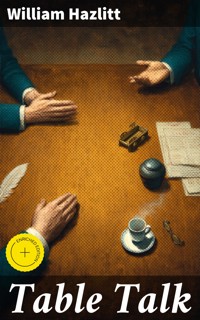
In "Table Talk," William Hazlitt offers a collection of essays that masterfully blend personal reflection with incisive social commentary. This work exemplifies Hazlitt's skillful prose and his ability to reveal the underlying truths of human experience through vivid anecdotes and absorbing dialogues. Written during the early 19th century, a time marked by shifting social and political landscapes in England, Hazlitt's essays delve into a range of topics including philosophy, art, politics, and the intricacies of everyday life, structured in a style that is both conversational and intellectually rigorous. William Hazlitt, a prominent figure in the Romantic literary movement, was known for his passionate advocacy of individual thought and his critique of societal norms. His diverse background as a son of a Unitarian minister and his experiences in the vibrant intellectual circles of his time shaped his eloquent yet candid style. Hazlitt's keen observations and his own struggles with social and personal identity provide rich context for this work, revealing his commitment to exploring the nuances of human nature. "Table Talk" is a must-read for anyone interested in the intersection of personal sentiment and broader societal issues. Hazlitt's eloquent prose and timeless insights encourage readers to engage in critical thought about their own lives and the world around them. This collection not only entertains but enlightens, making it a seminal work that resonates with both contemporary and modern audiences. In this enriched edition, we have carefully created added value for your reading experience: - A comprehensive Introduction outlines these selected works' unifying features, themes, or stylistic evolutions. - A Historical Context section situates the works in their broader era—social currents, cultural trends, and key events that underpin their creation. - A concise Synopsis (Selection) offers an accessible overview of the included texts, helping readers navigate plotlines and main ideas without revealing critical twists. - A unified Analysis examines recurring motifs and stylistic hallmarks across the collection, tying the stories together while spotlighting the different work's strengths. - Reflection questions inspire deeper contemplation of the author's overarching message, inviting readers to draw connections among different texts and relate them to modern contexts. - Lastly, our hand‐picked Memorable Quotes distill pivotal lines and turning points, serving as touchstones for the collection's central themes.
Das E-Book können Sie in Legimi-Apps oder einer beliebigen App lesen, die das folgende Format unterstützen:
Veröffentlichungsjahr: 2019
Ähnliche










Table Talk
Table of Contents
Introduction
This edition presents William Hazlitt’s Table Talk as a complete, two‑volume collection of essays, first published in 1821 and 1822. Composed in the mature phase of Hazlitt’s career, the series gathers his most characteristic reflections on art, literature, society, and character. Its purpose is not to systematise doctrine but to capture the energy of thought in motion—the quick, candid interplay of observation and judgment that the title evokes. As an English essayist and critic of the Romantic era (1778–1830), Hazlitt uses the form to test ideas against experience, inviting readers to a sustained conversation that ranges from painterly analysis to everyday manners and the deepest anxieties of selfhood.
The contents are prose essays: critical, reflective, descriptive, and argumentative. They include art criticism, literary appreciation, social and political observation, moral psychology, and character sketches. The range extends from meditations on painting and poetry to portraits of public figures and studies of habits, taste, and conversation. The pieces vary in emphasis—some speculative, some anecdotal, some polemical—and one remains explicitly marked as a fragment. There are no novels, plays, or poems, nor letters or diaries; the set is unified by its essayistic mode, its conversational cadence, and its balance of concrete example with general principle across both volumes.
A through‑line of the collection is Hazlitt’s defence of independent judgment and lived perception against cant, fashion, and received commonplace. He examines the tension between genius and common sense, the uses and abuses of paradox, and the attractions and distortions of taste. Equally prominent are themes of solitude and sociability, the ethics of criticism, the education of attention, and the psychology of habit and self‑deception. Time and memory—our orientation to the past and our projection toward the future—recur as testing grounds for thought and action. Together, these concerns yield a humane but unsentimental inquiry into how we see, value, and conduct our lives.
Table Talk endures because it refines the English familiar essay into a supple instrument for serious reflection without academic stiffness. Hazlitt’s pages marry intellectual pressure to everyday speech, advancing claims that are argued, illustrated, and felt. As a body of work, the collection stands at the crossroads of Romantic criticism and pragmatic moral philosophy, valuing the authority of experience while probing its limits. It remains significant not only for its analyses of art and literature but also for its lucid account of character in society. The essays exemplify how criticism can illuminate general life, and how general life can sharpen critical understanding.
The first volume moves from the pleasures and disciplines of painting to questions of genius, common sense, and the hazards of intellectual pride. It includes character study and social satire, as well as reflections on solitude, action, and practical ethics. The second volume broadens and deepens the portfolio: landscape painting and poetic form appear alongside travel, coffee‑house culture, literary style, and institutional behaviour. Debates about theatrical spectatorship and patronage meet inquiries into the knowledge of character and the nature of the picturesque. The sequence culminates in a meditation on mortality, drawing the collection’s moral psychology into sharp and memorable focus.
Stylistically, Hazlitt’s hallmarks are clarity, vigour, and a conversational poise that conceals careful structure. He proceeds from vivid particulars to general truths, using anecdote, comparison, and antithesis to keep thought nimble and accountable to experience. The tone shifts—urbane, indignant, amused, elegiac—yet the voice remains unmistakably direct. He distrusts jargon and puffery, favouring a familiar style that can carry close analysis of painters and poets as readily as street‑level observation. The result is criticism that is argumentative without pedantry, personal without self‑absorption, and ethical without preaching, a method that allows disparate topics to cohere as facets of a single intellectual temperament.
Read together, these essays offer a continuous education in attention: how to look at pictures and people, how to hear prose and public talk, how to test our opinions against stubborn facts. Their relevance lies in this discipline as much as in their subjects. Contemporary readers will find a guide to resisting groupthink, valuing craft, and measuring conviction against consequence. Approached as an extended conversation rather than a treatise, Table Talk rewards slow reading and re‑reading, each piece illuminating the next. As a complete two‑volume collection, it preserves the full range of Hazlitt’s inquiry and the living cadence that gives his criticism its lasting power.
Historical Context
William Hazlitt (1778–1830), born at Maidstone and raised among English Dissenters in Wem, Shropshire, wrote Table-Talk amid the metropolitan bustle of London and retreats at Winterslow on Salisbury Plain. Trained first as a painter under the influence of his brother John Hazlitt, he carried a visual sensibility into prose. Friendships with S. T. Coleridge, William Wordsworth, Charles Lamb, and Leigh Hunt, formed from 1798 onward, placed him at the core of Romantic debates on taste, politics, and style. Issued in two volumes in London in 1821–22, Table-Talk converts the sociable idiom of coffee-house conversation into essays on art, character, criticism, and conduct.
The collection reflects a generation shaped by the French Revolution (1789) and the long Napoleonic wars (1793–1815). Hazlitt visited Paris during the Peace of Amiens (1802) and again after 1814, later composing his multivolume Life of Napoleon (1828–30). At home, the struggle for civil liberty intensified after the Peterloo Massacre at Manchester, 16 August 1819, and the repressive Six Acts that winter. As a parliamentary reporter and political essayist in London, Hazlitt learned the idiom of public contention that informs pieces on “Coffee-house Politicians,” “On Corporate Bodies,” “On the Aristocracy of Letters,” and “On Thought and Action,” where private conscience confronts institutional power.
Hazlitt’s aesthetic arguments grow from late eighteenth-century art institutions and debates. The Royal Academy (founded 1768) and Sir Joshua Reynolds’s Discourses (1769–1790) had canonized the “ideal,” which Hazlitt interrogates in essays on Reynolds’s inconsistencies and on the “Picturesque and Ideal.” He admired Nicolas Poussin (1594–1665), whose landscapes he studied in Paris’s Musée Napoléon (the Louvre) and in English collections such as Dulwich Picture Gallery (opened 1817). Theories of the picturesque by William Gilpin (1782), Uvedale Price (1794), and Richard Payne Knight (1794), together with Edmund Burke’s Philosophical Enquiry (1757), provide the intellectual scenery for “On the Pleasure of Painting” and “Why Distant Objects Please.”
The literary field of Table-Talk is the vigorous periodical culture of the 1810s–20s. Reviews such as the Edinburgh Review (1802), the Quarterly Review (1809), Blackwood’s Magazine (1817), and the London Magazine (1820) shaped reputations, often violently, in the era of the “Cockney School.” As a Dissenter excluded from Oxford and Cambridge by the Test and Corporation Acts (repealed 1828), Hazlitt prized anti-pedantic clarity, lecturing on the English Poets in 1818 and defending a conversational prose derived from Addison and Steele, Swift, and Fielding—central to “On Familiar Style” and “On Criticism.” His “Milton’s Sonnets” joins Romantic sonnet revival and Milton’s republican legacy.
The London stage supplied Hazlitt with a living laboratory of manners and passion. After Covent Garden’s 1809 “O.P.” riots and Drury Lane’s rebuilding (opened 1812), theatres became arenas of class display as much as art. Hazlitt championed Edmund Kean after his Drury Lane debut on 26 January 1814, and his experience as a drama critic for metropolitan papers informs the essays’ judgments on taste, sincerity, and “vulgarity.” Questions of audience and status—whether actors should sit in the boxes, how puffery distorts acclaim, what constitutes affectation—arise from this Regency playhouse culture and echo through related reflections on paradox, common-place, and the knowledge of character.
Regency spectatorship also fed on empire, science, and feats of manual skill. The East India Company’s ascendancy made “Indian jugglers” familiar sights in London; performers such as Ramo Samee were exhibited in the 1810s, prompting Hazlitt’s meditations on practice, attention, and genius. New habits of seeing—panoramas in Leicester Square, optical toys, gaslit streets—met older associationist psychology (Hume, 1748; Hartley, 1749) and fashionable character-reading (Lavater’s physiognomy; Spurzheim’s phrenology, lecturing in London after 1815). Essays on why distance pleases, on people with one idea, on thought and action, and on the knowledge of character draw upon this mingling of spectacle, empirical curiosity, and moral scrutiny.
The book inhabits a rapidly commercializing metropolis. London’s population rose from about one million in 1801 to more than 1.5 million by 1831, enlarging markets for newspapers, galleries, and theatres. Aristocratic patronage yielded to publishers and publicity: John Murray’s Albemarle Street house (from 1812) and Henry Colburn’s magazines perfected “puffing,” while stamp duties and libel laws, tightened by the 1819 Newspaper and Stamp Duties Act, burdened the radical press. Credit booms and postwar slumps after 1815 sharpened anxieties about property and succession, the stuff of “On Will-Making.” Essays on patronage, criticism, and the aristocracy of letters track culture’s uneasy traffic with money.
Finally, the geography of Hazlitt’s life supplies a rhythm of sociability and retreat. The age of turnpike roads and Palmer’s mail-coach reforms after 1784 made solitary pedestrian tours and swift travel equally emblematic. From London lodgings to the Winterslow Hut on Salisbury Plain, he balanced coffee-house talk with rural silence, inspiring “On Going a Journey,” “On Living to One’s-self,” and meditations on the past and future. The early 1820s—George IV’s accession (1820), the deaths of friends and idols, personal estrangement—shadow “On the Fear of Death” without extinguishing its humane stoicism. Table-Talk thus links Enlightenment confidence to Romantic inwardness at a moment of national transition.
Synopsis (Selection)
On the Pleasure of Painting (Essays I–II)
Hazlitt celebrates the contemplative joy of amateur painting—the tactile and visual delight of color, form, and imitation—and how it fosters solitude and self-possession. He contrasts painting’s immediate, sensuous rewards with the anxieties of professional art and other pursuits.
On the Past and Future
A meditation on how memory and anticipation shape feeling, noting the past’s vividness and finality against the future’s alluring but uncertain promises.
On Genius and Common Sense (Essays IV–V)
Contrasts the imaginative boldness and waywardness of genius with the prudence and reliability of common sense. Hazlitt shows how society prizes the latter while misunderstanding the former, and how both can clash within a single character.
Character of Cobbett
A vigorous portrait of William Cobbett’s plain-spoken style, independence, and contradictions as a polemicist, balancing admiration with critique.
On People with One Idea
Observes minds dominated by a single obsession, whose focus yields effectiveness but also tedious narrowness.
On the Ignorance of the Learned
Critiques pedantry by showing how vast book-knowledge can coexist with practical ignorance and poor judgment.
The Indian Jugglers
Uses the marvel of jugglers’ dexterity to probe the nature of skill, the limits of emulation, and the relation between mechanical excellence and artistic genius.
On Living to One's-Self
Advocates for independence and the pleasures of solitude, warning against the dissipations of society without endorsing misanthropy.
On Thought and Action
Examines the gap between reflection and execution, exploring how habit, will, and circumstance determine whether ideas become deeds.
On Will-Making
A satiric meditation on testaments, mortality, and property, highlighting the whims, vanities, and anxieties that shape bequests.
On Certain Inconsistencies in Sir Joshua Reynolds's Discourses (Essays XIII–XIV)
Charges Reynolds with conflicting precepts about generalization, imitation, and nature and argues for fidelity to observed truth over academic formulas. Considers how such inconsistencies may mislead students and warp artistic judgment.
On Paradox and Common-Place
Assesses the allure of striking paradoxes against the solid worth of familiar truths, urging balance between novelty and common sense.
On Vulgarity and Affectation
Defines and contrasts coarseness and pretension in manners and style, showing how both distort taste and character.
On a Landscape of Nicolas Poussin
An ekphrastic meditation on a Poussin landscape that unfolds its moral grandeur and reflective calm, using the painting to discuss the union of nature, history, and ideal art.
On Milton's Sonnets
Defends the grave strength and public spirit of Milton’s sonnets, analyzing their style and singular dignity in contrast with other sonneteers.
On Going a Journey
Celebrates solitary travel as a liberation for the senses and mind, relishing roads, inns, and unencumbered observation.
On Coffee-House Politicians
A lively sketch of talkative partisans who make and unmake governments over coffee, illustrating the theatre of opinion versus the realities of power.
On the Aristocracy of Letters
Argues that literature forms a true aristocracy of mind and merit, distinct from birth or wealth, while noting its independence and precariousness.
On Criticism
Outlines the aims and limits of criticism, the cultivation of taste, and the dangers of faction, vanity, and dogma among critics.
On Great and Little Things
Reflects on our tendency to be absorbed by trifles while neglecting larger concerns, and what this reveals about human attention.
On Familiar Style
Advocates clear, idiomatic prose that feels spoken rather than written, warning alike against pedantry and slang.
On Effeminacy of Character
Considers how luxury, habit, and indulgence soften resolution and principle, distinguishing true sensibility from weakness.
Why Distant Objects Please
Explains the charm of remoteness in time and space, where vagueness and imagination heighten beauty and desire.
On Corporate Bodies
Argues that collective entities, lacking individual conscience, tend to act with self-interest and impunity unlike persons.
Whether Actors Ought to Sit in the Boxes?
Weighs theatrical decorum and social prejudice in the question of actors’ place among audiences, considering illusion, respectability, and professional status.
On the Disadvantages of Intellectual Superiority
Lists the social and personal costs of superior understanding—envy, isolation, and impracticality—despite its intrinsic worth.
On Patronage and Puffing
Exposes the corrupting influence of patronage and hype in the arts and letters, contrasting manufactured reputation with earned merit.
On the Knowledge of Character
Discusses how we judge character from signs, experience, and sympathy, noting the ease of error and self-deception.
On the Picturesque and Ideal (A Fragment)
Sketches the distinction between rough, striking particularity and purified, general beauty in art, hinting at a larger theory left unfinished.
On the Fear of Death
A sober reflection on mortality, the instinct to cling to life, and the limited consolations offered by philosophy or faith.
Table Talk
VOLUME I
ESSAY I. ON THE PLEASURE OF PAINTING
'There is a pleasure in painting which none but painters know[1q].' In writing, you have to contend with the world; in painting, you have only to carry on a friendly strife with Nature. You sit down to your task, and are happy. From the moment that you take up the pencil, and look Nature in the face, you are at peace with your own heart. No angry passions rise to disturb the silent progress of the work, to shake the hand, or dim the brow: no irritable humours are set afloat: you have no absurd opinions to combat, no point to strain, no adversary to crush, no fool to annoy—you are actuated by fear or favour to no man. There is 'no juggling here,' no sophistry, no intrigue, no tampering with the evidence, no attempt to make black white, or white black: but you resign yourself into the hands of a greater power, that of Nature, with the simplicity of a child, and the devotion of an enthusiast—'study with joy her manner, and with rapture taste her style.' The mind is calm, and full at the same time. The hand and eye are equally employed. In tracing the commonest object, a plant or the stump of a tree, you learn something every moment. You perceive unexpected differences, and discover likenesses where you looked for no such thing. You try to set down what you see—find out your error, and correct it. You need not play tricks, or purposely mistake: with all your pains, you are still far short of the mark. Patience grows out of the endless pursuit, and turns it into a luxury. A streak in a flower, a wrinkle in a leaf, a tinge in a cloud, a stain in an old wall or ruin grey, are seized with avidity as the spolia opima of this sort of mental warfare, and furnish out labour for another half-day. The hours pass away untold, without chagrin, and without weariness; nor would you ever wish to pass them otherwise. Innocence is joined with industry, pleasure with business; and the mind is satisfied, though it is not engaged in thinking or in doing any mischief.(1)
I have not much pleasure in writing these Essays, or in reading them afterwards; though I own I now and then meet with a phrase that I like, or a thought that strikes me as a true one. But after I begin them, I am only anxious to get to the end of them, which I am not sure I shall do, for I seldom see my way a page or even a sentence beforehand; and when I have as by a miracle escaped, I trouble myself little more about them. I sometimes have to write them twice over: then it is necessary to read the proof, to prevent mistakes by the printer; so that by the time they appear in a tangible shape, and one can con them over with a conscious, sidelong glance to the public approbation, they have lost their gloss and relish, and become 'more tedious than a twice-told tale.' For a person to read his own works over with any great delight, he ought first to forget that he ever wrote them. Familiarity naturally breeds contempt. It is, in fact, like poring fondly over a piece of blank paper; from repetition, the words convey no distinct meaning to the mind—are mere idle sounds, except that our vanity claims an interest and property in them. I have more satisfaction in my own thoughts than in dictating them to others: words are necessary to explain the impression of certain things upon me to the reader, but they rather weaken and draw a veil over than strengthen it to myself. However I might say with the poet, 'My mind to me a kingdom is,' yet I have little ambition 'to set a throne or chair of state in the understandings of other men.' The ideas we cherish most exist best in a kind of shadowy abstraction,
and derive neither force nor interest from being exposed to public view. They are old familiar acquaintance, and any change in them, arising from the adventitious ornaments of style or dress, is little to their advantage. After I have once written on a subject, it goes out of my mind: my feelings about it have been melted down into words, and then I forget. I have, as it were, discharged my memory of its old habitual reckoning, and rubbed out the score of real sentiment. For the future it exists only for the sake of others. But I cannot say, from my own experience, that the same process takes place in transferring our ideas to canvas; they gain more than they lose in the mechanical transformation. One is never tired of painting, because you have to set down not what you knew already, but what you have just discovered. In the former case you translate feelings into words; in the latter, names into things. There is a continual creation out of nothing going on. With every stroke of the brush a new field of inquiry is laid open; new difficulties arise, and new triumphs are prepared over them. By comparing the imitation with the original, you see what you have done, and how much you have still to do. The test of the senses is severer than that of fancy, and an over-match even for the delusions of our self-love. One part of a picture shames another, and you determine to paint up to yourself, if you cannot come up to Nature. Every object becomes lustrous from the light thrown back upon it by the mirror of art: and by the aid of the pencil we may be said to touch and handle the objects of sight. The air-drawn visions that hover on the verge of existence have a bodily presence given them on the canvas: the form of beauty is changed into a substance: the dream and the glory of the universe is made 'palpable to feeling as well as sight.'—And see! a rainbow starts from the canvas, with its humid train of glory, as if it were drawn from its cloudy arch in heaven. The spangled landscape glitters with drops of dew after the shower. The 'fleecy fools' show their coats in the gleams of the setting sun. The shepherds pipe their farewell notes in the fresh evening air. And is this bright vision made from a dead, dull blank, like a bubble reflecting the mighty fabric of the universe? Who would think this miracle of Rubens' pencil possible to be performed? Who, having seen it, would not spend his life to do the like? See how the rich fallows, the bare stubble-field, the scanty harvest-home, drag in Rembrandt's landscapes! How often have I looked at them and nature, and tried to do the same, till the very 'light thickened,' and there was an earthiness in the feeling of the air! There is no end of the refinements of art and nature in this respect. One may look at the misty glimmering horizon till the eye dazzles and the imagination is lost, in hopes to transfer the whole interminable expanse at one blow upon the canvas. Wilson said, he used to try to paint the effect of the motes dancing in the setting sun. At another time, a friend, coming into his painting-room when he was sitting on the ground in a melancholy posture, observed that his picture looked like a landscape after a shower: he started up with the greatest delight, and said, 'That is the effect I intended to produce, but thought I had failed.' Wilson was neglected; and, by degrees, neglected his art to apply himself to brandy. His hand became unsteady, so that it was only by repeated attempts that he could reach the place or produce the effect he aimed at; and when he had done a little to a picture, he would say to any acquaintance who chanced to drop in, 'I have painted enough for one day: come, let us go somewhere.' It was not so Claude left his pictures, or his studies on the banks of the Tiber, to go in search of other enjoyments, or ceased to gaze upon the glittering sunny vales and distant hills; and while his eye drank in the clear sparkling hues and lovely forms of nature, his hand stamped them on the lucid canvas to last there for ever! One of the most delightful parts of my life was one fine summer, when I used to walk out of an evening to catch the last light of the sun, gemming the green slopes or russet lawns, and gilding tower or tree, while the blue sky, gradually turning to purple and gold, or skirted with dusky grey, hung its broad marble pavement over all, as we see it in the great master of Italian landscape. But to come to a more particular explanation of the subject:—
The first head I ever tried to paint was an old woman with the upper part of the face shaded by her bonnet, and I certainly laboured (at) it with great perseverance. It took me numberless sittings to do it. I have it by me still, and sometimes look at it with surprise, to think how much pains were thrown away to little purpose,—yet not altogether in vain if it taught me to see good in everything, and to know that there is nothing vulgar in Nature seen with the eye of science or of true art. Refinement creates beauty everywhere: it is the grossness of the spectator that discovers nothing but grossness in the object. Be this as it may, I spared no pains to do my best. If art was long, I thought that life was so too at that moment. I got in the general effect the first day; and pleased and surprised enough I was at my success. The rest was a work of time—of weeks and months (if need were), of patient toil and careful finishing. I had seen an old head by Rembrandt at Burleigh House, and if I could produce a head at all like Rembrandt in a year, in my lifetime, it would be glory and felicity and wealth and fame enough for me! The head I had seen at Burleigh was an exact and wonderful facsimile of nature, and I resolved to make mine (as nearly as I could) an exact facsimile of nature. I did not then, nor do I now believe, with Sir Joshua, that the perfection of art consists in giving general appearances without individual details, but in giving general appearances with individual details. Otherwise, I had done my work the first day. But I saw something more in nature than general effect, and I thought it worth my while to give it in the picture. There was a gorgeous effect of light and shade; but there was a delicacy as well as depth in the chiaroscuro which I was bound to follow into its dim and scarce perceptible variety of tone and shadow. Then I had to make the transition from a strong light to as dark a shade, preserving the masses, but gradually softening off the intermediate parts. It was so in nature; the difficulty was to make it so in the copy. I tried, and failed again and again; I strove harder, and succeeded as I thought. The wrinkles in Rembrandt were not hard lines, but broken and irregular. I saw the same appearance in nature, and strained every nerve to give it. If I could hit off this edgy appearance, and insert the reflected light in the furrows of old age in half a morning, I did not think I had lost a day. Beneath the shrivelled yellow parchment look of the skin, there was here and there a streak of the blood-colour tinging the face; this I made a point of conveying, and did not cease to compare what I saw with what I did (with jealous, lynx-eyed watchfulness) till I succeeded to the best of my ability and judgment. How many revisions were there! How many attempts to catch an expression which I had seen the day before! How often did we try to get the old position, and wait for the return of the same light! There was a puckering up of the lips, a cautious introversion of the eye under the shadow of the bonnet, indicative of the feebleness and suspicion of old age, which at last we managed, after many trials and some quarrels, to a tolerable nicety. The picture was never finished, and I might have gone on with it to the present hour.(2) I used to sit it on the ground when my day's work was done, and saw revealed to me with swimming eyes the birth of new hopes and of a new world of objects. The painter thus learns to look at Nature with different eyes. He before saw her 'as in a glass darkly, but now face to face.' He understands the texture and meaning of the visible universe, and 'sees into the life of things,' not by the help of mechanical instruments, but of the improved exercise of his faculties, and an intimate sympathy with Nature. The meanest thing is not lost upon him, for he looks at it with an eye to itself, not merely to his own vanity or interest, or the opinion of the world. Even where there is neither beauty nor use—if that ever were—still there is truth, and a sufficient source of gratification in the indulgence of curiosity and activity of mind. The humblest printer is a true scholar; and the best of scholars—the scholar of Nature. For myself, and for the real comfort and satisfaction of the thing, I had rather have been Jan Steen, or Gerard Dow, than the greatest casuist or philologer that ever lived. The painter does not view things in clouds or 'mist, the common gloss of theologians,' but applies the same standard of truth and disinterested spirit of inquiry, that influence his daily practice, to other subjects. He perceives form, he distinguishes character. He reads men and books with an intuitive eye. He is a critic as well as a connoisseur. The conclusions he draws are clear and convincing, because they are taken from the things themselves. He is not a fanatic, a dupe, or a slave; for the habit of seeing for himself also disposes him to judge for himself. The most sensible men I know (taken as a class) are painters; that is, they are the most lively observers of what passes in the world about them, and the closest observers of what passes in their own minds. From their profession they in general mix more with the world than authors; and if they have not the same fund of acquired knowledge, are obliged to rely more on individual sagacity. I might mention the names of Opie, Fuseli, Northcote, as persons distinguished for striking description and acquaintance with the subtle traits of character.(3) Painters in ordinary society, or in obscure situations where their value is not known, and they are treated with neglect and indifference, have sometimes a forward self-sufficiency of manner; but this is not so much their fault as that of others. Perhaps their want of regular education may also be in fault in such cases. Richardson, who is very tenacious of the respect in which the profession ought to be held, tells a story of Michael Angelo, that after a quarrel between him and Pope Julius II., 'upon account of a slight the artist conceived the pontiff had put upon him, Michael Angelo was introduced by a bishop, who, thinking to serve the artist by it, made it an argument that the Pope should be reconciled to him, because men of his profession were commonly ignorant, and of no consequence otherwise; his holiness, enraged at the bishop, struck him with his staff, and told him, it was he that was the blockhead, and affronted the man himself would not offend: the prelate was driven out of the chamber, and Michael Angelo had the Pope's benediction, accompanied with presents. This bishop had fallen into the vulgar error, and was rebuked accordingly.'
Besides the exercise of the mind, painting exercises the body. It is a mechanical as well as a liberal art. To do anything, to dig a hole in the ground, to plant a cabbage, to hit a mark, to move a shuttle, to work a pattern,—in a word, to attempt to produce any effect, and to succeed, has something in it that gratifies the love of power, and carries off the restless activity of the mind of man. Indolence is a delightful but distressing state; we must be doing something to be happy. Action is no less necessary than thought to the instinctive tendencies of the human frame; and painting combines them both incessantly.(4) The hand is furnished a practical test of the correctness of the eye; and the eye, thus admonished, imposes fresh tasks of skill and industry upon the hand. Every stroke tells as the verifying of a new truth; and every new observation, the instant it is made, passes into an act and emanation of the will. Every step is nearer what we wish, and yet there is always more to do. In spite of the facility, the fluttering grace, the evanescent hues, that play round the pencil of Rubens and Van-dyke, however I may admire, I do not envy them this power so much as I do the slow, patient, laborious execution of Correggio, Leonardo da Vinci, and Andrea del Sarto, where every touch appears conscious of its charge, emulous of truth, and where the painful artist has so distinctly wrought,
In the one case the colours seem breathed on the canvas as if by magic, the work and the wonder of a moment; in the other they seem inlaid in the body of the work, and as if it took the artist years of unremitting labour, and of delightful never-ending progress to perfection.(5) Who would wish ever to come to the close of such works,—not to dwell on them, to return to them, to be wedded to them to the last? Rubens, with his florid, rapid style, complains that when he had just learned his art, he should be forced to die. Leonardo, in the slow advances of his, had lived long enough!
Painting is not, like writing, what is properly understood by a sedentary employment. It requires not indeed a strong, but a continued and steady exertion of muscular power. The precision and delicacy of the manual operation, makes up for the want of vehemence,—as to balance himself for any time in the same position the rope-dancer must strain every nerve. Painting for a whole morning gives one as excellent an appetite for one's dinner as old Abraham Tucker acquired for his by riding over Banstead Downs. It is related of Sir Joshua Reynolds, that 'he took no other exercise than what he used in his painting-room,'—the writer means, in walking backwards and forwards to look at his picture; but the act of painting itself, of laying on the colours in the proper place and proper quantity, was a much harder exercise than this alternate receding from and returning to the picture. This last would be rather a relaxation and relief than an effort. It is not to be wondered at, that an artist like Sir Joshua, who delighted so much in the sensual and practical part of his art, should have found himself at a considerable loss when the decay of his sight precluded him, for the last year or two of his life, from the following up of his profession,—'the source,' according to his own remark, 'of thirty years' uninterrupted enjoyment and prosperity to him.' It is only those who never think at all, or else who have accustomed themselves to brood incessantly on abstract ideas, that never feel ennui.
To give one instance more, and then I will have done with this rambling discourse. One of my first attempts was a picture of my father, who was then in a green old age, with strong-marked features, and scarred with the smallpox. I drew it out with a broad light crossing the face, looking down, with spectacles on, reading. The book was Shaftesbury's Characteristics, in a fine old binding, with Gribelin's etchings. My father would as lieve it had been any other book; but for him to read was to be content, was 'riches fineless.' The sketch promised well; and I set to work to finish it, determined to spare no time nor pains. My father was willing to sit as long as I pleased; for there is a natural desire in the mind of man to sit for one's picture, to be the object of continued attention, to have one's likeness multiplied; and besides his satisfaction in the picture, he had some pride in the artist, though he would rather I should have written a sermon than painted like Rembrandt or like Raphael. Those winter days, with the gleams of sunshine coming through the chapel-windows, and cheered by the notes of the robin-redbreast in our garden (that 'ever in the haunch of winter sings'),—as my afternoon's work drew to a close,—were among the happiest of my life. When I gave the effect I intended to any part of the picture for which I had prepared my colours; when I imitated the roughness of the skin by a lucky stroke of the pencil; when I hit the clear, pearly tone of a vein; when I gave the ruddy complexion of health, the blood circulating under the broad shadows of one side of the face, I thought my fortune made; or rather it was already more than made, I might one day be able to say with Correggio, 'I also am a painter!' It was an idle thought, a boy's conceit; but it did not make me less happy at the time. I used regularly to set my work in the chair to look at it through the long evenings; and many a time did I return to take leave of it before I could go to bed at night. I remember sending it with a throbbing heart to the Exhibition, and seeing it hung up there by the side of one of the Honourable Mr. Skeffington (now Sir George). There was nothing in common between them, but that they were the portraits of two very good-natured men. I think, but am not sure, that I finished this portrait (or another afterwards) on the same day that the news of the battle of Austerlitz came; I walked out in the afternoon, and, as I returned, saw the evening star set over a poor man's cottage with other thoughts and feelings than I shall ever have again. Oh for the revolution of the great Platonic year, that those times might come over again! I could sleep out the three hundred and sixty-five thousand intervening years very contentedly!—The picture is left: the table, the chair, the window where I learned to construe Livy, the chapel where my father preached, remain where they were; but he himself is gone to rest, full of years, of faith, of hope, and charity!
FN to ESSAY I
(1) There is a passage in Werter which contains a very pleasing illustration of this doctrine, and is as follows:—
'About a league from the town is a place called Walheim. It is very agreeably situated on the side of a hill: from one of the paths which leads out of the village, you have a view of the whole country; and there to a good old woman who sells wine, coffee, and tea there: but better than all this are two lime-trees before the church, which spread their branches over a little green, surrounded by barns and cottages. I have seen few places more retired and peaceful. I send for a chair and table from the old woman's, and there I drink my coffee and read Homer. It was by accident that I discovered this place one fine afternoon: all was perfect stillness; everybody was in the fields, except a little boy about four years old, who was sitting on the ground, and holding between his knees a child of about six months; he pressed it to his bosom with his little arms, which made a sort of great chair for it; and notwithstanding the vivacity which sparkled in his eyes, he sat perfectly still. Quite delighted with the scene, I sat down on a plough opposite, and had great pleasure in drawing this little picture of brotherly tenderness. I added a bit of the hedge, the barn-door, and some broken cart-wheels, without any order, just as they happened to lie; and in about an hour I found I had made a drawing of great expression and very correct design without having put in anything of my own. This confirmed me in the resolution I had made before, only to copy Nature for the future. Nature is inexhaustible, and alone forms the greatest masters. Say what you will of rules, they alter the true features and the natural expression.'
(2) It is at present covered with a thick slough of oil and varnish (the perishable vehicle of the English school), like an envelope of goldbeaters' skin, so as to be hardly visible.
(3) Men in business, who are answerable with their fortunes for the consequences of their opinions, and are therefore accustomed to ascertain pretty accurately the grounds on which they act, before they commit themselves on the event, are often men of remarkably quick and sound judgements. Artists in like manner must know tolerably well what they are about, before they can bring the result of their observations to the test of ocular demonstration.
(4) The famous Schiller used to say, that he found the great happiness of life, after all, to consist in the discharge of some mechanical duty.
(5) The rich impasting of Titian and Giorgione combines something of the advantages of both these styles, the felicity of the one with the carefulness of the other, and is perhaps to be preferred to either.
ESSAY II. THE SAME SUBJECT CONTINUED
The painter not only takes a delight in nature, he has a new and exquisite source of pleasure opened to him in the study and contemplation of works of art—
He turns aside to view a country gentleman's seat with eager looks, thinking it may contain some of the rich products of art. There is an air round Lord Radnor's park, for there hang the two Claudes, the Morning and Evening of the Roman Empire—round Wilton House, for there is Vandyke's picture of the Pembroke family—round Blenheim, for there is his picture of the Duke of Buckingham's children, and the most magnificent collection of Rubenses in the world—at Knowsley, for there is Rembrandt's Handwriting on the Wall—and at Burleigh, for there are some of Guido's angelic heads. The young artist makes a pilgrimage to each of these places, eyes them wistfully at a distance, 'bosomed high in tufted trees,' and feels an interest in them of which the owner is scarce conscious: he enters the well-swept walks and echoing archways, passes the threshold, is led through wainscoted rooms, is shown the furniture, the rich hangings, the tapestry, the massy services of plate—and, at last, is ushered into the room where his treasure is, the idol of his vows—some speaking face or bright landscape! It is stamped on his brain, and lives there thenceforward, a tally for nature, and a test of art. He furnishes out the chambers of the mind from the spoils of time, picks and chooses which shall have the best places—nearest his heart. He goes away richer than he came, richer than the possessor; and thinks that he may one day return, when he perhaps shall have done something like them, or even from failure shall have learned to admire truth and genius more.
My first initiation in the mysteries of the art was at the Orleans Gallery: it was there I formed my taste, such as it is; so that I am irreclaimably of the old school in painting. I was staggered when I saw the works there collected, and looked at them with wondering and with longing eyes. A mist passed away from my sight: the scales fell off. A new sense came upon me, a new heaven and a new earth stood before me. I saw the soul speaking in the face—'hands that the rod of empire had swayed' in mighty ages past—'a forked mountain or blue promontory,'
Old Time had unlocked his treasures, and Fame stood portress at the door. We had all heard of the names of Titian, Raphael, Guido, Domenichino, the Caracci—but to see them face to face, to be in the same room with their deathless productions, was like breaking some mighty spell—was almost an effect of necromancy! From that time I lived in a world of pictures. Battles, sieges, speeches in parliament seemed mere idle noise and fury, 'signifying nothing,' compared with those mighty works and dreaded names that spoke to me in the eternal silence of thought. This was the more remarkable, as it was but a short time before that I was not only totally ignorant of, but insensible to the beauties of art. As an instance, I remember that one afternoon I was reading The Provoked Husband with the highest relish, with a green woody landscape of Ruysdael or Hobbima just before me, at which I looked off the book now and then, and wondered what there could be in that sort of work to satisfy or delight the mind—at the same time asking myself, as a speculative question, whether I should ever feel an interest in it like what I took in reading Vanbrugh and Cibber?
I had made some progress in painting when I went to the Louvre to study, and I never did anything afterwards. I never shall forget conning over the Catalogue which a friend lent me just before I set out. The pictures, the names of the painters, seemed to relish in the mouth. There was one of Titian's Mistress at her toilette. Even the colours with which the painter had adorned her hair were not more golden, more amiable to sight, than those which played round and tantalised my fancy ere I saw the picture. There were two portraits by the same hand—'A young Nobleman with a glove'—Another, 'a companion to it.' I read the description over and over with fond expectancy, and filled up the imaginary outline with whatever I could conceive of grace, and dignity, and an antique gusto—all but equal to the original. There was the Transfiguration too. With what awe I saw it in my mind's eye, and was overshadowed with the spirit of the artist! Not to have been disappointed with these works afterwards, was the highest compliment I can pay to their transcendent merits. Indeed, it was from seeing other works of the same great masters that I had formed a vague, but no disparaging idea of these. The first day I got there, I was kept for some time in the French Exhibition Room, and thought I should not be able to get a sight of the old masters. I just caught a peep at them through the door (vile hindrance!) like looking out of purgatory into paradise—from Poussin's noble, mellow-looking landscapes to where Rubens hung out his gaudy banner, and down the glimmering vista to the rich jewels of Titian and the Italian school. At last, by much importunity, I was admitted, and lost not an instant in making use of my new privilege. It was un beau jour to me. I marched delighted through a quarter of a mile of the proudest efforts of the mind of man, a whole creation of genius, a universe of art! I ran the gauntlet of all the schools from the bottom to the top; and in the end got admitted into the inner room, where they had been repairing some of their greatest works. Here the Transfiguration, the St. Peter Martyr, and the St. Jerome of Domenichino stood on the floor, as if they had bent their knees, like camels stooping, to unlade their riches to the spectator. On one side, on an easel, stood Hippolito de Medici (a portrait by Titian), with a boar-spear in his hand, looking through those he saw, till you turned away from the keen glance; and thrown together in heaps were landscapes of the same hand, green pastoral hills and vales, and shepherds piping to their mild mistresses underneath the flowering shade. Reader, 'if thou hast not seen the Louvre thou art damned!'—for thou hast not seen the choicest remains of the works of art; or thou hast not seen all these together with their mutually reflected glories. I say nothing of the statues; for I know but little of sculpture, and never liked any till I saw the Elgin Marbles.... Here, for four months together, I strolled and studied, and daily heard the warning sound—'Quatres heures passees, il faut fermer, Citoyens'—(Ah! why did they ever change their style?) muttered in coarse provincial French; and brought away with me some loose draughts and fragments, which I have been forced to part with, like drops of life-blood, for 'hard money.' How often, thou tenantless mansion of godlike magnificence—how often has my heart since gone a pilgrimage to thee!
It has been made a question, whether the artist, or the mere man of taste and natural sensibility, receives most pleasure from the contemplation of works of art; and I think this question might be answered by another as a sort of experimentum crucis, namely, whether any one out of that 'number numberless' of mere gentlemen and amateurs, who visited Paris at the period here spoken of, felt as much interest, as much pride or pleasure in this display of the most striking monuments of art as the humblest student would? The first entrance into the Louvre would be only one of the events of his journey, not an event in his life, remembered ever after with thankfulness and regret. He would explore it with the same unmeaning curiosity and idle wonder as he would the Regalia in the Tower, or the Botanic Garden in the Tuileries, but not with the fond enthusiasm of an artist. How should he? His is 'casual fruition, joyless, unendeared.' But the painter is wedded to his art—the mistress, queen, and idol of his soul. He has embarked his all in it, fame, time, fortune, peace of mind—his hopes in youth, his consolation in age: and shall he not feel a more intense interest in whatever relates to it than the mere indolent trifler? Natural sensibility alone, without the entire application of the mind to that one object, will not enable the possessor to sympathise with all the degrees of beauty and power in the conceptions of a Titian or a Correggio; but it is he only who does this, who follows them into all their force and matchless race, that does or can feel their full value. Knowledge is pleasure as well as power. No one but the artist who has studied nature and contended with the difficulties of art, can be aware of the beauties, or intoxicated with a passion for painting. No one who has not devoted his life and soul to the pursuit of art can feel the same exultation in its brightest ornaments and loftiest triumphs which an artist does. Where the treasure is, there the heart is also. It is now seventeen years since I was studying in the Louvre (and I have on since given up all thoughts of the art as a profession), but long after I returned, and even still, I sometimes dream of being there again—of asking for the old pictures—and not finding them, or finding them changed or faded from what they were, I cry myself awake! What gentleman-amateur ever does this at such a distance of time,—that is, ever received pleasure or took interest enough in them to produce so lasting an impression?
But it is said that if a person had the same natural taste, and the same acquired knowledge as an artist, without the petty interests and technical notions, he would derive a purer pleasure from seeing a fine portrait, a fine landscape, and so on. This, however, is not so much begging the question as asking an impossibility: he cannot have the same insight into the end without having studied the means; nor the same love of art without the same habitual and exclusive attachment to it. Painters are, no doubt, often actuated by jealousy to that only which they find useful to themselves in painting. Wilson has been seen poring over the texture of a Dutch cabinet-picture, so that he could not see the picture itself. But this is the perversion and pedantry of the profession, not its true or genuine spirit. If Wilson had never looked at anything but megilps and handling, he never would have put the soul of life and manners into his pictures, as he has done. Another objection is, that the instrumental parts of the art, the means, the first rudiments, paints, oils, and brushes, are painful and disgusting; and that the consciousness of the difficulty and anxiety with which perfection has been attained must take away from the pleasure of the finest performance. This, however, is only an additional proof of the greater pleasure derived by the artist from his profession; for these things which are said to interfere with and destroy the common interest in works of art do not disturb him; he never once thinks of them, he is absorbed in the pursuit of a higher object; he is intent, not on the means, but the end; he is taken up, not with the difficulties, but with the triumph over them. As in the case of the anatomist, who overlooks many things in the eagerness of his search after abstract truth; or the alchemist who, while he is raking into his soot and furnaces, lives in a golden dream; a lesser gives way to a greater object. But it is pretended that the painter may be supposed to submit to the unpleasant part of the process only for the sake of the fame or profit in view. So far is this from being a true state of the case, that I will venture to say, in the instance of a friend of mine who has lately succeeded in an important undertaking in his art, that not all the fame he has acquired, not all the money he has received from thousands of admiring spectators, not all the newspaper puffs,—nor even the praise of the Edinburgh Review,—not all these put together ever gave him at any time the same genuine, undoubted satisfaction as any one half-hour employed in the ardent and propitious pursuit of his art—in finishing to his heart's content a foot, a hand, or even a piece of drapery. What is the state of mind of an artist while he is at work? He is then in the act of realising the highest idea he can form of beauty or grandeur: he conceives, he embodies that which he understands and loves best: that is, he is in full and perfect possession of that which is to him the source of the highest happiness and intellectual excitement which he can enjoy.
In short, as a conclusion to this argument, I will mention a circumstance which fell under my knowledge the other day. A friend had bought a print of Titian's Mistress, the same to which I have alluded above. He was anxious to show it me on this account. I told him it was a spirited engraving, but it had not the look of the original. I believe he thought this fastidious, till I offered to show him a rough sketch of it, which I had by me. Having seen this, he said he perceived exactly what I meant, and could not bear to look at the print afterwards. He had good sense enough to see the difference in the individual instance; but a person better acquainted with Titian's manner and with art in general—that is, of a more cultivated and refined taste—would know that it was a bad print, without having any immediate model to compare it with. He would perceive with a glance of the eye, with a sort of instinctive feeling, that it was hard, and without that bland, expansive, and nameless expression which always distinguished Titian's most famous works. Any one who is accustomed to a head in a picture can never reconcile himself to a print from it; but to the ignorant they are both the same. To a vulgar eye there is no difference between a Guido and a daub—between a penny print, or the vilest scrawl, and the most finished performance. In other words, all that excellence which lies between these two extremes,—all, at least, that marks the excess above mediocrity,—all that constitutes true beauty, harmony, refinement, grandeur, is lost upon the common observer. But it is from this point that the delight, the glowing raptures of the true adept commence. An uninformed spectator may like an ordinary drawing better than the ablest connoisseur; but for that very reason he cannot like the highest specimens of art so well. The refinements not only of execution but of truth and nature are inaccessible to unpractised eyes. The exquisite gradations in a sky of Claude's are not perceived by such persons, and consequently the harmony cannot be felt. Where there is no conscious apprehension, there can be no conscious pleasure. Wonder at the first sights of works of art may be the effect of ignorance and novelty; but real admiration and permanent delight in them are the growth of taste and knowledge. 'I would not wish to have your eyes,' said a good-natured man to a critic who was finding fault with a picture in which the other saw no blemish. Why so? The idea which prevented him from admiring this inferior production was a higher idea of truth and beauty which was ever present with him, and a continual source of pleasing and lofty contemplations. It may be different in a taste for outward luxuries and the privations of mere sense; but the idea of perfection, which acts as an intellectual foil, is always an addition, a support, and a proud consolation!
Richardson, in his Essays, which ought to be better known, has left some striking examples of the felicity and infelicity of artists, both as it relates to their external fortune and to the practice of their art. In speaking of the knowledge of hands, he exclaims: 'When one is considering a picture or a drawing, one at the same time thinks this was done by him(1) who had many extraordinary endowments of body and mind, but was withal very capricious; who was honoured in life and death, expiring in the arms of one of the greatest princes of that age, Francis I., King of France, who loved him as a friend. Another is of him(2) who lived a long and happy life, beloved of Charles V. emperor; and many others of the first princes of Europe. When one has another in hand, we think this was done by one(3) who so excelled in three arts as that any of them in that degree had rendered him worthy of immortality; and one moreover that durst contend with his sovereign (one of the haughtiest popes that ever was) upon a slight offered to him, and extricated himself with honour. Another is the work of him(4) who, without any one exterior advantage but mere strength of genius, had the most sublime imaginations, and executed them accordingly, yet lived and died obscurely. Another we shall consider as the work of him(5) who restored Painting when it had almost sunk; of him whom art made honourable, but who, neglecting and despising greatness with a sort of cynical pride, was treated suitably to the figure he gave himself, not his intrinsic worth; which, (he) not having philosophy enough to bear it, broke his heart. Another is done by one(6) who (on the contrary) was a fine gentleman and lived in great magnificence, and was much honoured by his own and foreign princes; who was a courtier, a statesman, and a painter; and so much all these, that when he acted in either character, that seemed to be his business, and the others his diversion. I say when one thus reflects, besides the pleasure arising from the beauties and excellences of the work, the fine ideas it gives us of natural things, the noble way of thinking it suggest to us, an additional pleasure results from the above considerations. But, oh! the pleasure, when a connoisseur and lover of art has before him a picture or drawing of which he can say this is the hand, these are the thoughts of him(7) who was one of the politest, best-natured gentlemen that ever was; and beloved and assisted by the greatest wits and the greatest men then in Rome: of him who lived in great fame, honour, and magnificence, and died extremely lamented; and missed a Cardinal's hat only by dying a few months too soon; but was particularly esteemed and favoured by two Popes, the only ones who filled the chair of St. Peter in his time, and as great men as ever sat there since that apostle, if at least he ever did: one, in short, who could have been a Leonardo, a Michael Angelo, a Titian, a Correggio, a Parmegiano, an Annibal, a Rubens, or any other whom he pleased, but none of them could ever have been a Raffaelle.'




