


0,49 €
Niedrigster Preis in 30 Tagen: 2,49 €
Niedrigster Preis in 30 Tagen: 2,49 €
Mehr erfahren.
- Herausgeber: Booksell-Verlag
- Kategorie: Geisteswissenschaft
- Sprache: Englisch
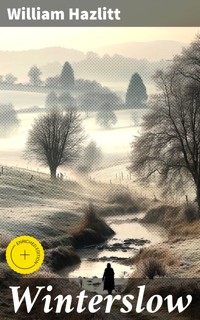
In "Winterslow," William Hazlitt presents a reflective and evocative exploration of rural life, cloaked in the profound beauty of the English countryside. This semi-autobiographical work, written in a prose style that deftly shifts between lyrical observation and philosophical contemplation, captures the essence of nature and the human spirit. Hazlitt's love for the pastoral landscape is evident as he intertwines his personal experiences with broader meditations on art, beauty, and the passage of time, positioning the book within the Romantic literary tradition, which emphasizes individual experience and emotion in response to nature. William Hazlitt, a prominent essayist, critic, and painter, is often regarded as a key figure of the Romantic movement. His deep appreciation for individualism and the human condition is reflected in his writings. Having lived through significant cultural and philosophical upheavals in early 19th-century England, Hazlitt's contemplations in "Winterslow" stem from his personal quest for solace and reflection amidst the chaos of modern life, revealing his profound connection to his own experiences in the countryside. I highly recommend "Winterslow" to readers seeking a contemplative journey through the English landscape and a deeper understanding of the interplay between nature and the self. Hazlitt's vivid descriptions and insightful reflections invite the reader to ponder their own relationship with the world around them, making this work not just a book, but a meditative experience. In this enriched edition, we have carefully created added value for your reading experience: - A succinct Introduction situates the work's timeless appeal and themes. - The Synopsis outlines the central plot, highlighting key developments without spoiling critical twists. - A detailed Historical Context immerses you in the era's events and influences that shaped the writing. - A thorough Analysis dissects symbols, motifs, and character arcs to unearth underlying meanings. - Reflection questions prompt you to engage personally with the work's messages, connecting them to modern life. - Hand‐picked Memorable Quotes shine a spotlight on moments of literary brilliance. - Interactive footnotes clarify unusual references, historical allusions, and archaic phrases for an effortless, more informed read.
Das E-Book können Sie in Legimi-Apps oder einer beliebigen App lesen, die das folgende Format unterstützen:
Veröffentlichungsjahr: 2019
Ähnliche






Winterslow
Table of Contents
Introduction
A restless, self-scrutinising mind seeks a hard-won balance between the clarifying solitude of the countryside and the entangling claims of society, testing its tastes, affections, and judgments against the textures of ordinary life and the pressure of public debate, and finding in the alternation between retreat and encounter not an escape but a means of sharpening conviction, tempering enthusiasm, and measuring the world of books and conversation by the standard of lived experience, so that reflection itself becomes a journey whose stages are marked by weather, memory, temperament, and the stubborn desire to think and feel for oneself.
Winterslow is a collection of essays and character pieces by William Hazlitt, a leading English essayist and critic of the Romantic era. Its title evokes the village of Winterslow in Wiltshire, where periods of rural quiet frame the book’s imaginative vantage point. The work belongs to the nineteenth-century tradition of the personal essay, in which an individual voice addresses literature, art, manners, and the life of the mind with directness and style. Drawn from the milieu of early nineteenth-century British letters and their vigorous periodical culture, it presents reflections composed within, and about, the rhythm of retreat and return.
In place of a storyline, the collection offers a sequence of meditations that move from the immediate to the abstract and back again, inviting the reader into the cadence of thinking as an activity. Hazlitt’s voice is candid, argumentative, and unexpectedly lyrical, combining plainspoken force with a relish for nuance. The essays tend to begin from a concrete impression—an interior, a walk, a social observation—and widen into broader judgments about taste and conduct. The mood ranges from reflective calm to spirited contest, yet always with an insistence on independence of mind and the authority of first-hand perception.
Several themes recur with distinctive clarity. Solitude is explored not as withdrawal but as a workshop where sensibility gathers strength before re-entering conversation. The relation between habit and imagination prompts questions about how we form opinions and how those opinions harden or yield. The essays probe the claims of pleasure and principle, the sway of memory, the education of taste, and the everyday theatre of character. Through these inquiries runs an ethical interest in sincerity: speaking plainly, resisting cant, and accepting the costs of such candour. The result is a portrait of thinking as strenuous, pleasurable, and morally charged.
Formally, Winterslow showcases the supple reach of the familiar essay and the character sketch. Hazlitt builds arguments by juxtaposing anecdote with abstraction, sharpened by images drawn from rooms, roads, weather, and the human face. Paragraphs often pivot on a pressure point—a hesitation, an objection, a remembered scene—so that the page feels like a conversation carried on with oneself and with an imagined reader. The pieces can be read singly or in clusters; they accrue resonance through repetition of concerns rather than through linear design. The prose aims for clarity without smoothness, preferring friction that illuminates motives and ideas.
For contemporary readers, the collection speaks to perennial anxieties about judgment, attention, and belonging. Its account of solitude offers a counterpoint to distraction, while its combative civility models disagreement that does not abandon curiosity. In an age of commentary, Hazlitt’s insistence on experience as a discipline of thought prompts self-scrutiny: what do we truly like, and why do we like it? The book also argues, implicitly, for reading as a lived practice—part of one’s habits, not a separate realm. Its vigor, compression, and humane skepticism make it a reliable companion for anyone testing convictions in public and in private.
Approached on its own terms, Winterslow is best read at a measured pace, allowing its turns of thought to settle and spark. It offers not a system but a sensibility: a way of looking that honours particulars and refuses borrowed certainty. The place named in its title functions as emblem and method—a retreat that enables clearer engagement with books, people, and events when one returns to them. Readers find companionship in its forthrightness and challenge in its expectations. The collection endures because it makes thinking feel like an activity one performs with one’s whole life, not merely on the page.
Synopsis (Selection)
Winterslow is a collection of essays by William Hazlitt, published in 1825, largely written during periods of retreat in the Wiltshire village of Winterslow. The pieces, some revised from earlier periodical work, share a vantage point shaped by solitude, observation, and recollection. Hazlitt uses the quiet of the countryside to consider the conduct of life, the practice of writing, the arts, and the pressures of public opinion. The book does not develop a single argument; instead, it unfolds a sequence of related inquiries. Its unifying purpose is to examine human nature and taste with clarity, independence of mind, and experiential detail.
The collection opens with meditations on retirement, privacy, and the uses of leisure. These essays consider the advantages of withdrawing from social bustle to cultivate attention and preserve consistency of character. They describe how a quiet setting sharpens the senses and steadies judgment, while also acknowledging that isolation has limits and cannot wholly replace conversation or society. Scenes of the countryside frame these reflections, translating rural images into ethical and aesthetic principles. The tone remains descriptive and analytic. Throughout, the essays establish an approach: to derive general truths not by system, but by precise notice of familiar feelings and occasions.
From this foundation, subsequent pieces turn to movement and the open road. They discuss walking and travel as forms of thought, emphasizing how solitary journeys free the mind from routine associations. The essays weigh the pleasures of passing landscapes against the fatigue of company, proposing that pace, distance, and weather influence reflection and prose. The contrast between town and country recurs: streets stimulate argument and performance, fields encourage reverie and proportion. By linking locomotion to imagination, these chapters suggest that physical path and mental path often coincide, and that changing one’s surroundings is a practical method for renewing attention.
A central portion examines reading, conversation, and style. The essays praise the companionship of old books, preferring durable affinity to novelty for its own sake. They argue for a familiar style—plain, pointed, and flexible—capable of conveying thought as it is felt. Differences between speaking and writing are analyzed: conversation rewards quickness and exchange, writing demands solitude, revision, and exactness. Grammatical pedantry and empty eloquence are rejected in favor of idiomatic precision and lived example. The pieces also consider learning’s limits, proposing that knowledge without sensibility produces stiffness, while sentiment without knowledge drifts into enthusiasm untested by fact.
Hazlitt then surveys the arts—especially the stage and painting—to illustrate principles of criticism. Memories of notable performances and actors are used to define expression, timing, and truth to character. The essays describe how the theatre educates feeling by presenting passions in action, and how judgment should value vitality over fashion or mere novelty. Observations on pictures similarly emphasize sincerity of effect, natural gesture, and the power of association. The criteria remain consistent: art should clarify experience rather than display technical vanity. These treatments connect the rural retreat to earlier urban life, showing how recollection and comparison guide critical standards.
Attention next shifts to social life, politics, and opinion. Essays on talkers, clubs, and coffee-house debate consider how ideas circulate, harden into party labels, and influence behavior. The pieces outline pressures exerted by fashion and praise, the hazards of faction, and the limits of public virtue when motives are mixed. Hazlitt distinguishes sympathy grounded in justice from the enthusiasm of coteries, insisting that independence of judgment protects fairness. Obligations—personal, civic, and moral—are examined with care, not to recommend withdrawal, but to show how private conviction and public engagement must be balanced if integrity is to be retained.
The volume also includes character sketches of acquaintances and public figures, treating them as examples of temperament and habit rather than occasions for personal attack. These portraits select significant traits—ways of speaking, modes of reasoning, characteristic gestures—to reveal how disposition shapes conduct. The aim is to exhibit recognizable types: the enthusiast, the humorist, the confident talker, the wary observer. Admiration and reserve appear side by side, allowing the sketches to avoid flattery and invective alike. Together, they demonstrate the method announced earlier: particulars are observed closely, then arranged to illustrate general truths about manners and mind.
Later essays return to philosophical reflection on time, memory, and mortality. The past is weighed against the future, with attention to how recollection refines pleasure and how anticipation alters desire. The pieces consider the love of life as a steady sentiment, distinct from transient excitements, and examine the fear of death without sensationalism. Ordinary habits—reading, walking, conversation—are presented as safeguards of continuity in a changing world. The argument remains descriptive: it records common feelings in exact terms, neither consolatory nor despairing. The result is a composed view of human limits, attached to concrete instances rather than abstract systems.
Taken together, Winterslow forms a coherent miscellany organized by the experience of retreat and the discipline of attention. Its sequence moves from solitude to movement, from reading to art, from public life to character, and finally to the universal conditions of time and loss. Throughout, the essays advance consistent conclusions: clarity in style, sincerity in judgment, and fidelity to experience are the best guides in conduct and taste. The book’s overall purpose is to make familiar things intelligible by exact description. It leaves a general message of independence of mind and measured feeling, grounded in ordinary life.
Historical Context
Winterslow gathers essays William Hazlitt wrote in and about his retreats to the village of Winterslow in Wiltshire between roughly 1809 and 1819, during the late Georgian and early Regency years. The locale sits on the edge of Salisbury Plain, east of Salisbury, along coaching roads that linked rural England to London’s political center. The period spans the regency of George, Prince of Wales (from 1811) and the transition to George IV in 1820, framed by post-Napoleonic peace and domestic unrest. Hazlitt’s quiet cottage and the nearby Winterslow Hut inn supplied a vantage point from which he measured the distances—moral, social, and political—between metropolitan power and provincial life.
The French Revolution of 1789 and its British repercussions formed the generational backdrop to Hazlitt’s politics. In Britain, fear of Jacobinism produced measures such as the Treasonable Practices and Seditious Meetings Acts (1795) and a tightening of surveillance of dissenting societies. Hazlitt, raised in a Unitarian milieu hospitable to reform, embraced the Revolution’s civic ideals while deploring its excesses, and he never forgave Britain’s governing elite for exploiting anti-Jacobin panic. In Winterslow’s essays, he repeatedly tests public virtue against private conscience, and his portraits of everyday talk—especially about "politics" in coffee-houses and inns—mirror the way 1790s arguments about rights and authority still structured opinion in the 1810s.
The Napoleonic Wars (1803–1815) dominated British life: Trafalgar (21 October 1805) confirmed naval supremacy; Austerlitz (2 December 1805) showcased French ascendancy on land; the Peninsular War (1808–1814) drained resources; and Waterloo (18 June 1815) ended the epic struggle. At home, successive ministries—Pitt to 1806, Grenville (1806–1807), Portland (1807–1809), Perceval (assassinated 11 May 1812), and Liverpool (1812–1827)—managed wartime taxation, including the income tax first introduced in 1799, and a ballooning national debt. Hazlitt’s fascination with Napoleon, later culminating in his multi-volume biography, pervades Winterslow through meditations on glory, power, and the fate of great men. Waterloo’s aftermath, in particular, inflects his skepticism toward triumphalism and the moral costs of permanent mobilization.
Postwar distress and state repression shaped the years in which Hazlitt wrote at Winterslow. The Corn Law of 1815 protected grain prices, aggravating bread costs for the poor; protests erupted at Spa Fields (1816), and Parliament suspended habeas corpus (1817). On 16 August 1819, at St Peter’s Field in Manchester, a crowd of some 60,000 gathered for reform; cavalry charges left around 15 dead and hundreds injured in the Peterloo Massacre. The Six Acts (December 1819) followed, curbing meetings and the press. Hazlitt, writing for radical periodicals, attacks the logic of coercion that runs from ministerial fear to sabre-law. Winterslow’s calm cadence becomes a foil for exposing the dissonance of civic life under intimidation.
Industrial and rural dislocations frame Hazlitt’s social observations. The Luddite agitations (1811–1816) in Nottinghamshire, Yorkshire, and Lancashire—met by the Frame Breaking Act (1812), making machine-breaking a capital crime—reflected wage collapse and unregulated mechanization. In the countryside, enclosure accelerated and the Speenhamland system (initiated 1795, Berkshire) tied relief to bread prices, entrenching dependency and depressing wages. Wiltshire’s farm laborers and the economies of coaching inns near Salisbury felt these tides directly. In Winterslow, reflections on walking the road, encountering ostlers and wayfarers, and measuring the price of a meal or a bed stand as social documents: they register the granular pressures of a nation where fiscal policy, parish relief, and new machines rearranged customary life.
The contentious culture of the press and courtroom was another defining context. The Examiner, founded in 1808 by Leigh and John Hunt, championed reform and drew prosecutions; Leigh Hunt was jailed in 1813 for libelling the Prince Regent. In 1817 William Hone’s three celebrated trials for blasphemous libel ended in acquittal, curbing ministerial overreach and energizing public opinion. Hazlitt contributed to radical papers and delivered public lectures in 1818, extending the reach of political criticism beyond Parliament. Winterslow’s essays anatomize the "public" as it forms in coffee-houses, subscription rooms, and print shops, insisting that judgment belongs to citizens and that conversation—however partisan—constitutes a counter-power to official narratives.
Crises around constitutional inclusion culminated later in the repeal of the Test and Corporation Acts (1828) and the Catholic Relief Act (1829), after Daniel O’Connell’s 1828 Clare by-election forced the issue on the Wellington ministry. The debates were long prepared by earlier campaigns for civil equality and parliamentary reform, which agitated through the 1810s. Hazlitt, a Dissenter’s son, repeatedly condemns religious tests and inherited privilege in his essays, arguing from first principles of conscience and capacity rather than birth or creed. From Winterslow, he models a scrutiny of office-holding and patronage that anticipates the direction of 1828–1829, pressing the case that the moral legitimacy of the state depends on removing sectarian barriers.
As social and political critique, the book exposes the moral psychology of a society governed by deference, war-habit, and legal intimidation. It indicts the oligarchic culture of borough patronage, the court’s appetite for flattery, and the policing of assembly and print that followed Peterloo. By staging encounters with laborers, innkeepers, and coach passengers, the essays rebuke class insularity and insist on common experience as a standard of justice. Hazlitt’s portraits of power—military, ministerial, and media—show how opinion is manufactured and how autonomy can be defended. Winterslow’s disciplined solitude is a political act: a refusal of servility that calls readers to exercise independent judgment against the era’s inequities.




