


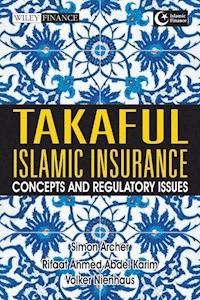
Takaful Islamic Insurance E-Book
111,99 €
Mehr erfahren.
- Herausgeber: John Wiley & Sons
- Kategorie: Fachliteratur
- Serie: Wiley Finance Editions
- Sprache: Englisch
Authors Rifaat, Archer and Volker bring an international perspective to the growing Islamic Insurance industry. Drawing on contributions from leading experts around the world, they present a comprehensive view of the very issues governing the industry and its future direction. As top financial institutes around the world seem to enter the lucrative Takaful markets, this timely book offers crucial background information and advice, invaluable for any serious player in the market.
Sie lesen das E-Book in den Legimi-Apps auf:
Seitenzahl: 547
Veröffentlichungsjahr: 2011
Ähnliche




















Copyright © 2009 John Wiley & Sons (Asia) Pte. Ltd.
Published in 2009 by John Wiley & Sons (Asia) Pte. Ltd.
2 Clementi Loop, #02-01, Singapore 129809
All rights reserved.
No part of this publication may be reproduced, stored in a retrieval system, or transmitted in any form or by any means, electronic, mechanical, photocopying, recording, scanning, or otherwise, except as expressly permitted by law, without either the prior written permission of the Publisher, or authorization through payment of the appropriate photocopy fee to the Copyright Clearance Center. Requests for permission should be addressed to the Publisher, John Wiley & Sons (Asia) Pte. Ltd., 2 Clementi Loop, #02-01, Singapore 129809, tel: 65-6463-2400, fax: 65-6463-4605, e-mail: enquiry@wiley.com.
This publication is designed to provide accurate and authoritative information in regard to the subject matter covered. It is sold with the understanding that the publisher is not engaged in rendering professional services. If professional advice or other expert assistance is required, the services of a competent professional person should be sought.
Neither the authors nor the publisher are liable for any actions prompted or caused by the information presented in this book. Any views expressed herein are those of the authors and do not represent the views of the organizations they work for.
Other Wiley Editorial Offices
John Wiley & Sons, 111 River Street, Hoboken, NJ 07030, USA
John Wiley & Sons, The Atrium, Southern Gate, Chichester, West Sussex, P019 8SQ, United Kingdom
John Wiley & Sons (Canada) Ltd., 5353 Dundas Street West, Suite 400, Toronto, Ontario, M9B 6HB, Canada
John Wiley & Sons Australia Ltd, 42 McDougall Street, Milton, Queensland 4064, Australia
Wiley-VCH, Boschstrasse 12, D-69469 Weinheim, Germany
Library of Congress Cataloging-in-Publication Data:
ISBN 978-0-470-82352-1
Table of Contents
Dedication
About the Editors
About the Contributors
Foreword
Acknowledgment
Chapter 1: Conceptual, Legal, and Institutional Issues Confronting Takaful
1.1 Introduction
1.2 Developments in International Prudential Guidelines for Insurance and Takaful
1.3 Contents of this Book
Part 1
Chapter 2: Business Models in Takaful and Regulatory Implications
2.1 Introduction
2.2 Business Models
2.3 Business Structures and Regulatory Implications
2.4 Regulatory Perspectives
Chapter 3: Shari'ah Principles Governing Takaful Models
3.1 Introduction
3.2 Takaful: Nomenclature and Conceptual Meaning
3.3 Shari'ah Principles Governing Takaful Contracts
3.4 Takaful Management Models
Chapter 4: Corporate Governance and Stakeholder Rights in Islamic Insurance
4.1 Introduction
4.2 The Neo-Classical and Neo-Corporatist Models of Corporate Governance
4.3 Corporate Governance Issues in the Insurance Industry
4.4 Corporate Governance Issues in Takaful
4.5 Concluding Remarks
Chapter 5: Legal Issues in Takaful
5.1 Introduction
5.2 Takaful Models and their Impacts
5.3 The Legal Issues
5.4 The Call for an Effective Framework
5.5 Concluding Remarks
Chapter 6: Business Conduct in Islamic Insurance with Special Reference to Emerging Markets
6.1 Background
6.2 Business Environment in Emerging Markets
6.3 Framework of Business Conduct and Best Practices
6.4 Critical Drivers for Developing Market Infrastructure
6.5 Conclusion
Chapter 7: Supervisory Issues in Takaful: An Overview
7.1 Introduction
7.2 Governance Issues
7.3 Financial Issues
7.4 Market Conduct Issues
7.5 Market Issues
7.6 Supervisory Priorities
Part 2
Chapter 8: Reinsurance and Retakaful
8.1 Introduction
8.2 What is Reinsurance?
8.3 Functions of Reinsurance
8.4 Types of Reinsurance
8.5 Proportional Reinsurance
8.6 Non-Proportional Reinsurance
8.7 Reinsurance Market
8.8 Concept of Takaful
8.9 Need for Retakaful
8.10 Retakaful Models
8.11 Main Issues Raised by Retakaful
8.12 Conclusion
Chapter 9: Risk Management in Takaful
9.1 Introduction
9.2 Comparison Between Conventional Insurance And Takaful
9.3 Fundamental Principles of Takaful from a Risk Management Perspective
9.4 Risk Issues in Takaful Undertakings
9.5 Management of Risks in a Takaful Undertaking
9.6 Concluding Remarks
Chapter 10: Solvency and Capital Adequacy in Takaful
10.1 Introduction
10.2 The Need for Solvency
10.3 The Principle of Solvency
10.4 Traditional Approaches to Insurance Solvency
10.5 Risk-Based Capital
10.6 Summary
Chapter 11: Investment Portfolios of Takaful Undertakings
11.1 Total Investment Portfolio of Takaful Undertakings for All Funds
11.2 Shareholders' Funds
11.3 Analysis of Shareholders' Funds between the GCC Countries and Malaysia
11.4 General Fund
11.5 Analysis of General Fund between GCC and Malaysia
11.6 Family Fund
11.7 Influence of Related Parties on the Investment Portfolios of Participants' Funds
11.8 Summary and Conclusions
Chapter 12: Issues in Rating Takaful Companies
12.1 Introduction
12.2 What is a Credit Rating?
12.3 Types of Credit Rating
12.4 Credit Rating Basics
12.5 Key Issues for Rating Takaful Firms
12.6 Conclusion
Chapter 13: Transparency and Financial Reporting in Islamic Insurance
13.1 Introduction
13.2 Stakeholders Need Transparency in Financial Reporting by Islamic Insurance Companies
13.3 Existing Islamic Insurance Financial Reporting Framework Should be Improved to Achieve Greater Transparency
13.4 Conclusion
Part 3
Chapter 14: Concluding Remarks
14.1 Introduction
14.2 The Structure of Takaful Undertakings and Resultant Unresolved Issues
14.3 Corporate Governance and Related Matters
14.4 The Need for, and Scope of, a Comprehensive Regulatory Framework for Takaful
14.5 The Work of the IFSB in Developing International Prudential Guidelines for Takaful Undertakings
14.6 Some thoughts for the Future
Bibliography
Index
Dedication
We would like to dedicate this book to our wives Iglal, Evelyne, and Hannelor.
About the Editors
Professor Simon Archer is Visiting Professor at the ICMA Centre, Henley Business School, University of Reading (U.K.), where he teaches on an MSc program, Investment Banking and Islamic Finance. Previously, he was Professor of Financial Management at the University of Surrey (U.K.) having been Midland Bank Professor of Financial Sector Accounting at the University of Wales, Bangor. After studies in Philosophy, Politics, and Economics at Oxford University, he qualified as a Chartered Accountant with Arthur Andersen in London and then moved to Price Waterhouse in Paris, where he became a Partner in Management Consultancy Services. In addition to being co-editor of, and chapter contributor to, Islamic Finance: Innovation and Growth, and Islamic Finance: The Regulatory Challenge (published by John Wiley), Professor Archer is co-author of the CCH International Accounting/Financial Reporting Standards Guide and the author of a considerable number of academic papers on international accounting and on accounting, finance, and related issues in Islamic financial institutions. He also supervises research students in these areas. He has carried out a number of consultancy assignments for the Accounting and Auditing Organization for Islamic Financial Institutions, the Islamic Financial Services Board, and the World Bank on issues connected with Islamic finance.
Professor Rifaat Ahmed Abdel Karim has been the Secretary-General of the Islamic Financial Services Board since 2002. Prior to his current position, Professor Rifaat was the Secretary-General of the Accounting and Auditing Organization for Islamic Financial Institutions, a post he held for more than eight years. He was a member of the Standards Advisory Council of the International Accounting Standards Board for two terms, and is currently a member of the Consultative Advisory Group of the International Auditing and Assurance Standards Board. Professor Rifaat was a Visiting Professor at Surrey University (U.K.) and Honorary Professor at Monash University (Australia). He is currently a Visiting Professor at Reading University (U.K.). Professor Rifaat is the co-author of Business and Accounting Ethics in Islam, the Euromoney bestseller book Islamic Finance: Innovation and Growth, and Islamic Finance: The Regulatory Challenge recently published by John Wiley. He is also the author of many academic and professional papers on accounting, governance, and finance issues in Islamic banking and finance.
Dr. Volker Nienhaus was Professor of Economics at the German universities of Trier (1989–90) and Bochum (1990–2004) before he became President of the University of Marburg (election period 2004–10). He has published numerous books and articles on Islamic economics and Islamic banking and finance since the 1980s. He was a member of several academic advisory boards of public and private institutions in Germany, including the German Orient-Foundation (1993–2006) and the Federal Ministry of Economic Cooperation and Development (1998–2008). In 2006, he was appointed a member of the Governing Council of the International Centre for Education in Islamic Finance (INCEIF) in Kuala Lumpur. He is also consultant to the Islamic Financial Services Board on governance issues of takaful operations.
About the Contributors
Mahomed Akoob (Chapter 8) has been Chief Executive Officer of the newly established Hannover ReTakaful B.S.C.© Bahrain since November 2006. He brings to this role a wealth of experience in general management, technical insurance and reinsurance underwriting, risk management, and financial management. Prior to this, he was Group Chief Financial Officer of Hannover Re Africa from November 2002. His responsibilities included corporate finance, investments, information technology, and reinsurance. He was also instrumental in establishing the first takaful company in South Africa. He began his career with Munich Reinsurance Company of Africa in 1976 and was appointed General Manager in 1996. He currently serves on the Advisory Committee of Short Term Insurance and the Directorate of Market Abuse in South Africa, appointed by the Minister of Finance. He also serves as a director of the South African Reserve Bank Captive Insurance Company (SARBCIC) and Fahmiyah Investments (Pty.) Limited (Investment Company).
Dr. Mohd Daud Bakar (Chapter 3) is currently the President/CEO of International Institute of Islamic Finance (IIIF) Inc. (BVI), IIIF Education Sdn. Bhd., and Amanie Business Solutions Sdn. Bhd. (Kuala Lumpur). He was the Deputy Rector (Student Affairs and Development) and an Associate Professor at the International Islamic University Malaysia. He received his first degree in Shari'ah from the University of Kuwait (1988) and a Ph.D. from the University of St. Andrews, United Kingdom (1993). In 2002, he completed his external Bachelor of Jurisprudence at the University of Malaya. He has published more than 30 articles in various academic journals and presented more than 200 papers at conferences both local and abroad. He is now Chairman of the Shari'ah Advisory Council at the Central Bank of Malaysia, and a member of the Shari'ah Advisory Council at various regional and global financial institutions. He has been involved in advising Islamic funds and Islamic sukuk both local and globally. He is a licensed Shari'ah advisor for Islamic Securities in Malaysia. He was awarded the Islamic Banker Award of 2005 by the Association of Islamic Banking Institutions Malaysia.
Peter Casey (Chapter 7) is Director, Policy and Head of Islamic Finance in the Dubai Financial Services Authority (DFSA), having previously been responsible for the supervision of banking and insurance firms. In this role, he has been a member of several Islamic Financial Services Board Working Groups, including those on Governance of Takaful Operations, and Solvency Requirements for Takaful Operators. Before joining the DFSA, he was Head of the Non-Life Insurance Department of the U.K. Financial Services Authority. Before that, he held senior regulatory posts in the Treasury, the Department of Trade and Industry, and the Office of Fair Trading. Peter was educated at Cambridge University.
Arup Chatterjee (Chapter 6) is Principal Administrator, International Association of Insurance Supervisors (IAIS) at Basel, Switzerland. He has over 20 years' hands-on experience in the insurance industry spanning across operations, regulation, supervision, and policy making in emerging and developed markets. A former Deputy Director of the Insurance Regulatory and Development Authority–India, in his current position at IAIS he focuses on standards setting and its implementation, including microinsurance and takaful. An honors graduate in Economics from Delhi University, and with a Master's from Jawaharlal Nehru University and the Indian Institute of Foreign Trade, both in New Delhi, he also serves as a resource person in the area of insurance regulations and risk management.
Abdullah Haron (Chapter 9) is Assistant Secretary General of the Islamic Financial Services Board. Previously, he was a Project Manager where his main area of work was on the preparation of guidance on risk management, the supervisory review process, and special issues of capital adequacy. He also participated in task forces on, among other matters, the preparation of an issues paper on prudential takaful regulation and supervision, and a compilation guide on a prudential database of Islamic financial services institutions. His prior experience includes the development of a risk management and measurement framework, and insurance prudential regulation and supervision. Abdullah received a BSLAS in Actuarial Science from the University of Illinois and an MBA from Ohio University.
Elham Hassan (Chapter 13) is the Senior Partner of PricewaterhouseCoopers Bahrain. She has more than 25 years' experience in banking and financial institutions—more specifically, Islamic banking and takaful. In 1986, Elham became the first qualified U.S. Certified Public Accountant in the Gulf Cooperation. She is a regular speaker at banking and capital market conferences. With her vast experience, she provided advice to a wide range of regional and international organizations. Elham is active in economic circles in the Middle East and has been voted as one of the region's most powerful businesswomen by Forbes magazine. She sits on several professional, academic, and economic boards.
Madzlan Mohamad Hussain (Chapter 5) is Senior Project Manager, Islamic Financial Services Board (IFSB). Madzlan has been with the IFSB since April 2004, when he first joined as a Project Manager and was later promoted to Senior Project Manager. He is responsible for overseeing the development of IFSB prudential standards on corporate governance practices for all segments of Islamic financial services, including banking, capital markets, and insurance. Prior to joining the IFSB, Madzlan practiced law at one of the premier legal firms in Kuala Lumpur, where he specialized in capital markets practices, corporate and debt restructurings, and Islamic finance. Madzlan graduated with a Bachelor of Laws (Hons.) from the International Islamic University Malaysia and obtained his Master of Science in Islamic Economics, Banking and Finance from Loughborough University (U.K.).
Andrew Murray (Chapter 12) is a Senior Director within Fitch's insurance department. Since joining Fitch in May 2002, his role has included rating various insurance and reinsurance companies in the U.K. and Northern Europe. He now also has responsibility for the rating of insurance-linked securities, hybrid capital securities, and takaful firms. Prior to joining Fitch, Andrew worked for Deloitte in its financial services practice, which included experience in insurance company audits. He graduated in Economics from Cambridge University, and is a qualified Chartered Accountant and a CFA charter holder.
Andre Rohayem (Chapter 13) is the Partner leading the insurance practice of PricewaterhouseCoopers in the Middle East. He has 14 years' experience in the insurance and reinsurance industry in Europe and the Middle East. Andre has been actively involved in auditing and providing advisory services to insurance and reinsurance companies. He has also advised and assisted several investors and multinational companies in the establishment of insurance and takaful companies in the Middle East.
James Smith (Chapter 10) is an Executive Director in the Hong Kong firm of Ernst & Young. During his career, he has specialized in providing services to the insurance industry, including audit, due diligence, and regulatory consultancy. Originally from the U.K., he has also lived and worked in Australia and several Asian countries, during which time he developed an interest in takaful. A chartered accountant and certified insurance professional, James holds Scottish and English university degrees. He has written and spoken extensively on financial services regulatory issues, and currently serves on the Islamic Financial Services Board's Working Party on Solvency Requirements for Takaful Operators.
Dawood Taylor (Chapter 9) has recently been appointed Senior Regional Executive–Takaful, Middle East for Prudential PLC, where his role is to develop takaful throughout the Gulf region. Previously, Dawood was the General Manager of the Bank Aljazira Takaful Ta'awuni operation, where he was at the forefront of Islamic life insurance development in Saudi Arabia and the Middle East. He and his team developed the Takaful Ta'awuni program, a hugely successful and multi-award-winning Islamic life insurance and savings program for Bank Aljazira. Dawood conceived and developed the initial wakalah-based Takaful Ta'awuni concept that is now the Islamic contract model of choice for most new takaful operators. Dawood is a member of the Islamic Financial Services Board Takaful Governance and Takaful Solvency committees, and of the International Cooperative and Mutual Insurance Federation Intelligence Committee.
Abdulrahman Tolefat (Chapter 11) is the Chief Executive Officer of Allianz Takaful BSC. He began his career as a Mathematics lecturer in the University of Bahrain and later moved into the fast-growing financial services field in Bahrain. Profound knowledge of the region and outstanding credentials have driven his career graph in the Central Bank of Bahrain–CBB (formerly known as Bahrain Monetary Agency). After nine years, Dr. Tolefat took charge of Allianz Takaful in Bahrain, the global hub for Islamic insurance (takaful) of Allianz Group. As a member of various committees and boards in the financial field, he has played an instrumental role in imparting international standards to Islamic banking and takaful. Dr. Tolefat pursued higher education following his graduation from the University of Bahrain, including being awarded an MBA from the prestigious DePaul University in the U.S. and a Ph.D. from the renowned Durham University in the U.K.
Foreword
The emergence of takaful, or mutual insurance arrangements that conform to the principles of Shari'ah, is a welcomed development that enhances and completes the Islamic financial system. Through takaful, consumers and providers of Islamic financial services are provided with a Shari'ah-compliant means to obtain insurance cover against personal and business losses. Takaful companies support Islamic capital markets through their active subscription of and trading in Islamic financial instruments. Insurance coverage for the assets underlying Islamic financial contracts can also now be done in a Shari'ah-compliant manner.
Growth in the takaful industry has been robust in recent years. Nonetheless, the industry is still in its early stages of development relative to the other sectors of Islamic finance in banking and capital fund-raising. Industry estimates put takaful contributions globally at about US$3.4 billion in 2007. This figure is creditable given the low penetration rates for takaful in many jurisdictions and that the industry is presently more focused on the retail markets, with wholesale needs largely yet to be addressed. Herein lies the still largely untapped potential of takaful. There are now about 150 takaful operators worldwide, including those in non-Muslim countries. In Singapore, takaful products have been available since 1995 and the first retakaful company started operations in 2004.
One of the main challenges confronting the takaful industry is raising awareness among its various stakeholders. Misconceptions about insurance cover among potential consumers would have to be dispelled, so as to foster greater acceptance of takaful. Providers of takaful would need to acquire stronger and more in-depth understanding of the technical, operational, legal and Shari'ah requirements for takaful operations, if they are to broaden the range of takaful products they offer and raise the quality of their services. Regulators too would also need to develop a full understanding of the risks to ensure that takaful operations within their jurisdictions are adequately regulated and supervised. All stakeholders, including rating agencies and standard-setting bodies, should also not lose sight of an important objective in the takaful industry—that is to ably meet the rising consumer demand in the most cost-effective manner. Only then can this nascent industry grow and develop in a sustained path and reach a wider segment of consumers, both Muslim and non-Muslims. Drawing lessons from the present financial crisis, takaful operators will also need to have in place robust risk management and corporate governance systems in order to be able to serve their customers well over the longer-term.
Against this perspective, Takaful Islamic Insurance: Concepts and Regulatory Issues is a timely and welcomed addition to the growing body of literature on takaful. The book is edited by three eminent scholars and practitioners in Islamic finance, Professors Rifaat Ahmed Abdel Karim, Simon Archer and Volker Nienhaus. Distilling from their considerable expertise, they have joined other notable scholars, regulators, and industry practitioners to contribute insightful chapters to this book. Part 1 of the book examines the business models and conduct, the Shari'ah principles, corporate governance as well as regulatory, legal and supervisory issues in Takaful. Part 2 then delves in detail into the technical and operational issues of takaful and retakaful encompassing solvency and capital adequacy, investment of contribution, risk management, risk ratings, transparency and financial reporting. This publication is therefore well placed to help raise the much-needed awareness and understanding among stakeholders of the takaful industry and contribute to its sustained development.
Heng Swee Keat
Managing Director
The Monetary Authority of Singapore
June 2009
Acknowledgment
We would like to thank each of the contributing authors for taking the time to write their chapters. Their insights and practical experiences have made the book much richer.
Special thanks go to Mrs. Marni Rafiza Mohammad for her enthusiastic support. Her relentless energy and valuable assistance have made this book possible.
Also thanks to Nick Wallwork, Fiona Wong, Joel Balbin, and the team of John Wiley & Sons (Asia) for getting the book into shape and guiding us through the publishing process.
Finally, we are indebted to our families, who have been a great source of encouragement and support every step of the way.
Chapter 1
Conceptual, Legal, and Institutional Issues Confronting Takaful
Simon Archer, Rifaat Ahmed Abdel Karim, and Volker Nienhaus
1.1 INTRODUCTION
While the last decades of the 20th century saw the emergence of Islamic banking as a significant development in a number of predominantly Muslim countries, takaful (Islamic insurance) has been slower to emerge. This is in spite of the fact that schemes for mutual protection against losses have traditionally existed in Islamic societies. As will be seen from the analyses presented in this book, modern versions of such schemes face a number of highly complex juristic,1 institutional, legal, and regulatory issues some of which are far from being resolved. In addition, it should be noted that the conventional insurance industry also faces major regulatory issues, in which it may be thought to lag behind banking with particular respect to international prudential standards on solvency, capital adequacy and related matters (there being as yet no insurance equivalent to Basel II), and financial reporting. Work is, however, in progress, which will be described briefly below.
The first modern takaful undertaking was founded in Sudan in 1979. Its foundation was due to the solution by a Sudanese Shari'ah scholar2 of a juristic problem: how may the Shari'ah prohibition of trading in insurance (and in indemnities and guarantees more generally) be overcome? Part of the solution lies in the adoption of a mutual structure for underwriting insured risks: the insureds (participants) mutually insure one another, on a non-profit basis, according to the principle of takaful (the Arabic word for “solidarity”). Another aspect of the solution consists of characterizing the policy contributions (premiums) to the risk fund as incorporating an element of conditional and irrevocable donation (tabarru'), the donor making the contribution to the risk fund subject to being entitled to benefit from mutual protection against insured losses.
However, the adoption of a mutual structure runs into two kinds of institutional obstacles. First, the legal systems of many countries do not accept mutual or cooperative forms of company without share capital. Second, even if such forms of company are accepted for insurance undertakings, they need to be able to raise enough capital from policyholders to meet regulatory capital adequacy and solvency requirements. To surmount these two obstacles, the vast majority of takaful undertakings have a two-tier, hybrid structure in which the risk funds operate on a mutual basis but are managed by a takaful operator, which is a company with shareholders. However, this hybrid structure involves complexities and raises juristic and legal issues which are yet to be satisfactorily resolved.
In addition to the need to overcome juristic and institutional problems, the development of takaful is inevitably constrained by the economic and social development of predominantly Muslim countries, which affects the market for and the propensity (especially at the retail level) to take up insurance cover. At the same time, takaful can contribute to economic development at the micro level by enabling more efficient risk management by firms and households, and at the macro level (particularly in life or family takaful) by mobilizing savings and providing funding for investment in long-lived assets.
1.2 DEVELOPMENTS IN INTERNATIONAL PRUDENTIAL GUIDELINES FOR INSURANCE AND TAKAFUL
As noted above, the development of international prudential standards for insurance has lagged behind that for banking. However, there has been a significant amount of work in this area. The International Association of Insurance Supervisors (IAIS) has issued a number of important documents, including the Core Principles of Insurance Supervision, and the European Commission is developing a new prudential system for the insurance industry in the European Union (known as Solvency II to distinguish it from the existing EU guideline which is considered to be obsolete). As its name suggests, Solvency II is considered to be the insurance counterpart of Basel II, and is likewise constructed around three “pillars.”
At the same time, the Islamic Financial Services Board (IFSB) has been working on two international prudential guidelines for the takaful industry sector, and another that will be applicable to firms in the sector. The Guiding Principles on Corporate Governance of Islamic Insurance (Takaful) Operations and the Guiding Principles on Conduct of Business for Institutions Offering Islamic Financial Services (applicable to takaful operators) have been issued as exposure drafts, while an exposure draft on capital adequacy and solvency of takaful undertakings was in the course of preparation when this book went to press.
1.3 CONTENTS OF THIS BOOK
The rest of the book is divided into two main parts, followed by a concluding chapter by the editors.
Part 1 (Chapters 2–7) deals with the business models used in takaful, from the perspectives of their regulatory implications, the relevant Shari'ah principles, stakeholder rights and corporate governance issues, and legal issues, as well as issues of business conduct and policyholder (or consumer) protection, with particular reference to emerging markets, and with supervisory issues more generally.
Chapter 2, by the editors, examines the business models employed for takaful undertakings, both non-life and life (or family) takaful. These models involve complexities resulting from the hybrid nature of takaful undertakings: risk funds that function on the basis of mutuality (the equity of which belongs to the policyholders) being managed by a company with shareholders. The chapter addresses the daunting challenge that these complex business models, which raise a number of unresolved issues, represent for insurance industry regulators.
The models also raise important Shari'ah issues, which are the concern of Chapter 3 by Daud Bakar. The fact that there are two categories of equity holders in a takaful undertaking, shareholders as well as policyholders, also raises important issues regarding stakeholder rights and corporate governance, which form the subject of Chapter 4, by the editors.
The business models and structure of takaful undertakings also entail knotty legal issues, which are examined in Chapter 5 by Madzlan Mohamad Hussain. The author points out that these issues tend to be aggravated by the fact that the notion of mutual insurance, while intrinsic to takaful, is unknown in the legal and regulatory systems of most of the countries in which takaful undertakings operate.
In Chapter 6, Arup Chatterjee emphasizes that a sound regulation and supervision framework is essential for improving the efficiency of the market for insurance generally and for takaful in particular. He describes the work of the IAIS in developing its Solvency Structure, and the importance of principles of good business conduct with particular respect to managing reputation risk. He also draws attention to the need for good data on losses and expenses per unit of exposure in pricing insurance products.
Chapter 7, by Peter Casey, also refers to the work of the IAIS, with particular reference to its 2005 paper, “A New Framework for Insurance Supervision.” He points out that while for an insurance supervisor governance issues are among the most difficult to deal with, in the case of takaful undertakings, the key governance risks are failures of Shari'ah governance, misalignment of interests between shareholders and policyholders, and inadequate consideration of the interests of the latter.
Part 2 (Chapters 8–13) addresses issues of risk, solvency, and capital adequacy in takaful, the investment portfolios of takaful undertakings, and the transparency of, and market information on, takaful undertakings, including ratings by external credit assessment institutions and external financial reporting.
In Chapter 8, Mahomed Akoob explains the importance of retakaful (Shari'ah-compliant reinsurance) to the takaful industry, especially for those takaful undertakings that are of relatively small size. He then explains how reinsurance may be structured so as to be Shari'ah compliant.
Chapter 9, by Abdullah Haron and Dawood Taylor, deals more generally with risk management in takaful undertakings, which is the responsibility of the takaful operator and needs to take account of the hybrid, two-tier structure of takaful undertakings (entailing underwriting and other risk exposures of the takaful policyholders' funds, and risk exposures of the takaful operator itself).
In Chapter 10, James Smith focuses on the key topic of solvency and capital adequacy, which is problematic because of the structural complexities of takaful undertakings with both shareholders' and policyholders' equity.
Chapter 11, by Abdulrahman Tolefat, analyzes the investment portfolios of takaful undertakings, comprising the assets of the participants' risk funds, participants' investment funds in family takaful, and shareholders' own funds. He shows how investment strategies deal with the need for liquidity, but points to possible dangers of related party investment transactions, and consequent risk concentrations.
In Chapter 12, Andrew Murray points out how the structural complexity of takaful undertakings raises difficult issues for external credit assessment institutions, and indicates how these may be dealt with.
Chapter 13, by Elham Hassan and Andre Rohayem, addresses the thorny topic of external financial reporting by takaful undertakings. There is no comprehensive set of International Financial Reporting Standards applicable to takaful, and the applicable standards issued by the Accounting and Auditing Organization for Islamic Financial Institutions provide useful but far from comprehensive guidance.
The final chapter, by the editors, presents some overall conclusions that may be drawn from the preceding chapters.
Notes
1 The term “juristic” is used here to refer to issues of Shari'ah commercial jurisprudence (Fiqh al Muamalat), as distinct from matters of secular law.
2 Professor Al-Sideeq Mohammed Alamin Al-Dareer.
Part 1
Chapter 2
Business Models in Takaful and Regulatory Implications
Simon Archer, Rifaat Ahmed Abdel Karim, and Volker Nienhaus
2.1 INTRODUCTION
Conventional insurance is based on an exchange of premium payments now for future indemnities in case of specified events. Such an exchange (sale) contract would not be valid under Shari'ah law due to the uncertainty (gharar) of the value of the future indemnities. The Shari'ah view on conventional insurance and the basics of an Islamic alternative are outlined in Chapter 3. Shari'ah scholars accept uncertainty in contracts for one-sided transfers (tabarru') such as endowments or donations. Therefore, they base takaful schemes as the Islamic alternative to insurance on the concept of “donations” (voluntary individual contributions) to a risk pool out of which indemnities are paid to other contributors. The term “donation” may be somewhat misleading because there is no recipient who can dispose of the donated funds at his will, and the motive of the donor is not altruism or the well-being of others but a claim to benefits for himself in case of damage. The result is a “conditional donation,” which is in conformity with : participants donate a sum of money to a risk pool (the fund) subject to the condition that they will receive compensation from the pool for specified types of losses suffered by them.
Lesen Sie weiter in der vollständigen Ausgabe!
Lesen Sie weiter in der vollständigen Ausgabe!
Lesen Sie weiter in der vollständigen Ausgabe!
Lesen Sie weiter in der vollständigen Ausgabe!
Lesen Sie weiter in der vollständigen Ausgabe!
Lesen Sie weiter in der vollständigen Ausgabe!
Lesen Sie weiter in der vollständigen Ausgabe!
Lesen Sie weiter in der vollständigen Ausgabe!
Lesen Sie weiter in der vollständigen Ausgabe!
Lesen Sie weiter in der vollständigen Ausgabe!
Lesen Sie weiter in der vollständigen Ausgabe!
Lesen Sie weiter in der vollständigen Ausgabe!
Lesen Sie weiter in der vollständigen Ausgabe!
Lesen Sie weiter in der vollständigen Ausgabe!
Lesen Sie weiter in der vollständigen Ausgabe!
Lesen Sie weiter in der vollständigen Ausgabe!




