


Erhalten Sie Zugang zu diesem und mehr als 300000 Büchern ab EUR 5,99 monatlich.
- Herausgeber: JABberwocky Literary Agency, Inc.
- Kategorie: Fantasy und Science-Fiction
- Serie: Rivers of London
- Sprache: Englisch
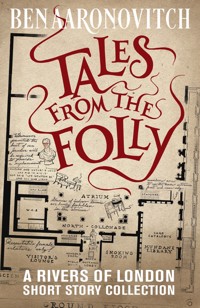
Return to the world of Rivers of London in this first short story collection from #1 Sunday Times bestselling author, Ben Aaronovitch. Tales from the Folly is a carefully curated collection that gathers together previously published stories and brand new tales in the same place for the first time. Each tale features a new introduction from the author, filled with insight and anecdote offering the reader a deeper exploration into this absorbing fictional world. This is a must read for any Rivers of London fan. Join Peter, Nightingale, Abigail, Agent Reynolds and Tobias Winter for a series of perfectly portioned tales. Discover what's haunting a lonely motorway service station, who still wanders the shelves of a popular London bookshop, and what exactly happened to the River Lugg… With an introduction from internationally bestselling author of the Sookie Stackhouse series, Charlaine Harris. This collection includes: The Home Crowd Advantage The Domestic The Cockpit The Loneliness of the Long-Distance Granny King of The Rats A Rare Book of Cunning Device A Dedicated Follower of Fashion Favourite Uncle Vanessa Sommer's Other Christmas List Three Rivers, Two Husbands and a Baby Moments One-Three Praise for the Rivers of London series: 'Ben Aaronovitch has created a wonderful world full of mystery, magic and fantastic characters. I love being there more than the real London' –Nick Frost 'As brilliant and funny as ever' –The Sun 'Charming, witty, exciting' –The Independent 'An incredibly fast-moving magical joyride for grown-ups' –The Times Discover why this incredible series has sold over two million copies around the world. If you're a fan of Terry Pratchett or Douglas Adams—don't panic—you will love Ben Aaronovitch.
Sie lesen das E-Book in den Legimi-Apps auf:
Seitenzahl: 214
Veröffentlichungsjahr: 2020
Das E-Book (TTS) können Sie hören im Abo „Legimi Premium” in Legimi-Apps auf:
Ähnliche


















Tales from the Folly: A Rivers of London Short Story Collection
Copyright © 2020 by Ben AaronovitchAll rights reserved.
Published as an ebook in 2020 by Jabberwocky Literary Agency, Inc., in association with Zeno Agency LTD.
Cover design by Caleb Cleveland. Cover text layout by John Berlyne and Lisa Rodgers. Hand lettering by Patrick Knowles.
ISBN 978-1-625675-00-2
This book is a work of fiction. Names, characters, businesses, organizations, places and events are either the product of the author’s imagination or are used fictitiously. Any resemblance to actual persons, living or dead, events or locales is entirely coincidental.
TABLE OF CONTENTS
Title Page
Copyright
Charlaine Harris on Rivers of London
An Introduction to The Introductions
PART ONE: THE PETER GRANT STORIES
The Home Crowd Advantage
The Domestic
The Cockpit
The Loneliness of the Long-Distance Granny
King of The Rats
A Rare Book of Cunning Device
PART TWO: THE OTHERS’ STORIES
Introduction
A Dedicated Follower of Fashion
Favourite Uncle
Vanessa Sommer’s Other Christmas List
Three Rivers, Two Husbands and a Baby
Moment One: London September 1966
Moment Two: Reynolds—Florence, Az. 2014
Moment Three: Tobias Winter—Meckenheim 2012
Just One More Thing…
About the Author
Also by Ben Aaronovitch
Charlaine Harris on Rivers of London
Since I wait anxiously for Ben Aaronovitch’s books to be released, I was tickled pink to be invited to write an introduction for this collection of his short stories.
Aaronovitch’s Peter Grant is one of the warmest and most interesting characters in Urban Fantasy. Peter was born an outsider, so being even more of an outsider by dint of his discovered magical ability does not throw Peter off course. He’s doing the job he was born to do, with the legendary Nightingale as his mentor.
We can only stand by and watch breathlessly as Peter copes with bizarre situations, odd people, and creatures that have never been people.
Since we’ve become part of Peter’s life and adventures, we get to meet the most interesting characters as soon as he does.
I understand that the idea for Ben to write some short fiction in the Rivers of London world was originally Waterstones’, so we have them to thank for coaxing Ben Aaronovitch to write much of this collection. I take my hat off to all those who encouraged him to let us have small adventures on top of big ones.
I know you’ll enjoy these stories as much as I did.
—Charlaine Harris
An Introduction to The Introductions
Welcome to the long-awaited Rivers of London short story collection. Like most people I almost never read the introductions to books, so will try and keep this as short, sweet and as useful as possible.
In this volume you will find all the short stories that I’ve written so far that are set in the world of Rivers of London. Most of them were published in special limited hardback editions for Waterstones and the Australian/New Zealand market.
I started writing Rivers of London in 2008 in a desperate attempt to stave off bankruptcy. I really only have one talent and that’s writing but my script writing career had gone bung and you cannot live unassisted in London on what you earn working as a bookseller. When the idea of Peter Grant, policeman, apprentice wizard and story magnet, coalesced in my mind I knew it was a goer—experience taught me that much—what I didn’t know was that it was going to go so far. Several book deals later and I no longer have to hustle printed matter to survive—although I still find myself absentmindedly tidying up other people’s bookshelves.
The short stories came about because of the 2012 Olympics for reasons I will detail below.
I have provided each short story with a brief introduction of its own and an indication of where it falls in the chronological sequence. And to answer your next question—what is the correct chronological order of the books? I have listed the order below…
Masquerades of Spring (novella)
Action at a Distance (graphic novel #7)
Rivers of London
Moon Over Soho
Whispers Under Ground
Broken Homes
Body Work (graphic novel #1)
Foxglove Summer
What Abigail Did that Summer (novella)
Night Witch (graphic novel #2)
Black Mould (graphic novel #3)
The Furthest Station (novella)
The Hanging Tree
Winter’s Gifts (novella)
Detective Stories (graphic novel #4)
Cry Fox (graphic novel #5)
Water Weed (graphic novel #6)
Lies Sleeping
The October Man (novella)
The Fey and the Furious (graphic novel #8)
False Value
Monday Monday (graphic novel #9)
Deadly Ever After (graphic novel #10)
Here Be Dragons (graphic novel #11)
Stray Cat Blues (graphic novel #12)
Stone and Sky
PART ONE
The Peter Grant Stories
Introduction: The Home Crowd Advantage
(Notionally set between Rivers of London and Moon Over Soho)
Write something for the Olympics they said.
Do I have to? I asked.
Yes, they said, we’re going to publish a special edition in 2012 and we want to capitalise on the fact that London is going to host the Olympics.
So that was me told.
Up till then I’d avoided setting the books in a specific year because of the Olympics. Books are written years before they’re published, so I’d either have to guess at the likely outcomes of the events or write a story referencing them after the games had taken place and risk nobody giving a toss what happened when the book finally made its way onto a shelf. The Olympics—that’s so 2012, Grandad!
So when tasked to write a short story which was specifically Olympian, my solution was to set a story built around the events of the 1948 London Games, which were safely over. So, I did some research and came across the France vs USA basketball final and the little idea birdie went ‘ping’.
I’d originally had the idea that Rivers, Moon and Whispers Under Ground were all set in 2011 but that meant Broken Homes would be set during 2012—the Olympic year. Which I wanted to avoid. My solution was to declare that the first three books were always set during 2012 and hope no one noticed.
So strictly speaking ‘The Home Crowd Advantage’ isn’t canon—but I still think it’s fun.
The Home Crowd Advantage
Thanks to the city's diversity, there will be supporters from every Olympic nation. Every athlete will have a home crowd.
—Gold Medallist Denise Lewis during her speech in support of the London 2012 bid.
We were a grumpy lot that summer of 2012.
There’s nothing the police like better than a good moan, but in the run-up to the Olympics the Met had raised its game to world beating levels. What with the pension thing, the fitness thing and the personnel cuts, we were feeling hard done by. And on top of that we had to handle Olympic security.
I say “we” but my role, unofficially handed down from the Commissioner’s office, was to stay as far away from any Olympic venues as was consistent with my duties. I guess they were worried about property damage, what with Covent Garden burning down, the ambulance hijack, that business in Oxford Circus and the thing that happened in Kew that was totally not my fault.
When Nightingale was called north of the border to deal with an unspecified ‘situation’ in Aberdeen, I found myself rattling around the Folly, alone except for Molly—which is, believe me, much creepier than being alone by yourself. As a result, when the phone rang my response time was pretty much instantaneous.
‘Folly,’ I said and there was a short pause at the other end.
‘This is CCC, I’m looking for ECB9,’ said a female voice.
‘We used to be ECB9,’ I said. ‘But now we’re the SAU or SCD-fourteen.’
The operator sighed—the Met reorganises every three years or so—nobody can keep up. Not even the people who draw up the organisational flow charts.
‘Whoever you are now,’ she said. ‘I have a job for you.’
That was a surprise. The Folly has always operated on an informal word-of-mouth basis. Usually, when a senior officer on the spot thinks they may have a ‘situation’ which might benefit from some ‘specialist’ assistance, they know to call us directly. As part of the Olympic readiness programme, I had responded to a request to define the Folly’s operational parameters, to better facilitate a co-ordinated and timely response. But I never expected it to filter down to CCC.
‘Are you sure?’ I asked.
‘You’re the guys who do magic, right?’ asked the operator. She sounded testy.
‘Sort of,’ I said.
‘Then this is your shout,’ she said. ‘Green Lanes Shopping Park.’
The operator didn’t tell me much beyond the fact that ‘specialist’ assistance was required and that it was sierra-grade, urgent. So I put my Kojak light on the roof and ‘made progress’ down the Essex Road in an attempt to arrive there in the same geological epoch as I started out. Half an hour later I turned into the access road of the shopping park to be met by blue tape, flashing lights and knots of uniforms standing around and trying to work out how this would improve their overtime pay.
I parked up beside an ambulance that was idling with its back doors open. Inside, a man in a hard hat and high-vis jacket was having his hands bandaged by the paramedic. A tall, spare, athletic white woman with a beaky nose and skipper’s tabs introduced herself as Sergeant Warwick. She didn’t look that pleased to see me.
‘Are you it?’ she asked after looking me up and down.
‘Yes, sarge,’ I said. ‘What were you hoping for?’
‘To be honest,’ she said, ‘someone a bit less cheeky.’
* * *
Green Lanes Shopping Park used to be the location of the famous Haringey Arena where, back in the old days, they used to show everything from ice hockey to the Moscow State Circus. Paul Robeson sang there in 1949 and Billy Graham launched his first British crusade. With a rich history like that there was nothing to be done except flatten it and replace it with a shopping arcade designed in the who-the-fuck-cares school of retail architecture. The result was a two-storey warehouse with a flat roof designed to maximise floor space and nothing else. The corner unit was occupied by a Costa Coffee, sandwiched between a Fitness First and Dreams: Britain’s Leading Bed Specialist.
At approximately quarter past two on this particular day, a well-dressed IC1 male in his late sixties, possibly older, entered the shop, approached the counter and proceeded to shout at the members of staff, in what they thought was probably French. The staff had been given clear instructions on how to deal with such situations, although none of them could remember what these were. Instead, one of them asked the man to leave while a second called the police. It might have been a winning strategy, if another customer, presumably impatient for his coffee, had not intervened to remonstrate with the suspect—going so far as to grab the old man’s arm.
‘That’s when fire came out his hands,’ said Matilda Stümpel, student and part-time barista. ‘His hands didn’t catch fire,’ she gave Sergeant Warwick a poisonous look. ‘It was like a ball of fire, okay?’ She nodded at me. ‘He believes me,’ she said to Warwick, which was true.
‘Can I see your phone?’ I asked her.
She was reluctant to give it up but handed it over. ‘It’s stopped working anyway,’ she said.
I cracked it open and wasn’t surprised to find that the phone’s chipset had been reduced to a fine, brownish powder.
‘That was brand new,’ said Matilda Stümpel, as I dropped the phone, and as much of the powder as I could catch, into an evidence bag. ‘Am I going to get that back?’
I told her it was unlikely.
I didn’t bother with the guy who had his hands burnt, Warwick had his details and the paramedic wanted to take him to casualty. So, I went off to meet the two uniforms who’d attended the scene first.
‘So, you arrived on the scene?’ I asked.
‘That’s right,’ said the large talkative one. His colleague was small, balding but with unusually big hands with which he gestured, rather than talking.
‘You went into the coffee shop and approached the suspect?’
‘The way you do,’ said the talkative one while his colleague nodded agreement.
‘And then you turned round and left the premises?’
‘That’s right.’
‘Any particular reason?’
‘We thought,’ said the talkative one, ‘that it was time for a break.’ His colleague made a palms-up gesture as if to say—what can you do?
‘Did you just decide that, or did the suspect say something first?’
‘He said we should go and get a cup of coffee,’ said the talkative one while his partner mimed drinking from a cup with a saucer.
‘So, you left?’
‘Right.’
‘To get some coffee?’
‘Right.’
‘Despite the fact that you were already in a coffee shop?’
The quiet one slowly shook his head at my inability to grasp the obvious. ‘We had to,’ he said in surprisingly deep baritone. ‘All the baristas had run outside.’
‘It’s like hypnotism,’ I told Warwick, after the two had been dispatched off to drink more coffee. But Warwick wasn’t buying.
‘Hypnotism doesn’t work like that,’ she said.
‘And that’s the way it’s not like hypnotism,’ I said. ‘He’s definitely on his own in there?’
‘Everyone in the shop has been accounted for,’ said Warwick.
‘I’d better go get him, then,’ I said.
‘Are you sure you want to do that?’
‘It’s that or we call in CO19 and have them shoot him.’
‘Don’t be stupid, that’s out of the question. I couldn’t possibly authorise that,’ she said. ‘CO19 are all on standby for the games. We’d never get them up here.’
* * *
Your Metvest comes in the two basic flavours, the one with a plain white cover for wearing under your jacket and the one you get when you pass out of Hendon which is blue, has POLICE in nice reflective letters, front and back, and lots of useful pockets and clips. Strictly speaking, now that I’m plainclothes I should have traded that one in for the plain cover, but it’s often useful when you’re on a job to look as much like a copper as possible. So, I keep it in the emergency bag in the back of my Ford Asbo, along with other bits of kit from my uniform days, plus a couple of things I’ve added especially for ‘special’ jobs.
I put on the duty belt and taser as well and loaded up with all the kit I had in the bag. I didn’t think I was going to need my notebook or the airwave radio, but members of the public are so used to us waddling around like Batman’s fat younger brother that they often don’t register what we are carrying—that can be useful.
‘I’ve called for another ambulance,’ said Warwick. ‘Just to be on the safe side.’
There’s a comfort, I thought, and started the long walk across the strip of car park to the front of the Costa Coffee. Once the initial excitement of transgression has faded, people are often keen to see a return to order. That’s why they like to see a uniformed police officer. Even the criminals. And sometimes,—if things have escalated out of control and you’re looking at somebody’s dear old mum down the other end of your shotgun and two to six years with good behaviour is ratchetting up to life with a recommendation of thirty years minimum and your face on the front cover of a tabloid—especially the criminals.
That’s when the uniform comes in handy. That and the ability to walk towards an incident projecting an air of quiet confidence and blokey no nonsense don’t-worry-there’s-nothing-we-can’t-sort-out-ness, when what you really want to do is hide behind a riot shield.
After all that, the suspect wasn’t even visible when I arrived at the shop doorway. There was only the one room, tables on the left, nooks and sofas on the right. A couple of chairs had gone over in the customers’ scramble for the exit and I could smell coffee soaking into the carpet. My mum hates coffee stains. She says you never get them out, not even with the industrial strength solvent she buys under the counter at the cleaning wholesaler.
I stepped slowly into the shop.
‘Hello, police,’ I said loudly, ‘Is there anyone in here?’
‘Your friends are probably waiting for you outside,’ said a voice from behind the counter. ‘Why don’t you go join them?’
Since I became an apprentice, everybody—and I mean everybody—with the slightest bit of magical potential in London has tried to put the glamour on me. I’ve built up an immunity.
‘That’s not going to work,’ I said. ‘Sorry.’
‘Merde,’ said the voice. ‘In that case would you like a cup of coffee?’
‘Yes please,’ I said.
‘So would I,’ said the voice. ‘Do you know how to work one of these machines?’
‘I’ll give it a go,’ I said. ‘I’m going to walk around the counter now—if that’s okay with you?’
‘If you can make a cup of coffee you can do what you like.’
I walked slowly and non-threateningly around the counter and got my first look.
He was sitting on the floor with his back against the wall, out of the line of sight for any possible sniper, but with a good view of the sides should someone try to flank him. Short, I thought, although it was hard to tell with him sitting down. Definitely seventies plus with thin grey hair cut in a side parting, blue eyes and a narrow face that had avoided jowls by not having enough spare flesh to droop.
I introduced myself.
‘Antonin Bobet,’ said the man. ‘Who trained you?’
‘Nightingale,’ I said.
‘Thomas Nightingale?’ said Antonin. ‘He’s not dead?’
‘Not as far as I can tell,’ I said. ‘Do you know him?’
‘Are you going to make me wait much longer for the coffee?’ asked Antonin.
I’ve always preferred ye olde greasy spoon to chain coffee shops but my dad, who had largely misspent his youth in the espresso bars of Soho, made sure I knew how to use a moka pot and the principles are the same as on the big commercial coffee machines—sort of.
Antonin, I noticed, shuffled sideways to stay out of convenient lunging range and was careful to keep an eye on me as I made two espressos.
‘Both of them without milk,’ said Antonin, as I reached for the steam nozzle.
I asked if he wanted sugar, but he declined and instructed me to sit on the floor with my back to the counter and place his coffee on the floor between us.
‘Using only your left hand,’ he said.
More than a metre separated us and I had to stretch awkwardly to place the cup within his reach. I also managed to spill half my own coffee and spent an entertaining minute or so wiping it off my Metvest and duty belt.
Antonin waited politely for me to finish rearranging myself before sipping his coffee.
‘Not bad,’ he said.
I sipped mine. The longer people sit around being calm and civilised, the harder it is for them to become uncivilised later—it’s just too much effort. The rule of thumb is that if you keep them talking for over twenty minutes you can usually walk away without the use of force. Usually.
‘Who trained you?’ I asked.
‘Maurice Guillaume,’ he said. ‘Not that you know him of course.’
‘He was your master?’
This amused Antonin.
‘How archaic,’ he said. ‘Maurice was my professeur at the Academy. Do you call Nightingale “master”?’
‘Not if I can help it,’ I said.
‘Why not?’
‘Too much history,’ I said.
Antonin nodded.
‘That I can understand,’ he said, but I doubted it.
‘Well Monsieur Bobet,’ I said. ‘Let’s talk about how we get out of this situation.’
‘Do you think Nightingale will be here soon?’
‘He’s out of the city,’ I said. ‘Is it important?’
‘I killed a man,’ said Antonin. ‘On this very spot, I think, or at least quite close to here. I did it in 1948 so I think Nightingale may be a little more interested in the case than you. History, you understand.’
‘I’m interested in history,’ I said. ‘Why don’t you tell me what happened.’
‘Why would a young man like you be interested in history?’
‘So I can avoid repeating it.’
‘Then stay away from men who talk about the Fatherland,’ he said. ‘That’s my advice.’
‘Good advice.’
‘How far out of the city is Nightingale?’ he asked.
I shrugged and offered to make another coffee.
‘You can stay where you are,’ he said. ‘And I’ll tell you a story.’
They do things differently in France, apparently, even in the wacky way-back days of the Third Republic. Antonin Bobet was from an old family in Lyon and had been selected, aged fourteen, to attend the Academy in Paris where he learnt the forms and wisdoms.
‘In Latin?’ I had to ask.
‘The forms, yes,’ said Antonin. ‘The wisdoms were all in French.’
And it was all properly exam based and meritocratic and if certain old family names, like Bobet for example, turned up with unusual frequency in the rolls, then that was merely an assurance that quality and tradition were being maintained.
‘Some of us valued our traditions,’ said Antonin. ‘Others wanted to be modern.’
‘What about your Professor?’ I asked.
‘He was a Parisian,’ he said. ‘You can never be sure what Parisians believe in—beyond Paris of course.’
It was all a lot like the Folly as far as I could tell, including the point where it all came crashing down in 1940. Not that everyone thought the fall of the Third Republic was a bad thing—even if it had taken a German invasion to do it.
‘After the Armistice we all made our choices,’ said Antonin. ‘I chose Petain and Professeur Guillaume chose De Gaulle.’
Antonin didn’t elaborate as to his days working for the collaborationist Vichy Government except to claim, unprompted, that somebody had to ensure some continuity to ensure that the French state survived the war. Which it did in no small part, according to Antonin, thanks to the efforts of someone called Jean Bichelonne and people like Antonin.
‘Not that any of this mattered to the Gaullists and Communists,’ said Antonin. The resistance took a perversely dim view of collaborators and things might have gone very badly for him after the war if not for the timely intervention of his old professor. ‘He said that purging me would be a waste of material.’
Which was why, in the summer of 1948, when Professor Guillaume told him they were travelling to London in ‘support’ of the French Olympic team, Antonin didn’t ask what on earth kind of ‘support’ they were supposed to provide.
‘You know what the terrible thing about the English is?’ asked Antonin. ‘You never do what is expected of you. Your city was in ruins, your people barely had enough to eat, your government was bankrupt and you think it’s a good idea to hold the Olympics—unbelievable.’ So Antonin had not been expecting much in the way of hospitality and he wasn’t disappointed.
‘And I’m not even going to talk about the food,’ he said.
‘Thank you for not bringing that up,’ I said and he gave me a sharp look.
Professor Guillaume’s plan was to ‘help’ the French basketball team to victory.
‘How was he going to do that?’ I asked.
‘He was going to make their opponent’s feet heavy,’ said Antonin. He didn’t know the details of the spell because he had strictly been the lookout man and, if necessary, the getaway driver. They had made their preparations and were about to leave for the first game—France versus Iran—when they received a visitor at their hotel.
‘It was your ‘master’,’ said Antonin. ‘Nightingale.’
‘And he warned you off?’
Antonin made a puffing noise. ‘Nothing so obvious or indiscreet. He merely welcomed us to London and hoped that we would enjoy the games in the spirit of fraternal brotherhood and fair play that were the true Olympic ideals.’
‘So he warned you off?’
‘He warned us off.’ And they stayed warned off because Nightingale was famous by that point as the most dangerous wizard in Europe. This did not sit well with Professor Guillaume, but what could they do? Things probably would have been left that way had not the French basketball team, buoyed up by emergency meat supplies from the Fatherland, managed to fight their way to the semi-finals where they beat Brazil 45 to 33 to face the Americans in the final.
This was too much for Professor Guillaume who resented the Americans almost as much as he resented the English. They knew that the Folly had been decimated at Ettersberg, so they decided to take a chance that Nightingale would be otherwise engaged and sneak into the Haringey Arena to carry out their original plan.
The arena had originally been built as an ice hockey rink and so they set up in the machine room. It was there, amongst the pipes and compressors, that Antonin had his change of heart.
‘I said that I didn’t think what we were doing was right. The Americans had been our allies and this was a violation of the Olympic spirit,’ said Antonin. Professor Guillaume didn’t take this well.
‘He said he should have expected as much from a collaborationist like me and that I should have had my head shaved like the German-loving whore I was,’ said Antonin. ‘I told him that I didn’t think it was right to be so petty to our allies and that it was unsportsmanlike. This he found very funny. “Unsportsmanlike,” he shouted. “This is for France, what does France care for sportsmanlike?” He raised his hand to me.’ Antonin shook his head. ‘So I struck him with the pushing spell—I don’t know what you call it in English—and down he went.’
And never got up again, on account of having smacked his head against a pipe on the way down. Antonin quickly determined that his Professor was permanently dead and then considered his next move.
‘Letting France lose at basketball was one thing,’ he said. ‘Having her and the Academy disgraced by a murder investigation and trial was something else entirely.’




