


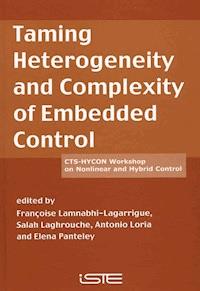
Taming Heterogeneity and Complexity of Embedded Control E-Book
416,99 €
Mehr erfahren.
- Herausgeber: John Wiley & Sons
- Kategorie: Wissenschaft und neue Technologien
- Sprache: Englisch
This book gathers together a selection of papers presented at the Joint CTS-HYCON Workshop on Nonlinear and Hybrid Control held at the Paris Sorbonne, France, 10-12 July 2006. The main objective of the Workshop was to promote the exchange of ideas and experiences and reinforce scientific contacts in the large multidisciplinary area of the control of nonlinear and hybrid systems.
Sie lesen das E-Book in den Legimi-Apps auf:
Seitenzahl: 1086
Veröffentlichungsjahr: 2013
Ähnliche




















Preface
Chapter 1. Ellipsoidal Output-Feedback Sets for ∞ Control of a Class of Stochastic Hybrid Systems with State-Dependent Noise
1. Introduction
2. Dynamical Model of the AFTCSMP with Wiener Process
3. Definitions
4. Stochastic Stabilization
5. The ∞ Control Problem
6. Computational Issues and Examples
7. Conclusion
8. References
Chapter 2. A Contribution to the Study of Periodic Systems in the Behavioral Approach
1. Introduction
2. Periodic behavioral systems
3. P-periodic kernel representations - PPKR
4. P-periodic image representations - PPIR
5. Controllability
6. Autonomicity
7. Free variables
8. Conclusions
9. Acknowledgements
10. References10s
Chapter 3. Iteratively Improving Moving Horizon Observers for Repetitive Processes
1. Introduction
2. Problem Setup
3. Basic Idea
4. Stability
5. Application Example
6. Epilogue
7. References
Chapter 4. Exponential Stability of Dynamic Equations on Time Scales
1. Introduction
2. Calculus on Time Scales
3. Exponential Stability for Linear Equations
4. Set of Exponential Stability
5. Stability For Time Invariant System
6. Exponential Stability For Time Varying Systems
7. Conclusions
8. References
Chapter 5. Jurdjevic-Quinn Conditions and Discontinuous Bounded Damping Control
1. Introduction
2. Smooth Jurdjevic-Quinn control
3. Discontinuous control, main result
4. Proofs
5. Conclusion
6. Acknowledgements
7. References
Chapter 6. Smooth Approximations of Single-Input Optimal Orbital Transfer using Continuation and Averaging Techniques
1. Introduction
2. The time-minimal control problem
3. Continuation methods
4. Averaging method
5. Acknowledgements
6. References
Chapter 7. Achieving Stability in Non-holonomic Systems by Means of Switched Control Laws.
1. Introduction
2. Basic notions and useful notations
3. Switching-based stability
4. An application: the Artstein’s circle
5. Simulations
6. Conclusions
7. Acknowledgments
8. Appendix
B. References
Chapter 8. Stability of Equilibria for Hybrid Models of Genetic Regulatory Networks
1. Introduction
2. Piecewise-linear Models of Genetic Regulatory Networks
3. Equilibria and Stability
4. Graph of the Qualitative Dynamics
5. Criteria for Stability of Singular Equilibria
6. Discussion
7. Acknowledgments
8. References
Chapter 9. Tools for Semiglobal Practical Stability Analysis of Cascaded Systems and Applications
1. Introduction
2. Stability definitions
3. Lyapunov sufficient conditions
4. Stability for cascades
5. Converse results
6. Applications
7. Conclusion
8. Acknowledgements
9. References
Chapter 10. A Rigorous Numerical Algorithm for Controllability
1. Introduction
2. Interval Krawczyk Method
3. Searching for the switching times
4. Algorithm is Reachable
5. Examples
6. References
Chapter 11. Dead-locks and Break of Symmetry in Robot Coordination
1. Introduction
2. Coordinated dynamics
3. Cooperative controls
4. Problem P1: two robots with symmetrical initial/final positions
5. Problem P2: break of symmetry
6. Conclusions
7. References
Chapter 12. Iterative Nonlinear Model Predictive Control: A Review
1. Introduction
2. Controller synthesis
3. Examples
4. Applications
5. Conclusions
6. Acknowledgements
7. References
Chapter 13. Transient Stabilization and Voltage Regulation of a Synchronous Generator
1. Introduction
2. Problem Statement
3. Nonlinear Control Design
4. Simulation Results
5. Conclusions
6. Acknowledgements
7. Bibliography
Chapter 14. A Current-based Approach to Wave Reflection Suppression in AC Drives Fed through Long Cables
Introduction
1. Preliminaries and background
2. Proposed topology: current-injection compensation scheme
3. Proposed compensators
4. Overall system representation
5. Towards a practically feasible implementation of current-injections based compensators
6. Active compensators proposed implementations: simulation and experimental results
7. Conclusions
8. Acknowledgements
9. References
Chapter 15. Stabilizability of Affine Switching Systems: A Kalman-like Approach
1. Introduction
2. Preliminaries and basic definitions
3. Invariant hybrid subspaces
4. State space reductions based on stabilizability
5. Conclusions
6. Aknowledgement
7. References
Chapter 16. Observability of Hybrid Automata by Abstraction
1. Introduction
2. Basic definitions
3. Observability of Timed Automata
4. Abstraction of Hybrid Automata
5. Conclusions
6. References
Chapter 17. New Convenient Formula for Impedance Change Calculation in Non-destructive Testing Problems by Control of Eddy Currents
1. Introduction
2. Proof of the new convenient formula
3. Conclusion
4. References
Chapter 18. Dynamic Optimization of Nonlinear Bioreactors
1. Introduction
2. NDOT toolbox features
3. Case studies
4. Results
5. Conclusions
6. Acknowledgements
7. References
Chapter 19. About Stability Analysis for Discrete Time Systems with Time Varying Delays
1. Introduction
2. Context
3. The Krasovskii-Lyapunov inspired approach
4. The switched system transformation approach
5. Theoretical link between the two approaches
6. Numerical example
7. Conclusion
8. References
Chapter 20. Real-time Implementation of Rotor Flux and Speed Control of Induction Motors using Online Rotor Resistance and Load Torque Adaptation
1. Introduction
2. Model description and problem statements
3. Summary of basic equations used for the rotor speed and flux control
4. Rotor speed and flux adaptive control design
5. Experimental results
6. Conclusion and future works
7. Acknowledgments
A. Proof of the convergence of the rotor resistance estimate
B. Induction motor data
C. References
Chapter 21. The On-line Diagnosis of Time Petri Nets Based on Partial Orders
1. Introduction
2. Notation and definitions
3. Diagnosis of TPNs
4. The analysis of TPNs based on partial orders
5. The Extended Linear Complementarity Problem
6. The method based on constraint propagation
7. The on-line diagnosis
8. Conclusions
9. Acknowledgements
10. References
Chapter 22. Optimization Methods for the Sphere Packing Problem on Grassmannians
1. Introduction
2. Riemannian gradient descent
3. Optimal packings on Grassmannians
4. Nonsmooth optimal packing algorithm
5. A smoothed variant of the algorithm
6. Numerical simulations
7. References
Chapter 23. Analytical Solution of the Problem on a Magnetohydrodynamic Flow in the Initial Part of a Plane Channel in a Transverse Magnetic Field in Oseen Approximation
1. Introduction
2. Formulation of the problem and its solution
3. Conclusions
4. References
Chapter 24. A Formation Control Algorithm using Voronoi Regions
1. Introduction
2. Problem definition
3. Coordination algorithm
4. Properties of the algorithm
5. Simulations
6. Conclusions
7. References
Chapter 25. Output Delay Systems Tracking Using System Centre Approach and Sliding Mode Control
1. Introduction
2. Problem Formulation
3. Padé Approximations and Time Delay Systems
4. System Centre Method and Sliding Mode Control
5. Numerical Example and Simulations
6. Feedback by and Describing Function
7. Conclusion
8. References
Chapter 26. State-Linearization of Positive Nonlinear Systems; Applications to Lotka-Volterra Controlled Dynamics
1. Introduction
2. Positive Linear Systems
3. Positive Nonlinear Systems
4. Linearization of Positive Nonlinear Systems
5. Positively Invariant Population Dynamics Models in 2
6. Concluding Remarks
7. References
Chapter 27. Energy Transfer via Point Interaction Controls
1. Introduction
2. The Main Result
3. A Sketch of the Proof
4. A Further Remark
5. Acknowledgement
6. References
Chapter 28. Further Remarks on Stability Crossing Curves of Distributed Delay Systems
1. Introduction and motivating examples
2. Notions and assumptions
3. Preliminary results and prerequisites
4. Maximum delay deviation problem
5. Illustrative examples
6. Concluding remarks
7. Acknowledgements
8. References
Chapter 29. A New Adaptive Controller for Systems with Multilinear Parameterization
1. Introduction
2. A new adaptive controller for systems with multilinear parameterization
3. Simulations
4. Conclusions
5. Acknowledgements
6. References
Chapter 30. Hybrid Model Predictive Control Applied on Sewer Networks: The Barcelona Case Study
1. Introduction
2. Hybrid MPC on Sewer Networks
3. Hybrid MPC Problem Formulation
4. Implementation and Results
5. Conclusions and further work
6. Acknowledgements
7. References
Chapter 31. Realization Theory of Nonlinear Hybrid System
1. Introduction
2. Notation and terminology
3. Algebraic preliminaries
4. Moore-automata
5. Nonlinear Hybrid Systems
6. Input-Output Maps of Hybrid Systems
7. Formal Realization Problem For Hybrid Systems
8. Main Result
9. Conclusions
Chapter 32. Adaptive Sliding Mode Observer Based Uncertain Chaotic Masking Communication
1. Introduction
2. Chaos and Cryptography
3. Proposed Chaotic Cryptosystem via Adaptive Sliding mode Observer Design
4. Simulation Example
5. Conclusions
6. References
Chapter 33. Navier-Stokes Equation on a Plane Bounded Domain: Continuity Properties for Controllability
1. Introduction
2. Linear Operators. The Spaces
3. Existence, Uniqueness and Continuity
4. Change of Variables. Relaxation
5. Realization onto the Projection
6. Saturating sets
7. Controllability: a sufficient condition
8. References
Chapter 34. Hybrid Predictive Control of a Simulated Chemical Plant
1. Introduction
2. Model of the plant
3. Hybrid model predictive control
4. Control results
5. Conclusions
6. References
Chapter 35. Robust Identification in Nonlinear Dynamic Process Models
1. Introduction
2. Problem statement
3. Methods
4. Case study
5. Conclusions
6. References
Chapter 36. Generic Families and Generic Bifurcations of Control-Affine Systems
1. Introduction
2. Notations
3. Non-degeneracy conditions
4. Classification results
5. Bifurcations
6. Proofs of the classification theorems
7. References
Chapter 37. Sliding Control and Optimization in a Full Bridge Boost Converter
1. Introduction
2. Problem statement
3. Sliding control
4. Tracking a sinusoidal reference
5. Optimization
6. Simulation
7. Conclusions
8. References
Chapter 38. Feedback Stabilization of the Periodic Operation of an Hybrid Chemical Plant
1. Introduction
2. Hybrid chemical plant with parallel production lines, shared resources and a continuous output
3. Feedback stabilization
4. Application of the feedback control and of a rescheduling strategy on the hybrid chemical plant
5. Conclusions and future work
6. Acknowledgements
7. References
Chapter 39. Fast Tracking of Poiseuille Trajectories in Navier Stokes 2D Channel Flow
1. Introduction
2. Channel flow model
3. Trajectory generation and control objective
4. Main results
5. Mathematical preliminaries
6. Proof of theorem 4.1
7. Proof of theorem 4.2
8. Acknowledgements
9. References
Chapter 40. Some Remarks on Interconnection and Damping Assignment Passivity-Based Control of Mechanical Systems
1. Introduction
2. Background on IDA–PBC and Problem Formulation
3. Generating an Homogeneous Kinetic Energy PDE
4. Solving the Original PDEs
5. Examples
6. Conclusions
7. References
List of Authors
First published in Great Britain and the United States in 2007 by ISTE Ltd
Apart from any fair dealing for the purposes of research or private study, or criticism or review, as permitted under the Copyright, Designs and Patents Act 1988, this publication may only be reproduced, stored or transmitted, in any form or by any means, with the prior permission in writing of the publishers, or in the case of reprographic reproduction in accordance with the terms and licenses issued by the CLA. Enquiries concerning reproduction outside these terms should be sent to the publishers at the undermentioned address:
ISTE Ltd6 Fitzroy SquareLondon W1T 5DXUK
ISTE USA4308 Patrice RoadNewport Beach, CA 92663USA
www.iste.co.uk
© ISTE Ltd, 2007
The rights of Françoise Lamnabhi-Lagarrigue, Salah Laghrouche, Antonio Loria and Elena Panteley to be identified as the authors of this work have been asserted by them in accordance with the Copyright, Designs and Patents Act 1988.
Library of Congress Cataloging-in-Publication Data
Taming heterogeneity and complexity of embedded control/edited by Françoise Lamnabhi-Lagarrigue … [et al.].
p. cm.
ISBN 978-1-905209-65-1
1. Digital control systems--Congresses. 2. Embedded computer systems--Congresses. 3. Nonlinear control theory--Congresses. I. Lamnabhi-Lagarrigue, F. (Françoise), 1953-
TJ223.M53T36 2007
629.8'36--dc22
2006038969
British Library Cataloguing-in-Publication Data
A CIP record for this book is available from the British Library
ISBN 13: 978-1-905209-65-1
SPONSORS’ LIST
Preface
This book gathers selected papers presented at the Joint CTS-HYCON Workshop on Nonlinear and Hybrid Control, held at Paris Sorbonne University (Paris IV) on 10-12 July 2006. The book contains timely theoretical and applied contributions to the analysis and control of nonlinear and hybrid systems.
CTS stands for Control Training Site (www.mc-cts.org) and is a Multi-partner Marie Curie Training Site funded by the European Commission in the framework of the FP5 Programme Improving Human Research Potential & the Socio-economic Knowledge Base. HYCON is the acronym of the Network of Excellence entitled "Hybrid Control: Taming Heterogeneity and Complexity of Networked Embedded Systems" (www.isthycon.org) funded by the European Commission in the framework of the FP6 Programme Information Society Technologies. The CTS aimed to partially train outside their home university any European student starting or pursuing doctoral studies in the area of control and optimization, including various domains of control theory, optimization and control engineering. The objective of the NoE HYCON is to establish a durable community of leading researchers and practitioners who develop approaches to the design of networked embedded control systems as found, e.g., in industrial production, transportation systems, generation and distribution of energy, communication systems. In this latter framework, the recently created European Embedded Control Institute (EECI) aims to act on the triangle education, research and innovation for the Knowledge Community of Networked and Embedded Control.
In particular, the aim of this workshop was to promote exchanges of ideas and experiences and reinforce scientific contacts on nonlinear and hybrid control. Another aim was to benefit from pedagogical talks from 17 invited experts: Frank Allgower and Christian Ebenbauer, John Baras, Georges Bastin, Alexandre M. Bayen, Antonio Bicchi, Eduardo Camacho, Bronislaw Jakubczyk, Karl H Johansson, John Lygeros, Henk Nijmeijer, Gauthier Sallet, Shankar Sastry, Arjan van der Schaft, Rodolphe Sepulchre, Andrew Teel and Claire Tomlin.
The Preface of this book is an opportunity to thank all the CTS Members who have been host during five years to a total of around 150 Fellows and have organized successful events throughout the duration of the project. I would like also to thank the HYCON Members for making this project also a success with a very good working ambiance.
The main sponsor of this workshop, the European Commission through the CTS and HYCON projects, is gratefully acknowledged. We would also like to thank the Region Ile de France for its partial support of this successful event.
Françoise Lamnabhi-Lagarrigue, Salah Laghrouche, Antonio Loria, Elena Panteley.
Ellipsoidal Output-Feedback Sets for Control of a Class of Stochastic Hybrid Systems with State-Dependent Noise
Samir Aberkane Jean Christophe Ponsart Dominique Sauter
CRAN CNRS UMR 7039Universit Henri Poincar, Nancy 1, BP 239,F-54506 Vandoeuvre-ls-Nancy CedexTel.: +33 3 83 68 44 80, Fax: +33 3 83 68 44 62e-mail:[email protected]
ABSTRACT. This paper deals with static output feedback control of continuous time Active Fault Tolerant Control Systems with Markovian Parameters (AFTCSMP) and state-dependent noise. It adopts a new framework based on the synthesis of ellipsoidal sets of controllers. It is also shown that the obtained results can easily be applied to the problematic of modeindependent static output feedback control of another class of stochastic hybrid systems known as Markovian Jump Linear Systems. Results are formulated as matrix inequalities, one of which is nonlinear. A numerical algorithm based on nonconvex optimization is provided and its running is illustrated on classical examples from literature.
KEYWORDS: Stochastic Hybrid Systems, Markovian Jumping Parameters, Control, Static Output Feedback, Ellipsoidal Sets, Linear Matrix Inequalities (LMI)
1. Introduction
As performance requirements increase in advanced technological systems, their associated control systems are becoming more and more complex. At the same time, complicated systems could have various consequences in the event of component failures. Therefore, it is very important to consider the safety and fault tolerance of such systems at the design stage. For these safety-critical systems, Fault Tolerant Control Systems (FTCS) have been developed to meet these essential objectives. FTCS have been a subject of great practical importance, which has attracted a lot of interest for the last three decades. A bibliographical review on reconfigurable fault tolerant control systems can be found in [ZHA 03].
Active fault tolerant control systems are feedback control systems that reconfigure the control law in real time based on the response from an automatic fault detection and identification (FDI) scheme. The dynamic behaviour of Active Fault Tolerant Control Systems (AFTCS) is governed by stochastic differential equations and can be viewed as a general hybrid system [SRI 93]. A major class of hybrid systems is Markovian Jump Linear Systems (MJLS). In MJLS, a single jump process is used to describe the random variations affecting the system parameters. This process is represented by a finite state Markov chain and is called the plant regime mode. The theory of stability, optimal control and 2/ control, as well as important applications of such systems, can be found in several papers in the current literature, for instance in [BOU 06, BOU 05, BOU 99, COS 99, FAR 00, SOU 93, JI 90, JI 92].
To deal with AFTCS, another class of hybrid systems was defined, denoted as AFTCSMP. In this class of hybrid systems, two random processes are defined: the first random process represents system components failures and the second random process represents the FDI process used to reconfigure the control law. This model was proposed by Srichander and Walker [SRI 93]. Necessary and sufficient conditions for stochastic stability of AFTCSMP were developed for a single component failure (actuator failures). The problem of stochastic stability of AFTCSMP in the presence of noise, parameter uncertainties, detection errors, detection delays and actuator saturation limits has also been investigated in [MAH 99a, MAH 01, MAH 03]. Another issue related to the synthesis of fault tolerant control laws was also addressed by [MAH 99b, SHI 97, SHI 03]. In [MAH 99b], the authors designed an optimal control law for AFTCSMP using the matrix minimum principle to minimize an equivalent deterministic cost function. The problem of and robust control was treated in [SHI 97, SHI 03] for both continuous and discrete time AFTCSMP. The authors showed that the state feedback control problem can be solved in terms of the solutions of a set of coupled Riccati equations. The dynamic/static output feedback counterpart was treated by [ABE 05b, ABE 05c, ABE 05a] in a convex programming framework. Indeed, the authors provide an LMI characterization of dynamical/static output feedback compensators that stochastically stabilize (robustly stabilize) the AFTCSMP and ensures (robust ) constraints. In addition, it is important to mention that the design problem in the framework of AFTCSMP remains an open and challenging problematic. This is due, particulary, to the fact that the controller only depends on the FDI process the number of controllers to be designed is less than the total number of the closed loop systems modes by combining both failure an FDI processes. The design problem involves searching feasible solutions of a problem where there are more constraints than variables to be solved. Generally speaking, there lacks tractable design methods for this stochastic FTC problem. Indeed, in [ABE 05b, ABE 05c, MAH 03, SHI 97, SHI 03], the authors make the assumption that the controller must access both failures and FDI processes. However, this assumption is too restrictive to be applicable in practical FTC systems. In this note, the assumption on the availability of failure processes, for the synthesis purposes, is stressed.
Lesen Sie weiter in der vollständigen Ausgabe!
Lesen Sie weiter in der vollständigen Ausgabe!
Lesen Sie weiter in der vollständigen Ausgabe!
Lesen Sie weiter in der vollständigen Ausgabe!
Lesen Sie weiter in der vollständigen Ausgabe!
Lesen Sie weiter in der vollständigen Ausgabe!
Lesen Sie weiter in der vollständigen Ausgabe!
Lesen Sie weiter in der vollständigen Ausgabe!
Lesen Sie weiter in der vollständigen Ausgabe!
Lesen Sie weiter in der vollständigen Ausgabe!
Lesen Sie weiter in der vollständigen Ausgabe!
Lesen Sie weiter in der vollständigen Ausgabe!
Lesen Sie weiter in der vollständigen Ausgabe!
Lesen Sie weiter in der vollständigen Ausgabe!
Lesen Sie weiter in der vollständigen Ausgabe!
Lesen Sie weiter in der vollständigen Ausgabe!
Lesen Sie weiter in der vollständigen Ausgabe!
Lesen Sie weiter in der vollständigen Ausgabe!
Lesen Sie weiter in der vollständigen Ausgabe!
Lesen Sie weiter in der vollständigen Ausgabe!
Lesen Sie weiter in der vollständigen Ausgabe!
Lesen Sie weiter in der vollständigen Ausgabe!
Lesen Sie weiter in der vollständigen Ausgabe!
Lesen Sie weiter in der vollständigen Ausgabe!
Lesen Sie weiter in der vollständigen Ausgabe!
Lesen Sie weiter in der vollständigen Ausgabe!
Lesen Sie weiter in der vollständigen Ausgabe!
Lesen Sie weiter in der vollständigen Ausgabe!
Lesen Sie weiter in der vollständigen Ausgabe!
Lesen Sie weiter in der vollständigen Ausgabe!
Lesen Sie weiter in der vollständigen Ausgabe!
Lesen Sie weiter in der vollständigen Ausgabe!
Lesen Sie weiter in der vollständigen Ausgabe!
Lesen Sie weiter in der vollständigen Ausgabe!
Lesen Sie weiter in der vollständigen Ausgabe!
Lesen Sie weiter in der vollständigen Ausgabe!
Lesen Sie weiter in der vollständigen Ausgabe!
Lesen Sie weiter in der vollständigen Ausgabe!
Lesen Sie weiter in der vollständigen Ausgabe!
Lesen Sie weiter in der vollständigen Ausgabe!




