


Erhalten Sie Zugang zu diesem und mehr als 300000 Büchern ab EUR 5,99 monatlich.
- Herausgeber: Independent Thinking Press
- Kategorie: Bildung
- Sprache: Englisch
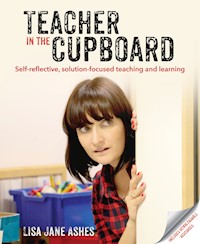
In Teacher in the Cupboard: Self-reflective, solution-focused teaching and learning, Lisa Jane Ashes takes educators on a self-reflective journey that will inspire them to challenge the 'how to', tick-box approach to teaching. Even if all the problems in your classroom have been solved by the time you read this, plenty more would surface to take their place ... And while each problem has multiple solutions, you'll need your creativity in order to find them. In this book, Lisa explores how spending time 'in the cupboard' - a metaphor for removing yourself from a situation and seeing it through a more objective lens - can help teachers come up with creative solutions to everyday challenges and positively transform their classroom practice and human interactions. Teacher in the Cupboard encompasses Lisa's many and varied observations in education - and each chapter includes real-life experiences to make you think, as well as practical techniques to help educators avoid retreating into self-blindness: a common affliction that robs them of their perception of their own contribution as part of the teaching and learning process. Brimming with fresh perspectives, the book presents a wide range of innovative ideas to enable educators to harness the power of self-reflection and create a stimulating learning environment that produces excellent results for them, their students and their colleagues. It also talks teachers through a number of methods, approaches and resources that will enable them to instil in their learners a sense of satisfaction derived from the learning skills and behaviours being developed in the classroom. These materials are collated in the 'Resource Cupboard' section at the back of the book, offering adaptable - and downloadable - resources that Lisa has used to successfully enhance learning in the classroom. Suitable for NQTs, teachers and school leaders.
Sie lesen das E-Book in den Legimi-Apps auf:
Seitenzahl: 264
Veröffentlichungsjahr: 2019
Das E-Book (TTS) können Sie hören im Abo „Legimi Premium” in Legimi-Apps auf:
Ähnliche



















Praise for Teacher in the Cupboard
Lisa Jane Ashes’ beautifully crafted exploration of the difficulties faced by teachers and students is thoroughly enjoyable. As well as exploring these challenges from a variety of insightful perspectives, Lisa shares a wealth of accessible strategies and signposts which will directly support teaching professionals in their daily work.
A refreshing blend of reality, hope, humour, compassion and pragmatic solutions, Teacher in the Cupboard resets the moral compass and hands educators a road map to purposeful teaching and learning.
Barry Dunn, Head of Religious Studies, Seaham High School
Lisa Jane Ashes’ Teacher in the Cupboard is a truthful and heartfelt reflection on the realities of the teaching profession – every teacher will recognise a little bit of themselves in the scenarios described.
From time to time we all find ourselves in challenging and tricky situations – and therefore the need for self-awareness and evaluation is critical for teachers. Lisa has clearly taken note of this necessity and in this book offers many practical strategies to help facilitate reflective thinking. She prompts us to really observe and listen to what is happening around us, and poses probing questions we should ask ourselves when children appear to disengage from their learning.
Teacher in the Cupboard will offer similar comfort to that of the friendly colleague in the staffroom, who we can all turn to when we need a little guidance.
Katy Hodges, Assistant Head Teacher and SENCO, Westfield School
At last, a voice that puts people back into education. I for one am tired of the ‘system’ and its inherent fear with its managers, inspectors, know-it-alls and education ministers being the domineering naysayers of our schools. Lisa is on the money when she says that what we do requires us all to see the humanity in one another. Education will be richer as a result. The book’s subtitle, ‘Self-reflective, solution-focused teaching and learning’, is a worthy reminder that the teaching profession is a human endeavour, often forgotten in the milieu of modern education.
Teacher in the Cupboard challenges us to reflect on what the problems in our contexts are – and on the excuses we make for not resolving them – and encourages us to think creatively to find workable and humane solutions. It is filled with calm and level-headed examples of problem-solving, from tackling difficult classes and reluctant learners to managing our frantic workloads. Lisa is unshakeably positive in her outlook, even when reflecting on teaching’s difficult moments – insisting that a solution can always be found within ourselves if we just stop, look and listen. She also offers ideas around why and how difficulties arise, and how we can find pre-emptive solutions that enable us to be more productive and our students better behaved and better learners.
At the heart of Lisa’s approach are the relationships teachers build between themselves and their students. The neat, succinct examples of what this might look, sound and feel like offer excellent opportunities to reflect on your own practice as well as that of those you work alongside.
Teacher in the Cupboard is instantly useable for expert and beginner teachers alike. Lisa’s honesty and positivity make it an enjoyable, humbling and useful read, and one that I will return to again and again in reflecting upon and refining my practice.
Darren Mead, teacher and author of The Expert Teacher
I think Lisa Jane Ashes’ ‘self-blindness’ metaphor is appropriate for any teacher. We are never too old to learn new things about ourselves or how to handle situations, and Teacher in the Cupboard advocates just that. It’s practical, easy to follow, and grounded in real-life examples, which makes its ideas and suggestions both reliable and easy to action. It also offers some fresh ideas about how to deal with staff, and how to approach them when an issue arises.
I felt like Lisa was coaching me personally throughout this book, and it’s made me reflect on a few situations I have found myself in – whether with staff or with students – that I would want to handle differently. I now feel invigorated and ready to tackle my trickier classes, taking greater care to reflect on how I can adapt my practice to better manage behaviour and ensure I’m fully stretching my learners.
Teacher in the Cupboard would be a particularly encouraging read for newly qualified teachers, to help them develop the high levels of reflection needed to enhance students’ behaviour for learning.
Kathy Howell, English Faculty Leader, Caludon Castle Teaching School
For Tony, Miesha and Samuel.
FOREWORD
I have to admit, I never thought I’d see Lisa Jane Ashes telling people to get back in the closet. I still remember the evening when the improbable title of this book was born. Lisa was sitting across from me and Independent Thinking’s Ian Gilbert in a bar in Manchester when she announced that she’d been relegated to a cupboard during her first term of assisting an English teacher. ‘It was quite a large cupboard,’ she reassured me, as she sipped on her pint and beheld my horrified expression. ‘I guess the teacher just really didn’t want an assistant.’
Of course, I immediately wanted to express righteous indignation on my friend’s behalf – in a ‘Nobody-puts-Baby-in-a-corner’ sort of way. After all, Lisa’s skills as a teacher, mentor and trainer have long since been proven. But Lisa’s perception of the situation was casually philosophical: ‘It was ok …’ she shrugged, ‘I just used the time to watch and think and learn as much as possible about what could be done.’
A quote alleged to be by psychiatrist Viktor E. Frankl, or maybe even Stephen Covey, provides precious insight to life: ‘Between stimulus and response there is space. In that space is our power to choose our response. In our response lies our growth and our freedom.’ For Lisa, this ‘space’, this priceless moment of stepping back, breathing and observing before reacting, is where the power lies, not just for us as teachers, but as parents, managers, colleagues and friends. This space offers us the chance to explore and acknowledge the undercurrents of a problem and to shine a light on our own attitudes. This exquisite, underused space is what Lisa affectionately calls ‘the cupboard’.
And that’s how Lisa approaches problems – in this book and in life: not with trepidation, or rash reaction, or even dogged determination, but instead with a period of considered and gentle curiosity before taking any action at all. Unlike those staffroom dementors we’ve all encountered at some point in our careers, Lisa doesn’t see problems as a nuisance, a buzzkill, a frigging pain in the backside. When she encounters a tricky situation, she pauses and simply says, ‘Hmmm … This is interesting …’
Fast forward from the Mancunian bar by several years and Lisa and I are working on charity projects in Nepal and Uganda, where difficulties present themselves almost hourly – from man-eating mosquitoes to child-caning teachers. As a privileged co-worker, I’ve witnessed Lisa braving her way through a myriad of complex setbacks, defusing rows between volunteers and uniting the most unlikely companions in a common goal. Her willingness to bypass fear and find the key to manipulate an apparently insurmountable problem into a tremendous opportunity for learning and growth has often been a great source of amusement (as well as relief!) to me. It’s not that Lisa doesn’t feel fear, it’s that she sort of takes it with her … So I think it’s fair to say that over the years I have come to see Lisa as the trickster imp of the teaching community; a Geordie Puck in the great Forest of Education. And not just because she’s five foot two … but also because she whispers into the ears of educators with her quick-witted inspiration: ‘You can see this another way. You can feel and experience this differently.’ Indeed, in this book, she sabotages the factory setting of ‘I am powerless, I am helpless, I am the hapless recipient of this situation,’ and sets into motion the cogs of innovation, empowerment and breakthrough, making delightful mischief of our tendency to stay in our comfort zones.
This is all well and good, but can you really trust a narrator who ended up leaving a perfectly good teaching and consulting job to pursue action research into the most difficult aspects of teaching … by becoming a supply teacher! Who in their right mind would elect to lose their power? Who would choose a position perceived as inferior in the eyes of many staff and students? I mean, isn’t that a little bit masochistic or just, well, crazy?
But Lisa knows she didn’t sign up for power and superiority. In fact, I think she went into teaching in the same open-minded way she went into that northern tattoo shop: ‘I don’t know what’s going to happen here, but let’s just experiment and see what takes form. Go ahead and decorate me.’
And she’s right about supply teaching being a perfect place to explore the nuances of real problem-solving in schools. After all, every NQT knows how frustrating it feels when a long-established teacher tells you, ‘I never have any trouble with behaviour’ – and you just can’t quite work out what it is they do that transforms that class-from-hell into a choir of little cherubs. Often, of course, it’s simply because the teacher’s reputation precedes them and therefore it’s not a formula you can bottle and roll out to other teachers. When your reputation precedes you, you can achieve all sorts of astounding results. It’s why Ariana Grande can stick a pair of cat ears on her head and start a worldwide fashion craze; whereas if I’d tried to be the originator of feline headbands, people would quite probably have just felt sorry for me. Lisa stuck herself in the line of fire and built her solution-focused approach to teaching from ground zero. No rock-star status, no friends in high places, not even a modest teaching and learning responsibility (TLR).
So why is a solution-based approach so sorely needed in schools right now? Well, consider the gradual stripping away of teacher autonomy that has taken place over the last few decades. Longstanding teachers often tell me that they remember when they could ‘choose’ what to teach and so would select something which fired them with enthusiasm and passion that they could transmit to their learners. Now they lament that they often feel they must simply wait for instruction about what to teach and how to teach it – down to the last prescribed lesson plan, activity and resource. But do we want to fill our schools with obedient recipients, rather than innovative creators? Technicians who will simply deliver the curriculum, rather than conceive of and give birth to it? Because if creative teaching isn’t valued then it obviously won’t be honed and developed, and so, as a terrifying consequence, creative problem-solving and an internal locus of control may fall by the wayside too.
I catch a glimpse of this scary phenomenon sometimes when I’m working with teachers to develop their classroom practice. An earnest teacher will approach me during the break and tell me, ‘I’d love to try that strategy you showed us, but unfortunately we’re not allowed to move the children around. They have to stay sitting in their “ability groups” and they have to be organised boy, girl, boy, girl. That’s school policy.’ Sadly, there’s an implication in this ‘school policy’ that the teacher’s professional judgement is not to be trusted and they must work instead within parameters dictated by someone who probably does not intricately know the children and their needs. And sometimes teacher disempowerment is even more striking: teachers have said to me, ‘I loved the exercise you demonstrated where the students make the question cards, but we don’t have card available in my school – only paper. Would it be okay for them to write on paper instead of card?’ This uncertainty about whether it’s acceptable to deviate in any way from a given idea, to independently problem-solve or creatively adapt without seeking permission, is, in my opinion, quite alarming. There should surely be an in-built right for educators of the next generation to be just a little rebellious.
Perhaps problem-solving and perceptive analysis have not been adequately valued or cultivated in teachers because it‘s far harder to measure those skills than it is to measure teachers’ performance by their students’ test results. And we do like to measure things, don’t we? A teacher’s ability to inspire, care, innovate and view problems from multiple perspectives is extremely difficult to quantify. We are right to fear that the ‘teach-to-the-test’ approach murders the broadness of the curriculum and the creativity of learners; but what if there’s another more insidious, more horrifying impact? What if that approach is also whittling away the self-governing skills of us teachers?
Lisa reminds us all that, as experts in our field, we need to know we have the right to a voice and a vision of our own. We need to have autonomy and we need to make sure that our decisions are driven by curiosity rather than fear, by exploration rather than comfort and by solution-seeking rather than self-reproach or ego. Is this kind of ‘time out’ in ‘the cupboard’ a comfortable notion? No. Is it the easiest option? No. But, is it a sure-fire way to rapidly grow as a practitioner? Yes. Yes. Yes.
Isabella Wallace
ACKNOWLEDGEMENTS
Thank you to every colleague and teacher far and wide who has contributed, perhaps unknowingly, to my learning journey. Whether you were the teacher who put me in a cupboard, a learning mentor who modelled compassion, my mentor, my line manager, a nameless teacher in the staffroom or a mate who drank cups of tea with me on a Friday, without you, this book would not have been possible.
Thank you to the wonderful Jane Hewitt for being so patient with me as I messed about in so many cupboards for the cover of this book. Also, to the entire Independent Thinking family, especially those who planned or took part in Thinking Saturdays. Those days gave me permission to be a learning geek and gave me a learning family with whom to share that experience.
Thank you to the wonderful team at Vision for Education, especially Liam, who inspired me to join the team through Haribo and Diet Coke, as well as Gareth and Paul for placing me in schools that helped me to reflect on teaching from an entirely new angle.
Also, thank you to my friends who ‘believe’ in my unorthodox ways and encourage my unusual journeys. Special thanks to Marsha Costigan for the cups of tea and motivating conversations in Dream Corner, and Isabella Wallace for her generosity, kindness and book recommendations which keep me always moving forward.
Finally, a huge thank you to my family for being there for me, no matter how stressful the writing became. To Tony, my husband, without whom I would starve both physically and intellectually. To my children who have embraced the dysfunction and keep me going through encouragement. To my brother for our joint dreams that keep me smiling. To my mam, Trish, who is a rock in any storm, and to Nana Ellen – legend.
CONTENTS
INTRODUCTION
View the cupboard as a metaphor for self-blindness. It is an affliction that affects so many and can be crippling to personal progress. Whether you are a student who blames their bad education on their teachers or a teacher who can’t control behaviour but never looks at their own, self-blindness can hold us all back.
People watching
It was my first day as a classroom assistant. Just 21 years old and straight from university, I was petrified! At five feet two inches tall, many students in this secondary school were already taller than me. I felt intimidated by the prospect of secondary students and intellectually inferior to the teachers. Having just completed an English degree, I had no clue what I was expected to do in this unfamiliar setting – unaware of my purpose and blind to my potential.
My first day was an INSET, which is the day (I quickly found out) when classroom assistants drink coffee and clean out cupboards. We were segregated from the teachers who, I could only assume, were being taught the magic of education in a hall somewhere else. My timetable wasn’t ready but they assured me this was ‘normal’. I was in no way prepared for classes of teenagers or terrifyingly professional teachers. My first day had left me even more unsure of what I was supposed to do as part of my new role, but the cupboards were sparkling!
When school really started, I was assigned to class 9Z3. My first lesson was English: I knew this subject! I had a degree in this subject! Hopefully, this would magically make me useful when the lesson began. I needn’t have worried. As I arrived, the teacher gave me a look that screamed, ‘Know your place!’ Classroom assistants were not welcome in this room. Not only had this teacher undergone the magical INSET workshops that I was unworthy of, but she had been teaching for over twenty years and certainly didn’t need my help. I was put in the cupboard.
I’m not talking about a metaphorical cupboard (yet). I was told that I should work in an actual cupboard, tucked away at the side of the classroom. Work? On what? Apart from following 9Z3 around the school, I didn’t have any ‘work’ to do.
The Z in the class code was no accident. They were viewed by all as the bottom of the barrel. These kids were not expected to achieve. They were expected to be a pain in the arse. I wasn’t earning much, but surely I was supposed to do more for my pittance than sit in a cupboard? Surely these Z-listers could use some support, right? But I knew better than to go against the experience of a well-established teacher. I took my seat in the cupboard and prepared to … well … sit.
How often have you done something you know to be wrong but someone in charge told you to do it, so you did? Why? Do you lack confidence? Why?
Check out the Milgram Experiment for some interesting further reading on this topic.1
It really wasn’t that long since I had been sitting in the classroom myself, and college and university had not felt much different from school for me. They were institutions that I fell into; they were not well-thought-out stepping stones to my own success. There were teachers and lecturers who knew it all, and then there was me regurgitating what they said without much of a clue why. In my new cupboard, there was a gap in the door just wide enough to witness the lessons. I could picture myself sitting back in that classroom, as bored then as I was now. The lessons would go over my head as I stared out of the window and daydreamed about anything other than learning. Had I landed a job that took me right back to the place I had been so desperate to get away from?
The more I observed, the more I began to see. It was like watching a repeat of some old TV programme – the same lesson, the same behaviours from both the teacher and students. Like a fly on the wall, I became a teacher in training from a cupboard. My self-blindness had kept me from challenging the authority of the teacher. I knew it was wrong to be relegated to a cupboard, but in I went nevertheless. I couldn’t see myself as anything other than subordinate. The cupboard would become a cure for self-blindness (although it is an ongoing regime of observation and reflection that keeps it at bay). I began to write down what I saw. As I travelled around the school with my Z-listers, I continued my observations, even in those classes where I was allowed to participate.
The titles of the chapters in this book are direct quotations from my observations in education. I’ve witnessed adults being hideous to children and expecting respect for their domineering behaviour. From my vantage point, the frustrations of teachers were obvious, but so were the mistakes they were making in the way they communicated with learners. Many students didn’t give their teachers a chance and, time after time, perfectly good lessons were ruined out of childishness (and not just the kids’). The perspectives of both teacher and students were opened up to me.
Your problems are your problems
As you read through this book, I’m sure you will have problems in mind that you would like to solve. Some concerns already exist, some will bubble up and more will be waiting to appear as the years go by and the book gathers dust on your bookshelf. This truth is not stated to depress you; rather to remind you of reality.
Problems are part of life and certainly a frequent part of the life of a teacher. Perhaps there is a specific difficulty in your mind now? Picture that child, that manager, that class, that situation which is filling you with fear, loathing, frustration, hopelessness. Are you hoping that the solution will be found within these pages? I hope so too!
This book is filled with observations from my many varied experiences in education, alongside examples and practical strategies. However, without your commitment to connect the content to your context – and your belief in yourself as being instrumental in creating a solution – you will be in danger of falling at the first hurdle on the get-out clause of ‘That won’t work for me!’ Know that this is just an excuse. The problem with excuses is that they make teachers feel justified in avoiding action, but they don’t solve anything. Action is the only way you will move forward.
Take action before you read on. To complete this task, you will need:
Something to represent a target.
A timer.
Some sheets of scrap paper.
Go and get these things now. Set up your target on the other side of the room (or across the swimming pool if this is holiday reading!). You don’t need to do this alone. If you have other people around you, make this a team challenge. The target could be a sheet of paper stuck to the wall; a bucket or a cardboard box would be even better. If you have a bigger space to play with, you might want to set up a line as your target to cross.
Don’t read past this page until you have given this a go.
Set your timer for one minute.
When the timer starts, you have one minute to get as many paper aeroplanes made and across to your target as possible.
Stop when the time is up.
Once you’ve finished you can turn the page …
A bike helmet did the trick when I challenged my husband with this task. He managed to get one plane on target.
He wasn’t too impressed when I beat him a moment later using a little creativity!
Did you assume that a paper aeroplane needed to look like an actual aeroplane? Did you believe this task was so simple that there was no room for some creative thinking? Did you let the voice in your head tell you that you couldn’t do this because you’re no good at making/throwing/aiming? Or worse, did you just turn the page and hope that someone else had solved the problem for you? Perhaps you saw straight through my suggestion and created a solution that was much more likely to be successful? Good for you! You are already ready for this book.
This is a fun icebreaker task, usually best done in small groups.2 No matter who I’ve played this game with in the past, much of the minute is always spent teaching each other how to make paper aeroplanes. Well-made planes may fly but very few hit the target. Successful players don’t stick rigidly to the rules; they see that there is always space for a little imagination and that a paper plane could take any shape. It is quicker to crumple up balls of paper, which are also more likely to go further than a poorly made plane.
This task is a metaphor for the problems we all face in daily life. When a problem pops up, we often stick to the rules and solutions we already know. We focus on our lack of time and do things as they have been done by others in the past. Your teacher gremlin starts talking you down or holding you back from being proactive. It tells you, ‘You’re a fraud.’ When a nightmare group, an inspection or a problem student comes along, it tells you, ‘You’re a lousy teacher – give up.’ So we stop trying. We can’t solve this one by crumpling up a sheet of paper, but it can be remedied by taking creative action.
If you listen to the gremlin, you will do nothing and hope that someone in charge will do all of the thinking for you. In that way, you get to sit in the staffroom and moan about what is going wrong without ever lifting a finger to put it right. However much you do this, the problems won’t go away. Creativity can be blocked by being too serious, listening to your teacher gremlin without questioning it, sticking rigidly to the rules, reproaching yourself for your shortcomings, blaming circumstances or other people and avoiding risk. Now is the time to ban these blockers of creativity! Wake up to the insane voice of your teacher gremlin, take action and embrace being a creative problem solver!
How many problems have you heard being discussed in your staffroom this week? You can stop counting now. Did you pick up on problems with the way children are assessed, behaviour issues, inspections, professional development, work–life balance, new initiatives that not only don’t work but make the job a lot harder? Even if all the current education problems have been solved by the time you read this, more would surface to take their place.
Problems are not the problem; excuses are.
The chapters in this book include real-life experiences to make you think, as well as practical solutions to some common problems. Hopefully, these ideas, methods and resources will give you the power and courage to act and find your own solutions. Remember, a paper plane can take any shape and your problems don’t have only one answer. They have many, and it’s your creativity that is going to be needed to find them. I found a variety of ways of dealing with the problems I witnessed from the cupboard, so let me now support you as you take action to change the lives of those you teach.
What are your current problems?
What are you hoping to solve?
My experiences in education vary widely. As the book progresses, you will find yourself looking through various lenses, not always in the order that you might expect. As a classroom assistant, I was able to observe what did and didn’t work. As a project coordinator, I was able to work with learning mentors, classroom teachers and outside providers. I have been a classroom teacher, a supply teacher, a head of department, an advanced skills teacher, a teaching and learning leader and a teaching consultant, and not strictly in that order. Life is not a straight line when you are investigating education. A week in my working life can go from consulting in an international private school to teaching a low-attaining group as a supply teacher. I use each role in which I find myself to further my understanding of education and how to get it right. I believe that if we are to support colleagues and students well, we need to be able to view things from their perspective.
1 See https://www.simplypsychology.org/milgram.html.
2 For more icebreakers like this see Edie West, 201 Icebreakers: Group Mixers, Warm Ups, Energisers and Playful Activities (New York: McGraw-Hill, 1997).
Part I
THE VIEW FROM THE CUPBOARD: STUDENTS
Chapter 1
GET SOME PERSPECTIVE!
Student’s perspective
As I sat in my cupboard one day, a teacher took a child aside during a lesson to discuss unfinished coursework. The student had been in the learning mentor’s office earlier that day, beside herself in panic, crying and looking for help. Her parents had just separated and she was unsure where she was going home to that night as both parents wanted custody. Home wasn’t the easiest place to do coursework and she had arranged to have time out of another lesson to try to get her mind on her work. This teacher either didn’t know any of this or didn’t care, and quickly launched into a verbal assault. I heard and saw it all. The class did too.
Imagine the high-pitched, shaking voice of someone who has lost their composure as you read this:
What’s wrong with you? I’ll tell you what, you’re lazy! Why should I have to teach you? Why should I have to spend every night awake worrying about making sure you get a good education when you don’t care yourself? Do you know the level of effort I go to for you? You deserve to fail this subject. Don’t you know that this is such an important subject, if you do fail, you will fail in life?
Inspiring, right? Did her admonishment work? No. The child never came back into lessons after that day. It was almost exam season and the school wrote her off, allowing her an early ‘study’ leave.
Have you ever taken your emotions out on a child? Why?
Try a daily mantra when working with frustrating children: no emotional response!




