


85,99 €
Mehr erfahren.
- Herausgeber: John Wiley & Sons
- Kategorie: Wissenschaft und neue Technologien
- Serie: Analytical Methods in Earth and Environmental Science
- Sprache: Englisch
Virtual palaeontology, the use of interactive three-dimensional digital models as a supplement or alternative to physical specimens for scientific study and communication, is rapidly becoming important to advanced students and researchers. Using non-invasive techniques, the method allows the capture of large quantities of useful data without damaging the fossils being studied
Techniques for Virtual Palaeontology guides palaeontologists through the decisions involved in designing a virtual palaeontology workflow and gives a comprehensive overview, providing discussions of underlying theory, applications, historical development, details of practical methodologies, and case studies. Techniques covered include physical-optical tomography (serial sectioning), focused ion beam tomography, all forms of X-ray CT, neutron tomography, magnetic resonance imaging, optical tomography, laser scanning, and photogrammetry. Visualization techniques and data/file formats are also discussed in detail.
Readership: All palaeontologists and students interested in three-dimensional visualization and analysis.
New Analytical Methods in Earth and Environmental Science
Because of the plethora of analytical techniques now available, and the acceleration of technological advance, many earth scientists find it difficult to know where to turn for reliable information on the latest tools at their disposal, and may lack the expertise to assess the relative strengths or limitations of a particular technique. This new series will address these difficulties by providing accessible introductions to important new techniques, lab and field protocols, suggestions for data handling and interpretation, and useful case studies. The series represents an invaluable and trusted source of information for researchers, advanced students and applied earth scientists wishing to familiarise themselves with emerging techniques in their field.
All titles in this series are available in a variety of full-colour, searchable eBook formats. Titles are also available in an enhanced eBook edition which may include additional features such as DOI linking, high resolution graphics and video.
Sie lesen das E-Book in den Legimi-Apps auf:
Seitenzahl: 388
Veröffentlichungsjahr: 2013
Ähnliche



















Contents
Acknowledgements
1 Introduction and History
1.1 Introduction
1.2 Historical Development
References
Further Reading/Resources
2 Destructive Tomography
2.1 Introduction
2.2 Physical-Optical Tomography
2.3 Focused Ion Beam Tomography
References
Further Reading/Resources
3 Non-Destructive Tomography
3.1 Introduction
3.2 X-Ray Computed Tomography
3.3 Neutron Tomography
3.4 Magnetic Resonance Imaging
3.5 Optical Tomography: Serial Focusing
References
Further Reading/Resources
4 Surface-Based Methods
4.1 Introduction
4.2 Laser Scanning
4.3 Photogrammetry
4.4 Mechanical Digitization
References
Further Reading/Resources
5 Digital Visualization
5.1 Introduction
5.2 Reconstructing Tomographic Data
5.3 Reconstructing Surface Data
5.4 Visualization Methodologies
5.5 Software and Formats
5.6 Case Studies
References
Further Reading/Resources
6 Applications beyond Visualization
6.1 Introduction
6.2 Geometric Morphometrics
6.3 Dental Microwear Texture Analysis
6.4 Biomechanical Modelling
References
Further Reading/Resources
7 Summary
7.1 Introduction
7.2 Summary of Data-Capture Methodologies
7.3 Recommendations for Method Selection
7.4 Developments and Trends
7.5 Concluding Remarks
Glossary
Index
New Analytical Methods in Earth and Environmental Science
A new e-book series from Wiley-Blackwell
Because of the plethora of analytical techniques now available, and the acceleration of technological advance, many earth scientists find it difficult to know where to turn for reliable information on the latest tools at their disposal, and may lack the expertise to assess the relative strengths or potential limitations of a particular technique. This new series addresses these difficulties, and by virtue of its comprehensive and up-to-date coverage, provides a trusted resource for researchers, advanced students and applied earth scientists wishing to familiarise themselves with emerging techniques in their field.
Authors will be encouraged to reach out beyond their immediate speciality to the wider earth science community, and to regularly update their contributions in the light of new developments.
Written by leading international figures, the volumes in the series will typically be 75–200 pages (30,000 to 60,000 words) in length – longer than a typical review article, but shorter than a normal book. Volumes in the series will deal with:
the elucidation and evaluation of new analytical, numerical modelling, imaging or measurement tools/techniques that are expected to have, or are already having, a major impact on the subject;
new applications of established techniques;
interdisciplinary applications using novel combinations of techniques.
All titles in this series are available in a variety of full-colour, searchable e-book formats. Titles are also available in an enhanced e-book edition which may include additional features such as DOI linking, high resolution graphics and video.
Series Editors
Kurt Konhauser, University of Alberta (biogeosciences)
Simon Turner, Macquarie University (magmatic geochemistry)
Arjun Heimsath, Arizona State University (earth-surface processes)
Peter Ryan, Middlebury College (environmental/low T geochemistry)
Mark Everett, Texas A&M (applied geophysics)
This edition first published 2014 © 2014 by John Wiley & Sons, Ltd
Registered OfficeJohn Wiley & Sons, Ltd, The Atrium, Southern Gate, Chichester, West Sussex, PO19 8SQ, UK
Editorial Offices9600 Garsington Road, Oxford, OX4 2DQ, UKThe Atrium, Southern Gate, Chichester, West Sussex, PO19 8SQ, UK111 River Street, Hoboken, NJ 07030–5774, USA
For details of our global editorial offices, for customer services and for information about how to apply for permission to reuse the copyright material in this book please see our website at www.wiley.com/wiley-blackwell.
The right of the author to be identified as the author of this work has been asserted in accordance with the UK Copyright, Designs and Patents Act 1988.
All rights reserved. No part of this publication may be reproduced, stored in a retrieval system, or transmitted, in any form or by any means, electronic, mechanical, photocopying, recording or otherwise, except as permitted by the UK Copyright, Designs and Patents Act 1988, without the prior permission of the publisher.
Designations used by companies to distinguish their products are often claimed as trademarks. All brand names and product names used in this book are trade names, service marks, trademarks or registered trademarks of their respective owners. The publisher is not associated with any product or vendor mentioned in this book.
Limit of Liability/Disclaimer of Warranty: While the publisher and author(s) have used their best efforts in preparing this book, they make no representations or warranties with respect to the accuracy or completeness of the contents of this book and specifically disclaim any implied warranties of merchantability or fitness for a particular purpose. It is sold on the understanding that the publisher is not engaged in rendering professional services and neither the publisher nor the author shall be liable for damages arising herefrom. If professional advice or other expert assistance is required, the services of a competent professional should be sought.
Library of Congress Cataloging-in-Publication Data
Sutton, M. D. (Mark D.), author. Techniques for virtual palaeontology / Mark D. Sutton, Imran A. Rahman, Russell J. Garwood. pages cm Includes bibliographical references and index. ISBN 978-1-118-59113-0 (cloth)1. Paleontological modeling. 2. Virtual reality in paleontology. 3. Paleontology–Data processing. I. Rahman, Imran A., author. II. Garwood, Russell J., author. III. Title. QE721.2.M63S88 2014 560.285–dc23
2013024697
A catalogue record for this book is available from the British Library.
Wiley also publishes its books in a variety of electronic formats. Some content that appears in print may not be available in electronic books.
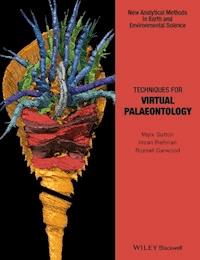
Cover image: “Ventral view of the horseshoe crab Dibasterium durgae Briggs et al. 2012, from the Silurian-aged Herefordshire Lagerstätte, England. Model reconstructed through physical-optical tomography, manual registration, virtual preparation, isosurfacing and ray-tracing, using software packages SPIERS and Blender.” Briggs, D.E.G., Siveter, Derek J., Siveter, David J., Sutton, M.D., Garwood, R.J, & Legg, D. 2012. Silurian horseshoe crab illuminates the evolution of arthropod limbs. P.N.A.S. 109, 15702–15705.
Acknowledgements
We thank Ian Francis (Wiley-Blackwell) for initially approaching MDS to solicit this work, and Delia Sandford and Kelvin Matthews (Wiley-Blackwell) for their assistance in technical matters during its production. The following are thanked for providing suggestions to improve our first drafts: Alex Ball, Karl Bates, Robert Bradley, Jen Bright, Martin Dawson, Kate Dobson, Phil Donoghue, Peter Falkingham, Stephan Lautenschlager, Heinrich Mallison, Maria McNamara, Laura Porro, Paul Shearing and Alex Ziegler. Alan Spencer assisted with photography. We also thank the following for permission to re-use figures or for providing previously unpublished images: Karl Bates, Jason Dunlop, Cornelius Faber, Peter Falkingham, Nicolas Goudemand, Joachim Haug, Jason Hilton, Thomas Kleinteich, Heinrich Mallison, Andrew McNeil, Daniel Mietchen, Susanne Mueller, David Penney, Robert Scott, Leyla Seyfullah, David Wacey, Mark Wilson, Philip J. Withers, Florian Witzmann and Alex Ziegler. IR was funded by a NERC Postdoctoral Research Fellowship (NE/H015817/1). RG was funded by an 1851 Royal Commission Research Fellowship. Finally, we wish to thank our families, partners, friends and institutions for their forbearance with us over the long, cold winter of 2012/13, during which this book has taken shape.
1Introductionand History
Abstract: We define virtual palaeontology as the study of three-dimensional fossils through digital visualizations. This approach can be the only practical means of studying certain fossils, and also brings benefits of convenience, ease of dissemination, and amenability to dissection and mark-up. Associated techniques fundamentally divide into surface-based and tomographic; the latter is a more diverse category, sub-divided primarily into destructive and non-destructive approaches. The history of the techniques is outlined. A long history of physical-optical studies throughout the 20th century predates the true origin of virtual palaeontology in the 1980s. Subsequent development was driven primarily by advances in X-ray computed tomography and computational resources, but has also been supplemented by a range of other technologies.
1.1Introduction
Virtual palaeontology is the study of fossils through interactive digital visualizations, or virtual fossils. This approach involves the use of cutting-edge imaging and computer technologies in order to gain new insights into fossils, thereby enhancing our understanding of the history of life. While virtual palaeontological techniques do exist for handling two-dimensional data (e.g. the virtual lighting approach of Hammer et al. 2002), for most palaeontologists the field is synonymous with the study of three-dimensionally preserved material, and the term is used in this context throughout this book. Note also that the manual construction of idealized virtual models of taxa (e.g. Haug et al. 2012, Fig. 11), while very much a worthwhile undertaking, is not included in the concept of virtual palaeontology followed herein.
The majority of fossils are three-dimensional objects. While compression of fossils onto a genuinely two-dimensional plane does of course occur (Figure 1.1a), it is the exception, and in most preservational scenarios at least an element of the original three-dimensionality is retained (Figure 1.1b). Three-dimensional preservation retains more morphological information than true two-dimensional modes, but typically this information is problematic to extract. Isolation methods, of which several exist, are one solution. Fossils may simply ‘drop out’ or be naturally washed out of rocks; wet-sieving of poorly consolidated sediments mimics this process. Specimens may also be extracted chemically, for example, by dissolving the matrix (e.g. Aldridge 1990). These approaches are effective where applicable, but are prone to losing associations between disarticulated or weakly connected parts of fossils, and to damaging delicate structures. Specimens can also be physically ‘prepared’ out using needles, drills or gas-jet powder abrasive tools (e.g. Whybrow and Lindsay 1990); while usually preserving associations, this approach may also damage delicate structures, scales poorly to small specimens, and cannot always expose all of a specimen. Finally, isolation of a fossil only provides access to its surface.
Lesen Sie weiter in der vollständigen Ausgabe!
Lesen Sie weiter in der vollständigen Ausgabe!
Lesen Sie weiter in der vollständigen Ausgabe!
Lesen Sie weiter in der vollständigen Ausgabe!
Lesen Sie weiter in der vollständigen Ausgabe!
Lesen Sie weiter in der vollständigen Ausgabe!
Lesen Sie weiter in der vollständigen Ausgabe!
Lesen Sie weiter in der vollständigen Ausgabe!




