


104,99 €
Mehr erfahren.
- Herausgeber: John Wiley & Sons
- Kategorie: Wissenschaft und neue Technologien
- Sprache: Englisch
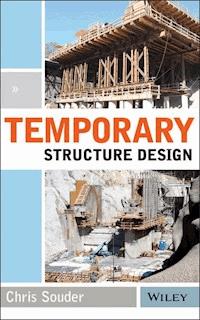
A comprehensive guide to temporary structures in construction projects Temporary Structure Design is the first book of its kind, presenting students and professionals with authoritative coverage of the major concepts in designing temporary construction structures. Beginning with a review of statistics, it presents the core topics needed to fully comprehend the design of temporary structures: strength of materials; types of loads on temporary structures; scaffolding design; soil properties and soil loading; soldier beam, lagging, and tiebacks; sheet piling and strutting; pressure and forces on formwork and falsework; concrete formwork design; falsework; bracing and guying; trestles and equipment bridges; and the support of existing structures. Temporary structures during construction include scaffolding, formwork, shoring, ramps, platforms, earth-retaining structures, and other construction structures that are not part of the permanent installation. These structures are less regulated and monitored than most other parts of the construction process, even though they are often supporting tons of steel or concrete--and the safety of all workers on the site depends on these structures to perform as designed. Unfortunately, most tragic failures occur during construction and are usually the result of improperly designed, constructed, and/or maintained temporary structures. Temporary Structure Design fills an important need in the literature by providing a trusted, comprehensive guide to designing temporary construction structures. * Serves as the first book to provide a design-oriented approach to the design of temporary structures * Includes coverage of the various safety considerations inherent in temporary structure design and construction * Provides information on estimating cost and schedules for these specialized structures * Covers formwork and falsework, as well as personnel protection, production support, environmental protection, and foundational structures If you're a student or a professional working in the field of construction or structural engineering, Temporary Structure Design is a must-have resource you'll turn to again and again.
Sie lesen das E-Book in den Legimi-Apps auf:
Seitenzahl: 562
Veröffentlichungsjahr: 2014
Ähnliche




















Table of Contents
Title Page
Copyright
Dedication
About the Author
Preface
Acknowledgments
Chapter 1: Statics Review
1.1 Statics Review
1.2 Units of Measure
1.3 Statics
Chapter 2: Strength of Materials Review
2.1 Stress
2.2 Bending Moments
2.3 Materials
2.4 Deflection
2.5 Shear and Moment Diagrams
2.6 Beam Design
Chapter 3: Types of Loads on Temporary Structures
3.1 Supports and Connections on Temporary Structures
Chapter 4: Scaffolding Design
4.1 Regulatory
4.2 Types of Scaffolding
4.3 Loading on Scaffolding
4.4 Scaffolding Factors of Safety
4.5 Scaffold Components
4.6 Scaffold Design
Chapter 5: Soil Properties and Soil Loading
5.1 Soil Properties
5.2 Soil Loading
Chapter 6: Soldier Beam, Lagging, and Tiebacks
6.1 System Description and Units of Measure
6.2 Materials
Chapter 7: Sheet Piling and Strutting
7.1 Sheet Piling Basics
Chapter 8: Pressure and Forces on Formwork and Falsework
8.1 Properties of Materials
Chapter 9: Concrete Formwork Design
9.1 General Requirements
9.2 Formwork Design
9.3 Conclusion
Chapter 10: Falsework Design
10.1 Falsework Risks
Chapter 11: Bracing and Guying
11.1 Rebar Bracing and Guying
11.2 Form Bracing with Steel Pipe and Concrete Deadmen
11.3 Rebar Guying on Highway Projects
11.4 Alternate Anchor Method
Chapter 12: Trestles and Equipment Bridges
12.1 Basic Composition of a Standard Trestle
12.2 Other Projects Utilizing Methods of Access
12.3 Conclusion
Chapter 13: Support of Existing Structures
13.1 Basic Building Materials
Appendixes
Appendix 1: Steel Beams (AISC)
Appendix 2: Steel Pipe
Appendix 3: H Pile (AISC)
Appendix 4: Allowable Buckling Stress
Appendix 5: Sheet Pile (Skyline)
Appendix 6: Wood Properties
Appendix 7: Formwork Charts (Williams)
Appendix 8: Form Hardware Values (Williams)
Appendix 9: Aluminum Beams (Aluma)
Index
End User License Agreement
Pages
371
372
373
374
375
376
377
378
379
380
381
382
383
384
385
386
387
388
389
390
391
392
393
394
395
396
397
398
399
400
401
402
403
404
405
406
407
408
409
410
411
412
413
414
415
416
417
418
419
420
421
422
423
424
1
2
3
4
5
6
7
8
9
10
11
12
13
14
15
16
17
18
19
20
21
22
23
24
25
26
27
28
29
30
31
32
33
34
35
36
37
38
39
40
41
42
43
44
45
46
47
48
49
50
51
52
53
54
55
56
57
58
59
60
61
62
63
64
65
66
67
68
69
70
71
72
73
74
75
76
77
78
79
80
81
82
83
84
85
86
87
88
89
90
91
92
93
94
95
96
97
98
99
100
101
102
103
104
105
106
107
108
109
110
111
112
113
114
115
116
117
118
119
120
121
122
123
124
125
126
127
128
129
130
131
132
133
134
135
136
137
138
139
140
141
142
143
144
145
146
147
148
149
150
151
152
153
154
155
156
157
158
159
160
161
162
163
164
165
166
167
168
169
170
171
172
173
174
175
176
177
178
179
180
181
182
183
184
185
186
187
188
189
190
191
192
193
194
195
196
197
198
199
200
201
202
203
204
205
206
207
208
209
210
211
212
213
214
215
216
217
218
219
220
221
222
223
224
225
226
227
228
229
230
231
232
233
234
235
236
237
238
239
240
241
242
243
244
245
246
247
248
249
250
251
252
253
254
255
256
257
258
259
260
261
262
263
264
265
266
267
268
269
270
271
272
273
274
275
276
277
278
279
280
281
282
283
284
285
286
287
288
289
290
291
292
293
294
295
296
297
298
299
300
301
302
303
304
305
306
307
308
309
310
311
312
313
314
315
316
317
318
319
320
321
322
323
324
325
326
327
328
329
330
331
332
333
334
335
336
337
338
339
340
341
342
343
344
345
346
347
348
349
350
351
352
353
354
355
356
357
358
359
360
361
362
363
364
365
366
367
368
425
426
427
428
429
Guide
Cover
Table of Contents
Preface
Begin Reading
List of Illustrations
Figure 1.1
Figure 1.2
Figure 1.3
Figure 1.4
Figure 1.5
Figure 1.6
Figure 1.7
Figure 1.8
Figure 1.9
Figure 1.10
Figure 1.11
Figure 1.12
Figure 1.13
Figure 1.14
Figure 1.15
Figure 1.16
Figure 1.17
Figure 1.18
Figure 1.19
Figure 1.20
Figure 1.21
Figure 1.22
Figure 1.23
Figure 2.1
Figure 2.2
Figure 2.3
Figure 2.4
Figure 2.5
Figure 2.6
Figure 2.7
Figure 2.8
Figure 2.9
Figure 2.10
Figure 2.11
Figure 2.12
Figure 2.13
Figure 2.14
Figure 2.15
Figure 2.16
Figure 2.17
Figure 2.18
Figure 3.1
Figure 3.2
Figure 3.3
Figure 3.4
Figure 3.5
Figure 3.6
Figure 3.7
Figure 3.8
Figure 3.9
Figure 3.10
Figure 3.11
Figure 3.12
Figure 3.14
Figure 3.13
Figure 3.15
Figure 3.16
Figure 3.17
Figure 3.18
Figure 4.1
Figure 4.2
Figure 4.3
Figure 4.4
Figure 4.5
Figure 4.6
Figure 4.7
Figure 4.8
Figure 4.9
Figure 4.10
Figure 4.11
Figure 4.12
Figure 4.13
Figure 4.14
Figure 4.15
Figure 5.1
Figure 5.2
Figure 5.3
Figure 5.4
Figure 5.5
Figure 5.6
Figure 5.7
Figure 5.8
Figure 5.9
Figure 5.10
Figure 5.11
Figure 5.12
Figure 5.13
Figure 5.14
Figure 5.15
Figure 5.16
Figure 5.17
Figure 5.18
Figure 5.19
Figure 5.20
Figure 5.21
Figure 5.22
Figure 5.23
Figure 5.24
Figure 5.25
Figure 5.26
Figure 5.29
Figure 5.27
Figure 6.1
Figure 6.2
Figure 6.3
Figure 6.4
Figure 6.5
Figure 6.6
Figure 6.7
Figure 6.8
Figure 6.9
Figure 6.10
Figure 6.11
Figure 6.12
Figure 6.13
Figure 6.14
Figure 6.15
Figure 6.16
Figure 6.17
Figure 6.18
Figure 6.19
Figure 6.20
Figure 6.21
Figure 6.22
Figure 6.23
Figure 6.24
Figure 6.25
Figure 6.29
Figure 6.CS1
Figure 6.CS2
Figure 7.1
Figure 7.2A
Figure 7.2B
Figure 7.3
Figure 7.4
Figure 7.5
Figure 7.6
Figure 7.7
Figure 7.8
Figure 7.9
Figure 7.10
Figure 7.11
Figure 7.12
Figure 7.13
Figure 7.14
Figure 7.15
Figure 7.16
Figure 7.17
Figure 7.18
Figure 7.19
Figure 7.20
Figure 7.21
Figure 7.22
Figure 7.CS1
Figure 7.CS2
Figure 7.CS3
Figure 8.1
Figure 8.2
Figure 8.3
Figure 8.4
Figure 8.5
Figure 8.6
Figure 8.7
Figure 8.8
Figure 8.9
Figure 8.10
Figure 8.11
Figure 8.12
Figure 8.CS1
Figure 8.CS2
Figure 8.CS3
Figure 8.CS4
Figure 9.1
Figure 9.2
Figure 9.3
Figure 9.4
Figure 9.5
Figure 9.6
Figure 9.7
Figure 9.8
Figure 9.9
Figure 9.10
Figure 9.11
Figure 9.12
Figure 9.13
Figure 9.14
Figure 9.15
Figure 9.16
Figure 9.17
Figure 9.CS1
Figure 9.CS2
Figure 9.CS3
Figure 9.CS4
Figure 9.CS5A
Figure 9.CS5B
Figure 9.CS6
Figure 9.CS7
Figure 9.CS8
Figure 10.1
Figure 10.2
Figure 10.3
Figure 10.4
Figure 10.5
Figure 10.6
Figure 10.7
Figure 10.8
Figure 10.9
Figure 10.10
Figure 10.11
Figure 10.12
Figure 10.13
Figure 10.14
Figure 10.15
Figure 10.16
Figure 10.17
Figure 10.18
Figure 10.CS1
Figure 10.CS2
Figure 10.CS3
Figure 10.CS4
Figure 10.CS5
Figure 10.CS6
Figure 10.CS7
Figure 10.CS8
Figure 10.CS9
Figure 10.CS10
Figure 10.CS11
Figure 10.CS12
Figure 10.CS14
Figure 10.CS15
Figure 11.1
Figure 11.2
Figure 11.3
Figure 11.4
Figure 11.5
Figure 11.6
Figure 11.7
Figure 11.8
Figure 11.9
Figure 11.10
Figure 11.11
Figure 11.12
Figure 11.13
Figure 11.14
Figure 11.15
Figure 11.16
Figure 11.17
Figure 11.18
Figure 11.19
Figure 11.20
Figure 11.21
Figure 11.22
Figure 11.23
Figure 11.24
Figure 11.25
Figure 11.26
Figure 11.27
Figure 11.28
Figure 11.29
Figure 11.CS1
Figure 11.CS2
Figure 11.CS3
Figure 12.1
Figure 12.2
Figure 12.3
Figure 12.4
Figure 12.5
Figure 12.6
Figure 12.7
Figure 12.8
Figure 12.9
Figure 12.10
Figure 12.11
Figure 12.12
Figure 12.13
Figure 12.14
Figure 12.15
Figure 12.16
Figure 12.17
Figure 12.18
Figure 12.19
Figure 12.20
Figure 12.21
Figure 12.22
Figure 12.23
Figure 12.24
Figure 12.25
Figure 12.26
Figure 12.27
Figure 12.28
Figure 12.29
Figure 12.30
Figure 12.31
Figure 12.32
Figure 12.33
Figure 12.34
Figure 12.35
Figure 12.36
Figure 12.37
Figure 12.38
Figure 12.39
Figure 12.40
Figure 12.CS1
Figure 12.CS2
Figure 12.CS3
Figure 12.CS4
Figure 12.CS5
Figure 12.CS6
Figure 12.CS7
Figure 13.1
Figure 13.2
Figure 13.3
Figure 13.4
Figure 13.5
Figure 13.6
Figure 13.7
Figure 13.8
Figure 13.9
Figure 13.10
Figure 13.11
Figure 13.12
Figure 13.13
Figure 13.14
Figure 13.15
Figure 13.16
Figure 13.17
Figure 13.18
Figure 13.19
Figure 13.20
Figure 13.21
Figure 13.22
Figure 13.23
Figure 13.24
Figure 13.CS1
Figure 13.CS2
Figure 13.CS3
Figure 13.CS4
Figure 13.CS5
List of Tables
Table 1.1
Table 1.2
Table 1.3
Table 2.1
Table 2.2
Table 2.3
Table 2.4
Table 2.5
Table 2.6
Table 2.7
Table 2.8
Table 2.9
Table 3.1
Table 3.2
Table 4.1
Table 4.2
Table 4.3
Table 5.1
Table 5.2
Table 5.3
Table 5.4
Table 5.5
Table 5.6
Table 5.7
Table 5.8
Table 6.1
Table 6.2
Table 6.3
Table 6.4
Table 7.1
Table 8.1
Table 8.2
Table 8.3
Table 8.4
Table 9.1
Table 9.2
Table 9.3
Table 9.4
Table 9.5
Table 9.6
Table 9.7
Table 9.8
Table 9.9
Table 9.10
Table 9.11
Table 9.12
Table 9.13
Table 9.14
Table 9.15
Table 9.16
Table 9.17
Table 10.1
Table 10.2
Table 10.3
Table 10.4
Table 11.1
Table 11.2
Table 11.3
Table 11.4
Table 11.5
Table 11.6
Table 11.7
Table 11.8
Table 12.1
Table 12.2
Table 12.3
Table 12.4
Table 12.5
Table 12.6
Table 12.7
Table 12.8
Table 13.1
Table 13.2
Table 13.3
Table 13.4
TEMPORARY STRUCTURE DESIGN
Chris Souder
Cover image: © Chris Souder
Cover design: Wiley
This book is printed on acid-free paper.
Copyright © 2015 by John Wiley & Sons, Inc. All rights reserved
Published by John Wiley & Sons, Inc., Hoboken, New Jersey
Published simultaneously in Canada
No part of this publication may be reproduced, stored in a retrieval system, or transmitted in any form or by any means, electronic, mechanical, photocopying, recording, scanning, or otherwise, except as permitted under Section 107 or 108 of the 1976 United States Copyright Act, without either the prior written permission of the Publisher, or authorization through payment of the appropriate per-copy fee to the Copyright Clearance Center, 222 Rosewood Drive, Danvers, MA 01923, (978) 750-8400, fax (978) 646-8600, or on the web at www.copyright.com. Requests to the Publisher for permission should be addressed to the Permissions Department, John Wiley & Sons, Inc., 111 River Street, Hoboken, NJ 07030, (201) 748-6011, fax (201) 748-6008, or online at www.wiley.com/go/permissions.
Limit of Liability/Disclaimer of Warranty: While the publisher and author have used their best efforts in preparing this book, they make no representations or warranties with the respect to the accuracy or completeness of the contents of this book and specifically disclaim any implied warranties of merchantability or fitness for a particular purpose. No warranty may be created or extended by sales representatives or written sales materials. The advice and strategies contained herein may not be suitable for your situation. You should consult with a professional where appropriate. Neither the publisher nor the author shall be liable for damages arising herefrom.
For general information about our other products and services, please contact our Customer Care Department within the United States at (800) 762-2974, outside the United States at (317) 572-3993 or fax (317) 572-4002.
Wiley publishes in a variety of print and electronic formats and by print-on-demand. Some material included with standard print versions of this book may not be included in e-books or in print-on-demand. If this book refers to media such as a CD or DVD that is not included in the version you purchased, you may download this material at http://booksupport.wiley.com. For more information about Wiley products, visit www.wiley.com.
ISBN 978-1-118-90558-6 (cloth); ISBN 978-1-118-93414-2 (ebk); ISBN 978-1-118-93996-3 (ebk)
I would like to dedicate this book to Stuart (Bart) Bartholomew.
I only knew Bart for 14 years, but in this short time he had more influence on me than most. Not only did Bart design the temporary structure class that this book was designed for, he was instrumental in my decision to change to the teaching profession. Countless breakfast and lunch meetings had me listening in amazement to the years of construction, teaching, and consulting experiences. Bart, you are a model of integrity, honesty, and ethical behavior.
About the Author
Chris Souder graduated with an undergraduate degree in construction management in 1988 before going to work for Kiewit Pacific Co. in northern California. Chris had a successful 16-year career with Kiewit and was involved with many projects in the heavy civil arena. Chris held positions from field engineer to project manager to lead estimator. Some of the projects Chris was involved with were the Woodland WWTP expansion in Woodland, California, Highway 85 Bridge construction for CalTrans in San Jose, California, WWTP Expansion and new facilities for the City of Roseville at its Booth Rd. and Pleasant Grove Plants, Highway 101 Retrofit work for CalTrans in San Francisco, California, new Highway 880 construction of bridge structures for CalTrans in Oakland, California, following the 1989 Loma Prieta earthquake, Water storage facilities for the City of Sacramento, new bridge and 2 miles of road construction including a pump station in Oroville, California, an expansion of the Sacramento River WTP facility for the City of Sacramento, and various estimating assignments for both heavy highway and water treatment facilities throughout northern California. These projects as a whole had total revenues in excess of $420 million.
Chris then pursued an Interdisciplinary Master's degree in construction planning at California State University, Chico, while teaching full time in the construction management program. Today, Chris teaches temporary structures and scheduling and project controls to fourth-year students at Chico State while maintaining a continuous portfolio of consulting projects and industry trainings ranging from cost estimating, temporary structures design, and scheduling services. While teaching, Chris received the terminal degree in construction management by completing his M.S. in construction planning at Chico State. This education, combined with 16 years of heavy civil industry experience makes Chris a most effective type of professor in the construction management discipline.
Preface
Temporary structure design is not taken lightly by the owner, engineer, or contractor. It has and should always be a practice that is performed by a licensed engineer in its specific discipline. However, the construction manager should be versed in the design procedures to a point where he can request a particular design or review a concept or submittal with the ability to understand the basic components of the design.
In 1989, the fourth edition of Simplified Mechanics and Strength of Materials was written. This book is an example of the present book's goal. I was inspired by the simplicity that Parker and Ambrose displayed in their text. I truly believe that this subject can be well understood by the construction manager without the ultimate goal of becoming a licensed engineer. However, if that is the goal of the student, this text will prepare you to take the next step in engineering pursuing your goal to be licensed.
There is a need for this topic in a construction management (CM) degree, both undergraduate and graduate, civil engineering (CE), both under graduate and graduate, or in industry that is simplified enough that the student, intern, or engineer can simply follow the major concepts without sacrificing key engineering principles. Different universities approach the temporary structures topic in several ways. Some, like Chico State, make it the culminating experience following statics and mechanics. This text will compliment a similar program. Others teach a “structure” class that gives the students a basic understanding of how structures are designed. The latter focuses more on permanent design. Many civil engineering students graduate and go on to work for state agencies or heavy civil contractors. Both of these careers rely heavily on the design of temporary structures. With the state agency, one will be reviewing and inspecting temporary structures. With the contractor, one will be involved with helping design and building temporary structures. These two paths are very rewarding for a CM or CE undergraduate or graduate student.
I also wanted students of temporary structures to be able to comprehend the more complicated analysis that come with more difficult loading conditions without the need for a complete understanding or need for indeterminate structure analysis. I want the student to be aware of the available software on the market today that can simplify even the most complicated loading condition.
I also thought it was important that the student or engineer of this subject be able to understand and perform simple cost estimates of the designs that are explained in each chapter. Most chapters have brief explanations of cost analyses so the educated decisions can be made during the design phase.
Acknowledgments
To Jessica, Jason and Devon, thank you for putting up with me through this life of construction. To my brothers Greg and Mike, Greg for encouraging me to go into a construction management program and Mike for his constant support. To my parents, Dick and Ines Souder for your constant support, even if you really don't know what I do for a living.
To Robert Towne and Ruth Younger for your hours of assistance to the manuscript.
To Valentina Pozin and Don Hamann for your sound engineering advise and “hand holding.”
To the following industry folks and colleagues:
Jim Dick
Steve Floyd
Howard Mattfield
Jim Cole
Dan Collins
Jon Re
Dave Mitchell
Clint Cole
Ken Riley
Dave Jack
Dan Griffin
Shawn Drobny
Brad Kaufman
Bill Cooke
Matt Halleen
Dan Munson
Dave Hazen
Rovane Younger
Bruce Yoakum
Lee Cushman
for your contributions, advice, and case study assistance.
To the following companies:
Kiewit
Traylor Bros.
Golden State Bridge
Cushman Contractors Inc.
Flatiron Corporation
Pankow Builders, LTD
for your case study contributions.
I thank you all.
Chapter 1Statics Review
1.1 Statics Review
In construction management and civil engineering programs, students are required to take statics and strength of material classes in preparation for their successor. The successor might be a generic “structures” course, a temporary structure course, or maybe no successor course at all. Whichever direction the curriculum goes, the basics of statics and strength of materials is the common denominator.
This book has been written under the assumption that the student has a background in statics and strength of materials and these skills only need to be refined. Temporary structures utilizes many of the less complicated aspects of statics and strength of materials, so even if the student did not master the two prerequisites, he should still be successful in the subject matter of this book. In addition, temporary structure design is a very practical subject, and the student should be energized to see that the challenges that this book covers are real construction situations that the student will experience for his or her entire career.
1.2 Units of Measure
At the time of this writing, local and state projects in the United States continue to use the English “Imperial” unit system (feet, pounds, etc.). While most of Europe and the rest of the world use the metric system, the United States has resisted this movement. Even the California Department of Transportation, which had converted current and future projects to the Imperial system of measures late in the 20th century, has gone back to using the Imperial system in the early 21st century. Since England has also gone to the metric system, their “English” Imperial system is now referred to as the U.S. units. Because this text has been written for students in the United States, examples will be given in U.S. units only. shows most of the common units of measure used in this book.
Lesen Sie weiter in der vollständigen Ausgabe!
Lesen Sie weiter in der vollständigen Ausgabe!
Lesen Sie weiter in der vollständigen Ausgabe!
Lesen Sie weiter in der vollständigen Ausgabe!
Lesen Sie weiter in der vollständigen Ausgabe!
Lesen Sie weiter in der vollständigen Ausgabe!
Lesen Sie weiter in der vollständigen Ausgabe!
Lesen Sie weiter in der vollständigen Ausgabe!
Lesen Sie weiter in der vollständigen Ausgabe!
Lesen Sie weiter in der vollständigen Ausgabe!
Lesen Sie weiter in der vollständigen Ausgabe!
Lesen Sie weiter in der vollständigen Ausgabe!
Lesen Sie weiter in der vollständigen Ausgabe!
Lesen Sie weiter in der vollständigen Ausgabe!
Lesen Sie weiter in der vollständigen Ausgabe!
Lesen Sie weiter in der vollständigen Ausgabe!
Lesen Sie weiter in der vollständigen Ausgabe!
Lesen Sie weiter in der vollständigen Ausgabe!
Lesen Sie weiter in der vollständigen Ausgabe!
Lesen Sie weiter in der vollständigen Ausgabe!
Lesen Sie weiter in der vollständigen Ausgabe!
Lesen Sie weiter in der vollständigen Ausgabe!
Lesen Sie weiter in der vollständigen Ausgabe!
Lesen Sie weiter in der vollständigen Ausgabe!
Lesen Sie weiter in der vollständigen Ausgabe!




