


7,49 €
Mehr erfahren.
- Herausgeber: Open Book Publishers
- Kategorie: Wissenschaft und neue Technologien
- Sprache: Englisch
Terrestrial Mammal Conservation provides a thorough summary of the available scientific evidence of what is known, or not known, about the effectiveness of all of the conservation actions for wild terrestrial mammals across the world (excluding bats and primates, which are covered in separate synopses). Actions are organized into categories based on the International Union for Conservation of Nature classifications of direct threats and conservation actions. Over the course of fifteen chapters, the authors consider interventions as wide ranging as creating uncultivated margins around fields, prescribed burning, setting hunting quotas and removing non-native mammals.
This book is written in an accessible style and is designed to be an invaluable resource for anyone concerned with the practical conservation of terrestrial mammals.
The authors consulted an international group of terrestrial mammal experts and conservationists to produce this synopsis. Funding was provided by the MAVA Foundation, Arcadia and National Geographic Big Cats Initiative.
Terrestrial Mammal Conservation is the seventeenth publication in the Conservation Evidence Series, linked to the online resource www.ConservationEvidence.com. Conservation Evidence Synopses are designed to promote a more evidence-based approach to biodiversity conservation. Others in the series include Bat Conservation, Primate Conservation, Bird Conservation and Forest Conservation and more are in preparation. Expert assessment of the evidence summarised within synopses is provided online and within the annual publication What Works in Conservation.
Das E-Book können Sie in Legimi-Apps oder einer beliebigen App lesen, die das folgende Format unterstützen:
Veröffentlichungsjahr: 2020
Ähnliche



















Terrestrial Mammal Conservation
Terrestrial Mammal Conservation
Global evidence for the effects of interventions for terrestrial mammals excluding bats and primates
Conservation Evidence Series Synopses University of Cambridge, Cambridge, UK
Nick A. Littlewood, Ricardo Rocha, Rebecca K. Smith, Philip A. Martin, Sarah L. Lockhart, Rebecca F. Schoonover, Elspeth Wilman, Andrew J. Bladon, Katie A. Sainsbury, Stuart Pimm and William J. Sutherland
https://www.openbookpublishers.com
© 2020 Littlewood, N.A., Rocha, R., Smith, R.K., Sutherland W.J. et al.
This work is licensed under a Creative Commons Attribution 4.0 International license (CC BY 4.0). This license allows you to share, copy, distribute and transmit the text; to adapt the text and to make commercial use of the text providing attribution is made to the authors (but not in any way that suggests that they endorse you or your use of the work). Attribution should include the following information:
N.A. Littlewood, R. Rocha, R.K. Smith, W.J. Sutherland et al., Terrestrial Mammal Conservation: Global evidence for the effects of interventions for terrestrial mammals excluding bats and primates. Synopses of Conservation Evidence Series, University of Cambridge (Cambridge, UK: Open Book Publishers, 2020), https://doi.org/10.11647/OBP.0234
In order to access detailed and updated information on the license, please visit, https://doi.org/10.11647/OBP.0234#copyright
Further details about CC BY licenses are available at https://creativecommons.org/licenses/by/4.0/
All external links were active at the time of publication unless otherwise stated and have been archived via the Internet Archive Wayback Machine at https://archive.org/web
Updated digital material and resources associated with this volume are available at https://doi.org/10.11647/OBP.0234#resources
Every effort has been made to identify and contact copyright holders and any omission or error will be corrected if notification is made to the publisher.
ISBN Paperback: 9781800640832
ISBN Hardback: 9781800640849
ISBN Digital (PDF): 9781800640856
ISBN Digital ebook (epub): 9781800640863
ISBN Digital ebook (mobi): 9781800640870
ISBN XML: 9781800640887
DOI: 10.11647/OBP.0234
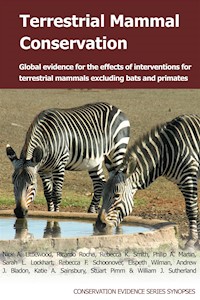
Cover image: Cape mountain zebra (Equus zebra zebra), De Hoop Nature Reserve, South Africa. Photograph by Rebecca K. Smith, CC-BY.
Cover design by Anna Gatti.
Contents
Advisory Board
xxi
About the authors
xxiii
Acknowledgements
xxv
1.
About this book
1
The Conservation Evidence project
1
The purpose of Conservation Evidence synopses
2
Who this synopsis is for
2
Background
3
Scope of the Terrestrial Mammal Conservation synopsis
4
Review subject
4
Advisory board
5
Creating the list of interventions
5
Methods
6
Literature searches
6
Publication screening and inclusion criteria
10
Study quality assessment & critical appraisal
14
Data extraction
15
Evidence synthesis
15
Dissemination/communication of evidence synthesis
20
How you can help to change conservation practice
20
References
20
2.
Threat: Residential and commercial development
23
2.1.
Protect mammals close to development areas (e.g. by fencing)
24
2.2.
Keep cats indoors or in outside runs to reduce predation of wild mammals
24
2.3.
Use collar-mounted devices to reduce predation by domestic animals
25
2.4.
Keep dogs indoors or in outside enclosures to reduce threats to wild mammals
29
2.5.
Keep domestic cats and dogs well-fed to reduce predation of wild mammals
30
2.6.
Translocate problem mammals away from residential areas (e.g. habituated bears) to reduce human-wildlife conflict
30
2.7.
Issue enforcement notices to deter use of non-bear-proof garbage dumpsters to reduce human-wildlife conflict
38
2.8.
Prevent mammals accessing potential wildlife food sources or denning sites to reduce nuisance behaviour and human-wildlife conflict
39
2.9.
Provide diversionary feeding for mammals to reduce nuisance behaviour and human-wildlife conflict
41
2.10.
Scare or otherwise deter mammals from human- occupied areas to reduce human-wildlife conflict
44
2.11.
Retain wildlife corridors in residential areas
50
2.12.
Install underpasses beneath ski runs
51
2.13.
Provide woody debris in ski run area
53
3.
Threat: Agriculture and aquaculture
55
All farming systems
55
3.1.
Establish wild flower areas on farmland
55
3.2.
Create uncultivated margins around intensive arable or pasture fields
58
3.3.
Provide or retain set-aside areas on farmland
64
3.4.
Maintain/restore/create habitat connectivity on farmland
68
3.5.
Manage hedgerows to benefit wildlife on farmland
68
3.6.
Plant new or maintain existing hedgerows on farmland
69
3.7.
Plant trees on farmland
71
3.8.
Pay farmers to cover the costs of conservation measures
74
3.9.
Provide refuges during crop harvesting or mowing
77
3.10.
Use repellent on slug pellets to reduce non-target poisoning
78
3.11.
Restrict use of rodent poisons on farmland with high secondary poisoning risk
79
Annual & Perennial Non-Timber Crops
80
3.12.
Increase crop diversity for mammals
80
3.13.
Create beetle banks on farmland
80
3.14.
Plant crops to provide supplementary food for mammals
82
3.15.
Change mowing regime (e.g. timing, frequency, height)
85
3.16.
Leave areas of uncut ryegrass in silage field
85
3.17.
Leave cut vegetation in field to provide cover
86
3.18.
Establish long-term cover on erodible cropland
87
Livestock Farming & Ranching
88
3.19.
Exclude livestock from semi-natural habitat (including woodland)
88
3.20.
Reduce intensity of grazing by domestic livestock
94
3.21.
Use livestock fences that are permeable to wildlife
102
3.22.
Install mammal crossing points along fences on farmland
103
3.23.
Use traditional breeds of livestock
106
3.24.
Change type of livestock
108
Reduce human-wildlife conflict
110
3.25.
Relocate local pastoralist communities to reduce human-wildlife conflict
110
3.26.
Pay farmers to compensate for losses due to predators/wild herbivores to reduce human-wildlife conflict
111
3.27.
Install non-electric fencing to exclude predators or herbivores and reduce human-wildlife conflict
114
3.28.
Install electric fencing to reduce predation of livestock by mammals to reduce human-wildlife conflict
120
3.29.
Exclude wild mammals using ditches, moats, walls or other barricades to reduce human-wildlife conflict
126
3.30.
Use flags to reduce predation of livestock by mammals to reduce human-wildlife conflict
128
3.31.
Use visual deterrents (e.g. scarecrows) to deter predation of livestock by mammals to reduce human-wildlife conflict
132
3.32.
Use pheromones to deter predation of livestock by mammals to reduce human-wildlife conflict
134
3.33.
Use taste-aversion to reduce predation of livestock by mammals to deter human-wildlife conflict
134
3.34.
Dispose of livestock carcasses to deter predation of livestock by mammals to reduce human-wildlife conflict
140
3.35.
Use guardian animals (e.g. dogs, llamas, donkeys) bonded to livestock to deter predators to reduce human-wildlife conflict
141
3.36.
Use loud noises to deter predation of livestock by mammals to reduce human-wildlife conflict
148
3.37.
Translocate predators away from livestock to reduce human-wildlife conflict
151
3.38.
Provide diversionary feeding to reduce predation of livestock by mammals to reduce human-wildlife conflict
158
3.39.
Keep livestock in enclosures to reduce predation by mammals to reduce human-wildlife conflict
160
3.40.
Install electric fencing to protect crops from mammals to reduce human-wildlife conflict
161
3.41.
Install metal grids at field entrances to prevent mammals entering to reduce human-wildlife conflict
168
3.42.
Install automatically closing gates at field entrances to prevent mammals entering to reduce human-wildlife conflict
170
3.43.
Use tree nets to deter wild mammals from fruit crops to reduce human-wildlife conflict
171
3.44.
Deter predation of livestock by mammals by having people close by to reduce human-wildlife conflict
172
3.45.
Deter predation of livestock by herding livestock using adults instead of children to reduce human- wildlife conflict
173
3.46.
Deter predation of livestock by using shock/electronic dog-training collars to reduce human-wildlife conflict
174
3.47.
Fit livestock with protective collars to reduce risk of predation by mammals to reduce human-wildlife conflict
178
3.48.
Use lights and sound to deter predation of livestock by mammals to reduce human-wildlife conflict
180
3.49.
Use scent to deter predation of livestock by mammals to reduce human-wildlife conflict
182
3.50.
Use watchmen to deter crop damage by mammals to reduce human-wildlife conflict
185
3.51.
Use mobile phone communications to warn farmers of problematic mammals (e.g. elephants)
185
3.52.
Use fencing/netting to reduce predation of fish stock by mammals to reduce human-wildlife conflict
186
3.53.
Establish deviation ponds in fish farms to reduce predation of fish stock by mammals to reduce human-wildlife conflict
187
3.54.
Use lights and sound to deter crop damage by mammals to reduce human-wildlife conflict
188
3.55.
Provide diversionary feeding to reduce crop damage by mammals to reduce human-wildlife conflict
190
3.56.
Use scarecrows to deter crop damage by mammals to reduce human-wildlife conflict
194
3.57.
Use loud noises to deter crop damage (e.g. banger sticks, drums, tins, iron sheets) by mammals to reduce human-wildlife conflict
194
3.58.
Use noise aversive conditioning to deter crop damage by mammals to reduce human-wildlife conflict
201
3.59.
Use ultrasonic noises to deter crop damage by mammals to reduce human-wildlife conflict
202
3.60.
Use drones to deter crop damage by mammals to reduce human-wildlife conflict
204
3.61.
Translocate crop raiders away from crops (e.g. elephants) to reduce human-wildlife conflict
205
3.62.
Use negative stimuli to deter consumption of livestock feed by mammals to reduce human-wildlife conflict
207
3.63.
Play predator calls to deter crop damage by mammals to reduce human-wildlife conflict
209
3.64.
Use target species distress calls or signals to deter crop damage by mammals to reduce human-wildlife conflict
209
3.65.
Use bees to deter crop damage by mammals (e.g. elephants) to reduce human-wildlife conflict
213
3.66.
Grow unattractive crop in buffer zone around crops (e.g. chili peppers) to reduce human-wildlife conflict
215
3.67.
Use chili to deter crop damage by mammals to reduce human-wildlife conflict
216
3.68.
Use light/lasers to deter crop damage by mammals to reduce human-wildlife conflict
221
3.69.
Use fire to deter crop damage by mammals to reduce human-wildlife conflict
223
3.70.
Use pheromones to deter crop damage by mammals to reduce human-wildlife conflict
225
3.71.
Use predator scent to deter crop damage by mammals to reduce human-wildlife conflict
225
3.72.
Use target species scent to deter crop damage by mammals to reduce human-wildlife conflict
228
3.73.
Use ‘shock collars’ to deter crop damage by mammals to reduce human-wildlife conflict
229
3.74.
Use repellents that taste bad (‘contact repellents’) to deter crop or property damage by mammals to reduce human-wildlife conflict
231
3.75.
Use repellents that smell bad (‘area repellents’) to deter crop or property damage by mammals to reduce human-wildlife conflict
238
3.76.
Use dogs to guard crops to reduce human-wildlife conflict
240
3.77.
Drive wild animals away using domestic animals of the same species to reduce human-wildlife conflict
241
4.
Threat: Energy production and mining
243
4.1.
Restore former mining sites
243
4.2.
Use electric fencing to deter mammals from energy installations or mines
251
4.3.
Use repellents to reduce cable gnawing
252
4.4.
Translocate mammals away from sites of proposed energy developments
254
5.
Threat: Transportation and service corridors
257
Roads & Railroads
258
5.1.
Install tunnels/culverts/underpass under roads
258
5.2.
Install tunnels/culverts/underpass under railways
273
5.3.
Modify culverts to make them more accessible to mammals
278
5.4.
Install ledges in culverts under roads/railways
279
5.5.
Dig trenches around culverts under roads/railways
282
5.6.
Install fences around existing culverts or underpasses under roads/railways
282
5.7.
Install overpasses over roads/railways
287
5.8.
Install pole crossings for gliders/flying squirrels
299
5.9.
Install rope bridges between canopies
304
5.10.
Install one-way gates or other structures to allow wildlife to leave roadways
310
5.11.
Install barrier fencing along roads
315
5.12.
Install barrier fencing and underpasses along roads
323
5.13.
Install barrier fencing along railways
355
5.14.
Install wildlife warning reflectors along roads
356
5.15.
Install acoustic wildlife warnings along roads
365
5.16.
Install wildlife crosswalks
367
5.17.
Install wildlife exclusion grates/cattle grids
368
5.18.
Reduce legal speed limit
370
5.19.
Install traffic calming structures to reduce speeds
372
5.20.
Modify vegetation along roads to reduce collisions with mammals by enhancing visibility for drivers
373
5.21.
Modify the roadside environment to reduce collisions by reducing attractiveness of road verges to mammals
374
5.22.
Remove roadkill regularly to reduce kill rate of predators/scavengers
376
5.23.
Modify vegetation along railways to reduce collisions by reducing attractiveness to mammals
376
5.24.
Retain/maintain road verges as small mammal habitat
378
5.25.
Fit vehicles with ultrasonic warning devices
379
5.26.
Install signage to warn motorists about wildlife presence
382
5.27.
Use road lighting to reduce vehicle collisions with mammals
387
5.28.
Use chemical repellents along roads or railways
389
5.29.
Use alternative de-icers on roads
393
5.30.
Provide food/salt lick to divert mammals from roads or railways
394
5.31.
Use reflective collars or paint on mammals to reduce collisions with road vehicles
397
5.32.
Use wildlife decoy to reduce vehicle collisions with mammals
397
5.33.
Close roads in defined seasons
398
Utility & Service Lines
399
5.34.
Install crossings over/under pipelines
399
Shipping Lanes
402
5.35.
Install overpasses over waterways
402
5.36.
Install barrier fencing along waterways
404
5.37.
Provide mammals with escape routes from canals
404
6.
Threat: Biological resource use
409
Hunting & Collecting Terrestrial Animals
409
6.1.
Prohibit or restrict hunting of a species
409
6.2.
Ban private ownership of hunted mammals
412
6.3.
Site management for target mammal species carried out by field sport practitioners
413
6.4.
Set hunting quotas based on target species population trends
414
6.5.
Prohibit or restrict hunting of particular sex/ breeding status/age animals
417
6.6.
Incentivise species protection through licensed trophy hunting
419
6.7.
Use selective trapping methods in hunting activities
420
6.8.
Use wildlife refuges to reduce hunting impacts
421
6.9.
Provide/increase anti-poaching patrols
423
6.10.
Make introduction of non-native mammals for sporting purposes illegal
427
6.11.
Commercially breed for the mammal production trade
428
6.12.
Promote sustainable alternative livelihoods
429
6.13.
Promote mammal-related ecotourism
429
6.14.
Ban exports of hunting trophies
430
Logging & Wood Harvesting
432
6.15.
Use selective harvesting instead of clearcutting
432
6.16.
Use patch retention harvesting instead of clearcutting
437
6.17.
Retain undisturbed patches during thinning operations
440
6.18.
Clear or open patches in forests
442
6.19.
Retain dead trees after uprooting
445
6.20.
Use thinning of forest instead of clearcutting
446
6.21.
Remove competing vegetation to allow tree establishment in clearcut areas
448
6.22.
Retain understorey vegetation within plantations
450
6.23.
Leave standing deadwood/snags in forests
452
6.24.
Leave coarse woody debris in forests
453
6.25.
Gather coarse woody debris into piles after felling
456
6.26.
Retain riparian buffer strips during timber harvest
458
6.27.
Retain wildlife corridors in logged areas
459
6.28.
Thin trees within forest
461
6.29.
Apply fertilizer to trees
469
6.30.
Fell trees in groups, leaving surrounding forest unharvested
472
6.31.
Coppice trees
474
6.32.
Allow forest to regenerate naturally following logging
475
6.33.
Harvest timber outside mammal reproduction period
477
6.34.
Control firewood collection in remnant native forest and woodland
477
6.35.
Plant trees following clearfelling
478
6.36.
Use tree tubes/small fences/cages to protect individual trees
479
6.37.
Provide supplementary feed to reduce tree damage
480
7.
Threat: Human intrusions and disturbance
483
7.1.
Use signs or access restrictions to reduce disturbance to mammals
483
7.2.
Set minimum distances for approaching mammals
484
7.3.
Set maximum number of people/vehicles approaching mammals
485
7.4.
Exclude or limit number of visitors to reserves or protected areas
486
7.5.
Provide paths to limit extent of disturbance to mammals
489
7.6.
Use voluntary agreements with locals to reduce disturbance
490
7.7.
Habituate mammals to visitors
491
7.8.
Translocate mammals that have habituated to humans (e.g. bears)
492
7.9.
Treat mammals to reduce conflict caused by disease transmission to humans
494
7.10.
Use conditioned taste aversion to reduce human-wildlife conflict in non-residential sites
496
7.11
Use non-lethal methods to deter carnivores from attacking humans
498
8.
Threat: Natural system modifications
505
8.1.
Use prescribed burning
505
8.2.
Burn at specific time of year
524
8.3.
Provide shelter structures after fire
526
8.4.
Thin trees to reduce wildfire risk
527
8.5.
Remove burnt trees and branches after wildfire
530
8.6.
Remove mid-storey vegetation in forest
531
8.7.
Remove understorey vegetation in forest
533
8.8.
Remove trees and shrubs to recreate open areas of land
535
8.9.
Provide artificial waterholes in dry season
537
8.10.
Use fencing to protect water sources for use by wild mammals
540
8.11.
Provide supplementary food after fire
540
9.
Threat: Invasive alien and other problematic species
543
9.1.
Use fencing to exclude grazers or other problematic species
543
9.2.
Use fencing to exclude predators or other problematic species
546
Invasive Non-Native/Alien Species/Diseases
553
9.3.
Remove/control non-native amphibians (e.g. cane toads)
553
9.4.
Remove/control non-native invertebrates
554
9.5.
Remove/control non-native mammals
555
9.6.
Remove/control non-native mammals within a fenced area
571
9.7.
Remove/control non-native plants
573
9.8.
Control non-native/problematic plants to restore habitat
575
9.9.
Reintroduce top predators to suppress and reduce the impacts of smaller non-native predator and prey species
575
9.10.
Control non-native prey species to reduce populations and impacts of non-native predators
576
9.11.
Provide artificial refuges for prey to evade/escape non-native predators
577
9.12.
Remove/control non-native species that could interbreed with native species
578
9.13.
Modify traps used in the control/eradication of non- native species to avoid injury of non-target mammal
579
9.14.
Use conditioned taste aversion to prevent non-target species from entering traps
580
9.15.
Use reward removal to prevent non-target species from entering traps
582
Problematic Native Species/Diseases
583
9.16.
Remove or control predators
583
9.17.
Sterilize predators
590
9.18.
Remove or control competitors
591
9.19.
Provide diversionary feeding for predators
593
9.20.
Sterilise non-native domestic or feral species (e.g. cats and dogs)
593
9.21.
Train mammals to avoid problematic species
596
9.22.
Treat disease in wild mammals
598
9.23.
Use vaccination programme
600
9.24.
Eliminate highly virulent diseases early in an epidemic by culling all individuals (healthy and infected) in a defined area
605
9.25.
Cull disease-infected animals
606
9.26.
Use drugs to treat parasites
608
9.27.
Establish populations isolated from disease
613
9.28.
Control ticks/fleas/lice in wild mammal populations
615
10.
Threat: Pollution
619
10.1.
Reduce pesticide or fertilizer use
619
10.2.
Leave headlands in fields unsprayed
622
10.3.
Establish riparian buffers
623
10.4.
Translocate mammals away from site contaminated by oil spill
624
11.
Threat: Climate change and severe weather
627
11.1.
Retain/provide migration corridors
627
11.2.
Protect habitat along elevational gradients
628
11.3
Translocate animals from source populations subject to similar climatic conditions
629
11.4.
Provide dams/water holes during drought
630
11.5.
Apply water to vegetation to increase food availability during drought
631
11.6.
Remove flood water
632
12.
Habitat protection
635
12.1.
Legally protect habitat for mammals
635
12.2.
Encourage habitat protection of privately-owned land
640
12.3.
Build fences around protected areas
641
12.4.
Retain buffer zones around core habitat
643
12.5.
Increase size of protected area
644
12.6.
Increase resources for managing protected areas
645
13.
Habitat restoration and creation
647
13.1.
Remove topsoil that has had fertilizer added to mimic low nutrient soil
647
13.2.
Manage vegetation using livestock grazing
648
13.3.
Manage vegetation using grazing by wild herbivores
652
13.4.
Replant vegetation
654
13.5.
Remove vegetation by hand/machine
654
13.6.
Remove vegetation using herbicides
666
13.7.
Restore or create grassland
670
13.8.
Restore or create savannas
673
13.9.
Restore or create shrubland
675
13.10.
Restore or create forest
677
13.11.
Restore or create wetlands
681
13.12.
Manage wetland water levels for mammal species
684
13.13.
Create or maintain corridors between habitat patches
685
13.14.
Apply fertilizer to vegetation to increase food availability
688
13.15.
Provide artificial refuges/breeding sites
689
13.16.
Provide artificial dens or nest boxes on trees
695
13.17.
Provide more small artificial breeding sites rather than fewer large sites
710
14.
Species management
713
14.1.
Cease/reduce payments to cull mammals
713
14.2.
Temporarily hold females and offspring in fenced area to increase survival of young
715
14.3.
Rehabilitate injured, sick or weak mammals
715
14.4.
Hand-rear orphaned or abandoned young in captivity
723
14.5.
Place orphaned or abandoned wild young with wild foster parents
727
14.6.
Place orphaned or abandoned wild young with captive foster parents
730
14.7.
Provide supplementary food to increase reproduction/survival
732
14.8.
Provide supplementary water to increase reproduction/survival
747
14.9.
Graze herbivores on pasture, instead of sustaining with artificial foods
752
Translocate Mammals
753
14.10.
Translocate to re-establish or boost populations in native range
753
14.11.
Translocate mammals to reduce overpopulation
788
14.12.
Translocate predators for ecosystem restoration
790
14.13.
Use holding pens at release site prior to release of translocated mammals
792
14.14.
Hold translocated mammals in captivity before release
814
14.15.
Use tranquillizers to reduce stress during translocation
824
14.16.
Airborne translocation of mammals using parachutes
825
14.17.
Release translocated mammals into fenced areas
826
14.18.
Provide supplementary food during/after release of translocated mammals
842
Captive-breeding
854
14.19.
Breed mammals in captivity
854
14.20.
Place captive young with captive foster parents
857
14.21.
Use artificial insemination
859
14.22.
Clone rare species
861
14.23.
Preserve genetic material for use in future captive breeding programs
863
Release captive-bred mammals
865
14.24.
Release captive-bred individuals to re-establish or boost populations in native range
865
14.25.
Captive rear in large enclosures prior to release
882
14.26.
Use holding pens at release site prior to release of captive-bred mammals
885
14.27.
Provide live natural prey to captive mammals to foster hunting behaviour before release
904
14.28.
Train captive-bred mammals to avoid predators
907
14.29.
Release captive-bred mammals into fenced areas
909
14.30.
Provide supplementary food during/after release of captive-bred mammals
919
Release captive-bred/translocated mammals
929
14.31.
Release translocated/captive-bred mammals in areas with invasive/problematic species eradication/control
929
14.32.
Release translocated/captive-bred mammals to islands without invasive predators
945
14.33.
Release translocated/captive-bred mammals in family/social groups
950
14.34.
Release translocated/captive-bred mammals in larger unrelated groups
967
14.35.
Release translocated/captive-bred mammals into area with artificial refuges/breeding sites
972
14.36.
Release translocated/captive-bred mammals at a specific time (e.g. season, day/night)
984
14.37.
Release translocated/captive-bred mammals to areas outside historical range
989
15.
Education and awareness raising
995
15.1.
Encourage community-based participation in land management
995
15.2.
Use campaigns and public information to improve behaviour towards mammals and reduce threats
997
15.3.
Provide education programmes to improve behaviour towards mammals and reduce threats
999
15.4.
Provide science-based films, radio programmes, or books about mammals to improve behaviour towards mammals and reduce threats
1002
15.5.
Train and support local staff to help reduce persecution of mammals
1003
15.6.
Publish data on ranger performance to motivate increased anti-poacher efforts
1004
Appendix 1: Journals (and years) searched
1007
Index
1017
Advisory Board
We thank the following people for advising on the scope and content of this synopsis:
Esteban Brenes-Mora, Nai Conservation, Costa Rica
Steve Carter, Vincent Wildlife Trust, UK
Marco Festa-Bianchet, Université de Sherbrooke, Canada
José F. González-Maya, PROCAT Colombia/Internacional, Colombia
Clara Grilo, CDV — Transport Research Centre, Czech Republic
Menna Jones, Australian Mammal Society & University of Tasmania, Australia
Ros Kennerley, Durrell Conservation Trust,
Fiona Mathews, University of Sussex & The Mammal Society, UK
Nyumba Tobias Ochieng, University of Nairobi & African Conservation Centre, Kenya
Michela Pacifici, Sapienza University of Rome, Italy
Sara Roque, Iberian Wolf Research Team, Portugal
Miguel Rosalino, University of Lisbon, Portugal
Laurentiu Rozylowicz, University of Bucharest, Romania
About the authors
Nick Littlewood was a Research Associate in the Department of Zoology, University of Cambridge, UK and is now a Lecturer at SRUC (Scotland’s Rural College), UK.
Ricardo Rocha was a Research Associate in the Department of Zoology, University of Cambridge, UK and is now a Post-doctoral Researcher at the University of Porto, Portugal.
Rebecca K. Smith is a Senior Research Associate in the Department of Zoology, University of Cambridge, UK.
Philip Martin is a Research Associate in the Department of Zoology, University of Cambridge, UK.
Sarah Lockhart was a Master’s student at the Nicholas School of the Environment, Duke University, USA and is now a doctoral student and research assistant at the Center for Landscape Conservation Planning, University of Florida, USA.
Rebecca F. Schoonover was a Research Associate at Nicholas School of the Environment, Duke University, USA and is now a Brand Director.
Elspeth Wilman was a Master’s student at Duke University, USA and is now a PhD Candidate at the University of Hong Kong.
Andrew J. Bladon is a Research Associate in the Department of Zoology, University of Cambridge, UK.
Katie A. Sainsbury is a Research Associate in the Department of Zoology, University of Cambridge, UK.
Stuart Pimm is the Doris Duke Chair of Conservation at the Nicholas School of the Environment, Duke University, USA.
William J. Sutherland is the Miriam Rothschild Professor of Conservation Biology at the University of Cambridge, UK.
Acknowledgements
This synopsis was made possible with funding from the MAVA Foundation, Arcadia and National Geographic Big Cats Initiative.
We would also like to thank Anna Berthinussen, William Morgan, Kate Willott and all others who contributed and provided help and advice.
1. About this book
© Book Authors, CC BY 4.0 https://doi.org/10.11647/OBP.0234.01
The Conservation Evidence project
The Conservation Evidence project has four main parts:
The
synopses
of the evidence captured for the conservation of particular species groups or habitats, such as this synopsis. Synopses bring together the evidence for each possible intervention. They are freely available online and, in some cases, available to purchase in printed book form.
An ever‐expanding
database of summaries
of previously published scientific papers, reports, reviews or systematic reviews that document the effects of interventions. This resource comprises over 6,616 pieces of evidence, all available in a searchable database on the website
www.conservationevidence.com
.
What Works in Conservation,
which is an assessment of the effectiveness of interventions by expert panels, based on the collated evidence for each intervention for each species group or habitat covered by our synopses. This is available as part of the searchable database and is published as an updated book edition each year (
www.conservationevidence.com/content/page/79
).
An online,
open access journal:
Conservation Evidence
publishes new pieces of research on the effects of conservation management interventions. All our papers are written by, or in conjunction with, those who carried out the conservation work and include some monitoring of its effects (
http://conservationevidencejournal.com/
).
The purpose of Conservation Evidence synopses
Conservation Evidence synopses do
Conservation Evidence synopses do not
Bring together scientific evidence captured by the Conservation Evidence project (over 6,616 studies so far) on the effects of interventions to conserve biodiversity
Include evidence on the basic ecology of species or habitats, or threats to them
List all realistic interventions for the species group or habitat in question, regardless of how much evidence for their effects is available
Make any attempt to weight or prioritize interventions according to their importance or the size of their effects
Describe each piece of evidence, including methods, as clearly as possible, allowing readers to assess the quality of evidence
Weight or numerically evaluate the evidence according to its quality
Work in partnership with conservation practitioners, policymakers and scientists to develop the list of interventions and ensure we have covered the most important literature
Provide recommendations for conservation problems, but instead provide scientific information to help with decision-making
Who this synopsis is for
If you are reading this, we hope you are someone who has to make decisions about how best to support or conserve biodiversity. You might be a land manager, a conservationist in the public or private sector, a farmer, a campaigner, an advisor or consultant, a policymaker, a researcher or someone taking action to protect your own local wildlife. Our synopses summarize scientific evidence relevant to your conservation objectives and the actions you could take to achieve them.
We do not aim to make your decisions for you, but to support your decision‐making by telling you what evidence there is (or isn’t) about the effects that your planned actions could have.
When decisions have to be made with particularly important consequences, we recommend carrying out a systematic review, as the latter is likely to be more comprehensive than the summary of evidence presented here. Guidance on how to carry out systematic reviews can be found from the Centre for Evidence‐Based Conservation at the University of Bangor (www.cebc.bangor.ac.uk).
Background
At present, more than 6,300 extant mammal species are known to science (Burgin et al. 2018). They inhabit most of the planet’s habitats and, following a commonly observed biogeographic pattern, increase in diversity with increasing proximity to the equator and peak in tropical regions (Schipper et al. 2008). Mammals are key providers of crucial ecosystem roles, such as herbivory, predation and seed dispersal, and they generate numerous benefits to human well-being (e.g. food, recreation and income; Schipper et al. 2008). Yet, over the last few decades, direct and indirect drivers of population decline, such as habitat loss, overexploitation, pollution and the impact of invasive species, have led to widespread declines in mammal population sizes and ranges (Ceballos et al. 2017; Ripple et al. 2017).
The fragile status of our mammalian fauna was reflected in the last complete IUCN assessment of the conservation status of the group, which revealed that at least one-fifth of all mammal species are currently at risk of extinction in the wild (Schipper et al. 2008). Extinction risks are particularly high in large-bodied species and, although the decline in mammal populations is a global pattern, the conservation status of mammal species in the Indomalayan and Australasian realms is deteriorating the fastest (Hoffmann et al. 2011). Conservation efforts have managed to counteract some of these population declines and, in some instances, even prevent species extinctions (Hoffmann et al. 2015). In fact, habitat protection and management, legal protection, and ex-situ conservation followed by reintroduction have contributed to the improvement of the conservation status of at least 24 species of mammal (Hoffmann et al. 2011). Furthermore, without conservation efforts at least 148 ungulates would have deteriorated in their IUCN red list category placement, including six species that would now likely be extinct in the wild (Hoffmann et al. 2015).
Evidence-based knowledge is key for planning successful conservation strategies and for the cost-effective allocation of scarce conservation resources. Targeted reviews have already collated evidence on the effects of particular interventions aimed at improving the conservation status of mammals. For example, a recent review of management practices for feral cats Felis catus in Australia has shown that the establishment of predator‐free refuges on offshore islands, or within fenced mainland enclosures, has been crucial for the conservation of numerous threatened Australian mammals (Doherty et al. 2017). However, most conservation interventions targeting mammals have not yet been synthesised within a formal review and those that have could benefit from periodic update in light of new research.
Targeted reviews are labour-intensive and expensive. Furthermore, they are ill-suited for areas where the data are scarce and patchy. Here, we use a subject-wide evidence synthesis approach (Sutherland et al. 2019) to simultaneously summarize the evidence for the wide range of interventions dedicated to the conservation of all terrestrial mammals (excluding bats and primates). By simultaneously targeting the entire body of interventions, we are able to review the evidence for each intervention cost-effectively, and the resulting synopsis can be updated periodically and efficiently. The synopsis is freely available at www.conservationevidence.com and, alongside the Conservation Evidence online database, is a valuable asset to the toolkit of practitioners and policy makers seeking sound information to support mammal conservation. We aim to periodically update the synopsis to incorporate new research. The methods used to produce the Terrestrial Mammal Conservation Synopsis are outlined below.
Scope of the Terrestrial Mammal Conservation synopsis
Review subject
This synopsis focuses on the evidence for the effectiveness of global interventions for the conservation of terrestrial mammals, excluding bats and primates, each of which are covered in separate synopses (Berthinussen et al. 2019; Junker et al. 2017). It also excludes all species within mammal families comprised primarily of marine species, namely cetaceans (whales, dolphins and allies), pinnipeds (seals, sea lions and walruses) and sirenians (manatees and dugong). These are being covered in a separate synopsis. The Terrestrial Mammal Conservation synopsis was produced using a subject-wide evidence synthesis approach. This is defined as a systematic method of evidence synthesis that covers entire subjects at once (e.g. bird or forest conservation), including all review topics within that subject (e.g. the effects of each conservation intervention) at a fine scale and analysing results through study summary and expert assessment, or through meta-analysis; the term can also refer to any product arising from this process (Sutherland et al. 2019).
This synthesis covers evidence for the effects of conservation interventions for wild terrestrial mammals. We have not included evidence from the literature on husbandry of captive terrestrial mammals, such as those kept in zoos. However, where interventions carried out in captivity are relevant to the conservation of wild declining or threatened species, they were included, e.g. captive breeding for the purpose of reintroductions. For this synthesis, conservation interventions include management measures that aim to conserve wild terrestrial mammal populations and ameliorate the deleterious effects of threats. The output of the project is an authoritative, freely accessible evidence-base that will support mammal conservation objectives with the latest evidence and help to achieve conservation outcomes.
Advisory board
An advisory board made up of international conservationists and academics with expertise in terrestrial mammal conservation has been formed. These experts inputted into the synopsis at two key stages: a) producing the comprehensive list of conservation interventions for review, and b) reviewing the draft evidence synthesis. The advisory board is listed above and online (https://www.conservationevidence.com/content/page/119).
Creating the list of interventions
At the start of the project, a comprehensive list of interventions was developed by searching the literature and in partnership with the advisory board. The list was also checked by Conservation Evidence to ensure that it followed the standard structure.
The aim was to include all interventions that have been carried out or advised to support populations or communities of wild terrestrial mammals (excluding bats and primates), whether evidence for the effectiveness of an intervention is available or not. During the synthesis process further interventions were discovered and integrated into the synopsis structure.
The list of interventions was organized into categories based on the IUCN classifications of direct threats: (https://www.iucnredlist.org/resources/threat-classification-scheme) and conservation actions: (https://www.iucnredlist.org/resources/conservation-actions-classification-scheme).
In total, we found 294 conservation and/or management interventions that could be carried out to conserve terrestrial mammal (excluding bats and primates) populations. The evidence was reported as 1,261 summaries from 935 relevant publications found during our searches (see Methods below).
Methods
Literature searches
Literature was obtained from the Conservation Evidence discipline-wide literature database, and from searches of additional subject-specific literature sources (see Appendix 1). The Conservation Evidence discipline-wide literature database is compiled using systematic searches of journals (all titles and abstracts) and report series (‘grey literature’); relevant publications describing studies of conservation interventions for all species groups and habitats were saved from each and were added to the database. The final list of evidence sources searched for this synopsis is published in this synopsis document (see Appendix 1), and the full list of journals and report series is published online (https://www.conservationevidence.com/journalsearcher/synopsis).
a) Global evidence
Evidence from all around the world was included.
b) Languages included
The following non-English journals published in Spanish and Portuguese were searched and relevant papers extracted.
Therya Vol. 1, Issue 1 (2010) — Vol. 8, Issue 3 (2017)
Galemys Vol. 1 (2011) — Vol. 7 (2017)
Boletim da Sociedade Brasileira de Mastozoologia Vol. 66 (2013) — Vol. 78 (2017)
Mastozoologia Neotropical Vol. 1, Issue 1 (1994) — Vol. 24, Issue 1 (2017)
Mammalogy Notes Vol. 1, Issue 1 (2014) — Vol. 4, Issue 1 (2017)
Revista Mexicana de Mastozoología Vol. 1 (1995) — Vol. 7, Issue 2 (2017)
All other journals searched are published in English or at least carry English summaries (see below). A recent study on the topic of language barriers in global science indicates that approximately 35% of conservation studies may be in non-English languages (Amano et al. 2016). While searching only a small number of non-English language journals may therefore potentially introduce some bias to the review process, project resources and time constraints determined the number of journals that could be searched within the project timeframe.
c) Journals searched
i)
From Conservation Evidence discipline-wide literature database
All of the journals (and years) listed in Appendix 1 were searched prior to or during the completion of this project by authors of other synopses, and relevant papers added to the Conservation Evidence discipline-wide literature database. An asterisk indicates the journals most relevant to this synopsis. Others are less likely to include papers relevant to this synopsis, but if they did, those papers were summarised.
ii)
Update searches
The authors of this synopsis updated the search of the following journals:
Hystrix, the Italian Journal of Mammalogy (2014–2016)
Journal of Mammalogy (2013–2017)
Mammal Review (2013–2017)
Mammal Study (2013–2017)
Mammalia (2013–2017)
Mammalian Biology (2013–2017)
iii)
New searches
Additional, focussed searches of journals most relevant to the conservation of terrestrial mammal populations listed in Appendix 1 were undertaken. These journals were identified through expert judgement by the project researchers and the advisory board.
Acta Theriologica (1997–2014)
Australian Mammalogy (2000–2017)
Biotropica (1990–2017)
Mammal Research (2001–2017)
d) Reports from specialist websites searched
i)
From Conservation Evidence discipline-wide literature database
All report series (and years) below have already been systematically searched for the Conservation Evidence project. An asterisk indicates the report series most relevant to this synopsis. Others are less likely to have included reports relevant to this synopsis but, if they did, they have been summarised.
Amphibian Survival Alliance 1994–2012 Vol 9–Vol 104
British Trust for Ornithology 1981–2016 Report 1–687
IUCN Invasive Species Specialist Group 1995–2013 Vol 1–Vol 33
Scottish Natural Heritage* 2004–2015 Reports 1–945
ii)
Update searches
Updated searches of report series already searched as part of the wider Conservation Evidence project were not undertaken for thissynopsis.
No new report searches were undertaken for this synopsis due to time constraints.
e) Other literature searches
The online database (www.conservationevidence.com) was searched for relevant publications that have already been summarised. If such summaries existed, they were extracted and added to this synopsis update.
Where a systematic review was found for an intervention, if the intervention had a small literature (<20 papers), all available English language publications including the systematic review were summarised. If the intervention had a large literature (≥20 papers), then only the systematic review was summarised. Where a non-systematic review (or editorial, synthesis, preface, introduction etc.) was found for an intervention, all relevant and accessible English language publications referenced within it were included, but the review itself was not summarised. However, if the review also provided new/collective data, then the review itself was also included/summarised. Relevant publications cited in other publications summarised for the synopsis were not included (due to time restrictions).
f) Supplementary literature identified by advisory board or relevantstakeholders
Relevant papers or reports suggested by the advisory board or relevant stakeholders were also included, if relevant.
g) Search record database
A database was created of all relevant publications found during searches. Reasons for exclusion were recorded for all studies included during screening but not summarised for the synopsis.
Publication screening and inclusion criteria
a) Screening
We acknowledge that the literature search and screening method used by Conservation Evidence, as with any method, results in gaps in the evidence. The Conservation Evidence literature database currently includes relevant papers from over 270 English language journals as well as over 150 non-English journals. Additional journals are frequently added to those searched, and years searched are often updated. It is possible that searchers will have missed relevant papers from those journals searched. Publication bias, where studies reporting negative or non-significant findings are less likely to be written up and published in journals (e.g. Dwan et al. 2013), will not be taken into account, and it is likely that additional biases will result from the evidence that is available. For example, there are often geographic biases in study locations.
b) Inclusion criteria
The following Conservation Evidence inclusion criteria were used.
1)
There has to be an intervention that conservationists would be likely to do.
2)
Its effects on biodiversity or ecosystem services must have been monitored quantitatively.
If the intervention can be used for conservation purposes, but is being done for a different purpose in the study in question, it should be included, provided the details of the intervention are the same and the effects on biodiversity or ecosystem services have been monitored.
For example, methods to rear bumblebees in captivity for commercial pollination have been used to support conservation of rare bumblebees. All studies testing these methods were included in our bee synopsis. Another example is the construction of artificial wetlands for amphibian conservation. Studies that monitor amphibian numbers in wetlands constructed largely for recreational purposes were included.
Interventions for captive animals are only included if they are directly relevant to the conservation of native wild species, e.g. breeding animals in captivity for release into natural habitats, or trials of animals’ responses to interventions designed to reduce human-wildlife conflict.
Modelling studies that do not actually test the intervention vs a control on the ground are not included.
c) Relevant subject
Studies relevant to the synopsis subject were those focused on the conservation of wild, native terrestrial mammals (excluding bats and primates). All mammals belonging to groups that are primarily comprised of marine species (cetaceans, pinnipeds and sirenians) were also excluded. For the remaining mammal groups, all species were deemed relevant for this synopsis, including those that may spend most of their time in water (e.g. sea otter Enhydra lutris).
d) Relevant types of intervention
An intervention has to be one that could be put in place by a manager, conservationist, policy maker, advisor or consultant to protect, manage, restore or reduce the impacts of threats to wild, native terrestrial mammals. Alternatively, interventions may aim to change human behaviour (actual or intentional), which is likely to protect, manage, restore or reduce threats to terrestrial mammal populations.
If the following two criteria were met, a combined intervention was created within the synopsis, rather than repeating evidence under all the separate interventions: a) there are five or more publications that use the same well-defined combination of interventions, with very clear description of what they were, without separating the effects of each individual intervention, and b) the combined set of interventions is a commonly used conservation strategy.
e) Relevant types of comparator
To determine the effectiveness of interventions, studies must include a comparison, i.e. monitoring change over time (typically before and after the intervention was implemented), or for example at treatment and control sites. Alternatively, a study could compare one specific intervention (or implementation method) against another. For example, this could be comparing the abundance of a mammal species before and after woodland is restored, or the reduction in mammal mortality at roads with different underpass designs.
Exceptions, which may not have a control but were still included, are for example the effectiveness of captive breeding or rehabilitation programmes or use made of nest boxes for arboreal mammals or of wildlife overpasses across roads.
f) Relevant types of outcome
Below we provide a list of included metrics:
Community response
Community composition
Richness/diversity
Population response
Abundance: mammal activity (relative abundance), number, presence/absence
Reproductive success: mating success, birth rate, infant survival
Survival: survival, mortality
Condition: body mass, weight, size, forearm length, disease symptoms
Behaviour
Uptake
Use
Behaviour change: movement, range, timing (e.g. emergence, foraging period)
Other
Human-wildlife conflict
Human behaviour change
Genetic diversity
g) Relevant types of study design
The table below lists the study designs included. The strongest evidence comes from randomized, replicated, controlled trials with paired-sites and before-and-after monitoring.
Table 1. Study designs
Term
Meaning
Replicated
The intervention was repeated on more than one individual or site. In conservation and ecology, the number of replicates is much smaller than it would be for medical trials (when thousands of individuals are often tested). If the replicates are sites, pragmatism dictates that between five and ten replicates is a reasonable amount of replication, although more would be preferable. We provide the number of replicates wherever possible. Replicates should reflect the number of times an intervention has been independently carried out, from the perspective of the study subject. For example, 10 plots within a mown field might be independent replicates from the perspective of plants with limited dispersal, but not independent replicates for larger motile animals such as birds. In the case of translocations/release of captive bred animals, replicates should be sites, not individuals.
Randomized
The intervention was allocated randomly to individuals or sites. This means that the initial condition of those given the intervention is less likely to bias the outcome.
Paired sites
Sites are considered in pairs, within which one was treated with the intervention and the other was not. Pairs, or blocks, of sites are selected with similar environmental conditions, such as soil type or surrounding landscape. This approach aims to reduce environmental variation and make it easier to detect a true effect of the intervention.
Controlled*
Individuals or sites treated with the intervention are compared with control individuals or sites not treated with the intervention. (The treatment is usually allocated by the investigators (randomly or not), such that the treatment or control groups/sites could have received the treatment).
Before-and-after
Monitoring of effects was carried out before and after the intervention was imposed.
Site comparison*
A study that considers the effects of interventions by comparing sites that historically had different interventions (e.g. intervention vs no intervention) or levels of intervention. Unlike controlled studies, it is not clear how the interventions were allocated to sites (i.e. the investigators did not allocate the treatment to some of the sites).
Review
A conventional review of literature. Generally, these have not used an agreed search protocol or quantitative assessments of the evidence.
Systematic review
A systematic review follows an agreed set of methods for identifying studies and carrying out a formal ‘meta-analysis’. It will weight or evaluate studies according to the strength of evidence they offer, based on the size of each study and the rigour of its design. All environmental systematic reviews are available at: www.environmentalevidence.org/index.htm.
Study
If none of the above apply, for example a study measuring change over time in only one site and only after an intervention. Or a study measuring use of nest boxes at one site.
* Note that ‘controlled’ is mutually exclusive from ‘site comparison’. A comparison cannot be both controlled and a site comparison. However, one study might contain both controlled and site comparison aspects e.g. study of fertilized grassland, compared to unfertilized plots (controlled) and natural, target grassland (site comparison).
Study quality assessment & critical appraisal
We did not quantitatively assess the evidence from each publication or weight it according to quality. However, to allow interpretation of the evidence, we made the sample size and design of each study we reported clear.
We critically appraised each potentially relevant study and excluded those that did not provide data for a comparison to the treatment, did not statistically analyse the results (or if included it was stated in the summary paragraph that statistical analysis was not carried out) or had obvious errors in their design or analysis. A record of the reason for excluding any of the publications included during screening was kept within the synopsis database.
Data extraction
Data on the effectiveness of the relevant intervention (e.g. mean species abundance inside or outside a protected area; reduction in mortality after installation of an overpass) were extracted from, and summarised for, publications that included the relevant subject, types of intervention, comparator and outcomes outlined above. The total number of publications included following data extraction is 931.
At the start of each month, authors swapped three summaries with another author to ensure that the correct type of data had been extracted and that the summary followed the Conservation Evidence standard format.
Evidence synthesis
a) Summary protocol
Each publication usually had just one paragraph for each intervention it tested describing the study. Summaries were in plain English and, where possible, were no more than 150 words long, though more complex studies required longer summaries. Each summary used the following format:
A [TYPE OF STUDY] in [YEARS X-Y] in [HOW MANY SITES] in/of [HABITAT] in [REGION and COUNTRY] [REFERENCE] found that [INTERVENTION] [SUMMARY OF ALL KEY RESULTS] for [SPECIES/HABITAT TYPE]. [DETAILS OF KEY RESULTS, INCLUDING DATA]. In addition, [EXTRA RESULTS, IMPLEMENTATION OPTIONS, CONFLICTING RESULTS]. The [DETAILS OF EXPERIMENTAL DESIGN, INTERVENTION METHODS and KEY DETAILS OF SITE CONTEXT]. Data was collected in [DETAILS OF SAMPLING METHODS].
Type of study — see terms and order in Table 1.
Site context — for the sake of brevity, only nuances essential to the interpretation of the results are included. The reader is always encouraged to read the original source to get a full understanding of the study site (e.g. history of management, physical conditions, landscape context).
For example:
A controlled study in 2008 of a grassland and woodland site in Nevada, USA (1) found that reducing grazing intensity by long-term exclusion of domestic livestock resulted in a higher species richness and abundance of small mammals. More small mammal species were recorded on ungrazed land (six) than on grazed land (four). Small mammal abundance on ungrazed land (0.08 animals/trap night) was higher than on grazed land (0.05 animals/trap night). Three species were caught in sufficient quantities for individual analyses. The Great Basin pocket mouse Perognathus parvus was more abundant on ungrazed than grazed land (0.05 vs 0.02 individuals/trap night) as was western jumping mouse Zapus princeps (0.02 vs 0.00 individuals/trap night). Deer mice Peromyscus maniculatus showed no preference (0.01 vs 0.01 individuals/trap night). Sampling occurred in a 10-ha enclosure, characterised by mixed shrubs and trees, from which domestic livestock were excluded at least 50 years previously and in a similar sized, adjacent cattle-grazed grassland. Small mammals were sampled using lines of snap-traps, over three or four nights, in July 2008.
(1) Rickart E.A., Bienek K.G. & Rowe R.J. (2013) Impact of livestock grazing on plant and small mammal communities in the Ruby Mountains, northeastern Nevada. Western North American Naturalist, 73, 505–515.
A replicated study in 1999–2004 in a wetland on an island in Catalonia, Spain (2) found that all 69 bat boxes of two different designs were used by soprano pipistrelles Pipistrellus pygmaeus with an average occupancy rate of 71%. During at least one of the four breeding seasons recorded, 96% of boxes were occupied and occupation rates by females with pups increased from 15% in 2000 to 53% in 2003. Bat box preferences were detected in the breeding season only, with higher abundance in east-facing bat boxes (average 22 bats/box) compared to west-facing boxes (12 bats/box), boxes with double compartments (average 25 bats/box) compared to single compartments (12 bats/box) and boxes placed on posts (average 18 bats/box) and houses (average 12 bats/box). Abundance was low in bat boxes on trees (average 2 bats/box). A total of 69 wooden bat boxes (10 cm deep × 19 cm wide × 20 cm high) of two types (44 single and 25 double compartment) were placed on three supports (10 trees, 29 buildings and 30 electricity posts) facing east and west. From July 2000 to February 2004, the boxes were checked on 16 occasions. Bats were counted in boxes or upon emergence when numbers were too numerous to count within the box.
(2) Flaquer C., Torre I. & Ruiz-Jarillo R. (2006) The value of bat-boxes in the conservation of Pipistrellus pygmaeus in wetland rice paddies. Biological Conservation, 128, 223–230.
b) Terminology used to describe the evidence
Unless specifically stated otherwise, results reflect statistical tests performed on the data, i.e. we only state that there was a difference if it was a significant difference or state that there was no difference if it was not significant. Table 1 above defines the terms used to describe the study designs.
c) Dealing with multiple interventions within a publication
When separate results are provided for the effects of each of the different interventions tested, separate summaries have been written under each intervention heading. However, when several interventions were carried out at the same time and only the combined effect reported, the results were described with a similar paragraph under all relevant interventions. The first sentence makes it clear that there was a combination of interventions carried out, i.e. ‘… (REF) found that [x intervention], along with [y] and [z interventions] resulted in [describe effects]’. Within the results section we also added a sentence such as: ‘It is not clear whether these effects were a direct result of [x], [y] or [z] interventions’, or ‘The study does not distinguish between the effects of [x], and other interventions carried out at the same time: [y] and [z].’
d) Dealing with multiple publications reporting the same results
If two publications described results from the same intervention implemented in the same space and at the same time, we only included the most stringently peer-reviewed publication (i.e. journal of the highest impact factor). If one included initial results (e.g. after year one) of another (e.g. after 1–3 years), we only included the publication covering the longest time span. If two publications described at least partially different results, we included both but made it clear they were from the same project in the paragraph, e.g. ‘A controlled study… (Gallagher et al. 1999; same experimental set-up as Oasis et al. 2001)…’.
e) Taxonomy
Taxonomy was not updated but followed that used in the original publication. Where possible, common names and Latin names were both given the first time each species was mentioned within each summary.
f) Key messages
Each intervention for which evidence is found has a set of concise, bulleted key messages at the top, which was written once all the literature had been summarised. These include information such as the number, design and location of studies included.
The first bullet point describes the total number of studies that tested the intervention and the locations of the studies, followed by key information on the relevant metrics presented under the headings and sub-headings shown below (with number of relevant studies in parentheses for each).
X studies
examined the effects of [INTERVENTION] on [TARGET POPULATION]. Y studies were in [LOCATION 1]
1,2
and Z studies were in [LOCATION 2]
3,4
.
Locations will usually be countries, ordered based on chronological order of studies rather than alphabetically, i.e. ‘USA
1
, Australia
2
’ rather than ‘Australia
2
, USA
1
’. However, when more than 4–5 separate countries, they may be grouped into regions to make it clearer e.g. Europe, North America. The distribution of studies amongst habitat types may also be added here if relevant.
COMMUNITY RESPONSE (x STUDIES)
Community composition (x studies):
Richness/diversity (x studies):
POPULATION RESPONSE (x STUDIES)
Abundance (x studies):
Reproductive success (x studies):
Survival (x studies):
Condition (x studies):
BEHAVIOUR (x STUDIES)
Uptake (x
studies):
Use (x studies):
Behaviour change (x studies):
OTHER (x STUDIES) (Included only for interventions/chapters where relevant)
[Sub-heading(s) for the metric(s) reported will be created] (x
studies):
If no evidence was found for an intervention, the following text was added in place of the key messages above:
We found no studies that evaluated the effects of [INTERVENTION] on [TARGET POPULATION].
‘We found no studies’ means that we have not yet found any studies that have directly evaluated this intervention during our systematic journal and report searches.
Therefore, we have no evidence to indicate whether or not the intervention has any desirable or harmful effects.
g) Background information
Background information for an intervention is provided to describe the intervention and where we feel recent knowledge is required to interpret the evidence. This is presented before the key messages and relevant references included in the reference list at the end of the intervention section. In some cases, where a body of literature has strong implications for terrestrial mammal conservation, but does not directly test interventions for their effects, we may also refer the reader to this literature in the background sections.
Dissemination/communication of evidence synthesis
The information from this synopsis update will be available in three ways:
This synopsis pdf, downloadable from
www.conservationevidence.com
, which contains the study summaries, key messages and background information on each intervention.
The searchable database at
www.conservationevidence.com
, which contains all the summarized information from the synopsis, along with updated expert assessment scores.
A chapter in
What Works in Conservation
, available as a pdf to download and a book from
www.conservationevidence.com/content/page/79
, which contains the key messages from the synopsis as well as updated expert assessment scores on the effectiveness and certainty of the synopsis, with links to the online database.
How you can help to change conservation practice
If you know of evidence relating to terrestrial mammal conservation that is not included in this synopsis, we invite you to contact us via our website www.conservationevidence.com. You can submit a published study by clicking ‘Submit additional evidence’ on the right-hand side of an intervention page. If you have new, unpublished evidence, you can submit a paper to the Conservation Evidence journal. We particularly welcome papers submitted by conservation practitioners.
References
Amano T., González-Varo J.P. & Sutherland W.J. (2016) Languages are still a major barrier to global science. PLoS Biology, 14, e2000933, https://doi.org/10.1371/journal.pbio.2000933
Berthinussen A., Richardson O.C. & Altringham J.D. (2019) Bat Conservation: Global Evidence for the Effects of Interventions. Synopses of Conservation Evidence Series. University of Cambridge, Cambridge, UK.
Burgin C.J., Colella J.P., Kahn P.L. & Upham N.S. (2018) How many species of mammals are there? Journal of Mammalogy, 99, 1–11, https://doi.org/10.1093/jmammal/gyx147
Ceballos G., Ehrlich P.R. & Dirzo, R. (2017) Biological annihilation via the ongoing sixth mass extinction signaled by vertebrate population losses and declines. Proceedings of the National Academy of Sciences, 114, E6089–E6096, https://doi.org/10.1073/pnas.1704949114
Doherty T.S., Dickman C.R., Johnson C.N., Legge S.M., Ritchie E.G & Woinarski J.C.Z. (2017) Impacts and management of feral cats Felis catus in Australia. Mammal Review, 47, 83–97, https://doi.org/10.1111/mam.12080
Dwan, K., Gamble, C., Williamson, P.R., & Kirkham, J.J., (2013) Systematic review of the empirical evidence of study publication bias and outcome reporting bias—an updated review. PloS ONE 8(7), e66844, https://doi.org/10.1371/journal.pone.0066844
Hoffmann M., Belant J.L., Chanson J.S., Cox N.A., Lamoreux J., Rodrigues A.S., Schipper J. & Stuart S.N. (2011) The changing fates of the world’s mammals. Philosophical Transactions of the Royal Society B: Biological Sciences, 366, 2598–2610, https://doi.org/10.1098/rstb.2011.0116
Hoffmann M., Duckworth J.W., Holmes K., Mallon D.P., Rodrigues A.S. & Stuart S.N. (2015) The difference conservation makes to extinction risk of the world’s ungulates. Conservation Biology, 29, 1303–1313, https://doi.org/10.1111/cobi.12519
Junker J., Kühl H.S., Orth L., Smith R.K., Petrovan S.O. & Sutherland W.J. (2017) Primate conservation: Global evidence for the effects of interventions. University of Cambridge, Cambridge, UK.
Ripple W.J., Newsome T.M., Wolf C., Dirzo R., Everatt K.T., Galetti M., Hayward M.W., Kerley G.I., Levi T., Lindsey P.A. & Macdonald D.W. (2015) Collapse of the world’s largest herbivores. Science Advances, 1, p.e1400103, https://doi.org/10.1126/sciadv.1400103
Schipper et al. (2008) The status of the world’s land and marine mammals: diversity, threat, and knowledge. Science, 322, 225–230, https://doi.org/10.1126/science.1165115




