


Terror and the Postcolonial E-Book
38,99 €
Mehr erfahren.
- Herausgeber: John Wiley & Sons
- Kategorie: Geisteswissenschaft
- Serie: Concise Companions to Literature and Culture
- Sprache: Englisch
Terror and the Postcolonial is a major comparative study of terrorism and its representations in postcolonial theory, literature, and culture.
- A ground-breaking study addressing and theorizing the relationship between postcolonial studies, colonial history, and terrorism through a series of contemporary and historical case studies from various postcolonial contexts
- Critically analyzes the figuration of terrorism in a variety of postcolonial literary texts from South Asia, Africa, and the Middle East
- Raises the subject of terror as both an expression of globalization and a postcolonial product
- Features key essays by well-known theorists, such as Robert J. C. Young, Derek Gregory, and Achille Mbembe, and Vron Ware
Sie lesen das E-Book in den Legimi-Apps auf:
Seitenzahl: 784
Veröffentlichungsjahr: 2015
Ähnliche




















Table of Contents
Cover
Title Page
Notes on Contributors
Acknowledgments
Introduction: Terror and the Postcolonial
As If Invoked, Like Dracula
Terror, the Colony and the Postcolony
Terror, the Logic of Unilateral Orientalism
The Aestheticization of Terror
Texts on Terror: Honest Fundamentalists
The Colonialism of Terror; the Terror of the Postcolonial: Essays
Part I: Theories of Colonial and Postcolonial Terror
Chapter 1: The Colony: Its Guilty Secret and Its Accursed Share
Remembering the Potentate
The Critique of Time and the Aesthetics of Recollection
Process of the Cure; Question of the Proper Noun
Conclusion
Chapter 2: Vanishing Points: Law, Violence, and Exception in the Global War Prison
Power, Space, and Visibility
A Hooded Man, a Masked Philosopher, and an Outlaw President
Guantánamo and Abu Ghraib
Agamben and Auschwitz
Guantánamo Bay
Abu Ghraib
After Words
Chapter 3: The White Fear Factor
Anthrax Culture
Border Politics
Colonial Paranoia
Chapter 4: Sacrificial Militancy and the Wars around Terror
Proposition I: “Neither God nor transcendence are dead; rather, they are death”
Proposition II: “They are, therefore I sacrifice; I sacrifice, therefore we are”
Proposition III: “The place of death is increasingly being taken”
Proposition IV: “Sacrifice escalates largely through necromimesis”
Chapter 5: Postcolonial Writing and Terror
Part II: Histories of Post/colonial Terror
Chapter 6: Revolutionary Terrorism in British Bengal
Violent Resistance before 1900
The Start of “Modern” Revolutionary Terrorism in Bengal
Influences and Ideology
Structure of the Terrorist Societies
Composition of the Terrorist Societies
Activities of the Terrorist Societies
A Brief Account of the Terrorist Movement in Bengal after 1910
Conclusions
Chapter 7: Excavating Histories of Terror: Thugs, Sovereignty, and the Colonial Sublime
Chapter 8: Terrorism, Literature, and Sedition in Colonial India
“… so admirably vague” Sedition Legislation in the Indian Penal Code
Sedition and Colonial Intelligence Gathering in Edmund Candler’s
Siri Ram Revolutionist
Subaltern Pasts and the Limits of Colonial Intelligence
Pather Dabi
and the Bengali Revolutionaries of Burma
Chapter 9: Israel in the US Empire
US Imperialism and Israeli Settler Colonialism
Chapter 10: The Poetics of State Terror in Twenty-first-century Zimbabwe
A Narrative of Ordeal
Incremental Time
Polarized Agency
A Ghostly Polemic
Post-script: On the Perils of Adventurism
Chapter 11: The Mediation of “Terror”: Authority, Journalism, and the Stockwell Shooting
Introduction
Framing the Event: Authority and Utterance
Surveillance and “Shoot to Kill”
Surveillance and Mediation
Entering the Domain of Risk: “Tragedy,” Guilt, and Innocence
Conclusion
Part III: Genres of Terror
Chapter 12: Terror Effects
Terror as Affect
Terror as Gothic
Terror as Sublime
Terror as Suspense
Terror as Farce
Terror as Trauma
Chapter 13: “Gendering” Terror: Representations of the Female “Freedom Fighter” in Contemporary Sri Lankan Literature and Cultural Production
The Female Militant: Critical Readings
Aggressor to Victim: The Female Militant in Contemporary Sri Lankan Cultural Texts
Conclusion
Chapter 14: Terror, Spectacle, and the Secular State in Bombay Cinema
Dil Se
(
From the Heart
, dir. Mani Ratnam, 1998)
Mission Kashmir
(dir. Vidhu Vinod Chopra, 2000)
Chapter 15: “The age of reason was over … an age of fury was dawning”: Contemporary Fiction and Terror
Chapter 16: Bodies of Terror: Performer and Witness
Bodies of Terror
Happiness
My Neck Is Thinner Than a Hair
Conclusion
Index
End User License Agreement
List of Tables
Chapter 06
Table 6.1 Age of Bengali terrorists, 1907–8 and 1907–17
Table 6.2 Actions undertaken by the Maniktala Secret Society
Guide
Cover
Table of Contents
Begin Reading
Pages
ii
iii
vii
viii
ix
x
xi
xii
1
2
3
4
5
6
7
8
9
10
11
12
13
14
15
16
17
18
19
20
21
22
24
23
25
27
28
29
30
31
32
33
34
35
36
37
38
39
40
41
42
43
44
45
46
47
48
49
50
52
53
54
51
55
56
57
58
59
60
61
62
63
64
65
66
67
68
69
70
71
72
73
74
75
76
77
78
79
80
81
82
83
84
85
86
87
88
89
93
94
95
96
97
98
90
91
92
99
100
101
102
103
104
105
106
107
108
109
110
112
111
113
114
115
116
117
118
119
120
121
122
123
124
125
126
127
128
129
130
131
132
133
134
139
140
135
136
137
138
141
142
143
144
145
146
147
148
149
150
151
153
154
155
156
157
158
159
160
161
162
163
164
165
167
168
169
171
172
173
174
175
176
177
178
179
180
181
182
183
184
185
186
187
188
189
190
191
192
193
194
195
198
199
200
201
196
197
202
203
204
205
206
207
208
209
210
211
212
213
214
215
216
217
218
219
220
221
222
223
224
225
226
227
228
229
230
231
232
233
234
235
236
237
238
239
240
241
242
243
244
245
246
247
251
252
253
248
249
250
254
255
256
257
258
259
260
261
262
263
264
265
266
267
268
269
270
271
272
273
274
275
276
277
278
279
280
281
282
283
284
285
286
287
288
289
290
291
292
293
300
301
302
303
294
295
296
297
298
299
305
307
308
309
310
311
312
313
314
315
316
317
318
319
320
321
322
323
324
325
326
327
328
329
330
331
332
333
334
335
336
337
338
339
340
341
342
343
344
345
346
347
348
349
350
351
352
353
354
355
356
357
358
359
360
361
362
363
364
365
366
367
368
369
370
371
372
373
374
375
376
377
378
379
380
381
382
383
384
385
386
387
388
389
390
391
392
393
394
395
Concise Companions to Literature and CultureGeneral Editor: David Bradshaw, University of Oxford
This series offers accessible, innovative approaches to major areas of literary study. Each volume provides an indispensable companion for anyone wishing to gain an authoritative understanding of a given period or movement's intellectual character and contexts.
Published
Modernism
Edited by David Bradshaw
Feminist Theory
Edited by Mary Eagleton
The Restoration and Eighteenth Century
Edited by Cynthia Wall
Postwar American Literature and Culture
Edited by Josephine G. Hendin
The Victorian Novel
Edited by Francis O’Gorman
Twentieth-Century American Poetry
Edited by Stephen Fredman
Chaucer
Edited by Corinne Saunders
Shakespeare on Screen
Edited by Diana E. Henderson
Contemporary British Fiction
Edited by James F. English
English Renaissance Literature
Edited by Donna B. Hamilton
Milton
Edited by Angelica Duran
Shakespeare and the Text
Edited by Andrew Murphy
Contemporary British and Irish Drama
Edited by Nadine Holdsworth and Mary Luckhurst
American Fiction 1900–1950
Edited by Peter Stoneley and Cindy Weinstein
The Romantic Age
Edited by Jon Klancher
Postwar British and Irish Poetry
Edited by Nigel Alderman and C. D. Blanton
Middle English Literature
Edited by Marilyn Corrie
Terror and the Postcolonial
Edited by Elleke Boehmer and Stephen Morton
Postcolonial Literature
Edited by Shirley Chew and David Richards
Realism
Edited by Matthew Beaumont
Psychoanalysis, Literature, and Culture
Edited by Laura Marcus and Ankhi Mukherjee
The Study of Manuscripts, Printed Books, and the Production of Early Modern Texts
Edited by Edward Jones
Terror and the Postcolonial
Edited by Elleke Boehmer and Stephen Morton
This paperback edition first published 2015© 2010 John Wiley & Sons, Ltd except for editorial material and organization© 2010 Elleke Boehmer and Stephen Morton
Edition history: Blackwell Publishing Ltd (hardback, 2010)
Registered OfficeJohn Wiley & Sons Ltd, The Atrium, Southern Gate, Chichester, West Sussex, PO19 8SQ, UK
Editorial Offices350 Main Street, Malden, MA 02148-5020, USA9600 Garsington Road, Oxford, OX4 2DQ, UKThe Atrium, Southern Gate, Chichester, West Sussex, PO19 8SQ, UK
For details of our global editorial offices, for customer services, and for information about how to apply for permission to reuse the copyright material in this book please see our website at www.wiley.com/wiley-blackwell.
The right of Elleke Boehmer and Stephen Morton to be identified as the authors of the editorial material in this work has been asserted in accordance with the UK Copyright, Designs and Patents Act 1988.
All rights reserved. No part of this publication may be reproduced, stored in a retrieval system, or transmitted, in any form or by any means, electronic, mechanical, photocopying, recording or otherwise, except as permitted by the UK Copyright, Designs and Patents Act 1988, without the prior permission of the publisher.
Wiley also publishes its books in a variety of electronic formats. Some content that appears in print may not be available in electronic books.
Designations used by companies to distinguish their products are often claimed as trademarks. All brand names and product names used in this book are trade names, service marks, trademarks or registered trademarks of their respective owners. The publisher is not associated with any product or vendor mentioned in this book.
Limit of Liability/Disclaimer of Warranty: While the publisher and authors have used their best efforts in preparing this book, they make no representations or warranties with respect to the accuracy or completeness of the contents of this book and specifically disclaim any implied warranties of merchantability or fitness for a particular purpose. It is sold on the understanding that the publisher is not engaged in rendering professional services and neither the publisher nor the author shall be liable for damages arising herefrom. If professional advice or other expert assistance is required, the services of a competent professional should be sought.
Library of Congress Cataloging-in-Publication Data
Terror and the postcolonial : a concise companion / edited by Elleke Boehmer and Stephen Morton. p. cm. — (Concise companions to literature and culture) Includes bibliographical references and index.
ISBN 978-1-4051-9154-8 (hardcover : alk. paper) ISBN 978-1-119-05619-5 (papercover)1. Commonwealth literature (English)—History and criticism. 2. Terrorism in literature. 3. Colonies in literature. 4. Postcolonialism in literature. 5. Postcolonialism. 6. Terrorism-Social aspects-Commonwealth countries. I. Boehmer, Elleke, 1961– II. Morton, Stephen, 1972–
PR9080.5.T46 2009 820.9-dc22
2009009387
A catalogue record for this book is available from the British Library.
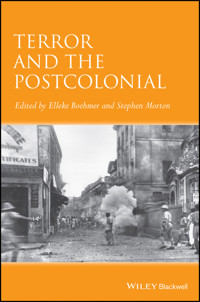
Cover image: Policemen use tear gas bombs during riots in Calcutta, India, August 1946. Photo Keystone/Getty Images.
Notes on Contributors
Bashir Abu-Manneh is Assistant Professor of English at Barnard College, New York, and the author of several articles in journals such as Interventions, New Formations, and Monthly Review. He is writing a book on the Palestinian novel and nationalism.
Elleke Boehmer is well known for her research in international writing and postcolonial theory, and is the author of the world best-seller Colonial and Postcolonial Literature: Migrant Metaphors (1995, 2005), the monographs Empire, the National and the Postcolonial, 1890–1920 (2002) and Stories of Women (2005), and of the acclaimed edition of Robert Baden-Powell’s Scouting for Boys (2004). Elleke Boehmer is the Professor of World Literature in English at the University of Oxford. Her most recent books are Nelson Mandela and Nile Baby (both 2008).
Emma Brodzinski is a Senior Lecturer in the Department of Drama and Theatre at Royal Holloway, University of London. She has a background in theatre-making and applied theatre practice. She is also a dramatherapist and has worked in both National Health Service and private settings. In collaboration with Helen Nicholson and Katie Normington she has recently published a book examining devised theatre entitled Making a Performance: Devising Histories and Contemporary Practices (2007). She is also currently writing a publication for Palgrave on theatre in health and care, and is engaged in a research project jointly funded by the AHRC, ESRC, Arts Council, and DTI, which examines creativity in the health and care workforce.
Robert Eaglestone is Professor of Contemporary Literature and Thought at Royal Holloway, University of London. His publications include Ethical Criticism (1997), Doing English (3rd ed. 2009), and The Holocaust and the Postmodern (2004), and four edited books including J. M. Coetzee in Context and Theory with Elleke Boehmer and Katy Iddiols. He is the series editor of Routledge Critical Thinkers.
Derek Gregory is Distinguished University Scholar and Professor of Geography at the University of British Columbia at Vancouver. He is a Fellow of the British Academy and of the Royal Society of Canada and was awarded the Founder’s Medal of the Royal Geographical Society in 2006. He is the author of several books including The Colonial Present: Afghanistan, Palestine, Iraq (2004) and Violent Geographies: Fear, Terror and Political Violence (edited with Allan Pred) (2007). His research focuses on political and cultural geographies of modern war, the subject of his forthcoming War Cultures.
Louise Hardwick is a Postdoctoral Fellow at Homerton College, Cambridge, and a graduate of Trinity College, Oxford. Her doctoral thesis examines the significance of childhood narratives in the development of Francophone Caribbean literature (Patrick Chamoiseau, Maryse Condé, Raphaël Confiant and Dany Laferrière), and she has published on Condé, Confiant and Joseph Zobel. She is the editor of a forthcoming volume on approaches to crime in French literature and visual culture.
Peter Heehs is an American historian based in Pondicherry, India. He writes on modern Indian history, and Indian spirituality and religion. Much of his work focuses on the Indian political and spiritual leader Sri Aurobindo. His publications include The Lives of Sri Aurobindo (2008), The Bomb in Bengal (1993 and 2004), Nationalism, Terrorism, Communalism (1998), and more than 40 articles in journals and magazines.
Alex Houen is a University Lecturer in Modern Literature at Cambridge University. He is the author of Terrorism and Modern Literature: From Joseph Conrad to Ciaran Carson (2002), and numerous articles on modern literature, theory, and politics.
Achille Mbembe, born in Cameroon, and educated at the Sorbonne in Paris and at the Institut d’études politiques (IEP), Paris, is Research Professor in History and Politics at the University of Wiwatersrand, South Africa. He is the author of several books on African history and politics, most notably On the Postcolony (2001).
Stephen Morton is a Senior Lecturer in English at the University of Southampton. He has written widely on postcolonial literature and theory, and is the author of Gayatri Chakravorty Spivak (2003), Gayatri Spivak: Ethics, Politics and the Critique of Postcolonial Reason (2006), Salman Rushdie: Fictions of Postcolonial Modernity (2007), and is the co-editor of Foucault in an Age of Terror: Biopolitics and the Defence of Society (2008). He is currently working on a monograph on Colonial States of Emergency in Literature and Culture 1905–2005.
Stuart Price is Principal Lecturer in Media, Film and Journalism at De Montfort University, Leicester. He is the author of Discourse Power Address (2007), and has also produced material on politics and security, including “Missiles in Athens, Tanks at Heathrow” (Social Semiotics, 2008: 18/1). Forthcoming work includes Brute Reality: Structures of Representation in the “War on Terror” (2010). Current research encompasses a study of public disorder in Greece following the death of the teenager Alexandros Grigoropoulos.
Ranka Primorac is a Teaching Fellow at the University of Southampton. She has written widely about Zimbabwean literatures and cultures, and is the author of The Place of Tears: The Novel and Politics in Modern Zimbabwe (2006) and co-editor of Versions of Zimbabwe (2005) and Zimbabwe in Crisis (2007). Her edited collection African City Textualities is forthcoming with Routledge in 2009. Her research interests are centered on narrative constructions of space-time, the social functioning of literary fictions, city cultures and texts, and postcolonial/literary theory.
Neluka Silva is Professor in English and Head of Department at the University of Colombo, Sri Lanka and a visiting lecturer for the Postgraduate Diploma in Peace and Conflict Studies of the University of Bradford Sri Lanka program. She is also a creative writer and has been involved in the Sri Lankan theatre in English for over 20 years. Her research interests include cultural production in South Asia; Gender, Peace, and Conflict issues; and Contemporary Theatre.
Sujala Singh is a Senior Lecturer in English at the University of Southampton. Her publications include essays in Wasafiri, CriticalSurvey, New Formations, and Kunapipi, and she is currently completing a monograph on Postcolonial Children: Representing the Nation in South Asian Literature.
Alex Tickell is a Senior Lecturer in English at the University of Portsmouth. His publications include Arundhati Roy’s The God of Small Things (2007), a critical edition of Selections from “Bengaliana” by Shoshee Chunder Dutt (2005), and articles in journals such as the Journal of Commonwealth Literature, Ariel, and Postcolonial Studies. He is currently working on a monograph on Violence, Terror, and Insurgency in Indian-English Writing.
Vron Ware is currently a Research Fellow at the Centre for Research on Socio-Cultural Change and the Centre for Citizenship, Identities and Governance, based at the Open University. Previous publications include Beyond the Pale: White Women, Racism and History (1992), Out of Whiteness: Color, Politics and Culture (2002), and Who Cares About Britishness? A Global View of the National Identity Debate (2007).
Robert J. C. Young is Julius Silver Professor of English and Comparative Literature at New York University. He was formerly Professor of English and Critical Theory at Oxford University. He has published White Mythologies: Writing History and the West (1990, new edition 2004), Colonial Desire: Hybridity in Culture, Theory and Race (1995), Postcolonialism: An Historical Introduction (2001), Postcolonialism: A Very Short Introduction (2003), and The Idea of English Ethnicity (2008). His edited books include Untying the Text (1981), and, with Derek Attridge and Geoffrey Bennington, Poststructuralism and the Question of History (1987). He is also General Editor of Interventions: International Journal of Postcolonial Studies, and was a founding editor of the Oxford Literary Review. His work has been translated into 20 languages, and he is currently writing a book on translation.
Acknowledgments
The editors would like to express their gratitude to the School of Humanities and the English Department at the University of Southampton for their generous financial contribution towards the costs of translation and permissions for this book; and to the British Academy, the Canadian High Commission, and HARC (Humanities and Arts Research Committee) at Royal Holloway, University of London for their support of the two workshops on Terror and the Postcolonial at Royal Holloway, University of London (RHUL) and Southampton University in 2006. We would also like to express our gratitude to colleagues and graduate students at RHUL and at the University of Southampton for their participation and critical feedback on the workshops. In particular we would wish to thank Alice Christie, then in the English Department office at RHUL, for her sterling help with the workshop accounts and administration. We thank the English Faculty, University of Oxford, for kind support with the indexing process.
We owe a big debt of gratitude to Professor Susheila Nasta of the Open University, Editor of Wasafiri, for hosting the special issue “Cultures of Terror” (July 2007), co-edited with Elleke Boehmer, in which earlier versions of three of the essays collected here first appeared.
The editors would also like to thank Routledge for permission to reprint the following articles: Derek Gregory, “Vanishing Points: Law, Violence, and Exception in the Global War Prison,” in Derek Gregory and Allan Pred (eds.), Violent Geographies: Fear, Terror and Political Violence (New York: Routledge, 2007), pp. 205–36; Robert Eaglestone, “‘The age of reason was over … an age of fury was dawning’: Contemporary Fiction and Terror,” Wasafiri 22:2 (2007), pp. 19–22; Ranka Primorac, “The Poetics of State Fiction in Twenty-First Century Zimbabwe,” Interventions 9:3 (2007), pp. 434–50; Vron Ware, “The White Fear Factor,” Wasafiri 22:2 (2007), pp. 51–6; Bashir Abu-Manneh, “Israel in the US Empire,” first published in Priyamvada Gopal and Neil Lazarus (eds.), After Iraq: Reframing Postcolonial Studies, new formations 59 (London: Lawrence and Wishart, 2006); Elleke Boehmer, “Post-colonial Writing and Terror,” Wasafiri 22:2 (2007), pp. 4–7.
Our partners Steven Matthews and Susan Kelly have offered unfailing support across the many days and hours we have spent on this absorbing and ongoing “Terror and the Postcolonial” project: our gratitude to them is boundless.
Introduction: Terror and the Postcolonial
Elleke Boehmer and Stephen Morton
As If Invoked, Like Dracula
Terror, postcolonial or otherwise, induces affect, as a number of essays in this book describe. Among the affective repercussions of acts of terror are extreme fear, galvanizing shock, vengeful anger, displacement, and, perhaps above all, paranoia – the belief that having struck once, terror will do so again, at the same place, like lightning. Or, even if it has not appeared before, the deep paranoia associated with terror is that, once conceived, once entertained in the mind, terror will in-exorably arise, somewhere, and attack the body, whether national, social, or individual, just as Dracula attacks, with his type of watchfulness and cunning.
That day, 7/7/2005, “London’s 9/11” (with apposite, necromantic rhyme), it certainly did seem to this book’s editors that our theoretical engagement with terror and terrorism, defiant and skeptical as it was, had in some way called forth the configuration of terrorist events that manifested all about us. North, east, west of our meeting that day in the heart of London, bombs exploded, the repercussions of which we almost immediately felt; the aftershocks of which pulled through us, forming as we did part of a vast, moving crowd. Thus drawn in, it was as if our academic investigations – especially because they were skeptical and against current neo-imperial orthodoxies concerning the unquestioned rightness of the war on terror – had mysteriously invoked these outrages, even conjured them into being.
We had fixed the July 7 date some months before, for a meeting in Senate House to discuss the overall shape and tenor of two workshops we were planning, to which we had given the name this book now bears as its title: Terror and the Postcolonial. The workshops, funded in part by the British Academy, as well as by the Canadian High Commission, HARC at Royal Holloway, and the Southampton English Department, set out to address a range of questions concerning the links between postcolonial writing and theory, and the phenomenon of terror. We asked, for example, why it was that the post/colonial state sought to propagate terror? And in what ways did West/non-West divisions underpin the rhetoric of terrorism and its “real world” manifestations? How did postcolonial concepts of, for example, resistance and worldliness contribute to our understanding of contemporary terror? And how might we set about redefining the human in a situation of terror?
For the two of us located at separate institutions, Stephen Morton at the University of Southampton, Elleke Boehmer, then at Royal Holloway, University of London, the Institute of English Studies in Senate House in Bloomsbury seemed an excellent, central place to meet. This was especially the case as we had invited a few other colleagues, now among the contributors to this volume, to participate in the meeting. We were keen to gauge their different insights into the risks and difficulties involved in organizing a series of terror workshops that would seek to analyze contemporary developments while retaining historical and ethical perspective, and foreground the terror phenomenon without making of it a spectacle. In the event our colleagues never made it to Senate House that morning. They were turned away at stations proximate to London, instructed that “something had happened” in the capital and it was best not to continue on their journey.
Lesen Sie weiter in der vollständigen Ausgabe!
Lesen Sie weiter in der vollständigen Ausgabe!
Lesen Sie weiter in der vollständigen Ausgabe!
Lesen Sie weiter in der vollständigen Ausgabe!
Lesen Sie weiter in der vollständigen Ausgabe!
Lesen Sie weiter in der vollständigen Ausgabe!
Lesen Sie weiter in der vollständigen Ausgabe!
Lesen Sie weiter in der vollständigen Ausgabe!
Lesen Sie weiter in der vollständigen Ausgabe!
Lesen Sie weiter in der vollständigen Ausgabe!
Lesen Sie weiter in der vollständigen Ausgabe!
Lesen Sie weiter in der vollständigen Ausgabe!
Lesen Sie weiter in der vollständigen Ausgabe!
Lesen Sie weiter in der vollständigen Ausgabe!
Lesen Sie weiter in der vollständigen Ausgabe!
Lesen Sie weiter in der vollständigen Ausgabe!
Lesen Sie weiter in der vollständigen Ausgabe!
Lesen Sie weiter in der vollständigen Ausgabe!
Lesen Sie weiter in der vollständigen Ausgabe!
Lesen Sie weiter in der vollständigen Ausgabe!
Lesen Sie weiter in der vollständigen Ausgabe!




