


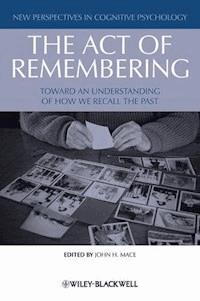
The Act of Remembering E-Book
42,99 €
Mehr erfahren.
- Herausgeber: John Wiley & Sons
- Kategorie: Geisteswissenschaft
- Serie: New Perspectives in Cognitive Psychology
- Sprache: Englisch
The first volume devoted solely to autobiographical memory retrieval, The Act of Remembering serves as a primer of ideas, methodology, and central topics, and lays the groundwork for future research in the field. * Contains new, forward-looking theories from leading international scholars * Answers questions such as: Do we retrieve memories according to when and where we need them? How much conscious control do we have over what we remember? Why are some people more likely than others to have intrusive 'flashbacks' following a stressful event? * Pays particular attention to voluntary and involuntary recall
Sie lesen das E-Book in den Legimi-Apps auf:
Seitenzahl: 762
Veröffentlichungsjahr: 2011
Ähnliche




















Contents
Preface
List of Contributors
Part I Introduction
1: The Act of Remembering the Past
Autobiographical Memory in Brief
Overview of Book
References
2: From Diaries to Brain Scans
Cognitive Psychology Approach
Cognitive Neuroscience Approach
Future Directions
Acknowledgments
References
Part II Theories and Reviews of Involuntary and Voluntary Remembering
3: Involuntary Remembering and Voluntary Remembering
Introduction
Taxonomic Differences between Involuntary and Voluntary Forms of Remembering
Functional Comparisons of Involuntary and Voluntary Remembering
Comparing the Memories Generated from Involuntary and Voluntary Remembering
Comparing Involuntary Remembering to Voluntary Remembering
Conclusion
References
4: Accessing Autobiographical Memories
Accessing Information in Long-Term Memory
Memory Representations
Uncontrolled Direct Retrieval: A Case Study
Concluding Comments
References
5: Involuntary and Voluntary Memory Sequencing Phenomena
Introduction
Laboratory Techniques Used to Study Autobiographical Memory Organization
Involuntary Memory Chains: Naturally Occurring Indicators of Autobiographical Memory Organization?
Explaining the Dissociation
How are Memories Organized in the Autobiographical Memory System?
Summary
References
6: Spontaneous Remembering is the Norm
Introduction
Conscious Cognition and Memory: Basic Facts to be Accounted For
Novel Hypotheses from the LIDA/GWT Model
GWT as a Functional Interpretation of Conscious Cognition
The LIDA Model
Memory Systems and Terminology
The LIDA Cognitive Cycle
Learning in the LIDA Model
The Availability Heuristic
Conclusions
Acknowledgments
Notes
References
7: Priming, Automatic Recollection, and Control of Retrieval
1. Introduction
2. Evidence for Automatic Retrieval in Incidental Tests
3. Retrieval Control versus Conscious Recollection of Prior Episodes
4. Automatic Recollection and Two-Process Models of Explicit and Implicit Memory
5. Beyond Two-Process Models of Explicit and Implicit Memory: Toward an Integrative Retrieval Architecture
6. Conclusion
Acknowledgments
Notes
References
Part III Broader Issues in the Science of Remembering
8: Understanding Autobiographical Remembering from a Spreading Activation Perspective
Introduction
The Nature of Spreading Activation in Autobiographical Memory
Studies Supporting Spreading Activation and Its Effects on Autobiographical Remembering
Considering the Functional Nature of Spreading Activation in Autobiographical Memory
Concluding Comments: Additional Questions, Reflections, and Future Directions
References
9: Retrieval Inhibition in Autobiographical Memory
Introduction
Experimental Paradigms for the Study of Inhibitory Processes
Emotion and Retrieval Inhibition
Neural Substrates of Retrieval Inhibition
Neural Substrates of AM Retrieval
Future Lines of Research
Conclusions
References
10: Seeing Where We’re At
Introduction
Point of View in Personal Memories – Nigro and Neisser’s Seminal Study
Emotional Intensity, Emotional Valence, and Visual Perspective
Self-Awareness, Self-Concept, and Visual Perspective
Temporal Distance, Vividness, Constructive Processes, and Visual Perspective
Future Directions
Acknowledgments
Notes
References
11: The Emergence of Recollection
Introduction
The Neural Substrate of Recollection
The Social Context of Recollection
The Development of Recollection
Note
References
12: You Get What You Need
Introduction
Review of Retrieval in the Self-Memory System
Retrieval In Situ: You Get What You Need
A Review of Empirical Research Using a Functional Perspective
Conclusion
References
Part IV Theories of Abnormal Remembering
13: Exploring Involuntary Recall in Posttraumatic Stress Disorder from an Information Processing Perspective
Introduction
PTSD Theories
Empirical Investigations of Intrusive Trauma Memories
Conclusions and Discussion
Note
References
14: Unwanted Traumatic Intrusions
Introduction
Neuropsychological Findings
Executive Control as a Premorbid Vulnerability Factor
Executive Control in the Experimental Memory Literature
Interference Control and Intrusive Memories
Executive Control May Help Disengagement of Attention from Stressful Trauma Reminders
Further Theoretical Considerations
Conclusion and Future Directions
Notes
References
15: The Content, Nature, and Persistence of Intrusive Memories in Depression
Intrusive Memories in PTSD
Summary of Intrusive Memories in PTSD
Intrusive Memories in Depression
Evidence of Shared Features of Intrusive Memories in PTSD and Depression
Moving Towards a Model of Intrusive Memories in Depression
Summary
References
Author Index
Subject Index
New Perspectives in Cognitive Psychology
New Perspectives in Cognitive Psychology is a series of works that explore the latest research, current issues, and hot topics in cognitive psychology. With a balance of research, applications, and theoretical interpretations, each book will educate and ignite research and ideas on important topics.
Memory and Emotion: Interdisciplinary Perspectives
Edited by Bob Uttl, Nobuo Ohta, and Amy L. Siegenthaler
Involuntary Memory
Edited by John H. Mace
Regulating Emotions: Culture, Social Necessity, and Biological InheritanceEdited by Marie Vandekerckhove, Christian von Scheve, Sven Ismer, Susanne Jung, and Stefanie Kronast
The Act of Remembering: Toward an Understanding of How We Recall the Past
Edited by John H. Mace
This edition first published 2010
© 2010 Blackwell Publishing Ltd except for editorial material and organization © 2010 John H. Mace
Blackwell Publishing was acquired by John Wiley & Sons in February 2007. Blackwell's publishing program has been merged with Wiley's global Scientific, Technical, and Medical business to form Wiley-Blackwell.
Registered Office
John Wiley & Sons Ltd, The Atrium, Southern Gate, Chichester, West Sussex, PO19 8SQ, United Kingdom
Editorial Offices
350 Main Street, Malden, MA 02148–5020, USA
9600 Garsington Road, Oxford, OX4 2DQ, UK
The Atrium, Southern Gate, Chichester, West Sussex, PO19 8SQ, UK
For details of our global editorial offices, for customer services, and for information about how to apply for permission to reuse the copyright material in this book please see our website at www.wiley.com/wiley-blackwell.
The right of John H. Mace to be identified as the author of the editorial material in this work has been asserted in accordance with the UK Copyright, Designs and Patents Act 1988.
All rights reserved. No part of this publication may be reproduced, stored in a retrieval system, or transmitted, in any form or by any means, electronic, mechanical, photocopying, recording or otherwise, except as permitted by the UK Copyright, Designs and Patents Act 1988, without the prior permission of the publisher.
Wiley also publishes its books in a variety of electronic formats. Some content that appears in print may not be available in electronic books.
Designations used by companies to distinguish their products are often claimed as trademarks. All brand names and product names used in this book are trade names, service marks, trademarks or registered trademarks of their respective owners. The publisher is not associated with any product or vendor mentioned in this book. This publication is designed to provide accurate and authoritative information in regard to the subject matter covered. It is sold on the understanding that the publisher is not engaged in rendering professional services. If professional advice or other expert assistance is required, the services of a competent professional should be sought.
Library of Congress Cataloging-in-Publication Data
The act of remembering: toward an understanding of how we recall the past/edited by John H. Mace.
p. cm. – (New perspectives in cognitive psychology)
Includes bibliographical references and index.
ISBN 978-1-4051-8904-0 (hardcover: alk. paper) – ISBN 978-1-4051-8903-3 (pbk.: alk. paper)
1. Autobiographical memory. I. Mace, John H.
BF378.A87A25 2010
153.1’23-dc22
2010016199
Preface
This volume represents the first occasion when a group of memory researchers have come together for the single purpose of addressing the problem of remembering the past, or in other words, autobiographical memory retrieval. The chapters contained herein examine involuntary and voluntary retrieval, the functions and development of autobiographical remembering, inhibitory process in autobiographical remembering, and abnormal recall processes, particularly those found in certain clinical syndromes, such as PTSD. Each chapter looks at a particular aspect of the problem of remembering, with some offering entirely novel views, and some introducing or advancing approaches for autobiographical remembering that have been successfully applied in other research domains. Regardless of the focus, the central aim of the volume is to move the science of remembering forward.
John H. Mace
List of Contributors
Nicole Alea, Department of Behavioural Sciences, University of the West Indies, St. Augustine, Trinidad and Tobago
Bernard J. Baars, The Neurosciences Institute, San Diego, CA, USA
Christopher T. Ball, Psychology Department, College of William & Mary, Williamsburg, VA, USA
Patricia J. Bauer, Department of Psychology, Emory University, Atlanta, GA, USA
Karl-Heinz T. Bauml, Department of Experimental Psychology, Regensburg University, Regensburg, Germany
Eni S. Becker, Department of Clinical Psychology, Behavioural Science Institute, Radboud University Nijmegen, Nijmegen, the Netherlands
Susan Bluck, Department of Psychology, University of Florida, Gainesville, FL, USA
Martin A. Conway, Institute of Psychological Sciences, The Leeds Memory Group, University of Leeds, Leeds, UK
Burcu Demiray, Department of Psychology, University of Florida, Gainesville, FL, USA
Robyn Fivush, Department of Psychology, Emory University, Atlanta, GA, USA
Stan Franklin, Department of Computer Science and Institute for Intelligent Systems, University of Memphis, Memphis, TN, USA
Emily A. Holmes, Department of Psychiatry, Warneford Hospital, University of Oxford, Oxford, UK
Julie Krans, Department of Clinical Psychology, Behavioural Science Institute, Radboud University Nijmegen, Nijmegen, the Netherlands
Catherine Loveday, Department of Psychology, University of Westminster, London, UK List of Contributorsix
John H. Mace, Psychology Department, Eastern Illinois University, Charleston, IL, USA
Michelle L. Moulds, Department of Psychology, University of New South Wales, Sydney, Australia
Gérard Näring, Department of Clinical Psychology, Behavioural Science Institute, Radboud University Nijmegen, Nijmegen, the Netherlands
Bernhard Pastötter, Department of Experimental Psychology, Regensburg University, Regensburg, Germany
Heather J. Rice, Department of Psychology, Washington University in St. Louis, St. Louis, MO, USA
Alan Richardson-Klavehn, Departments of Neurology and Stereotactic Neurosurgery, Otto von Guericke University, Magdeburg, Germany
Jennifer M. Talarico, Department of Psychology, Lafayette College, Easton, PA, USA
Johan Verwoerd, Division of Clinical and Developmental Psychology, University of Groningen, Groningen, Netherlands
Ineke Wessel, Division of Clinical and Developmental Psychology, University of Groningen, Groningen, Netherlands
Alishia D. Williams, Department of Psychology, University of New South Wales, Sydney, Australia
Marcella L. Woud, Department of Clinical Psychology, Behavioural Science Institute, Radboud University Nijmegen, Nijmegen, the Netherlands
Part I
Introduction
1
The Act of Remembering the Past
An Overview
John H. Mace
One could argue that the quest to understand remembering (autobiographical memory retrieval) is central to the quest to understand autobiographical memory. One could also argue that understanding the processes of autobiographical recall might also be important to an understanding of more general cognition. For example, it is fairly easy to see how constructing a thought or solving a problem may involve many of the same mental (and perhaps neural) operations as reconstructing a past experience. While the importance of retrieval to memory and cognition has been noted by numerous other writers (too numerous to list), autobiographical memory retrieval may have a greater place in this larger aspect of the quest, given the complexity of information that has to be assembled in order to experience a memory of the past, including the knowledge, awareness, or feeling that one is “re-experiencing” a past event (Tulving, 1985).
The chapters contained in this book advance the quest to understand remembering, as they tackle many of the problems that face the science of remembering. In this first chapter, I briefly review the concept of autobiographical memory and, as this is the first chapter of a collective of works, I devote most of it to highlighting many of the major questions raised by the various authors.
Autobiographical Memory in Brief
Although the recognition of autobiographical memory (in one form or another) has a long scholarly history in psychology and philosophy (see an excellent history in Brewer, 1986), the formal study of it is relatively recent, growing out of Tulving’s (1972) introduction of the episodic/semantic memory distinction, and Neisser’s (1978) plea to memory researchers to take up the study of ecologically valid forms of memory (or real-world memory phenomena). Although the terms episodic memory and autobiographical memory are often used synonymously, autobiographical memory takes in a wider range of personal knowledge forms than was originally conceived in the early views of episodic memory.
For example, autobiographical memories encompass discrete forms of abstract knowledge about the self (e.g., “knowing that I lived in Philadelphia growing up”), general or summary (i.e., repeated events) forms of personal knowledge (e.g., “my trip to London in 2005,” “Sunday walks in Central Park”), and, of course, memories for discrete, specific experiences (e.g., “seeing the mummies at the British Museum during my London trip,” a quintessential episodic memory; see early treatments in Barsalou, 1988; Brewer, 1986). Conway (1996, 2006) has proposed that these different forms of personal knowledge are organized in a networked fashion in a memory system that he calls the self memory system. In the self memory system, different forms of autobiographical knowledge are layered hierarchically, such that the most abstract forms of knowledge are at the top layer (i.e., themes and lifetime periods, such as the knowledge that one grew up in Philadelphia), with the layers of knowledge becoming relatively less abstract (or increasingly more sensory/perceptual in detail) as one moves down the hierarchy, from general forms of memories (i.e., general events, such as the trip to London) to specific memories (i.e., episodic memories, see Figure 4.1 in Conway & Loveday, chapter 4, this volume, and also discussions on theories of an additional transient episodic memory system in Conway, 2005; chapter 4, this volume; and Bluck, Alea, & Demiray, chapter 12, this volume). Whether one agrees with Conway’s view or not, it seems clear that autobiographical memory takes in a number of different personal knowledge forms.
Overview of Book
In chapter 2, Ball rounds off the introductory section of this book by providing us with a comprehensive review of the various methods used to study autobiographical memory and retrieval. His review starts off with the era of Ebbinghaus, traces developments of the twentieth century, and finally culminates with the most recent developments, including methods as diverse as qualitative diary protocols and the latest imaging techniques (e.g., fMRI). The remaining chapters are separated into three main sections. I review each of these in turn.
Involuntary and voluntary remembering
The second section of this book is devoted entirely to a major subtheme which runs throughout the entire volume: involuntary remembering (spontaneous recollection of the past) and voluntary remembering (deliberate recollection of the past). Clearly an important question for any theory of retrieval to tackle, the chapters in this section exemplify the more elaborate set of questions that the involuntary/voluntary distinction in autobiographical memory has created. The treatments range from the problems of categorization (in both forms of recall), the generative retrieval model of voluntary recall, dissociations between involuntary and voluntary remembering, the larger role of consciousness in the control of retrieval, to models of involuntary and voluntary recall which derive their inspiration from more traditional laboratory approaches examining the implicit/explicit memory distinction.
In chapter 3, Mace grapples with phenomenological categorization, claiming that three categories of involuntary remembering exist (Mace, 2007b). As he argues, the three divisions of involuntary remembering might be caused by different sets of encoding or retrieval circumstances (e.g., occurring only after a traumatic experience, in one, or owing to different types of spreading activation processes in the others). However, the main thrust of the chapter is a comparison of involuntary remembering to voluntary remembering. Here, the phenomenological characteristics of involuntary and voluntary memories are compared, but mostly the focus is on similarities and differences in involuntary and voluntary retrieval. The chapter concludes with an examination of the main contrast, the involuntary/voluntary distinction, with Mace offering another categorization schema, one which places remembering phenomena along different points of a voluntary- involuntary continuum that deemphasizes or limits the role of volition. This aspect of the chapter challenges the idea that voluntary remembering can be treated as a monolithic form of recall and it also deals with the dicey concept of volition.
In chapter 4, Conway and Loveday review the generative model of voluntary recall (e.g., Conway, 2005). In their review of the model, they, too, appear to argue for a diminution of the role of volition in voluntary recall, arguing that many parts of the process are likely to be involuntary. And, while their chapter reviews the generative retrieval model, it also adds some important case data to the discussion (i.e., the case of patient CR). CR is a middle-aged woman with significant and widespread damage to the right side of her brain. While she shows many of the obvious memory disorders of an anterograde amnesic (i.e., an inability to recall the past after short periods of time), unlike most amnesics this appears to be limited to voluntary recall. So, upon questioning or self-prompting, she is unable to generate a memory of the past; however, when given very explicit cues (e.g., pictures of a past event), she is able to remember, much in the same way that one spontaneously recalls the past. Conway and Loveday use this case to make a convincing argument that CR has intact involuntary recall processes while having impaired voluntary recall processes. This is an important observation because CR’s syndrome (1) supports the notion of generative retrieval; (2) supports the notion that voluntary remembering contains separate voluntary and involuntary components; and (3) strengthens the involuntary/voluntary distinction, while at the same time helping to delineate certain processes within this schema.
Talarico and Mace (chapter 5) review an interesting set of problems arising from the data produced by involuntary and voluntary memory sequencing phenomena, event cuing (a laboratory-based procedure where subjects deliberately recall memories in a sequence) and involuntary memory chaining (a naturally occurring phenomenon where involuntary memories are produced in a sequence, one of the three proposed categories of involuntary remembering). In brief, these two recall processes produce two somewhat different sets of data, each having different implications for the organization of memories in the autobiographical memory system. Talarico and Mace explore the possibility that the difference occurs as a result of biases in the laboratory procedure, thereby making the involuntary memory phenomenon the more reliable indicator. They also explore the possibility that the different patterns of results may instead be an indicator of some real differences underlying involuntary and voluntary retrieval, ones which may further our understanding of these processes.
Franklin and Baars (chapter 6) argue that spontaneous (involuntary) remembering in everyday life is a normal (functional) part of everyday cognition. Like the stream of consciousness and other forms of spontaneous cognition, they argue that rather than being merely accidental, that everyday involuntary memories play an important functional role in orientating one towards the future, solving problems, and so forth (a view which is consistent with directions being taken in involuntary memory research, e.g., Berntsen & Jacobson, 2008; Mace & Atkinson, 2009). However, their main message concerns the relationship between spontaneous memories and consciousness. Using a central tenet of Baars' (1988) global workspace theory (GWT) of conscious, the C-U-C triad, they explain how spontaneous memories (and other spontaneous processes, e.g., spontaneous problem solving) can emerge from a memory system and how this may be further explained with a computational model that has been built on GWT (LIDA-GWT).
Richardson-Klavehn’s contribution (chapter 7) does not address autobiographical memory retrieval per se, it, instead, addresses retrieval on word-list memory tasks (namely the word-stem completion task). Among the topics addressed are explicit (conscious or episodic) memory retrieval and implicit (unconscious or non-episodic) memory retrieval. Within this broader context, he delineates involuntary and voluntary retrieval processes, pointing out some of the problems surrounding the use of these terms in the word-list memory arena. One problem that has arisen in that arena is the tendency for some approaches to conflate retrieval processes (involuntary and voluntary) with memory types (explicit and implicit). Richardson-Klavehn points out how such approaches have been unable to accommodate the involuntary/ voluntary distinction in conscious memory, defining the concept of involuntary conscious memory (or spontaneous recollection) out of existence. Addressing the heart of this problem, Richardson-Klavehn introduces a novel retrieval architecture which can account for all variety and complexities of retrieval on word-stem tasks. This model could be important to autobiographical memory researchers, as in many ways they are facing similar problems in attempting to explain varied and complex forms of autobiographical memory retrieval. Thus in whole or in part, Richardson-Klavehn’s approach to the problem of retrieval may prove useful to the science of autobiographical remembering.
Broader theoretical considerations of autobiographical remembering
Apart from the more central focus on involuntary and voluntary recall in the first main section, the second main section includes chapters which focus on broader aspects of remembering, though involuntary and voluntary remembering are also considered in some of these chapters, in some cases centrally. The topics include using the perennial notion of spreading activation to understand autobiographical remembering, understanding the important role that retrieval inhibition plays in autobiographical remembering, the importance of visual imagery, and the difficult to track but highly important questions of development and functions, respectively, of remembering.
Mace (chapter 8) examines autobiographical remembering from a spreading activation perspective. Building on a handful of different studies, he argues that the autobiographical memory system appears to be subject to different types of within and between memory systems forms of spreading activation. And, while some spreading activation processes may occur unconsciously, he also argues that some can be observed to occur in the space of consciousness (e.g., the involuntary memory chaining mentioned above). He also argues that spreading activation may account for much of everyday involuntary remembering, including involuntary remembering during voluntary remembering. And, like in semantic memory, spreading activation in the autobiographical memory system appears to subject autobiographical remembering to priming effects. He further argues that all of these processes are likely to be functional to the process of autobiographical remembering.
Pastötter and Bäuml (chapter 9) examine retrieval inhibition in autobiographical remembering. They review a fairly extensive literature on retrieval inhibition, and while most of the findings there have been generated from word-list memory paradigms, they perform the important task of drawing inferences from them with the purpose of connecting them to inhibition in autobiographical memory recall. They, too, cover voluntary and involuntary recall processes, noting, for example, that similar distinctions appear to exist in the inhibition of retrieval as it appears that memory production can be inhibited either involuntarily or voluntarily. Apart from some of the main issues surrounding the study of retrieval inhibition (e.g., the manner in which it may be carried out), their chapter also reminds us of the importance of inhibition to the understanding of autobiographical remembering and other forms of retrieval. For example, involuntary inhibition may be at work when one is trying to recall a past experience, if for no other reason than to keep irrelevent information from coming to mind. And, in some sense, inhibitory processes may be “on” and “filtering” all the time, otherwise one may be constantly bombarded by memories in everyday life (Conway & Pleydell-Pearce, 2000).
Rice (chapter 10) reviews the role of memory perspective (i.e., field, one’s original viewpoint, or observer, a third-party viewpoint) and imagery in autobiographical memory retrieval. One of the important questions that she addresses is how visual imagery, most particularly perspective-based imagery, may be a determinative factor in the autobiographical memory retrieval process. Whether visual imagery or perspective per se have a causal role or not, her review reminds us of the complexity of information contained in an autobiographical memory, and the potential complexity of the retrieval processes that need to construct and bring this information to mind. Apart from this main issue, Rice also reviews how abnormal remembering in clinical syndromes (e.g., PTSD or social phobia) appears to distort visual perspective, as individuals with certain disorders tend to recall memories surrounding their condition from a third-party viewpoint.
Fivush and Bauer (chapter 11) take on the yeoman’s task of tracking and explaining the development of autobiographical remembering early in the life cycle. Among other considerations, they examine neural development, as well as the role of the social and cultural factors in the development of autobiographical remembering skills. Pointing out that the development of autobiographical remembering does not terminate in childhood, they also remind us that there are other important changes taking place along the path of the lifespan (e.g., adolescence and middle age).
While three other chapters in this volume in part examine the functional considerations of remembering (chapters 3, 6, & 8, but mainly with respect to involuntary remembering), Bluck, Alea, and Demiray (chapter 12) devote their entire chapter to this cause. Looking at the problem more globally, they examine autobiographical remembering within the context of its three hypothesized functions (i.e., directive, self, and social functions; Baddeley, 1988). A central focus of their chapter is an examination of how the self memory system’s (SMS, e.g., Conway, 2005) views on retrieval handle the question of function. Their take home message is that the SMS needs to do more – in particular, focus on person-environment interactions, which they view as key. While they offer this advice primarily to the SMS view, it should be noted that other approaches (present and future) may want to consider their advice.
Abnormal remembering
The last main section contains three chapters which address remembering (mostly involuntary forms) in clinical syndromes. The question of involuntary remembering in clinical syndromes (e.g., post-traumatic stress disorder) has a relatively longer history there than it has in the study of everyday normal remembering. Research in this area has developed in many ways: it has helped us to better understand the syndromes and the nature of abnormal remembering, and it has helped to inform understanding of normal remembering. The authors in this section show us how this area of inquiry continues to branch in several ways (e.g., bringing working memory into the discussion, and extending the question of abnormal involuntary remembering to depression).
Krans, Woud, Näring, Becker, and Holmes (chapter 13) review involuntary traumatic remembering in PTSD, including a comprehensive review of the different theoretical accounts of this type of remembering. Their review features a promising new information processing account recently put forward by Holmes and Bourne (2008), which argues that differential encoding (a focus more on perceptual rather than conceptual features) during the time of a traumatic event may be responsible for the development of traumatic involuntary memories. Verwoerd and Wessel (chapter 14) add another dimension to the discussion by focusing on the role of executive control (or working memory) in the production of traumatic memories in PTSD. They argue that a subset of trauma survivors develop traumatic intrusive memories because they had pre-morbid deficiencies in executive control. Williams and Moulds (chapter 15) look at involuntary remembering in depression. Their chapter reviews more recent observations that negative intrusive memories form a common part of the depressive syndrome, and that these memories share features in common with the traumatic memories of PTSD.
References
Baars, B. J. (1988). A cognitive theory of consciousness. Cambridge: Cambridge University Press.
Baddeley, A. (1988). But what the hell is it for? In M. M. Gruneberg, P. E. Morris, & R. N. Sykes (Eds.) Practical aspects of memory: Current research and issues (1st ed., pp. 3–18). Chichester: Wiley.
Barsalou, L. W. (1988). The content and organization of autobiographical memories. In U. Neisser & E. Winograd (Eds.), Remembering reconsidered: Ecological and traditional approaches to the study of memory (pp. 193–243). New York: Cambridge University Press.
Berntsen, D., & Jacobson, A. S. (2008). Involuntary (spontaneous) mental time travel into the past and future. Consciousness and Cognitive, 17, 1093–1104.
Brewer, W. F. (1986). What is autobiographical memory? In D. C. Rubin (Ed.), Autobiographical memory (pp. 25–49) New York: Cambridge University Press.
Conway, M. A. (1996). Autobiographical memories and autobiographical knowledge. In D. C. Rubin (Ed.),Remembering our past: Studies in autobiographical memory (pp. 67–93). New York: Cambridge University Press.
Conway, M. A. (2005). Memory and the self. Journal of Memory and Language, 53, 594–628.
Conway, M. A., & Pleydell-Pearce, C. W. (2000). The construction of autobiographical memories in the self-memory system. Psychological Review, 107, 261–288.
Holmes, E. A., & Bourne, C. (2008). Inducing and modulating intrusive emotional memories: A review of the trauma film paradigm. Acta Psychologica, 127 (3), 553–566.
Mace, J. H. (Ed.). (2007a). Involuntary memory. Oxford: Blackwell.
Mace, J. H. (2007b). Involuntary memory: Concept and theory. In J. H. Mace (Ed.), Involuntary memory (pp. 1–19). Oxford: Blackwell.
Mace, J. H., & Atkinson, E. (2009). Can we determine the functions of everyday involuntary autobiographical memories? In M. R. Kelley (Ed.),Applied memory (pp. 199–212). New York: Nova Science Publishers.
Neisser, U. (1978). Memory: What are the important questions? InM. M. Gruneberg, P. E. Morris, & R. N. Sykes (Eds.), Practical aspects of memory (pp. 3–24). London: Academic Press.
Tulving, E. (1972). Episodic and semantic memory. In E. Tulving & W. Donaldson (Eds.), Organization of memory (pp. 382–404). New York: Academic Press.
Tulving, E. (1985). Memory and consciousness. Canadian Psychologist, 26, 1–12.
2
From Diaries to Brain Scans
Methodological Developments in the Investigation of Autobiographical Memory
Christopher T. Ball
Hermann Ebbinghaus embarked on the first experimental analysis of human memory during the late 1800s that culminated in the publication of his classic text “Memory: A contribution to experimental psychology” in 1885 (translated into English in 1913). Ebbinghaus was determined to develop a research methodology for studying memory that rivaled the experimental rigor achieved by researchers in the natural sciences. His research relied for the most part on using nonsense syllables as memory stimuli. These three letter consonant–vowel–consonant combinations were chosen by Ebbinghaus because they did not appear in his native language, and consequently, he felt the nonsense syllables constituted “pure” memory stimuli. During the 1900s, memory researchers substituted nonsense syllable lists with word lists after databases became available that allowed researchers to control for confounding factors like the frequency of prior experience with a word.
The verbal learning approach has remained very popular since, but during the 1970s some cognitive psychologists began to raise concerns regarding this overreliance on memory stimuli that has little relevance to everyday, personal memories (Cohen 2008). These concerns became unified into the “everyday memory movement” that led to the first formal meeting of researchers interested in changing the focus of memory research in 1978. This conference was titled the “Practical Aspects of Memory Conference” (PAM), and the theme for this conference was to develop and report research programs that examined everyday memories and the practical aspects of such memory findings (Gruneberg, Morris, & Sykes, 1978). The everyday memory approach is now a strong and popular field of research that incorporates the study of many real–world memory topics, such as autobiographical memory, eyewitness memory, prospective memory, and memory training. Everyday memory researchers are faced with a difficult methodological balancing act. They want to investigate ecologically valid memory phenomena without completely sacrificing the experimental rigor provided by laboratory–based methodologies. The innovative and creative attempts by memory researchers to solve this balancing act over the past three decades are the basis of the current chapter, with a specific focus on the methodologies that have been developed to examine the retrieval of autobiographical memories.
Autobiographical memories are personal memories of past experiences that have self-relevance and that combine to form our life history. These complex memories represent the reconstruction of fragments of experience combined with our knowledge of such experiences and the knowledge of our self (Brewer, 1988; Conway, 1990). Williams, Conway, and Cohen (2008) suggest that autobiographical memories serve three functions: (1) social – communicating and sharing of past experiences with others, (2) problem solving – applying past experiences to new problem settings, and (3) self – past experiences provide a life-story that guides our self-goals. We are still at a fairly early stage in understanding the processing and storage of these memories when compared with other types of memories, but we have made substantial progress in this endeavor over the past three decades. The development of methods for studying autobiographical memory retrieval has been fundamental to these empirical and theoretical advancements, and further development is critically important for future progress (Baddeley, Eysenck, & Anderson, 2009).
Lesen Sie weiter in der vollständigen Ausgabe!
Lesen Sie weiter in der vollständigen Ausgabe!
Lesen Sie weiter in der vollständigen Ausgabe!
Lesen Sie weiter in der vollständigen Ausgabe!
Lesen Sie weiter in der vollständigen Ausgabe!
Lesen Sie weiter in der vollständigen Ausgabe!
Lesen Sie weiter in der vollständigen Ausgabe!
Lesen Sie weiter in der vollständigen Ausgabe!
Lesen Sie weiter in der vollständigen Ausgabe!
Lesen Sie weiter in der vollständigen Ausgabe!
Lesen Sie weiter in der vollständigen Ausgabe!
Lesen Sie weiter in der vollständigen Ausgabe!
Lesen Sie weiter in der vollständigen Ausgabe!
Lesen Sie weiter in der vollständigen Ausgabe!
Lesen Sie weiter in der vollständigen Ausgabe!
Lesen Sie weiter in der vollständigen Ausgabe!
Lesen Sie weiter in der vollständigen Ausgabe!
Lesen Sie weiter in der vollständigen Ausgabe!




