


Erhalten Sie Zugang zu diesem und mehr als 300000 Büchern ab EUR 5,99 monatlich.
- Herausgeber: Books on Demand
- Kategorie: Gesellschafts- und Liebesromane
- Sprache: Englisch
The white lab rat, threatened by a weapon that could be triggered via the internet, was to live in Florian Mehnert's art installation for eleven days. The internet world followed the livestream in an uproar. A worldwide shitstorm and numerous death threats followed. The art experiment `11 DAYS went around the world. How did the interactive art experiment work? Why was the experiment ended on the seventh day instead of the eleventh? Was the audience itself the lab rat in the end? The German Artist Florian Mehnert publishes for the first time what really happened. 11 DAYS gives a frightening insight into a society controlled by aggression and hatred.
Sie lesen das E-Book in den Legimi-Apps auf:
Seitenzahl: 111
Veröffentlichungsjahr: 2023
Das E-Book (TTS) können Sie hören im Abo „Legimi Premium” in Legimi-Apps auf:
Ähnliche



















The white lab rat, threatened by a weapon that could be triggered via the internet, was to live in Florian Mehnert‘s art installation for eleven days. The internet world followed the livestream in an uproar. A worldwide shitstorm and numerous death threats followed. The art experiment `11 DAYS ́ went around the world. How did the interactive art experiment work? Why was the experiment ended on the seventh day instead of the eleventh? Was the audience itself the lab rat in the end? The German artist Florian Mehnert publishes for the first time what really happened.
`11 DAYS´ gives a frightening insight into a society controlled by aggression and hatred.
Florian Mehnert gained international attention with many art projects. In his art project „Waldprotokolle“ (2013), he bugged paths and clearings in forests with microphones as a statement on the NSA affair. In his video installation „Menschentracks“ (2014), he showed 42 video sequences of hacked smartphones whose cameras and microphones were activated remotely. His photo series REFUGEE STACKS (2015) in which he stacked African refugees on top of each other was his reaction to the situation of refugee flows and an examination of post-colonialism and migration. With FREEDOM 2.0 (2016/2018) Florian Mehnert realised a participatory art installation in public space that asked about an influence of society on BIG DATA. During the pandemic, he created his globally acclaimed photo project „Social Distance Stacks“ in which he photographed, among others, dancers of the Stuttgart Ballet in bubbles (2020/2021). Florian Mehnert deals with social and current political issues. In doing so, he works with an expanded concept of art that often focuses on the participation of the recipients.
„After the twelfth day, the gun will be pointed at you! No matter where you are: in the mall, in the shop around the corner or on the street. You know a life is worth nothing, then it shall be the same for you.“
Table of Contents
Alexander G.
Friday
Day 1: Wednesday, 11 March, afternoon
Wednesday, 11 March, 9.03 p.m.
Day 2: Thursday, 12 March, 8.24 a.m.
Day 3: Friday, 13 March
Day 4: Saturday, 14 March
Saturday, 14 March, 18.53 p.m.
Day 5: Sunday, 15 March
Day 6: Monday, 16 March
Early Monday evening around 6.30 p.m.
Day 7: Tuesday, 17 March
Day 8: Wednesday, 18 March
Epilogue
Alexander G.
A young man.
Dark straight short hair. Wide mouth. Dark eyes. Perhaps with severe visual impairment judging by his thick glasses.
His head is slightly lowered. His closed mouth suggests a kind of smile. I only see his photo, which shows him on his Facebook account.
His name is Alexander G. He is interested in the music of the „Böhsen Onkelz“and the „Toten Hosen“. Under the heading television he likes the programme `Animals looking for a home´.
Under the category other he links: News from the Smurf, Otto Waalkes, Europa Park, Singen says NO to the asylum seekers‘ home, cuddly things for rats & co.
I‘m sitting in my kitchen behind the counter at a small wooden table in front of my laptop and scouring the website of a pop radio station for initial reactions. On the radio station‘s Facebook page, I discover a few entries under a short announcement of my project placed there.
Among them a post by Alexander G.:
„Where can I find this so-called artist, I think he needs a bullet through the head!
What they are up to is really perverse.“
I am surprised and feel unintentionally affected by his comment.
I then send an email to the radio station‘s editorial team asking them to delete the entry from their Facebook page immediately. It was a threat.
The radio station complies with my request.
At that time I had no idea that his entry would be the start of a worldwide shitstorm against me.
Friday
It is 9.23 a.m., 13 March.
Two days earlier I confronted the public with my art experiment `11 DAYS´.
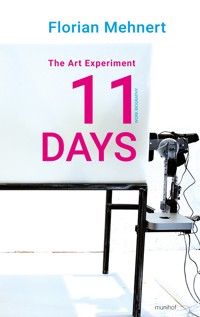
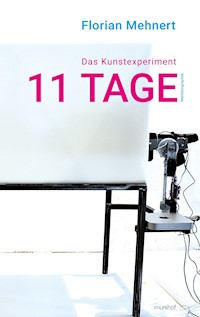
My art experiment consists of a milky white plastic box made of one centimetre thick polyethylene, one metre sixty in length and eighty centimetres in height and width. I had the box made by a plastic fabricator.
The plastic box rests on a table-like steel frame with four legs that I welded. A small aluminium turret is screwed to an outrigger on the steel frame, on which in turn a gun is mounted. It is a movable construction built by myself, driven by servo motors and gears, controlled by software scripts via a small computer.
The special thing is that the weapon can be controlled and triggered via the internet. I have attached a webcam to the barrel of the weapon which sends its livestream from inside the box to the world via the project‘s website. I order the powerful servo motors on the internet. The white gears from a gear shop.
They are unexpectedly expensive.
Weeks before, I spend days researching so-called Sentry Gun and Turret constructions, which were developed for military training or even paintball scenarios. I want to design my own construction and am inspired by photos I find on the internet.
For months I have been working on the preparation of the project and together with a programmer who lives in Texas, USA, I have been tinkering with the software for the weapon control.
His name is Brad.
I found Brad through my research on the net. I come across his small website which is not very up to date. It is difficult to find his email address. I discover it hidden in a PDF file in which he presents a kind of professional portrait of himself.
I write Brad an email in which I briefly explain that I want to build a remote-controlled weapon design. It takes weeks before he replies.
He is interested and asks me if I have a budget.
I have to confess that I don‘t have one.
Nevertheless, he decides to work with me.
I don‘t know anything about Brad.
I have never seen him.
We‘ve never spoken on the phone.
I‘ve never spoken to him in person.
I don‘t know what his voice sounds like.
All our communication is limited to emails and a Google Hangout, where we chat and initially exchange pictures of my controllable weapon design. We never talk about anything private.
I see Brad briefly once, over a low-resolution pixelated livestream he is setting up in his office one afternoon for testing purposes.
Brad gives me a friendly wave.
An unassuming, possibly slightly stocky man with dark hair and a checked shirt. Maybe in his early forties. He wears a beard around his mouth and chin. I wouldn‘t recognise him on the street. Brad is sitting at a computer.
In the background I see a messy purpose-built room and Darth Vader as a life-size plastic doll, or maybe it‘s just a cardboard Darth Vader stand-up.
I know from his website that he is a Star Wars fan. He also writes there that in his opinion the band Rush is the only true band that ever existed. Much later I learn that he is a red wine lover. The video stream is without sound.
I bought a black, plain paintball gun. Along with the accessories necessary to shoot. A small compressed air bottle with pressure hose, a so-called gravitiyloader and ammunition.
As far as the gravity loader is concerned, I decide on an electronic version, an „electronic hopper“, which loads bullet after bullet into the gun barrel with an electronically controlled small paddle.
I have never dealt with a paintball gun before and take a long time to get advice from a saleswoman called Kathy on the phone of an online shop. She speaks German with an American accent.
Kathy is amused by my inexperienced amateurish questions, obviously. She begins to answer my questions in a strangely irritatingly intimate way, murmuring into the phone that she is a „Woodland Gamer“:
„How cool it would all feel playing, how painful it would be, especially afterwards...“
A mood of wickedness flows through me. Commanded by her intimate phone voice, I click my weapon items into the shopping cart.
I can call her again any time, she breathes in farewell:
„All you have to do is ask for Kathy.“
On the internet, I find photos in paintball forums showing impressive bruises from being shot with paintball guns.
Late at night, I set up a kind of test station in my studio.
My turret construction is essentially two perforated aluminium plates bolted together, with carefully integrated servo motors and gears. I attach the turret construction to a threaded rod that I put through a large heavy piece of square steel tubing.
In the meantime, Brad has programmed the software to such an extent that I can initially control my weapon construction locally via a laptop with manual inputs of the angle of movement. In the silence of my studio, the quiet futuristic whirring of the servo motors reminds me of the cold movements of a robot in a science fiction film.
I attach thick drawing paper and cardboard to the wall of my studio, align my gun design with it and fire for the first time with the click of a mouse.
I wince as the dry short bang of the air gun, shatters the silence. The gun, operated with 200 bar air pressure, is louder than I expected.
The paint balls pierce the cardboard and leave a hole in it. The white wall behind it is smeared with yellow-green paint.
I am surprised by the penetrating power.
I realise that it could easily kill a smaller animal and imagine colourful paint balls bursting on a fluffy furry body from a short distance. I then fire several times at an aluminium plate that I lean against the cardboard. The yellow-green paint splashes metres into the surroundings and then flows viscously down the shiny grey surface.
It occurs to me to use red paint ammunition. As my research reveals, there seems to be no red ammunition in the paintball world because of the risk of confusion with blood.
There are paintballs in many colours, but not filled with red paint. After a persistent search, however, I do discover an Australian company that produces blood-red ammunition.
The company calls itself Killerpaintballs and advertises itself as „Zombie Premier“ or „Bezerk“. The red coloured ammunition is called „Psycho Blood“. The product description explains in English: „For the hardcore scenario gamer who wants to add more realism to their game.“
There is no option to purchase the ammunition on the Australian website itself.
My email to the company remains unanswered.
The website names a sales partner in Poland and in France.
I reach a man in Poland who speaks poor English via the mobile number given.
I have difficulty understanding him. He tells me that the ammunition is very hard to get and that he doesn‘t have any. I try my luck at a paintball shop in Toulouse.
No one there can be reached.
My e-mail was not answered.
Days later, I finally reach a man via a mobile number that I have previously noted down from an answering machine in the shop via a sonorous French voice. I explain to him in French my request for blood-red ammunition, repeating several times mimicking a French English accent:
„Killller“ and „Psychooo Blood!“
He understands and listlessly explains that he still has some ammunition somewhere.
The man is not particularly motivated.
I insist and ask him to take a look.
I wait impatiently by the phone while he looks and actually finds two boxes.
Days later, I receive an expensive package from Toulouse containing „Psycho Blood“. The packaging shows a blood-covered, snarling, grimacing zombie horror face.
The white, pupil-less eyes, narrowed to slits, stare viciously at me.
A white rat is supposed to live in the milky white plastic box of my installation.
It shall remain nameless because it is a lab rat.
Lab rats don‘t have names.
I have carefully strewn the plastic box with wood shavings and also draped a small branch and a cardboard roll inside. Of course, there is also a bowl with water and food.
I glued a small square shelter together from white plastic discs and sawed a semi-circular entrance into it.
Due to the size of the box, the rat will have quite a lot of run. I wonder if it might be too cold for it in my studio.
For days I have been driving around the area, visiting pet shops in order to buy a white rat. It turns out to be more difficult than expected.
Either there are no rats, or all rats are multi-coloured. I try to order a white rat from the pet shop at the local hardware store.
„You can‘t order a white rat from us,“ the shop assistant shakes his head, but he can take the trouble to see what‘s in the upcoming delivery. I should come back next week.
A week later I return to the pet shop.
The salesman from last week is no longer there.
But I am lucky. New rats have arrived.
They are coloured rats, but one is white except for a few very small pale grey spots.
I decide to buy this animal. It is a male rat, already relatively large, intended as snake food.
I also ask for a dead, frozen rat.
So-called frozen food.
It is important to me that the frozen rat is also white and about the same size. The small dark-haired saleswoman with thick black glasses opens a refrigerator with a glass door and pulls out a plastic box. She opens the lid of the plastic box, in which six rats lie stiffly frozen next to each other.
Like in a tin of sardines.
But there are only coloured rats inside.
I am dissatisfied. She is surprised at my persistence.
„It absolutely has to be a white rat as well, about the same size as the live one,“ I explain.
The shop assistant looks at me sceptically and reservedly.




